
BYCATCH MITIGATION ON SHRIMP TRAWL FISHERIES IN INDONESIA
BYCATCH MITIGATION ON SHRIMP TRAWL FISHERIES IN INDONESIA Presented in Meeting on Coral Triangle Fishers Forum Denpasar, 15 -17 June 2010 BY: WUDIANTO and BAMBANG SUMIONO 2010 RESEARCH CENTER FOR CAPTURE FISHERIES AGENCY FOR MARINE AND FISHERIES RESEARCH
OUT LINE 1. INTRODUCTION 2. DEVELOPMENT OF TRAWL FISHERIES IN INDONESIA 3. BYCATCH AND DISCARD IN TRAWL FISHERIES 4. HOW TO METIGATE BYCATCH IN TRAWL FISHERIES 5. RESEARCH ON BYCATCH IN TRAWL FISHERIES 6. CONCLUSION
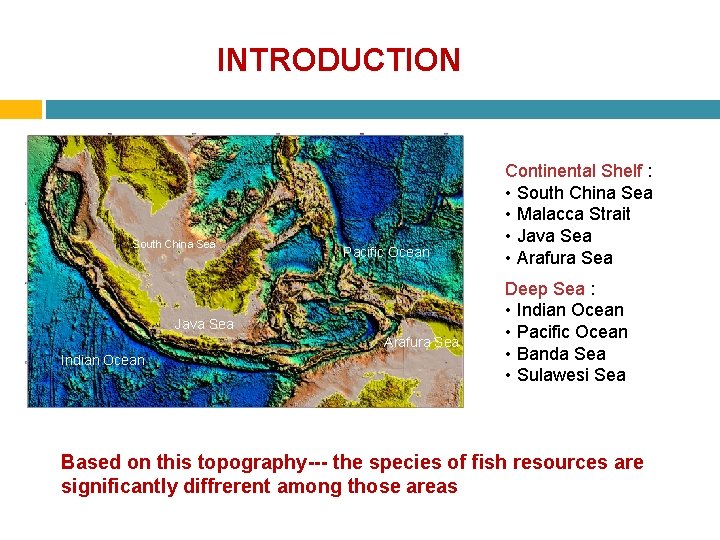
INTRODUCTION South China Sea Pacific Ocean Java Sea Arafura Sea Indian Ocean Continental Shelf : • South China Sea • Malacca Strait • Java Sea • Arafura Sea Deep Sea : • Indian Ocean • Pacific Ocean • Banda Sea • Sulawesi Sea Based on this topography--- the species of fish resources are significantly diffrerent among those areas
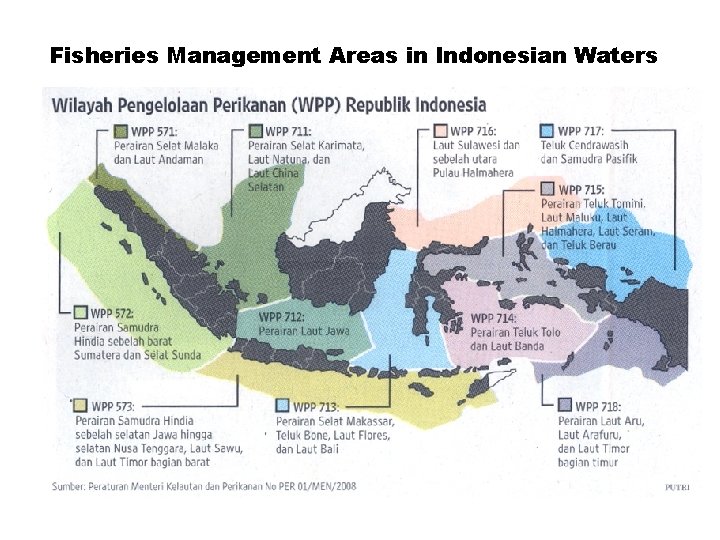
Fisheries Management Areas in Indonesian Waters
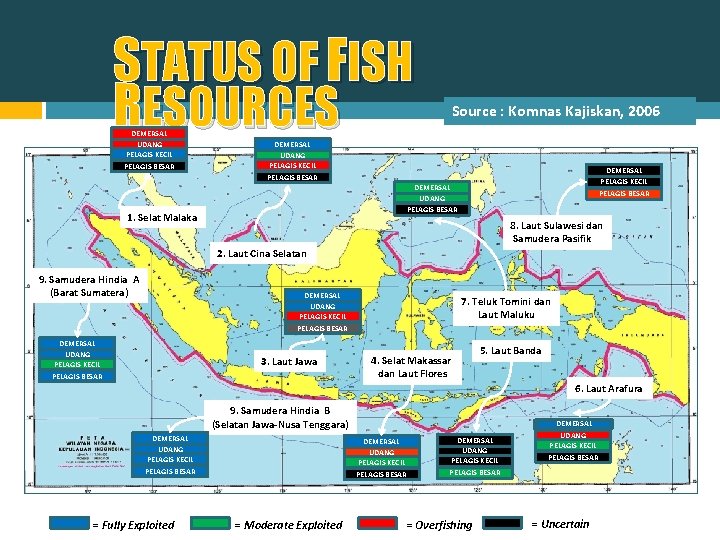
STATUS OF FISH RESOURCES DEMERSAL UDANG PELAGIS KECIL PELAGIS BESAR Source : Komnas Kajiskan, 2006 DEMERSAL UDANG PELAGIS KECIL PELAGIS BESAR DEMERSAL UDANG PELAGIS BESAR 1. Selat Malaka 8. Laut Sulawesi dan Samudera Pasifik 2. Laut Cina Selatan 9. Samudera Hindia A (Barat Sumatera) DEMERSAL UDANG PELAGIS KECIL 7. Teluk Tomini dan Laut Maluku PELAGIS BESAR DEMERSAL UDANG PELAGIS KECIL PELAGIS BESAR 3. Laut Jawa 4. Selat Makassar dan Laut Flores 5. Laut Banda 6. Laut Arafura 9. Samudera Hindia B (Selatan Jawa-Nusa Tenggara) DEMERSAL UDANG PELAGIS KECIL PELAGIS BESAR = Fully Exploited DEMERSAL UDANG PELAGIS KECIL PELAGIS BESAR = Moderate Exploited DEMERSAL UDANG PELAGIS KECIL PELAGIS BESAR = Overfishing DEMERSAL UDANG PELAGIS KECIL PELAGIS BESAR = Uncertain
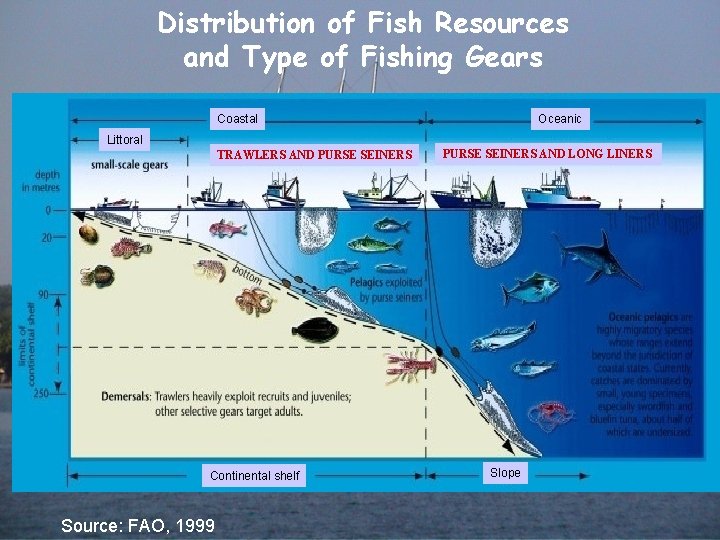
Distribution of Fish Resources and Type of Fishing Gears Coastal Oceanic Littoral TRAWLERS AND PURSE SEINERS Continental shelf Source: FAO, 1999 PURSE SEINERS AND LONG LINERS Slope
DEVELOPMENT OF TRAWL FISHERIES IN INDONESIA
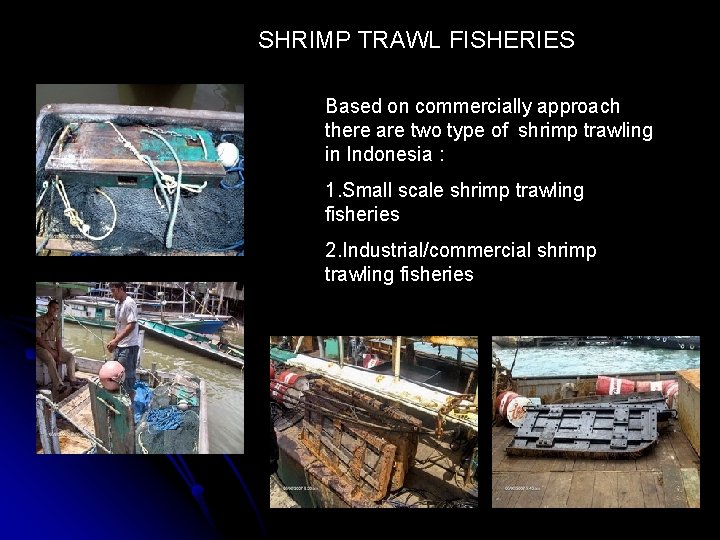
SHRIMP TRAWL FISHERIES Based on commercially approach there are two type of shrimp trawling in Indonesia : 1. Small scale shrimp trawling fisheries 2. Industrial/commercial shrimp trawling fisheries
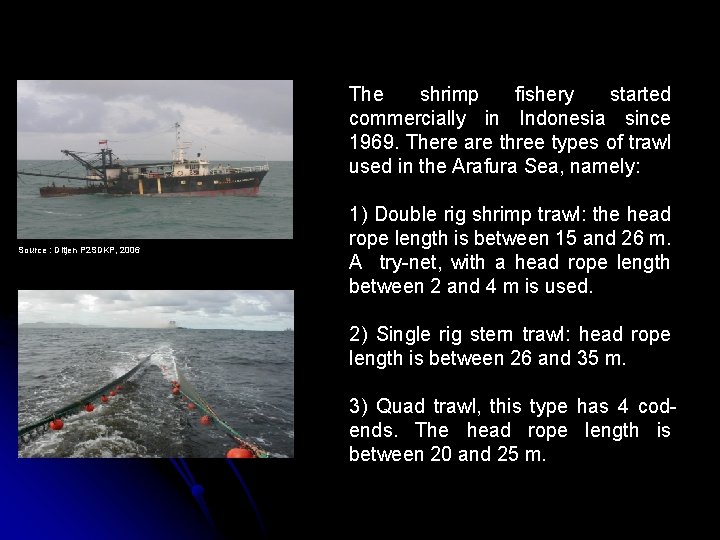
The shrimp fishery started commercially in Indonesia since 1969. There are three types of trawl used in the Arafura Sea, namely: Source : Ditjen P 2 SDKP, 2006 1) Double rig shrimp trawl: the head rope length is between 15 and 26 m. A try-net, with a head rope length between 2 and 4 m is used. 2) Single rig stern trawl: head rope length is between 26 and 35 m. 3) Quad trawl, this type has 4 codends. The head rope length is between 20 and 25 m.
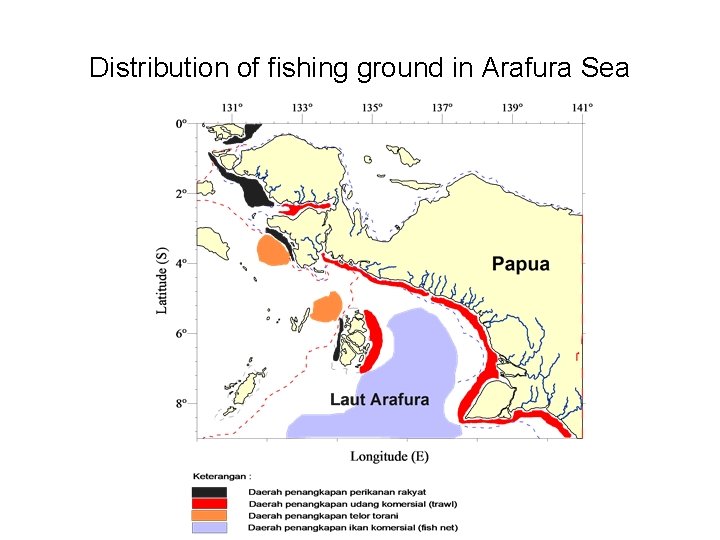
Distribution of fishing ground in Arafura Sea
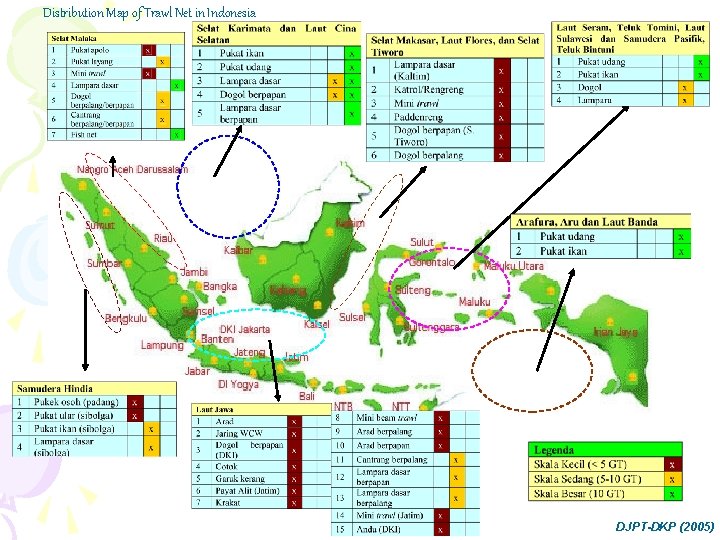
Distribution Map of Trawl Net in Indonesia DJPT-DKP (2005)
BYCATCH AND DISCARDS IN SHRIMP TRAWL FISHING
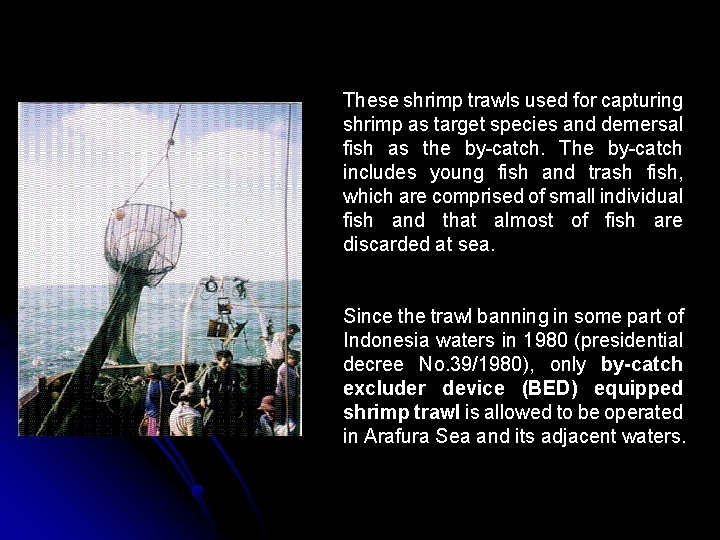
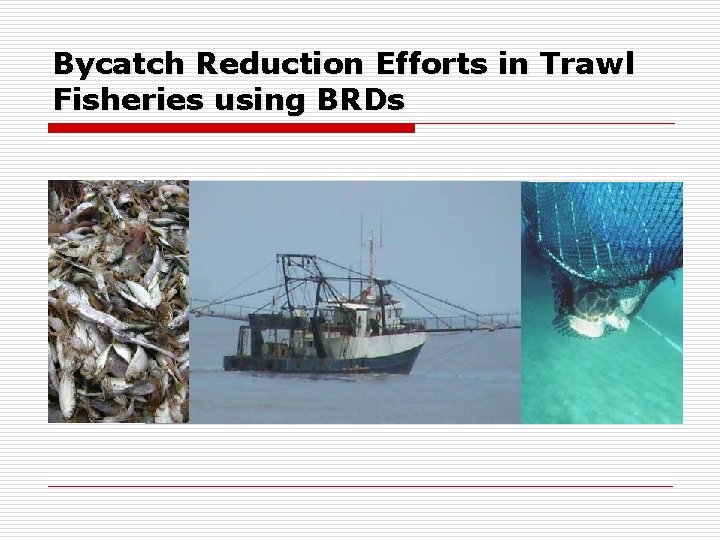
These shrimp trawls used for capturing shrimp as target species and demersal fish as the by-catch. The by-catch includes young fish and trash fish, which are comprised of small individual fish and that almost of fish are discarded at sea. Since the trawl banning in some part of Indonesia waters in 1980 (presidential decree No. 39/1980), only by-catch excluder device (BED) equipped shrimp trawl is allowed to be operated in Arafura Sea and its adjacent waters.
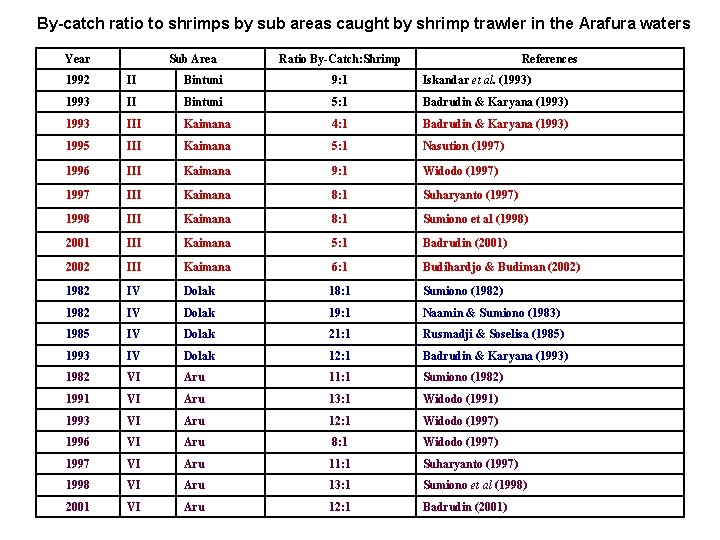
By-catch ratio to shrimps by sub areas caught by shrimp trawler in the Arafura waters Year Sub Area Ratio By-Catch: Shrimp References 1992 II Bintuni 9: 1 Iskandar et al. (1993) 1993 II Bintuni 5: 1 Badrudin & Karyana (1993) 1993 III Kaimana 4: 1 Badrudin & Karyana (1993) 1995 III Kaimana 5: 1 Nasution (1997) 1996 III Kaimana 9: 1 Widodo (1997) 1997 III Kaimana 8: 1 Suharyanto (1997) 1998 III Kaimana 8: 1 Sumiono et al (1998) 2001 III Kaimana 5: 1 Badrudin (2001) 2002 III Kaimana 6: 1 Budihardjo & Budiman (2002) 1982 IV Dolak 18: 1 Sumiono (1982) 1982 IV Dolak 19: 1 Naamin & Sumiono (1983) 1985 IV Dolak 21: 1 Rusmadji & Soselisa (1985) 1993 IV Dolak 12: 1 Badrudin & Karyana (1993) 1982 VI Aru 11: 1 Sumiono (1982) 1991 VI Aru 13: 1 Widodo (1991) 1993 VI Aru 12: 1 Widodo (1997) 1996 VI Aru 8: 1 Widodo (1997) 1997 VI Aru 11: 1 Suharyanto (1997) 1998 VI Aru 13: 1 Sumiono et al (1998) 2001 VI Aru 12: 1 Badrudin (2001)
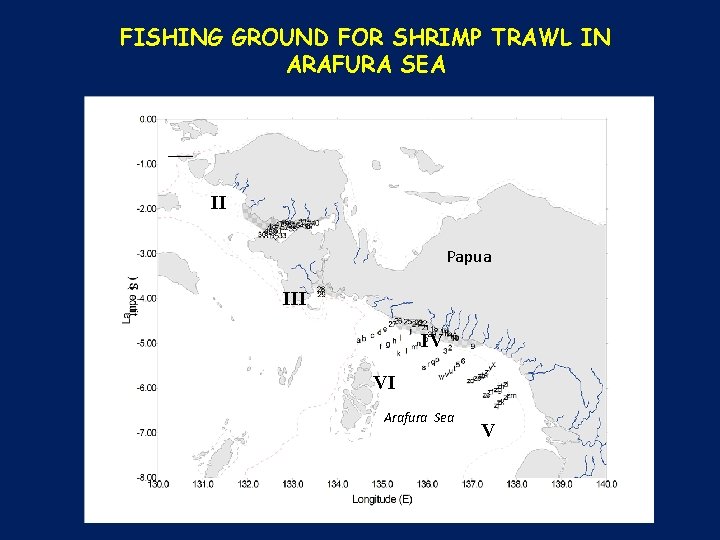
FISHING GROUND FOR SHRIMP TRAWL IN ARAFURA SEA II Papua III IV VI Arafura Sea V
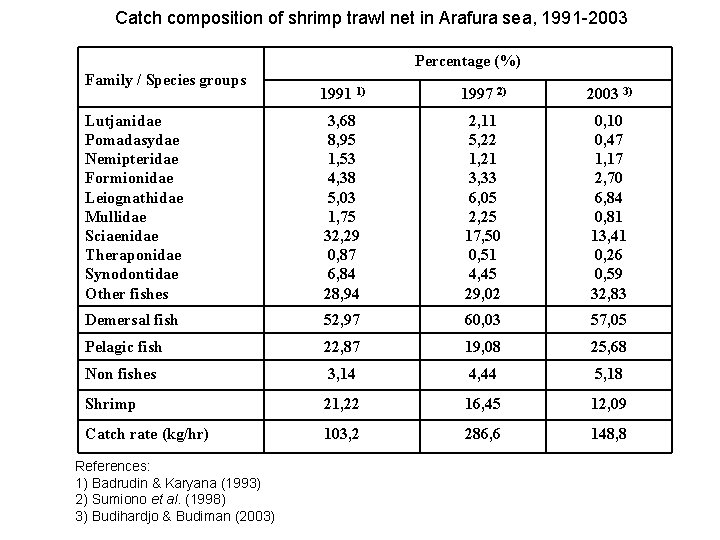
Catch composition of shrimp trawl net in Arafura sea, 1991 -2003 Percentage (%) Family / Species groups 1991 1) 1997 2) 2003 3) Lutjanidae Pomadasydae Nemipteridae Formionidae Leiognathidae Mullidae Sciaenidae Theraponidae Synodontidae Other fishes 3, 68 8, 95 1, 53 4, 38 5, 03 1, 75 32, 29 0, 87 6, 84 28, 94 2, 11 5, 22 1, 21 3, 33 6, 05 2, 25 17, 50 0, 51 4, 45 29, 02 0, 10 0, 47 1, 17 2, 70 6, 84 0, 81 13, 41 0, 26 0, 59 32, 83 Demersal fish 52, 97 60, 03 57, 05 Pelagic fish 22, 87 19, 08 25, 68 Non fishes 3, 14 4, 44 5, 18 Shrimp 21, 22 16, 45 12, 09 Catch rate (kg/hr) 103, 2 286, 6 148, 8 References: 1) Badrudin & Karyana (1993) 2) Sumiono et al. (1998) 3) Budihardjo & Budiman (2003)
Bycatch Reduction Efforts in Trawl Fisheries using BRDs
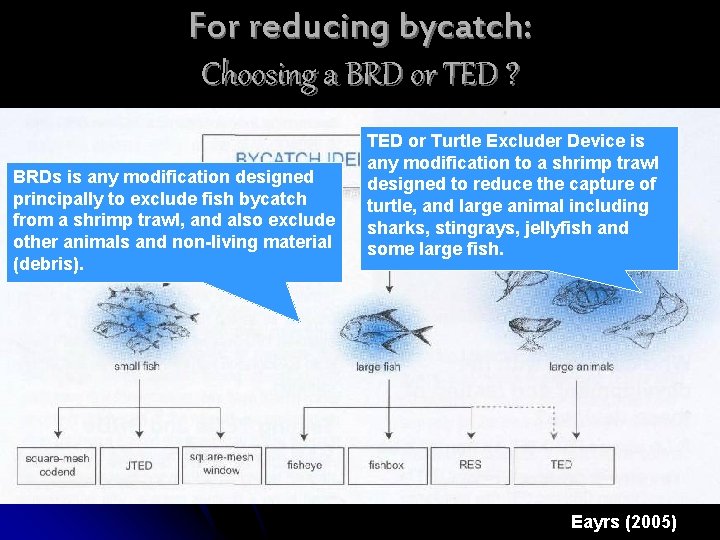
For reducing bycatch: Choosing a BRD or TED ? BRDs is any modification designed principally to exclude fish bycatch from a shrimp trawl, and also exclude other animals and non-living material (debris). TED or Turtle Excluder Device is any modification to a shrimp trawl designed to reduce the capture of turtle, and large animal including sharks, stingrays, jellyfish and some large fish. Eayrs (2005)
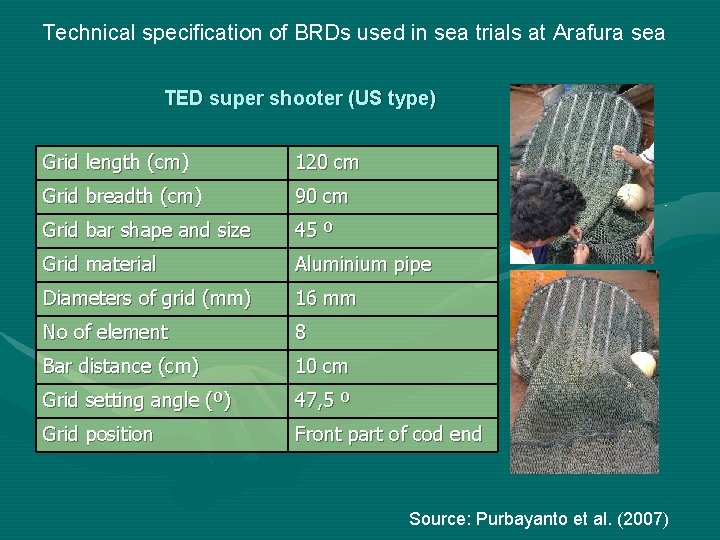
Technical specification of BRDs used in sea trials at Arafura sea TED super shooter (US type) Grid length (cm) 120 cm Grid breadth (cm) 90 cm Grid bar shape and size 45 º Grid material Aluminium pipe Diameters of grid (mm) 16 mm No of element 8 Bar distance (cm) 10 cm Grid setting angle (º) 47, 5 º Grid position Front part of cod end Source: Purbayanto et al. (2007)
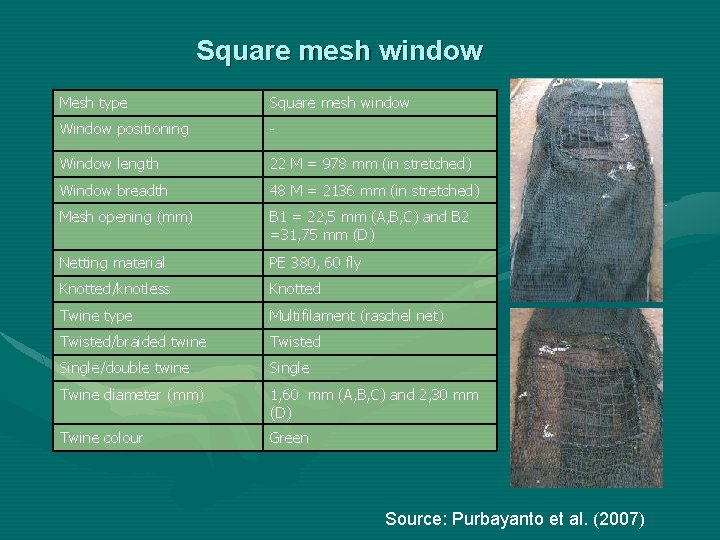
Square mesh window Mesh type Square mesh window Window positioning - Window length 22 M = 978 mm (in stretched) Window breadth 48 M = 2136 mm (in stretched) Mesh opening (mm) B 1 = 22, 5 mm (A, B, C) and B 2 =31, 75 mm (D) Netting material PE 380, 60 fly Knotted/knotless Knotted Twine type Multifilament (raschel net) Twisted/braided twine Twisted Single/double twine Single Twine diameter (mm) 1, 60 mm (A, B, C) and 2, 30 mm (D) Twine colour Green Source: Purbayanto et al. (2007)
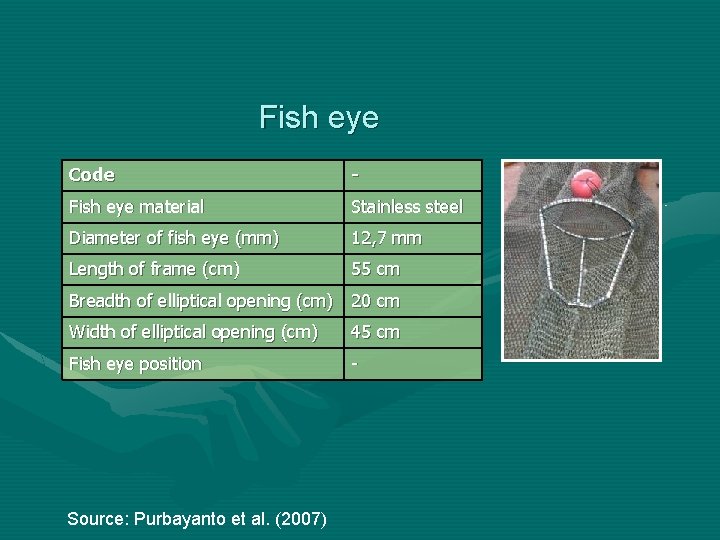
Fish eye Code - Fish eye material Stainless steel Diameter of fish eye (mm) 12, 7 mm Length of frame (cm) 55 cm Breadth of elliptical opening (cm) 20 cm Width of elliptical opening (cm) 45 cm Fish eye position - Source: Purbayanto et al. (2007)
RESEARCH ON BYCATCH REDUCTION DEVICES (BRDs) IN SHRIMP TRAWL FISHING
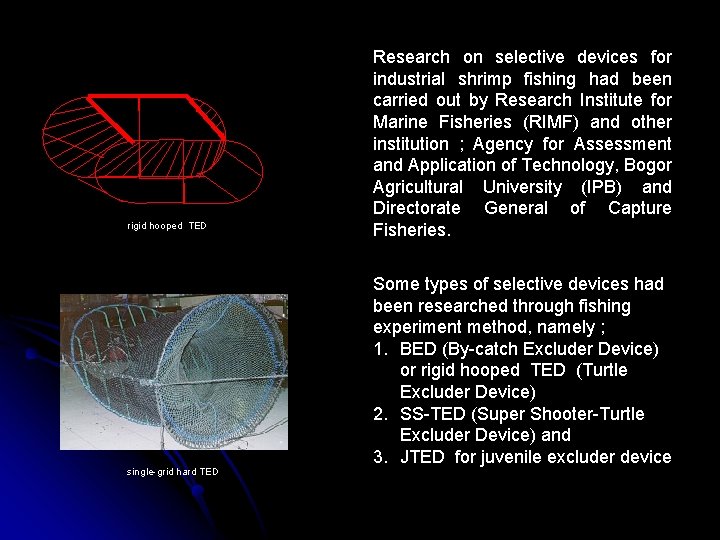
rigid hooped TED single-grid hard TED Research on selective devices for industrial shrimp fishing had been carried out by Research Institute for Marine Fisheries (RIMF) and other institution ; Agency for Assessment and Application of Technology, Bogor Agricultural University (IPB) and Directorate General of Capture Fisheries. Some types of selective devices had been researched through fishing experiment method, namely ; 1. BED (By-catch Excluder Device) or rigid hooped TED (Turtle Excluder Device) 2. SS-TED (Super Shooter-Turtle Excluder Device) and 3. JTED for juvenile excluder device
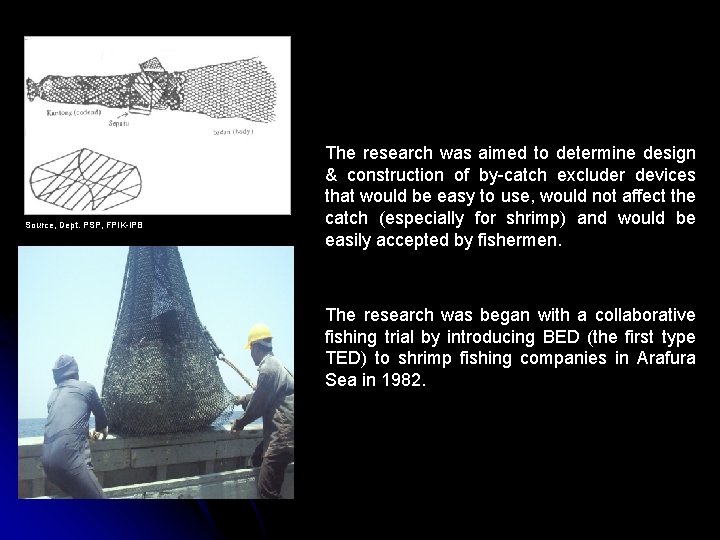
Source, Dept. PSP, FPIK-IPB The research was aimed to determine design & construction of by-catch excluder devices that would be easy to use, would not affect the catch (especially for shrimp) and would be easily accepted by fishermen. The research was began with a collaborative fishing trial by introducing BED (the first type TED) to shrimp fishing companies in Arafura Sea in 1982.
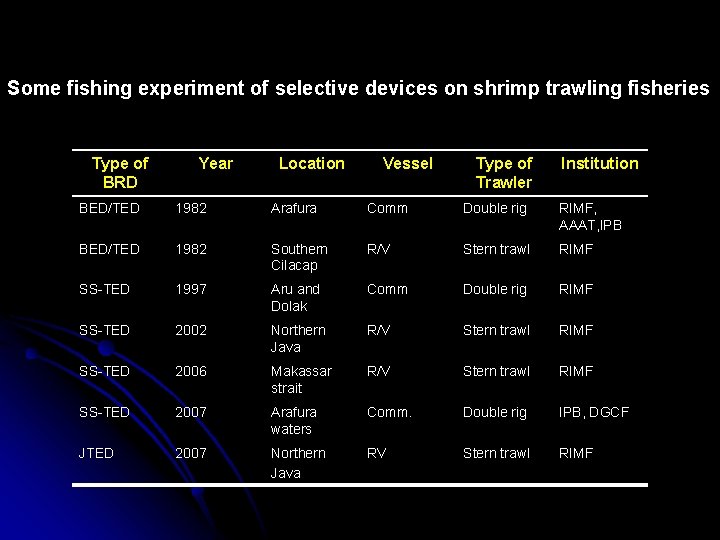
Some fishing experiment of selective devices on shrimp trawling fisheries Type of BRD Year Location Vessel Type of Trawler Institution BED/TED 1982 Arafura Comm Double rig RIMF, AAAT, IPB BED/TED 1982 Southern Cilacap R/V Stern trawl RIMF SS-TED 1997 Aru and Dolak Comm Double rig RIMF SS-TED 2002 Northern Java R/V Stern trawl RIMF SS-TED 2006 Makassar strait R/V Stern trawl RIMF SS-TED 2007 Arafura waters Comm. Double rig IPB, DGCF JTED 2007 Northern Java RV Stern trawl RIMF
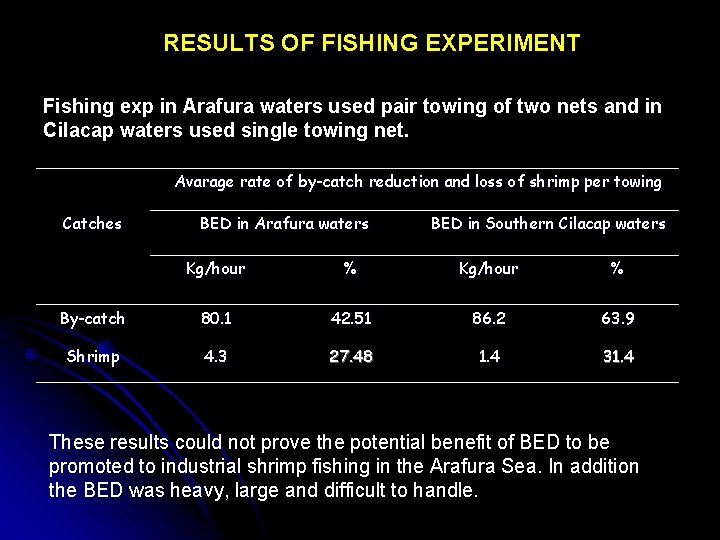
RESULTS OF FISHING EXPERIMENT Fishing exp in Arafura waters used pair towing of two nets and in Cilacap waters used single towing net. Avarage rate of by-catch reduction and loss of shrimp per towing Catches BED in Arafura waters BED in Southern Cilacap waters Kg/hour % By-catch 80. 1 42. 51 86. 2 63. 9 Shrimp 4. 3 27. 48 1. 4 31. 4 These results could not prove the potential benefit of BED to be promoted to industrial shrimp fishing in the Arafura Sea. In addition the BED was heavy, large and difficult to handle.
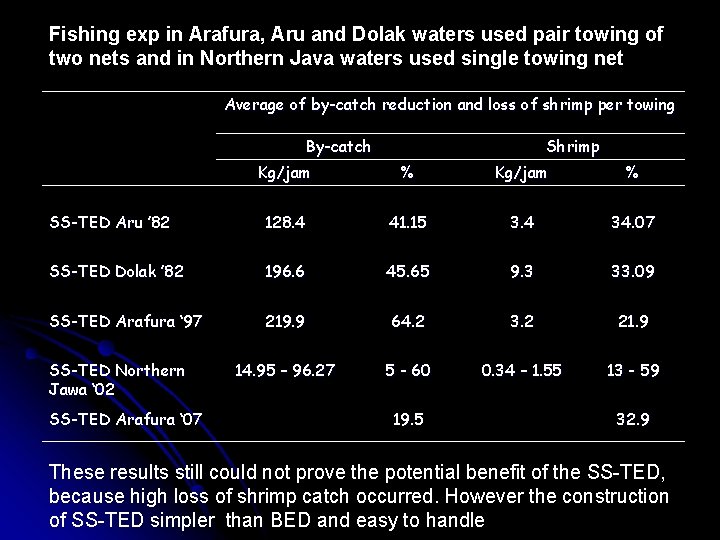
Fishing exp in Arafura, Aru and Dolak waters used pair towing of two nets and in Northern Java waters used single towing net Average of by-catch reduction and loss of shrimp per towing By-catch Shrimp Kg/jam % SS-TED Aru ’ 82 128. 4 41. 15 3. 4 34. 07 SS-TED Dolak ’ 82 196. 6 45. 65 9. 3 33. 09 SS-TED Arafura ‘ 97 219. 9 64. 2 3. 2 21. 9 14. 95 – 96. 27 5 - 60 0. 34 – 1. 55 13 - 59 SS-TED Northern Jawa ‘ 02 SS-TED Arafura ‘ 07 19. 5 32. 9 These results still could not prove the potential benefit of the SS-TED, because high loss of shrimp catch occurred. However the construction of SS-TED simpler than BED and easy to handle
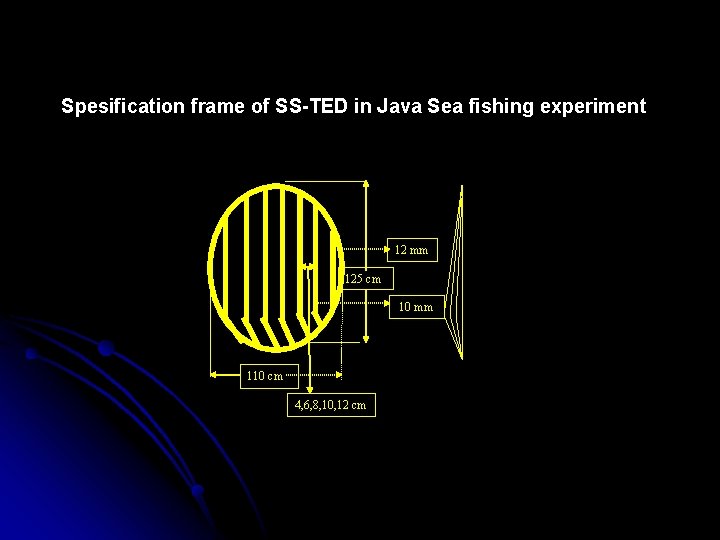
Spesification frame of SS-TED in Java Sea fishing experiment 12 mm 125 cm 10 mm 110 cm 4, 6, 8, 10, 12 cm
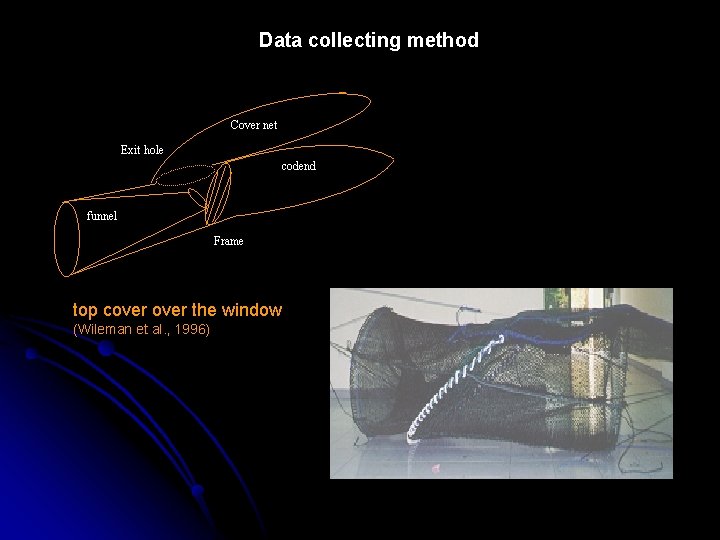
Data collecting method Cover net Exit hole codend funnel Frame top cover the window (Wileman et al. , 1996)
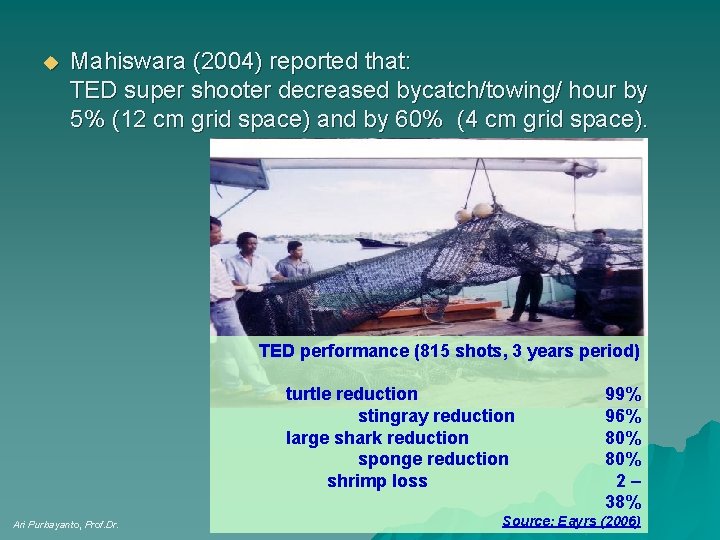
u Mahiswara (2004) reported that: TED super shooter decreased bycatch/towing/ hour by 5% (12 cm grid space) and by 60% (4 cm grid space). TED performance (815 shots, 3 years period) turtle reduction stingray reduction large shark reduction sponge reduction shrimp loss Ari Purbayanto, Prof. Dr. 99% 96% 80% 2– 38% Source: Eayrs (2006)
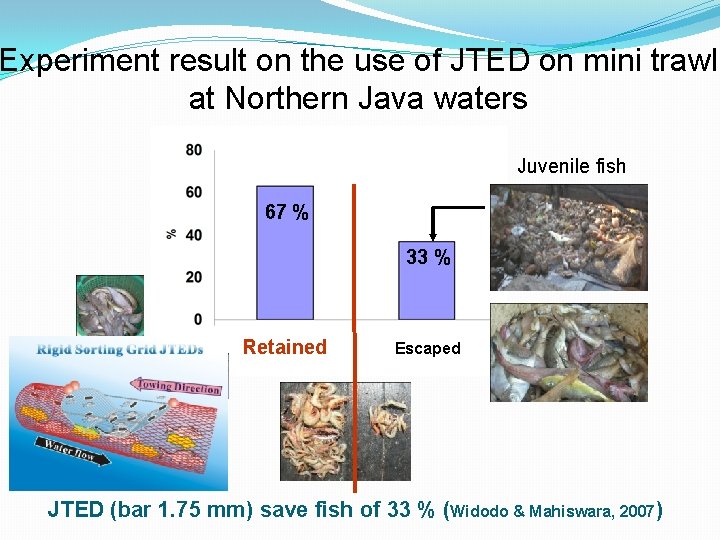
Experiment result on the use of JTED on mini trawl at Northern Java waters Juvenile fish 67 % 33 % Retained Escaped JTED (bar 1. 75 mm) save fish of 33 % (Widodo & Mahiswara, 2007)
Conclusion The ratio of by catch and shrimp as target species are fluctuated depend on fishing areas. The catch of bigger size of fish tend to decrease in the recent year. Result from experimental fishing indicated that technically BRD and SS-TED were effective enough in reducing by-catch. The use of by-catch excluder devices is compulsory on board for shrimp trawlers in Arafura Sea. In general, the fishing operators have still not perceived the benefit from using the devices because some loss of shrimp. Research for improving by-catch excluder devices should be carried out, include to study of soft BRD (square mesh and fish eye) and JTED.

Thank You
- Slides: 33