
By Wilfred Owen Dulce Et Decorum Est Learning
By Wilfred Owen Dulce Et Decorum Est
Learning Intention To understand the context of the poem
The poem was written during World War I What do you know about WWI? Tactics https: //www. bing. com/videos/search? q=blackadder+goes+forth+classic+sequences&&view=detail&mid=61 F 2 CFABF 12 E 26 B 95 FA 6&&FORM=VDRVRV Ending https: //www. bing. com/videos/search? q=blackadder+goes+forth+classic+sequences&&view=detail&mid=52 A 43 F 5995 DEA 790 B 59 C&&FORM=VRDGAR
World War I A particularly brutal and at times pointless war involving many nations It came to be called the “war to end all wars”
Author and title Wilfred Owen fought in the First World War It was inspired by his experience in the war The title is Latin for It is sweet and glorious It was a famous saying at the time: Dulce et decorum est pro patria mori It is sweet and glorious to die for one’s country What do you think this actually means?
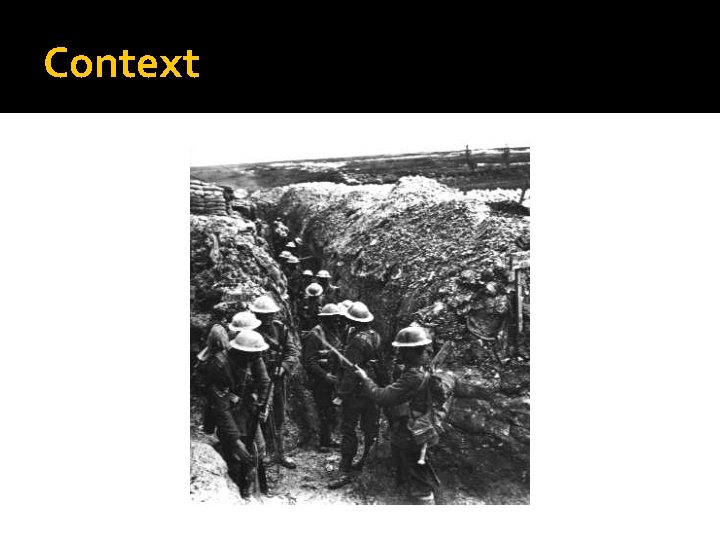
Context World War I was a horrific war that devastated much of Europe When it started, thousands of young men rushed to join the army There was a strong feeling of patriotism Patriotism: devotion and vigorous support of your country This lessened as people began to realise how brutal and pointless much of the fighting was http: //www. bbc. co. uk/schools/gcsebitesize/english_literature/poetryowen/1 owen_dulcesubjectact. shtml
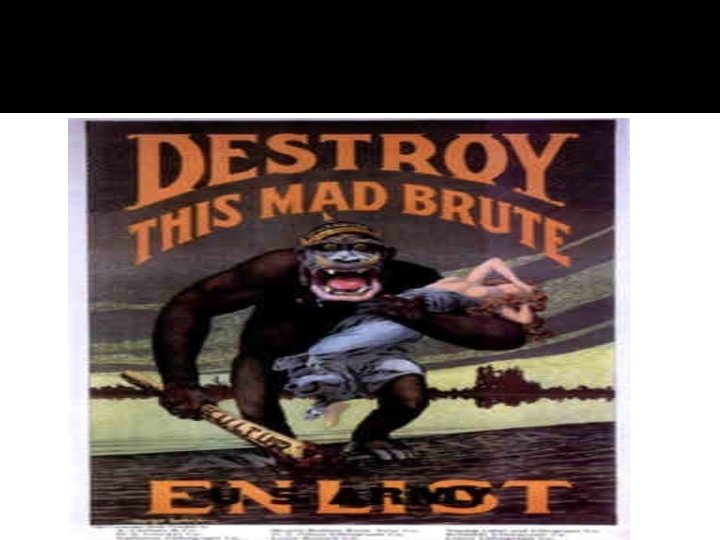
How do these images make you feel? What would you do if you were there?
Context
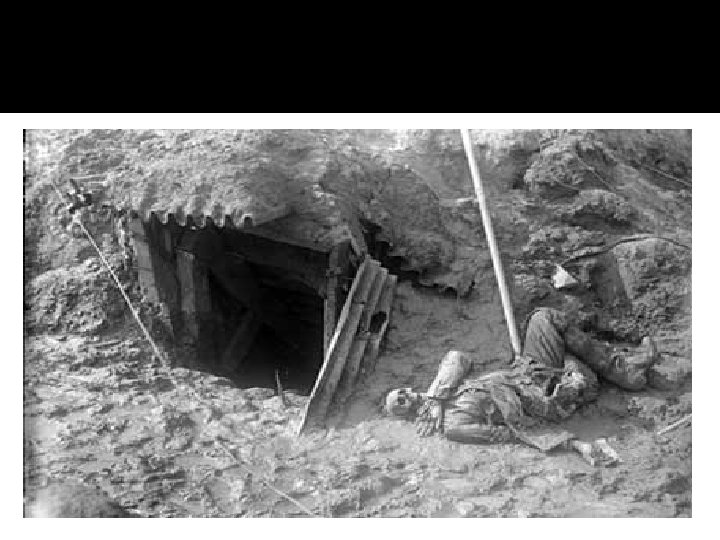
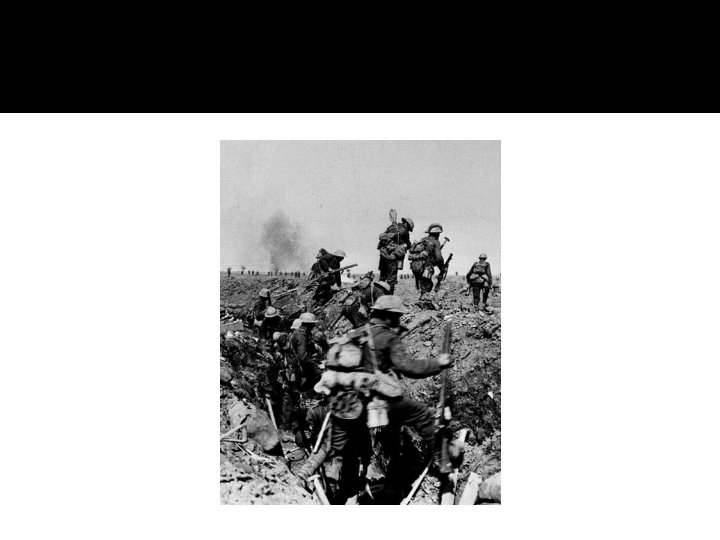
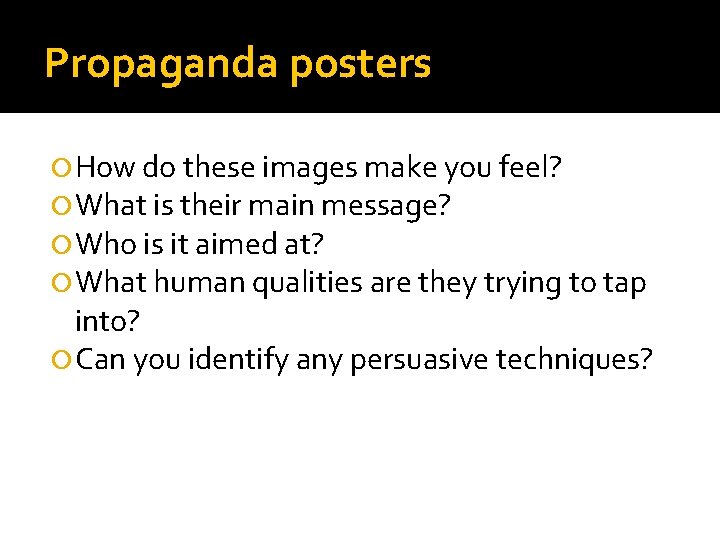
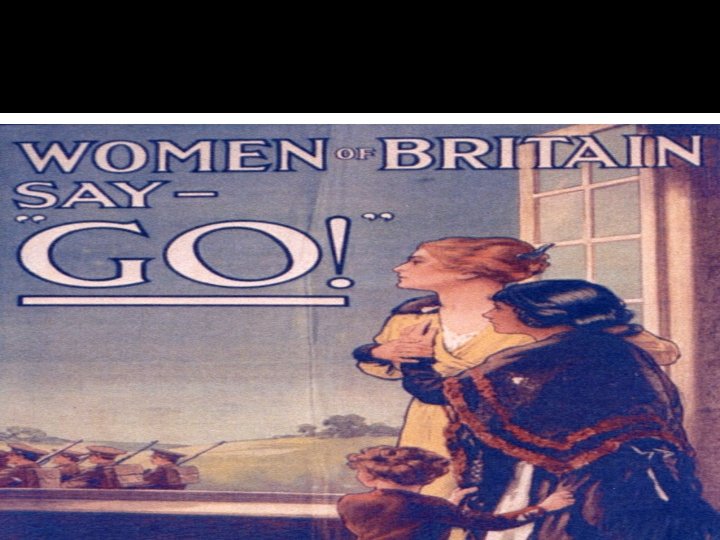
Propaganda posters How do these images make you feel? What is their main message? Who is it aimed at? What human qualities are they trying to tap into? Can you identify any persuasive techniques?
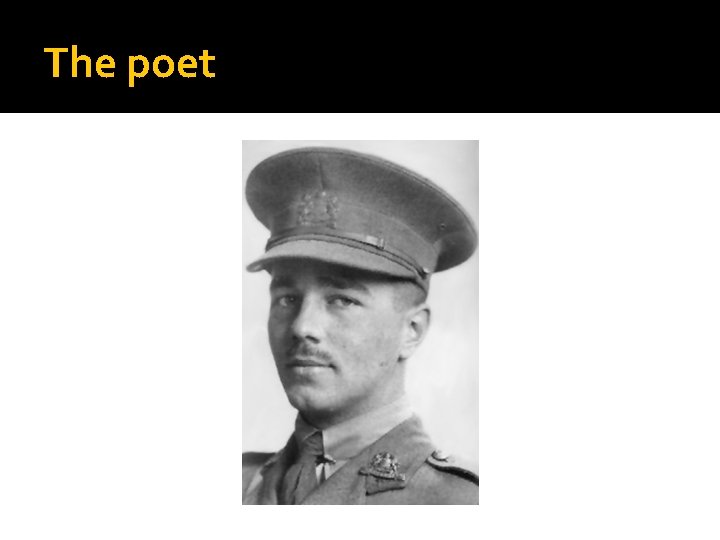
The poet
Owen was severely traumatised by his experiences of front line trench warfare, which included being trapped for days next to the dead body of a fellow officer. He spent time at Craiglockhart in Edinburgh which was a hospital that treated shell shock at the time While here, he wrote Dulce et Decorum est and another famous poem called Anthem for Doomed Youth http: //www. bbc. co. uk/programmes/articles/30 GBzxn. ZBKH 59 jv. SBbq. Dr. Wr/how-craiglockhart-in-edinburgh-turned-wilfred-owen-into-the-voice-of-world-war-one
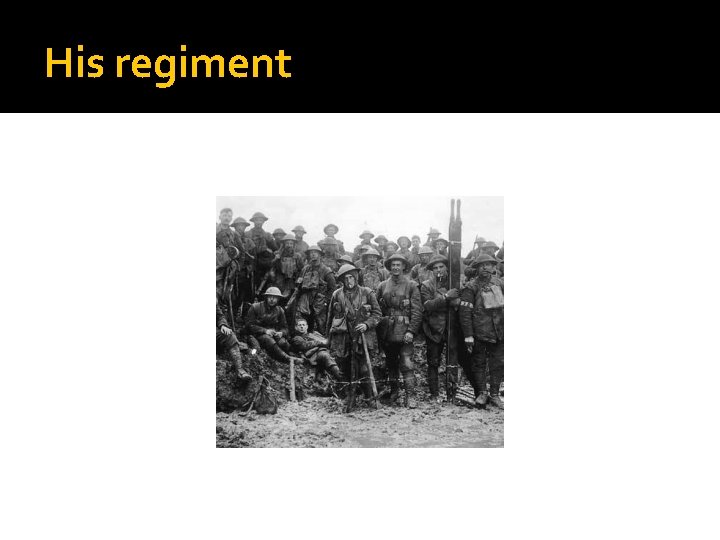
His regiment
Owen He returned to the front when he was ‘cured’ and tragically died one week before the Armistice
His grave
The poem Do the 5 Ws From which point of view is it told? What is happening in the poem? Write a short summary of the narrative Break it down into four distinct sections What do you think the poet is saying about war?
Who- the narrator is recalling a vivid experience in the trenches Where- the trenches When- WW 1 Why- to show that war is horrific and destroying a generation of young men
What? (understanding of key ideas) 1. 2. 3. 4. The poet describes life in the trenches and sets the scene. He is describing how his platoon are retreating from the front line and going back to base to rest. They are exhausted and it is difficult to travel across the muddy ground. There is a gas attack which causes panic and one soldier fails to fit his gas mask in time and dies a horrific death. The narrator (Owen) recalls this incident in his nightmares. He describes how the soldier is thrown into a cart. There is a graphic description of the inhumane death the youth suffered. He criticises the politicians who use patriotic feeling to encourage young men to join up.

Marcus. roskilly@jamesgillespies. edin. sch. uk
Analysis What do we mean by analysis?
Analysis: where you explain the effect of language/technique on the reader Technique: Simile Quotation: “Bent double, like old beggars under sacks” Effect: By comparing the young men to old worthless beggars carrying heavy weights, the poet creates a startling and surprising first impression of the soldiers. Young men should be fit, healthy and virile, not characterised as worthless and destitute members of society. It suggests that these young soldiers have been destroyed by the physical effects of war, and not only are they physically worn down by the effects of the war, but also emotionally ruined. Therefore, it is clear that Owen is setting a stark scene which will set the tone for the key incident (the gas attack) explored by the poem top show the brutal nature of war.
Understanding techniques Look at the hand out and make sure you understand the words that have been highlighted Look at the list of techniques on the other side and try to find and highlight some of these in the poem Choose at least one specific technique and have a go at analysing it in the same way as the model
Key terms Rhyme scheme- pattern of rhyme in a poem Rhythm- the sound pattern of the poem. Often regular (same amount of syllables in each line) or irregular
Structure: rhythm and rhyme Read through the poem again and try to identify the rhyme scheme Pay particular attention to the sound of the words at the end of each line. Is there a rhyme? Do the lines have the same amount of syllables? Is it regular?
Rhythm Many of the lines are in iambic pentameter but this is broken quite often Iambic pentameter : ten syllables per line which follows the pattern of one unstressed syllable followed by one stressed syllable It is evocative of the rhythm of the heart
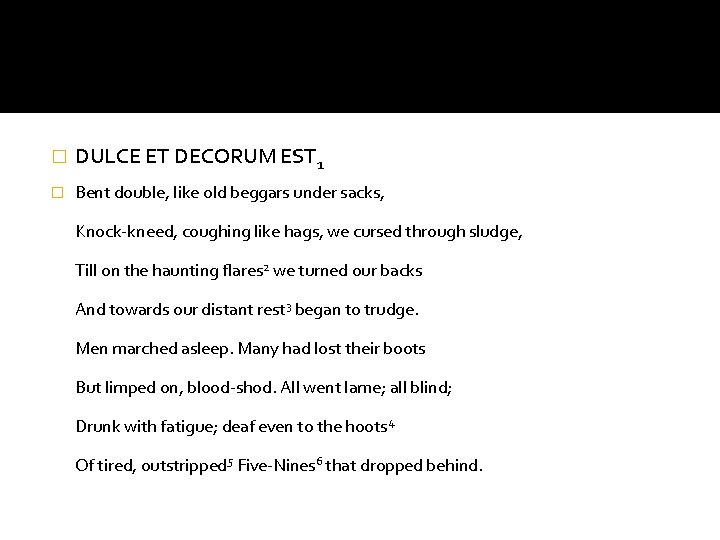
� DULCE ET DECORUM EST 1 � Bent double, like old beggars under sacks, Knock-kneed, coughing like hags, we cursed through sludge, Till on the haunting flares 2 we turned our backs And towards our distant rest 3 began to trudge. Men marched asleep. Many had lost their boots But limped on, blood-shod. All went lame; all blind; Drunk with fatigue; deaf even to the hoots 4 Of tired, outstripped 5 Five-Nines 6 that dropped behind.
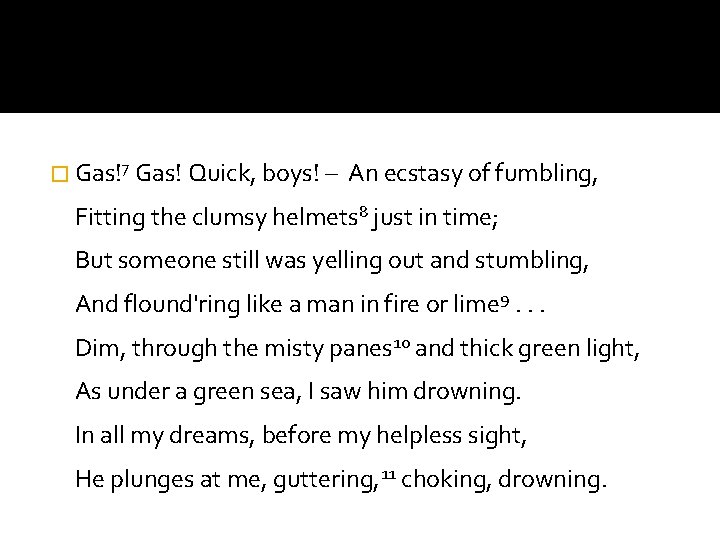
� Gas!7 Gas! Quick, boys! – An ecstasy of fumbling, Fitting the clumsy helmets 8 just in time; But someone still was yelling out and stumbling, And flound'ring like a man in fire or lime 9. . . Dim, through the misty panes 10 and thick green light, As under a green sea, I saw him drowning. In all my dreams, before my helpless sight, He plunges at me, guttering, 11 choking, drowning.
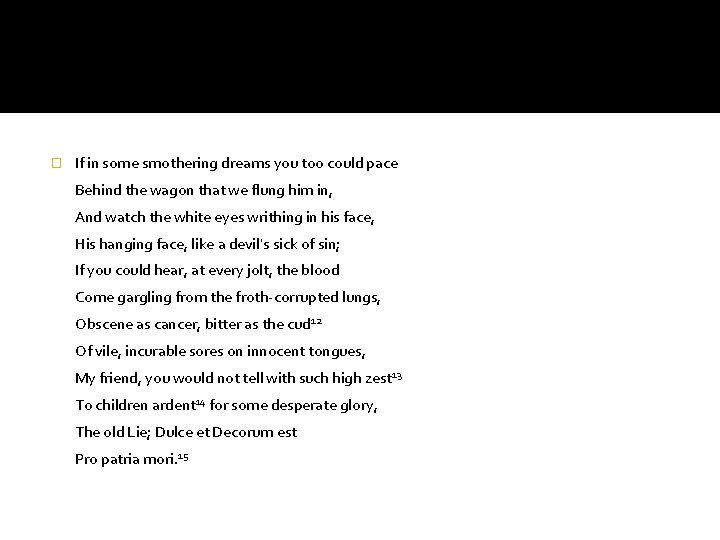
� If in some smothering dreams you too could pace Behind the wagon that we flung him in, And watch the white eyes writhing in his face, His hanging face, like a devil's sick of sin; If you could hear, at every jolt, the blood Come gargling from the froth-corrupted lungs, Obscene as cancer, bitter as the cud 12 Of vile, incurable sores on innocent tongues, My friend, you would not tell with such high zest 13 To children ardent 14 for some desperate glory, The old Lie; Dulce et Decorum est Pro patria mori. 15
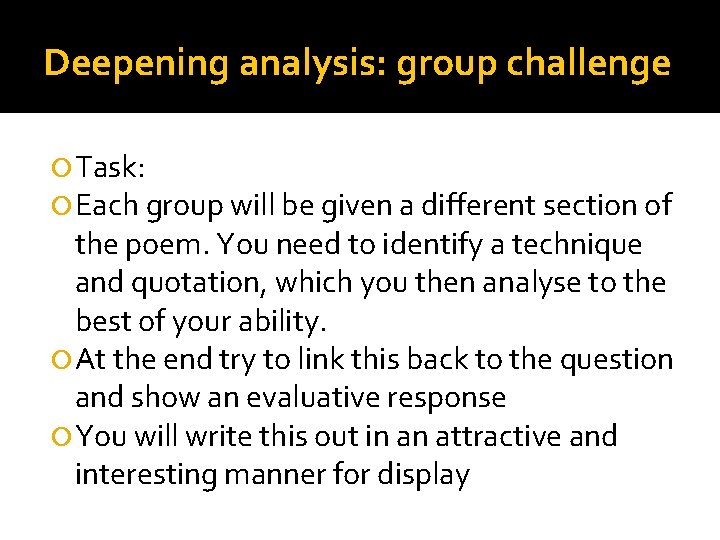
Deepening analysis: group challenge Task: Each group will be given a different section of the poem. You need to identify a technique and quotation, which you then analyse to the best of your ability. At the end try to link this back to the question and show an evaluative response You will write this out in an attractive and interesting manner for display
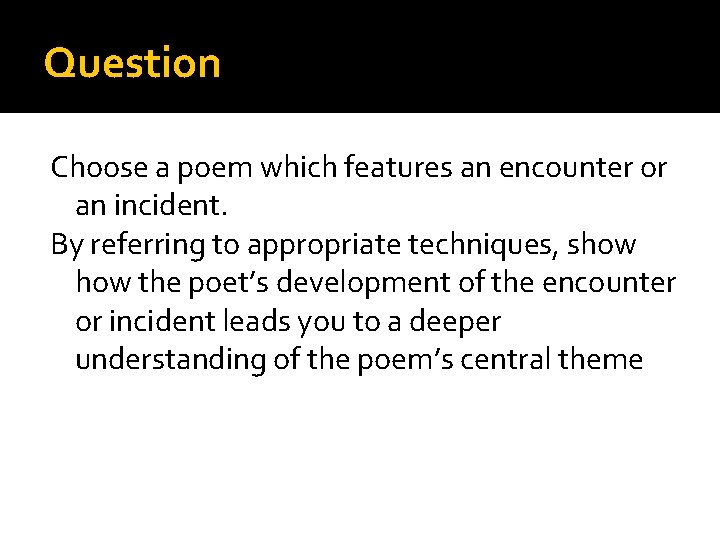
Question Choose a poem which features an encounter or an incident. By referring to appropriate techniques, show the poet’s development of the encounter or incident leads you to a deeper understanding of the poem’s central theme
Analysis: where you explain the effect of language/technique on the reader Technique: Simile Quotation: “Bent double, like old beggars under sacks” Effect: By comparing the young men to old worthless beggars carrying heavy weights, the poet creates a startling and surprising first impression of the soldiers. Young men should be fit, healthy and virile, not characterised as worthless and destitute members of society. It suggests that these young soldiers have been destroyed by the physical effects of war, and not only are they physically worn down by the effects of the war, but also emotionally ruined. Therefore, it is clear that Owen is setting a stark scene which will set the tone for the key incident (the gas attack) explored by the poem top show the brutal nature of war.
Revision notes You should memorise between 6 and 8 key quotations and techniques To help you to do this, make a booklet with key quotations, techniques and analysis notes Record these in a chronological order which follows the narrative of the actual poem You could use colour coding to help you to organise your notes, pictures, bullet points, mind maps etc Re-read your notes and look at the posters produced by other groups to help you with this activity
- Slides: 35