
by Russell Krick Publisher The GoodheartWillcox Co Inc
by Russell Krick Publisher The Goodheart-Willcox Co. , Inc. Tinley Park, Illinois © Goodheart-Willcox Co. , Inc. Permission granted to reproduce for educational use only
© Goodheart-Willcox Co. , Inc. Permission granted to reproduce for educational use only
q Functions of a suspension system q Basic suspension system q Independent and nonindependent suspension systems q Understeer and oversteer q Suspension system springs q Suspension system construction (Continued) © Goodheart-Willcox Co. , Inc. Permission granted to reproduce for educational use only
q q q q Long-short arm suspension Torsion bar suspension Mac. Pherson strut suspension Pickup truck suspension systems Rear suspension systems Suspension leveling systems Electronic suspension system Active suspension system © Goodheart-Willcox Co. , Inc. Permission granted to reproduce for educational use only
q Supports the weight of the vehicle q Allows the wheels to move up and down q Allows rapid cornering without extreme body roll q Keeps the tires in firm contact with the road © Goodheart-Willcox Co. , Inc. Permission granted to reproduce for educational use only
q Prevents excessive body squat when accelerating or heavily loaded q Prevents excessive body dive when braking q Allows the front wheels to turn left or right for steering q Helps keep the wheels in correct alignment © Goodheart-Willcox Co. , Inc. Permission granted to reproduce for educational use only
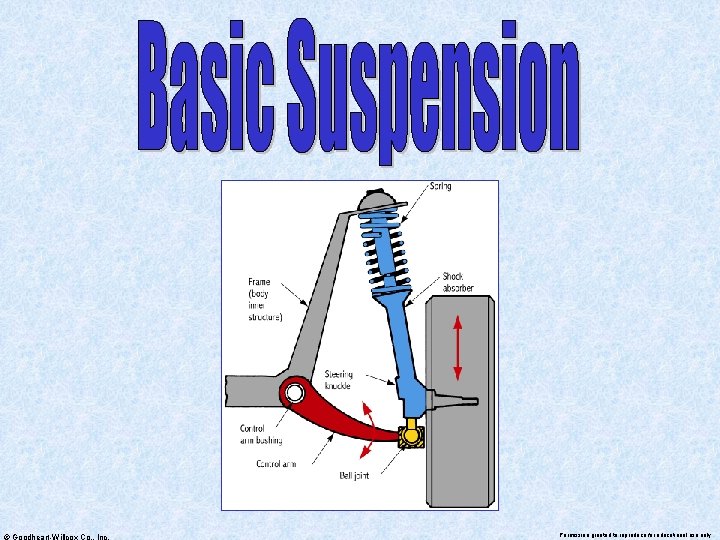
© Goodheart-Willcox Co. , Inc. Permission granted to reproduce for educational use only
© Goodheart-Willcox Co. , Inc. Permission granted to reproduce for educational use only
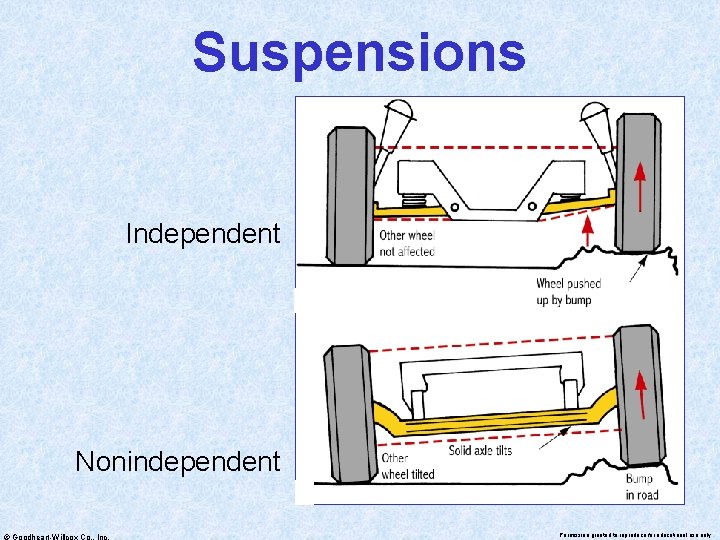
Suspensions Independent Nonindependent © Goodheart-Willcox Co. , Inc. Permission granted to reproduce for educational use only
Independent Suspension q Allows one wheel to move up and down with minimal effect on the other wheels q Each wheel is attached to its own suspension unit q Movement of one wheel does not cause direct movement of the wheel on the other side of the vehicle © Goodheart-Willcox Co. , Inc. Permission granted to reproduce for educational use only
Nonindependent Suspension q Both left and right wheels are attached to the same solid axle q When one tire hits a bump in the road, its upward movement causes a slight upward tilt of the other wheel q Neither wheel is independent of the other © Goodheart-Willcox Co. , Inc. Permission granted to reproduce for educational use only
© Goodheart-Willcox Co. , Inc. Permission granted to reproduce for educational use only
Understeer q The vehicle is slow to respond to steering changes in a turn m the rear tires retain traction m the front tires may slip on the road surface due to lack of downforce or other factors © Goodheart-Willcox Co. , Inc. Permission granted to reproduce for educational use only
Oversteer q The rear tires try to skid around sideways in a sharp or hard turn q The front tires retain traction q The rear tires skid © Goodheart-Willcox Co. , Inc. Permission granted to reproduce for educational use only
Neutral Steering q Suspension systems are designed to balance understeer and oversteer q Neutral steering is the result, where all four wheels have equal traction in turns © Goodheart-Willcox Co. , Inc. Permission granted to reproduce for educational use only
Lateral Acceleration q Amount of side force a vehicle can achieve before its tires lose traction and skid in a sharp turn q Measured in units of gravity (g-force) q Passenger cars might achieve 1. 0 g q Race cars might achieve 3. 0 g © Goodheart-Willcox Co. , Inc. Permission granted to reproduce for educational use only
q Springs must jounce (compress) and rebound (extend) as a vehicle travels over bumps and holes in the road surface q Springs must support the weight of the vehicle while still allowing suspension travel (movement) © Goodheart-Willcox Co. , Inc. Permission granted to reproduce for educational use only
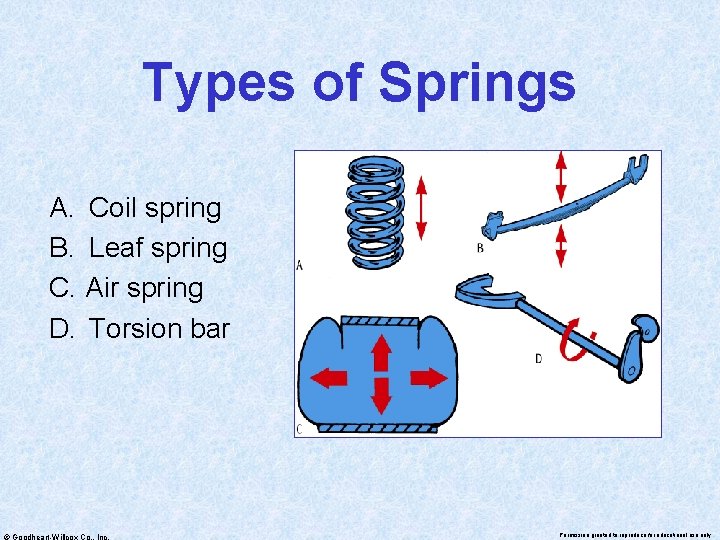
Types of Springs A. Coil spring B. Leaf spring C. Air spring D. Torsion bar © Goodheart-Willcox Co. , Inc. Permission granted to reproduce for educational use only
Coil Spring q Length of spring-steel rod wound into a spiral q Most common type of spring q Used on front and rear suspensions © Goodheart-Willcox Co. , Inc. Permission granted to reproduce for educational use only
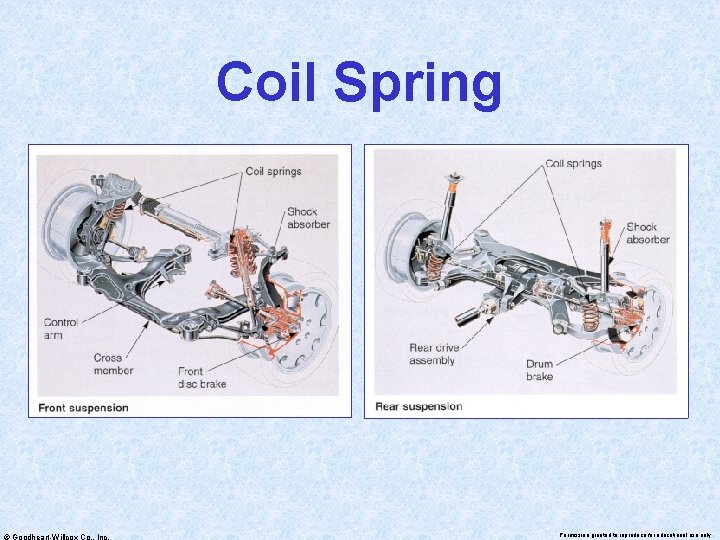
Coil Spring © Goodheart-Willcox Co. , Inc. Permission granted to reproduce for educational use only
Leaf Spring q Flat strips of spring steel bolted together q Limited to the rear of some cars q A monoleaf spring is made from a single, thick leaf of reinforced fiberglass q A shackle fastens the rear leaf spring eye to the frame or body and allows the spring to change length when bent © Goodheart-Willcox Co. , Inc. Permission granted to reproduce for educational use only
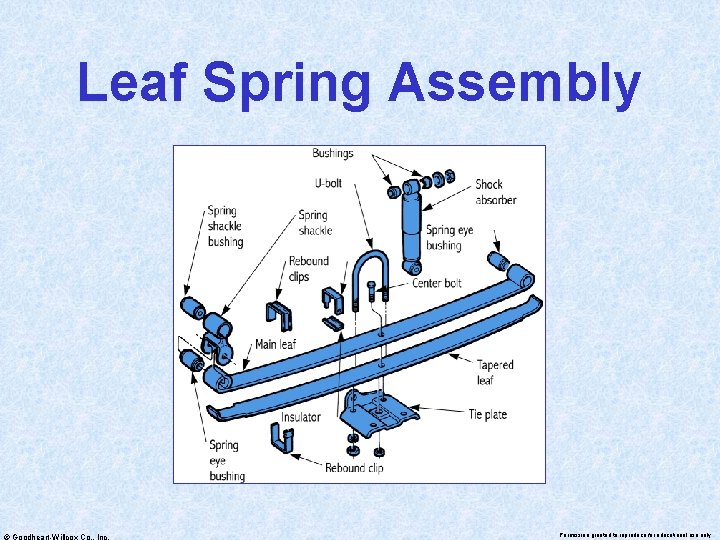
Leaf Spring Assembly © Goodheart-Willcox Co. , Inc. Permission granted to reproduce for educational use only
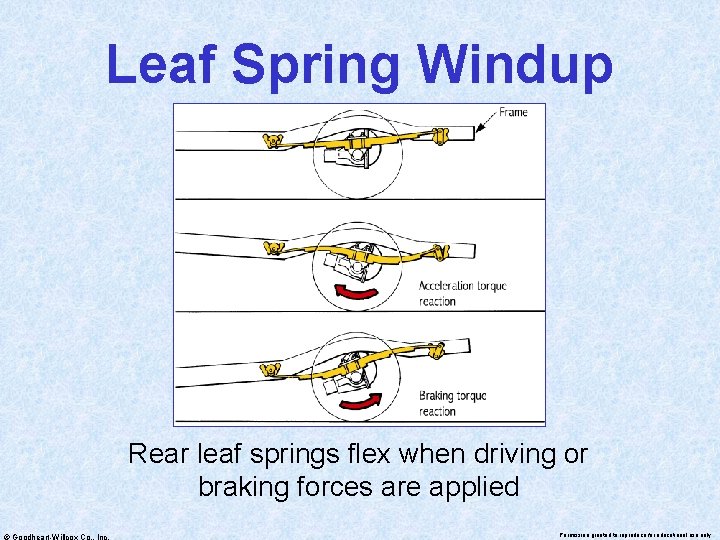
Leaf Spring Windup Rear leaf springs flex when driving or braking forces are applied © Goodheart-Willcox Co. , Inc. Permission granted to reproduce for educational use only
Air Spring q Rubber cylinder filled with air q End caps are formed on the ends for mounting q Air pressure in the rubber cylinder gives the unit a spring action q Special synthetic rubber compounds are used so the air spring can operate properly in cold weather © Goodheart-Willcox Co. , Inc. Permission granted to reproduce for educational use only
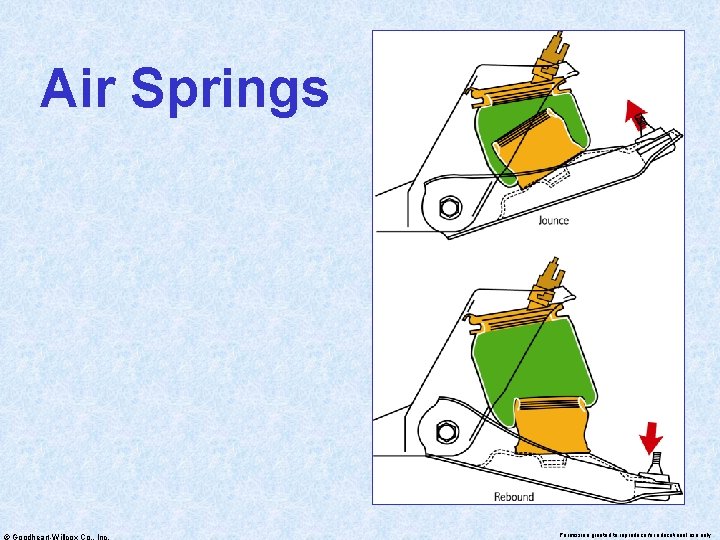
Air Springs © Goodheart-Willcox Co. , Inc. Permission granted to reproduce for educational use only
Torsion Bar q Made of a large spring-steel rod q One end is attached to the frame q The other end is fastened to the control arm q Jounce and rebound twists the torsion bar © Goodheart-Willcox Co. , Inc. Permission granted to reproduce for educational use only
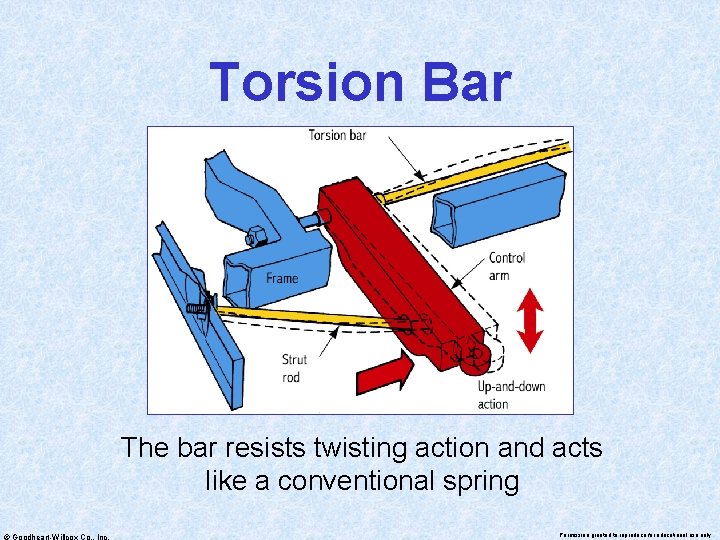
Torsion Bar The bar resists twisting action and acts like a conventional spring © Goodheart-Willcox Co. , Inc. Permission granted to reproduce for educational use only
Spring Rate q Stiffness, or tension, of a spring q Determined by the weight needed to bend the spring © Goodheart-Willcox Co. , Inc. Permission granted to reproduce for educational use only
Sprung Weight q Weight of the parts supported by the springs q Sprung weight should be kept high, in proportion to unsprung weight © Goodheart-Willcox Co. , Inc. Permission granted to reproduce for educational use only
Unsprung Weight q The weight of the parts not supported by the springs: m tires and wheels m wheel bearings and steering knuckles m axle housing q Unsprung weight should be kept low to improve ride smoothness © Goodheart-Willcox Co. , Inc. Permission granted to reproduce for educational use only
© Goodheart-Willcox Co. , Inc. Permission granted to reproduce for educational use only
Control Arms q Used to hold the steering knuckle, bearing support, or axle housing in position as the wheel moves up and down q The inner end contains bushings q The outer end contains a ball joint (independent) or bushing (solid axle) © Goodheart-Willcox Co. , Inc. Permission granted to reproduce for educational use only
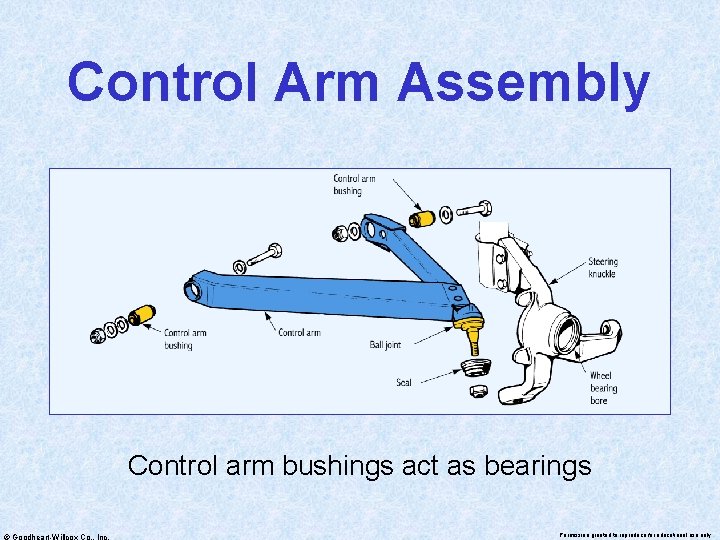
Control Arm Assembly Control arm bushings act as bearings © Goodheart-Willcox Co. , Inc. Permission granted to reproduce for educational use only
Strut Rod q Fastens to the outer end of the lower control arm and to the body or frame q Keeps the control arm from swinging toward the front or rear of the vehicle q The rod ends contain rubber bushings that soften the action of the rod and permit a controlled amount of lower control arm front-to-rear flex © Goodheart-Willcox Co. , Inc. Permission granted to reproduce for educational use only
Ball Joints q Connections that allow limited rotation in every direction q Filled with grease for lubrication q A grease fitting may be provided q A grease seal holds grease in and prevents water and contaminant entry © Goodheart-Willcox Co. , Inc. Permission granted to reproduce for educational use only
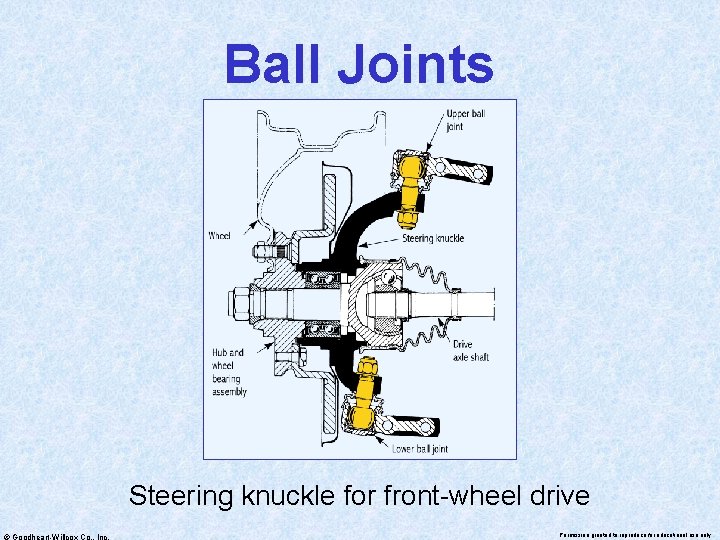
Ball Joints Steering knuckle for front-wheel drive © Goodheart-Willcox Co. , Inc. Permission granted to reproduce for educational use only
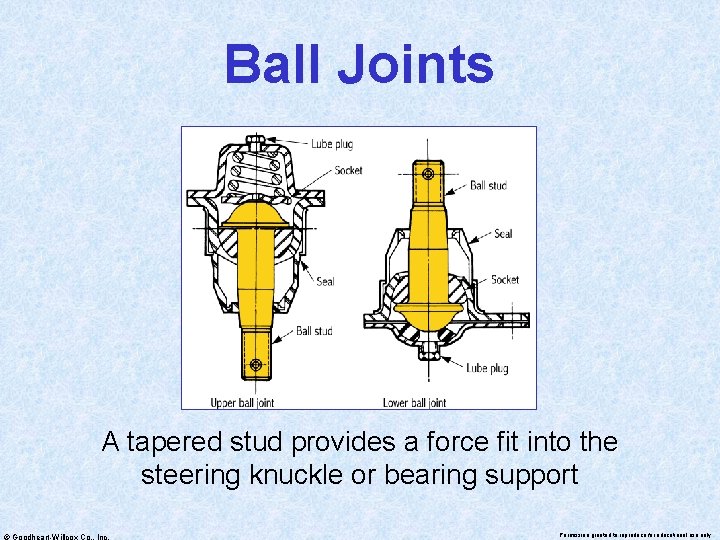
Ball Joints A tapered stud provides a force fit into the steering knuckle or bearing support © Goodheart-Willcox Co. , Inc. Permission granted to reproduce for educational use only
Shock Absorbers q Limit spring oscillations to smooth a vehicle’s ride q One end is connected to the body or frame, and the other is connected to the axle or control arm q When compressed or extended, oil inside the shock is forced through small orifices, absorbing energy and dampening spring action © Goodheart-Willcox Co. , Inc. Permission granted to reproduce for educational use only
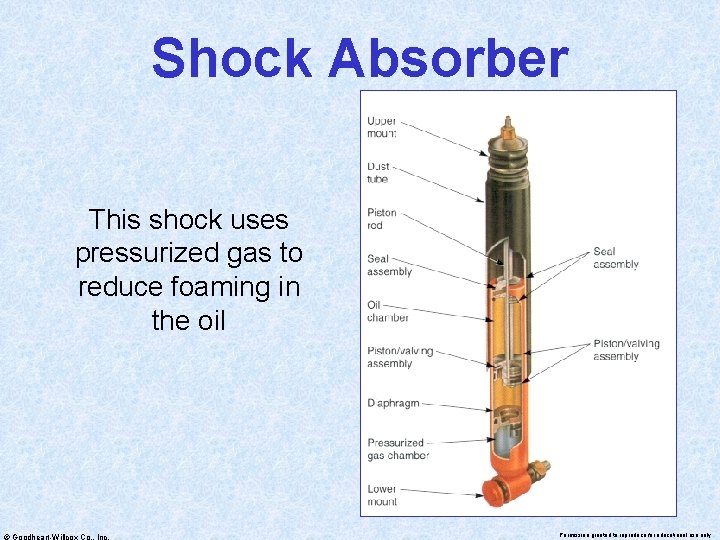
Shock Absorber This shock uses pressurized gas to reduce foaming in the oil © Goodheart-Willcox Co. , Inc. Permission granted to reproduce for educational use only
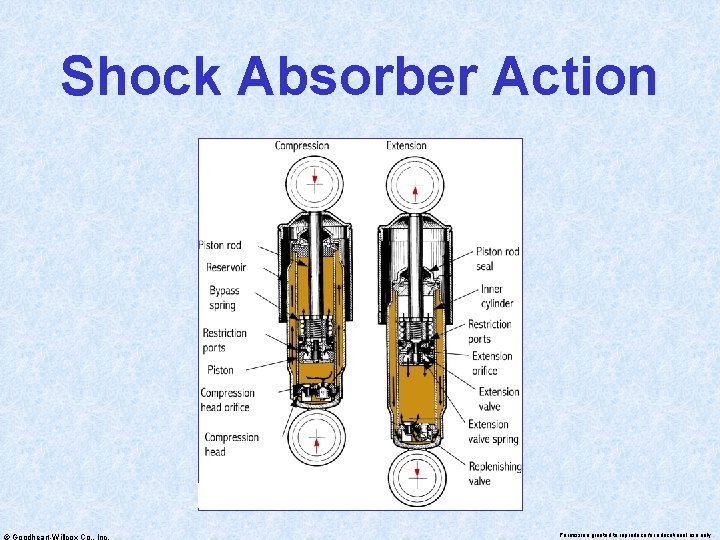
Shock Absorber Action © Goodheart-Willcox Co. , Inc. Permission granted to reproduce for educational use only
Gas-Charged Shock Absorbers q Use a low-pressure gas to help keep the oil in the shock from foaming q Nitrogen gas is enclosed in a chamber separate from the main oil cylinder q Gas pressure acting on the oil prevents air bubbles from forming © Goodheart-Willcox Co. , Inc. Permission granted to reproduce for educational use only
Self-Leveling Shock Absorbers q The special design causes a hydraulic lock action to help maintain normal curb height q A valve system in the shock retains hydraulic pressure when the shock is compressed near its minimum length m helps keep the shock rod at the same length with changes in force or curb weight © Goodheart-Willcox Co. , Inc. Permission granted to reproduce for educational use only
Adjustable Shocks q Provide a means of changing shock stiffness q The shock can be set for different dampening stiffness, usually by turning the shock’s outer body © Goodheart-Willcox Co. , Inc. Permission granted to reproduce for educational use only
Strut Assembly q Consists of a shock absorber, a coil spring, and an upper damper unit q Replaces the upper control arm q Only the lower control arm and the strut are needed to support the wheel assembly © Goodheart-Willcox Co. , Inc. Permission granted to reproduce for educational use only
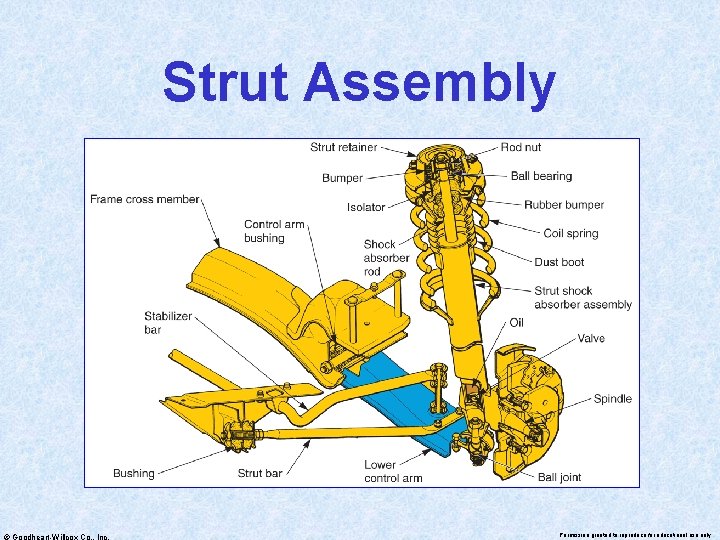
Strut Assembly © Goodheart-Willcox Co. , Inc. Permission granted to reproduce for educational use only
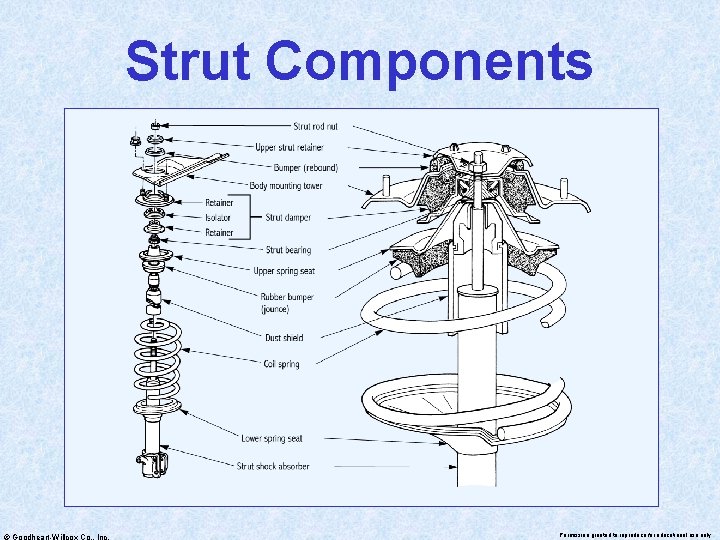
Strut Components © Goodheart-Willcox Co. , Inc. Permission granted to reproduce for educational use only
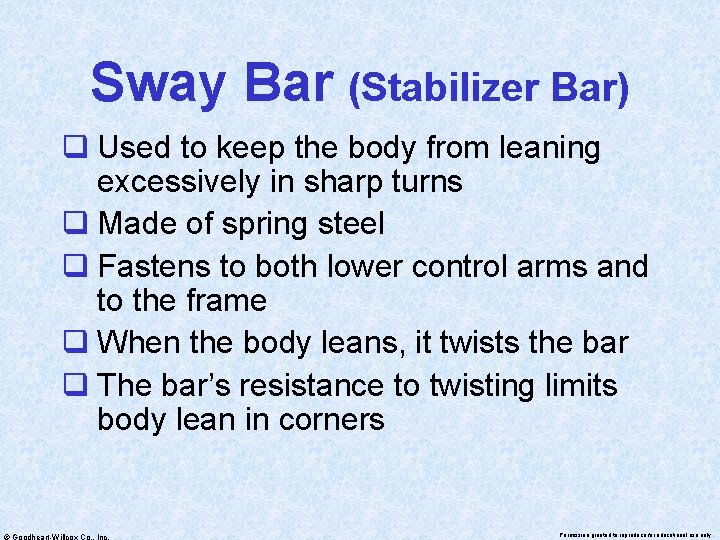
Sway Bar (Stabilizer Bar) q Used to keep the body from leaning excessively in sharp turns q Made of spring steel q Fastens to both lower control arms and to the frame q When the body leans, it twists the bar q The bar’s resistance to twisting limits body lean in corners © Goodheart-Willcox Co. , Inc. Permission granted to reproduce for educational use only
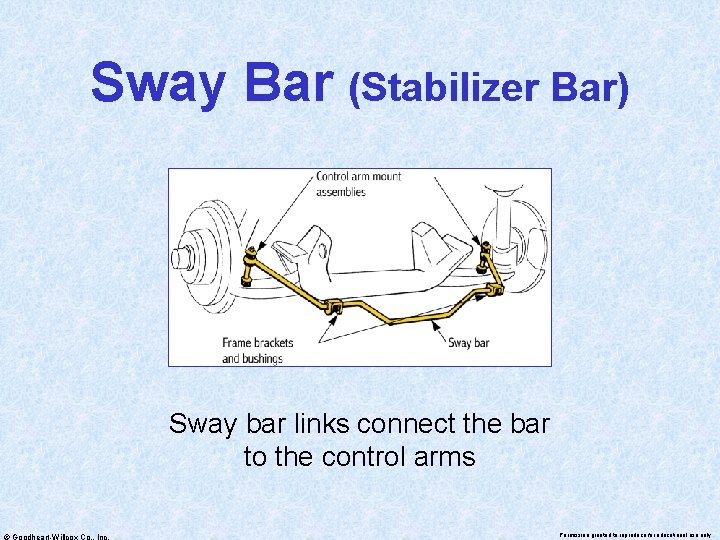
Sway Bar (Stabilizer Bar) Sway bar links connect the bar to the control arms © Goodheart-Willcox Co. , Inc. Permission granted to reproduce for educational use only
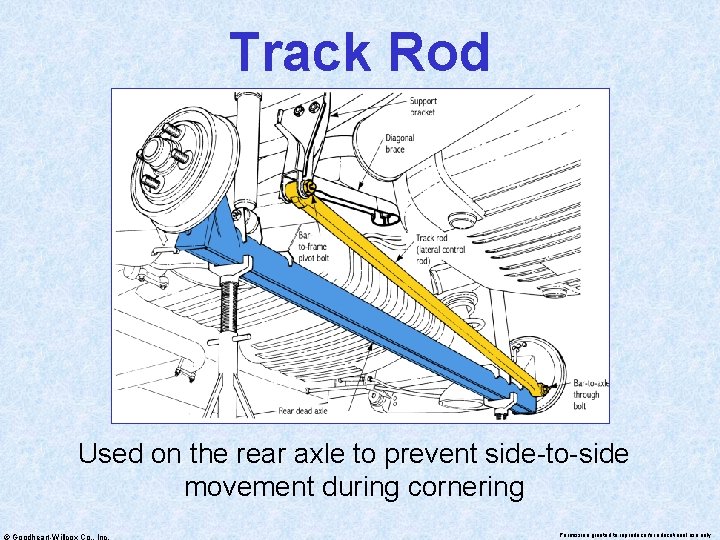
Track Rod Used on the rear axle to prevent side-to-side movement during cornering © Goodheart-Willcox Co. , Inc. Permission granted to reproduce for educational use only
q Uses control arms of different lengths q Minimizes tire tilting (camber change) with suspension action q Reduces tire scuffing and wear q The upper control arms are shorter than the lower control arms © Goodheart-Willcox Co. , Inc. Permission granted to reproduce for educational use only
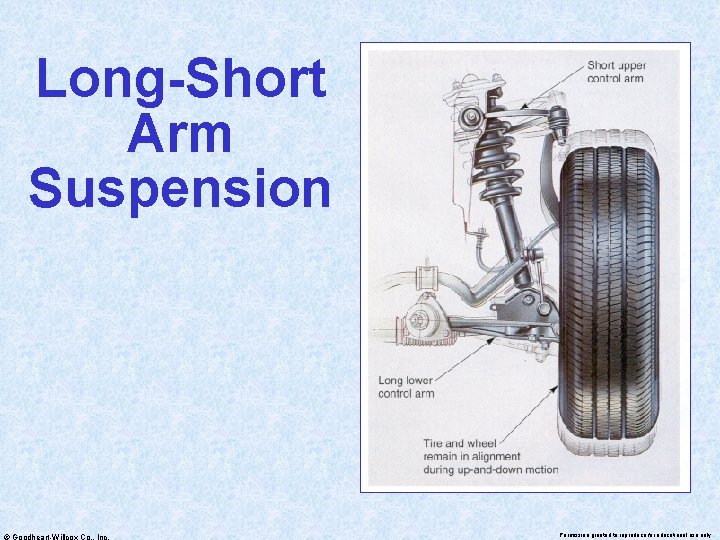
Long-Short Arm Suspension © Goodheart-Willcox Co. , Inc. Permission granted to reproduce for educational use only
q Contains torsion bar springs instead of coil springs q Most allow curb height adjustment q By turning an adjustment bolt, you can increase or decrease the tension on the torsion bar, raising or lowering the vehicle © Goodheart-Willcox Co. , Inc. Permission granted to reproduce for educational use only
q Uses only a lower control arm and a strut to support each wheel assembly q The top of the strut is fastened to the reinforced body structure, which supports the weight of the car q The most common system in use on late-model cars © Goodheart-Willcox Co. , Inc. Permission granted to reproduce for educational use only
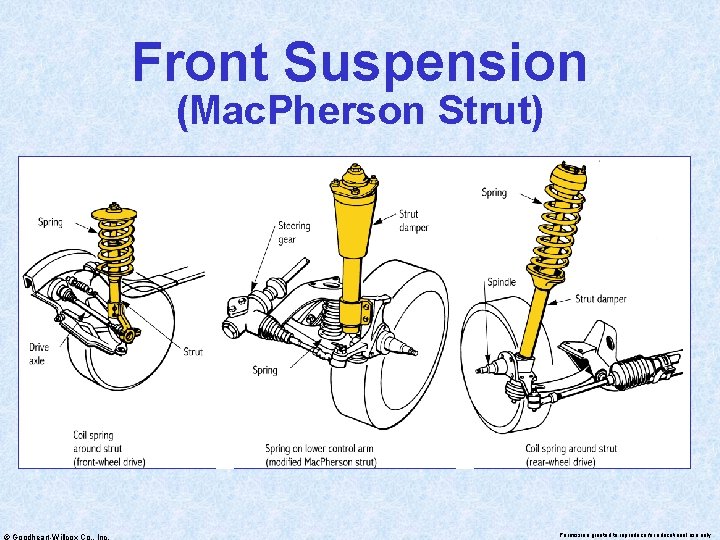
Front Suspension (Mac. Pherson Strut) © Goodheart-Willcox Co. , Inc. Permission granted to reproduce for educational use only
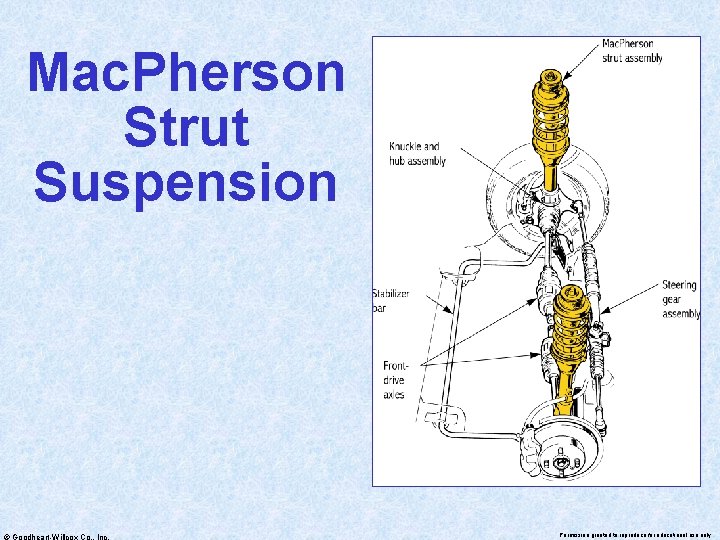
Mac. Pherson Strut Suspension © Goodheart-Willcox Co. , Inc. Permission granted to reproduce for educational use only
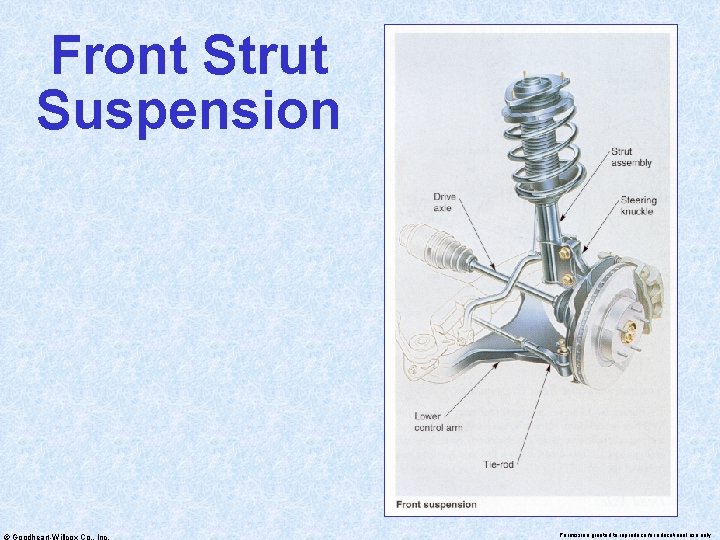
Front Strut Suspension © Goodheart-Willcox Co. , Inc. Permission granted to reproduce for educational use only
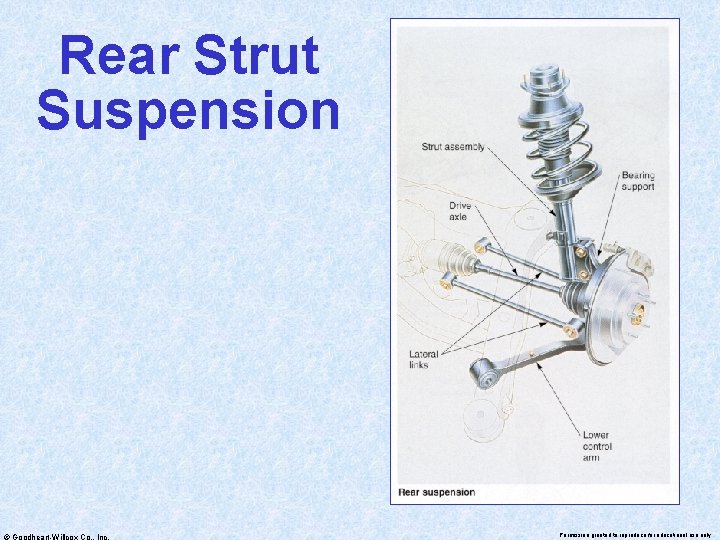
Rear Strut Suspension © Goodheart-Willcox Co. , Inc. Permission granted to reproduce for educational use only
q Pickup trucks use numerous designs: m long-short arm m Mac. Pherson strut m solid axle m twin axle (twin I-beam) q A four-wheel drive truck can have a solid axle housing and differential in the front or independent front suspension © Goodheart-Willcox Co. , Inc. Permission granted to reproduce for educational use only
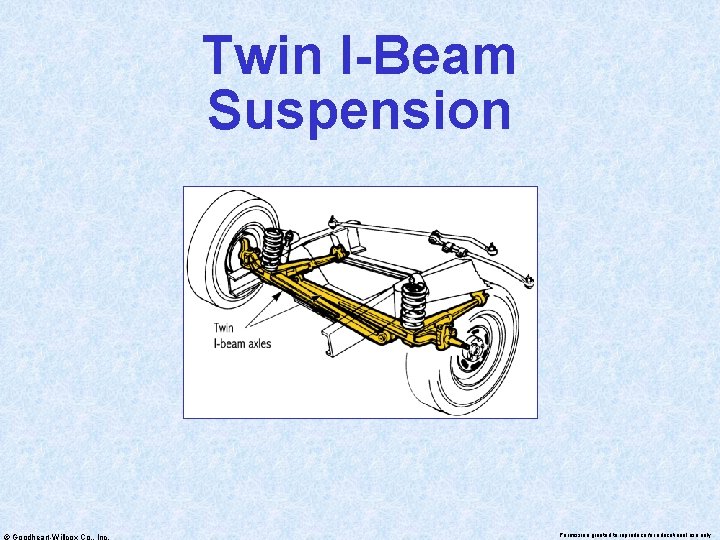
Twin I-Beam Suspension © Goodheart-Willcox Co. , Inc. Permission granted to reproduce for educational use only
q The rear axle housing may be solid m nonindependent suspension q Rear swing axles can also be used m independent suspension © Goodheart-Willcox Co. , Inc. Permission granted to reproduce for educational use only
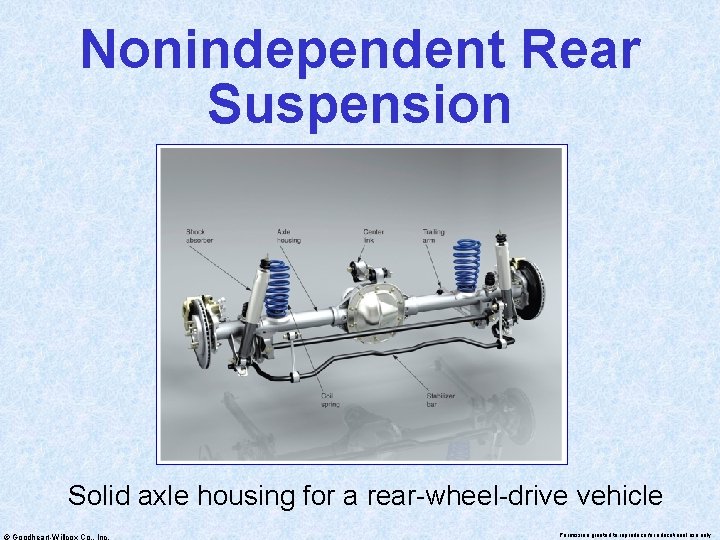
Nonindependent Rear Suspension Solid axle housing for a rear-wheel-drive vehicle © Goodheart-Willcox Co. , Inc. Permission granted to reproduce for educational use only
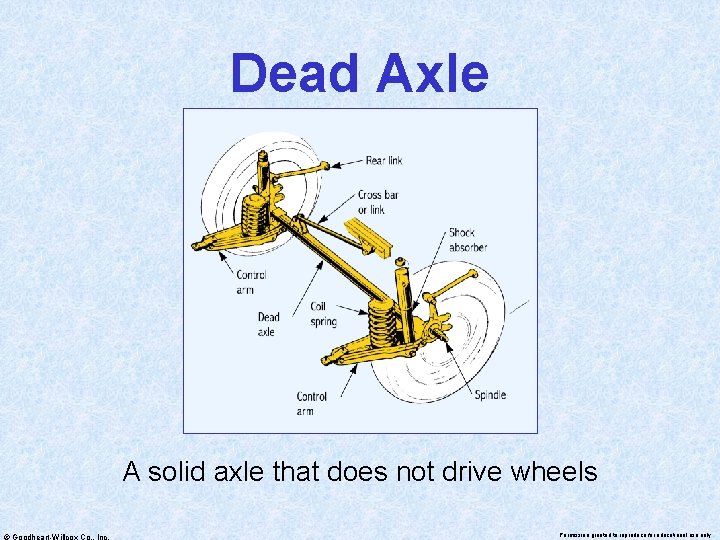
Dead Axle A solid axle that does not drive wheels © Goodheart-Willcox Co. , Inc. Permission granted to reproduce for educational use only
Semi-Independent Suspension q Uses a flexible axle, allowing the right and left wheels to be partially independent of each other q When one wheel hits a bump, its control arm moves up q Since the axle can flex, the effect on the other tire is minimized © Goodheart-Willcox Co. , Inc. Permission granted to reproduce for educational use only
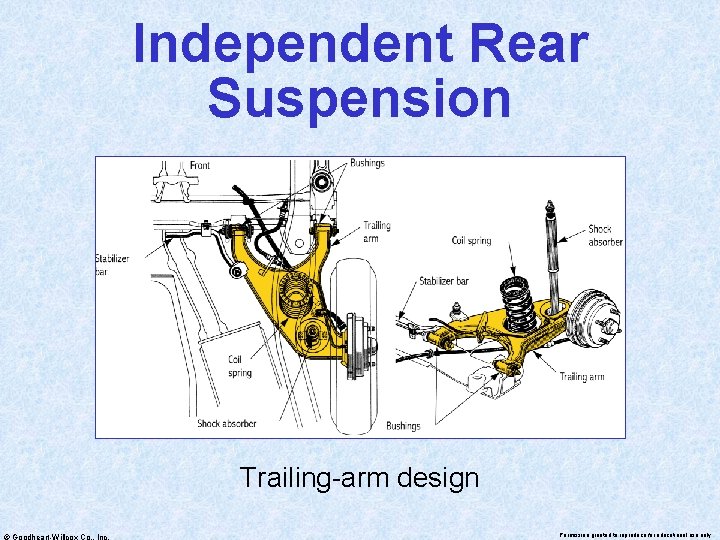
Independent Rear Suspension Trailing-arm design © Goodheart-Willcox Co. , Inc. Permission granted to reproduce for educational use only
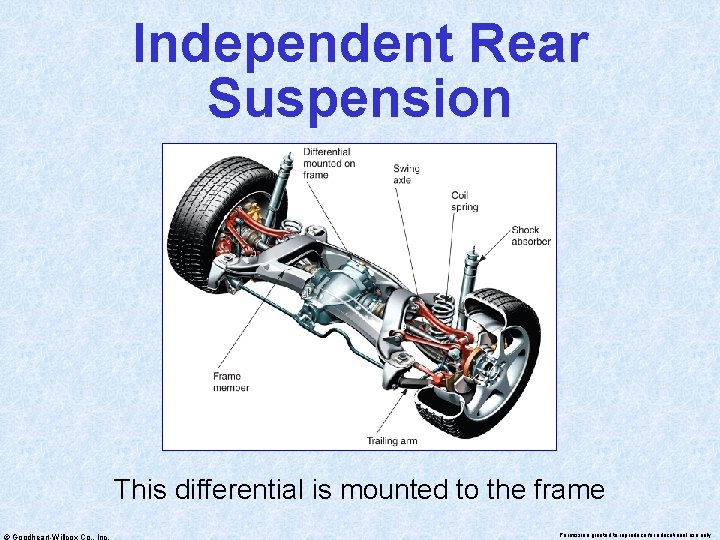
Independent Rear Suspension This differential is mounted to the frame © Goodheart-Willcox Co. , Inc. Permission granted to reproduce for educational use only
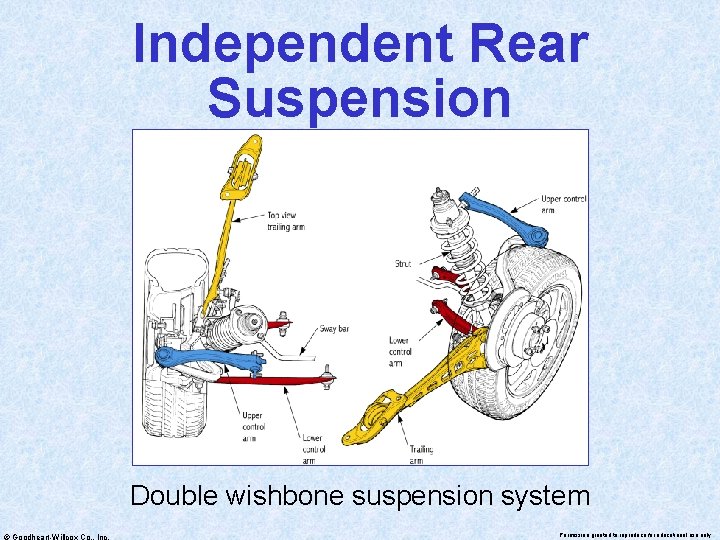
Independent Rear Suspension Double wishbone suspension system © Goodheart-Willcox Co. , Inc. Permission granted to reproduce for educational use only
q Used to maintain the same vehicle attitude (body height) with changes in the amount of weight in the car q Common classifications: m manual system m automatic system © Goodheart-Willcox Co. , Inc. Permission granted to reproduce for educational use only
Manual System q Uses air shocks and an electric compressor to counteract changes in passenger and luggage weight q A manual switch is used to activate the compressor to alter air shock pressure and body height © Goodheart-Willcox Co. , Inc. Permission granted to reproduce for educational use only
Automatic System q Uses air shocks or air springs, height sensors, and a compressor to maintain curb height q A height sensor is connected to the frame and to the axle housing q If the load changes, the sensor can turn the compressor on to increase pressure to the shocks or turn a solenoid on to vent pressure from the system © Goodheart-Willcox Co. , Inc. Permission granted to reproduce for educational use only
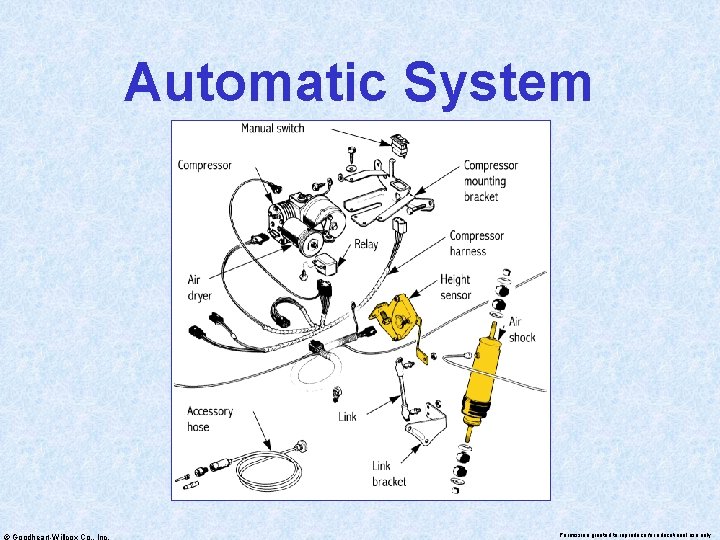
Automatic System © Goodheart-Willcox Co. , Inc. Permission granted to reproduce for educational use only
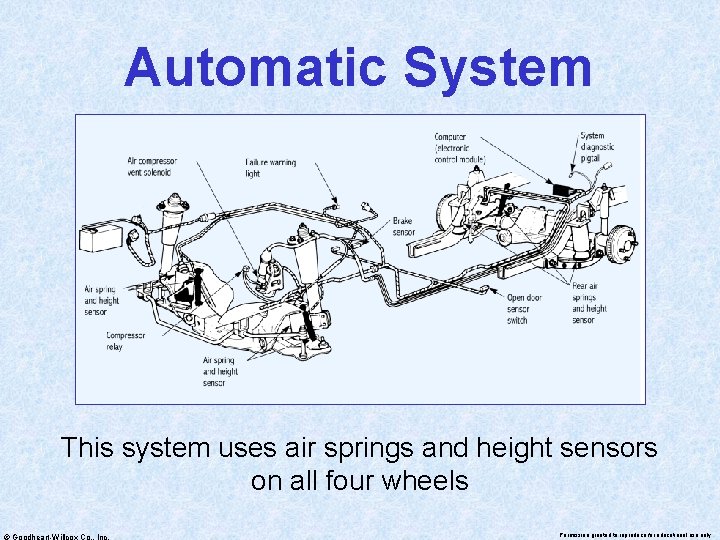
Automatic System This system uses air springs and height sensors on all four wheels © Goodheart-Willcox Co. , Inc. Permission granted to reproduce for educational use only
Electronic Height Control q Uses height sensors and an electronic control module to control the operation of a small electric air compressor, which maintains the correct ride height q Used on the rear of the car to compensate for heavy loads © Goodheart-Willcox Co. , Inc. Permission granted to reproduce for educational use only
Electronic Height Control q Components: m height sensor m compressor assembly m pressure lines m air shocks m sensor link m solenoid valve m suspension control module © Goodheart-Willcox Co. , Inc. Permission granted to reproduce for educational use only
Operation q If the trunk is heavily loaded, the weight will compress the rear air shocks q When the car is started, the height sensor will be activated by the action of the sensor link, and the sensor switch will close, energizing the compressor m rear shock air pressure increases m car body rises © Goodheart-Willcox Co. , Inc. Permission granted to reproduce for educational use only
Operation q When the weight is removed, the car body will rise q The height sensor will then be moved in the other direction by the link, closing another set of internal contacts, energizing the pressure release solenoid valve m air pressure is vented from the rear shocks m body drops down to the correct ride height © Goodheart-Willcox Co. , Inc. Permission granted to reproduce for educational use only
q Uses various sensors, a computer, and shock absorber actuators to control ride stiffness q Increases comfort and safety by matching suspension system action to driving conditions © Goodheart-Willcox Co. , Inc. Permission granted to reproduce for educational use only
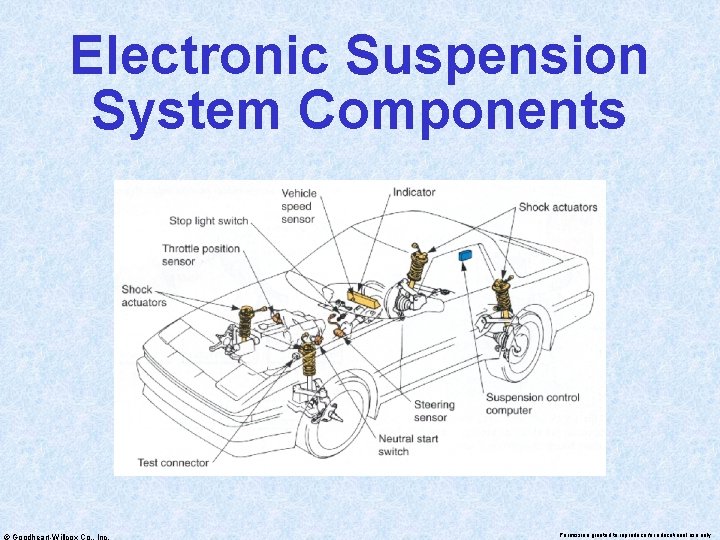
Electronic Suspension System Components © Goodheart-Willcox Co. , Inc. Permission granted to reproduce for educational use only
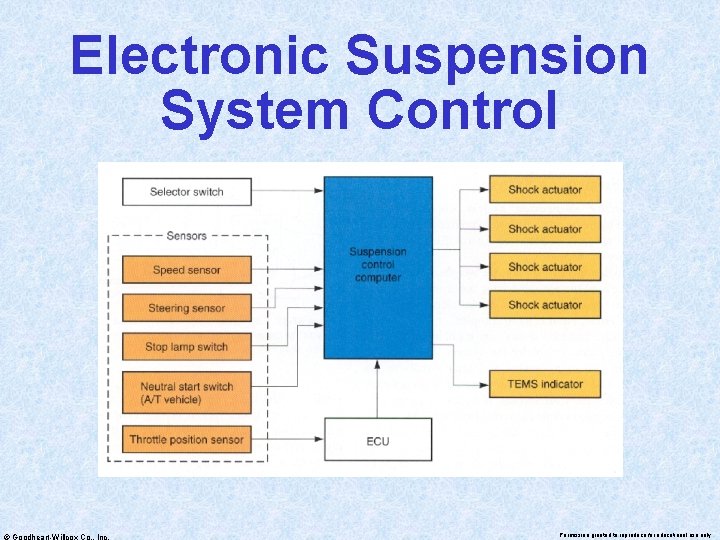
Electronic Suspension System Control © Goodheart-Willcox Co. , Inc. Permission granted to reproduce for educational use only
Operation q The system can produce a soft, smooth ride when traveling down a straight highway q Based on the selector switch setting and other inputs, the electronic control module would energize the shock actuators to open the valves more m reduces internal fluid restriction m softens the ride © Goodheart-Willcox Co. , Inc. Permission granted to reproduce for educational use only
Operation q The system can stiffen the ride when cornering, accelerating, or braking q Based on the selector switch setting and other inputs, the electronic control module would energize the shock actuators to close the valves more m increases internal fluid restriction m increases dampening action m prevents body roll and dive © Goodheart-Willcox Co. , Inc. Permission granted to reproduce for educational use only
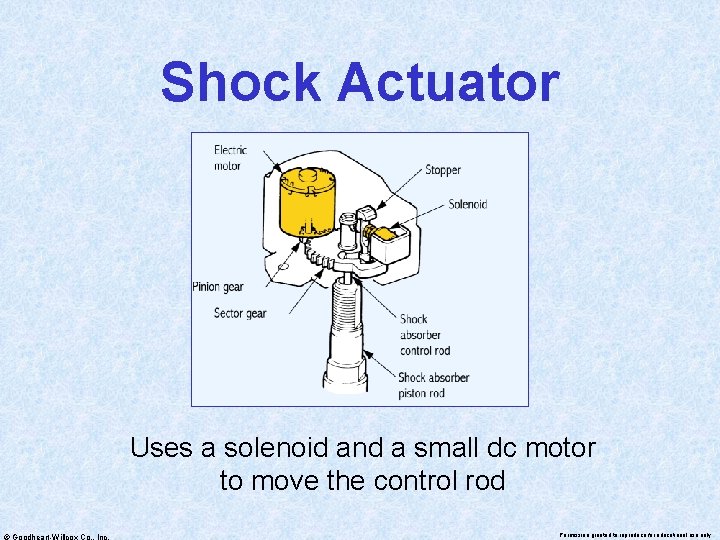
Shock Actuator Uses a solenoid and a small dc motor to move the control rod © Goodheart-Willcox Co. , Inc. Permission granted to reproduce for educational use only
q Uses computer-controlled hydraulic rams instead of conventional springs and shock absorber actuators to control ride characteristics q Hydraulic rams support the weight of the car and react to the road surface © Goodheart-Willcox Co. , Inc. Permission granted to reproduce for educational use only
Operation q Pressure sensors on each ram provide the main control for the system q The sensors react to suspension system movement and send signals to the computer q The computer extends or retracts each ram to match the road surface © Goodheart-Willcox Co. , Inc. Permission granted to reproduce for educational use only
Operation q Pressure control valves are located on each ram q By opening and closing these valves, the computer can adjust the pressure of the rams and the resulting height of each corner of the vehicle q The computer can theoretically eliminate most body movement as the car travels over small dips and bumps © Goodheart-Willcox Co. , Inc. Permission granted to reproduce for educational use only
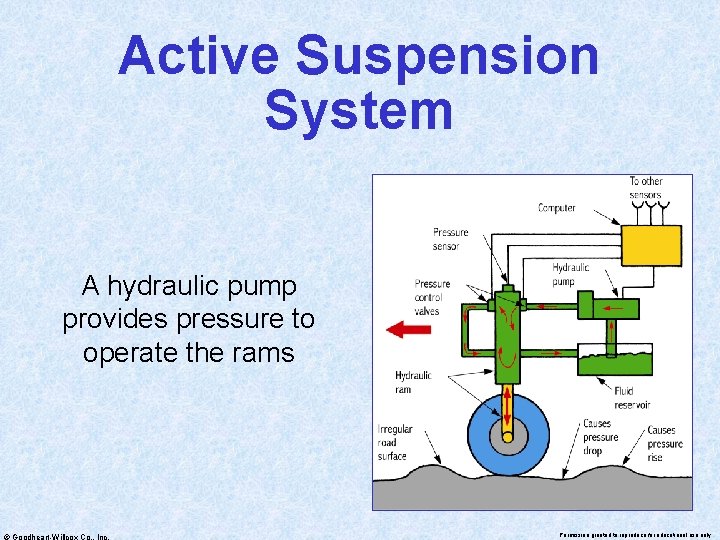
Active Suspension System A hydraulic pump provides pressure to operate the rams © Goodheart-Willcox Co. , Inc. Permission granted to reproduce for educational use only
Active Suspension Advantages q In turns, body roll is controlled, even banking into a turn is possible q For highway driving, the car can be lowered to improve aerodynamics q During city driving, the car can be raised for added ground clearance © Goodheart-Willcox Co. , Inc. Permission granted to reproduce for educational use only
- Slides: 86