
by Russell Krick Publisher The GoodheartWillcox Co Inc
by Russell Krick Publisher The Goodheart-Willcox Co. , Inc. Tinley Park, Illinois © Goodheart-Willcox Co. , Inc. Permission granted to reproduce for educational use only
© Goodheart-Willcox Co. , Inc. Permission granted to reproduce for educational use only
(9 Topics) q Fasteners q Washers q Machine screws q Sheet metal screws q Nonthreaded fasteners © Goodheart-Willcox Co. , Inc. Permission granted to reproduce for educational use only
q Torquing bolts and nuts q Thread repairs q Removing damaged fasteners q Gaskets and seals © Goodheart-Willcox Co. , Inc. Permission granted to reproduce for educational use only
q Devices that hold the parts of a vehicle together q Thousands of fasteners are used in vehicles © Goodheart-Willcox Co. , Inc. Permission granted to reproduce for educational use only
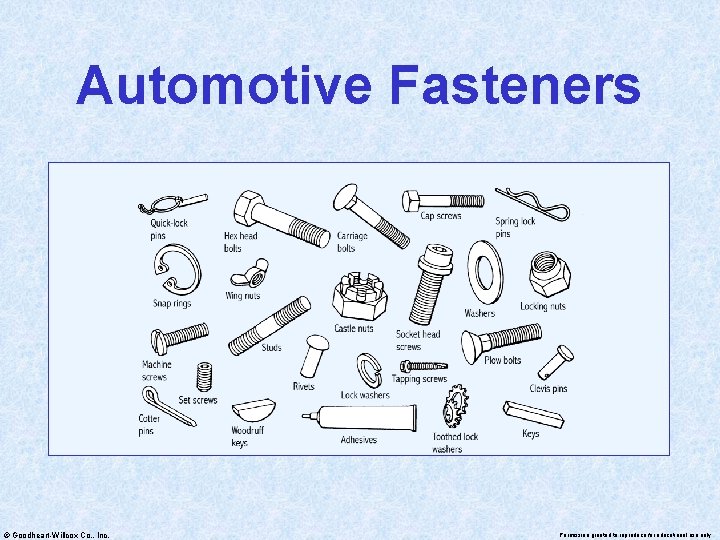
Automotive Fasteners © Goodheart-Willcox Co. , Inc. Permission granted to reproduce for educational use only
Bolts and Nuts q Bolt m metal rod with external threads on one end a head on the other m when a bolt is threaded into a part other than a nut, it can also be called a cap screw q Nut m has internal threads and, usually, a sixsided outer shape © Goodheart-Willcox Co. , Inc. Permission granted to reproduce for educational use only
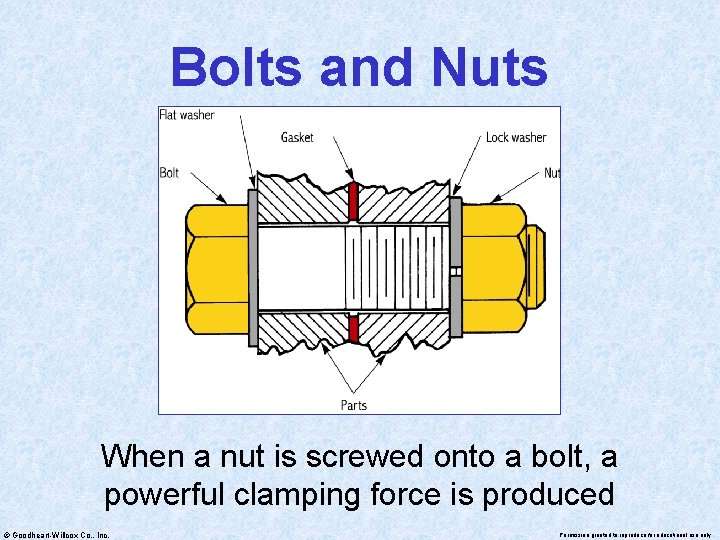
Bolts and Nuts When a nut is screwed onto a bolt, a powerful clamping force is produced © Goodheart-Willcox Co. , Inc. Permission granted to reproduce for educational use only
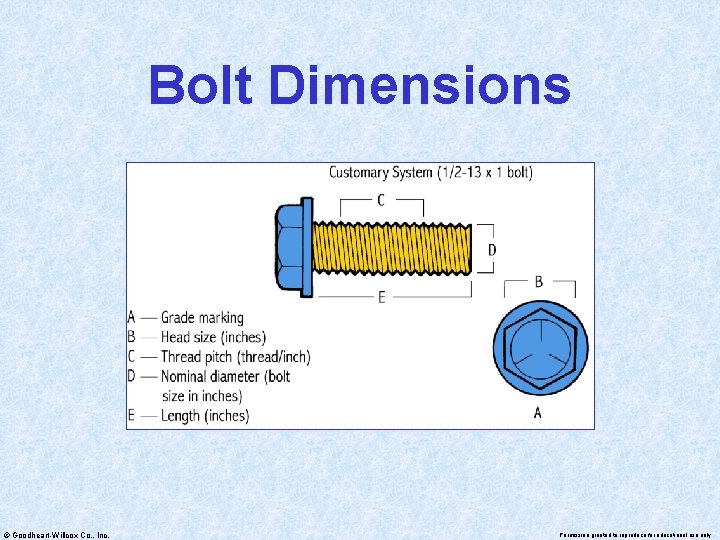
Bolt Dimensions © Goodheart-Willcox Co. , Inc. Permission granted to reproduce for educational use only
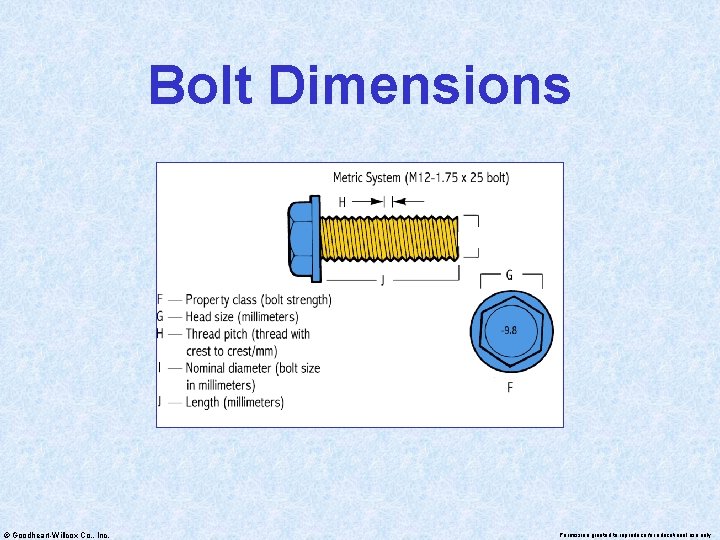
Bolt Dimensions © Goodheart-Willcox Co. , Inc. Permission granted to reproduce for educational use only
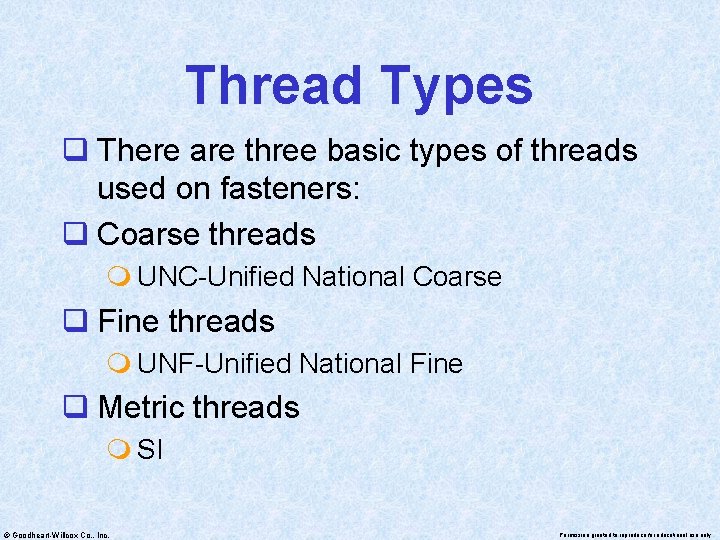
Thread Types q There are three basic types of threads used on fasteners: q Coarse threads m UNC-Unified National Coarse q Fine threads m UNF-Unified National Fine q Metric threads m SI © Goodheart-Willcox Co. , Inc. Permission granted to reproduce for educational use only
Thread Direction q Bolts and nuts come in right- and lefthand threads q Right-hand threads m fastener must be turned clockwise to tighten q Left-hand threads m fastener must be turned counterclockwise to tighten m letter L may be stamped on fastener © Goodheart-Willcox Co. , Inc. Permission granted to reproduce for educational use only
Bolt Grade q Also called tensile strength q Refers to the amount of pull a fastener can withstand before breaking q Bolt head markings specify the tensile strength of the bolt q U. S. customary bolts are marked with lines q Metric bolts are marked with numbers © Goodheart-Willcox Co. , Inc. Permission granted to reproduce for educational use only
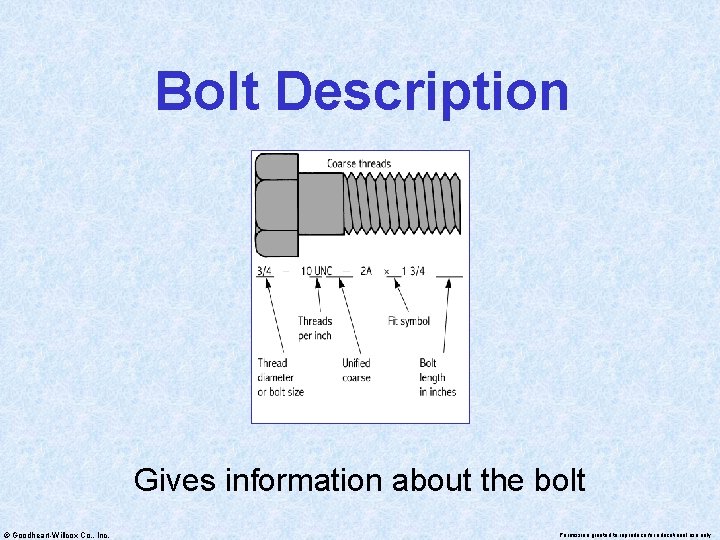
Bolt Description Gives information about the bolt © Goodheart-Willcox Co. , Inc. Permission granted to reproduce for educational use only
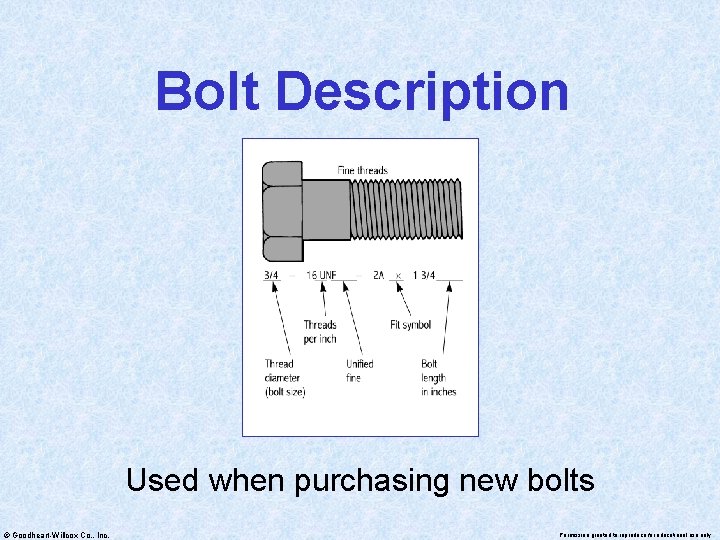
Bolt Description Used when purchasing new bolts © Goodheart-Willcox Co. , Inc. Permission granted to reproduce for educational use only
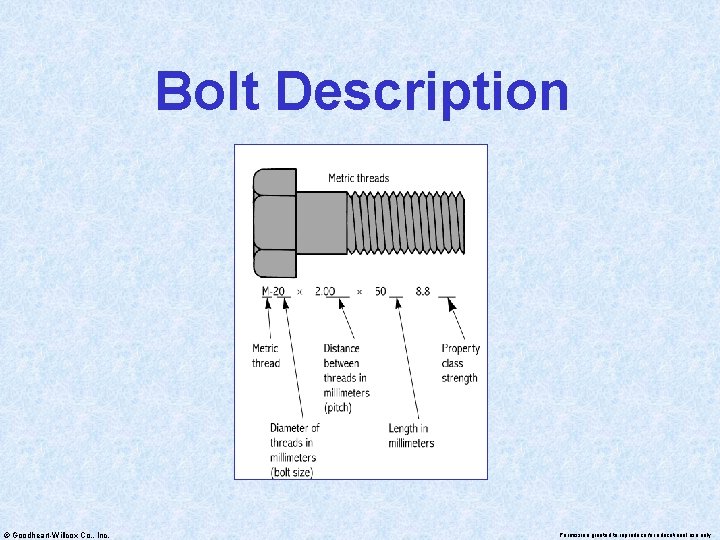
Bolt Description © Goodheart-Willcox Co. , Inc. Permission granted to reproduce for educational use only
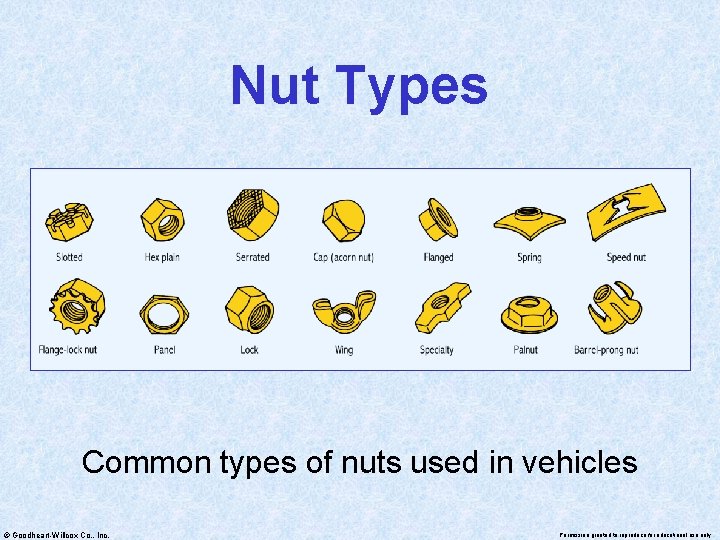
Nut Types Common types of nuts used in vehicles © Goodheart-Willcox Co. , Inc. Permission granted to reproduce for educational use only
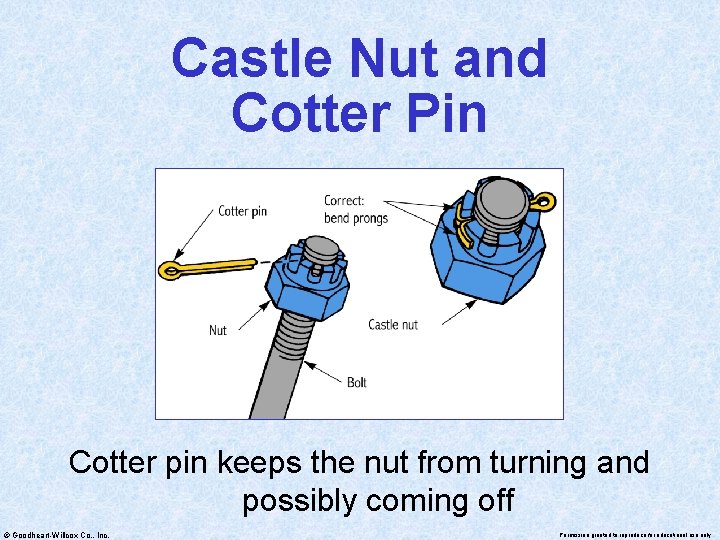
Castle Nut and Cotter Pin Cotter pin keeps the nut from turning and possibly coming off © Goodheart-Willcox Co. , Inc. Permission granted to reproduce for educational use only
q Used under bolt heads and nuts q Two basic types of washers are used: m flat washers m lock washers © Goodheart-Willcox Co. , Inc. Permission granted to reproduce for educational use only
Washer Types q Flat washer m increases the clamping surface under the fastener m prevents the bolt or nut from digging into the part q Lock washer m prevents the bolt or nut from becoming loose under stress and vibration © Goodheart-Willcox Co. , Inc. Permission granted to reproduce for educational use only
Washer Types q Lock tabs or lock plates m perform the functions of both flat washers and lock washers m increase clamping surface area and secure the fastener © Goodheart-Willcox Co. , Inc. Permission granted to reproduce for educational use only
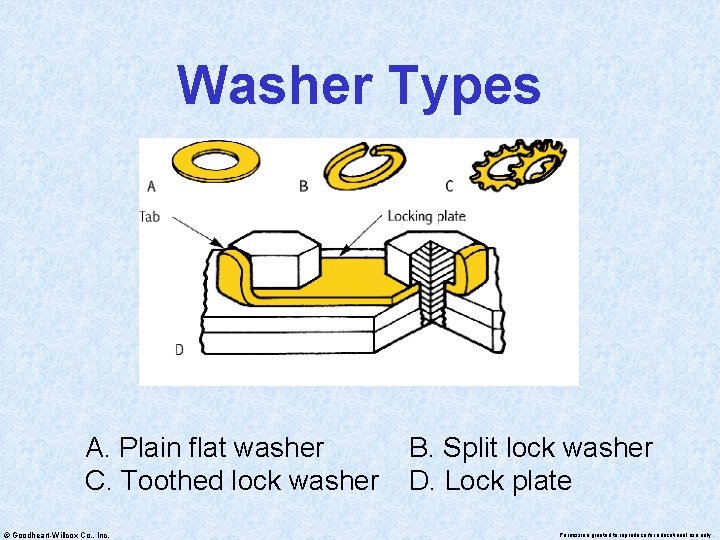
Washer Types A. Plain flat washer C. Toothed lock washer © Goodheart-Willcox Co. , Inc. B. Split lock washer D. Lock plate Permission granted to reproduce for educational use only
q Similar to bolts, but they normally have screw-type heads q Threaded along their full length q Used to secure parts when clamping loads are light q Available in various head shapes © Goodheart-Willcox Co. , Inc. Permission granted to reproduce for educational use only
q Also called tapping screws q Commonly used on plastic and sheet metal parts, such as body trim, dashboard panels, and grills q Use tapering threads that are widely spaced © Goodheart-Willcox Co. , Inc. Permission granted to reproduce for educational use only
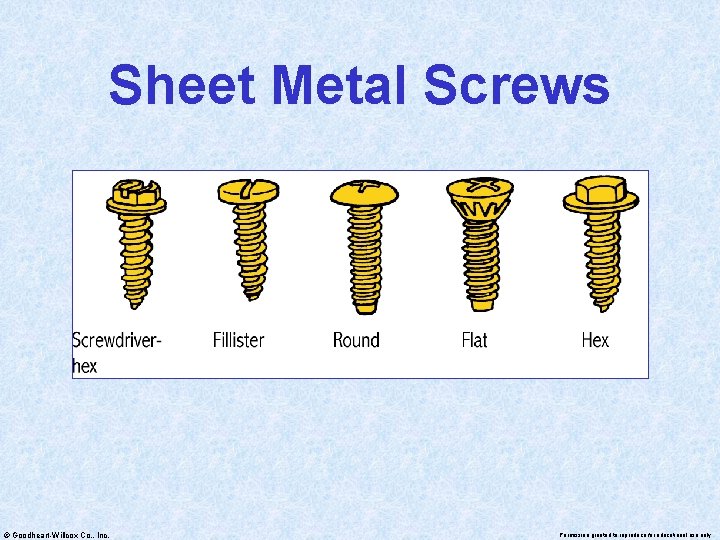
Sheet Metal Screws © Goodheart-Willcox Co. , Inc. Permission granted to reproduce for educational use only
Numerous types of nonthreaded fasteners, such as snap rings, clips, and adhesives, are used in the assembly of a vehicle © Goodheart-Willcox Co. , Inc. Permission granted to reproduce for educational use only
Snap Ring q Fits into a groove in a part and commonly holds shafts, bearings, gears, pins, and other components in place q Snap ring pliers are needed to remove and install a snap ring mspecial jaws grasp the snap ring © Goodheart-Willcox Co. , Inc. Permission granted to reproduce for educational use only
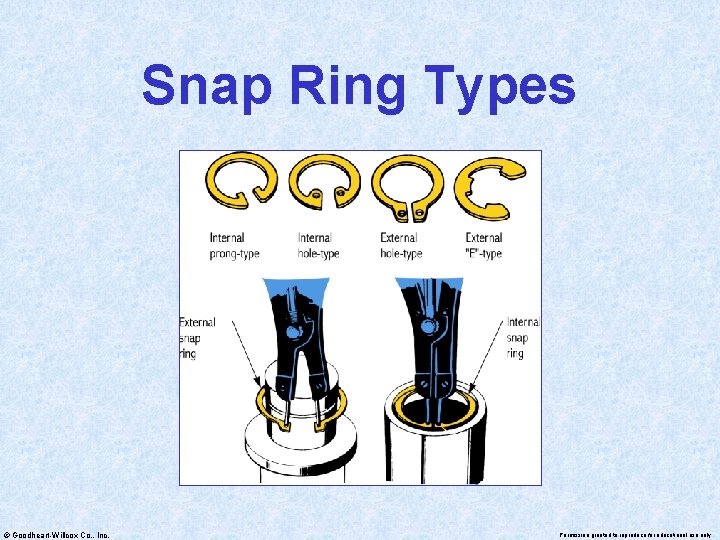
Snap Ring Types © Goodheart-Willcox Co. , Inc. Permission granted to reproduce for educational use only
Keys and Set Screws q Key m prevents a part from turning on its shaft m fits into a keyseat (slot) cut into a shaft and a keyway cut into the mating part q Set screw m normally used to lock a part onto a shaft m not as strong as a key © Goodheart-Willcox Co. , Inc. Permission granted to reproduce for educational use only
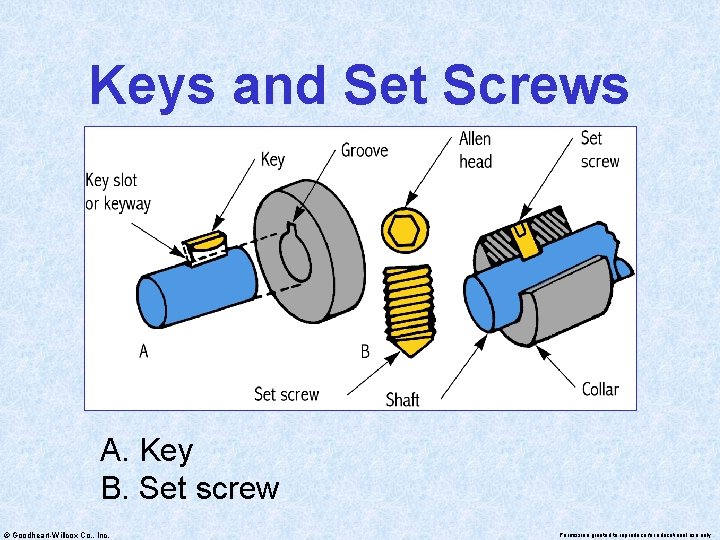
Keys and Set Screws A. Key B. Set screw © Goodheart-Willcox Co. , Inc. Permission granted to reproduce for educational use only
Splines q Series of slots cut into a shaft and a mating part q Allow the gear or collar to slide on the shaft but still not rotate q Used in manual transmissions, clutches, and drive shaft yokes © Goodheart-Willcox Co. , Inc. Permission granted to reproduce for educational use only
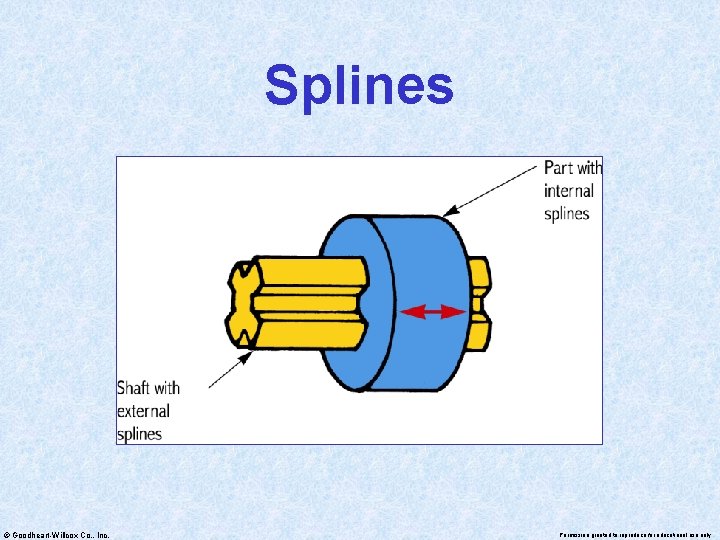
Splines © Goodheart-Willcox Co. , Inc. Permission granted to reproduce for educational use only
Adhesives q Special glues widely used in vehicles q Used to hold body moldings, rubber weather stripping, and body emblems q Some stay soft and pliable; others dry hard q Some take hours to dry; others dry in seconds q Observe all directions and safety precautions when using adhesives © Goodheart-Willcox Co. , Inc. Permission granted to reproduce for educational use only
It is very important that bolts and nuts be tightened properly—this is called torquing © Goodheart-Willcox Co. , Inc. Permission granted to reproduce for educational use only
Torque Specifications q Tightening values given by the auto manufacturer q Normally given for all precision assemblies, such as engines, transmissions, and differentials q Factory specifications should be used m general bolt torque chart may be used if factory specs are not available © Goodheart-Willcox Co. , Inc. Permission granted to reproduce for educational use only
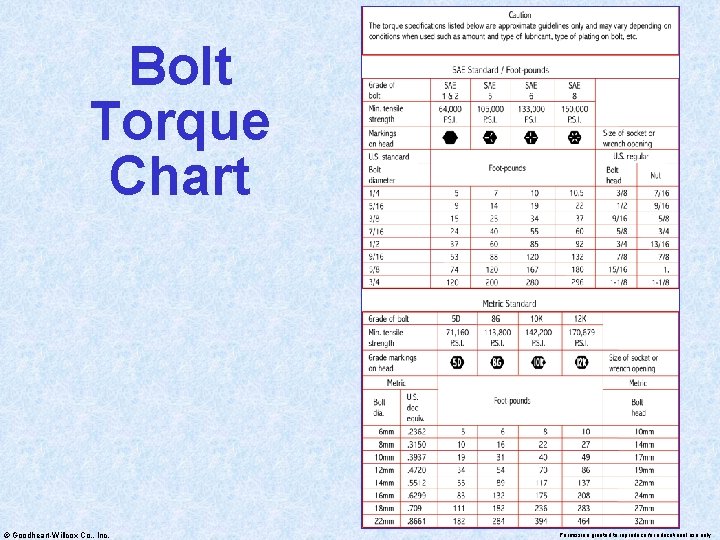
Bolt Torque Chart © Goodheart-Willcox Co. , Inc. Permission granted to reproduce for educational use only
Torque-to-Yield q Requires a bolt to be tightened to a specific torque and then turned an additional number of degrees q Procedure stretches the bolt to its correct yield point, preloading the fastener for better clamping under varying conditions q New bolts may be required each time © Goodheart-Willcox Co. , Inc. Permission granted to reproduce for educational use only
Torque Stretch q Determined by measuring bolt length change while torquing the bolt m when building a racing engine, you can “mike” connecting rod bolts to measure the length before and after tightening q Too much stretch indicates bolt weakness q Not enough stretch may indicate thread problems affecting torque © Goodheart-Willcox Co. , Inc. Permission granted to reproduce for educational use only
Bolt Tightening Sequence q Used to make sure that parts are fastened evenly q Creates an even, gradual clamping force along the entire mating surface of the parts q Crisscross pattern is often recommended © Goodheart-Willcox Co. , Inc. Permission granted to reproduce for educational use only
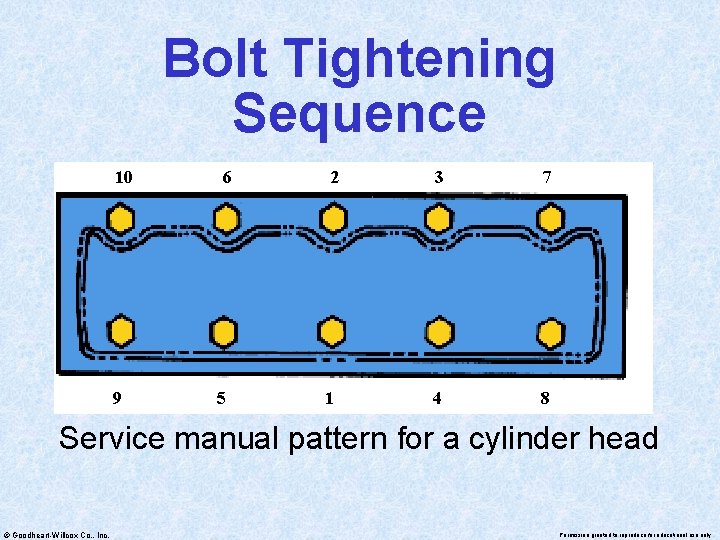
Bolt Tightening Sequence 10 9 6 5 2 1 3 7 4 8 Service manual pattern for a cylinder head © Goodheart-Willcox Co. , Inc. Permission granted to reproduce for educational use only
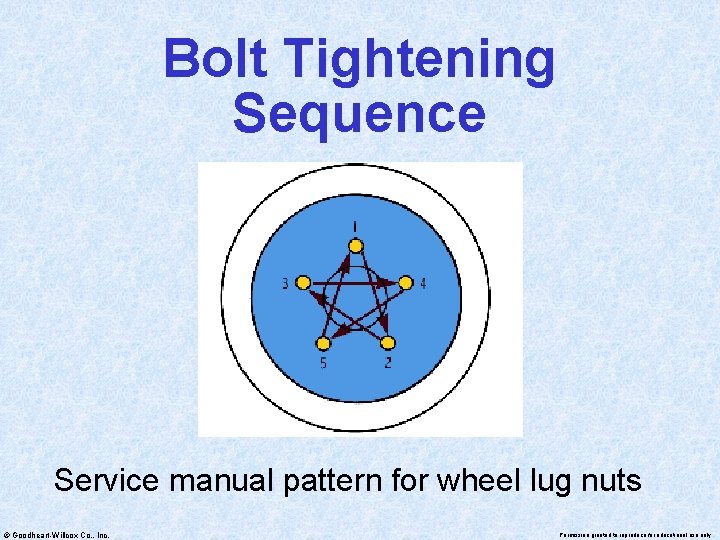
Bolt Tightening Sequence Service manual pattern for wheel lug nuts © Goodheart-Willcox Co. , Inc. Permission granted to reproduce for educational use only
Torque Wrench Rules q Keep a steady pull on the wrench q Clean fastener threads q Avoid using swivel joints q When reading a torque wrench, look straight down at the scale q Use manufacturer’s specifications when available © Goodheart-Willcox Co. , Inc. Permission granted to reproduce for educational use only
Torque Wrench Rules q When manufacturer’s specs are not available, use general specs in a crisscross pattern q To avoid a false reading, pull only on the handle q Tighten bolts and nuts in four steps q Retorque when required m some assemblies must be retightened after operation and heating © Goodheart-Willcox Co. , Inc. Permission granted to reproduce for educational use only
Threaded holes in parts can become damaged, requiring repairs. A technician must be capable of repairing damaged threads quickly and properly. © Goodheart-Willcox Co. , Inc. Permission granted to reproduce for educational use only
Minor Thread Repairs q Minor thread damage includes nicks, partial flattening, and other less serious problems q Minor damage can be repaired with a thread chaser or a thread file m the thread chaser is run through or over the threads to restore them © Goodheart-Willcox Co. , Inc. Permission granted to reproduce for educational use only
Major Thread Repairs q Badly smashed or stripped threads may be repaired with either a tap or die q Tap m threaded tool for cutting internal threads in holes q Die m cuts external threads on metal rods, bolts, shafts, and pins © Goodheart-Willcox Co. , Inc. Permission granted to reproduce for educational use only
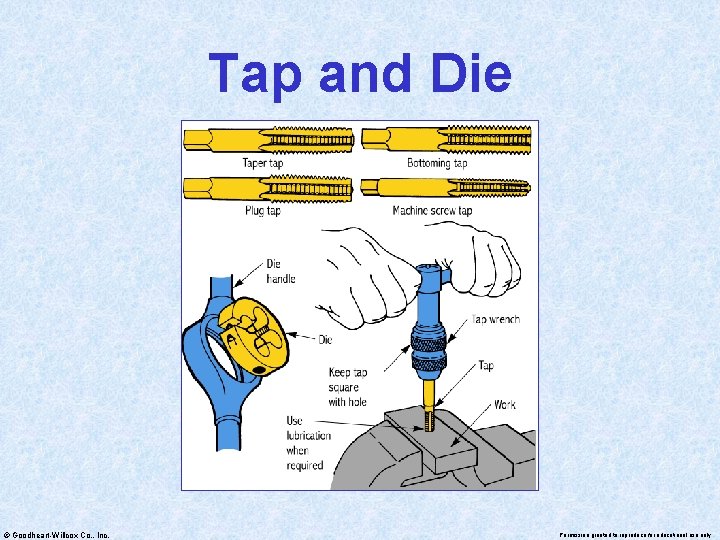
Tap and Die © Goodheart-Willcox Co. , Inc. Permission granted to reproduce for educational use only
Using a Tap and Die q Hold the handle squarely with the work q Back the handle off to clean metal out of the threads q Use a taper tap to start the threads q Use a plug tap and a bottoming tap to cut the threads to the bottom of the hole © Goodheart-Willcox Co. , Inc. Permission granted to reproduce for educational use only
Tap and Die Rules q Never force a tap handle or the tool may break q Keep the tap and die well oiled to ease cutting q Use coarse threads when threading or tapping into soft metal, like aluminum m coarse threads will hold better than fine threads © Goodheart-Willcox Co. , Inc. Permission granted to reproduce for educational use only
Tapping Oversize q When threads cannot be restored, the hole can be drilled and tapped oversize q Use a “drill and tap size chart” to choose a drill bit and tap q Drill the hole one size larger than the original hole q Cut new threads in the drilled hole q Use a larger bolt in the threaded hole © Goodheart-Willcox Co. , Inc. Permission granted to reproduce for educational use only
Thread Repair Insert q Used when the use of an oversize hole and fastener is not acceptable q Takes place of damaged internal threads q Allows the use of the original-size bolt © Goodheart-Willcox Co. , Inc. Permission granted to reproduce for educational use only
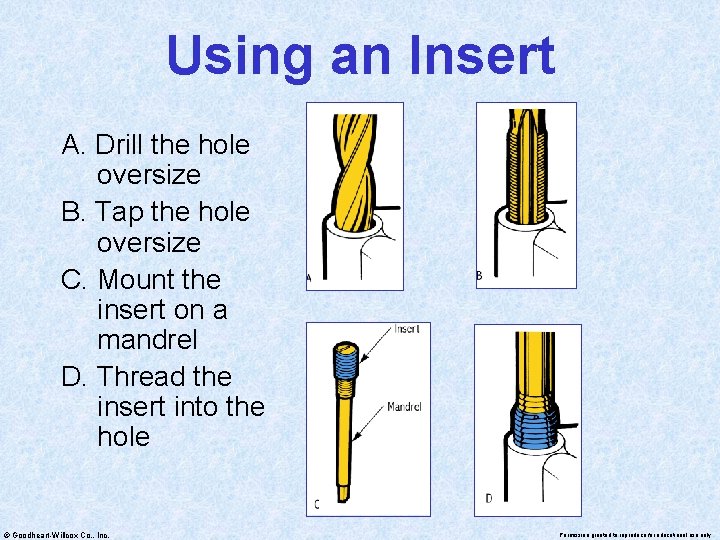
Using an Insert A. Drill the hole oversize B. Tap the hole oversize C. Mount the insert on a mandrel D. Thread the insert into the hole © Goodheart-Willcox Co. , Inc. Permission granted to reproduce for educational use only
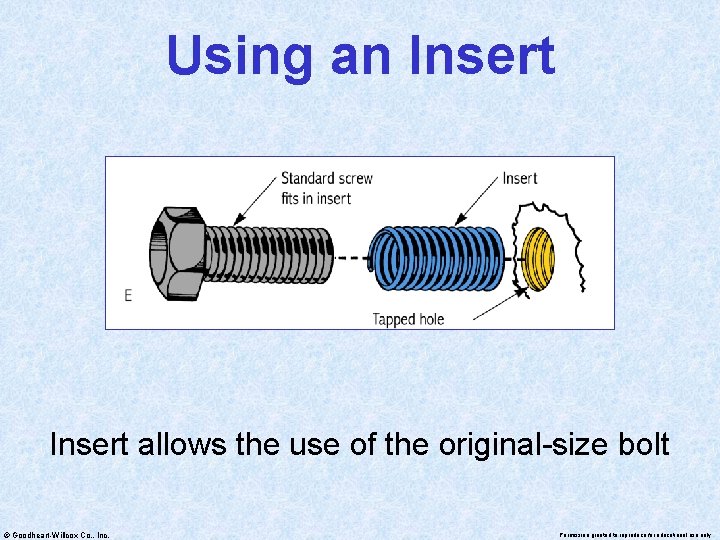
Using an Insert allows the use of the original-size bolt © Goodheart-Willcox Co. , Inc. Permission granted to reproduce for educational use only
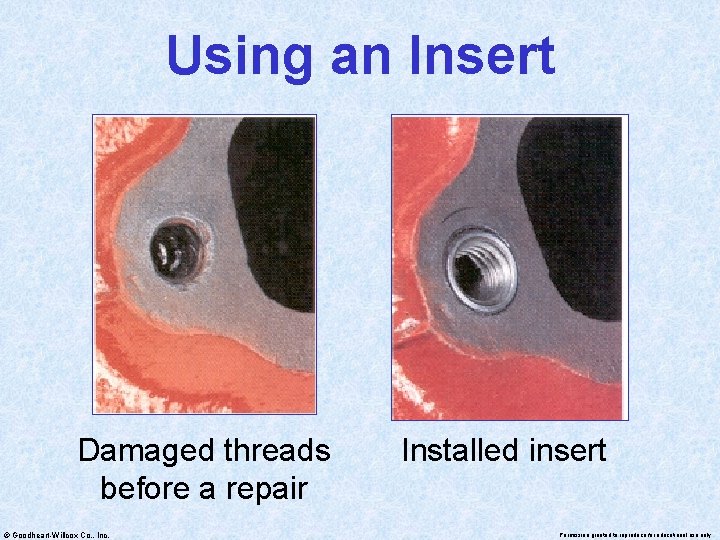
Using an Insert Damaged threads before a repair © Goodheart-Willcox Co. , Inc. Installed insert Permission granted to reproduce for educational use only
q An automotive technician must be able to remove broken bolts, screws, and studs, as well as fasteners having rusted or rounded-off heads q Specific tools and methods are needed for removing problem fasteners © Goodheart-Willcox Co. , Inc. Permission granted to reproduce for educational use only
Removal Methods q Grasp a rusted or rounded head with locking pliers q Use a stud puller or stud wrench m removes studs and bolts broken off above the surface of the part © Goodheart-Willcox Co. , Inc. Permission granted to reproduce for educational use only
Removal Methods q Cut a slot in the fastener with a hacksaw or weld on a nut to grasp q Use a hammer and punch m angle the punch so that blows from the hammer can drive out the broken fastener q Drill a hole almost as large as the inside diameter of the threads m use a tap or punch to remove thread shell © Goodheart-Willcox Co. , Inc. Permission granted to reproduce for educational use only
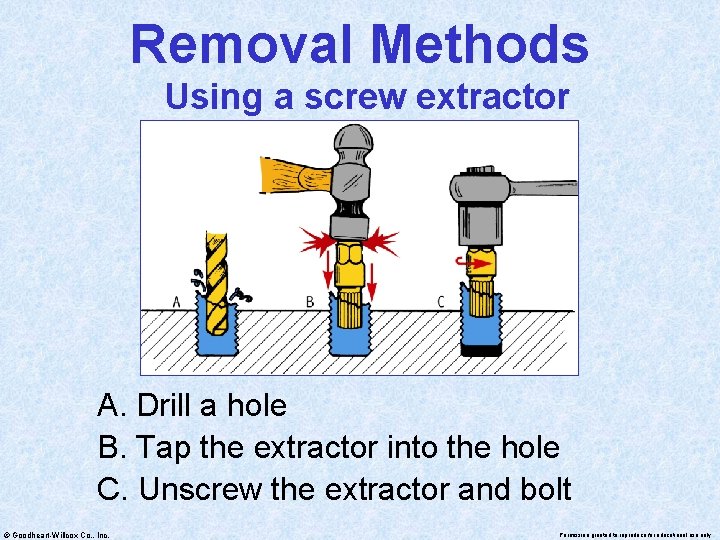
Removal Methods Using a screw extractor A. Drill a hole B. Tap the extractor into the hole C. Unscrew the extractor and bolt © Goodheart-Willcox Co. , Inc. Permission granted to reproduce for educational use only
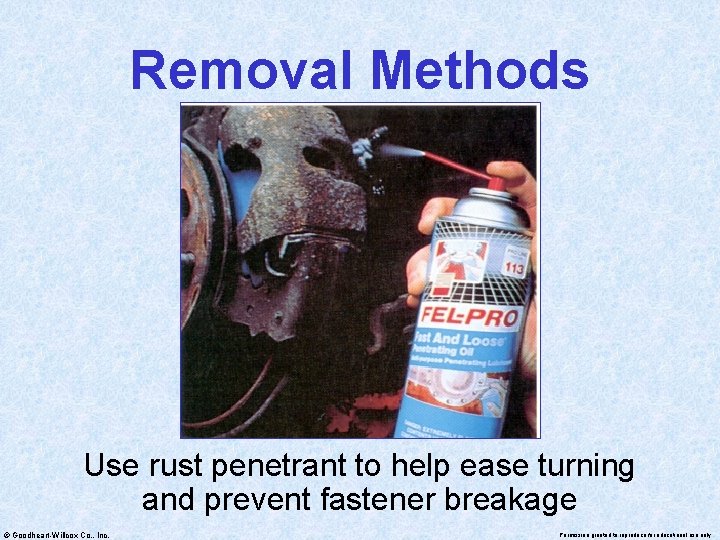
Removal Methods Use rust penetrant to help ease turning and prevent fastener breakage © Goodheart-Willcox Co. , Inc. Permission granted to reproduce for educational use only
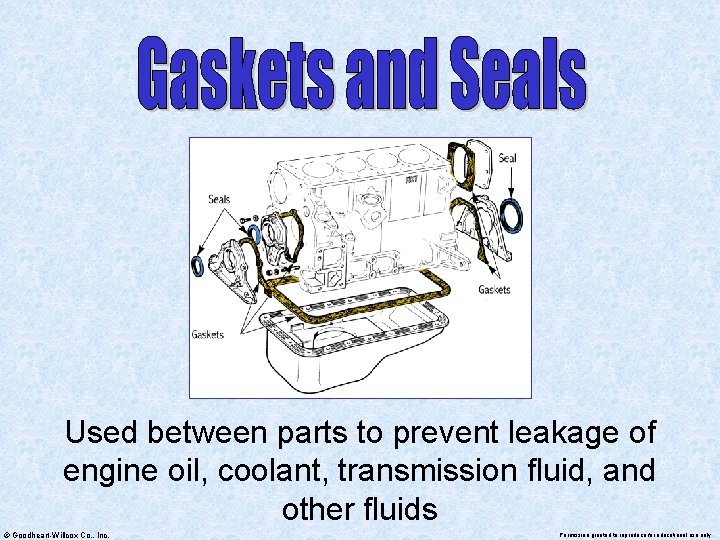
Used between parts to prevent leakage of engine oil, coolant, transmission fluid, and other fluids © Goodheart-Willcox Co. , Inc. Permission granted to reproduce for educational use only
Gaskets q Soft, flexible material placed between parts to prevent leakage q Made of fiber materials, rubber, neoprene (synthetic rubber), cork, treated paper, or thin steel q When parts are fastened together, the gasket material fills small gaps, dents, or scratches in the mating surfaces © Goodheart-Willcox Co. , Inc. Permission granted to reproduce for educational use only
Gasket Rules q Inspect for leaks before disassembly q Be careful not to damage mating surfaces while removing parts q Clean off old gaskets carefully q Wash and dry parts thoroughly q Compare the new gasket to the shape of the mating surface © Goodheart-Willcox Co. , Inc. Permission granted to reproduce for educational use only
Gasket Rules q Use a sealer if specified q When assembling, start all bolts by hand q Tighten fasteners in steps q Use a crisscross tightening pattern q Do not overtighten fasteners m apply only the specified torque © Goodheart-Willcox Co. , Inc. Permission granted to reproduce for educational use only
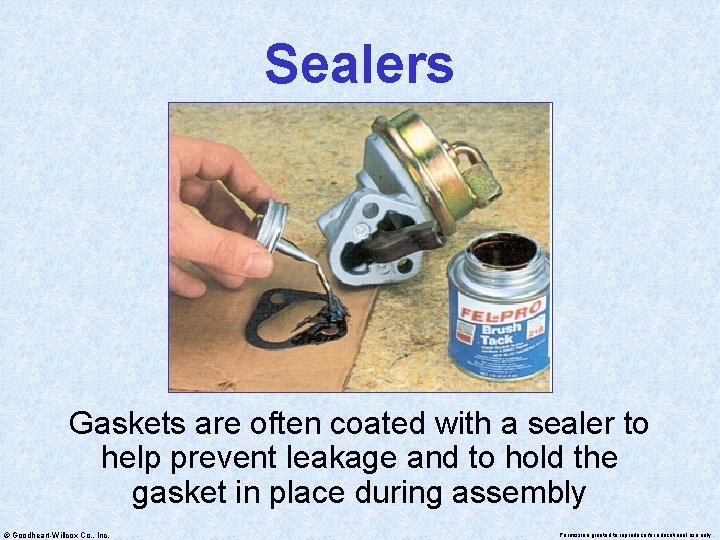
Sealers Gaskets are often coated with a sealer to help prevent leakage and to hold the gasket in place during assembly © Goodheart-Willcox Co. , Inc. Permission granted to reproduce for educational use only
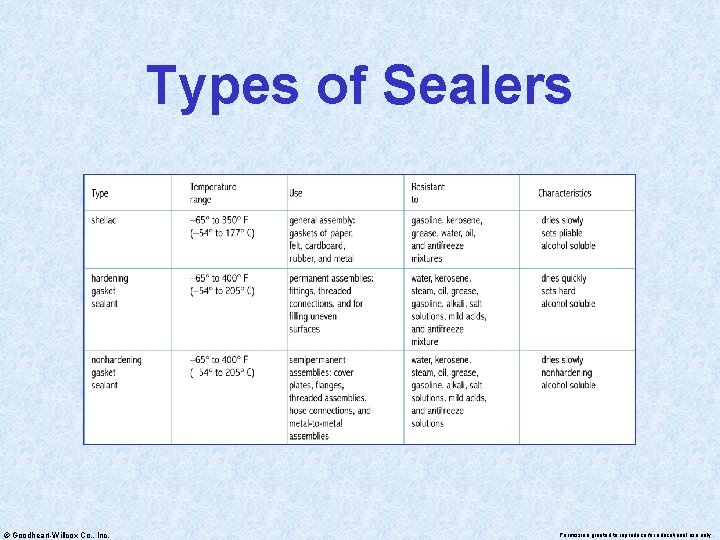
Types of Sealers © Goodheart-Willcox Co. , Inc. Permission granted to reproduce for educational use only
Form-in-Place Gaskets q Used instead of conventional fiber or rubber gaskets q Two common types are: m room temperature vulcanizing (RTV) sealer m anaerobic sealer © Goodheart-Willcox Co. , Inc. Permission granted to reproduce for educational use only
RTV Sealer q Also called silicone sealer q Dries in contact with air q Used to form a rubber-like gasket on thin, flexible flanges q Available in tubes mhas a shelf life of one to two years © Goodheart-Willcox Co. , Inc. Permission granted to reproduce for educational use only
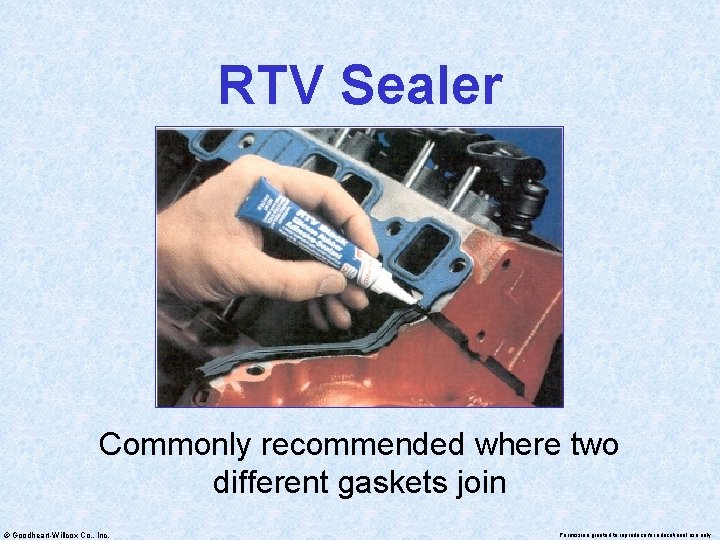
RTV Sealer Commonly recommended where two different gaskets join © Goodheart-Willcox Co. , Inc. Permission granted to reproduce for educational use only
Using RTV Sealer q Apply in a continuous bead that is approximately 1/8” (3 mm) wide q Circle all mounting holes q Torque components in place while the RTV is still wet to the touch m within about 10 minutes of application © Goodheart-Willcox Co. , Inc. Permission granted to reproduce for educational use only
Anaerobic Sealer q Cures to a plastic-like substance in the absence of air q Designed for tightly fitting, thick parts q Used between two smooth, true surfaces © Goodheart-Willcox Co. , Inc. Permission granted to reproduce for educational use only
Using Anaerobic Sealer q Apply in a continuous bead that is approximately 1/16"– 3/32" (1. 5 mm– 2 mm) wide q Circle all mounting holes q Torque components in place within 15 minutes of sealer application © Goodheart-Willcox Co. , Inc. Permission granted to reproduce for educational use only
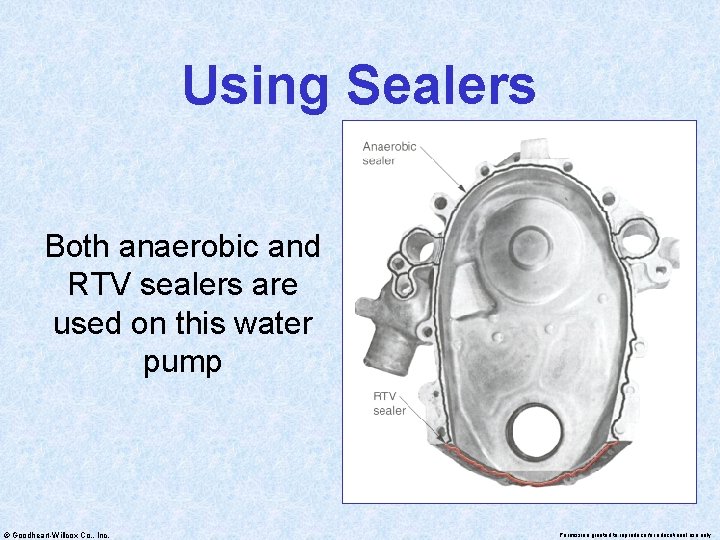
Using Sealers Both anaerobic and RTV sealers are used on this water pump © Goodheart-Willcox Co. , Inc. Permission granted to reproduce for educational use only
Seals q Prevent leakage between a stationary part and a moving part q Found in engines, transmissions, power steering units, and any part containing fluid and moving parts q Made of synthetic rubber molded onto a metal body © Goodheart-Willcox Co. , Inc. Permission granted to reproduce for educational use only
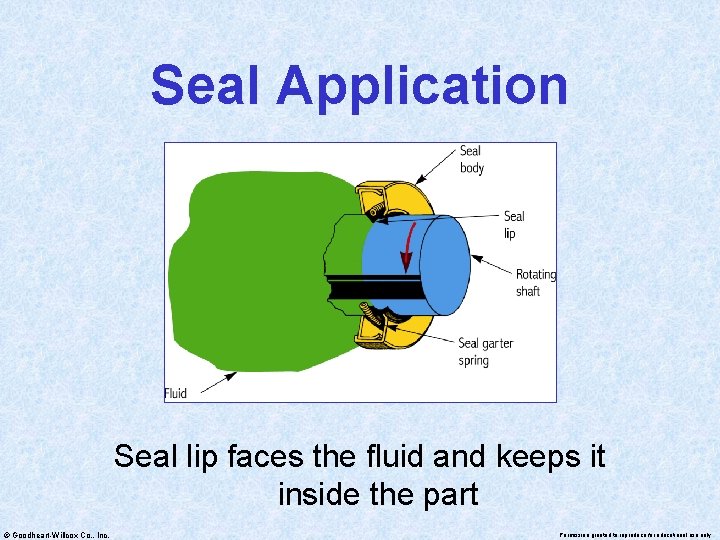
Seal Application Seal lip faces the fluid and keeps it inside the part © Goodheart-Willcox Co. , Inc. Permission granted to reproduce for educational use only
Seal Rules q Inspect the seal for leakage before disassembly m if the seal is leaking, look for a bent shaft, misaligned seal housing, or damaged parts q Remove the old seal carefully, without scratching the seal housing © Goodheart-Willcox Co. , Inc. Permission granted to reproduce for educational use only
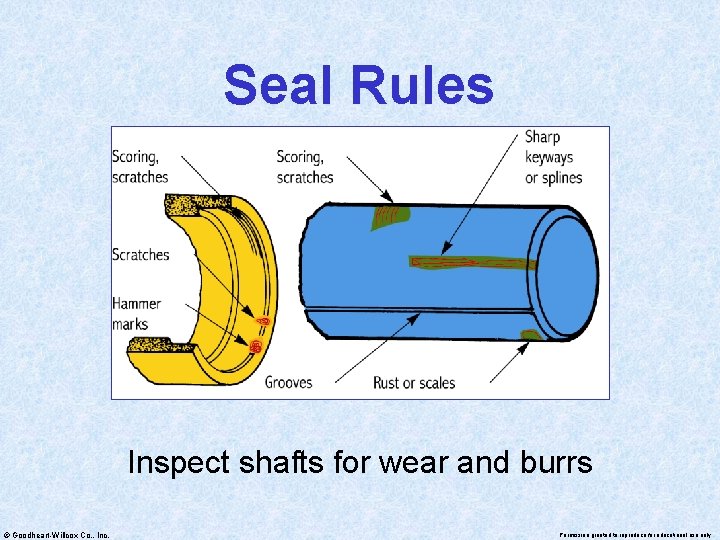
Seal Rules Inspect shafts for wear and burrs © Goodheart-Willcox Co. , Inc. Permission granted to reproduce for educational use only
Seal Rules q Compare the old seal to the new seal m make sure the inner and outer diameters match before installation q Install the new seal correctly m coat the outside with an approved sealer m coat the inner lip of the seal with system fluid m install the seal with the sealing lip toward the inside of the part © Goodheart-Willcox Co. , Inc. Permission granted to reproduce for educational use only
O-Ring Seal q Stationary seal that fits into a groove between two parts q When the parts are assembled, the synthetic rubber seal is partially compressed to form a leakproof joint © Goodheart-Willcox Co. , Inc. Permission granted to reproduce for educational use only
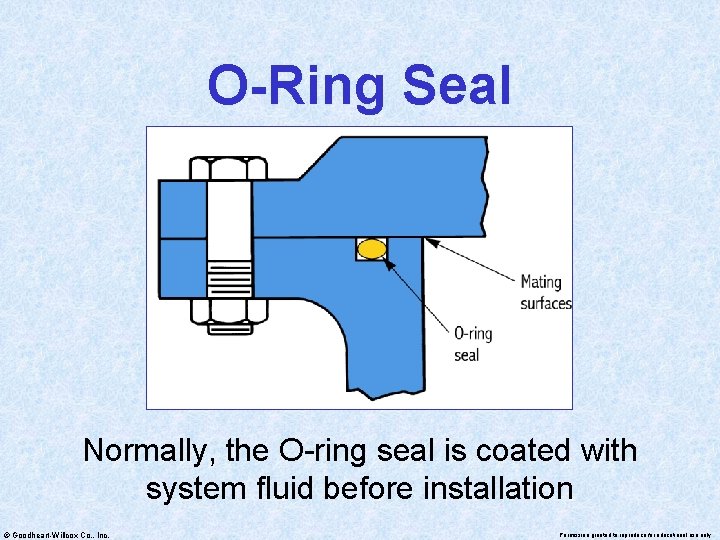
O-Ring Seal Normally, the O-ring seal is coated with system fluid before installation © Goodheart-Willcox Co. , Inc. Permission granted to reproduce for educational use only
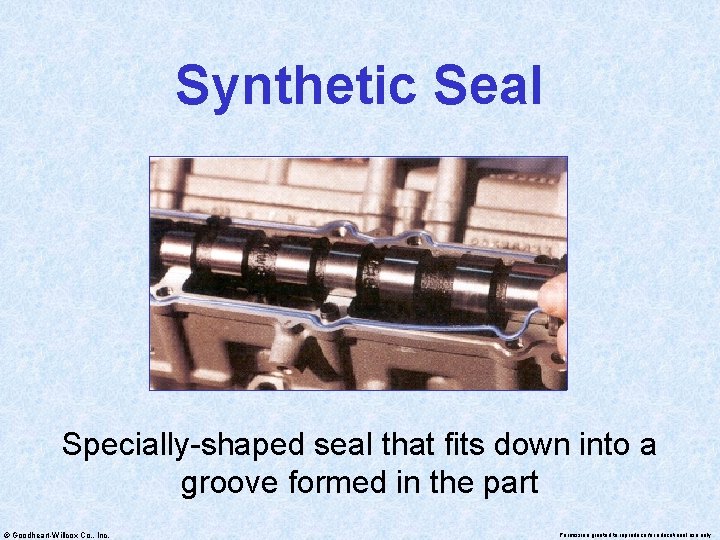
Synthetic Seal Specially-shaped seal that fits down into a groove formed in the part © Goodheart-Willcox Co. , Inc. Permission granted to reproduce for educational use only
- Slides: 80