
By R Vijay Krishna CONTENTS INTRODUCTION WORKING PRINCIPLE

By R. Vijay Krishna
CONTENTS Ø INTRODUCTION Ø WORKING PRINCIPLE OF C. B Ø TYPES OF CIRCUIT BREAKERS Ø SF 6 CIRCUIT BREAKER
INTRODUCTION Ø A circuit breaker is an equipment designed to protect an electrical apparatus from damage caused by overload or short circuit. Ø Unlike a fuse, a circuit breaker can be reset (either manually or automatically) to resume normal operation.
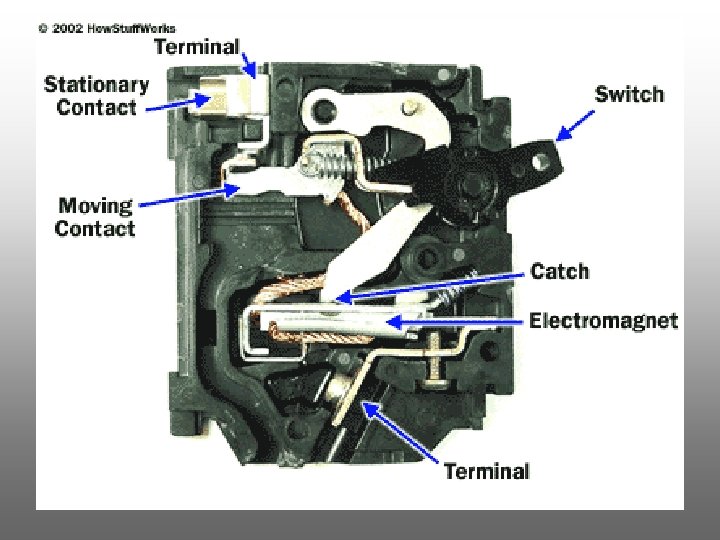
WORKING PRINCIPLE OF CIRCUIT BREAKER Ø The basic circuit breaker consists of a simple switch, connected to either a bimetallic strip or an electromagnet. Ø The electricity magnetizes the electromagnet When the current jumps to unsafe levels, the electromagnet is strong enough to pull down a metal lever connected to the switch linkage. Ø The entire linkage shifts, tilting the moving contact away from the stationary contact to break the circuit. The electricity shuts off.
TYPES OF CIRCUIT BREAKERS Ø OIL CIRCUIT BREAKERS Ø AIR CIRCUIT BREAKERS Ø VACUUM CIRCUIT BREAKERS Ø SF 6 CIRCUIT BREAKERS
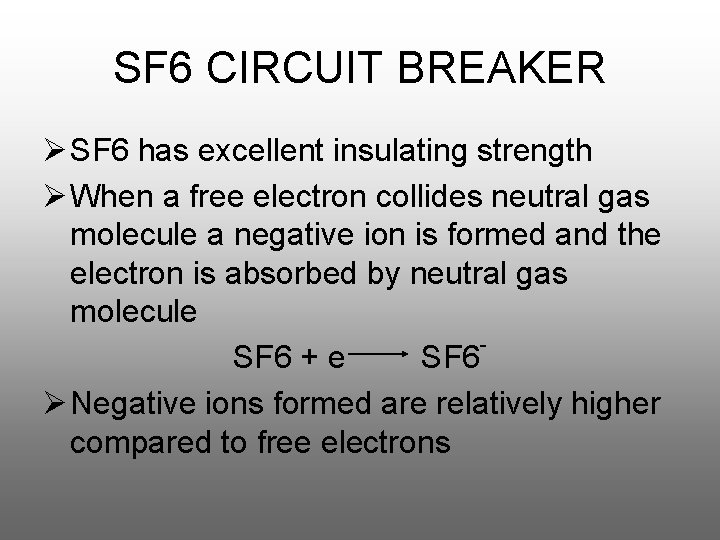
SF 6 CIRCUIT BREAKER Ø SF 6 has excellent insulating strength Ø When a free electron collides neutral gas molecule a negative ion is formed and the electron is absorbed by neutral gas molecule SF 6 + e SF 6 Ø Negative ions formed are relatively higher compared to free electrons
FEATURES OF SF 6 Ø SF 6 possess high dielectric strength Ø SF 6 has property of fast recombination after source energizing spark is removed. Ø SF 6 has excellent heat transfer properties because its high molecular weight together with its low gaseous viscosity enabling it to transfer heat by convection.
CONSTRUCTION OF SF 6 CIRCUIT BREAKER SF 6 circuit breaker consists of ØInterrupter unit ØGas system
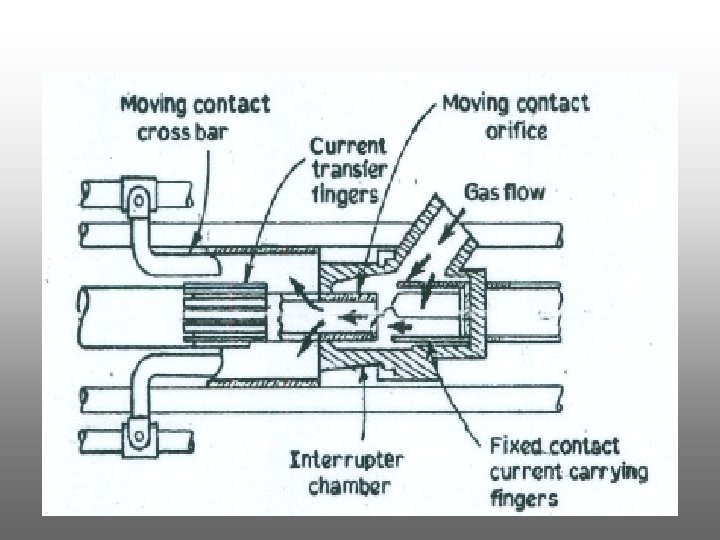
INTERRUPTER UNIT Ø Consists of fixed contacts with set of current carrying fingers and an arcing probe. Ø Fingers make contact with the moving contact when the breaker is in close position. Ø The contacts are surrounded by interrupting nozzles and a blast shield
Ø The moving contact is in the form of hollow nozzle sliding in a second set of spring loaded fingers. Ø As soon as the moving contact is with drawn from the fixed finger contacts an arc is drawn between the moving nozzle and the arcing probe. Ø As the contacts move further apart, the arc is extended and attenuated and finally extinguished by the gas flow from high pressure to low pressure.
GAS SYSTEM Ø Perfect sealing to prevent leakage of gas as it is maintained at high pressure. Ø Low and high pressure system are fitted with low pressure alarms which gives warning the moment gas pressure drops below certain value. Ø If danger limit is reached the safety devices immobilize the breaker.
ADVANTAGES OF SF 6 C. B. Ø Current chopping is minimized at low pressure and low velocity. Ø Eliminates moisture problem. Ø Gives noiseless operation. Ø No carbon particle is formed during arcing. Ø Atmospheric conditions does not affect Circuit breaker performance.

- Slides: 15