
By Patrick Carman SKELETON CREEKS ELEMENTS OF PLOT
By: Patrick Carman SKELETON CREEK’S ELEMENTS OF PLOT
All fiction is based on CONFLICT, and this conflict is presented in a structured format called… PLOT
Exposition The introductory material which gives the setting, creates tone, presents the characters, and other facts necessary to understand the story.
SETTING Time and Location in which a story takes place 1. ) Place – geographical location 2. ) Time – historical period, time of day year, etc. 3. ) Weather Conditions – rainy, sunny, stormy, etc. 4. ) Social Conditions – Daily life of character 5. ) Atmosphere – What feeling is created at the beginning of the story?
SETTING – Location Place Small town called Skeleton Creek in Oregon Isolated & forgotten - alone at the bottom of the mountains Secrets buried there that are best left alone More specific – Ryan’s Bedroom (for now)
Setting - Time Current day Begins Monday, September 13, 5: 30 a. m.
Setting - Weather Conditions Grey Fog hanging thick and sticky Hiding something unknown and diabolical
Setting – Social Conditions Ryan states “Privacy has long been the religion of our town. ” No one wants to talk about the past.
Setting – Tone (Atmosphere) Dark & Frightening Something’s not “right” with the town Fearful Foreboding Ominous Apprehensive Menacing Threatening Sinister
Characters Day - 3
Characters Major Characters Have good & bad qualities Their goals, ambitions & values change Are 3 -dimensional Grows to a higher level of understanding Are DYNAMIC – changes as a result of what happens to them
Types of Characters Protagonist – the MAIN CHARACTER in the story Antagonist – The character or force that OPPOSES the main character Foil – A character who provides contrast to the protagonist
Character Traits, Emotions & Motivations Trait – feature or quality that distinguishes a particular person or thing Can be physical , or dealing with personality Emotion –feelings (joy, sorrow, fear, love, hate etc. ) Motivation – what causes someone to do something
Minor Characters Flat (2 -dimensional) Lack depth STATIC – stay the same, never change
Question: WHAT DO WE KNOW ABOUT SARAH & RYAN’S CHARACTERS?

Skeleton Creek Characters Ryan (so far) We are reading his journal Was just released from the hospital (in for 2 weeks) Had accident at dredge He is scared – thinks something menacing is after him, hunting him Thought he was going to die – thinks he still might Has an overactive imagination Is Paranoid Loves to write Is “almost” old enough to drive Tall for his age, but needs to gain weight
Characters (so far) Sarah Is adventuresome & reckless Consumed by filmmaking Creative Persuasive Talks to anyone Posts her films on the internet Asked the question that started it all…
Characters (so far) Gladys Morgan Prehistoric Very unhappy Unmarried Town librarian Not friendly Does not want people in her library Stares at people like they just kicked her cat Skin like crumpled newspaper Lower lip hangs heavy over her chin Alarming overbite Wears wire-rimmed glasses Gave Ryan & Sarah their 1 st clue…
Characters Old Joe Bush Worked on the Dredge Died at the Dredge Pant leg caught in gears – leg crushed –” never emerged from the black pond…” Only one mention of his death (forgotten)
Characters Phantom at the dredge Recorded by Sarah Mysterious An UNKNOWN
Point of View Day 4
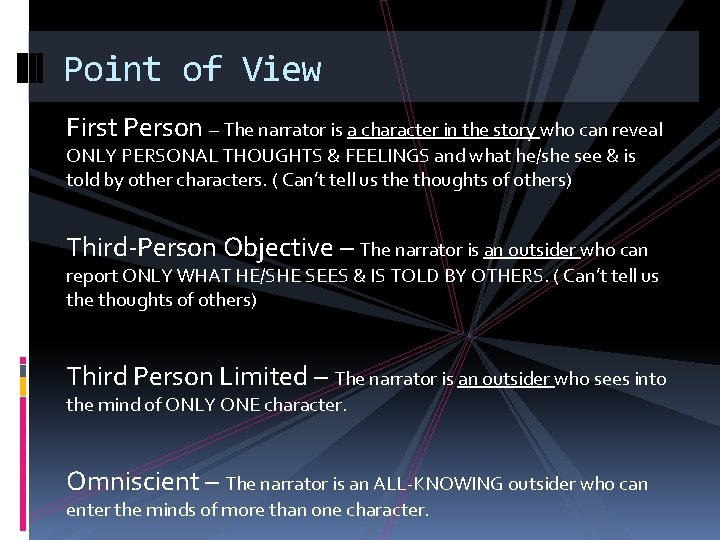
Point of View First Person – The narrator is a character in the story who can reveal ONLY PERSONAL THOUGHTS & FEELINGS and what he/she see & is told by other characters. ( Can’t tell us the thoughts of others) Third-Person Objective – The narrator is an outsider who can report ONLY WHAT HE/SHE SEES & IS TOLD BY OTHERS. ( Can’t tell us the thoughts of others) Third Person Limited – The narrator is an outsider who sees into the mind of ONLY ONE character. Omniscient – The narrator is an ALL-KNOWING outsider who can enter the minds of more than one character.
Skeleton Creek Point of View First Person • Ryan is writing about his personal thoughts, feelings & experiences. • Sarah is recording her personal thoughts, feelings & experiences on video.
Standard Vocabulary Day 6
ELA 7 R 1 – f. analyzes characterization (dynamic & static) in prose and plays as delineated through a character’s thoughts, words, speech patterns, and actions; the narrator’s description; and the thoughts, words, and actions of other characters. Characterization Dynamic Static Prose Delineated Speech Pattern
ELA 7 R 1 – In your own words
Sound & Figurative Language Day 7
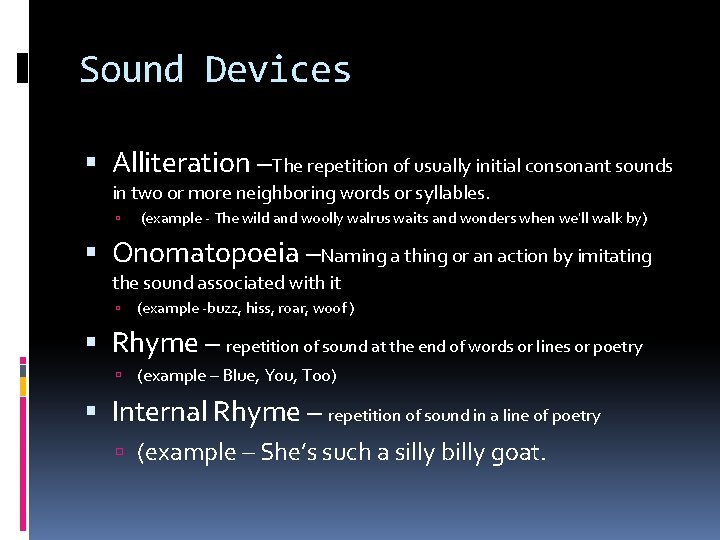
Sound Devices Alliteration –The repetition of usually initial consonant sounds in two or more neighboring words or syllables. (example - The wild and woolly walrus waits and wonders when we'll walk by) Onomatopoeia –Naming a thing or an action by imitating the sound associated with it (example -buzz, hiss, roar, woof ) Rhyme – repetition of sound at the end of words or lines or poetry (example – Blue, You, Too) Internal Rhyme – repetition of sound in a line of poetry (example – She’s such a silly billy goat.
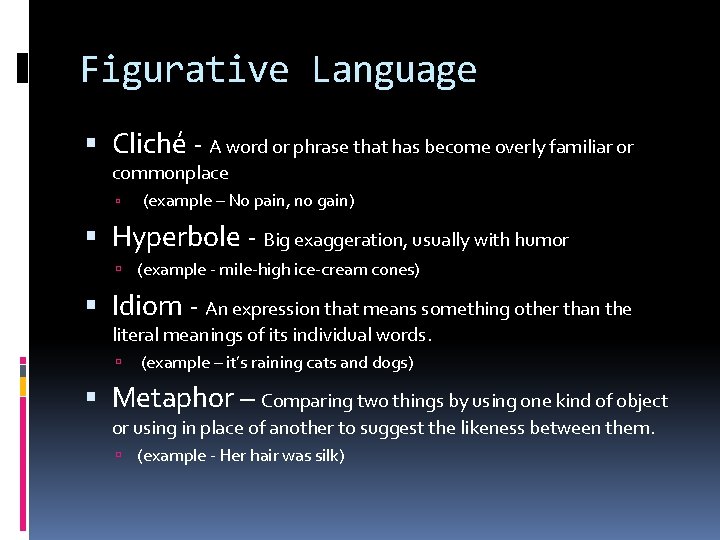
Figurative Language Cliché - A word or phrase that has become overly familiar or commonplace (example – No pain, no gain) Hyperbole - Big exaggeration, usually with humor (example - mile-high ice-cream cones) Idiom - An expression that means something other than the literal meanings of its individual words. (example – it’s raining cats and dogs) Metaphor – Comparing two things by using one kind of object or using in place of another to suggest the likeness between them. (example - Her hair was silk)
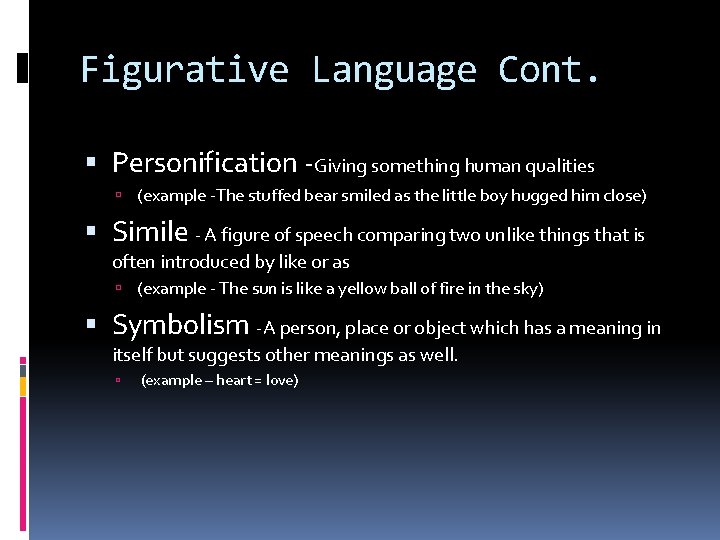
Figurative Language Cont. Personification -Giving something human qualities (example -The stuffed bear smiled as the little boy hugged him close) Simile - A figure of speech comparing two unlike things that is often introduced by like or as (example - The sun is like a yellow ball of fire in the sky) Symbolism -A person, place or object which has a meaning in itself but suggests other meanings as well. (example – heart = love)
Assignment: FIND EXAMPLES OF SOUND & FIGURATIVE LANGUAGE IN TODAY’S READING
Plot Day 8
Question: WHAT IS PLOT?
All fiction is based on CONFLICT, and this conflict is presented in a structured format called… PLOT
Plot Mountain Exposition Rising action Inciting force Conflict
Inciting Force The event that triggers the conflict Sarah asking “Why Skeleton Creek? ” is what causes the 2 kids to start their search.
“Why call a town Skeleton Creek? Nobody wants to visit a place with a name like that. It’s bad for tourism. ” CONFLICT – RYAN AND SARAH TRY TO SOLVE A MYSTERY THAT THE TOWN WANTS TO FORGET.
CONFLICT – Ryan & Sarah are trying to solve a mystery that the town’s people want to forget. Character versus Character (man versus man) “You’re not the first to ask about the past…let it go…you’ll only stir up trouble. ” “THE TOWN WASN’T CALLED SKELETON CREEK UNTIL 1959. ”
Plot Activity BEGIN YOUR PLOT MOUNTAIN NEED EXPOSITION AND RISING ACTION (3) (DON’T FORGET TO INCLUDE INCITING FORCE AND CONFLICT)
Question: WHAT OTHER CHARACTERS HAVE BEEN INTRODUCED?
Additional Characters Paul Ryan’s dad Ranger Bonner From Mesula Has a birdie tattoo Acts suspisious Is secretive Grills Sarah about the dredge Doesn’t talk much Warns Sarah aganist the dredge May be a member of crossbones Has a picture of Old Joe Bush Asks if Sarah saw anyone at the dredge Grey hair, average build
Additional Characters Henry Rainbow colored suspenders Mutton Chops Laughs a lot/card games Worked at the dredge Visits Skeleton Creek as much as he can Lives in New York Best Friends with Paul Feels guilty about his work at the dredge Likes to fish
Characterization Activity WHAT ARE YOUR CHARACTER’S TRAITS, EMOTIONS AND MOTIVATIONS?
Theme & Topic Day 9
Question: WHAT IS THE DIFFERENCE BETWEEN THEME & TOPIC?
Topic The subject
Theme The main idea or underlying meaning of a literary work. A theme may be stated or implied.
Plot Day
Plot Exposition Rising Action Climax Falling Action Resolution
Question: IS THERE FALLING ACTION & A RESOLUTION IN SKELETON CREEK?
Skeleton Creek = Cliffhanger
- Slides: 51