
By P D PATIL ARTIFICIAL CONSTRUCTION MATERIALS Visit

By P. D. PATIL ARTIFICIAL CONSTRUCTION MATERIALS Visit for more Learning Resources
Artificial Construction Materials Bricks Tiles Cement Pre cast concrete products Glass
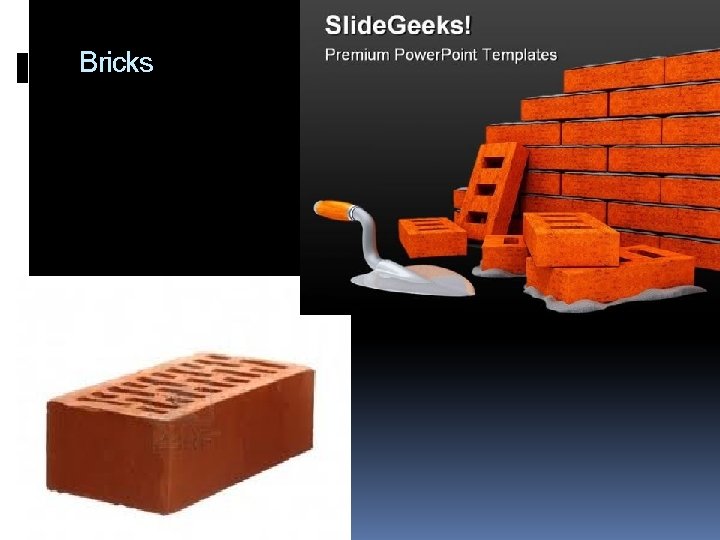
Bricks
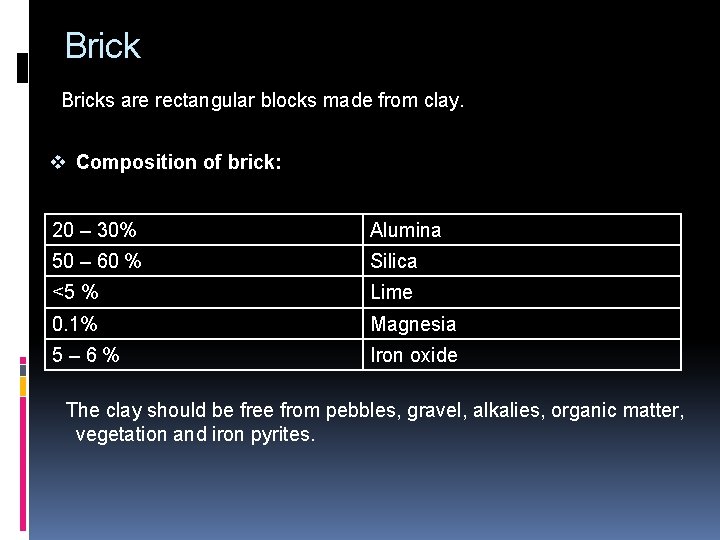
Bricks are rectangular blocks made from clay. v Composition of brick: 20 – 30% Alumina 50 – 60 % Silica <5 % Lime 0. 1% Magnesia 5– 6% Iron oxide The clay should be free from pebbles, gravel, alkalies, organic matter, vegetation and iron pyrites.
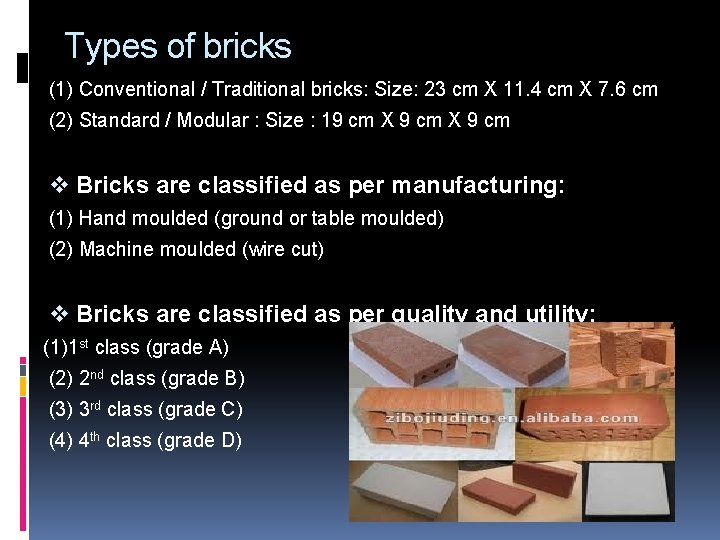
Types of bricks (1) Conventional / Traditional bricks: Size: 23 cm X 11. 4 cm X 7. 6 cm (2) Standard / Modular : Size : 19 cm X 9 cm v Bricks are classified as per manufacturing: (1) Hand moulded (ground or table moulded) (2) Machine moulded (wire cut) v Bricks are classified as per quality and utility: (1)1 st class (grade A) (2) 2 nd class (grade B) (3) 3 rd class (grade C) (4) 4 th class (grade D)
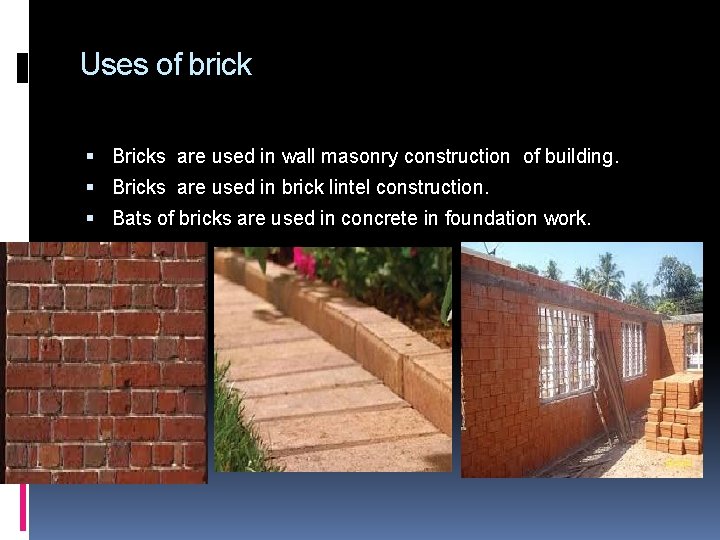
Uses of brick Bricks are used in wall masonry construction of building. Bricks are used in brick lintel construction. Bats of bricks are used in concrete in foundation work.
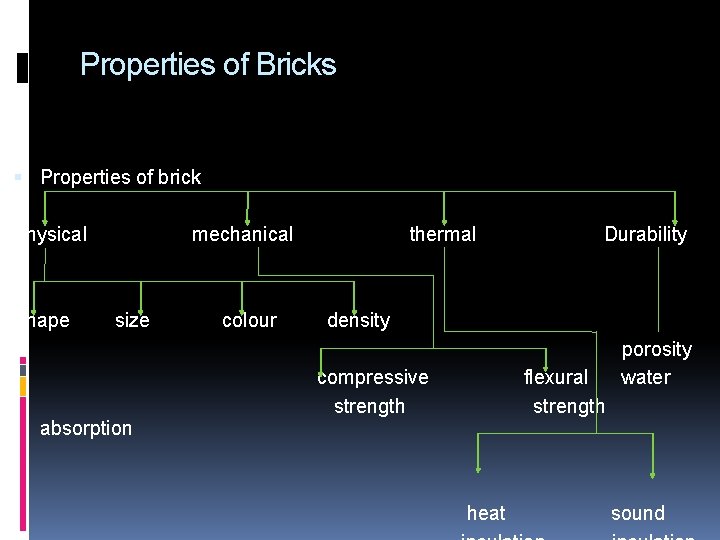
Properties of Bricks Properties of brick Physical Shape mechanical size absorption colour thermal Durability density compressive strength flexural strength heat porosity water sound
Tiles CHARACTERISTICS OF A GOOD TILES • It should be durable • It should be easy to clean • Noiseless • Have Good Appearance • Free from dampness • Fire Resistant • Low Maintenance cost

TYPES OF FLOOR FINISHES • Resilient floor finishes • Hard floor finishes • Smooth floor finishes
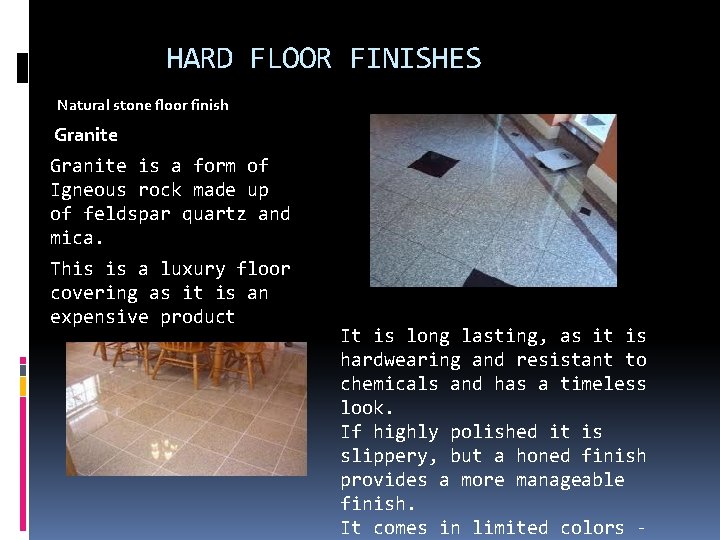
HARD FLOOR FINISHES Natural stone floor finish Granite is a form of Igneous rock made up of feldspar quartz and mica. This is a luxury floor covering as it is an expensive product It is long lasting, as it is hardwearing and resistant to chemicals and has a timeless look. If highly polished it is slippery, but a honed finish provides a more manageable finish. It comes in limited colors -
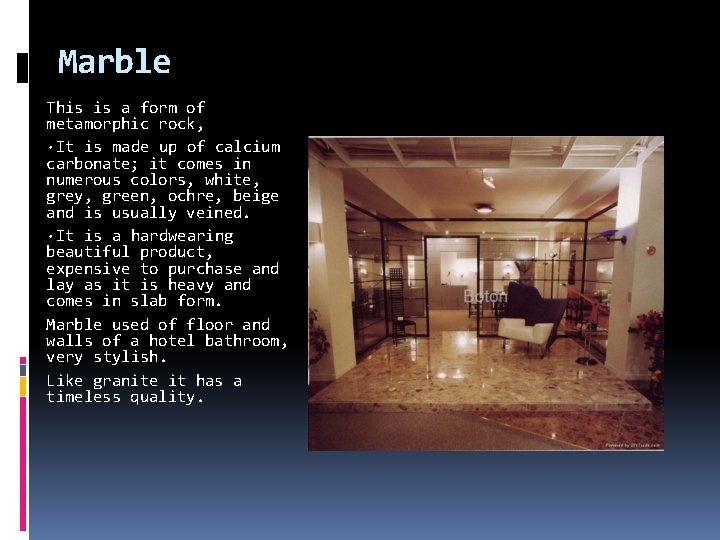
Marble This is a form of metamorphic rock, ·It is made up of calcium carbonate; it comes in numerous colors, white, grey, green, ochre, beige and is usually veined. ·It is a hardwearing beautiful product, expensive to purchase and lay as it is heavy and comes in slab form. Marble used of floor and walls of a hotel bathroom, very stylish. Like granite it has a timeless quality.
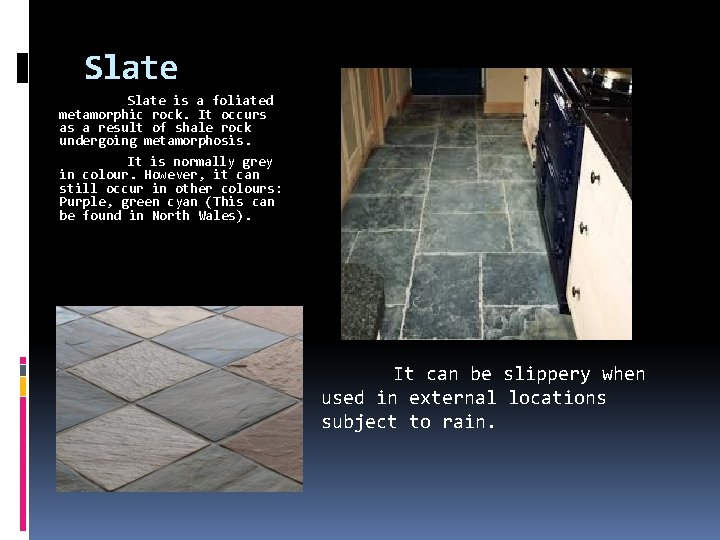
Slate is a foliated metamorphic rock. It occurs as a result of shale rock undergoing metamorphosis. It is normally grey in colour. However, it can still occur in other colours: Purple, green cyan (This can be found in North Wales). It can be slippery when used in external locations subject to rain.
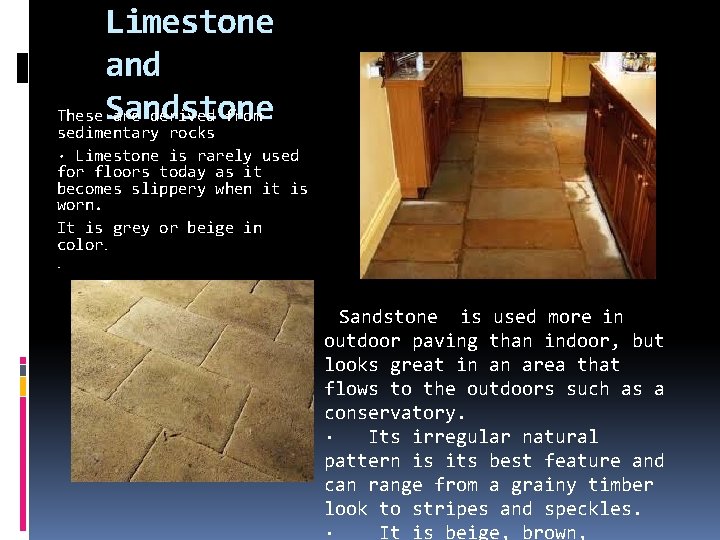
Limestone and Sandstone These are derived from sedimentary rocks · Limestone is rarely used for floors today as it becomes slippery when it is worn. It is grey or beige in color. · Sandstone is used more in outdoor paving than indoor, but looks great in an area that flows to the outdoors such as a conservatory. · Its irregular natural pattern is its best feature and can range from a grainy timber look to stripes and speckles. · It is beige, brown,
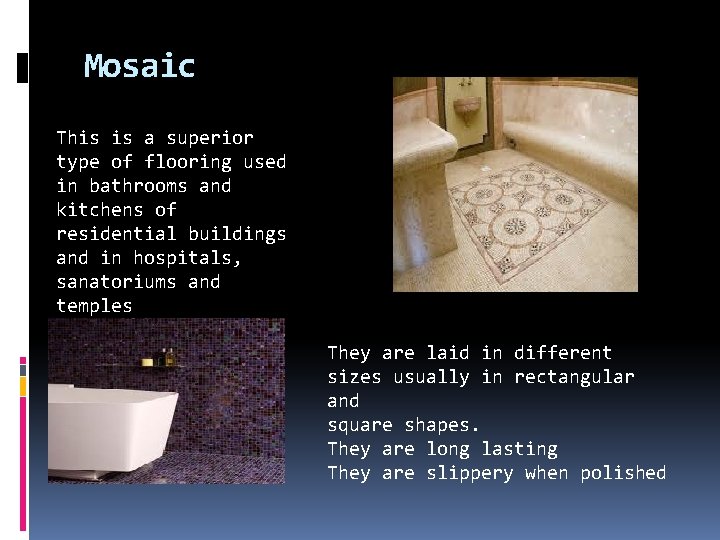
Mosaic This is a superior type of flooring used in bathrooms and kitchens of residential buildings and in hospitals, sanatoriums and temples Places where extra cleanliness is essential They are laid in different sizes usually in rectangular and square shapes. They are long lasting They are slippery when polished
CEMENT Definition: “Cement is a crystalline compound of calcium silicates and other calcium compounds having hydraulic properties” (Macfadyen, 2006).
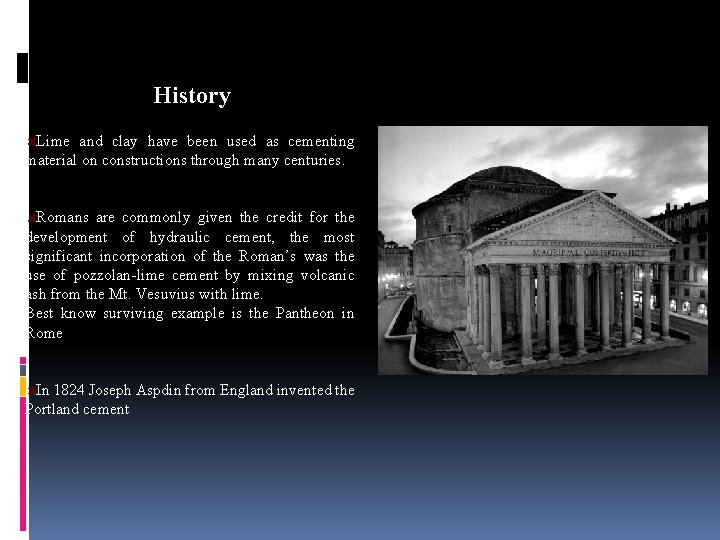
History Lime and clay have been used as cementing material on constructions through many centuries. Romans are commonly given the credit for the development of hydraulic cement, the most significant incorporation of the Roman’s was the use of pozzolan-lime cement by mixing volcanic ash from the Mt. Vesuvius with lime. Best know surviving example is the Pantheon in Rome In 1824 Joseph Aspdin from England invented the Portland cement
Types of Cements are considered hydraulic because of their ability to set and harden under or with excess water through the hydration of the cement’s chemical compounds or minerals There are two types: Those that activate with the addition of water And pozzolanic that develop hydraulic properties when the interact with hydrated lime Ca(OH)2 Pozzolanic: any siliceous material that develops hydraulic cementitious properties when interacted with hydrated lime. HYDRAULIC CEMENTS: Hydraulic lime: Only used in specialized mortars. Made from calcination of clay-rich limestones. Natural cements: Misleadingly called Roman. It is made from argillaceous limestones or interbedded limestone and clay or shale, with few raw materials. Because they were found to be inferior to portland, most plants switched.
Portland cement: Artificial cement. Made by the mixing clinker with gypsum in a 95: 5 ratio. Portland-limestone cements: Large amounts (6% to 35%) of ground limestone have been added as a filler to a portland cement base. Blended cements: Mix of portland cement with one or more SCM (supplementary cemetitious materials) like pozzolanic additives. Pozzolan-lime cements: Original Roman cements. Only a small quantity is manufactured in the U. S. Mix of pozzolans with lime. Masonry cements: Portland cement where other materials have been added primarily to impart plasticity. Aluminous cements: Limestones and bauxite are the main raw materials. Used for refractory applications (such as cementing furnace bricks) and certain applications where rapid hardening is required. It is more expensive than portland. There is only one producing facility in the U. S. (http: //pubs. usgs. gov/of/2005/1152/2005 -1152. pdf) (Macfadyen, 2006).
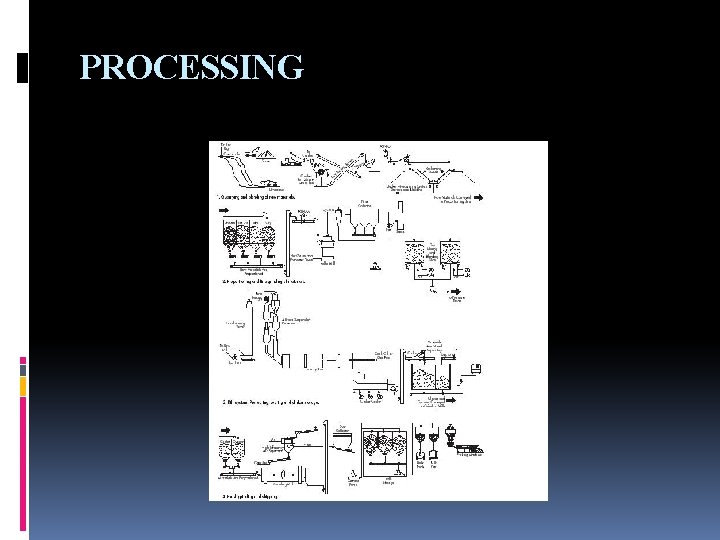
PROCESSING
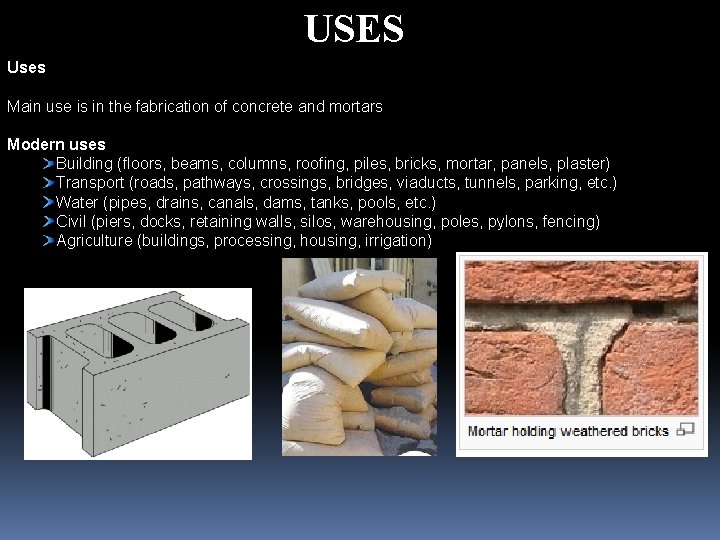
USES Uses Main use is in the fabrication of concrete and mortars Modern uses Building (floors, beams, columns, roofing, piles, bricks, mortar, panels, plaster) Transport (roads, pathways, crossings, bridges, viaducts, tunnels, parking, etc. ) Water (pipes, drains, canals, dams, tanks, pools, etc. ) Civil (piers, docks, retaining walls, silos, warehousing, poles, pylons, fencing) Agriculture (buildings, processing, housing, irrigation)

Pre cast concrete products Benefits Design Flexibility Controlled Production PCI-Certified Quality Safety & Security Sustainability • Layout Flexibility • Low Maintenance • Acoustical Control • Mold Resistance • Controlled Environments • Expansion Capabilities • Economy
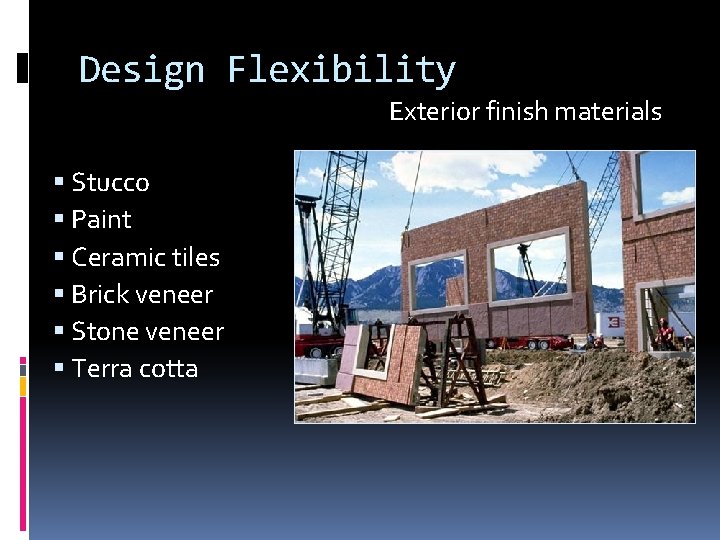
Design Flexibility Exterior finish materials Stucco Paint Ceramic tiles Brick veneer Stone veneer Terra cotta
Controlled Production Casting components under factory-controlled conditions benefits a project in many ways: • More control over final appearance • Tighter tolerances • Precaster as team member • Elimination of several trades and materials • Production regardless of weather conditions

Safety and Security A precast structure can increase the safety and security of its occupants: Fire Resistance Earthquake Resistance Vermin Resistance Blast/Wind Resistance
Glass
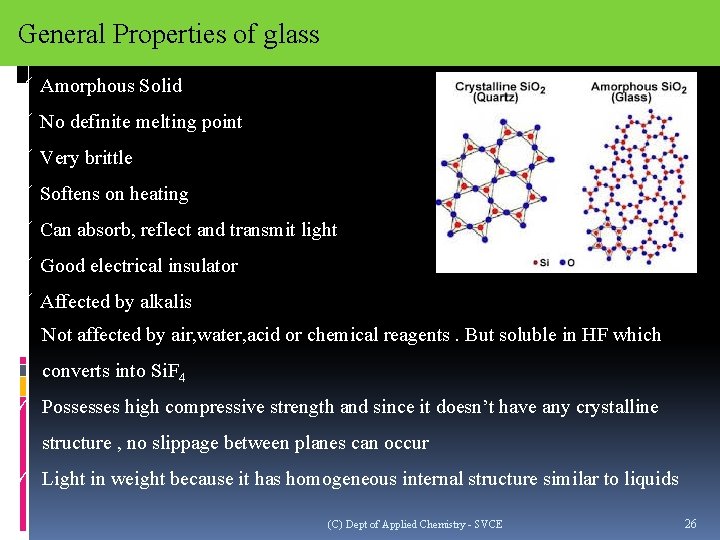
General Properties of glass ü Amorphous Solid ü No definite melting point ü Very brittle ü Softens on heating ü Can absorb, reflect and transmit light ü Good electrical insulator ü Affected by alkalis ü Not affected by air, water, acid or chemical reagents. But soluble in HF which converts into Si. F 4 ü Possesses high compressive strength and since it doesn’t have any crystalline structure , no slippage between planes can occur ü Light in weight because it has homogeneous internal structure similar to liquids (C) Dept of Applied Chemistry - SVCE 26
Types of glasses 1. Soda-lime or soda glass 2. Potash lime or hard glass 3. Lead glass or Flint glass 4. Borosilicate glass or Pyrex glass or Jena glass 5. Alumina silicate glass 6. Optical or Crookes glass 7. Glass wool 8. Quartz glass 9. Opal glass For more detail contact us 27
- Slides: 27