
BY MANEESHA DOMINIC REG NO 132820199 COPD A
BY: MANEESHA DOMINIC, REG. NO. : 132820199.
COPD: A BRIEF INSIGHT
“ COPD refers to a group of LUNG DISEASES, that block airflow, and make breathing difficult(includes CHRONIC BRONCHITIS & EMPHYSEMA)”. . .
1. TWO-THIRDS of men, and ONE-FOURTH of women have emphysema at death(as per US statistics) 2. COPD is the FOURTH LEADING CAUSE of DEATH in the US 3. It is the sixth leading cause of death worldwide. . .
1. Tobacco abuse 2. ALPHA-1 -ANTITRYPSIN DEFICIENCY 3. CYSTIC FIBROSIS 4. Air pollution 5. Occupational exposure 6. Bronchiectasis. . .
A. OF CHRONIC BRONCHITIS: - Chronic Bronchitis is defined as “excessive mucus production, with airway obstruction and hyperplasia of mucus-producing glands” - Endothelial damage impairs mucociliary response(that clears bacteria and mucus) increased inflammation and secretions occur body responds by REDUCING VENTILATION and INCREASING CARDIAC OUTPUT causes HYPOXEMIA, POLYCYTHEMIA HYPERCAPNIA and respiratory acidosis develops leads to PULMONARY ARTERY CONSTRICTION and COR PULMONALE. - Increased CO retention occurs - Such people are known as “BLUE BLOATERS”. . .
B. OF EMPHYSEMA: - EMPHYSEMA is defined as “destruction of airways, that are distal to terminal bronchiole”. - Gradual destruction of alveolar septae & pulmonary capillary bed reduces ability of lungs to OXYGENATE BLOOD Body compensates by reducing CARDIAC OUTPUT & causing HYPERVENTILATION Causes LIMITED BLOOD FLOW Rest of the body suffers from tissue hypoxia and pulmonary cachexia causes muscle wasting and weight loss such people are identified as “PINK PUFFERS”. . .
1. SOB(especially during EXERTION) 2. Chest-tightedness 3. Wheezing 4. Chronic productive cough 5. Cyanosis 6. Weight loss. . .
1. PFTs 2. Chest X-RAY 3. ABG ANALYSIS 4. SPUTUM TESTS. 5. HEMATOLOGICAL TESTS.
1. To ALLEVIATE the disability associated with AIRWAY OBSTRUCTION 2. To reduce ADRs associated with therapy given 3. To reduce MORBIDITY & MORTALITY 4. To avoid PROGRESSION into COMPLICATIONS 5. To improve HRQo. L. . .
I. BETA-2 AGONISTS: - Drugs potentiate beta-2 -receptors on bronchial smooth muscles reduce muscle tone in lungs, along with relieving of BRONCHOSPASM, by relaxing smooth muscles of bronchi improves ventilation, and reduces airway resistance - ADRs: i. Tremor ii. Nervousness iii. Tachycardia - Drugs include: i. TERBUTALINE SULPHATE(BRICANYL) ii. ALBUTEROL(PROVENTIL)
iii. SALMETEROL iv. FORMOTEROL. . . II. METHYLXANTHINES: - Drug increases CYCLIC-AMP LEVELS by blocking PDE-3 relaxes bronchial smooth muscles(bronchodilatation) - ADRs: i. Tremor ii. Tachycardia - Drugs include: i. THEOPHYLLINE(THEO-24) ii. ETIDOPHYLLINE iii. ACEBROPHYLLINE iv. AMINOPHYLLINE. . .
III. ANTI-CHOLINERGICS: - Usually have slow effects, and used in combination with corticosteroids, or beta- agonists for LONG TERM MAINTENANCE THERAPY OF COPD - Drug blocks action of ACETYLCHOLINE causes relaxation of bronchial smooth muscle - ADRs: i. Constipation ii. Blurred vision - Drugs include: i. IPRATROPIUM BROMIDE(ATROVENT) ii. TIOTROPIUM BROMIDE(SPIRIVA). . .

IV. CORTICOSTEROIDS: - Used to ACCELERATE RECOVERY from COPD EXACERBATION - ANTI-INFLAMMATORY PROPERTY of drugs in concern is EXPLOITED HERE - ADRs: i. Cataract ii. Glaucoma iii. Weight gain iv. High risk of infections, etc. . . - Drugs include: i. METHYLPREDNISOLONE(MEDROL) ii. PREDNISOLONE iii. BUDESONIDE(INHALATION)
V. PHOSPHODIESTERASE-4 INHIBITORS: - Reduce exacerbations, and improve dyspnea - Improve lung function in patients with severe COPD - Drug includes ROFLUMILAST(DALIRESP) - ROFLUMILAST blocks PDE-4 increases CYCLIC AMP in lung cells reduces frequency of exacerbations and worsening of symptoms from severe COPD - ADRs: i. Weight loss ii. Anorexia iii. Backache. . .
VI. ELECTROLYTE SUPPLEMENTS: - MAGNESIUM replenishes stores that become depleted in periods of ADRENERGIC EXCESS(like asthma, COPD, etc) - MAGNESIUM SULPHATE is used - Drug counteracts CALCIUM-MEDIATED SMOOTH MUSCLE CONTRACTION produces BRONCHODILATATION, - ADRs: i. Hypothermia ii. Flushing iii. Hypocalcemia. . .
VII. ANTIMICROBIAL THERAPY: - Mainly effective in COPD exacerbation, under the following CONDITIONS: 1. Increased dyspnea 2. Increased sputum volume 3. Increased sputum purulence - Treatment is based on MOST LIKELY OFFENDING MICROBES - ORGANISMS include: 1. H. influenzae 2. Moraxella catarrhalis 3. S. pneumoniae 4. H. parainfluenzae - Therapy should be started within 24 HOURS OF SYMPTOMS, and INITIATED FOR 7 -10 DAYS.
- For UNCOMPLICATED COPD EXACERBATIONS, use the following: i. MACROLIDES( AZITHROMYCIN, CLARITHROMYCIN) ii. 2 nd / 3 rd GENERATION CEPHALOSPORINS iii. DOXYCYCLINE - For COMPLICATED COPD EXACERBATIONS(including RESISTANCE), use the following: i. AMOXICILLIN+ CLAVULANATE ii. FLUOROQUINOLONES(LEVOFLOXACIN, GEMIFLOXACIN, MOXIFLOXACIN). . .
VII. NEWER DRUGS FOR COPD: 1. ACLIDINIUM(TUDORZA PRESSAIR): - LONG ACTING SELECTIVE M 3 -ANTAGONIST (LAMA) 2. INHALED INDACATEROL(ARCAPTA NEOHALER): - LABA(LONG ACTING BETA-2 -AGONIST) 3. UMECLIDINIUM BROMIDE(ANDRO ELLIPTA): - LAMA 4. VILANTEROL INHALED(ANDRO ELLIPTA): - LABA 5. GLYCOPYRROLATE INHALED(SEEBRI NEOHALER): - LAMA. . .
I. LUNG THERAPIES: - Oxygen therapy - Pulmonary rehabilitation programs II. SURGERY: - Lung volume reduction therapy - Lung transplantation III. HOME REMEDIES FOR COPD: - FOR EMPHYSEMA: 1. Stop smoking 2. MUSTARD OIL+ CAMPHOR chest massage combination, to reduce chest tightedness and breathing difficulties
- FOR CHRONIC BRONCHITIS: 1. Onion juice consumption 2. Turmeric powder+ a glass of milk every morning 3. Almonds(crushed)+ lemon juice. . . IV. PATIENT COUNSELLING TIPS: 1. Avoid smoking 2. Avoid exposure to allergens & pollution 3. Avoid fermented foods 4. Have raisins+ honey 5. Focus on eating well, with justifiable diet 6. Avoid oily& fried foods 7. Annual vaccination with inactivated influenza vaccine. . .
§ SEVERE COPD § EMPHYSEMA § RESPIRATORY FAILURE § COR PULMONALE. . .
I. PATIENT DETAILS: Name: Mrs. X Age: 65 yrs Sex: Female IP NO. : 198044 Department: Pulmonology Weight: 48 kgs Height: 160 cm BMI: 18. 92 DOA : 15/10/2017 DOD: 21/10/2017. . .
II. REASON FOR ADMISSION: Patient had c/o : 1. Breathlessness(for 2 days) 2. Fever(For 1 week) 3. Cough(For 1 week) 4. 1 episode of vomiting. . . III. PAST MEDICAL HISTORY: 1. K/C/O COPD(on DOMICILIARY OXYGEN for 25 years) 2. K/C/O RESPIRATORY FAILURE. . . 3. H/O TB (15 years back, took Rx for 1 year). . . IV. FAMILY HISTORY: Nil. . . V. KNOWN ALLERGIES: Allergic to cold. . .
VI. FOOD HABITS: Non-vegetarian VII. SOCIAL HABITS: Non-smoker, non-alcoholic. . .
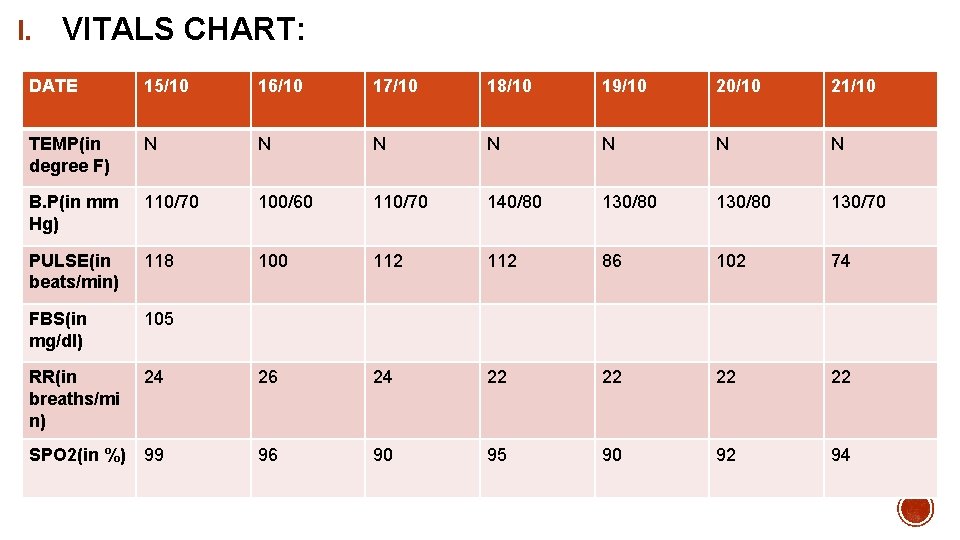
I. VITALS CHART: DATE 15/10 16/10 17/10 18/10 19/10 20/10 21/10 TEMP(in degree F) N N N N B. P(in mm Hg) 110/70 100/60 110/70 140/80 130/80 130/70 PULSE(in beats/min) 118 100 112 86 102 74 FBS(in mg/dl) 105 RR(in breaths/mi n) 24 26 24 22 22 SPO 2(in %) 99 96 90 95 90 92 94
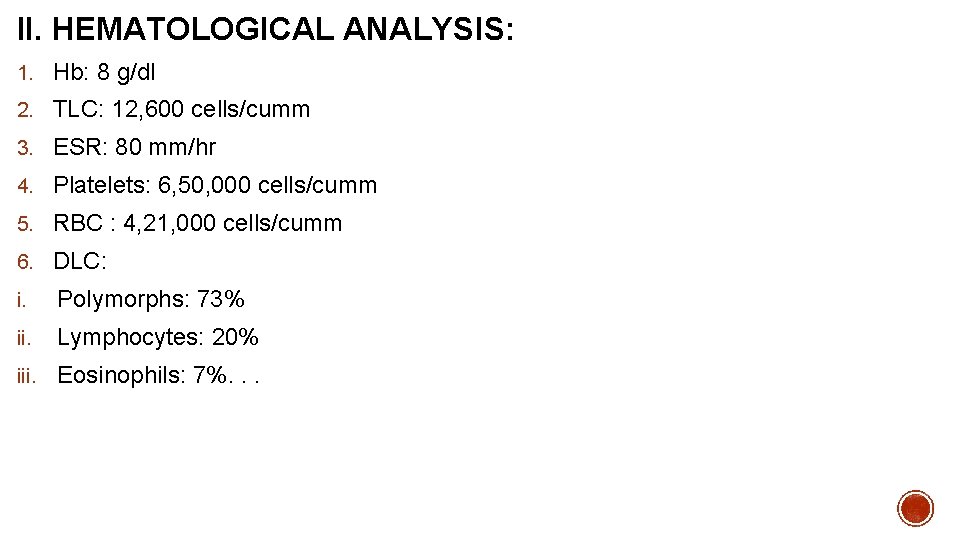
II. HEMATOLOGICAL ANALYSIS: 1. Hb: 8 g/dl 2. TLC: 12, 600 cells/cumm 3. ESR: 80 mm/hr 4. Platelets: 6, 50, 000 cells/cumm 5. RBC : 4, 21, 000 cells/cumm 6. DLC: i. Polymorphs: 73% ii. Lymphocytes: 20% iii. Eosinophils: 7%. . .
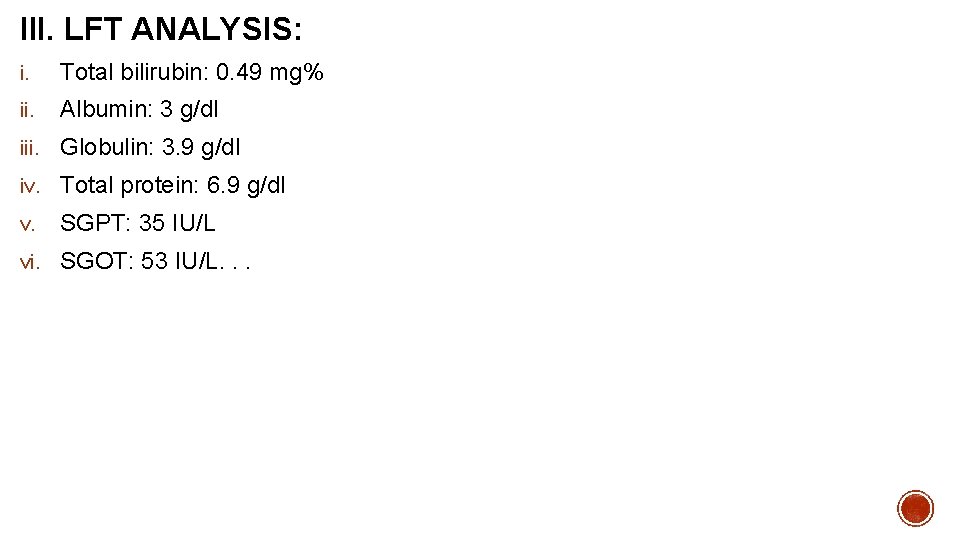
III. LFT ANALYSIS: i. Total bilirubin: 0. 49 mg% ii. Albumin: 3 g/dl iii. Globulin: 3. 9 g/dl iv. Total protein: 6. 9 g/dl v. SGPT: 35 IU/L vi. SGOT: 53 IU/L. . .
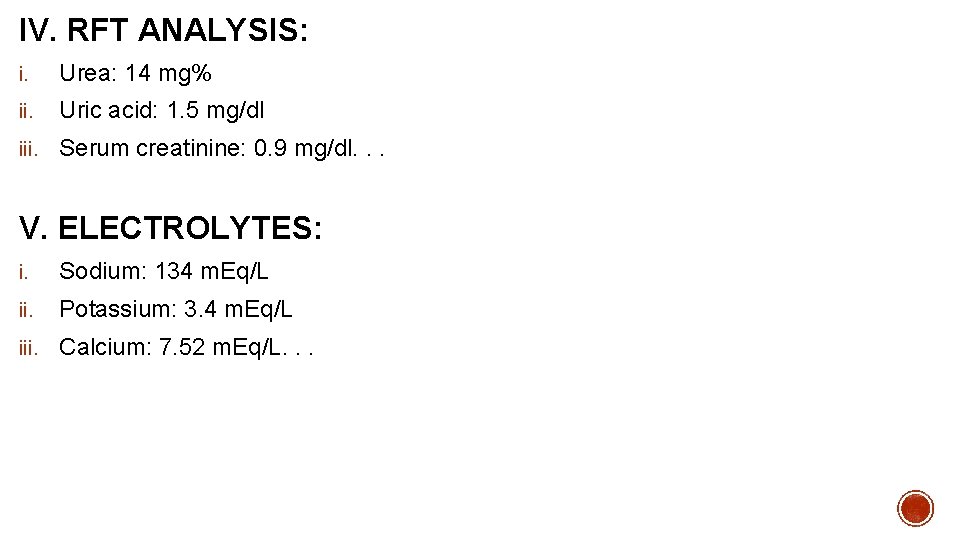
IV. RFT ANALYSIS: i. Urea: 14 mg% ii. Uric acid: 1. 5 mg/dl iii. Serum creatinine: 0. 9 mg/dl. . . V. ELECTROLYTES: i. Sodium: 134 m. Eq/L ii. Potassium: 3. 4 m. Eq/L iii. Calcium: 7. 52 m. Eq/L. . .
VI. OTHERS: 1. Edema: positive 2. Pallor: positive 3. JVP: Increased 4. RS: Crepts(++) 5. Clubbing: +ve 6. B/L wheeze: +ve 7. HR-CT of thorax: - Shows diffuse emphysematous changes in B/L lung field, & pleural thickening in left lower lobe & right middle lobe. . .
1. DIAGNOSIS: - Severe COPD - Emphysema - Respiratory failure - Cor pulmonale. . . 2. ASSESSMENT, IF THERAPY INDICATED: i. To treat current conditions of severe COPD, emphysema and Cor-pulmonale ii. To improve HRQo. L
3. ASSESSMENT OF CURRENT MEDICATIONS: i. INJ. LASIX(FUROSEMIDE); 40 mg i. v; stat(D 1): - INDICATION: Diuretic, to treat edema & right ventricular volume filling changes(for Cor Pulmonale) ii. INJ. EFCORLIN( HYDROCORTISONE); 100 mg i. v; stat(D 1): - INDICATION: Corticosteroid, to treat inflammation associated with COPD - Also reduces COPD exacerbations iii. INJ. PAN (PANTOPRAZOLE); 40 mg i. v; stat(D 1): - INDICATION: PPI, that works to reduce gastric irritation(generalized). iv. INJ. EMESET(ONDANSETRON); 4 mg i. v; stat(D 1): - INDICATION: Anti-emetic, that works to reduce emesis(N&V) v. INJ. IVPRED(METHYLPREDNISOLONE); 4 mg i. v, (D 1 -D 6): - INDICATION: Corticosteroid, to attenuate COPD exacerbations; anti-inflammatory.
vi. T. MUCINAR(ACETYLCYSTEINE); 5 mg OD; (D 1 -D 7): - INDICATION: Potent MUCOLYTIC, that reduces mucus viscosity. vii. T. MONTEK-AB( MONTELUKAST+ACEBROPHYLLINE); 5 mg OD; (D 2 -D 4): - INDICATION: Leukotriene receptor antagonist+ bronchodilator combination, that work to reduce inflammatory processes, and enhance bronchodilatation, by relaxation of bronchial smooth muscles. viii. T. DULCOLAX(BISACODYL SULFATE) ; 5 mg OD; (D 3 -D 4): - INDICATION: Increases laxative property, helps to treat constipation. ix. NEB. SALBAIR-I(SALBUTAMOL+ IPRATROPIUM BROMIDE); (500+2. 5 mcg) Q 6 H; (D 1 -D 7): - INDICATION: Combination of beta-2 -agonist and anticholinergic medications, used for LONG TERM MAINTENANCE OF COPD. x. T. ZOLFRESH(ZOLPIDEM); 5 mg OD, HS; (D 3 -D 7): - INDICATION: Produces SEDATION(induces sleep).
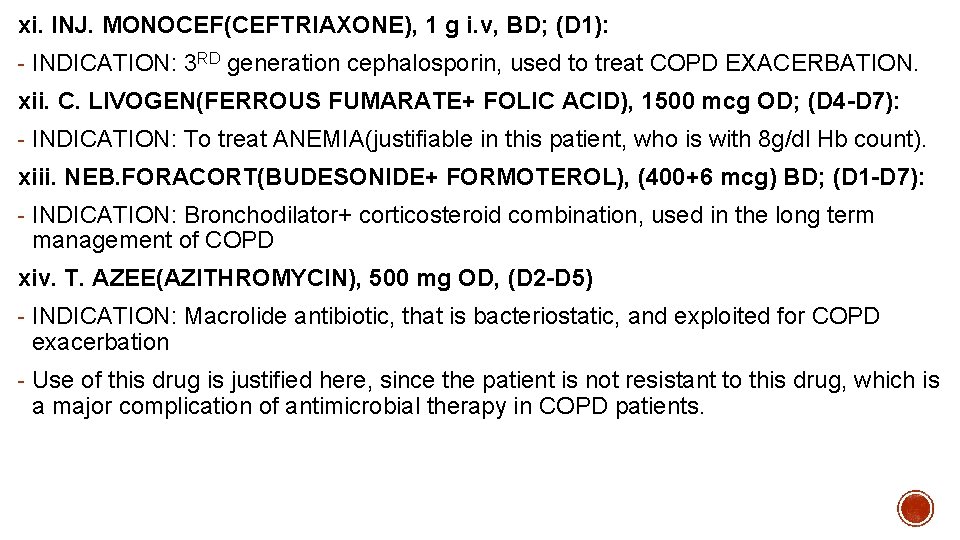
xi. INJ. MONOCEF(CEFTRIAXONE), 1 g i. v, BD; (D 1): - INDICATION: 3 RD generation cephalosporin, used to treat COPD EXACERBATION. xii. C. LIVOGEN(FERROUS FUMARATE+ FOLIC ACID), 1500 mcg OD; (D 4 -D 7): - INDICATION: To treat ANEMIA(justifiable in this patient, who is with 8 g/dl Hb count). xiii. NEB. FORACORT(BUDESONIDE+ FORMOTEROL), (400+6 mcg) BD; (D 1 -D 7): - INDICATION: Bronchodilator+ corticosteroid combination, used in the long term management of COPD xiv. T. AZEE(AZITHROMYCIN), 500 mg OD, (D 2 -D 5) - INDICATION: Macrolide antibiotic, that is bacteriostatic, and exploited for COPD exacerbation - Use of this drug is justified here, since the patient is not resistant to this drug, which is a major complication of antimicrobial therapy in COPD patients.
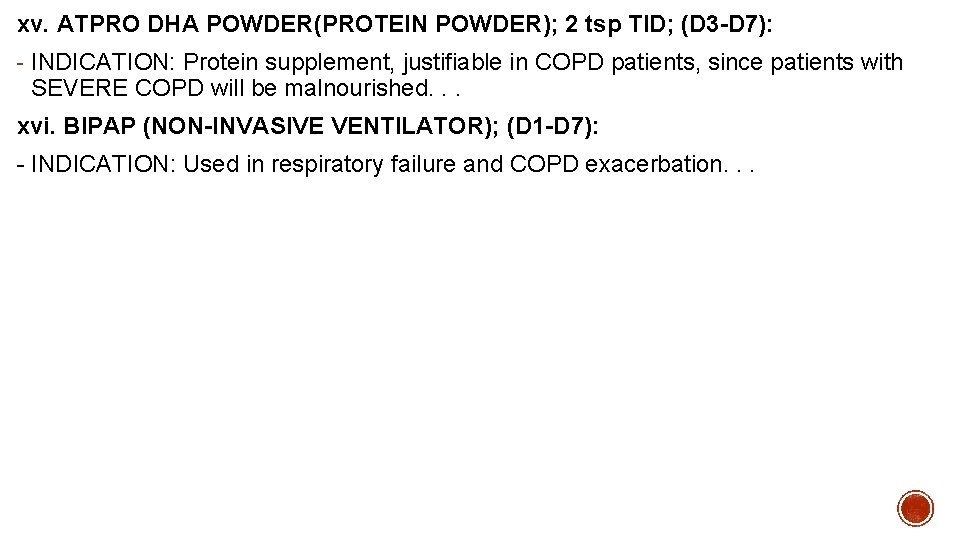
xv. ATPRO DHA POWDER(PROTEIN POWDER); 2 tsp TID; (D 3 -D 7): - INDICATION: Protein supplement, justifiable in COPD patients, since patients with SEVERE COPD will be malnourished. . . xvi. BIPAP (NON-INVASIVE VENTILATOR); (D 1 -D 7): - INDICATION: Used in respiratory failure and COPD exacerbation. . .
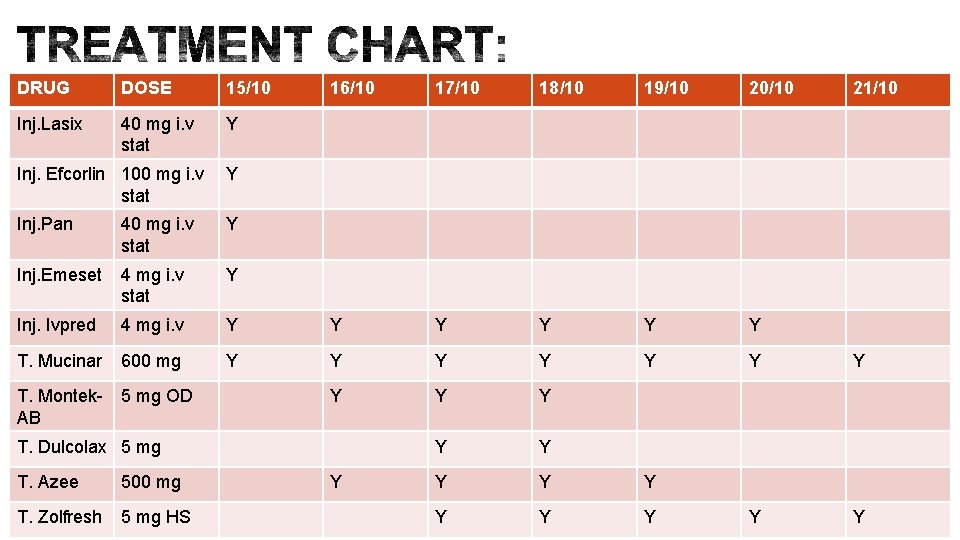
DRUG DOSE 15/10 Inj. Lasix 40 mg i. v stat Y 16/10 17/10 18/10 19/10 20/10 21/10 Inj. Efcorlin 100 mg i. v stat Y Inj. Pan 40 mg i. v stat Y Inj. Emeset 4 mg i. v stat Y Inj. Ivpred 4 mg i. v Y Y Y T. Mucinar 600 mg Y Y Y Y T. Montek. AB 5 mg OD Y Y Y Y T. Dulcolax 5 mg T. Azee 500 mg T. Zolfresh 5 mg HS Y
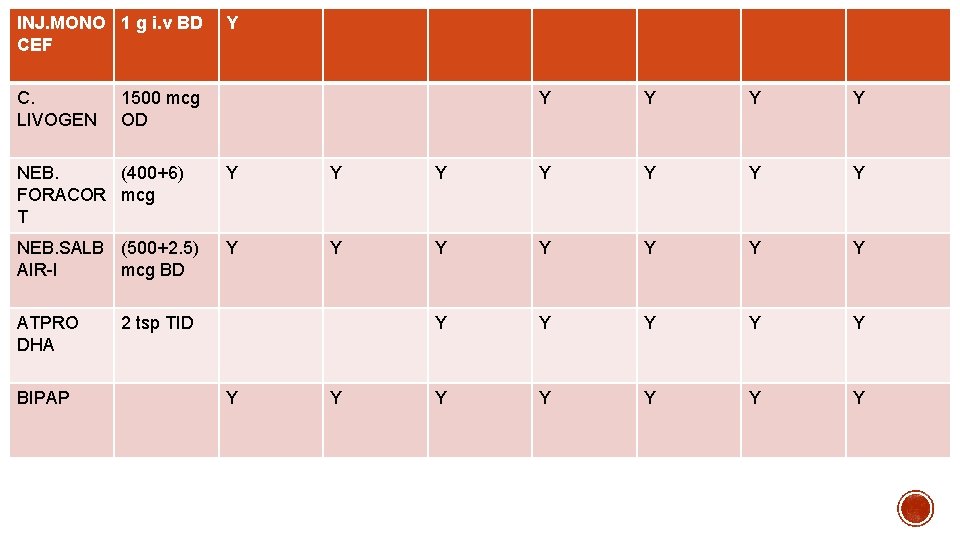
INJ. MONO 1 g i. v BD CEF C. LIVOGEN Y 1500 mcg OD Y Y NEB. (400+6) FORACOR mcg T Y Y Y Y NEB. SALB (500+2. 5) AIR-I mcg BD Y Y Y Y Y ATPRO DHA BIPAP 2 tsp TID Y Y
PROGRESS CHART: 15/10/2017: - Edema (+ve), crepts(+ve), B/L wheezing(+ve) 16/10/2017: - Patient felt better, reduced edema, crepts(+ve) 17/10/2017: - Persistent cough, blood transfusion done, slept well 18/10/2017: - Persistent cough, reduced breathlessness, c/o no motions for 2 days 19/10/2017: - Symptomatically better, crepts(+ve) 20/10/2017: - Patient felt better and no fresh complaints 21/10/2017: - Patient felt better, and was discharged appropriately. . .
DISCHARGE SUMMARY: A 65 yr old female, with k/c/o COPD, respiratory failure, emphysema, H/O TB, allergic to cold, was presented with high breathlessness, exacerbation for 2 days, cough & fever for 1 week, with 1 episode of vomiting. Patient was diagnosed to have severe COPD, emphysema, respiratory failure, Corpulmonale, and anemia. Patient was treated with i. v antibiotics, steroids, inhalers and bronchodilators. Patient felt symptomatically better at the time of discharge. . .
DISCHARGE ADVICE: 1. DUOLIN(R/C) , TID for 1 week 2. T. PAN (DSR), 40 mg OD, for 1 week 3. Cap. Livogen , 800 mcg for 1 week 4. T. Montek, 5 mg OD, for 1 week 5. Increase protein and calorie intake 6. Avoid exposure to allergenic environments 7. Review after 1 week. . .
DRUG-BASED COUNSELLING: 1. Patient should have proper knowledge on how to use ROTAHALERS 2. Avoid dose missing 3. Use ROTAHALERS TID, with a time interval of 4 hrs, between each administration 4. Avoid overdosing, since the contents in ROTAHALERS have potentiality to cause severe ADRs 5. Consume PAN-DSR 30 mins before food 6. Medication adherence is necessary to prevent disease worsening. . .
DISEASE-BASED COUNSELLING: 1. Avoid contact with allergens & polluted environment 2. Avoid fermented foods 3. Avoid dairy products 4. Avoid stress 5. Do breathing exercises(especially deep breathing) 6. Avoid oily& fried foods 7. Steam inhalation with eucalyptus/lavender essential oils 8. Chest massage with mustard oil+ camphor 9. Increase intake of calories 10. Keeping air purifiers also helps 11. Consume raisins with honey 12. Drink ginger tea/ green tea with little black pepper powder+ honey daily. . .

THANK YOU!!!!!
- Slides: 43