
By Dr yahya althabhwi NUTRITION QASIM University Nutrition
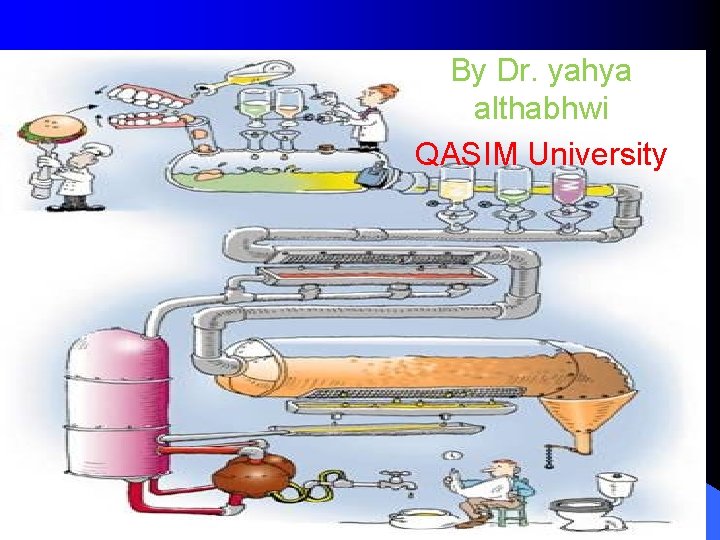
By Dr. yahya althabhwi NUTRITION QASIM University
Nutrition deals with providing the right nutrients in the right amounts in the diet. l Definition – Deals with the nutrients needed, their metabolism, feeds that supply them, and feeding systems to provide them
NUTRIENT l DEFINED – A chemical or chemical compound that aids in the support of life, and is essential for the normal function, growth and reproduction of the animal.
CLASSES of NUTRIENTS l There are 6 Classes of Nutrients – Water – Carbohydrates – Fats – Proteins – Vitamins – Minerals
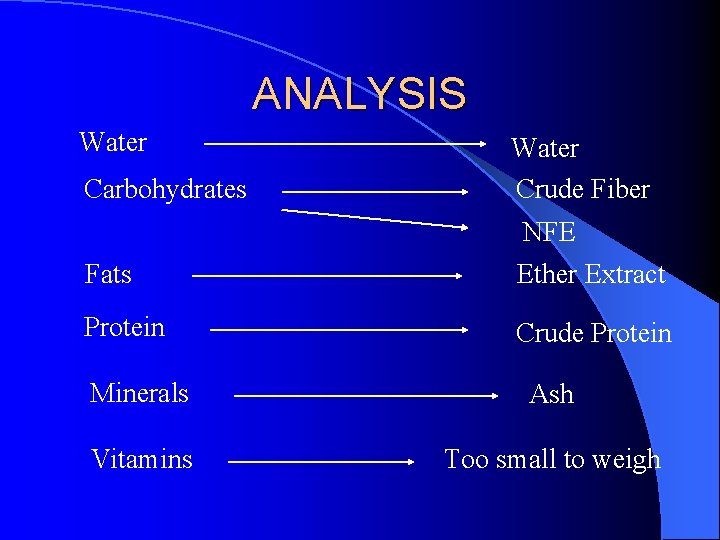
ANALYSIS Water Carbohydrates Water Crude Fiber NFE Fats Ether Extract Protein Crude Protein Minerals Ash Vitamins Too small to weigh
WATER l The most crucial nutrient. l What % water loss is fatal to animals? ~12%
Unique properties of Water: l What happens to most substances as they are cooled? l What happens when water freezes? l What is the consequence of this?
3 important properties of water to animals are: l High Dielectric Constant – High polarity of the molecule – Water dissolves many things l High Specific Heat – Takes a lot of heat to change temperature much – Helps maintain proper body temp
l High Latent Heat of Vaporization – Takes a lot of energy to change water from liquid into vapor – Result is: lots of heat is removed when sweat evaporates or l moisture-laden air is exhaled l
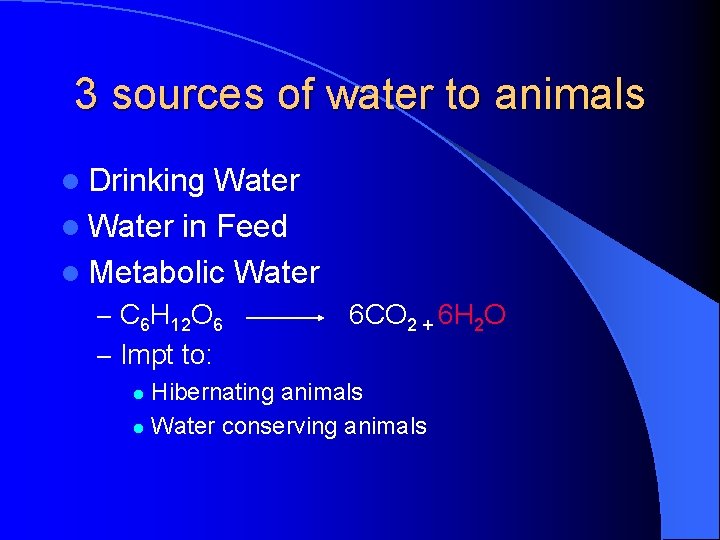
3 sources of water to animals l Drinking Water l Water in Feed l Metabolic Water – C 6 H 12 O 6 6 CO 2 + 6 H 2 O – Impt to: Hibernating animals l Water conserving animals l
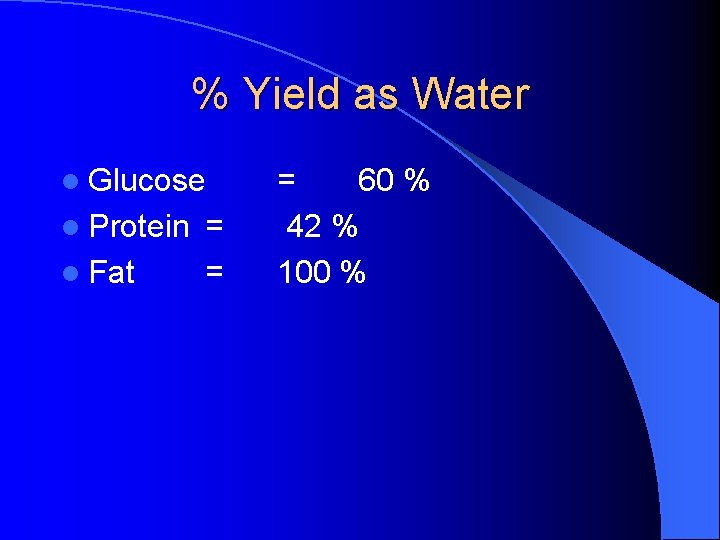
% Yield as Water l Glucose l Protein = l Fat = = 60 % 42 % 100 %
Functions of Water in Animals l Many many functions, which include: l Movement of nutrients and metabolites l Constant body temperature l Media for chemical reactions l Takes part in chemical reactions l Special roles
l Special Roles – Synovial fluid – lubricant – Cerebrospinal fluid – cushion – Sound transmission in ear – Light transmission in eye
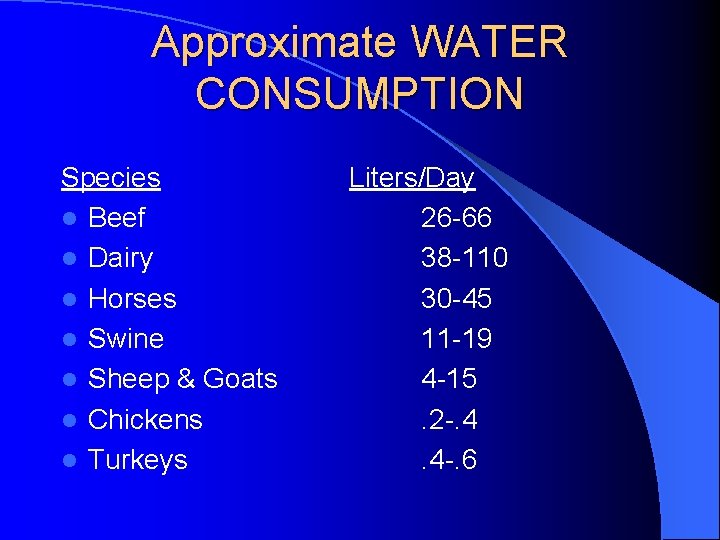
Approximate WATER CONSUMPTION Species l Beef l Dairy l Horses l Swine l Sheep & Goats l Chickens l Turkeys Liters/Day 26 -66 38 -110 30 -45 11 -19 4 -15. 2 -. 4. 4 -. 6
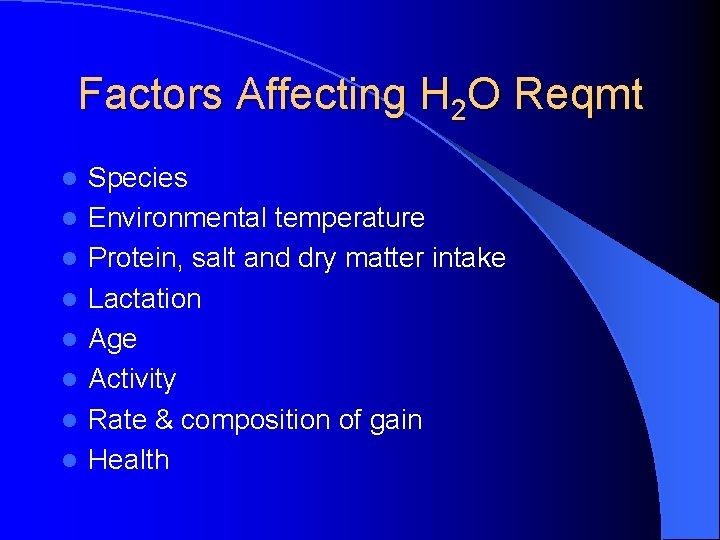
Factors Affecting H 2 O Reqmt l l l l Species Environmental temperature Protein, salt and dry matter intake Lactation Age Activity Rate & composition of gain Health
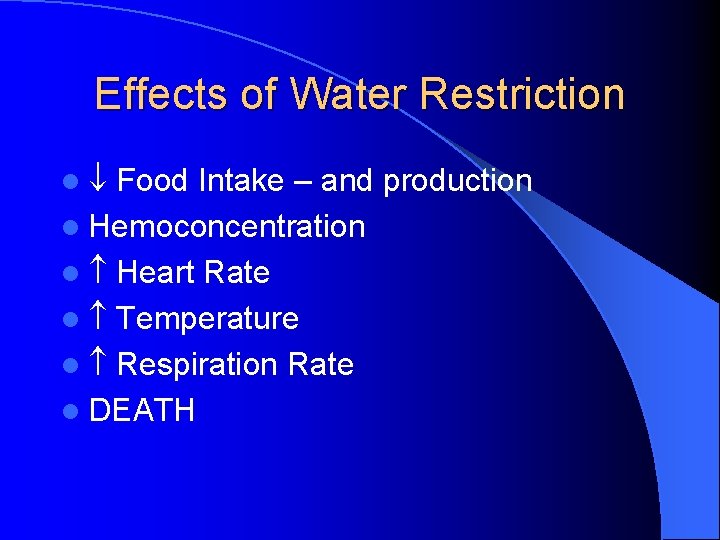
Effects of Water Restriction l Food Intake – and production l Hemoconcentration l Heart Rate l Temperature l Respiration Rate l DEATH

Practical Aspect l Make good, clean water liberally available at all times (EXCEPT certain conditions: Before or After HEAVY exercise)
CARBOHYDRATES
“The trouble with our food is that it’s filled with all kinds of chemicals, like for example polyhydroxy aldehydes and ketones and their anhydrides. ”
But THAT’S just a description of CARBOHYDRATE
ALL foods are CHEMICALS
CARBOHYDRATES l Carbohydrates are made of the elements: – Carbon – Hydrogen – Oxygen l H to O ration as in water (2: 1)
Carbohydrates are made of molecules called: l. SUGARS (saccharides)
Function of carbohydrates: ENERGY
Forms of Carbohydrates l soluble – – sugars – monosaccharides – disaccharides l insoluble – polysaccharides
There are many monosaccharides. You are to know just a few
l PENTOSES – Arabinose – Xylose – Ribose
l HEXOSES – Glucose – Fructose – Galactose – Mannose
2 simple sugars bond to form: l DISACCHARIDES – Sucrose – Maltose – Lactose – Cellobiose
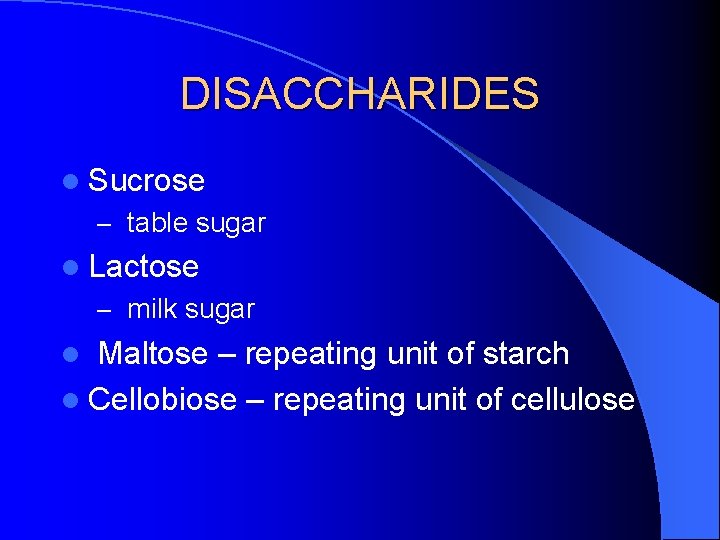
DISACCHARIDES l Sucrose – table sugar l Lactose – milk sugar l Maltose – repeating unit of starch l Cellobiose – repeating unit of cellulose
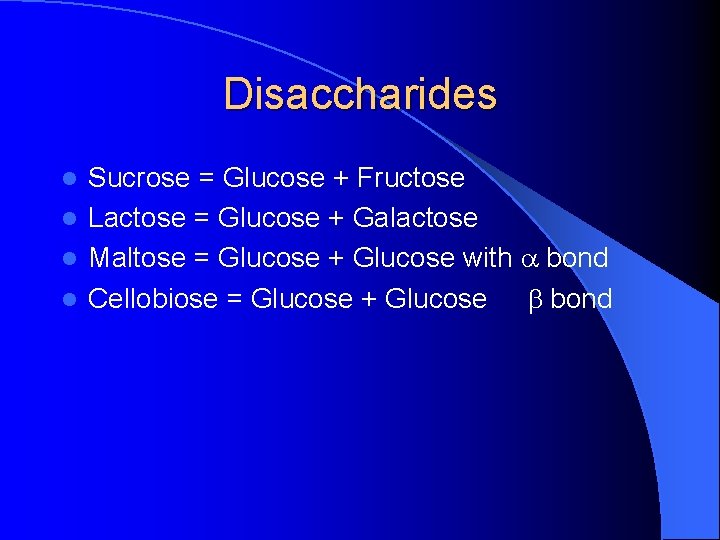
Disaccharides Sucrose = Glucose + Fructose l Lactose = Glucose + Galactose l Maltose = Glucose + Glucose with bond l Cellobiose = Glucose + Glucose bond l
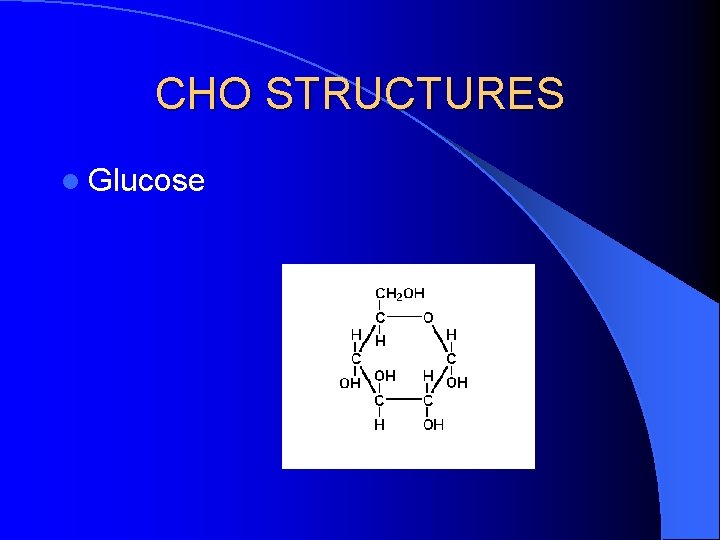
CHO STRUCTURES l Glucose
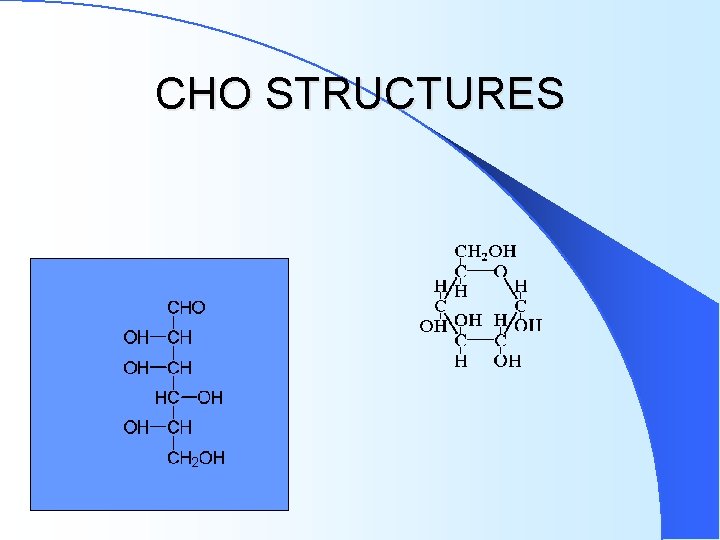
CHO STRUCTURES
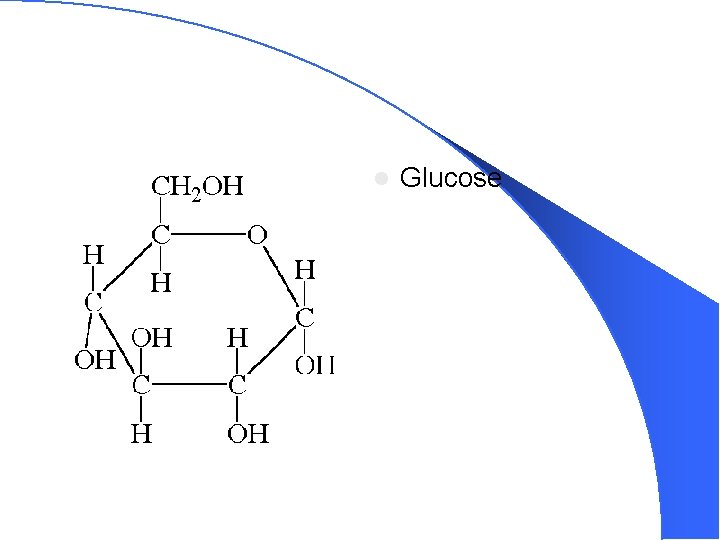
l Glucose
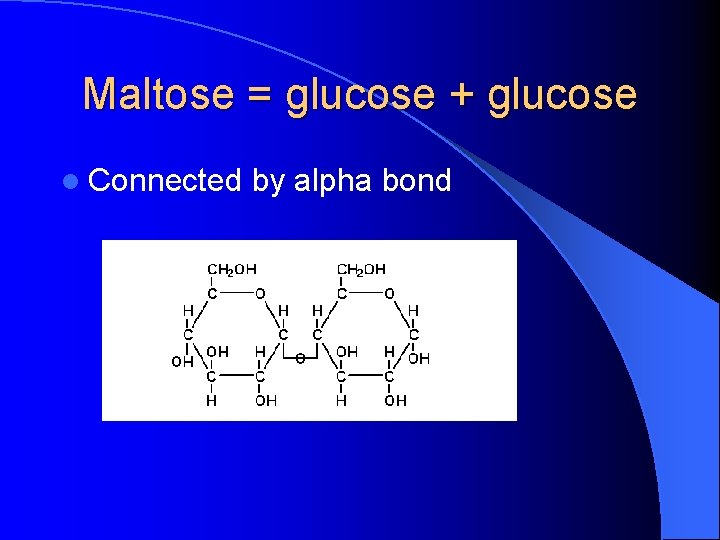
Maltose = glucose + glucose l Connected by alpha bond
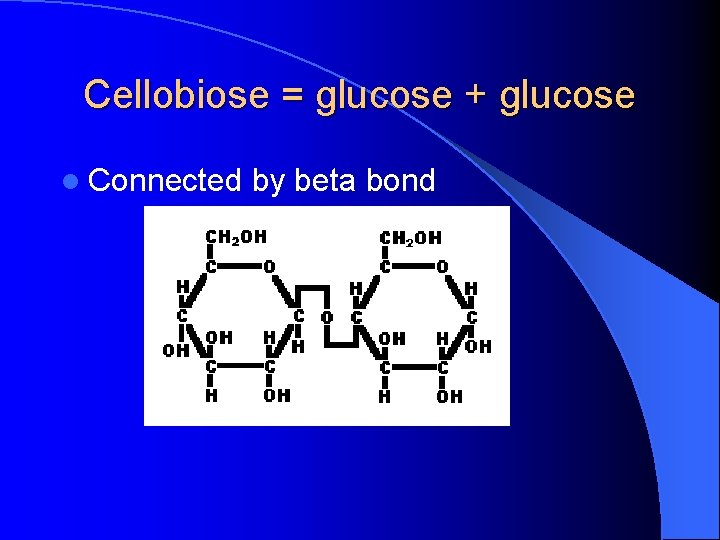
Cellobiose = glucose + glucose l Connected by beta bond
POLYSACCHARIDES l STARCH – Starch is made of repeating units of the disaccharide MALTOSE – so it is really all: l GLUCOSE
KINDS OF STARCH l AMYLOSE – Straight chain polymer l AMYLOPECTIN – Branched chain polymer
More Polysaccharides l Glycogen – Like amylopectin. Stored in animals (small amount) l Cellulose
Glycogen l Storage CHO found in animals, but only in small amounts l Readily available supply of energy
THE DIFFERENCE BETWEEN STARCH AND CELLULOSE IS: l Starch is glucose connected with alpha bonds l Cellulose is glucose connected with beta bonds
l Animals do NOT make the enzyme that digests beta bonds. l Only bacteria make cellulase
More about cellulose l Part of cell wall l Analyzed in Crude Fiber, or better, NDF and ADF l Only of value to ruminant animals because it takes bacteria to make cellulase to digest it. – (or bacteria in the cecum of nonruminant herbivores)
LIGNIN l LIGNIN IS NOT REALLY CARBOHYDRATE, but it is discussed here because it is in the fibrous part of the feed associated with cellulose, which is carbohydrate, and is analyized along with carbohydrate.
Bad things about lignin l Completely indigestible l Binds to cellulose and decreases the digestibility (dramatically) of other feed components
Good things about lignin l Nutritionally – NONE l For the plant – Helps insect resistance – Provides structural rigidity
Analysis of CHO l Crude Fiber l NFE Better l Neutral Detergent Fiber (NDF) l Acid Detergent Fiber (ADF) – (more about those later in the course)
LIPIDS l DEFINITION Lipids are substances that are soluble in ether (and other organic solvents).
LIPID CLASSIFICATION l Simple lipids - esters of fatty acids with alcohols – Fats, Oils, Waxes l Compound lipids - esters of fatty acids containing groups in addition to an alcohol and fatty acid. – Phospholipids, glycolipids, lipoproteins Derived lipids l Sterols l Terpenes (includes Vitamin A) l
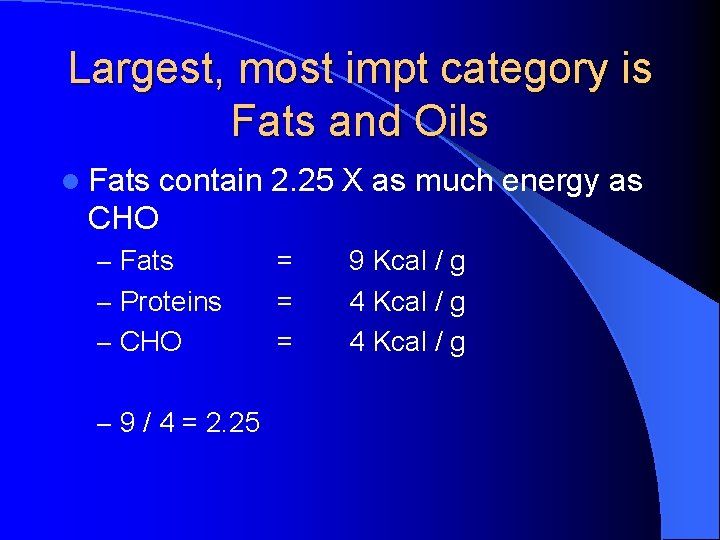
Largest, most impt category is Fats and Oils l Fats contain 2. 25 X as much energy as CHO – Fats – Proteins – CHO – 9 / 4 = 2. 25 = = = 9 Kcal / g 4 Kcal / g
Fat composition Lipids are composed of the elements Carbon, Hydrogen & Oxygen (just like CHO) Difference is Fats contain LITTLE Oxygen compared to H and C. – C & H are the real fuel, O can come from air.
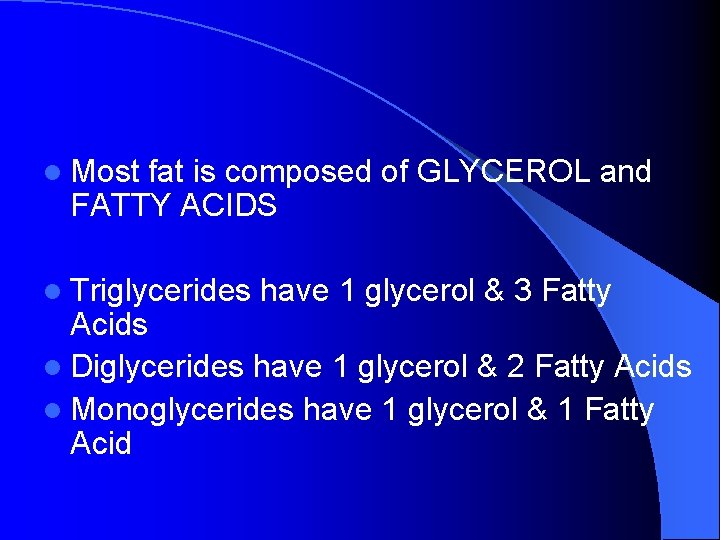
l Most fat is composed of GLYCEROL and FATTY ACIDS l Triglycerides have 1 glycerol & 3 Fatty Acids l Diglycerides have 1 glycerol & 2 Fatty Acids l Monoglycerides have 1 glycerol & 1 Fatty Acid
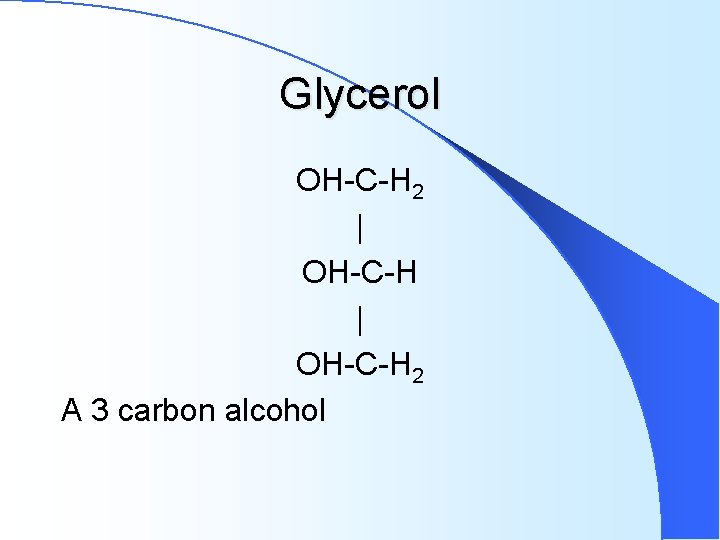
Glycerol OH-C-H 2 | OH-C-H 2 A 3 carbon alcohol
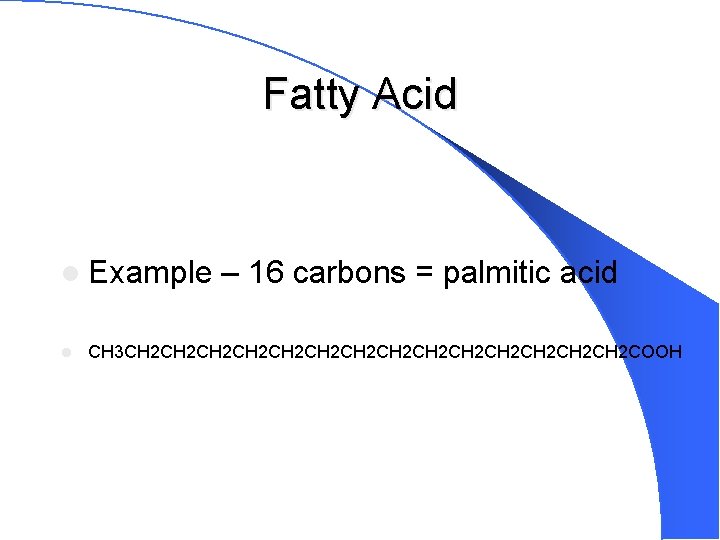
Fatty Acid l Example – 16 carbons = palmitic acid l CH 3 CH 2 CH 2 CH 2 CH 2 COOH
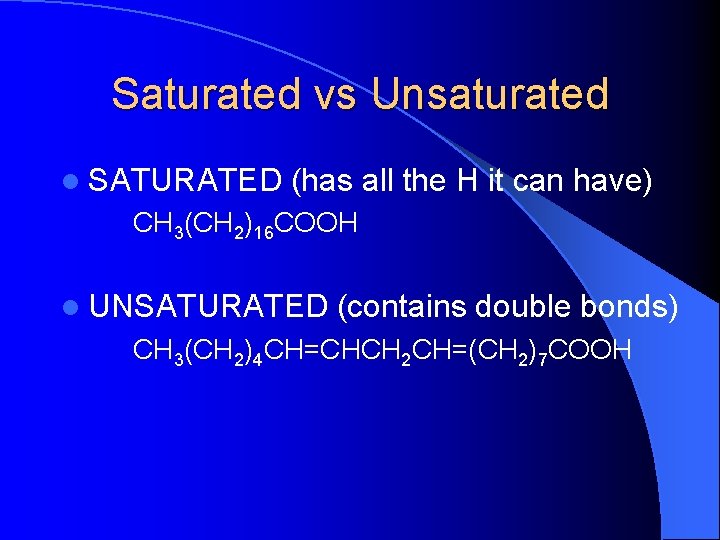
Saturated vs Unsaturated l SATURATED (has all the H it can have) CH 3(CH 2)16 COOH l UNSATURATED (contains double bonds) CH 3(CH 2)4 CH=CHCH 2 CH=(CH 2)7 COOH
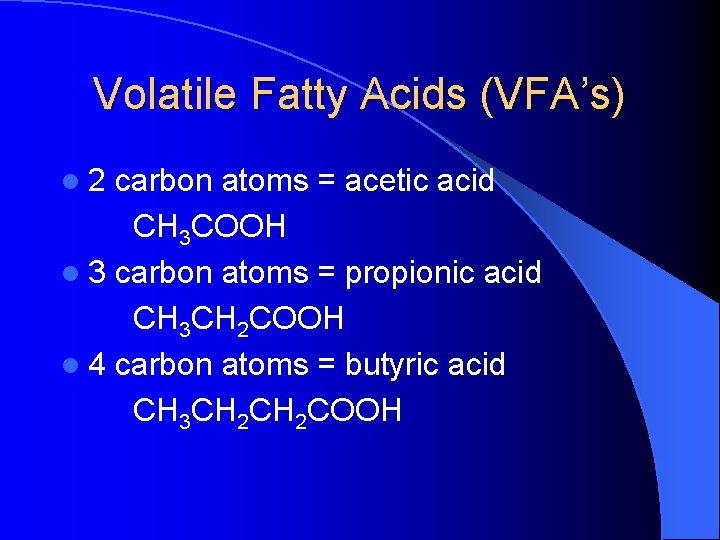
Volatile Fatty Acids (VFA’s) l 2 carbon atoms = acetic acid CH 3 COOH l 3 carbon atoms = propionic acid CH 3 CH 2 COOH l 4 carbon atoms = butyric acid CH 3 CH 2 COOH
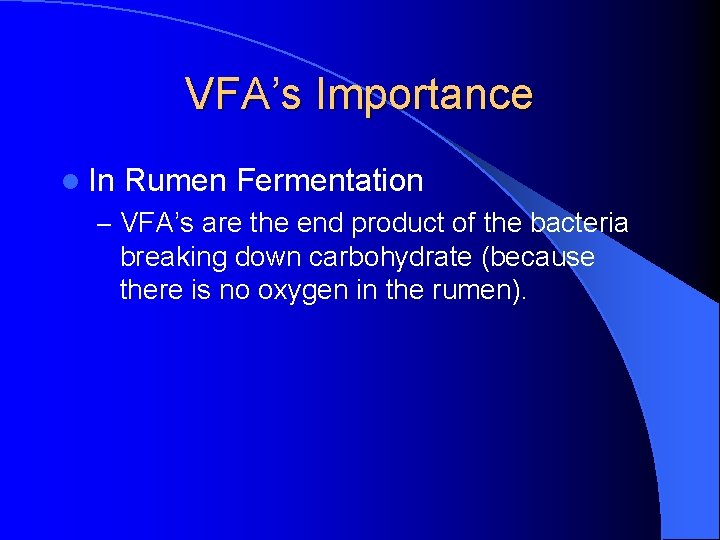
VFA’s Importance l In Rumen Fermentation – VFA’s are the end product of the bacteria breaking down carbohydrate (because there is no oxygen in the rumen).
Medium Chain Fatty Acids l C-6 to C-14 acids are not real abundant
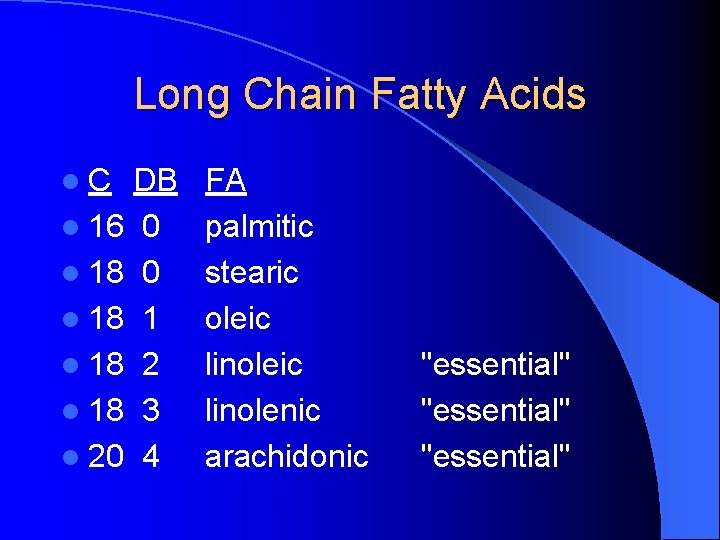
Long Chain Fatty Acids l. C DB l 16 0 l 18 1 l 18 2 l 18 3 l 20 4 FA palmitic stearic oleic linolenic arachidonic "essential"
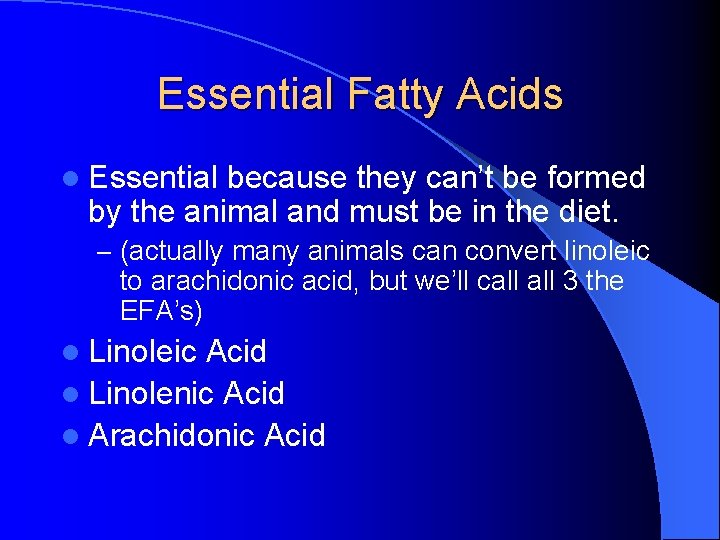
Essential Fatty Acids l Essential because they can’t be formed by the animal and must be in the diet. – (actually many animals can convert linoleic to arachidonic acid, but we’ll call 3 the EFA’s) l Linoleic Acid l Linolenic Acid l Arachidonic Acid
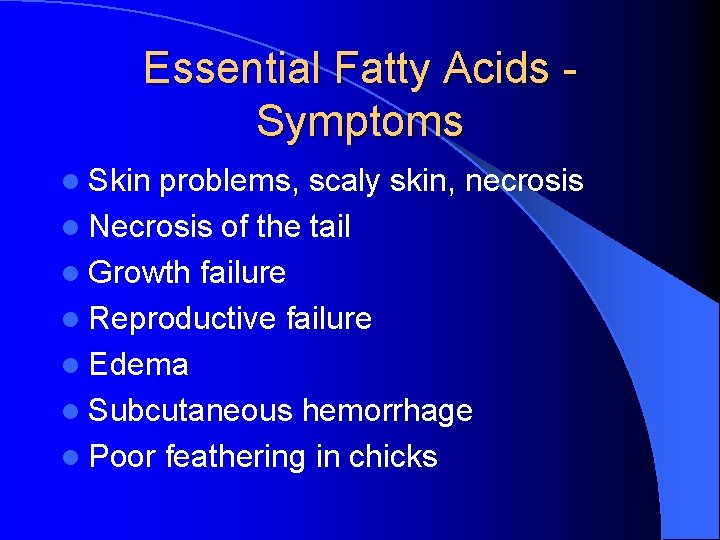
Essential Fatty Acids - Symptoms l Skin problems, scaly skin, necrosis l Necrosis of the tail l Growth failure l Reproductive failure l Edema l Subcutaneous hemorrhage l Poor feathering in chicks
EFA’s – Practical Aspects l You will NOT see deficiency on animals fed practical diets. l You will NOT see deficiency in ruminant animals – (there is enough microbial synthesis in the rumen, even though microbes hydrogenate unsaturated fats).
Functions for Fat in Diets Energy 2. Provide EFA’s l Also: 1. Dust control – ½ to 1% does a good job – Absorption of fat soluble vitamins – Improves palatability of some diets –
Lipid Categories l Glycerides - most common l Most important dietary fat l l · ~~~~~~~~~~ l · ~~~~
Lipid Categories Phospholipids l Usually glycerol + 2 Fatty Acids + P and something l · ~~~~~~~~ · ~P~~~~~ Lecithins -P-choline Cephalins -P-cholamine (amino ethyl alcohol) Part of membranes Surface active (both hydrophilic & hydrophobic) l
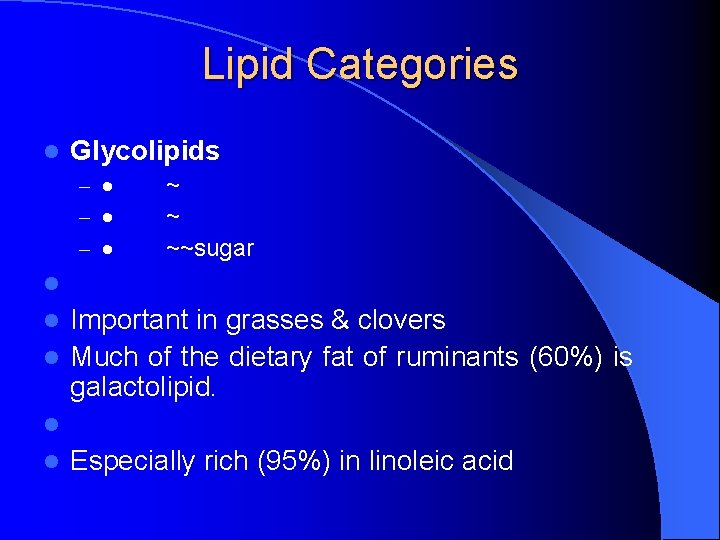
Lipid Categories l Glycolipids – · ~~sugar l l l Important in grasses & clovers Much of the dietary fat of ruminants (60%) is galactolipid. Especially rich (95%) in linoleic acid
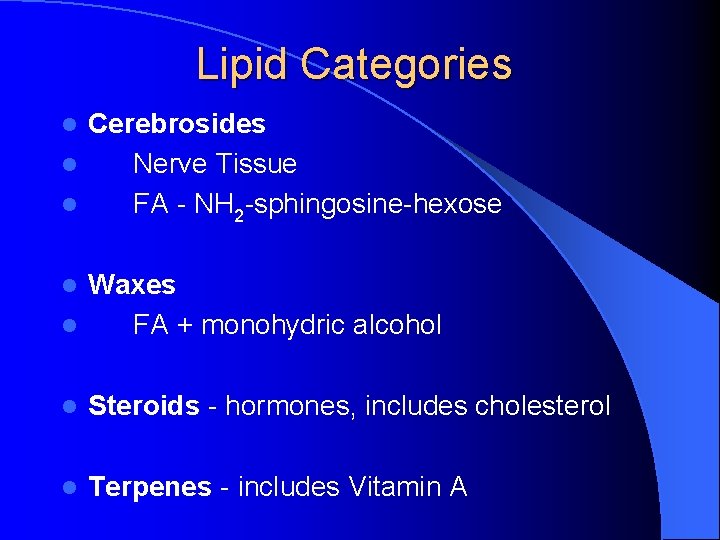
Lipid Categories Cerebrosides l Nerve Tissue l FA - NH 2 -sphingosine-hexose l Waxes l FA + monohydric alcohol l Steroids - hormones, includes cholesterol l Terpenes - includes Vitamin A l
PROTEINS And Amino Acids
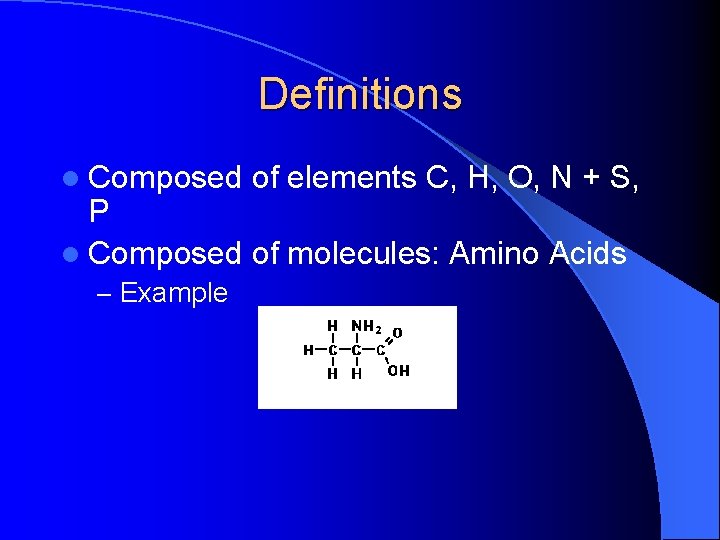
Definitions l Composed of elements C, H, O, N + S, P l Composed of molecules: Amino Acids – Example
Peptides and Polypeptides l Amino acids are connected in chains
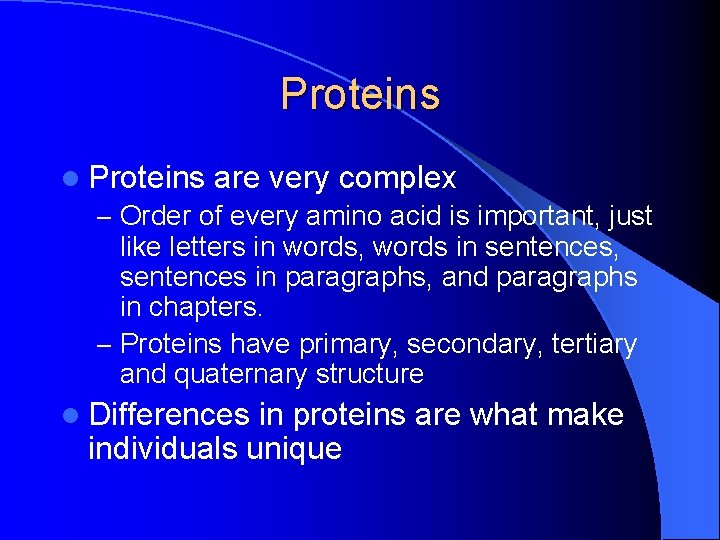
Proteins l Proteins are very complex – Order of every amino acid is important, just like letters in words, words in sentences, sentences in paragraphs, and paragraphs in chapters. – Proteins have primary, secondary, tertiary and quaternary structure l Differences in proteins are what make individuals unique
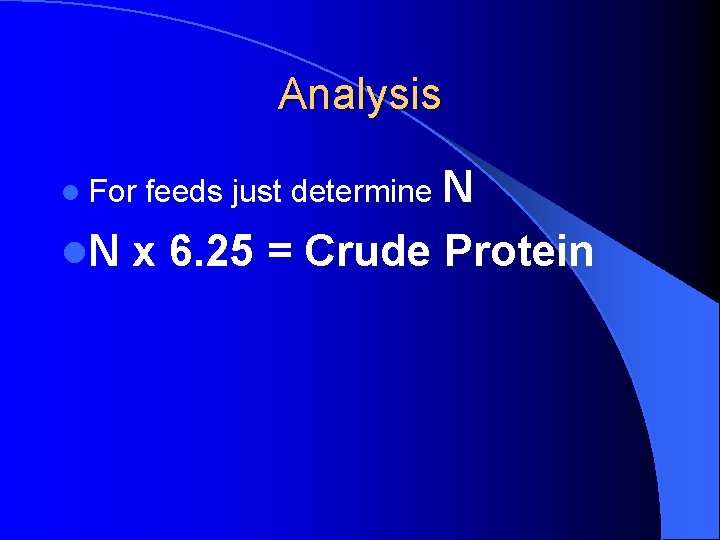
Analysis N l. N x 6. 25 = Crude Protein l For feeds just determine
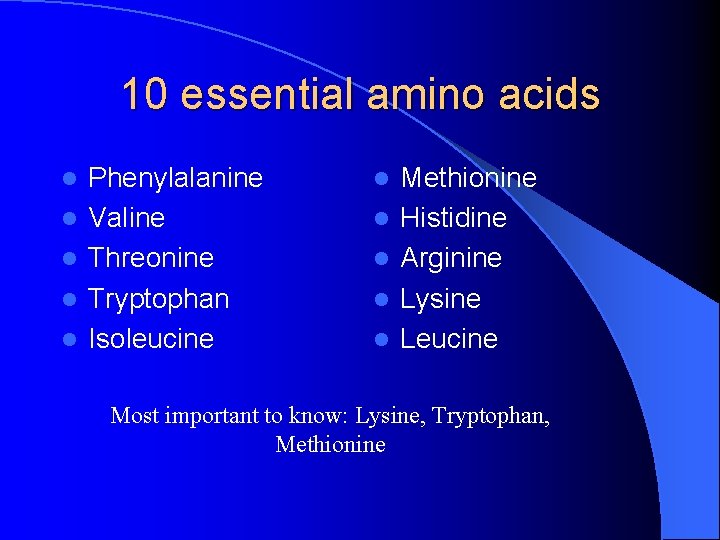
10 essential amino acids l l l Phenylalanine Valine Threonine Tryptophan Isoleucine l l l Methionine Histidine Arginine Lysine Leucine Most important to know: Lysine, Tryptophan, Methionine
Some non-essentail amino acids l l l Glycine Serine Glutamic Acid Taurine Cysteine l Aspartic acid
Protein Quality l Refers to the amount and balance of the essential amino acids in the protein. l Important for nonruminant animals but not ruminants – For ruminants, quantity of CP is what’s impt.
“IDEAL PROTEIN” l An “ideal protein” would just exactly meet the essential amino acid needs of the animal, with none in excess, and with the right level of non-essential amino acids.
Amino Acid Availability/Digestibility l Not all the amino acids in feeds are available l Digestibility is ‘confused’ by microbial synthesis in the Large Intestine l Therefore, availability has to be determined at the end of the small intestine l More about this later
NPN l Non-Protein Nitrogen l Ruminants can use NPN because the bacteria in the rumen can use it to build their own amino acids.
Functions of Dietary Proteins Supply the needed amino acids for the body to make its own proteins. l If present in excess, supplies energy l
VITAMINS
Vitamin Classification l Fat soluble vitamins A, D, E, K l Water soluble vitamins – Vitamin C – B-complex vitamins l Thiamine (B 1), Riboflavin (B 2), Niacin, B 6, B 12, Folic Acid, Choline, Pantothenic Acid, Biotin
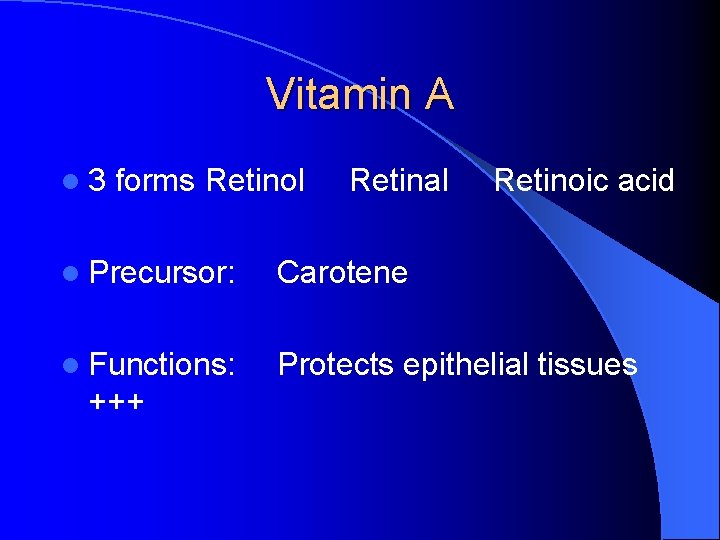
Vitamin A l 3 forms Retinol Retinal Retinoic acid l Precursor: Carotene l Functions: Protects epithelial tissues +++
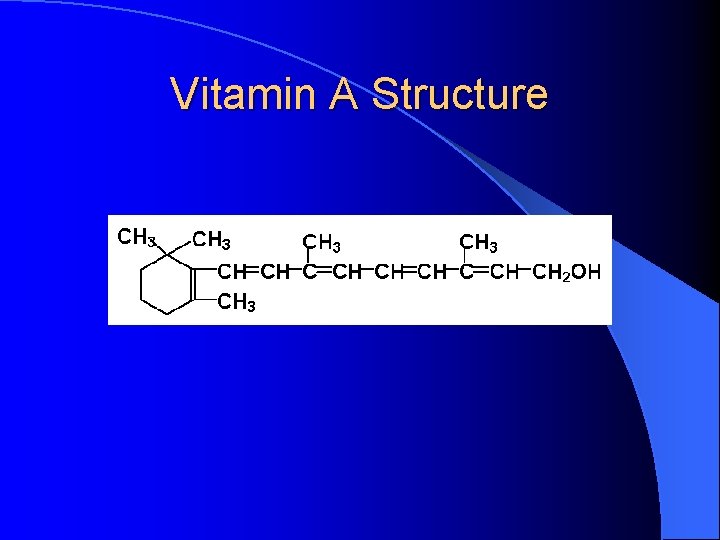
Vitamin A Structure
Vitamin A l A. Introduction – 1. Chemically known as retinol – 2. It is an unsaturated monohydric alcohol with the shown structural formula:
– 3. It is a pale yellow crystalline solid, insoluble in water, but soluble in fats and various fat solvents. – 4. It is readily destroyed by oxidation on exposure to air and light. – 5. Vitamin A does not occur in plants but rather as its precursor, carotene, or carotenoid pigments.
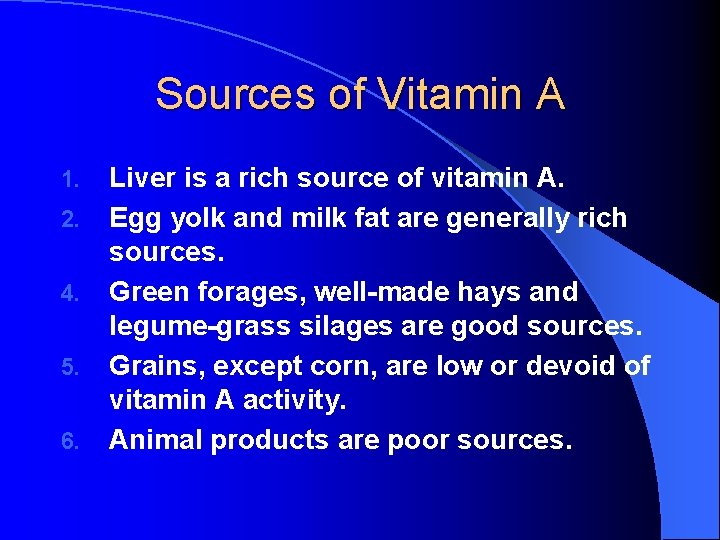
Sources of Vitamin A 1. 2. 4. 5. 6. Liver is a rich source of vitamin A. Egg yolk and milk fat are generally rich sources. Green forages, well-made hays and legume-grass silages are good sources. Grains, except corn, are low or devoid of vitamin A activity. Animal products are poor sources.
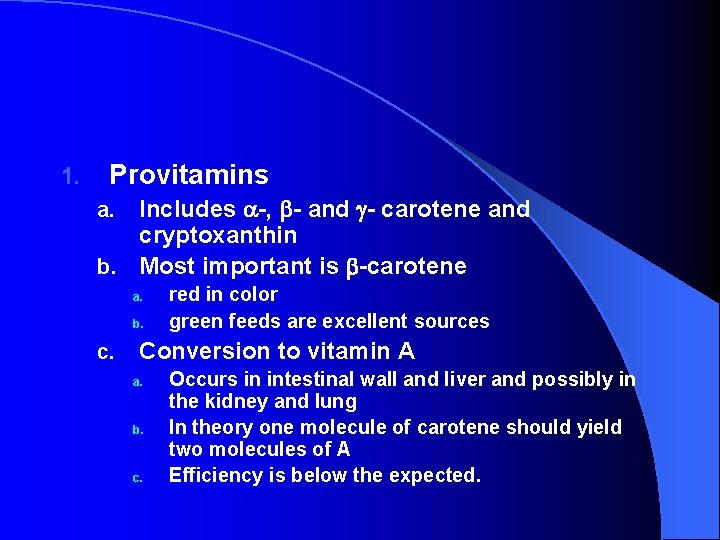
1. Provitamins Includes -, - and - carotene and cryptoxanthin b. Most important is -carotene a. b. c. red in color green feeds are excellent sources Conversion to vitamin A a. b. c. Occurs in intestinal wall and liver and possibly in the kidney and lung In theory one molecule of carotene should yield two molecules of A Efficiency is below the expected.
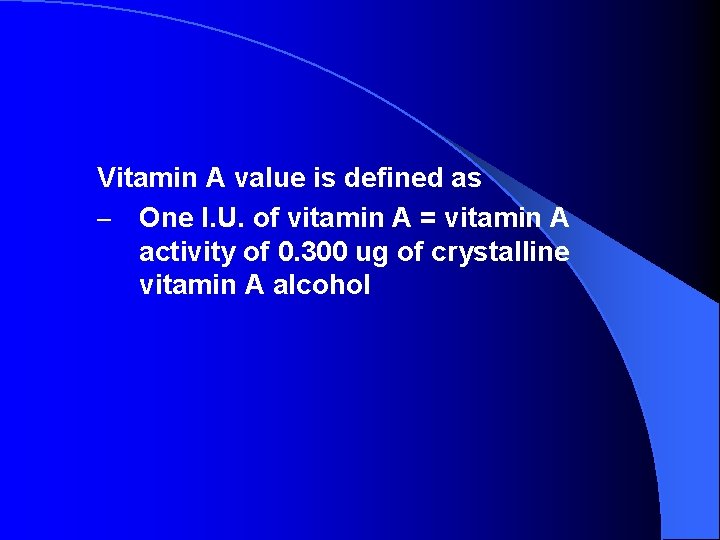
Vitamin A value is defined as – One I. U. of vitamin A = vitamin A activity of 0. 300 ug of crystalline vitamin A alcohol
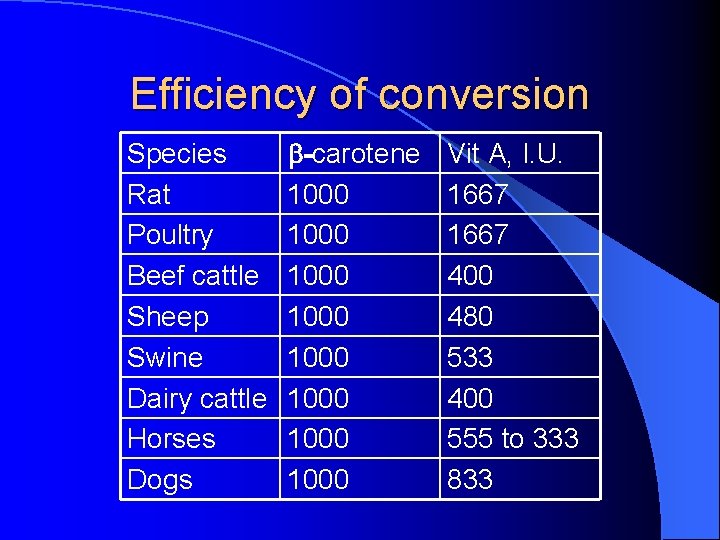
Efficiency of conversion Species Rat Poultry Beef cattle Sheep Swine Dairy cattle Horses Dogs -carotene 1000 1000 Vit A, I. U. 1667 400 480 533 400 555 to 333 833
Metabolism l Vitamin A and vision – Rhodopson (visual purple), the pigment of the rod cells of the retina of the eye, is made of the vitamin plus a protein moiety. When exposed to light, the pigment breaks down into its constituents and these chemical changes are accompanied by stimulation of the optic nerves. Rhodopsin is regenerated in the dark.
– Ability to see in dim light depends on the rate of resynthesis of rhodopsin. l Rhodopsin formation is impaired where vitamin A is deficient
Other tissues l Maintains mucous membranes of the respiratory tract, intestinal tract, urethra, kidney and eyes in a healthy condition – In absence of vitamin A, they become keratinized and susceptible to infection l Role in bone formation
Vitamin A Deficiencies l Night Blindness l Xeropthalmia l Infertility, abortion, fetal abnormalities l Metaplasia (change of cell type) l Infections l Dozens of other symptoms, as Vit A is involved all over the body
Deficiency symptoms l Adult cattle – A mild deficiency is associated with night blindness, roughened hair, scaly skin. – Prolonged deficiency – excessive watering, softening and cloudiness of the cornea and development of xeropthalmia characterized by a drying of the conjunctiva. – Constriction of the optic nerve canal in calves
Deficiency Symptoms (cont) l Infertility in breeding animals l Abortion or production of dead, weak or blind calves l Increased susceptibility to infectioncalves
Deficiency Symptoms (cont) l Ewes – Night blindness – Weak or dead lambs l Pigs – Eye disorders (xerophthalmia & blindness) – Blind, deformed litters – Impaired appetite and growth
Deficiency Symptoms (cont) l Poultry – High mortality – Retarded growth, weakness, ruffled plumage and a staggering gait – Reduced egg production and hatchability
Supplementation l Feed a carotene rich diet l Supplement by: – Add to water – Inject – Add to supplement or grain mix – Add to salt or mineral mix – Add to complete diet
Problem l Ruminants – Deficiency may occur when pastures are poor or high cereal rations are used l Swine – Some concentrate feeds are extremely poor sourses
Vitamin D l Necessary to use Ca & P l Deficiency causes RICKETS l Can be gotten from SUN on Skin l Active form: 1, 25 dihydroxycholecalciferol l Form in plants is D 2, in animals D 3. – poultry, cats need D 3
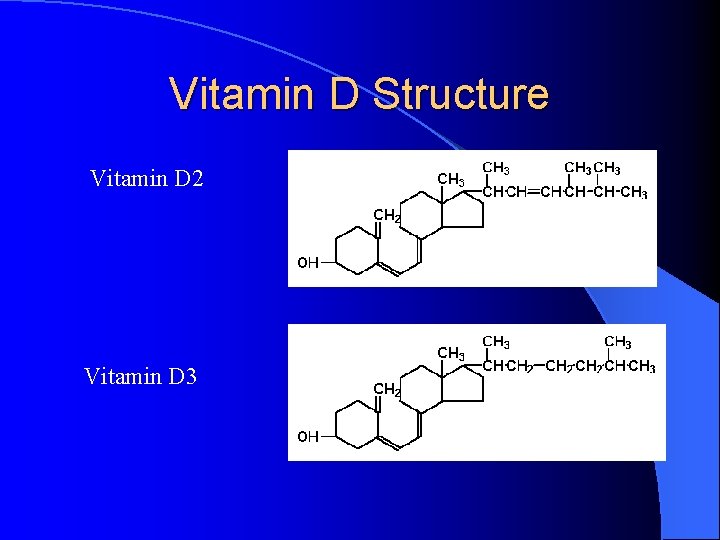
Vitamin D Structure Vitamin D 2 Vitamin D 3
Vitamin D as a Hormone Vitamin D is activated by UV light from 7 dehyro-cholesterol in the skin, goes to liver l In LIVER, is hydroxylated in the 1 position l Goes to KIDNEY where it is hydroxylated in the 25 position, forming: l 1, 25 dihydroxy cholecalciferol, the active form l
Metabolism l Facilitates deposition of calcium and phosphorus in bone l Increases the absorption of Ca & P from the intestine
Deficiency Symptoms l Young animals – Rickets with weak, easily broken bones, bowed legs l Young cattle – Swollen knees and hocks and arching of back l Pigs – Enlarged joints, broken bones, stiffness of joints, occasional paralysis
Vit D Deficiency symptoms l In older animals oesteomalacia (uncommon) l Poultry – Soft rubbery bones and beak, retarded growth, bowed legs, reduced egg production
Units of vitamin D l One I. U. of vit D = 0. 025 g of pure crystalline irradiated 7 dehydrocfholesterol (D 3)
Problems l Need is greater for pigs & poultry than cattle & sheep l Animals housed indoors may need suppl. l More Vit D may be helpful managing milk fever.
Sources l Most feeds for pigs & poultry are poor sources l Cod and fish-liver oils are good sources l Sun-cured hays are good sources l Irradiated yeast is a good source of D 2
Excessive Vitamin D l High doses mobilize Ca & P from the tissues causing vitamin D rickets l It may cause deposition of calcium salts in arteries, various organs and tissues
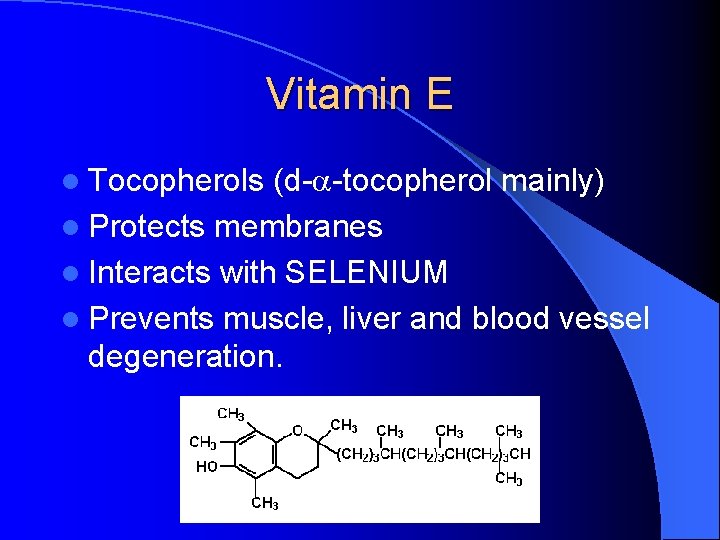
Vitamin E l Tocopherols (d- -tocopherol mainly) l Protects membranes l Interacts with SELENIUM l Prevents muscle, liver and blood vessel degeneration.
Deficiency Symptoms l Liver (cells die) l Stiff lamb disease l White muscle disease (calves) l Exudative diathesis (chickens)
Deficiency symptoms l Reproductive failure l Calves and lambs - muscular degeneration – calves called ‘white muscle disease’ – lambs called ‘stiff lamb disease’ l Chicks – nutritional encephalomalacia
E deficiencies l Pigs – Severe liver damage – muscular weakness – heart muscle affected with sudden death
Vitamin E & Selenium 1. Exact interrelationship is not known. l 2. Most enzootic muscular dystrophies in sheep and cattle can be prevented by administering Se or vitamin E. l 3. Necrotic liver degeneration in the rat and exudative diathesis in the chick can be prevented by either substance. l 4. Nutritional encephalomalacia in chick or muscular dystrophy by E but not by selenium. l
Units of vitamin E l 1 I. U. of vitamin E = one milligram of synthetic a-tocopheryl acetate
Sources of Vitamin E l Good – a. Wheat germ – b. Green forages – c. Soybean, peanut and cottonseed oils l 2. Poor – a. Corn – b. Soybean, peanut and cottonseed meals
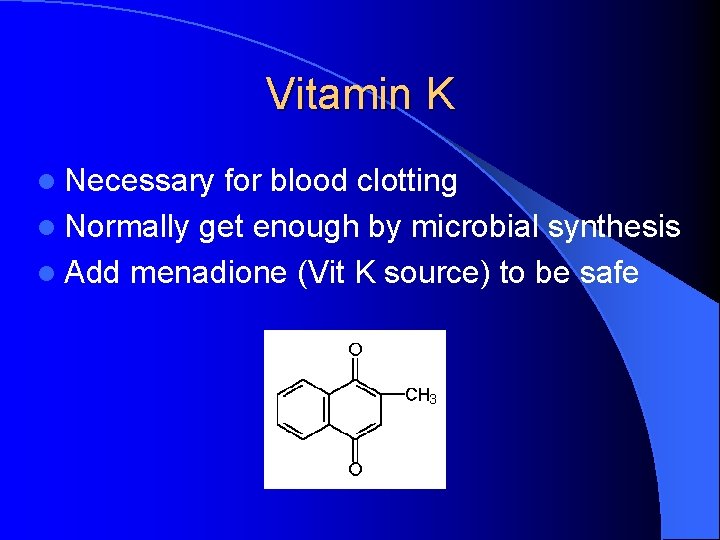
Vitamin K l Necessary for blood clotting l Normally get enough by microbial synthesis l Add menadione (Vit K source) to be safe
A number of compounds have vitamin K activity l phyloquinone, found in green plants l Naturally occurring naphthoquinone is vitamin K 2 l Menadione (K 3) is the most active synthetic compound
Functions l Necessary for the formation of prothrombin – so necessary for blood clotting
Deficiency symptoms l Prolonged clotting time l hemorrhage
Problems l Seldom really a problem l Synthesis occurs by microbes, even in non-ruminants l Practically, add to non-ruminant diets anyway l Beware moldy sweet clover poisoning – coumerol converted to dicoumarol by mold
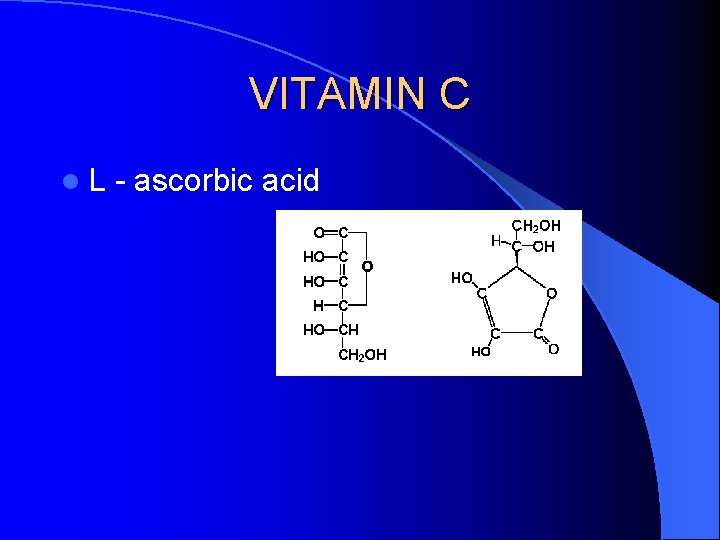
VITAMIN C l L - ascorbic acid
Functions l Important role in various oxidation- reduction mechanisms in living cells – ELECTRON TRANSPORT l Impt for normal collagen metabolism – hydroxyproline from proline & hydroxylysine from lysine
Other roles l Co-substrate in certain mixed-function oxidations – dopamine to norepinephrine – reqd with ATP for plasma Fe into ferritin
Most Animals Make Their Own Vitamin C
Required by: l Man l other primates l Guinea pigs l A few other species, including: – Indian fruit bat, red-vented bulbul, flying fox, rainbow trout, coho salmon, 2 species of locust, silkworm
Not required by farm animals l EXCEPT under some specific conditions: – debilitated animals – possibly newborns – possibly pigs following weaning briefly – any time metabolism is so altered that synthesis fails to occur
Deficiency symptoms l SCURVY – edema – weight loss – emaciation – diarrhea – structural defects in teeth, bone, cartilage, connective tissue, muscle – hemorrhages in muscles – – & gums capillary fragility fatty infiltration & necrosis of liver enlarged adrenal gland DELAYED WOUND HEALING
CONTROVERSY l Linus Pauling – Vitamin C and the Common Cold
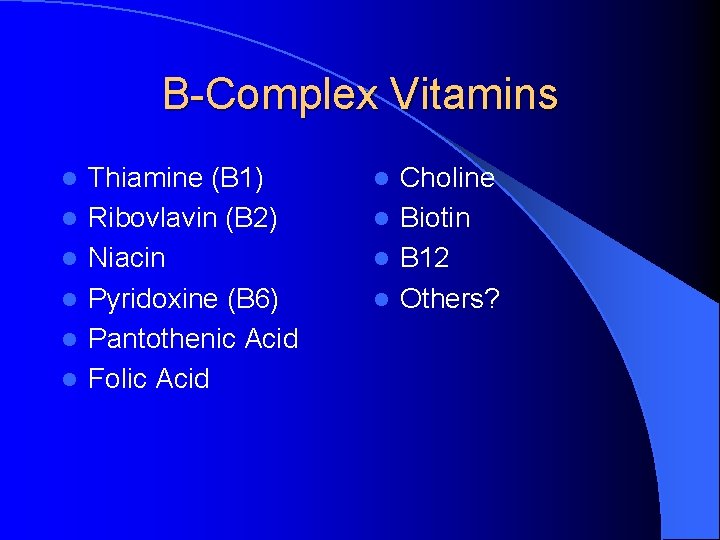
B-Complex Vitamins l l l Thiamine (B 1) Ribovlavin (B 2) Niacin Pyridoxine (B 6) Pantothenic Acid Folic Acid Choline l Biotin l B 12 l Others? l
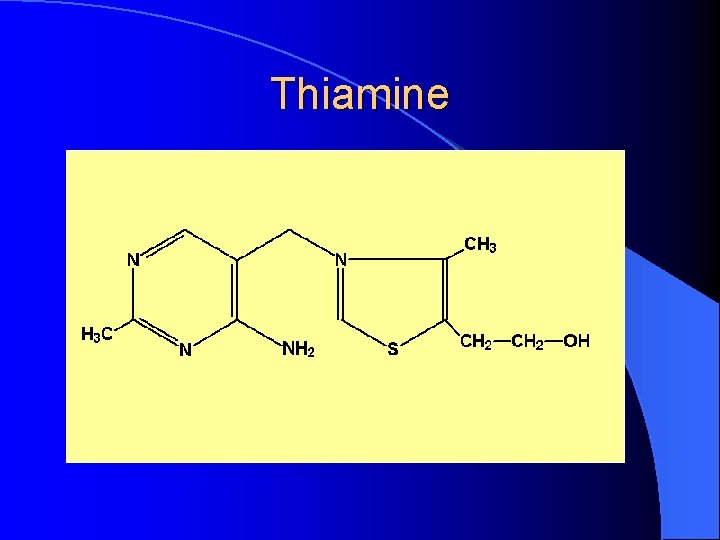
Thiamine
l Can form esters such as thiamin pyrophosphate, a cocarboxylase l Coenzyme in oxidative decarboxylation of pyruvic acid – Deficiency: accumulation of pyruvic acid and its reduction product lactic acid
B 1 Deficiency Symptoms l BERI in Humans l Loss of appetite, emaciation, muscular weakness and progressive dysfunction of nervous system l Pigs: appetite, growth, vomiting, respiratory problems l Chicks: polyneuritis (nerve degeneration and paralysis)
l Some feeds (bracken, raw fish) contain thiaminase which destroys thiamin.
B 1 l Widely distributed in foods – Particularly cereal grains – Therefore little problem, usually, for livestock
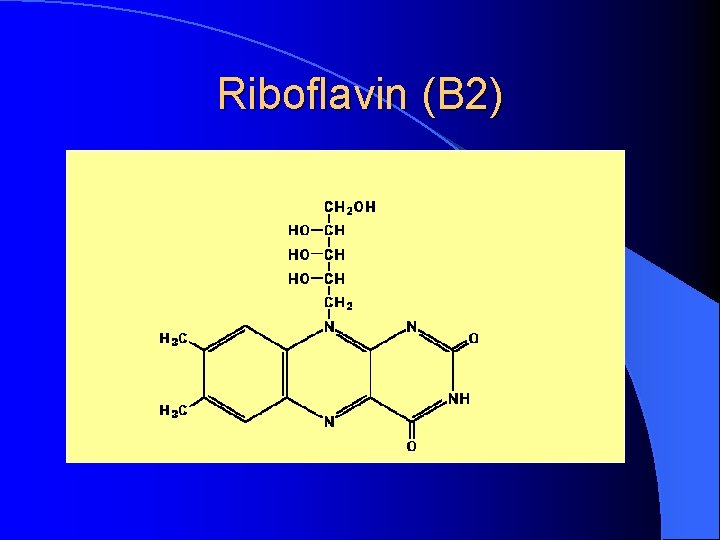
Riboflavin (B 2)
B 2 l Part of FLAVOPROTEINS – transport of H (transfer of electrons) l Oxidation-Reduction reactions l Limited storage l DO NEED to ADD to non-ruminant diets – Cereals are a poor source
B 2 Deficiency Symptoms l Pigs – Poor appetite, slow growth, vomiting, skin and eye problems l Chick – Curled toe paralysis (from nerve degeneration) l Hen – Poor hatchability, embryonic abnormalities
Deficiency symptoms (cont) l Ectodermal tissues – Skin, eye, nervous system – Cataracts – Slow growth – REPRO – increased stillbirth l Requirement proportional to Energy Intake
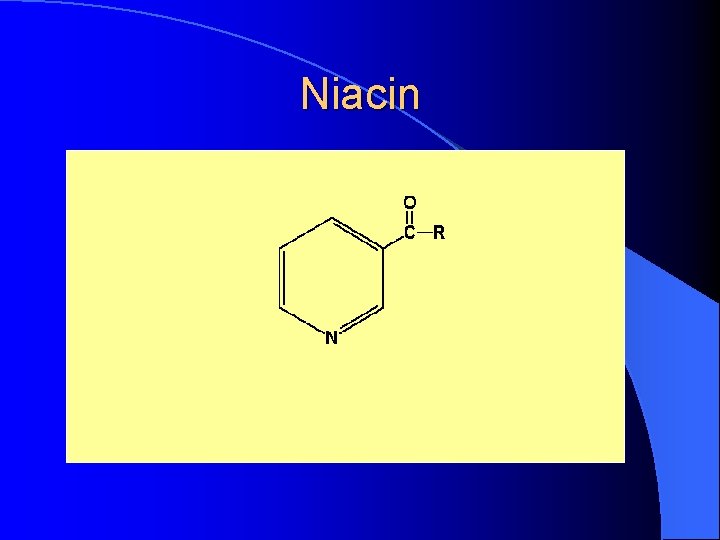
Niacin
Nicotinamide Nicotinic Acid l Can be formed from Tryptophan – (but not the reverse) – (not best to rely upon – cereals low in Try) l Active group of 2 important coenzymes – NAD & NADP (nicotinamide adenine dinucleotide and its phosphate)
Niacin Deficiency l Pellegra in Humans l “Black tongue” in dogs l Pigs – poor growth, enteritis, dermititis
l High corn diets are a problem because corn contains little niacin OR tryptophan
Pellegra l Diarrhoea, Dermatitis, Dementia l Gastrointestinal problems, affected tongue (swollen, beefy), Anorexia l Symmetrical appearing dermititis – Especially parts exposed to light or heat l Mental symptoms
Mental symptoms l Lassitude, apprehension, depression, and loss of memory. l Disorientation, confusion, hysteria, sometimes maniacal outbursts l It gets worse l Encephalopathy – Stupor, delirium, uncontrolled reflexes
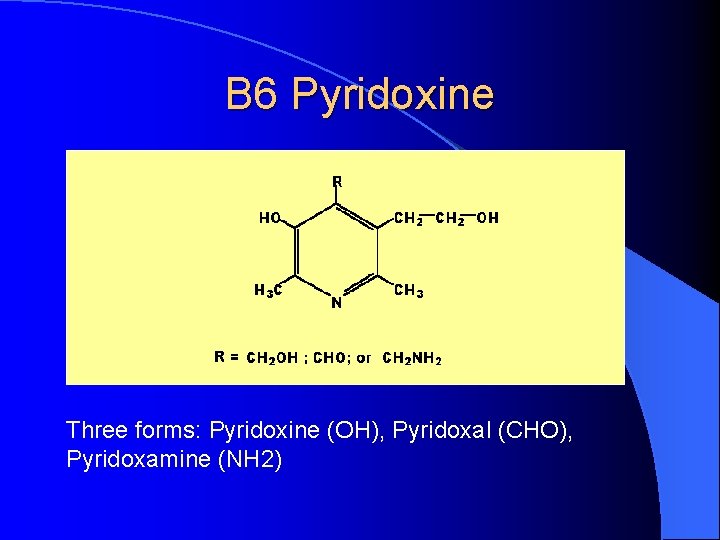
B 6 Pyridoxine Three forms: Pyridoxine (OH), Pyridoxal (CHO), Pyridoxamine (NH 2)
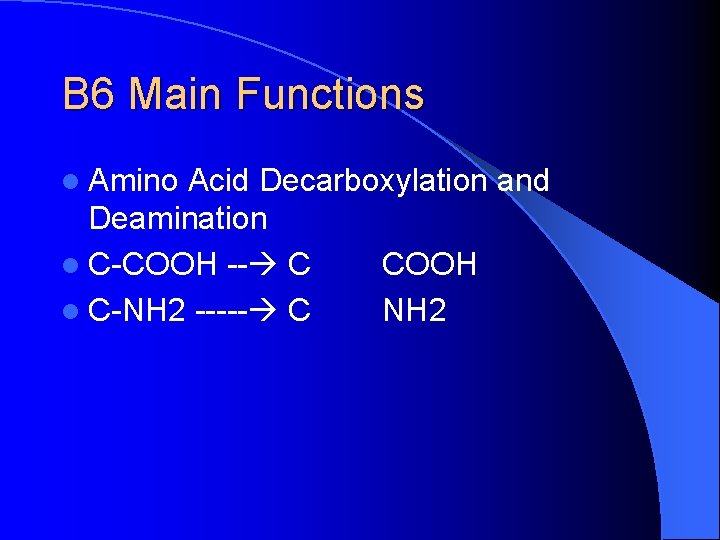
B 6 Main Functions l Amino Acid Decarboxylation and Deamination l C-COOH -- C COOH l C-NH 2 ----- C NH 2
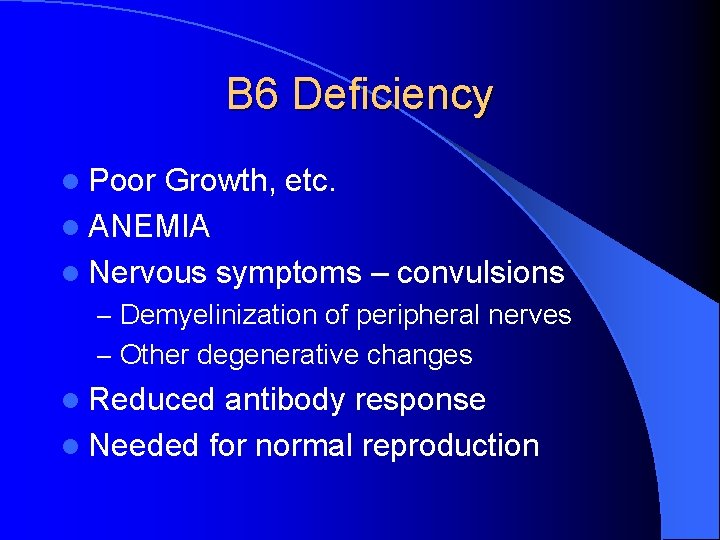
B 6 Deficiency l Poor Growth, etc. l ANEMIA l Nervous symptoms – convulsions – Demyelinization of peripheral nerves – Other degenerative changes l Reduced antibody response l Needed for normal reproduction
l Rqmt for humans increased during pregnancy and oral contraceptive use
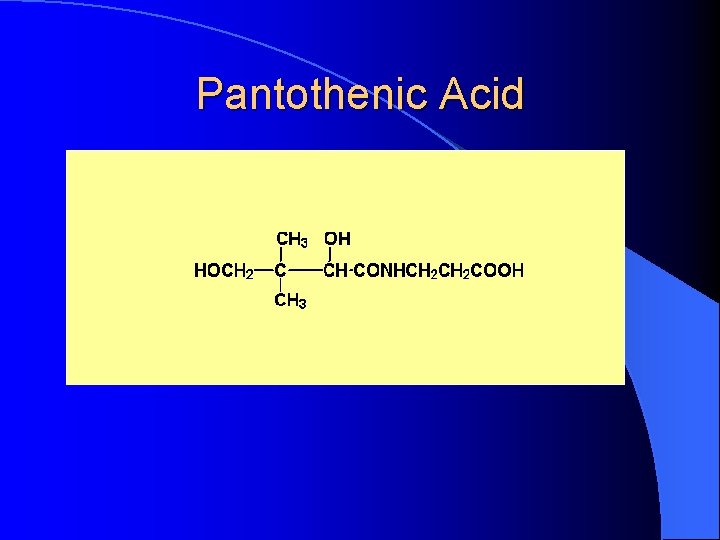
Pantothenic Acid
Pantothenic Acid l Component of Coenzyme A – Fatty Acid breakdown – CHO oxidation – Therefore – to use energy!!!
PA Deficiency l Goose Stepping in pigs – Nervous incoordination l Diarrhea l Loss of hair, skin problems l Poor growth, etc.
l More, of course, but widely distributed in plants and not a serious problem
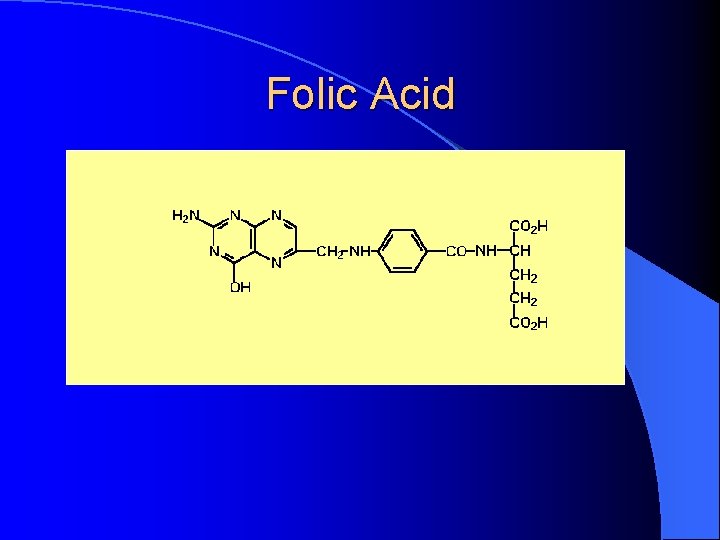
Folic Acid
Folacins l 3 associated compounds have activity l Movement of 1 Carbon residues – COO- and CH 3 – Synthesis of purines and amino acids – Related with B 12
Folic Deficiencies l Anemia – like B 12 but not cured w B 12 l Poor growth l Poor feathering
l Biggest problem is PEOPLE – Pregnancy – neural tube defects l Only Poultry, Pregnant Women and Kids normally need it added
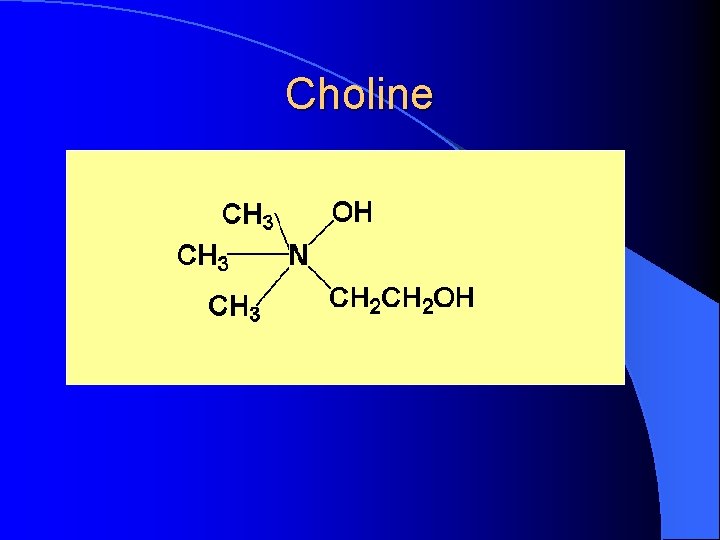
Choline
Choline l Unlike the other vitamins – Actually used up – Can be replaced by other substances, like betaine and methionine l Methyl Donor
Choline deficiency l Slow Growth l Fatty Liver l PEROSIS (also Mn) l Reduced litter size in pigs – Therefore add extra to sow’s diets
l Add LARGE amounts when needed – Light and fluffy – NOT part of regular vitamin mix l Add to Swine (sows) and Poultry diets – (adds ½ pig/litter for sows)
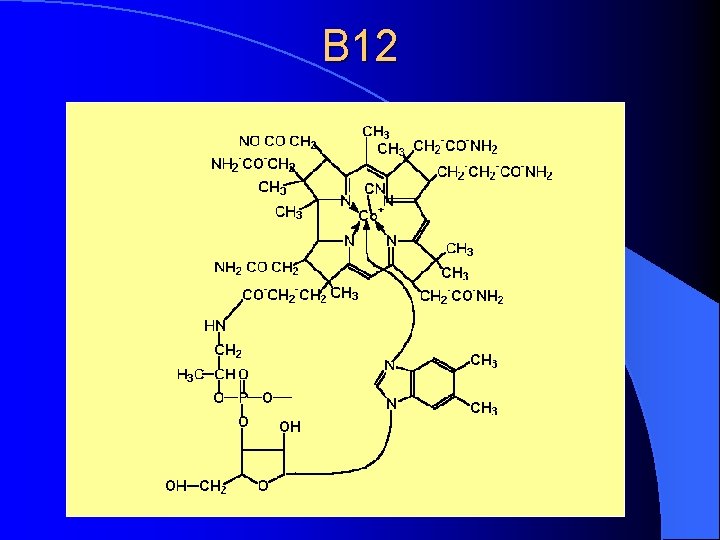
B 12
B 12 Cyanocobalamine l Contains COBALT l APF – Original “Animal Protein Factor” l Anti-pernicious anemia factor l Discovered in 1949
B 12 Function l Synthesis of RNA and DNA l Chemistry of Methyl Groups
INTRINSIC FACTOR l In order to absorb B 12, need Intrinsic Factor from the stomach.
B 12 Deficiency l Pernicious Anemia – Pernicious means “leading to death” l All the symptoms of starvation
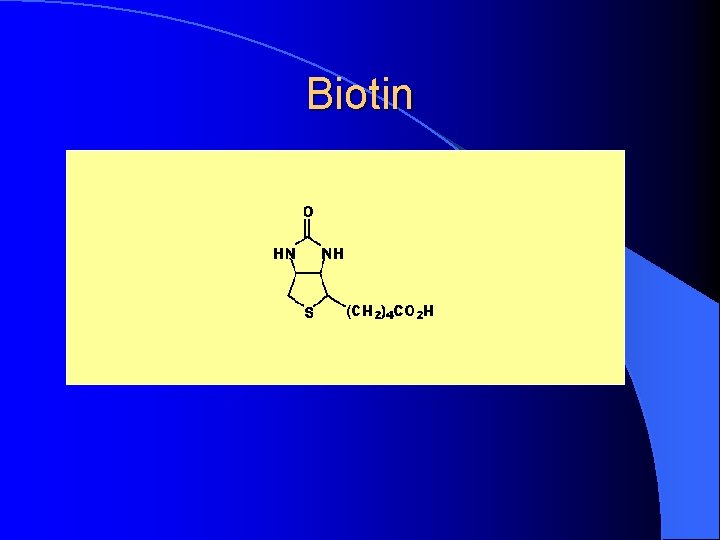
Biotin
Biotin l Role in Fat Synthesis l Problems are skin problems – Dermatitis – Loss of hair l Avidin (in raw egg white) inactivates it l Widely Distributed
HYERVITAMINOSIS l Water Soluble Vitamins – Unusual, reach renal threshold – High enough doses can be pharmocologic l Fat Soluble Vitamins – A & D – TOXIC
End of Vitamins View Vitamin Deficiency Slides
MINERALS Following is only an overview
Minerals l Macro Minerals – Ca, P, Mg, Na, K, Cl, S l Trace Minerals – Fe, Cu, Zn, I, Mn, Cr, Mo, F l Ultra Trace Minerals – maybe more
Macro Minerals l Calcium – bones, teeth, muscle l Phosphorus – bones, soft tissue – Needs proper Ca: P ratio and Vitamin D l Magnesium prevents Grass Tetany l Na (sodium), K (potassium), Cl (chloride) – Osmotic balance, Na pump, muscle, nerve l Sulfur – in proteins & other moleules
Trace Minerals l Iron (Fe) – prevents anemia l Copper (Cu) – need it to use Fe, connective tissue formation l Zinc (Zn) – prevents parakeratosis l Iodine (I) – prevents goiter l Manganese (Mn) need for proper bone, activates enzymes
Trace Minerals continued Need only tiny amounts of these, almost unmeasurable l Chromium (Cr) – CHO metabolism l Molybdenum (Mo) – toxic but essential l Fluorine (F) – toxic but benefits teeth
Ultra Trace Elements l Things in this category MAY be essential but that has not been proven (and accepted generally) l Includes many elements, including: B, As, Ba, Ni, Sr, Va and others l Text book (Church & Pond) accept some (Va) as essential that I do not
- Slides: 176