
BUURTZORG DOUBLE DUTCH ORGANISATIONAL DESIGN Agenda 2 JUST
BUURTZORG DOUBLE DUTCH (ORGANISATIONAL) DESIGN?
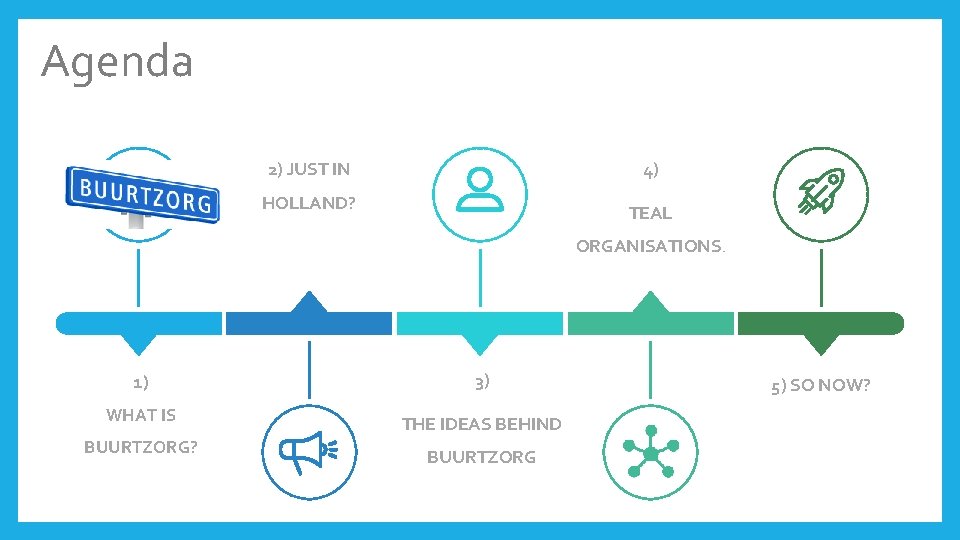
Agenda 2) JUST IN 4) HOLLAND? TEAL ORGANISATIONS. 1) 3) WHAT IS THE IDEAS BEHIND BUURTZORG? BUURTZORG 5) SO NOW?

Jos Started in 2007 with 1 team/4 nurses Delivering community care Buurtzorg - new approach to district nursing and home care services. “The RCN has long supported this model, which was founded in the Netherlands and has garnered international acclaim for its nurse-led, cost-effective principles, which rely upon nurse-innovation leading the way for care of patients in their own communities. ”[5] .
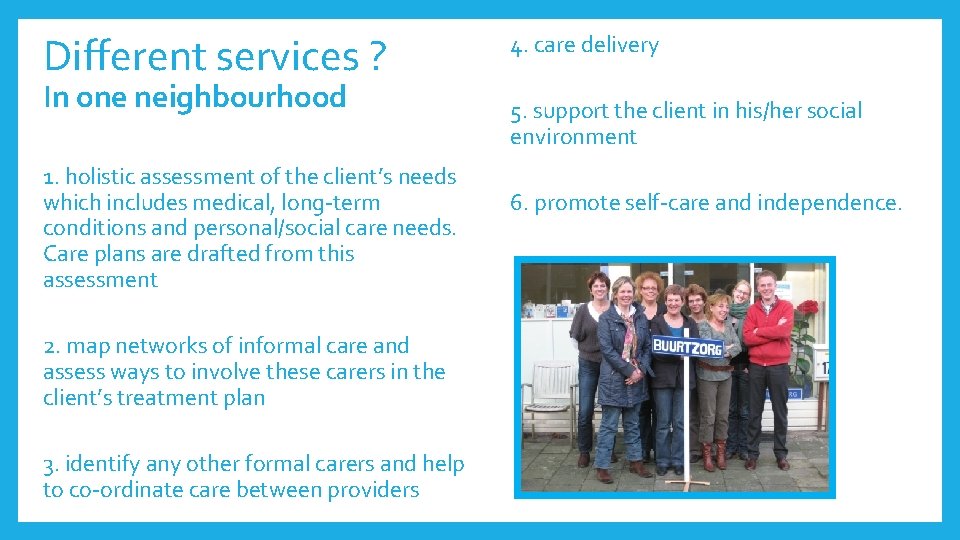
Different services ? In one neighbourhood 1. holistic assessment of the client’s needs which includes medical, long-term conditions and personal/social care needs. Care plans are drafted from this assessment 2. map networks of informal care and assess ways to involve these carers in the client’s treatment plan 3. identify any other formal carers and help to co-ordinate care between providers 4. care delivery 5. support the client in his/her social environment 6. promote self-care and independence.
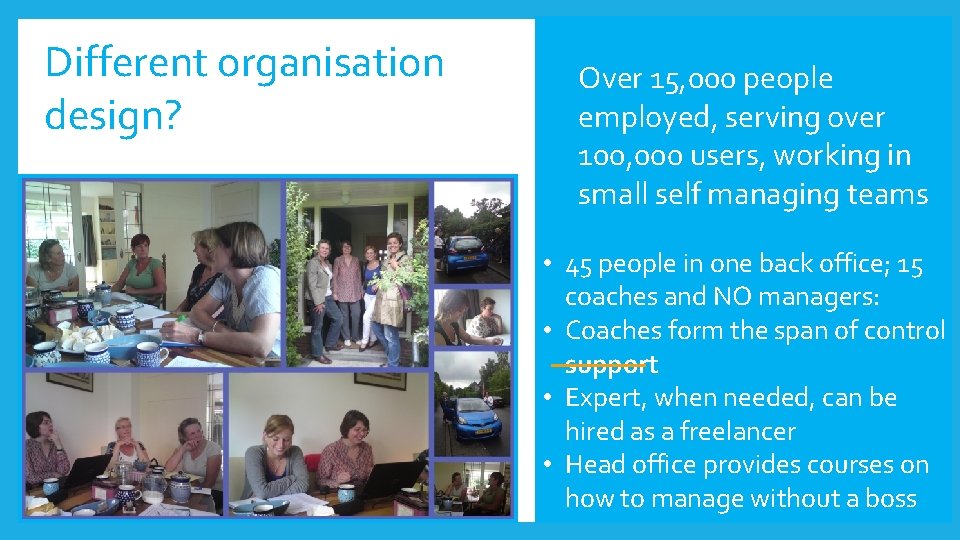
Different organisation design? Over 15, 000 people employed, serving over 100, 000 users, working in small self managing teams • 45 people in one back office; 15 coaches and NO managers: • Coaches form the span of control support • Expert, when needed, can be hired as a freelancer • Head office provides courses on how to manage without a boss
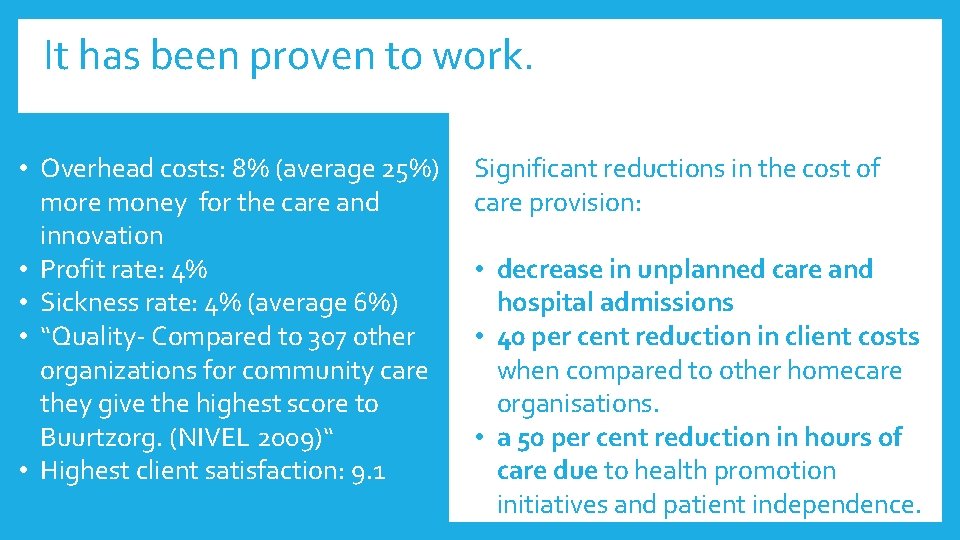
It has been proven to work. • Overhead costs: 8% (average 25%) more money for the care and innovation • Profit rate: 4% • Sickness rate: 4% (average 6%) • “Quality- Compared to 307 other organizations for community care they give the highest score to Buurtzorg. (NIVEL 2009)“ • Highest client satisfaction: 9. 1 Significant reductions in the cost of care provision: • decrease in unplanned care and hospital admissions • 40 per cent reduction in client costs when compared to other homecare organisations. • a 50 per cent reduction in hours of care due to health promotion initiatives and patient independence.
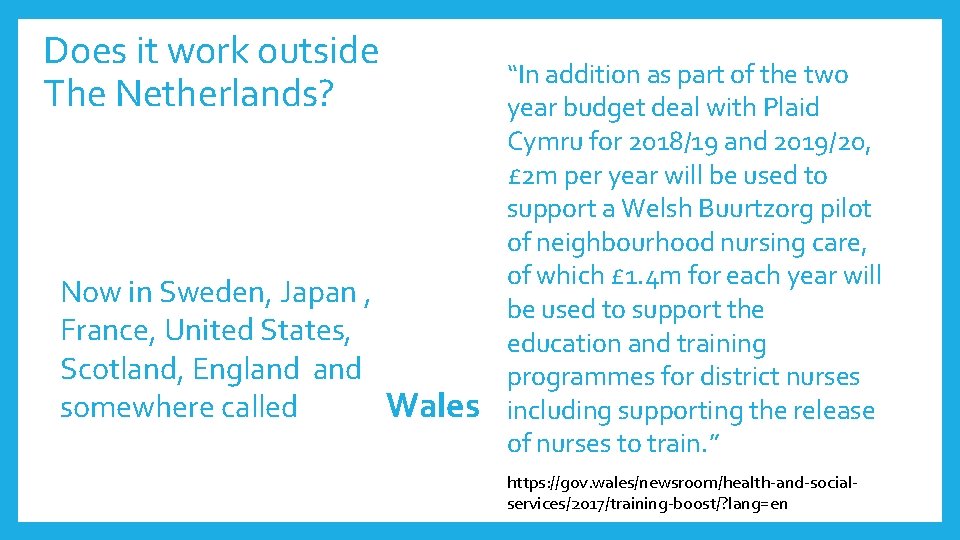
Does it work outside The Netherlands? Now in Sweden, Japan , France, United States, Scotland, England somewhere called Wales “In addition as part of the two year budget deal with Plaid Cymru for 2018/19 and 2019/20, £ 2 m per year will be used to support a Welsh Buurtzorg pilot of neighbourhood nursing care, of which £ 1. 4 m for each year will be used to support the education and training programmes for district nurses including supporting the release of nurses to train. ” https: //gov. wales/newsroom/health-and-socialservices/2017/training-boost/? lang=en
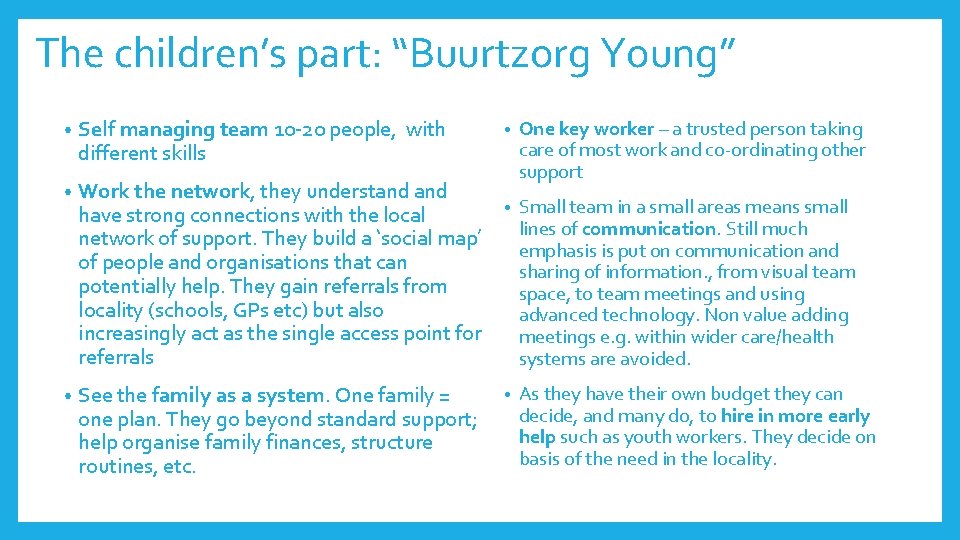
The children’s part: “Buurtzorg Young” • Self managing team 10 -20 people, with different skills • Work the network, they understand have strong connections with the local network of support. They build a ‘social map’ of people and organisations that can potentially help. They gain referrals from locality (schools, GPs etc) but also increasingly act as the single access point for referrals • See the family as a system. One family = one plan. They go beyond standard support; help organise family finances, structure routines, etc. • One key worker – a trusted person taking care of most work and co-ordinating other support • Small team in a small areas means small lines of communication. Still much emphasis is put on communication and sharing of information. , from visual team space, to team meetings and using advanced technology. Non value adding meetings e. g. within wider care/health systems are avoided. • As they have their own budget they can decide, and many do, to hire in more early help such as youth workers. They decide on basis of the need in the locality.
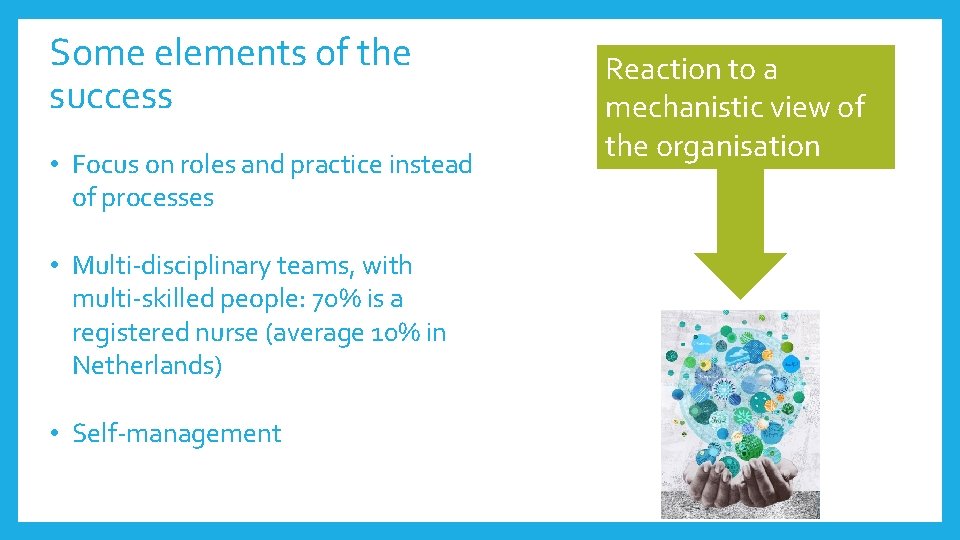
Some elements of the success • Focus on roles and practice instead of processes • Multi-disciplinary teams, with multi-skilled people: 70% is a registered nurse (average 10% in Netherlands) • Self-management Reaction to a mechanistic view of the organisation
TEAL MODELS PRINCIPLES BEHIND BUURTZORG AND OTHERS
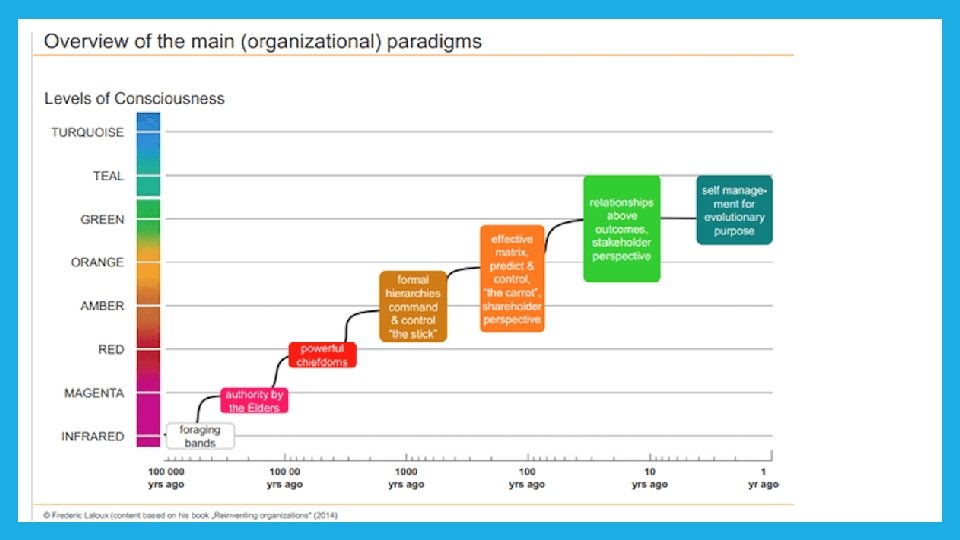
What lies at the basis…is it replicable? Foundation of concepts…. various People/organisations: Ricardo Semler, Bill Gore (of Gore-Tex), Eckart Wintzen (BSO), Valve, Zappo’s – Agile movement q Delegated leadership q Cell-philosophy > small teams • Buurtzorg: Skilled nurses working together in a team of no more than 12, in a neighbourhood of 10, 000 people, caring for all kinds of patients. q q Now part of ‘Teal’ or Holocracy’ ideas – especially after “Reinventing the organisation book”
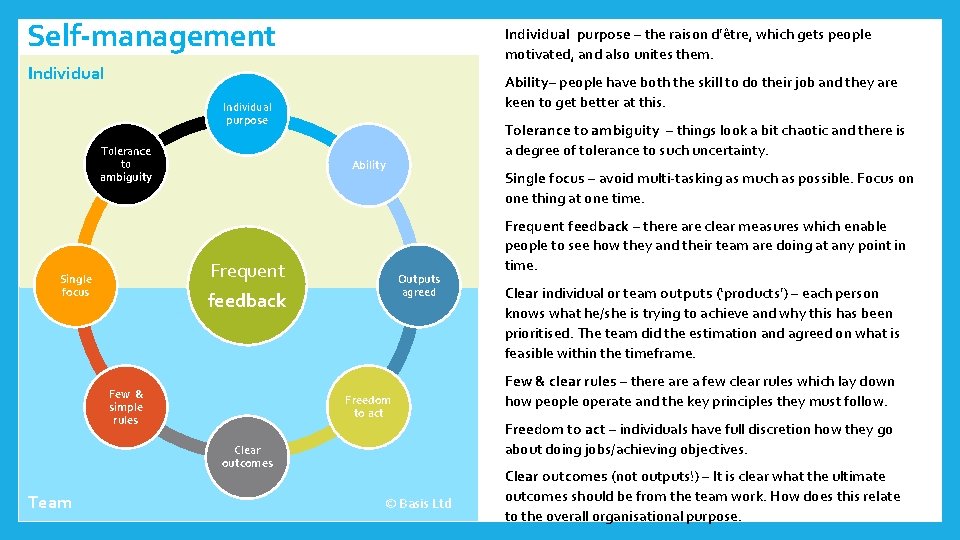
Self-management Individual purpose – the raison d’être, which gets people motivated, and also unites them. Individual Ability– people have both the skill to do their job and they are keen to get better at this. Individual purpose Tolerance to ambiguity Ability Frequent Single focus Tolerance to ambiguity – things look a bit chaotic and there is a degree of tolerance to such uncertainty. Outputs agreed feedback Few & simple rules Single focus – avoid multi-tasking as much as possible. Focus on one thing at one time. Freedom to act Clear outcomes Team © Basis Ltd Frequent feedback – there are clear measures which enable people to see how they and their team are doing at any point in time. Clear individual or team outputs (‘products’) – each person knows what he/she is trying to achieve and why this has been prioritised. The team did the estimation and agreed on what is feasible within the timeframe. Few & clear rules – there a few clear rules which lay down how people operate and the key principles they must follow. Freedom to act – individuals have full discretion how they go about doing jobs/achieving objectives. Clear outcomes (not outputs!) – It is clear what the ultimate outcomes should be from the team work. How does this relate to the overall organisational purpose.
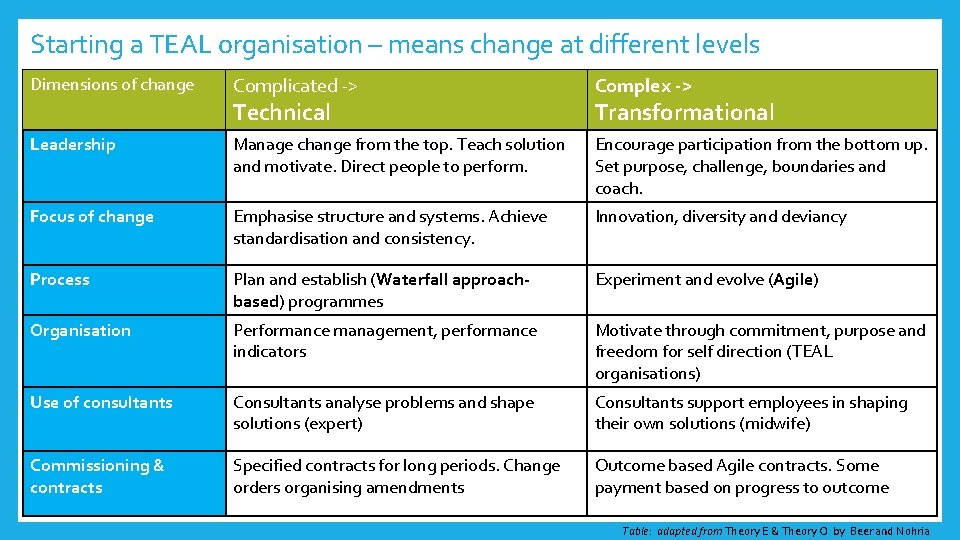
Starting a TEAL organisation – means change at different levels Complicated -> Complex -> Leadership Manage change from the top. Teach solution and motivate. Direct people to perform. Encourage participation from the bottom up. Set purpose, challenge, boundaries and coach. Focus of change Emphasise structure and systems. Achieve standardisation and consistency. Innovation, diversity and deviancy Process Plan and establish (Waterfall approachbased) programmes Experiment and evolve (Agile) Organisation Performance management, performance indicators Motivate through commitment, purpose and freedom for self direction (TEAL organisations) Use of consultants Consultants analyse problems and shape solutions (expert) Consultants support employees in shaping their own solutions (midwife) Commissioning & contracts Specified contracts for long periods. Change orders organising amendments Outcome based Agile contracts. Some payment based on progress to outcome Dimensions of change Technical Transformational Table: adapted from Theory E & Theory O by Beer and Nohria
FOR MORE INFORMATION 079 80 54 1990 DENNIS. VERGNE@BASIS. CO. UK JOSEPH. BADMAN@BASIS. CO. UK
- Slides: 15