
But how reliable are these statistics Reliability of
But how reliable are these statistics? Reliability of Disaster Statistics
Let’s have a look at two examples Using the templates provided you are going to research 1 example of mega-disasters from either: 2010 Eyjafjallajokull volcano 2011 Japanese Tohoku tsunami You’re going to exchange notes with your partner on the other
Key Enquiry Question 3: How successful is the management of tectonic hazards and disasters? LO: To understand the concept of a multiple-hazard zone. Which countries stand out as being the most hazard prone in the world? . . . Any ideas?
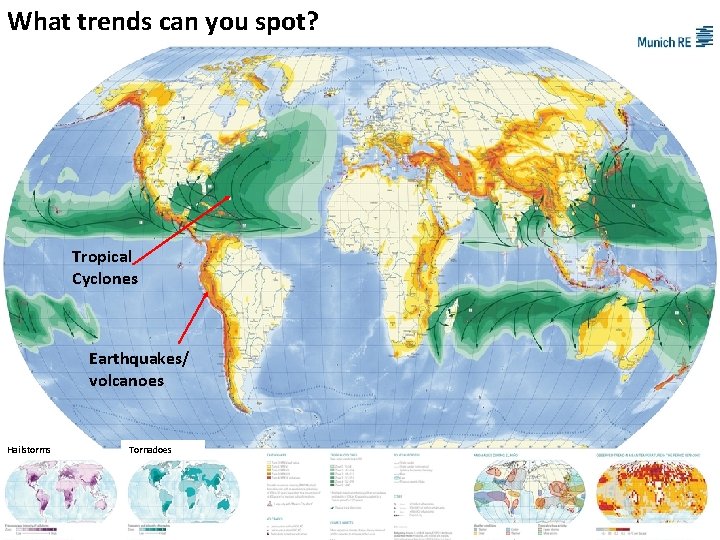
What trends can you spot? Tropical Cyclones Earthquakes/ volcanoes Hailstorms Tornadoes
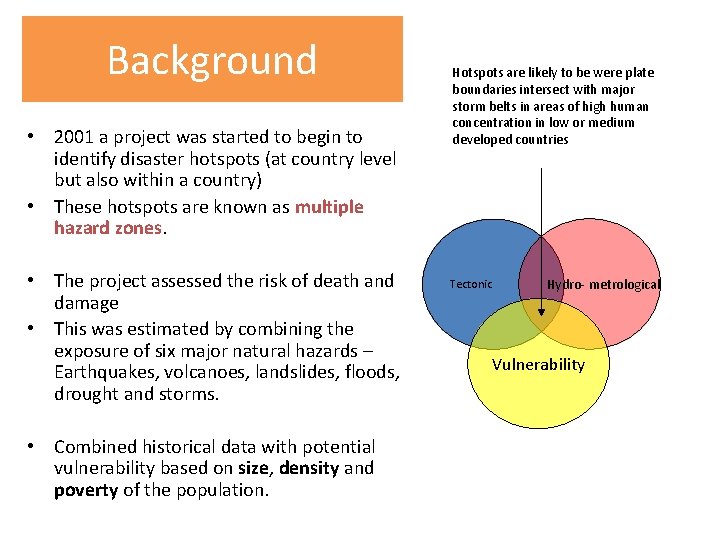
Background • 2001 a project was started to begin to identify disaster hotspots (at country level but also within a country) • These hotspots are known as multiple hazard zones. • The project assessed the risk of death and damage • This was estimated by combining the exposure of six major natural hazards – Earthquakes, volcanoes, landslides, floods, drought and storms. • Combined historical data with potential vulnerability based on size, density and poverty of the population. Hotspots are likely to be were plate boundaries intersect with major storm belts in areas of high human concentration in low or medium developed countries Tectonic Hydro- metrological Vulnerability
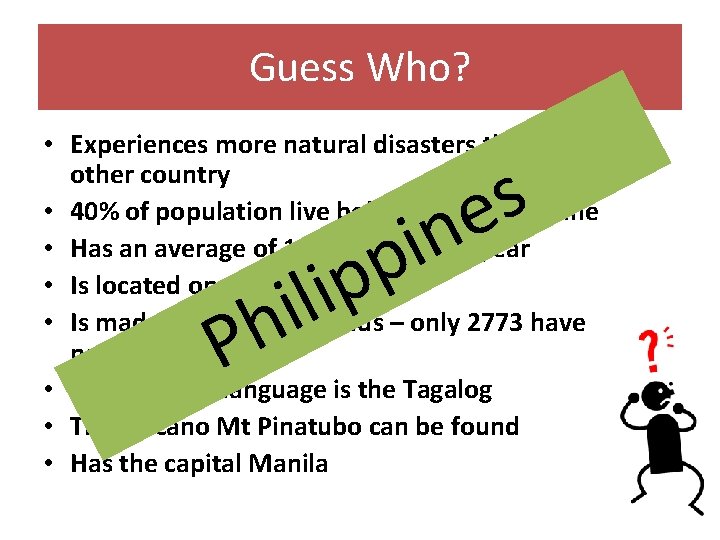
Guess Who? • Experiences more natural disasters than any other country • 40% of population live below the poverty line • Has an average of 10 typhoons per year • Is located on the ‘Ring of Fire’ • Is made up of 7, 107 islands – only 2773 have names! • The national language is the Tagalog • The volcano Mt Pinatubo can be found • Has the capital Manila i h P p il p s e in
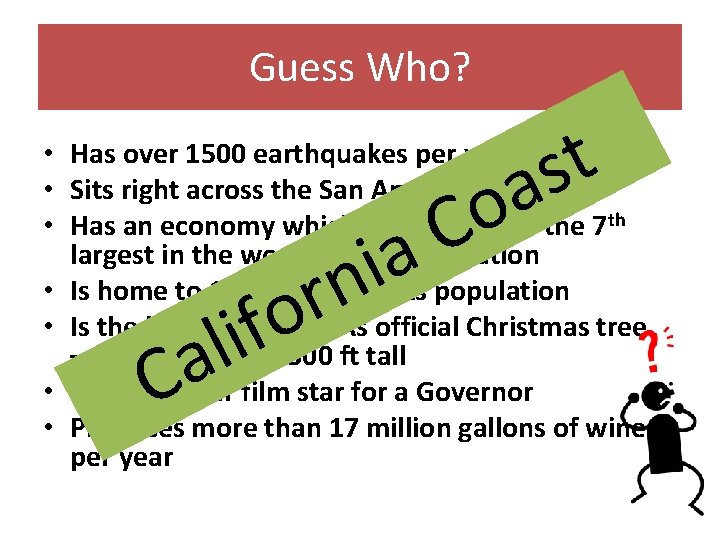
Guess Who? t s a • Has over 1500 earthquakes per year • Sits right across the San Andreas Fault • Has an economy which would rank as the 7 th largest in the world if it were a nation • Is home to 1 in 8 of the USAs population • Is the home of the USAs official Christmas tree – a giant sequoia 300 ft tall • Had a former film star for a Governor • Produces more than 17 million gallons of wine per year l a C n r fi o o C ia
California Coast Philippines Average income (US$) Country type Human development index Annual population growth Under 5 mortality rate Physical geography Hazards 45, 000 HIC 2. 3% 0. 78 Plains and mountain ranges 7 per 1, 000 0. 95 RIC 40 per 1, 000 1, 415 Numerous volcanic islands Earthquakes, volcanoes, landslides/lahars, typhoons, flooding Earthquakes, tsunamis, flash floods, fire
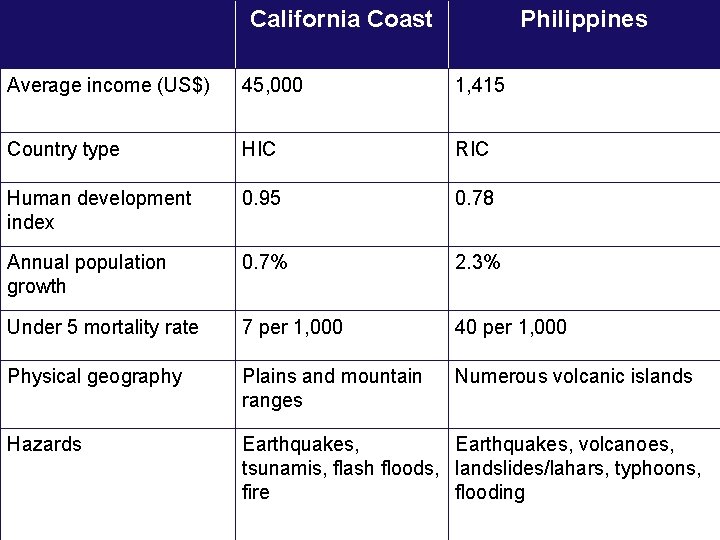
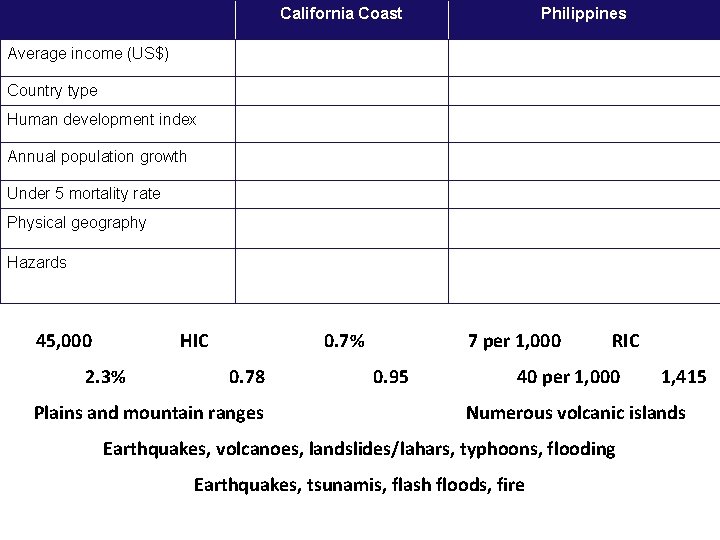
California Coast Philippines Average income (US$) 45, 000 1, 415 Country type HIC RIC Human development index 0. 95 0. 78 Annual population growth 0. 7% 2. 3% Under 5 mortality rate 7 per 1, 000 40 per 1, 000 Physical geography Plains and mountain ranges Numerous volcanic islands Hazards Earthquakes, volcanoes, tsunamis, flash floods, landslides/lahars, typhoons, fire flooding
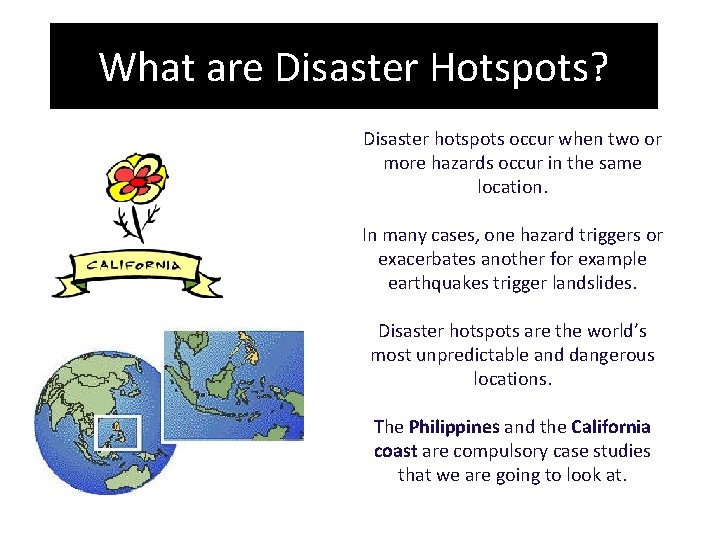
What are Disaster Hotspots? Disaster hotspots occur when two or more hazards occur in the same location. In many cases, one hazard triggers or exacerbates another for example earthquakes trigger landslides. Disaster hotspots are the world’s most unpredictable and dangerous locations. The Philippines and the California coast are compulsory case studies that we are going to look at.
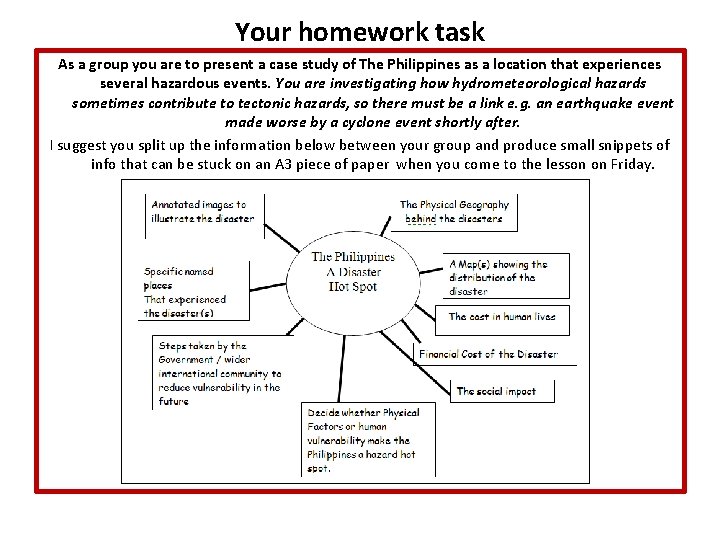
Your homework task As a group you are to present a case study of The Philippines as a location that experiences several hazardous events. You are investigating how hydrometeorological hazards sometimes contribute to tectonic hazards, so there must be a link e. g. an earthquake event made worse by a cyclone event shortly after. I suggest you split up the information below between your group and produce small snippets of info that can be stuck on an A 3 piece of paper when you come to the lesson on Friday.
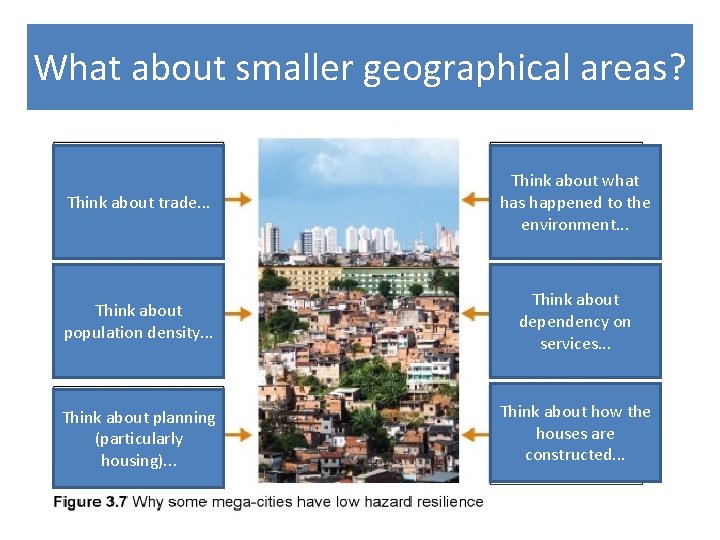
What about smaller geographical areas? Think about trade. . . Think about what has happened to the environment. . . Think about population density. . . Think about dependency on services. . . Think about planning (particularly housing). . . Think about how the houses are constructed. . .
- Slides: 12