
BusinessCentric Methodology For Enterprise Agility Interoperability OASIS BCM
Business-Centric Methodology For Enterprise Agility & Interoperability OASIS BCM Technical Committee 1
BCM in a Nutshell • Reduce the cost of doing business by making e. Business more accessible • Improve the time to market for new business solutions through information agility • Reduce the cost of ownership for community, industry groups / governments • Restoring the balance – the business solution and customers direct how the information technology serves 2
Agenda • Landscape • Approach – Learning the Terrain – Understanding Today’s Solutions – Paradigm Shift – Foundation of BCM • BCM Layers • Information Architecture • BCM Templates – Declarative Component Operations • Implementation – – Becoming Net. Centric Service Oriented Architecture (SOA) Communities and Domains Context – Managing via Choice Points • Adoption – – Holistic Approach Planning and Facilitation Resources and Existing Work Mission Summary 3
Landscape § Learning the Terrain § Understanding Today’s Solutions § Paradigm Shift 4
Learning the Terrain It is helpful to look back in time… … requirements have been documented … with the architecture completed to varying levels of resolution. … subject matter experts have met to define their processes and data … components are procured for the solution that best match the architecture … transition plans are in place and everyone is ready to pilot and implement … the need for change has been communicated to all stakeholders Now what? … customer’s begin to see capabilities that fit their needs … the team learns if interoperability was designed in properly … if the proposed infrastructure supports stakeholder collaboration … if semantics of the business are being managed or not … if ‘standardizations’ were selected correctly, based on the right Co. Is We learn if we were asking the right questions 5 Source: e. Process Solutions
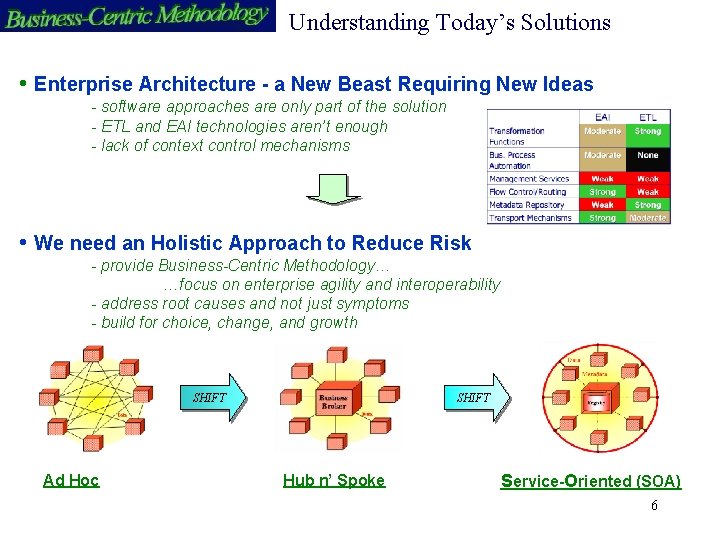
Understanding Today’s Solutions • Enterprise Architecture - a New Beast Requiring New Ideas - software approaches are only part of the solution - ETL and EAI technologies aren’t enough - lack of context control mechanisms • We need an Holistic Approach to Reduce Risk - provide Business-Centric Methodology… …focus on enterprise agility and interoperability - address root causes and not just symptoms - build for choice, change, and growth SHIFT Source: e. Process Solutions Ad Hoc Hub n’ Spoke Service-Oriented (SOA) 6
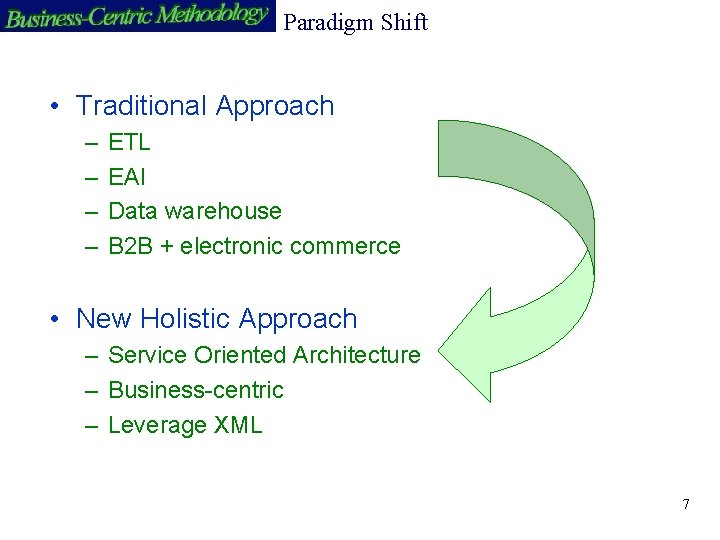
Paradigm Shift • Traditional Approach – – ETL EAI Data warehouse B 2 B + electronic commerce • New Holistic Approach – Service Oriented Architecture – Business-centric – Leverage XML 7

Approach § Foundation of BCM § BCM Layers § Information Architecture § BCM Templates § Declarative Component Operations 8
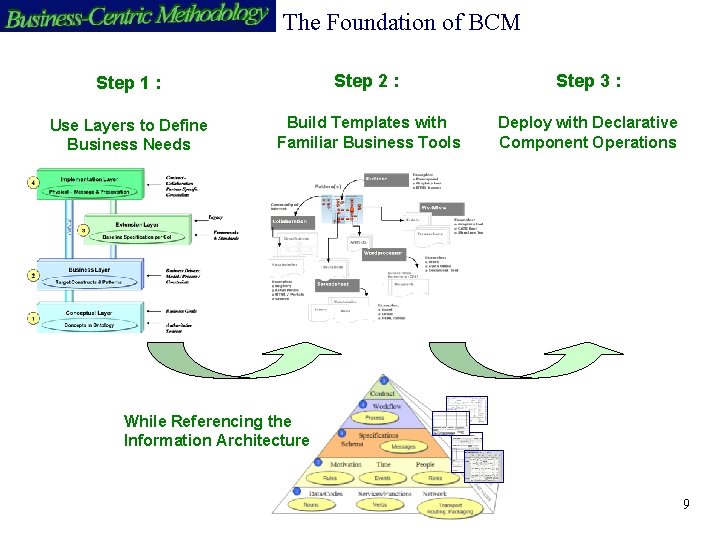
The Foundation of BCM Step 1 : Step 2 : Step 3 : Use Layers to Define Business Needs Build Templates with Familiar Business Tools Deploy with Declarative Component Operations While Referencing the Information Architecture 9
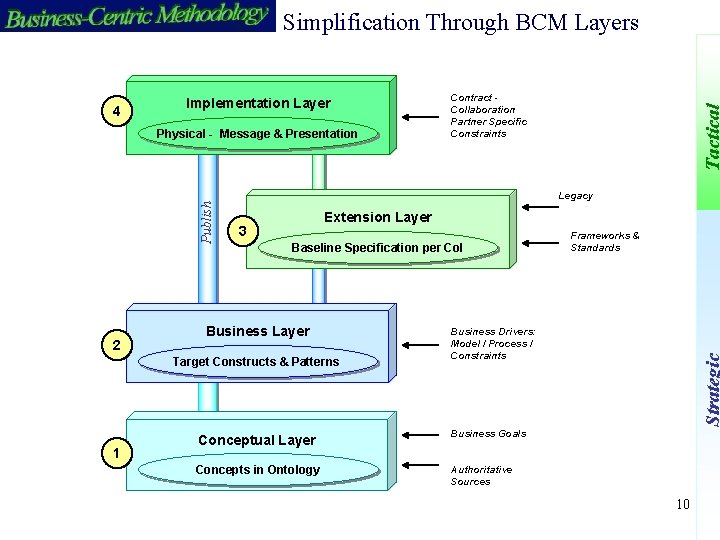
Simplification Through BCM Layers Publish 2 Legacy Extension Layer 3 Baseline Specification per Co. I Business Layer Target Constructs & Patterns 1 Tactical Physical - Message & Presentation Contract Collaboration Partner Specific Constraints Frameworks & Standards Business Drivers: Model / Process / Constraints Conceptual Layer Business Goals Concepts in Ontology Authoritative Sources Strategic 4 Implementation Layer 10
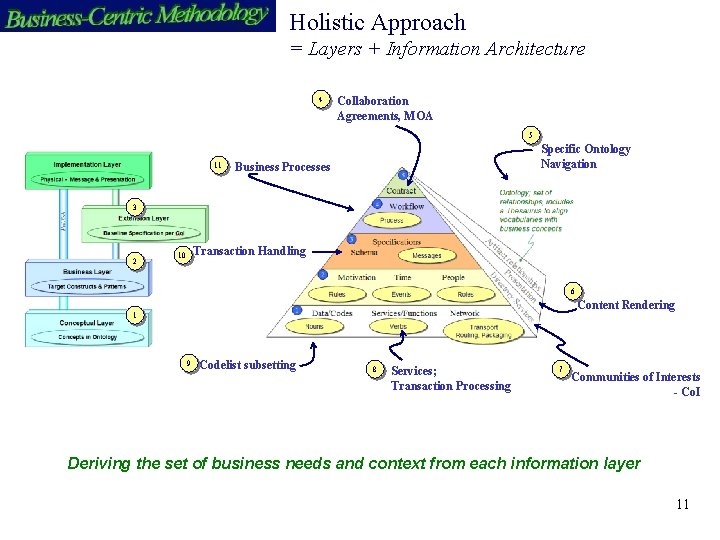
Holistic Approach = Layers + Information Architecture 4 Collaboration Agreements, MOA 5 11 Specific Ontology Navigation Business Processes 3 2 Transaction Handling 10 6 Content Rendering 1 9 Codelist subsetting 8 Services; Transaction Processing 7 Communities of Interests - Co. I Source: e. Process Solutions Deriving the set of business needs and context from each information layer 11
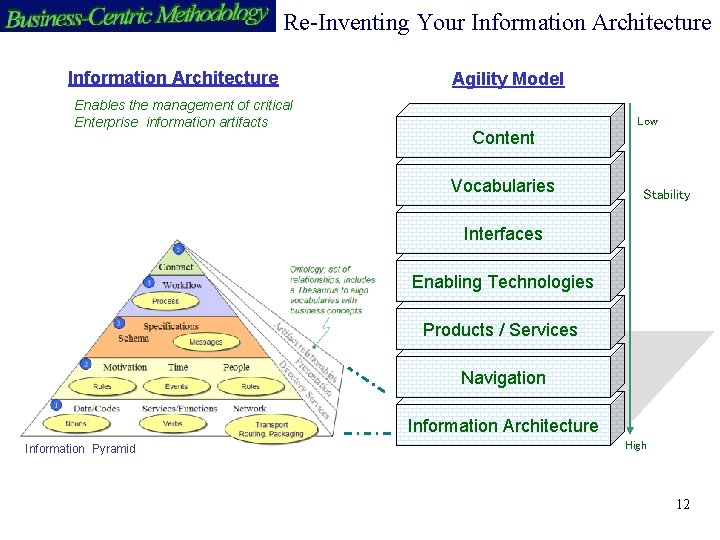
Re-Inventing Your Information Architecture Enables the management of critical Enterprise information artifacts Agility Model Low Content Vocabularies Stability Interfaces Enabling Technologies Products / Services Navigation Information Architecture Information Pyramid High 12
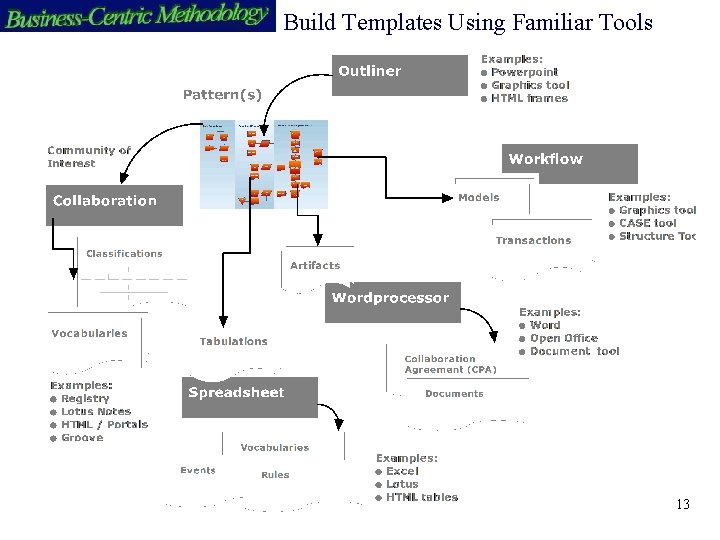
Build Templates Using Familiar Tools 13
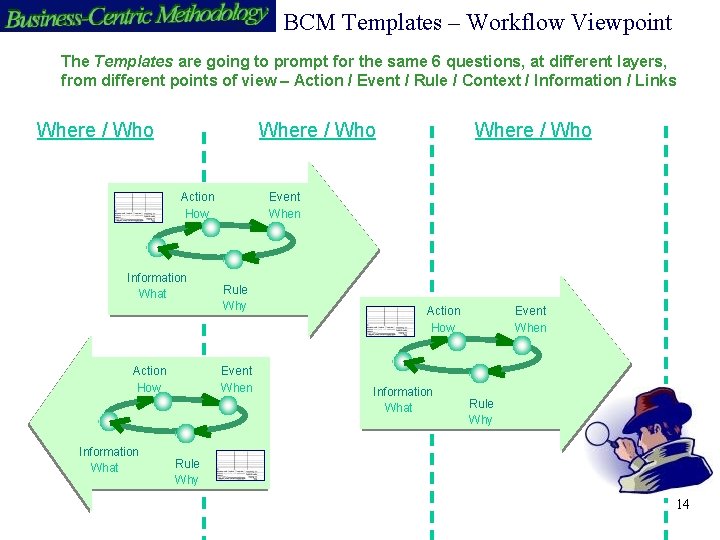
BCM Templates – Workflow Viewpoint The Templates are going to prompt for the same 6 questions, at different layers, from different points of view – Action / Event / Rule / Context / Information / Links Where / Who Action How Information What Where / Who Event When Rule Why Event When Action How Information What Event When Rule Why 14
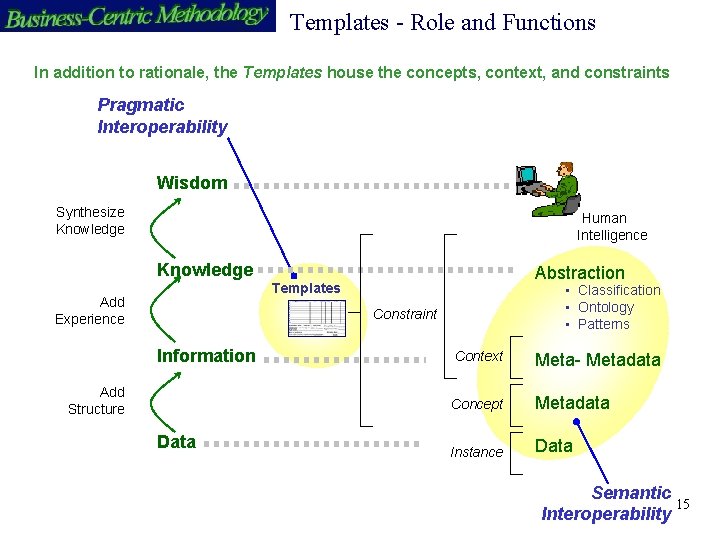
Templates - Role and Functions In addition to rationale, the Templates house the concepts, context, and constraints Pragmatic Interoperability Wisdom Synthesize Knowledge Human Intelligence Knowledge Abstraction Templates Add Experience • Classification • Ontology • Patterns Constraint Information Add Structure Data Context Meta- Metadata Concept Metadata Instance Data Semantic 15 Interoperability
Operational View Declarative Components of Interoperability 16
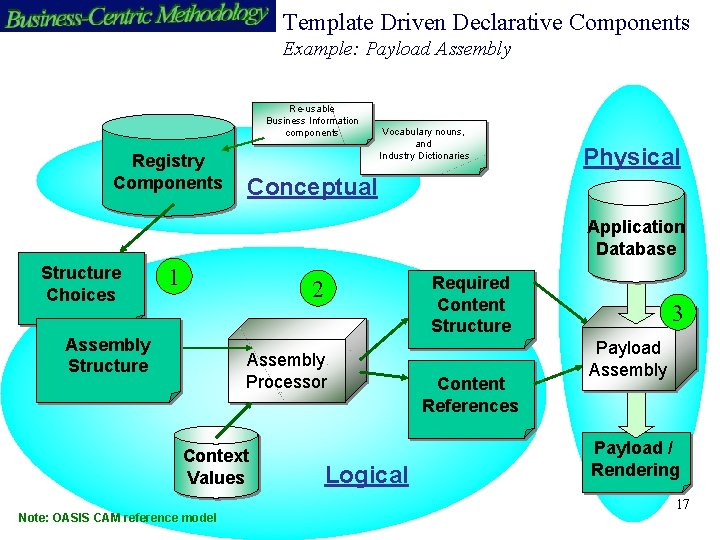
Template Driven Declarative Components Example: Payload Assembly Re-usable Business Information components Registry Components Vocabulary nouns, and Industry Dictionaries Physical Conceptual Application Database Structure Choices 1 Required Content Structure 2 Assembly Structure Assembly Processor Context Values Note: OASIS CAM reference model Logical Content References 3 Payload Assembly Payload / Rendering 17
Implementation § Becoming Net. Centric § Service-Oriented Architecture § Communities and Domains § Managing Context - Choice Points 18
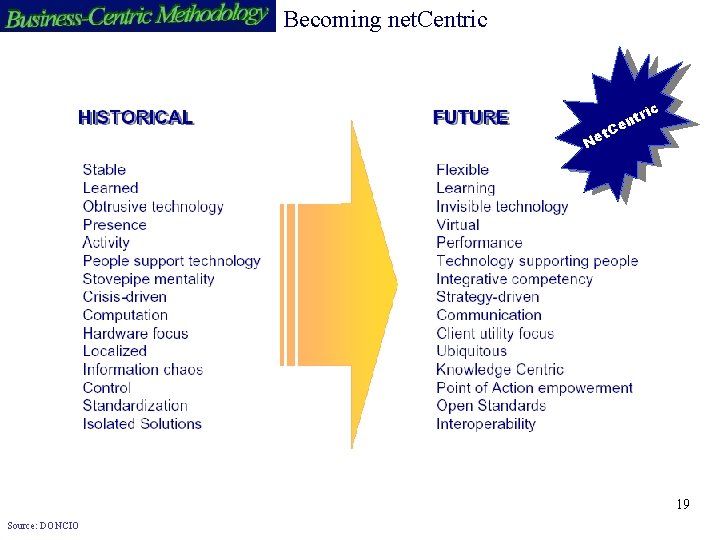
Becoming net. Centric t en t. C Ne 19 Source: DONCIO
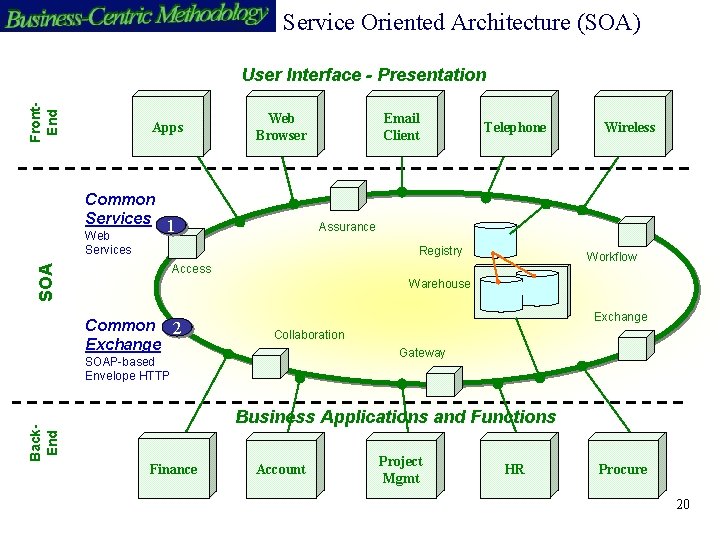
Service Oriented Architecture (SOA) Back. End Enterprise Information Services. SOA Layer - EISL Front. End User Interface - Presentation Apps Web Browser Common Services 1 Email Client Telephone Assurance Web Services Registry DCR Workflow Access Warehouse Common 2 Exchange Wireless DCD DCW Exchange Collaboration Gateway SOAP-based Envelope HTTP Business Applications and Functions Finance Account Project Mgmt HR Procure 20 Backup for side: 25
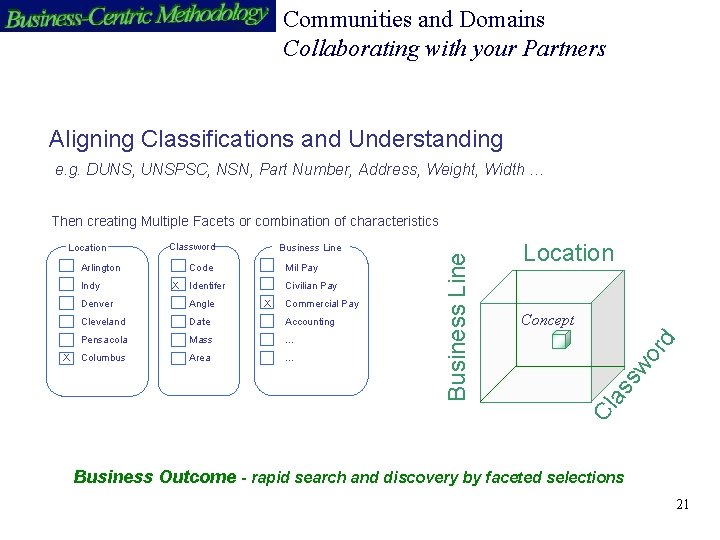
Communities and Domains Collaborating with your Partners Aligning Classifications and Understanding e. g. DUNS, UNSPSC, NSN, Part Number, Address, Weight, Width … Indy Mil Pay Identifer Civilian Pay X Commercial Pay Denver Angle Cleveland Date Accounting Pensacola Mass . . . Columbus Area … Location Concept Cl X X Code rd Arlington Business Line sw o Classword as Location Business Line Then creating Multiple Facets or combination of characteristics Business Outcome - rapid search and discovery by faceted selections 21
Context - Understanding • Context is the pervasive driver to effective engineering • Providing and managing context is needed to drive dynamic process configuring and control • Knowing context is needed to ensure accurate information capture, packaging and delivery • Qualifying context is key to ensuring correct relationships between partners in a collaboration Lack of context control mechanisms is the most prominent reason why legacy e-Business systems are difficult and complex to extend and support Date: circa 1568 1 : the parts of a discourse that surround a word or passage and can throw light on its meaning 2 : the interrelated conditions in which something exists or occurs 22
Context - Sample Types • • • Community of Interest determination Business agreement context Business agreement roles Classification of artifacts context Process selection context Process tracking context Transaction context Exception handling context Decisions context Rules context Choices tend to be one off and embedded in code, rather than an approach from a strategic viewpoint – people don’t look outside their purview 23
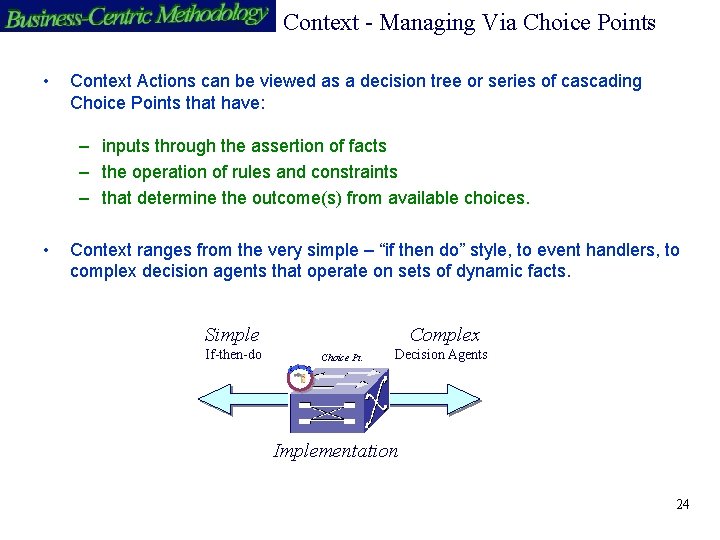
Context - Managing Via Choice Points • Context Actions can be viewed as a decision tree or series of cascading Choice Points that have: – inputs through the assertion of facts – the operation of rules and constraints – that determine the outcome(s) from available choices. • Context ranges from the very simple – “if then do” style, to event handlers, to complex decision agents that operate on sets of dynamic facts. Simple If-then-do Complex Choice Pt. Decision Agents Implementation 24
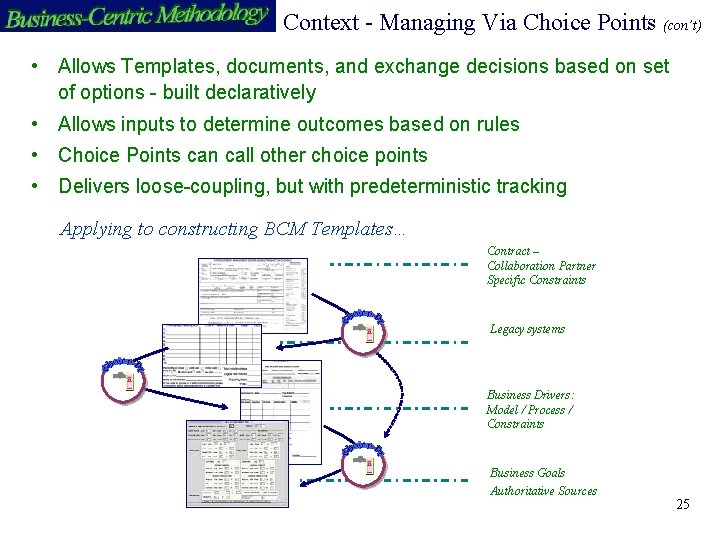
Context - Managing Via Choice Points (con’t) • Allows Templates, documents, and exchange decisions based on set of options - built declaratively • Allows inputs to determine outcomes based on rules • Choice Points can call other choice points • Delivers loose-coupling, but with predeterministic tracking Applying to constructing BCM Templates… Contract – Collaboration Partner Specific Constraints Legacy systems Business Drivers: Model / Process / Constraints Business Goals Authoritative Sources 25
Adoption § Holistic Approach § Planning and Facilitation § Resources and Existing work § Mission Summary 26
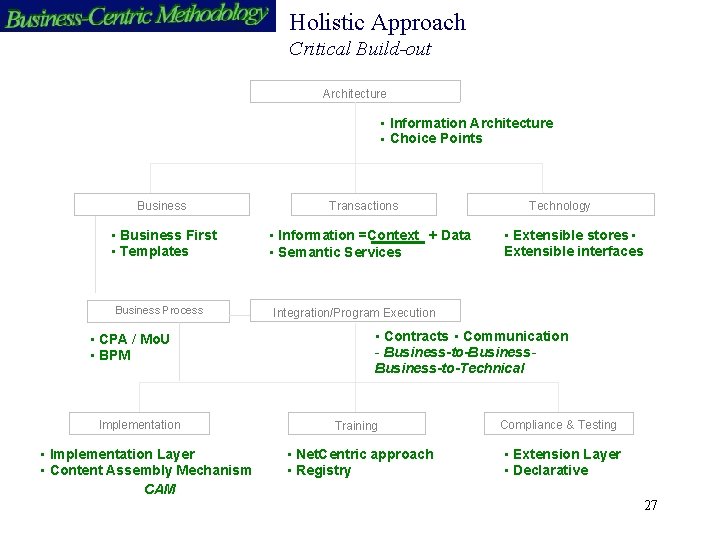
Holistic Approach Critical Build-out Architecture • Information Architecture • Choice Points Business • Business First • Templates Business Process • CPA / Mo. U • BPM Implementation • Implementation Layer • Content Assembly Mechanism CAM Transactions • Information =Context + Data • Semantic Services Technology • Extensible stores • Extensible interfaces Integration/Program Execution • Contracts • Communication - Business-to-Business-to-Technical Training • Net. Centric approach • Registry Compliance & Testing • Extension Layer • Declarative 27
Planning And Facilitation 28
Resources and Existing Work • Working with selected Communities of Interest (Co. I) • Defense Finance and Accounting Service (US Do. D) • epr. XML (Norway) • OASIS e. Gov • Liaison with OASIS TCs to refine requirements and implementation model • Public release of technical specification • Prototype using available tools • Demonstration using selected business scenarios 29
Mission Summary Interoperable Agile Information for e-Business … • addresses the root cause rather than just symptoms of our integration problems by providing semantic and pragmatic interoperability • is business-centric; shifting power to the business experts; managing Enterprise artifacts and governance through Communities of Interests (Co. I) • provides visibility, accessibility, understandability, using open declarative mechanisms that allow for mass customization of diverse vocabularies and models within heterogeneous environments • insulates business from the high rate of change of technology by dividing the problem into multiple levels and applying constraints properly to reduce complexity and promote reuse • provides for Enterprise agility and prepares the Enterprise for new opportunities in doing business A tactical-only solution is a waste of money – we need to adopt an Enterprise solution that addresses business context and people. 30
OASIS- Business-Centric Methodology Thank You! http: //dfas. info http: //www. oasis-open. org 31
- Slides: 31