
Business Transformation Initiative Strategy and Planning Phase Deliverable
Business Transformation Initiative Strategy and Planning Phase Deliverable 04 - Benchmark Comparison Report Final
Table of Contents § § § Executive Summary Approach List of Peer Organizations Current L&I Performance Measures Overview Benchmarking Comparison – Are people who live and work in Washingtonian safe? – Are people who live and work in Washingtonian working? – Are users/customers satisfied with their relationship with L&I? § Appendices Washington State Department of Labor & Industries 2
Executive Summary There are two ways to evaluate performance: § Compare to past performance to see if performance is improving or not § Compare to the performance of others – a benchmark – to see how performance “measures up” This report was created by 1) reviewing existing and past information on L&I’s performance and 2) comparing it to the performance of peer organizations. We considered the information in the context of three strategic questions about L&I’s performance as it affects L&I users: 1. Are people who live and work in Washington safe? • Including safe workplaces, safe equipment, and appropriate licensing 2. Are people who live and work in Washington working? • Including return-to-work, fair worker compensation and treatment, and apprenticeship opportunities 3. Are users/customers satisfied with their relationship with L&I? Note: The report summary distributed during the Enterprise Design Lab used a forth question “ Is L&I achieving the levels of compliance that people can expect? ”. This has been folded into questions 1 and 2. Washington State Department of Labor & Industries 3
Executive Summary Cont. Findings: L&I has strong, outcome based measures related to workers being safe and working, is able to track that performance over time, and L&I compares favorably to peer organizations in these areas. In contrast, L&I has few enterprise level, outcome based measures on equipment safety and licensing. This is an area where peer organizations also struggle. In these areas measures tend to focus on volume of activity, cycle time or finances rather than outcomes. L&I has multiple measures of customer satisfaction but none are enterprise wide. Peer organizations offer a spectrum of examples of metrics in this area. Some peers have developed effective mechanisms to make performance information easily available and accessible to the public. The ability for the public to access relevant L&I data in an easy and centralized manner remains limited. Washington State Department of Labor & Industries 4

Executive Summary Cont. Action Steps: Based on findings of this review we recommend L&I explore the following: Action Steps Considerations Develop outcome-based metrics for equipment safety and licensing • • • Develop enterprise wide customer service performance and satisfaction metrics Consider collaborating with peers in other states, equipment manufacturers and owners and license holders to develop relevant metrics While multiple factors outside of L&I’s control may contribute to equipment failures, consider tracking and benchmarking against total number of reported failures, regardless of inability to isolate lack of inspection as major contributing factor Explore using crowd sourcing and public accountability mechanisms to engage public • Establish standard metrics of user satisfaction that can be rolled-up into an enterprise-wide metric, e. g. by using common survey question language and scoring rubric • Develop easy, real time user feedback mechanisms versus relying on lagging surveys • Make performance information easily available and accessible to • the public Upgrade the visual display of information available to the public Make data sets easily accessible Washington State Department of Labor & Industries 5
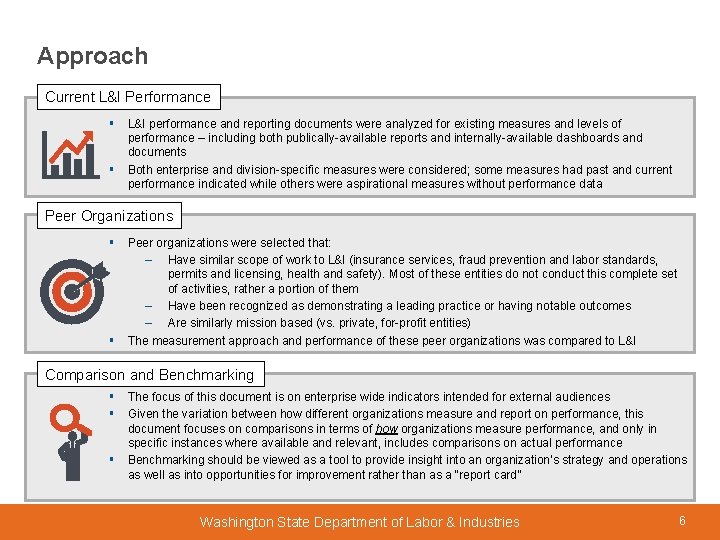
Approach Current L&I Performance § § L&I performance and reporting documents were analyzed for existing measures and levels of performance – including both publically-available reports and internally-available dashboards and documents Both enterprise and division-specific measures were considered; some measures had past and current performance indicated while others were aspirational measures without performance data Peer Organizations § § Peer organizations were selected that: – Have similar scope of work to L&I (insurance services, fraud prevention and labor standards, permits and licensing, health and safety). Most of these entities do not conduct this complete set of activities, rather a portion of them – Have been recognized as demonstrating a leading practice or having notable outcomes – Are similarly mission based (vs. private, for-profit entities) The measurement approach and performance of these peer organizations was compared to L&I Comparison and Benchmarking § § § The focus of this document is on enterprise wide indicators intended for external audiences Given the variation between how different organizations measure and report on performance, this document focuses on comparisons in terms of how organizations measure performance, and only in specific instances where available and relevant, includes comparisons on actual performance Benchmarking should be viewed as a tool to provide insight into an organization’s strategy and operations as well as into opportunities for improvement rather than as a “report card” Washington State Department of Labor & Industries 6
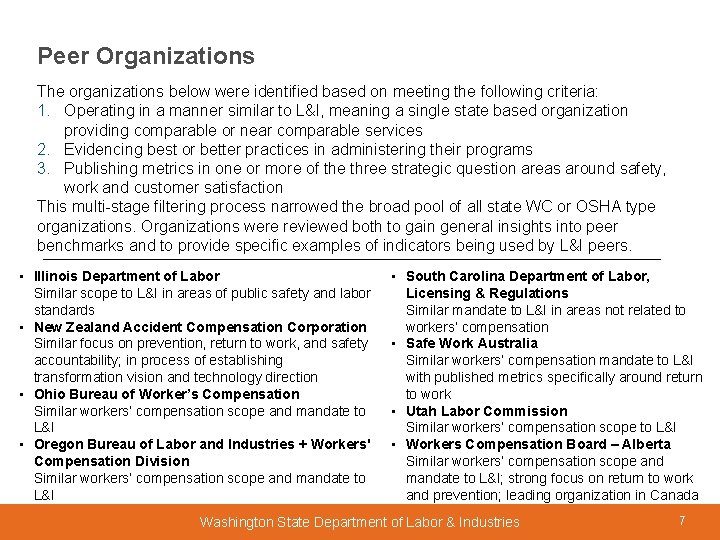
Peer Organizations The organizations below were identified based on meeting the following criteria: 1. Operating in a manner similar to L&I, meaning a single state based organization providing comparable or near comparable services 2. Evidencing best or better practices in administering their programs 3. Publishing metrics in one or more of the three strategic question areas around safety, work and customer satisfaction This multi-stage filtering process narrowed the broad pool of all state WC or OSHA type organizations. Organizations were reviewed both to gain general insights into peer benchmarks and to provide specific examples of indicators being used by L&I peers. • Illinois Department of Labor Similar scope to L&I in areas of public safety and labor standards • New Zealand Accident Compensation Corporation Similar focus on prevention, return to work, and safety accountability; in process of establishing transformation vision and technology direction • Ohio Bureau of Worker’s Compensation Similar workers’ compensation scope and mandate to L&I • Oregon Bureau of Labor and Industries + Workers' Compensation Division Similar workers’ compensation scope and mandate to L&I • South Carolina Department of Labor, Licensing & Regulations Similar mandate to L&I in areas not related to workers’ compensation • Safe Work Australia Similar workers’ compensation mandate to L&I with published metrics specifically around return to work • Utah Labor Commission Similar workers’ compensation scope to L&I • Workers Compensation Board – Alberta Similar workers’ compensation scope and mandate to L&I; strong focus on return to work and prevention; leading organization in Canada Washington State Department of Labor & Industries 7
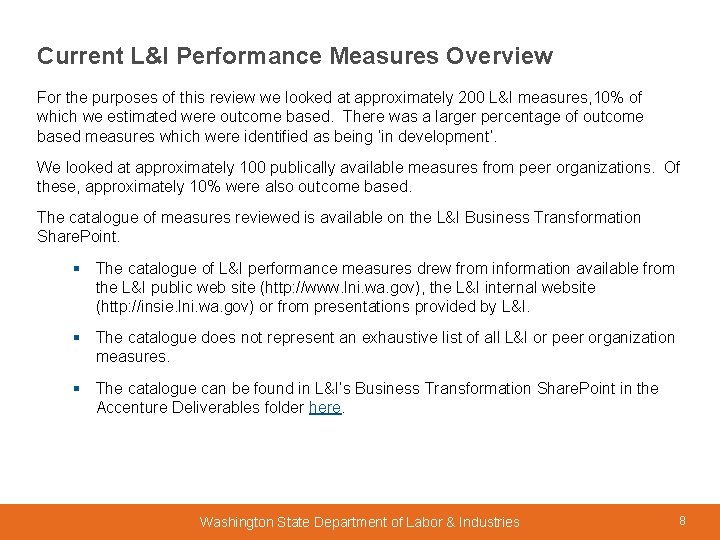
Current L&I Performance Measures Overview For the purposes of this review we looked at approximately 200 L&I measures, 10% of which we estimated were outcome based. There was a larger percentage of outcome based measures which were identified as being ‘in development’. We looked at approximately 100 publically available measures from peer organizations. Of these, approximately 10% were also outcome based. The catalogue of measures reviewed is available on the L&I Business Transformation Share. Point. § The catalogue of L&I performance measures drew from information available from the L&I public web site (http: //www. lni. wa. gov), the L&I internal website (http: //insie. lni. wa. gov) or from presentations provided by L&I. § The catalogue does not represent an exhaustive list of all L&I or peer organization measures. § The catalogue can be found in L&I’s Business Transformation Share. Point in the Accenture Deliverables folder here. Washington State Department of Labor & Industries 8
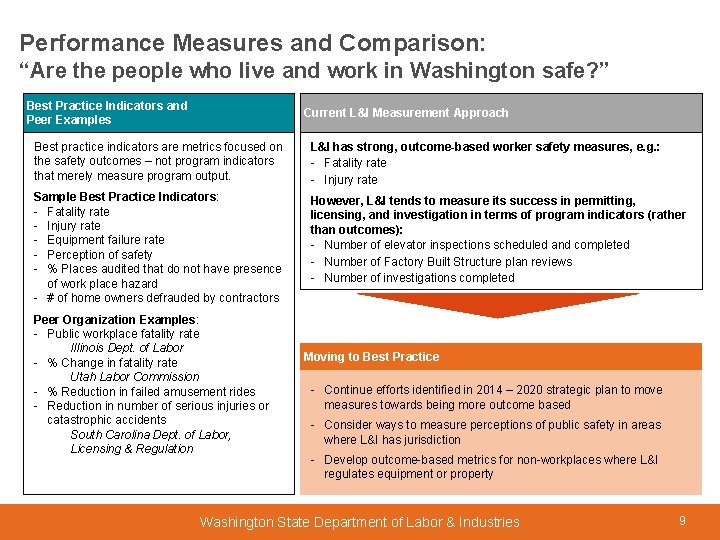
Performance Measures and Comparison: “Are the people who live and work in Washington safe? ” Best Practice Indicators and Peer Examples Current L&I Measurement Approach Best practice indicators are metrics focused on the safety outcomes – not program indicators that merely measure program output. L&I has strong, outcome-based worker safety measures, e. g. : - Fatality rate - Injury rate Sample Best Practice Indicators: - Fatality rate - Injury rate - Equipment failure rate - Perception of safety - % Places audited that do not have presence of work place hazard - # of home owners defrauded by contractors However, L&I tends to measure its success in permitting, licensing, and investigation in terms of program indicators (rather than outcomes): - Number of elevator inspections scheduled and completed - Number of Factory Built Structure plan reviews - Number of investigations completed Peer Organization Examples: - Public workplace fatality rate Illinois Dept. of Labor - % Change in fatality rate Utah Labor Commission - % Reduction in failed amusement rides - Reduction in number of serious injuries or catastrophic accidents South Carolina Dept. of Labor, Licensing & Regulation Moving to Best Practice - Continue efforts identified in 2014 – 2020 strategic plan to move measures towards being more outcome based - Consider ways to measure perceptions of public safety in areas where L&I has jurisdiction - Develop outcome-based metrics for non-workplaces where L&I regulates equipment or property Washington State Department of Labor & Industries 9

Performance Measures and Comparison: “Are the people who live and work in Washington working? ” Best Practice Indicators and Peer Examples Current L&I Measurement Approach Sample Best Practice Indicators: - Return to work rate - % Workers who return to work earning a wage equal to or higher than their pre-injury level - Rate of wage or labor violations - Rate of workers’ comp violations by employers - Rate of whistle-blower discrimination - % Registered apprentices placed into full time jobs following apprenticeships Peer Organization Examples: - % Returned to work within 10 weeks - % Returned to work within 9 months - Durable return-to-work rate (reports on return-to-work outcomes and injured workers’ perceptions of the return-to-work process) - Number of long-term clients returned to independence in the past 12 months - Return to independence for those not in the workforce New Zealand Accident Compensation Corporation (ACC) L&I tracks several outcome based measures, and has done so over time, to determine if WA is working: - % Injured workers who return to work within 6 months - Rate at which injured workers experience long-term disability Other tracking focuses on inputs/outputs, e. g. : - Total dollars collected and assessed for Employer Services Programs - # Permits completed - # New apprentice registrations Some cycle time measures are included, e. g. - % Farm Labor Contracting Investigations Completed (closed) in 90 days or less Moving to Best Practice - Move from measuring inputs (activities) regarding compliance to outcome measure, e. g. Rate of wage or labor violations - Enhance workers comp measures further by incorporating wage data Washington State Department of Labor & Industries 10
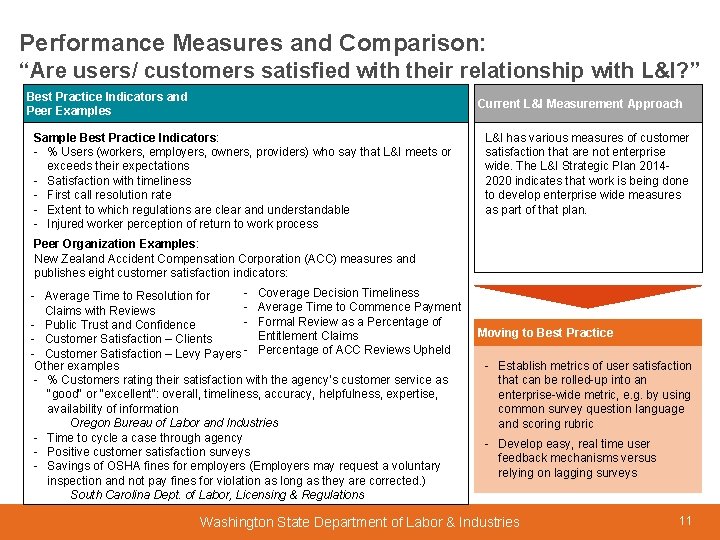
Performance Measures and Comparison: “Are users/ customers satisfied with their relationship with L&I? ” Best Practice Indicators and Peer Examples Current L&I Measurement Approach Sample Best Practice Indicators: - % Users (workers, employers, owners, providers) who say that L&I meets or exceeds their expectations - Satisfaction with timeliness - First call resolution rate - Extent to which regulations are clear and understandable - Injured worker perception of return to work process L&I has various measures of customer satisfaction that are not enterprise wide. The L&I Strategic Plan 20142020 indicates that work is being done to develop enterprise wide measures as part of that plan. Peer Organization Examples: New Zealand Accident Compensation Corporation (ACC) measures and publishes eight customer satisfaction indicators: - Coverage Decision Timeliness - Average Time to Resolution for - Average Time to Commence Payment Claims with Reviews - Formal Review as a Percentage of - Public Trust and Confidence Entitlement Claims - Customer Satisfaction – Clients - Customer Satisfaction – Levy Payers Percentage of ACC Reviews Upheld Other examples - % Customers rating their satisfaction with the agency's customer service as "good" or "excellent": overall, timeliness, accuracy, helpfulness, expertise, availability of information Oregon Bureau of Labor and Industries - Time to cycle a case through agency - Positive customer satisfaction surveys - Savings of OSHA fines for employers (Employers may request a voluntary inspection and not pay fines for violation as long as they are corrected. ) South Carolina Dept. of Labor, Licensing & Regulations Moving to Best Practice - Establish metrics of user satisfaction that can be rolled-up into an enterprise-wide metric, e. g. by using common survey question language and scoring rubric - Develop easy, real time user feedback mechanisms versus relying on lagging surveys Washington State Department of Labor & Industries 11
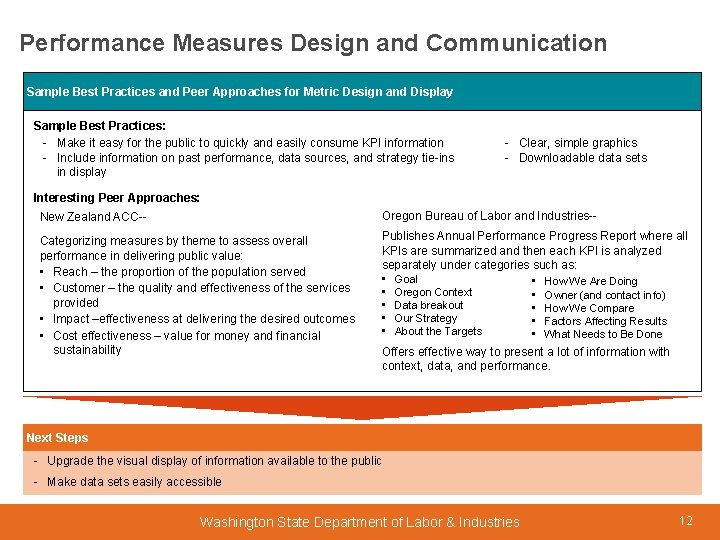
Performance Measures Design and Communication Sample Best Practices and Peer Approaches for Metric Design and Display Sample Best Practices: - Make it easy for the public to quickly and easily consume KPI information - Include information on past performance, data sources, and strategy tie-ins in display - Clear, simple graphics - Downloadable data sets Interesting Peer Approaches: New Zealand ACC-- Oregon Bureau of Labor and Industries-- Categorizing measures by theme to assess overall performance in delivering public value: • Reach – the proportion of the population served • Customer – the quality and effectiveness of the services provided • Impact –effectiveness at delivering the desired outcomes • Cost effectiveness – value for money and financial sustainability Publishes Annual Performance Progress Report where all KPIs are summarized and then each KPI is analyzed separately under categories such as: • Goal • How We Are Doing • Oregon Context • Owner (and contact info) • Data breakout • How We Compare • Our Strategy • Factors Affecting Results • About the Targets • What Needs to Be Done Offers effective way to present a lot of information with context, data, and performance. Next Steps - Upgrade the visual display of information available to the public - Make data sets easily accessible Washington State Department of Labor & Industries 12
Appendix § Examples of L&I and peer performance measures § Additional related research of Interest § Listing of data sources for external (non L&I) research Washington State Department of Labor & Industries 13
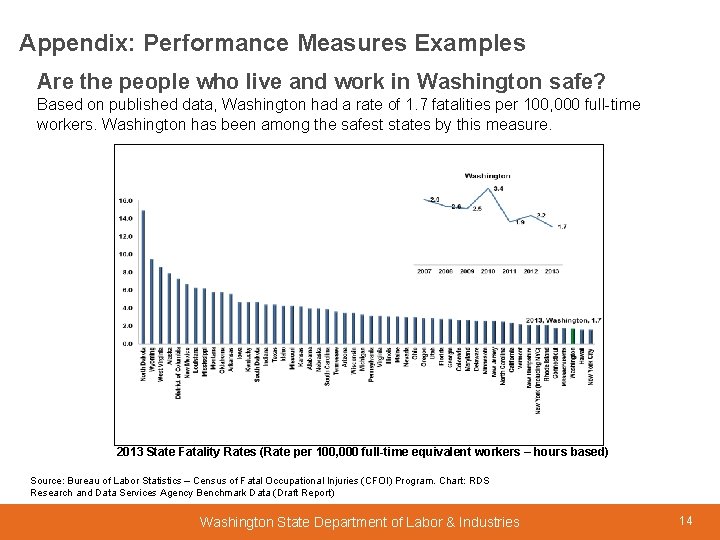
Appendix: Performance Measures Examples Are the people who live and work in Washington safe? Based on published data, Washington had a rate of 1. 7 fatalities per 100, 000 full-time workers. Washington has been among the safest states by this measure. 2013 State Fatality Rates (Rate per 100, 000 full-time equivalent workers – hours based) Source: Bureau of Labor Statistics – Census of Fatal Occupational Injuries (CFOI) Program. Chart: RDS Research and Data Services Agency Benchmark Data (Draft Report) Washington State Department of Labor & Industries 14
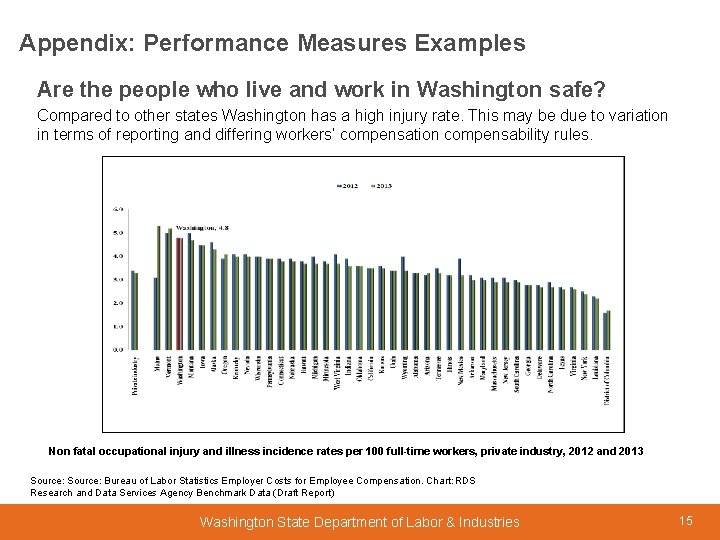
Appendix: Performance Measures Examples Are the people who live and work in Washington safe? Compared to other states Washington has a high injury rate. This may be due to variation in terms of reporting and differing workers’ compensation compensability rules. Non fatal occupational injury and illness incidence rates per 100 full-time workers, private industry, 2012 and 2013 Source: Bureau of Labor Statistics Employer Costs for Employee Compensation. Chart: RDS Research and Data Services Agency Benchmark Data (Draft Report) Washington State Department of Labor & Industries 15
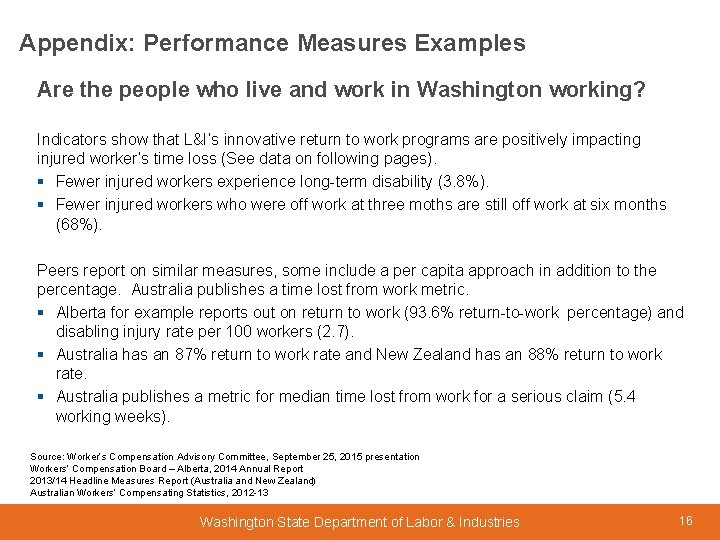
Appendix: Performance Measures Examples Are the people who live and work in Washington working? Indicators show that L&I’s innovative return to work programs are positively impacting injured worker’s time loss (See data on following pages). § Fewer injured workers experience long-term disability (3. 8%). § Fewer injured workers who were off work at three moths are still off work at six months (68%). Peers report on similar measures, some include a per capita approach in addition to the percentage. Australia publishes a time lost from work metric. § Alberta for example reports out on return to work (93. 6% return-to-work percentage) and disabling injury rate per 100 workers (2. 7). § Australia has an 87% return to work rate and New Zealand has an 88% return to work rate. § Australia publishes a metric for median time lost from work for a serious claim (5. 4 working weeks). Source: Worker’s Compensation Advisory Committee, September 25, 2015 presentation Workers’ Compensation Board – Alberta, 2014 Annual Report 2013/14 Headline Measures Report (Australia and New Zealand) Australian Workers’ Compensating Statistics, 2012 -13 Washington State Department of Labor & Industries 16
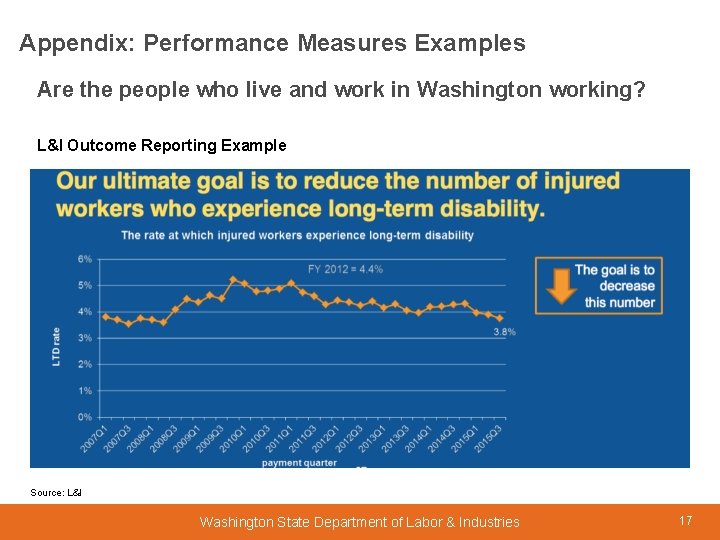
Appendix: Performance Measures Examples Are the people who live and work in Washington working? L&I Outcome Reporting Example Source: L&I Washington State Department of Labor & Industries 17
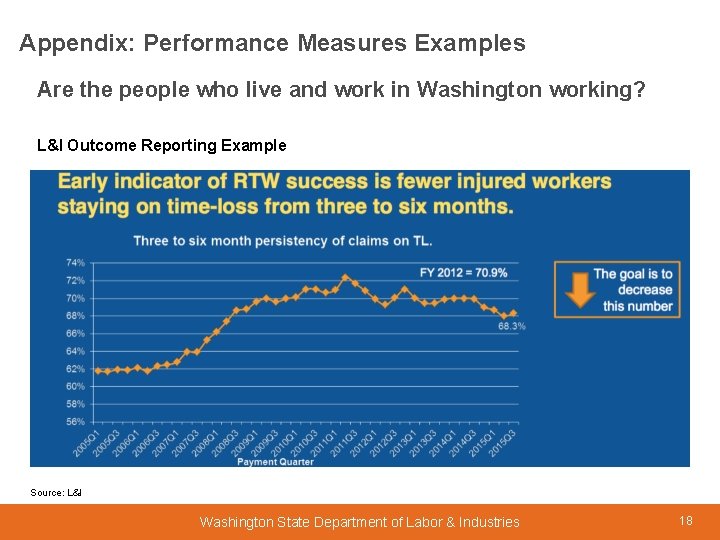
Appendix: Performance Measures Examples Are the people who live and work in Washington working? L&I Outcome Reporting Example Source: L&I Washington State Department of Labor & Industries 18
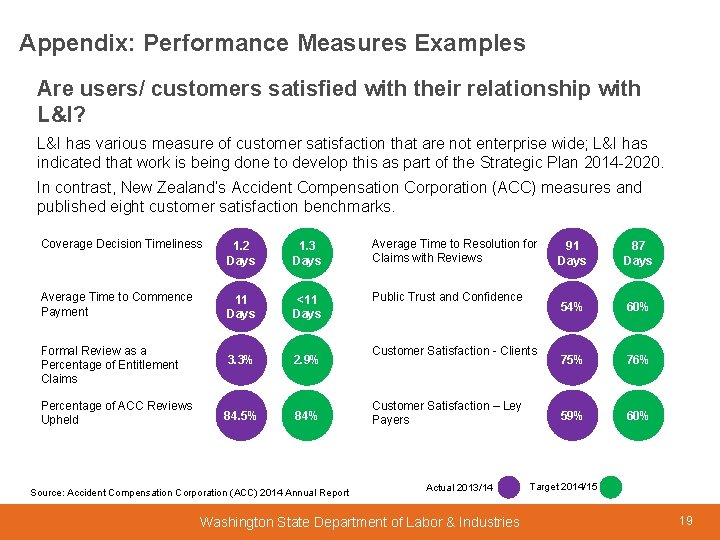
Appendix: Performance Measures Examples Are users/ customers satisfied with their relationship with L&I? L&I has various measure of customer satisfaction that are not enterprise wide; L&I has indicated that work is being done to develop this as part of the Strategic Plan 2014 -2020. In contrast, New Zealand’s Accident Compensation Corporation (ACC) measures and published eight customer satisfaction benchmarks. Coverage Decision Timeliness 1. 2 Days 1. 3 Days Average Time to Resolution for Claims with Reviews Average Time to Commence Payment 11 Days <11 Days Public Trust and Confidence Formal Review as a Percentage of Entitlement Claims 3. 3% 2. 9% Percentage of ACC Reviews Upheld 84. 5% 84% Source: Accident Compensation Corporation (ACC) 2014 Annual Report Customer Satisfaction - Clients Customer Satisfaction – Ley Payers Actual 2013/14 Washington State Department of Labor & Industries 91 Days 87 Days 54% 60% 75% 76% 59% 60% Target 2014/15 19
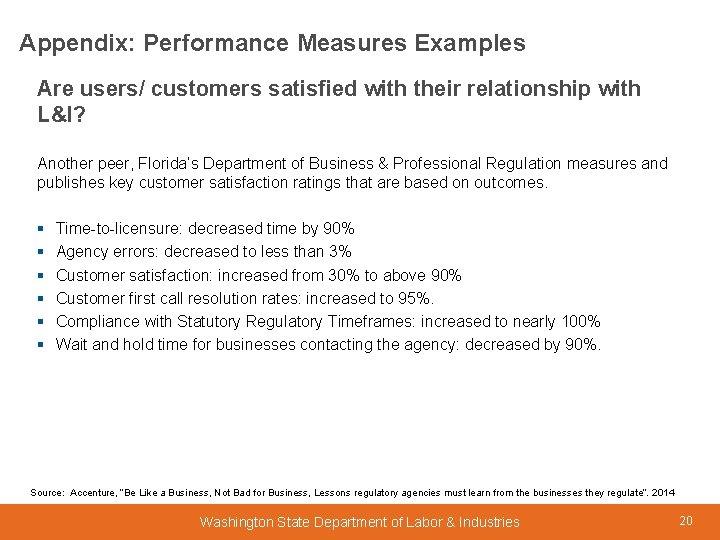
Appendix: Performance Measures Examples Are users/ customers satisfied with their relationship with L&I? Another peer, Florida’s Department of Business & Professional Regulation measures and publishes key customer satisfaction ratings that are based on outcomes. § § § Time-to-licensure: decreased time by 90% Agency errors: decreased to less than 3% Customer satisfaction: increased from 30% to above 90% Customer first call resolution rates: increased to 95%. Compliance with Statutory Regulatory Timeframes: increased to nearly 100% Wait and hold time for businesses contacting the agency: decreased by 90%. Source: Accenture, “Be Like a Business, Not Bad for Business, Lessons regulatory agencies must learn from the businesses they regulate”. 2014 Washington State Department of Labor & Industries 20
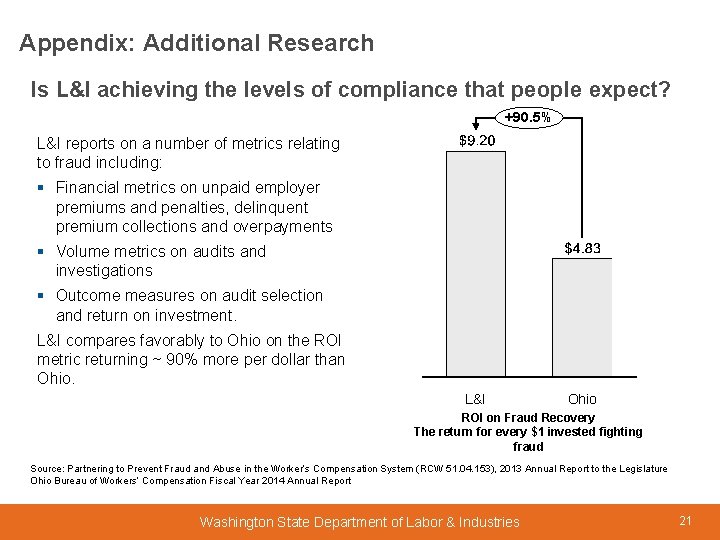
Appendix: Additional Research Is L&I achieving the levels of compliance that people expect? +90. 5% L&I reports on a number of metrics relating to fraud including: § Financial metrics on unpaid employer premiums and penalties, delinquent premium collections and overpayments § Volume metrics on audits and investigations § Outcome measures on audit selection and return on investment. L&I compares favorably to Ohio on the ROI metric returning ~ 90% more per dollar than Ohio. L&I Ohio ROI on Fraud Recovery The return for every $1 invested fighting fraud Source: Partnering to Prevent Fraud and Abuse in the Worker’s Compensation System (RCW 51. 04. 153), 2013 Annual Report to the Legislature Ohio Bureau of Workers’ Compensation Fiscal Year 2014 Annual Report Washington State Department of Labor & Industries 21
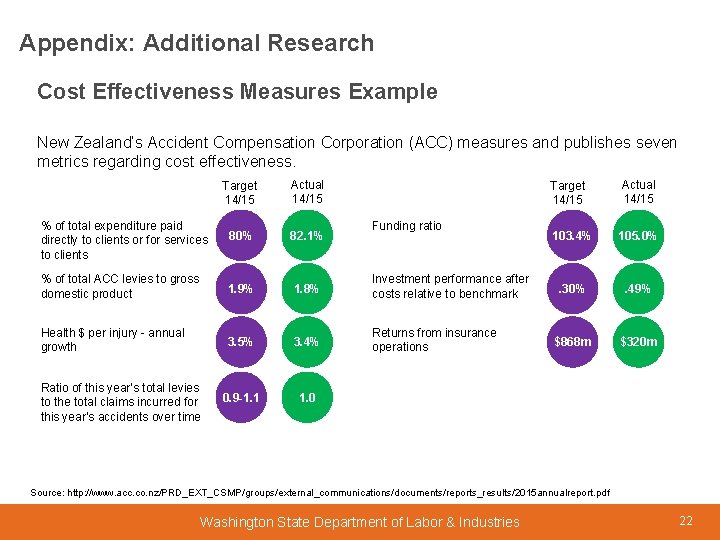
Appendix: Additional Research Cost Effectiveness Measures Example New Zealand’s Accident Compensation Corporation (ACC) measures and publishes seven metrics regarding cost effectiveness. Target 14/15 Actual 14/15 % of total expenditure paid directly to clients or for services to clients 80% 82. 1% % of total ACC levies to gross domestic product 1. 9% 1. 8% Investment performance after costs relative to benchmark Health $ per injury - annual growth 3. 5% 3. 4% Returns from insurance operations 0. 9 -1. 1 1. 0 Ratio of this year’s total levies to the total claims incurred for this year’s accidents over time Target 14/15 Funding ratio Actual 14/15 103. 4% 105. 0% . 30% . 49% $868 m $320 m Source: http: //www. acc. co. nz/PRD_EXT_CSMP/groups/external_communications/documents/reports_results/2015 annualreport. pdf Washington State Department of Labor & Industries 22
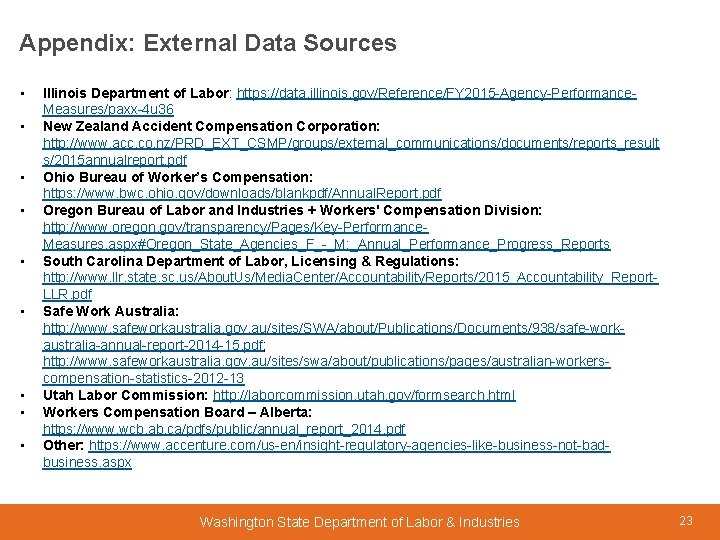
Appendix: External Data Sources • • • Illinois Department of Labor: https: //data. illinois. gov/Reference/FY 2015 -Agency-Performance. Measures/paxx-4 u 36 New Zealand Accident Compensation Corporation: http: //www. acc. co. nz/PRD_EXT_CSMP/groups/external_communications/documents/reports_result s/2015 annualreport. pdf Ohio Bureau of Worker’s Compensation: https: //www. bwc. ohio. gov/downloads/blankpdf/Annual. Report. pdf Oregon Bureau of Labor and Industries + Workers' Compensation Division: http: //www. oregon. gov/transparency/Pages/Key-Performance. Measures. aspx#Oregon_State_Agencies_F_-_M: _Annual_Performance_Progress_Reports South Carolina Department of Labor, Licensing & Regulations: http: //www. llr. state. sc. us/About. Us/Media. Center/Accountability. Reports/2015_Accountability_Report. LLR. pdf Safe Work Australia: http: //www. safeworkaustralia. gov. au/sites/SWA/about/Publications/Documents/938/safe-workaustralia-annual-report-2014 -15. pdf; http: //www. safeworkaustralia. gov. au/sites/swa/about/publications/pages/australian-workerscompensation-statistics-2012 -13 Utah Labor Commission: http: //laborcommission. utah. gov/formsearch. html Workers Compensation Board – Alberta: https: //www. wcb. ab. ca/pdfs/public/annual_report_2014. pdf Other: https: //www. accenture. com/us-en/insight-regulatory-agencies-like-business-not-badbusiness. aspx Washington State Department of Labor & Industries 23
- Slides: 23