
Business Tips for the Open Source Consultant About
Business Tips for the Open Source Consultant • • About Consulting Core Business Philosophy Consulting Techniques Appendix Presenter Contact Info: Will Glass-Husain Menlo Park, California USA wglass@forio. com www. jlamp. com + 1 415 440 -7500 October 12, 2006 © 2006, William Glass-Husain. Permission to redistribute granted provided copyright notice kept intact.
About Consulting Why Consult? • Have more control over lifestyle, working conditions, projects. (but not total control). • Set your own hours and work schedule. (e. g. open large blocks of time for family or travel). • Subsidize other interests in your life such as a startup or open source software project. • Or simply earn a lot of money. Consulting can be a great way to earn a living… … if it suits your skills and temperament October 12, 2006 © 2006, William Glass-Husain. Permission to redistribute granted provided copyright notice kept intact.
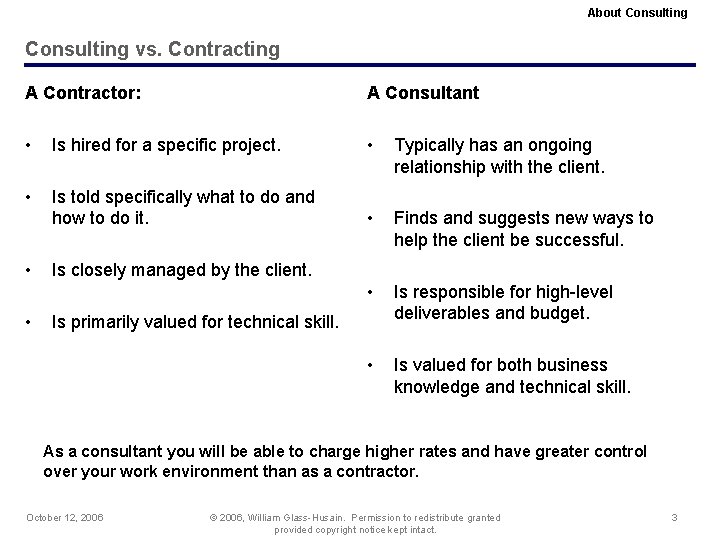
About Consulting vs. Contracting A Contractor: A Consultant • Is hired for a specific project. • Typically has an ongoing relationship with the client. • Is told specifically what to do and how to do it. • Finds and suggests new ways to help the client be successful. • Is responsible for high-level deliverables and budget. • Is valued for both business knowledge and technical skill. • • Is closely managed by the client. Is primarily valued for technical skill. As a consultant you will be able to charge higher rates and have greater control over your work environment than as a contractor. October 12, 2006 © 2006, William Glass-Husain. Permission to redistribute granted provided copyright notice kept intact. 3
About Consulting and Open Source Go Hand in Hand • Consultants benefit from using open source projects. – Consultants focus on business problems rather than developing code libraries and tools. – Independents can compete with much bigger firms (in the past such firms had an advantage with sophisticated in-house tools). – Being part of an open source project can lead to consulting or training work. • Open source projects benefit from consultants. – Consultants often have much more flexibility to contribute code back to the community than do corporate developers. – Projects become more relevant as developers use them in real world applications. – Some committers use consulting to fund special interest in open source projects. • Caution! – Before donating code to open source project be sure you have ownership of code or that your contract permits you to do so. – Avoid using GPL or other viral licenses without buy-in from client. October 12, 2006 © 2006, William Glass-Husain. Permission to redistribute granted provided copyright notice kept intact.
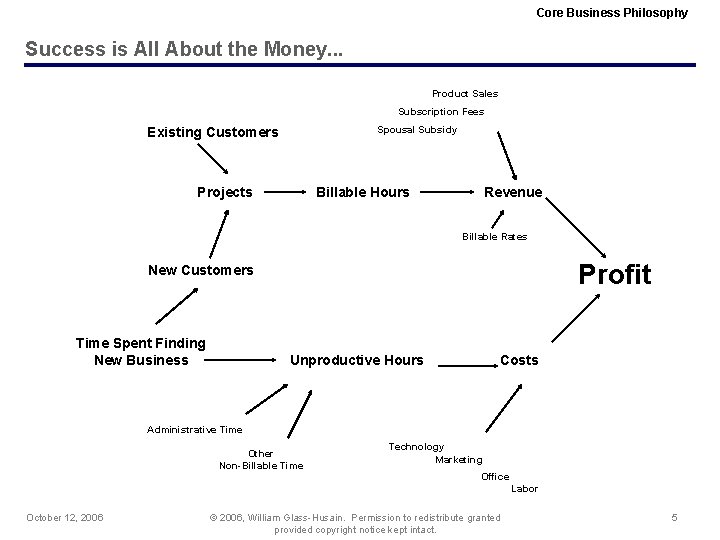
Core Business Philosophy Success is All About the Money. . . Product Sales Subscription Fees Spousal Subsidy Existing Customers Projects Billable Hours Revenue Billable Rates Profit New Customers Time Spent Finding New Business Unproductive Hours Costs Administrative Time Other Non-Billable Time Technology Marketing Office Labor October 12, 2006 © 2006, William Glass-Husain. Permission to redistribute granted provided copyright notice kept intact. 5
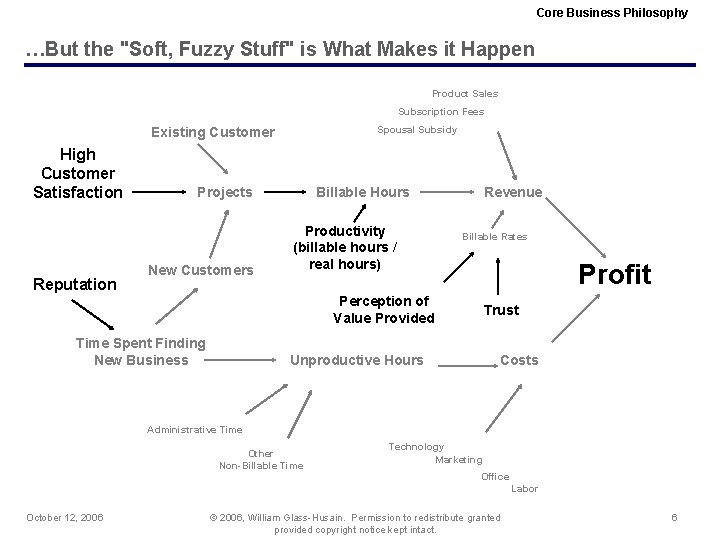
Core Business Philosophy …But the "Soft, Fuzzy Stuff" is What Makes it Happen Product Sales Subscription Fees Spousal Subsidy Existing Customer High Customer Satisfaction Reputation Projects New Customers Billable Hours Productivity (billable hours / real hours) Revenue Billable Rates Profit Perception of Value Provided Time Spent Finding New Business Trust Unproductive Hours Costs Administrative Time Other Non-Billable Time Technology Marketing Office Labor October 12, 2006 © 2006, William Glass-Husain. Permission to redistribute granted provided copyright notice kept intact. 6
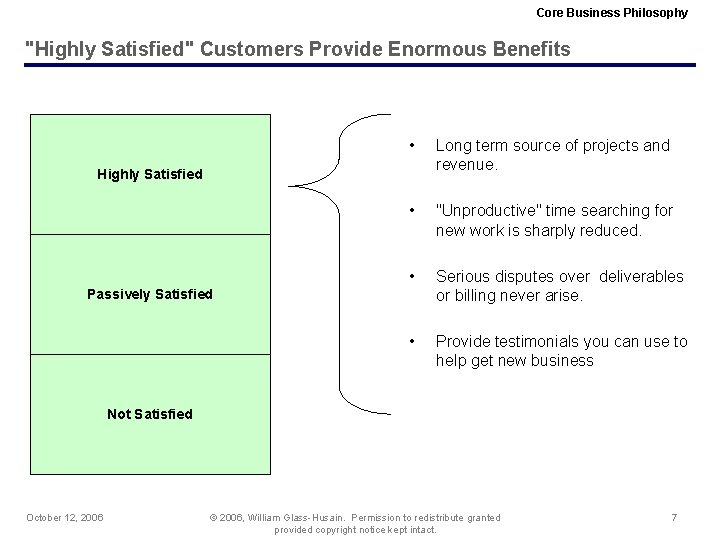
Core Business Philosophy "Highly Satisfied" Customers Provide Enormous Benefits • Long term source of projects and revenue. • "Unproductive" time searching for new work is sharply reduced. • Serious disputes over deliverables or billing never arise. • Provide testimonials you can use to help get new business Highly Satisfied Passively Satisfied Not Satisfied October 12, 2006 © 2006, William Glass-Husain. Permission to redistribute granted provided copyright notice kept intact. 7
Core Business Philosophy Example: Highly Satisfied Clients • Firm: Small, innovative IT services company in Silicon Valley provides lavish customer support to local clients. • Example services: – Innovative pricing – flat fee for all services – Maintains the “most important computer in the company” – computer in CEO’s home. (or vacation house!) – Regular “how is everything going? ” visits to each client – Local call center can dispatch technician to site in 10 minutes. • Benefit – has never lost a customer • Benefit – every customer is a reference for new business – Will invite potential customers to join on walk through existing customer facilities • Benefit – strong loyalty means that though they initially lose money on each customer the ultimate profit is high October 12, 2006 © 2006, William Glass-Husain. Permission to redistribute granted provided copyright notice kept intact.
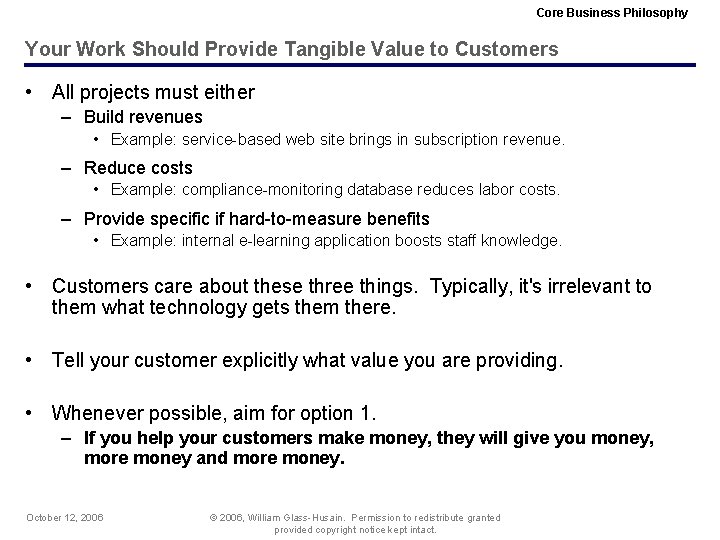
Core Business Philosophy Your Work Should Provide Tangible Value to Customers • All projects must either – Build revenues • Example: service-based web site brings in subscription revenue. – Reduce costs • Example: compliance-monitoring database reduces labor costs. – Provide specific if hard-to-measure benefits • Example: internal e-learning application boosts staff knowledge. • Customers care about these three things. Typically, it's irrelevant to them what technology gets them there. • Tell your customer explicitly what value you are providing. • Whenever possible, aim for option 1. – If you help your customers make money, they will give you money, more money and more money. October 12, 2006 © 2006, William Glass-Husain. Permission to redistribute granted provided copyright notice kept intact.
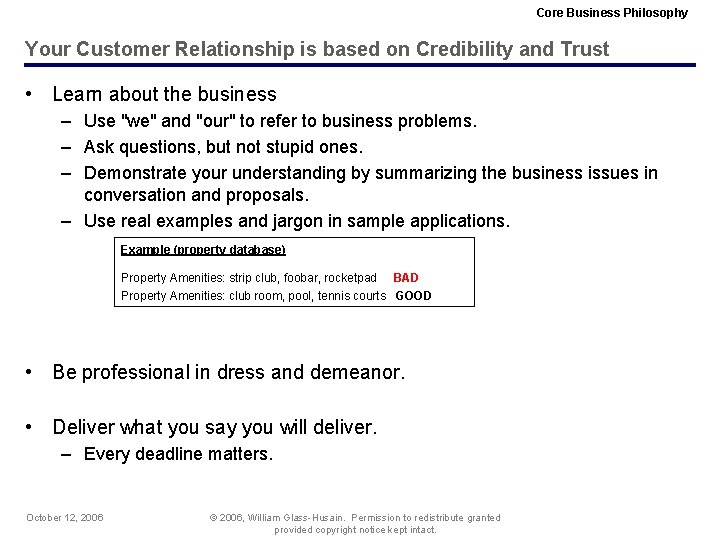
Core Business Philosophy Your Customer Relationship is based on Credibility and Trust • Learn about the business – Use "we" and "our" to refer to business problems. – Ask questions, but not stupid ones. – Demonstrate your understanding by summarizing the business issues in conversation and proposals. – Use real examples and jargon in sample applications. Example (property database) Property Amenities: strip club, foobar, rocketpad BAD Property Amenities: club room, pool, tennis courts GOOD • Be professional in dress and demeanor. • Deliver what you say you will deliver. – Every deadline matters. October 12, 2006 © 2006, William Glass-Husain. Permission to redistribute granted provided copyright notice kept intact.
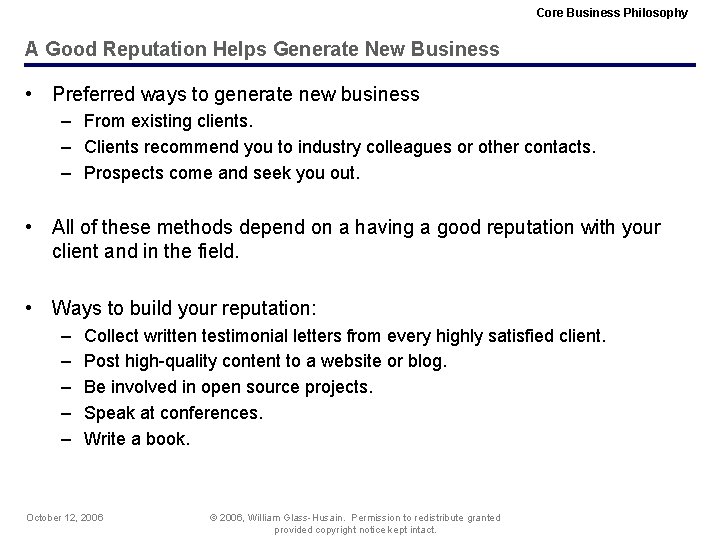
Core Business Philosophy A Good Reputation Helps Generate New Business • Preferred ways to generate new business – From existing clients. – Clients recommend you to industry colleagues or other contacts. – Prospects come and seek you out. • All of these methods depend on a having a good reputation with your client and in the field. • Ways to build your reputation: – – – Collect written testimonial letters from every highly satisfied client. Post high-quality content to a website or blog. Be involved in open source projects. Speak at conferences. Write a book. October 12, 2006 © 2006, William Glass-Husain. Permission to redistribute granted provided copyright notice kept intact.
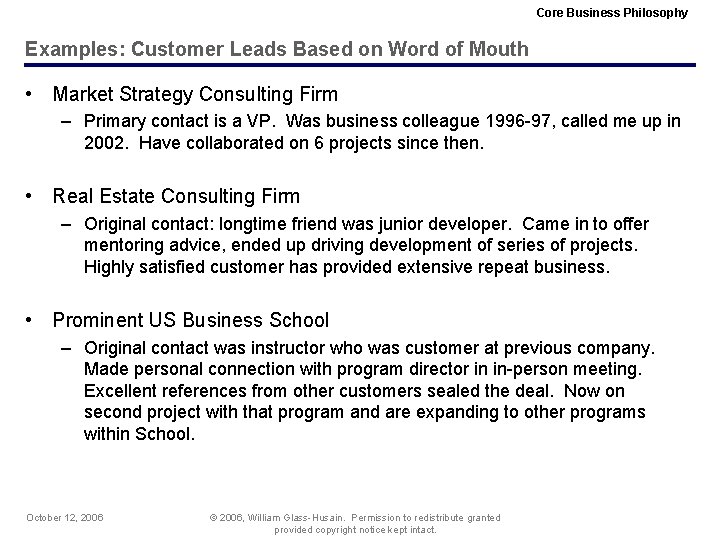
Core Business Philosophy Examples: Customer Leads Based on Word of Mouth • Market Strategy Consulting Firm – Primary contact is a VP. Was business colleague 1996 -97, called me up in 2002. Have collaborated on 6 projects since then. • Real Estate Consulting Firm – Original contact: longtime friend was junior developer. Came in to offer mentoring advice, ended up driving development of series of projects. Highly satisfied customer has provided extensive repeat business. • Prominent US Business School – Original contact was instructor who was customer at previous company. Made personal connection with program director in in-person meeting. Excellent references from other customers sealed the deal. Now on second project with that program and are expanding to other programs within School. October 12, 2006 © 2006, William Glass-Husain. Permission to redistribute granted provided copyright notice kept intact.
Core Business Philosophy Stay Productive – Focus on Benefits to Customer and Yourself • Manage your time carefully – time is money. • Avoid "dead hours" – time spent on miscellaneous tasks that provide no benefit and are not billable. • Provide transparency to the client on invoicing – track time by hour on a daily basis listing tasks accomplished. • Avoid refactoring for the sake of refactoring. Make sure that everything you do moves the project towards meeting the client needs. October 12, 2006 © 2006, William Glass-Husain. Permission to redistribute granted provided copyright notice kept intact.
Core Business Philosophy Keep Costs Low When Possible • Big benefit to independent consulting – costs can be extremely low. • Typical costs – – Office/Telephone Marketing (including web site) Labor costs (e. g. outside graphical designer) Technology • Working out of home has substantial cost benefits. • Technology is the most effective investment as it is directly tied to productivity. October 12, 2006 © 2006, William Glass-Husain. Permission to redistribute granted provided copyright notice kept intact.
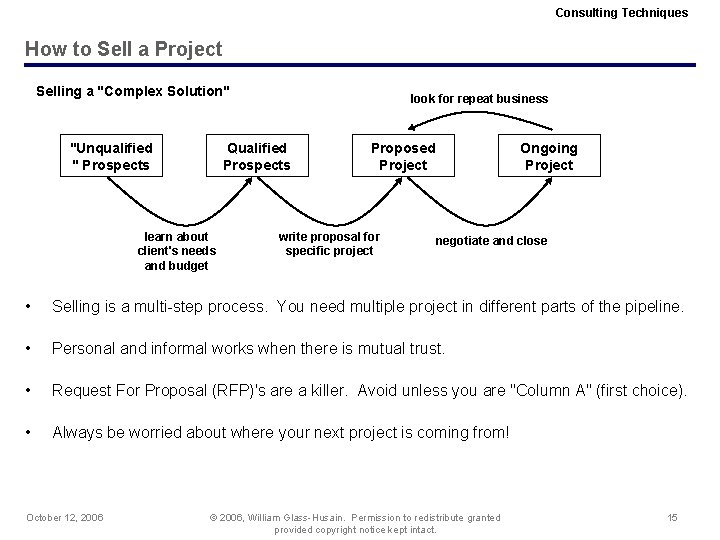
Consulting Techniques How to Sell a Project Selling a "Complex Solution" "Unqualified " Prospects look for repeat business Qualified Prospects learn about client's needs and budget Proposed Project write proposal for specific project Ongoing Project negotiate and close • Selling is a multi-step process. You need multiple project in different parts of the pipeline. • Personal and informal works when there is mutual trust. • Request For Proposal (RFP)'s are a killer. Avoid unless you are "Column A" (first choice). • Always be worried about where your next project is coming from! October 12, 2006 © 2006, William Glass-Husain. Permission to redistribute granted provided copyright notice kept intact. 15
Consulting Techniques Example: Project Lifecycle • Project: Executive Training simulation for US Business School. • Unqualified lead: referred by former customer, now instructor at school. (April 2005) • Qualified lead: Had several initial conversations verifying client needs, our capabilities and budget. Client wrote RFP (Request for Proposal) clearly favoring our approach. (June 2005) • Proposed project: Wrote detailed proposal summarizing their needs, our proposed solution, implementation schedule, and pricing. Later feedback from client was that this was only proposal that truly reflected client needs. (July 2005) • Closed deal: Met in-person at our site and theirs. Held phone calls to answer questions on proposal. Was accepted, had final negotiations on price. (July – November 2005). • Implementation: built simulation and assisted in course. (December 2005 – Jun 2006). • Repeat business: Smaller re-delivery of solution. Adapted solution for MBA program within same school. (September 2006) October 12, 2006 © 2006, William Glass-Husain. Permission to redistribute granted provided copyright notice kept intact.
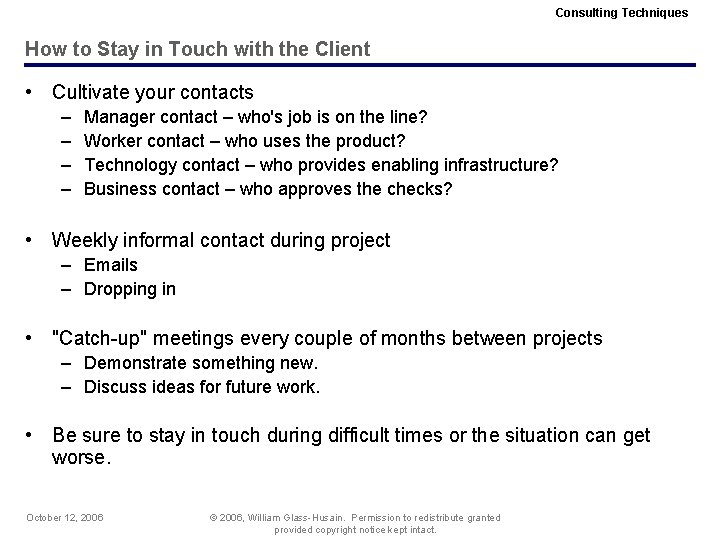
Consulting Techniques How to Stay in Touch with the Client • Cultivate your contacts – – Manager contact – who's job is on the line? Worker contact – who uses the product? Technology contact – who provides enabling infrastructure? Business contact – who approves the checks? • Weekly informal contact during project – Emails – Dropping in • "Catch-up" meetings every couple of months between projects – Demonstrate something new. – Discuss ideas for future work. • Be sure to stay in touch during difficult times or the situation can get worse. October 12, 2006 © 2006, William Glass-Husain. Permission to redistribute granted provided copyright notice kept intact.
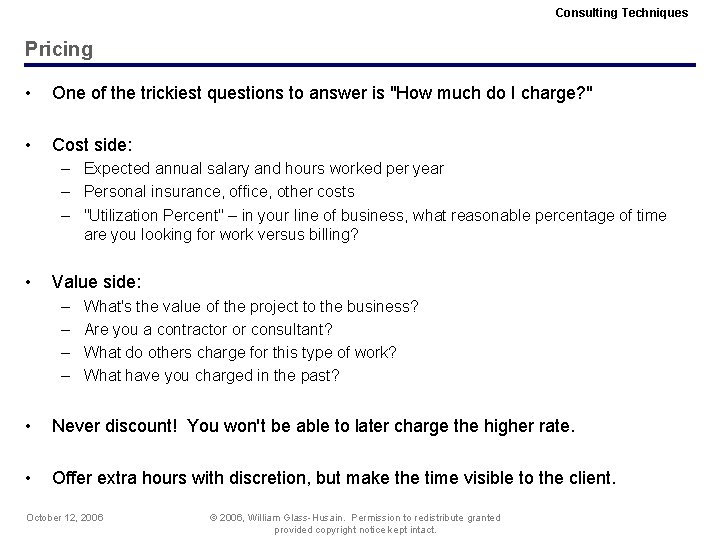
Consulting Techniques Pricing • One of the trickiest questions to answer is "How much do I charge? " • Cost side: – Expected annual salary and hours worked per year – Personal insurance, office, other costs – "Utilization Percent" – in your line of business, what reasonable percentage of time are you looking for work versus billing? • Value side: – – What's the value of the project to the business? Are you a contractor or consultant? What do others charge for this type of work? What have you charged in the past? • Never discount! You won't be able to later charge the higher rate. • Offer extra hours with discretion, but make the time visible to the client. October 12, 2006 © 2006, William Glass-Husain. Permission to redistribute granted provided copyright notice kept intact.
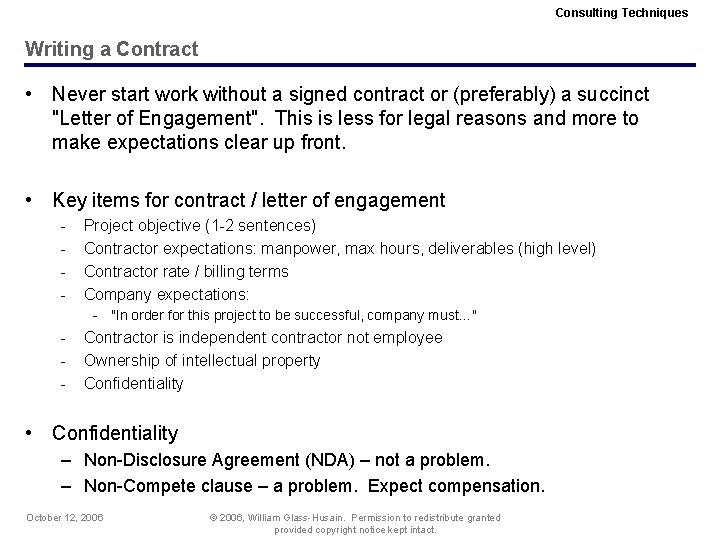
Consulting Techniques Writing a Contract • Never start work without a signed contract or (preferably) a succinct "Letter of Engagement". This is less for legal reasons and more to make expectations clear up front. • Key items for contract / letter of engagement - Project objective (1 -2 sentences) Contractor expectations: manpower, max hours, deliverables (high level) Contractor rate / billing terms Company expectations: - "In order for this project to be successful, company must…" - Contractor is independent contractor not employee Ownership of intellectual property Confidentiality • Confidentiality – Non-Disclosure Agreement (NDA) – not a problem. – Non-Compete clause – a problem. Expect compensation. October 12, 2006 © 2006, William Glass-Husain. Permission to redistribute granted provided copyright notice kept intact.
Discussion October 12, 2006 © 2006, William Glass-Husain. Permission to redistribute granted provided copyright notice kept intact. 20
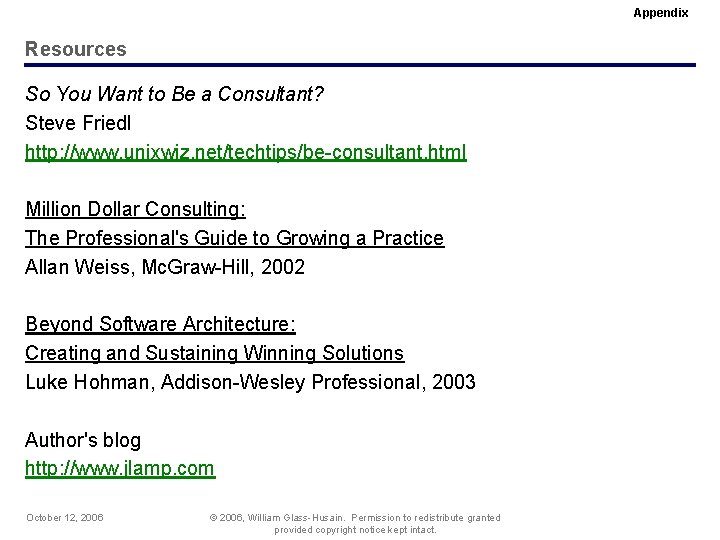
Appendix Resources So You Want to Be a Consultant? Steve Friedl http: //www. unixwiz. net/techtips/be-consultant. html Million Dollar Consulting: The Professional's Guide to Growing a Practice Allan Weiss, Mc. Graw-Hill, 2002 Beyond Software Architecture: Creating and Sustaining Winning Solutions Luke Hohman, Addison-Wesley Professional, 2003 Author's blog http: //www. jlamp. com October 12, 2006 © 2006, William Glass-Husain. Permission to redistribute granted provided copyright notice kept intact.
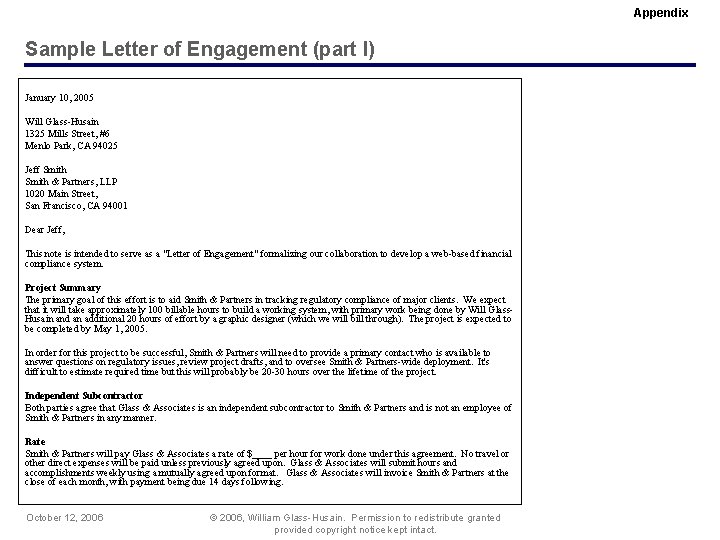
Appendix Sample Letter of Engagement (part I) January 10, 2005 Will Glass-Husain 1325 Mills Street, #6 Menlo Park, CA 94025 Jeff Smith & Partners, LLP 1020 Main Street, San Francisco, CA 94001 Dear Jeff, This note is intended to serve as a "Letter of Engagement" formalizing our collaboration to develop a web-based financial compliance system. Project Summary The primary goal of this effort is to aid Smith & Partners in tracking regulatory compliance of major clients. We expect that it will take approximately 100 billable hours to build a working system, with primary work being done by Will Glass. Husain and an additional 20 hours of effort by a graphic designer (which we will bill through). The project is expected to be completed by May 1, 2005. In order for this project to be successful, Smith & Partners will need to provide a primary contact who is available to answer questions on regulatory issues, review project drafts, and to oversee Smith & Partners-wide deployment. It's difficult to estimate required time but this will probably be 20 -30 hours over the lifetime of the project. Independent Subcontractor Both parties agree that Glass & Associates is an independent subcontractor to Smith & Partners and is not an employee of Smith & Partners in any manner. Rate Smith & Partners will pay Glass & Associates a rate of $____ per hour for work done under this agreement. No travel or other direct expenses will be paid unless previously agreed upon. Glass & Associates will submit hours and accomplishments weekly using a mutually agreed upon format. Glass & Associates will invoice Smith & Partners at the close of each month, with payment being due 14 days following. October 12, 2006 © 2006, William Glass-Husain. Permission to redistribute granted provided copyright notice kept intact.
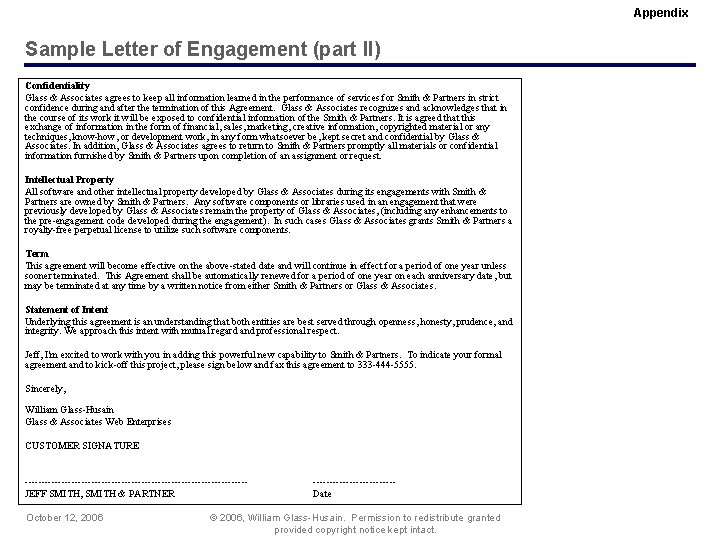
Appendix Sample Letter of Engagement (part II) Confidentiality Glass & Associates agrees to keep all information learned in the performance of services for Smith & Partners in strict confidence during and after the termination of this Agreement. Glass & Associates recognizes and acknowledges that in the course of its work it will be exposed to confidential information of the Smith & Partners. It is agreed that this exchange of information in the form of financial, sales, marketing, creative information, copyrighted material or any techniques, know-how, or development work, in any form whatsoever be, kept secret and confidential by Glass & Associates. In addition, Glass & Associates agrees to return to Smith & Partners promptly all materials or confidential information furnished by Smith & Partners upon completion of an assignment or request. Intellectual Property All software and other intellectual property developed by Glass & Associates during its engagements with Smith & Partners are owned by Smith & Partners. Any software components or libraries used in an engagement that were previously developed by Glass & Associates remain the property of Glass & Associates, (including any enhancements to the pre-engagement code developed during the engagement). In such cases Glass & Associates grants Smith & Partners a royalty-free perpetual license to utilize such software components. Term This agreement will become effective on the above-stated date and will continue in effect for a period of one year unless sooner terminated. This Agreement shall be automatically renewed for a period of one year on each anniversary date, but may be terminated at any time by a written notice from either Smith & Partners or Glass & Associates. Statement of Intent Underlying this agreement is an understanding that both entities are best served through openness, honesty, prudence, and integrity. We approach this intent with mutual regard and professional respect. Jeff, I'm excited to work with you in adding this powerful new capability to Smith & Partners. To indicate your formal agreement and to kick-off this project, please sign below and fax this agreement to 333 -444 -5555. Sincerely, William Glass-Husain Glass & Associates Web Enterprises CUSTOMER SIGNATURE ---------------------------------JEFF SMITH, SMITH & PARTNER October 12, 2006 ------------Date © 2006, William Glass-Husain. Permission to redistribute granted provided copyright notice kept intact.
- Slides: 23