
Business Structures Markets and Risk Management Lesson 2
Business Structures, Markets, and Risk Management Lesson 2: Using Business Structures in a Market Simulation Sarah Mc. Kay, Graduate Student, Department of Agricultural and Applied Economics, Virginia Tech Kristin Carr, Agriculture Teacher, Riverheads High School, Augusta County Public Schools Marie Rothwell, Virginia Cooperative Extension Agent, 4 -H Youth Development, Augusta County Shannon Wiley, Graduate Student, Agricultural, Leadership, and Community Education, Virginia Tech Hannah Scherer, Assistant Professor and Extension Specialist, Agricultural, Leadership, and Community Education, Virginia Tech Graduate Extension Scholars Program
Overview of Today • • Recap from last lesson Business organization Simulation Group discussion on findings Group presentations Recap Questions Take-home Graduate Extension Scholars Program
RECAP Graduate Extension Scholars Program
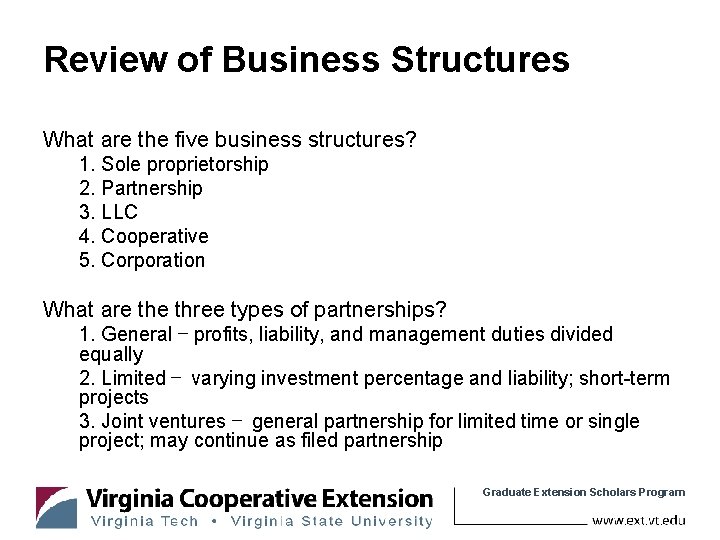
Review of Business Structures What are the five business structures? 1. Sole proprietorship 2. Partnership 3. LLC 4. Cooperative 5. Corporation What are three types of partnerships? 1. General − profits, liability, and management duties divided equally 2. Limited − varying investment percentage and liability; short-term projects 3. Joint ventures − general partnership for limited time or single project; may continue as filed partnership Graduate Extension Scholars Program
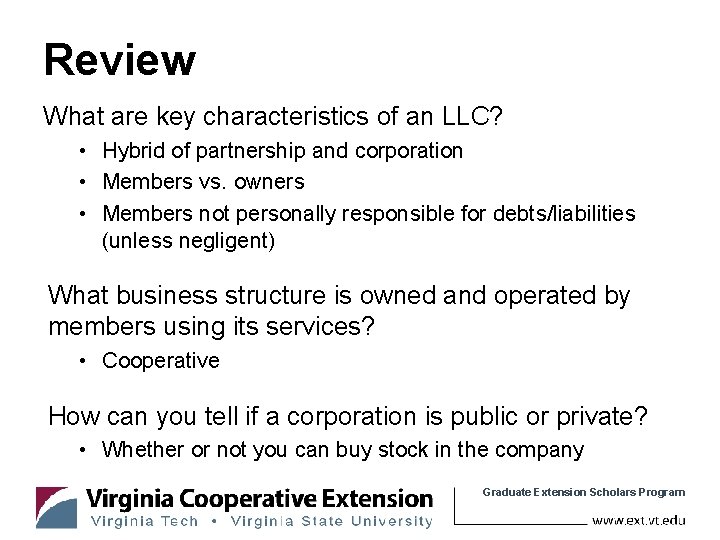
Review What are key characteristics of an LLC? • Hybrid of partnership and corporation • Members vs. owners • Members not personally responsible for debts/liabilities (unless negligent) What business structure is owned and operated by members using its services? • Cooperative How can you tell if a corporation is public or private? • Whether or not you can buy stock in the company Graduate Extension Scholars Program
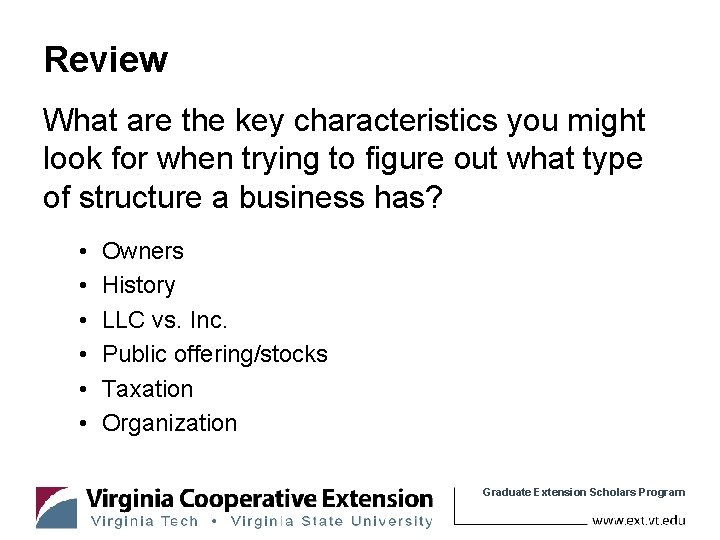
Review What are the key characteristics you might look for when trying to figure out what type of structure a business has? • • • Owners History LLC vs. Inc. Public offering/stocks Taxation Organization Graduate Extension Scholars Program
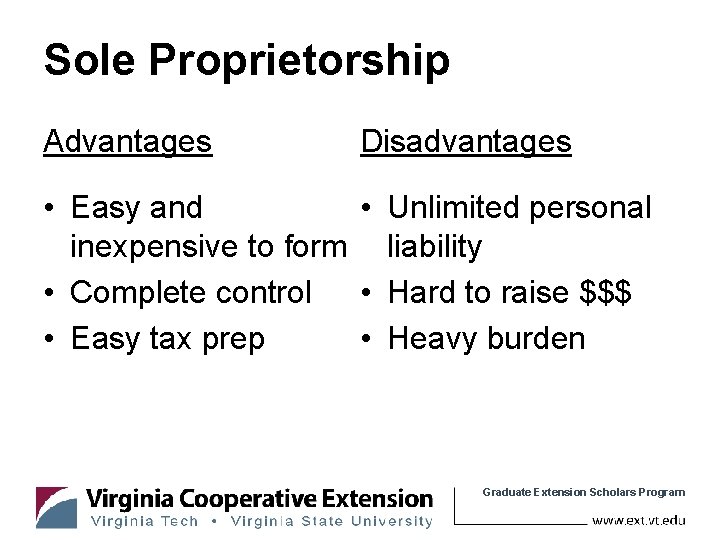
Sole Proprietorship Advantages Disadvantages • Unlimited personal • Easy and inexpensive to form liability • Complete control • Hard to raise $$$ • Heavy burden • Easy tax prep Graduate Extension Scholars Program
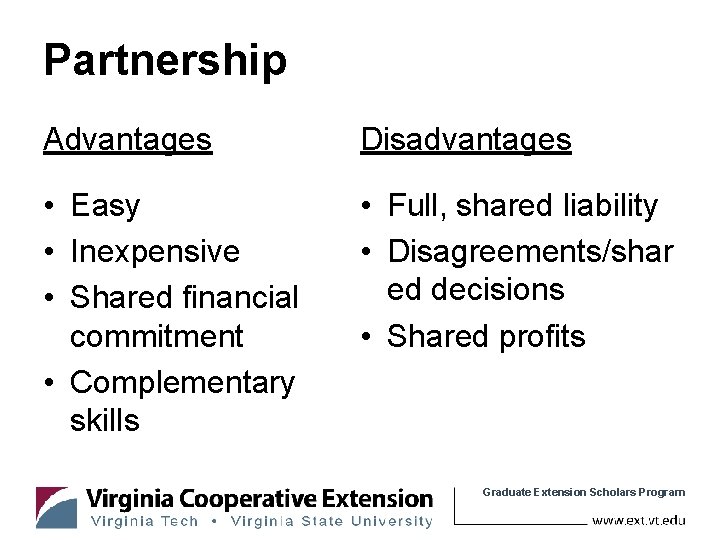
Partnership Advantages Disadvantages • Easy • Inexpensive • Shared financial commitment • Complementary skills • Full, shared liability • Disagreements/shar ed decisions • Shared profits Graduate Extension Scholars Program
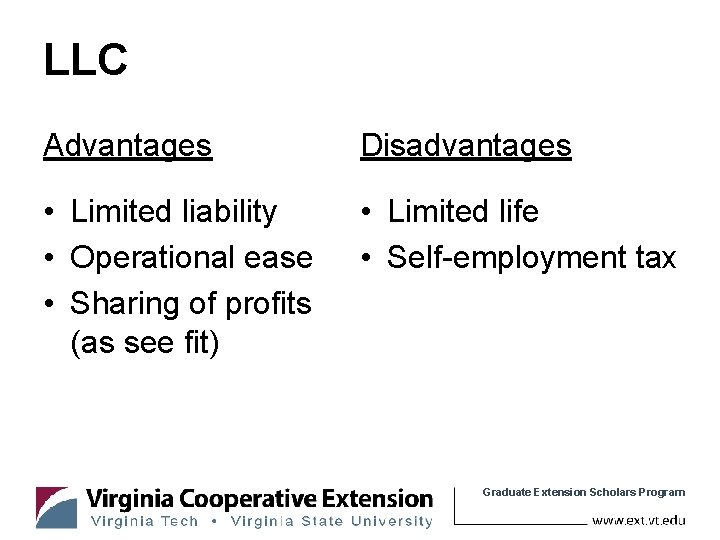
LLC Advantages Disadvantages • Limited liability • Operational ease • Sharing of profits (as see fit) • Limited life • Self-employment tax Graduate Extension Scholars Program
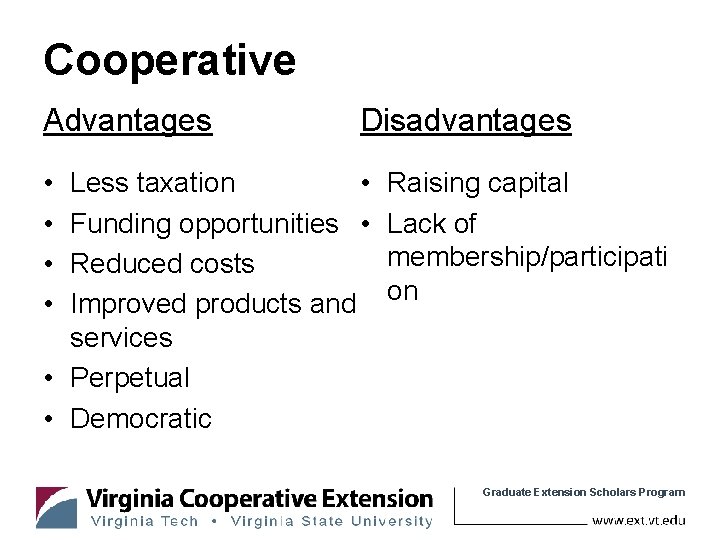
Cooperative Advantages Disadvantages • Less taxation Funding opportunities • Reduced costs Improved products and services • Perpetual • Democratic • • Raising capital Lack of membership/participati on Graduate Extension Scholars Program
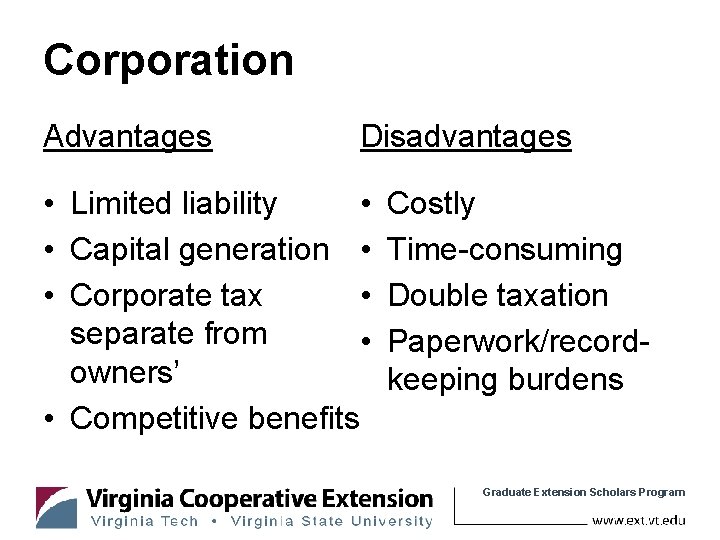
Corporation Advantages Disadvantages • • Limited liability • Capital generation • • • Corporate tax separate from • owners’ • Competitive benefits Costly Time-consuming Double taxation Paperwork/recordkeeping burdens Graduate Extension Scholars Program
BUSINESS SIMULATION GAME Graduate Extension Scholars Program
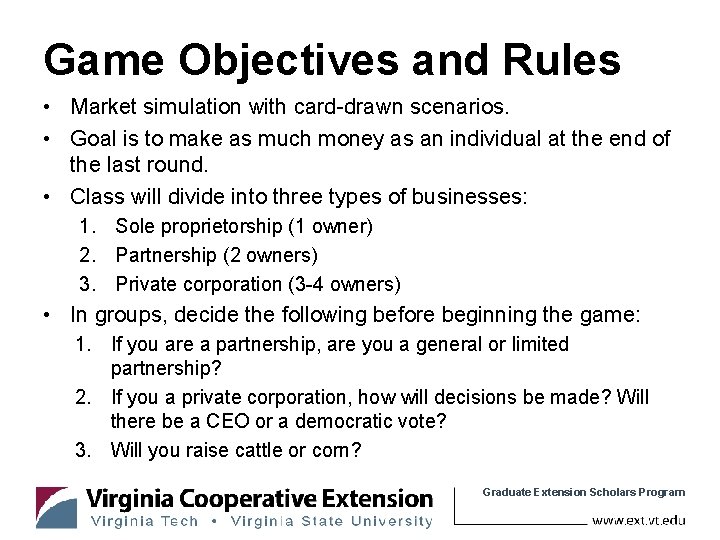
Game Objectives and Rules • Market simulation with card-drawn scenarios. • Goal is to make as much money as an individual at the end of the last round. • Class will divide into three types of businesses: 1. Sole proprietorship (1 owner) 2. Partnership (2 owners) 3. Private corporation (3 -4 owners) • In groups, decide the following before beginning the game: 1. If you are a partnership, are you a general or limited partnership? 2. If you a private corporation, how will decisions be made? Will there be a CEO or a democratic vote? 3. Will you raise cattle or corn? Graduate Extension Scholars Program
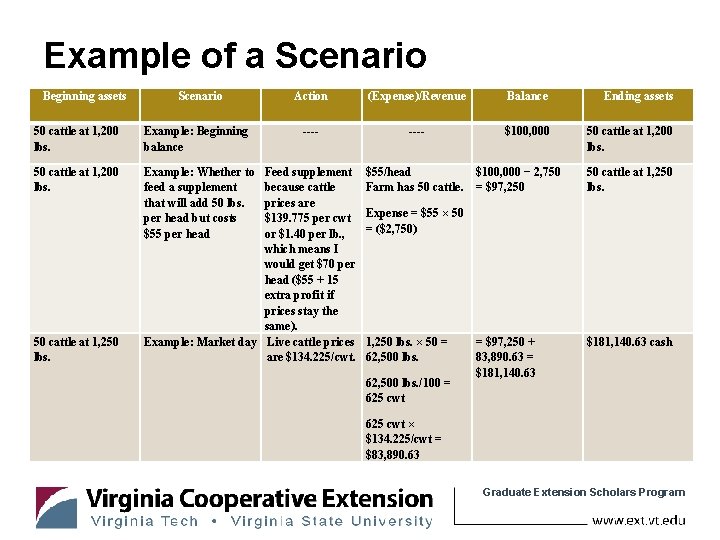
Example of a Scenario Beginning assets Scenario 50 cattle at 1, 200 lbs. Example: Beginning balance 50 cattle at 1, 200 lbs. Example: Whether to feed a supplement that will add 50 lbs. per head but costs $55 per head 50 cattle at 1, 250 lbs. Action (Expense)/Revenue Balance Ending assets ---- $100, 000 50 cattle at 1, 200 lbs. Feed supplement because cattle prices are $139. 775 per cwt or $1. 40 per lb. , which means I would get $70 per head ($55 + 15 extra profit if prices stay the same). Example: Market day Live cattle prices are $134. 225/cwt. $55/head Farm has 50 cattle. $100, 000 − 2, 750 = $97, 250 50 cattle at 1, 250 lbs. = $97, 250 + 83, 890. 63 = $181, 140. 63 cash Expense = $55 × 50 = ($2, 750) 1, 250 lbs. × 50 = 62, 500 lbs. /100 = 625 cwt × $134. 225/cwt = $83, 890. 63 Graduate Extension Scholars Program
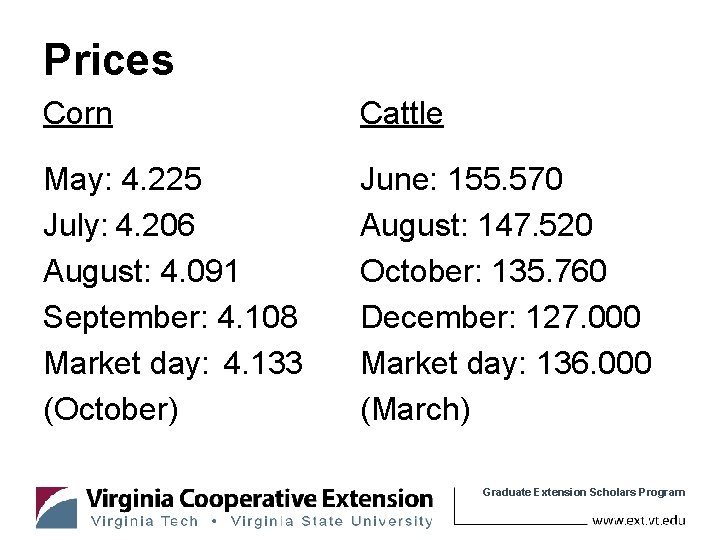
Prices Corn Cattle May: 4. 225 July: 4. 206 August: 4. 091 September: 4. 108 Market day: 4. 133 (October) June: 155. 570 August: 147. 520 October: 135. 760 December: 127. 000 Market day: 136. 000 (March) Graduate Extension Scholars Program
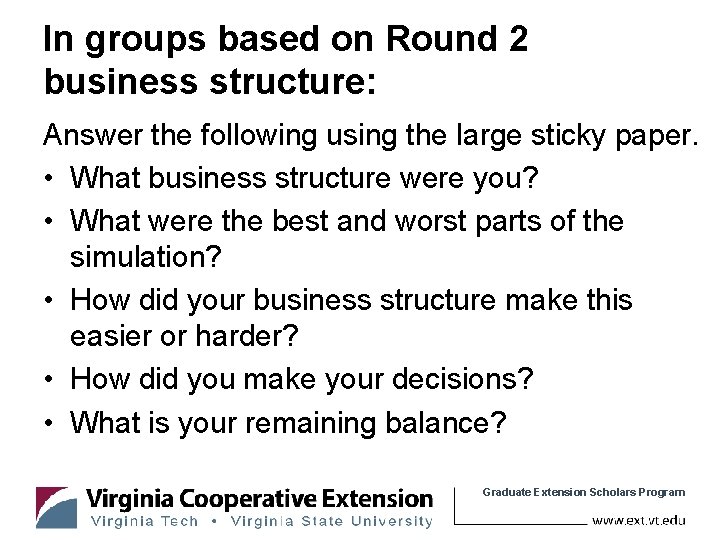
In groups based on Round 2 business structure: Answer the following using the large sticky paper. • What business structure were you? • What were the best and worst parts of the simulation? • How did your business structure make this easier or harder? • How did you make your decisions? • What is your remaining balance? Graduate Extension Scholars Program
GROUP PRESENTATIONS Graduate Extension Scholars Program
QUESTIONS? Graduate Extension Scholars Program
Take-Home for Next Time Consider the following questions: • What risks did your business face? • How might you manage this risk? • If you could do the simulation again, would you change your business structure? Graduate Extension Scholars Program
- Slides: 19