
Business Structures Business Ownership Chapter 6 Major Types
Business Structures Business Ownership Chapter 6
Major Types of Business Ownership § § § Sole proprietorship Partnership Corporation
Sole Proprietor § One-person business that is not registered with the state as a corporation or a limited liability company (LLC). § Easy to set up and maintain. § The simplest of business structures, § You may have to comply with local registration, business license, or permit laws to make your business legitimate. § You are personally responsible for paying both income taxes and business debts. § Can be held personally liable for any business-related obligation. This means that if your business doesn't pay a supplier, defaults on a debt, or loses a lawsuit, the creditor can legally come after your house or other possessions.

Ownership Differences § Sole proprietorship—One owner; easy startup. § Partnership—two or more owners; articles of partnership § Corporation—Many owners; must have written permission to operate.

Sole Proprietorship § Advantages § Easy to start § Owner has control and is the boss § Owner gets all profits. § Makes all business decisions. § Disadvantages § Capital is limited to what the owner can supply. § Owner is liable for all debts. § Can lose personal property of business fails. § Long hours & hard work.
Partnership § Advantages § Fairly easy to start § Has articles of partnership § More sources of capital § More business skills are available § Disadvantages § Each partner is liable for business debts made by all partners § Each partner shares profits

Corporations § Advantages § More sources of capital available § Specialized management skills available § Owners are liable up to the amount of their investments § Ownership can be easily transferred through sale of stock § Disadvantages § Difficult/complex process to start § Owners don’t have control of daily decisions unless they are an officer of the company. § Activities are limited to those stated in the certificate of incorporation.
Review Questions! § Name two advantages and two disadvantages of each type of business ownership.
Five Functions of Management § Managers § Plan § Organize § Staff § Lead § control
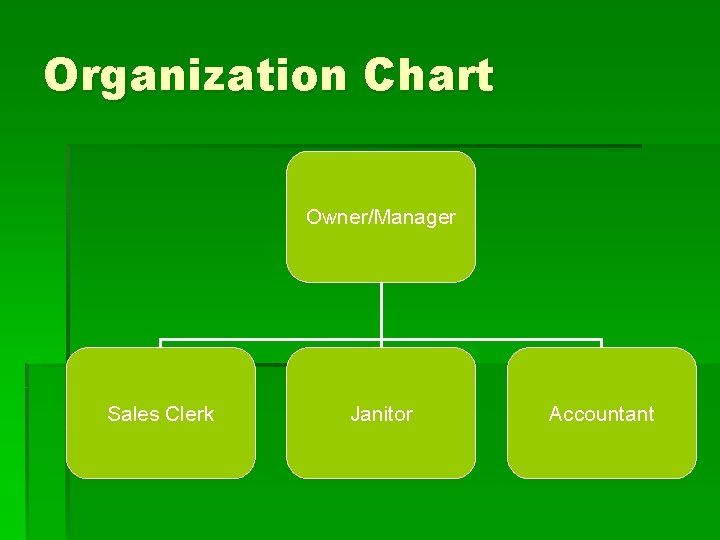
Organization Chart Owner/Manager Sales Clerk Janitor Accountant
Staffing § § Hiring Training Appraising rewarding
Leading § Managers must lead § Effective leaders § Inspire works to do their jobs. § Accept their share of responsibility in achieving goals of the business § Have good human relations § Excellent communication skills
Controlling § Comparing what actually happens with what was planned. § Page 73
Articles of Partnership § § § Name of new business Amount each partner invests Salary requirements of each partner Disbursements of profits Responsibilities of each partners Partnership dissolution
Creating Corporations § Business needs to expand grow § To do so requires more money § Forming a corporation can do this. § Plan for corporation must be drafted. § Divide the company up by selling shares
Board of Directors § Group of people responsible for guiding the company. § Board elects executive officers § President (CEO) § Vice President § Corporate lawyer
Specialized Business Organization § § § Franchises Cooperatives Non-profit organizations
Franchise § Written contract giving permission to sell someone else’s product or service. § Can be operated as a proprietorship, partnership, or corporation. § Look on page 77
Franchise Advantages § Relatively easy to start § Franchisor often helps the franchisee get started § Franchisor helps in selling product by giving national advertising.
Franchise Disadvantages § Require large investments of capital to start § Very competitive § Often fail because they were not competitive or in a good location.
Franchise Agreement § States the duties and rights of both parties § Franchisee agrees to run the business in a certain way. § Name of the business § Products or services offered § Design and color of the building § Prices of the product or service § How employees dress
Cooperatives § A co-op is a business that is owned and controlled by the very same customers who use its services. § The voice of every person makes a difference. § The economic benefits of a cooperative are given back to the members, reinvested in the co-op or used to provide member services.
REA § The rural electric cooperatives began back in 1935 when the Rural Electric Administration (REA) was created with the help of Franklin D. Roosevelt. § The REA's goal was to provide electricity to the rural areas and jobs during hard times. § The idea was to provide established memberowned utility companies with federal REA loans. The objective was to bring electric power to the countryside when no one else would.
Consumer’s Cooperative § A business owned by its customers. § Employees can also generally become members. § Members vote on major decisions, and elect the board of directors from amongst their own number. § A well known example in the United States is the REI (Recreational Equipment Incorporated) co-op § Houchen’s Grocery
Producer’s Cooperative § Organization of producers who cooperate in the areas of buying supplies and equipment and of marketing. § Dairy farms § Chicken producers § Family farms
Non-Profit Corporations § Municipalities § A town, city, or district possessing corporate jurisdiction
Two Ways a Cooperative is Controlled § Each owner-member may have one vote § Each member vote may be based on the amount of service he or she has bought from the cooperative.

Questions?
- Slides: 28