
Business Strategy Game Simulation The Business Strategy Game
Business Strategy Game Simulation The Business Strategy Game is the most widely played computer simulation in the strategic management market and is used in business schools all across the world. The industry's product is athletic footwear and the geographic scope of the market is global. Each company in the industry is managed by a team of students/players who must match their strategic wits against the other company teams-competition is head-to-head. The company that players manage has plants to operate, a work force to compensate, distribution expenses and inventories to control, capital expenditure decisions to make, marketing and sales campaigns to wage, a website to operate, sales forecasts to consider, and ups and downs in exchange rates, interest rates, and the stock market to take into account. Template by: www. itdepartment. biz
Decisions q Operation Decisions Product Quality and Price Material Prices Labour Productivity Reject Rate q Plant Decisions Plant construction, Purchase, Sale, Shutdown Expansion Automation Options q Marketing Decisions Private Label Markets Branded Markets Service Rating Sales Forecast Annual Advertising Number of models Product Image Number of Retail Outlets q Financial Decisions Financial Strategy Short-term loans Bonds Common Stock Template by: www. itdepartment. biz
Flex. Wear Decision Mistakes q Operation Decisions Good service rating: 100 (50 is considered satisfactory) at the beginning Stock outs and inadequate delivery times drove service rating for 2 years to 0 Steady declining productivity - Layoffs of workers - Cutting the costs on salaries - Insufficient investment in improving production methods and plant upgrades q Plant Decisions Opening new plant in North America and investing USD 11 650 000 at Y 10 2 Years plan to shift production capabilities to cheaper geographic areas: Asia, Latin America completed in Y 14 - Gradually cutting production - Layoff personnel in North America and hiring personnel in Asia and Latin America Shutdown of North American plant at Y 14 Failing to arrange financial resources for productivity upgrade investments in the new plant Selling 1 000 capacity units to competitors in Y 20 in its efforts to rearrange its financial resources and getting back its competitiveness. Template by: www. itdepartment. biz
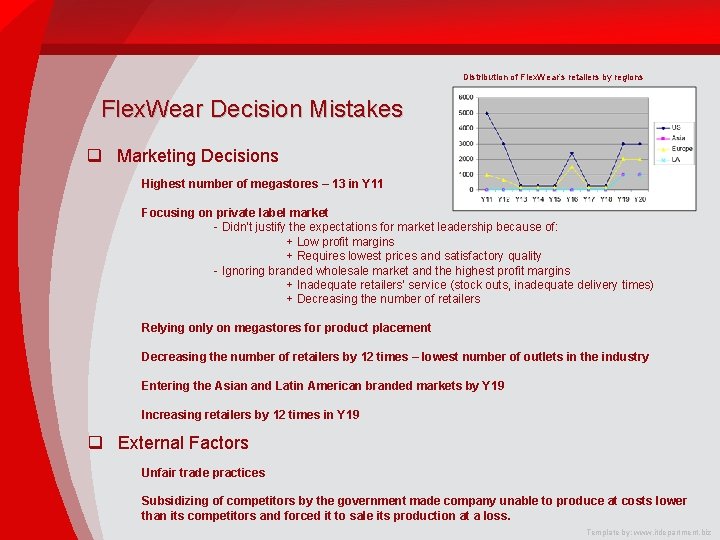
Distribution of Flex. Wear’s retailers by regions Flex. Wear Decision Mistakes q Marketing Decisions Highest number of megastores – 13 in Y 11 Focusing on private label market - Didn’t justify the expectations for market leadership because of: + Low profit margins + Requires lowest prices and satisfactory quality - Ignoring branded wholesale market and the highest profit margins + Inadequate retailers’ service (stock outs, inadequate delivery times) + Decreasing the number of retailers Relying only on megastores for product placement Decreasing the number of retailers by 12 times – lowest number of outlets in the industry Entering the Asian and Latin American branded markets by Y 19 Increasing retailers by 12 times in Y 19 q External Factors Unfair trade practices Subsidizing of competitors by the government made company unable to produce at costs lower than its competitors and forced it to sale its production at a loss. Template by: www. itdepartment. biz

Flex. Wear Strategy Goals Mistakes q Lack of clear strategic vision for market development according to its requirements Private Label Market Branded Wholesale Market Internet Market q Inadequate Production Facilities Investments North America Asia and Latin America q Established Inadequate Key Success Factors High quality image Service Level Productivity Template by: www. itdepartment. biz
Flex. Wear’s Insolvency q Suspended by “Government” in Y 19 q Closing its facilities after 19 years on the market q Laying off more than 2380 employees Template by: www. itdepartment. biz
Thank you for your time Template by: www. itdepartment. biz
- Slides: 7