
Business Strategy and Policy Lecture 29 1 Recap
Business Strategy and Policy Lecture 29 1
Recap • Nature of Strategy Analysis & Choice • Comprehensive Strategy-Formulation Framework • SWOT Matrix • Strategic Position and Action Evaluation (SPACE) • BCG Matrix • IE Matrix • QSPM 2
Today’s Lecture • IMPLEMENTING STRATEGIES: MANAGEMENT AND OPERATIONS ISSUES § Management Perspectives 1. ANNUAL OBJECTIVES 2. POLICIES 3. RESOURCE ALLOCATION 4. MANAGING CONFLICT 5. MATCHING STRATEGY WITH STRUCTURE 6. RESTRUCTURING, REENGINEERING, AND E-ENGINEERING 7. LINKING PERFORMANCE AND PAY TO STRATEGIES 8. MANAGING RESISTANCE TO CHANGE 9. MANAGING THE NATURAL ENVIRONMENT 10. CREATING A STRATEGY-SUPPORTIVE CULTURE 11. PRODUCTION/OPERATIONS CONCERNS 12. HUMAN RESOURCE CONCERNS 3
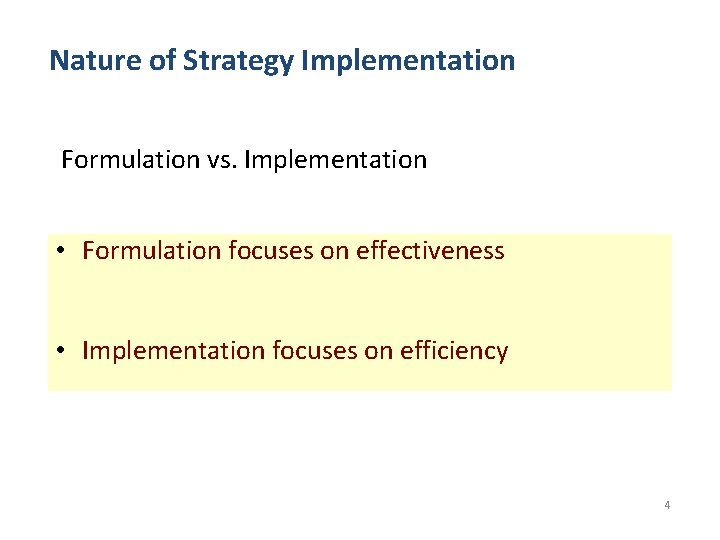
Nature of Strategy Implementation Formulation vs. Implementation • Formulation focuses on effectiveness • Implementation focuses on efficiency 4
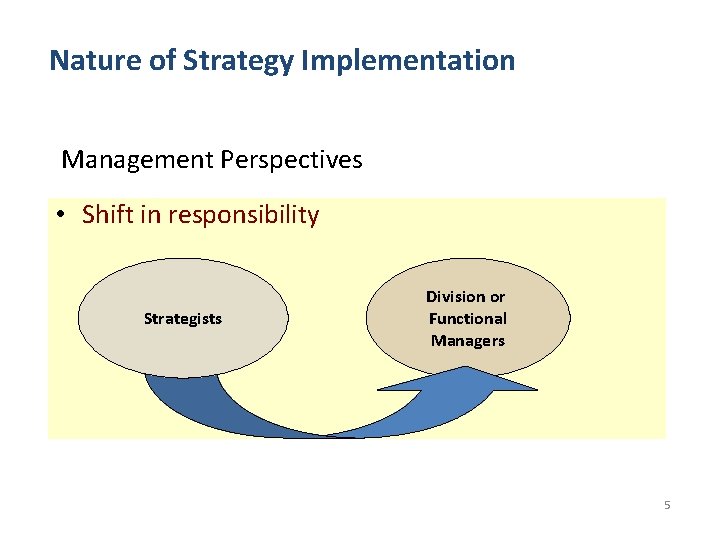
Nature of Strategy Implementation Management Perspectives • Shift in responsibility Strategists Division or Functional Managers 5
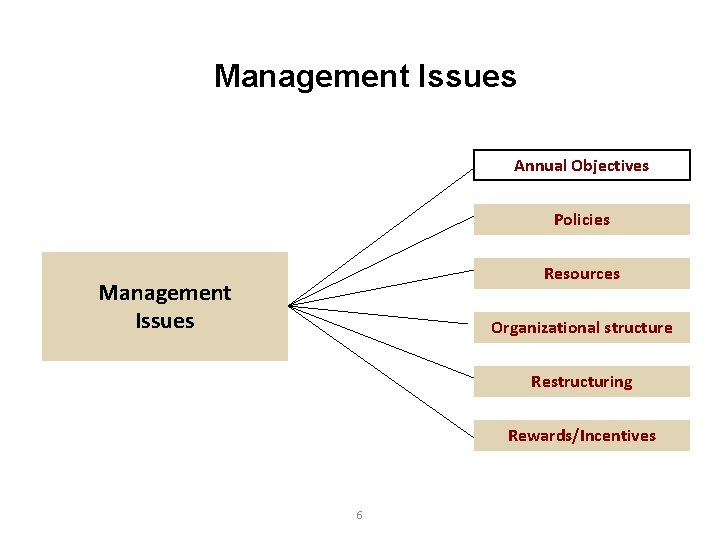
Management Issues Annual Objectives Policies Resources Management Issues Organizational structure Restructuring Rewards/Incentives 6
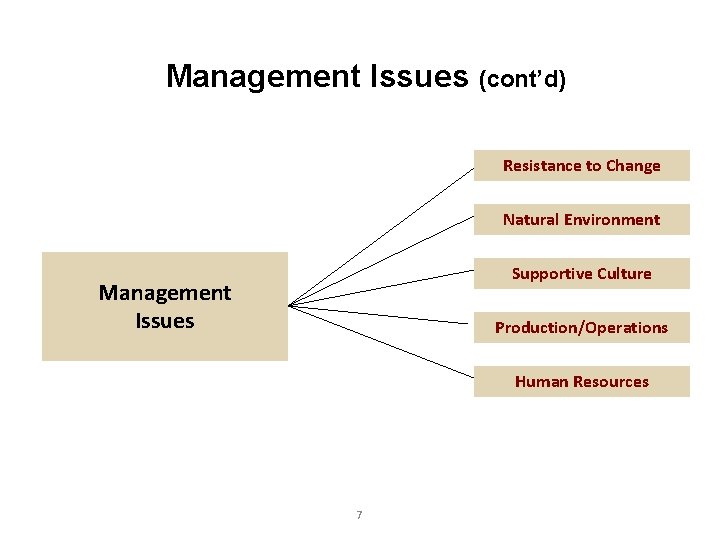
Management Issues (cont’d) Resistance to Change Natural Environment Supportive Culture Management Issues Production/Operations Human Resources 7
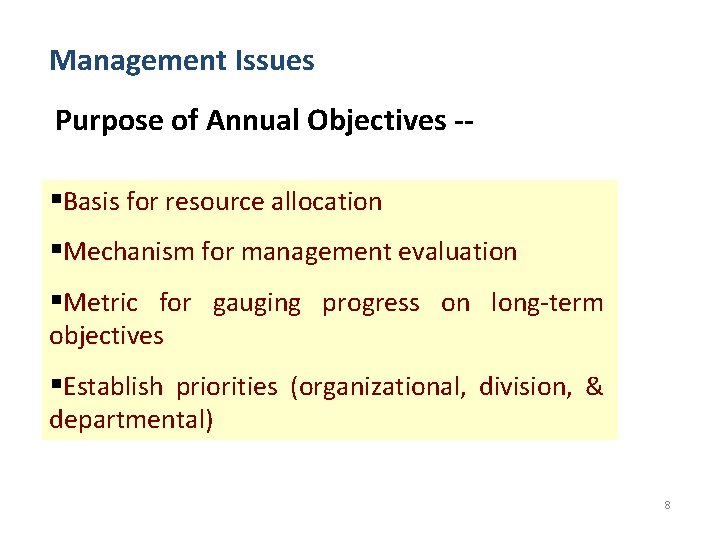
Management Issues Purpose of Annual Objectives -§Basis for resource allocation §Mechanism for management evaluation §Metric for gauging progress on long-term objectives §Establish priorities (organizational, division, & departmental) 8
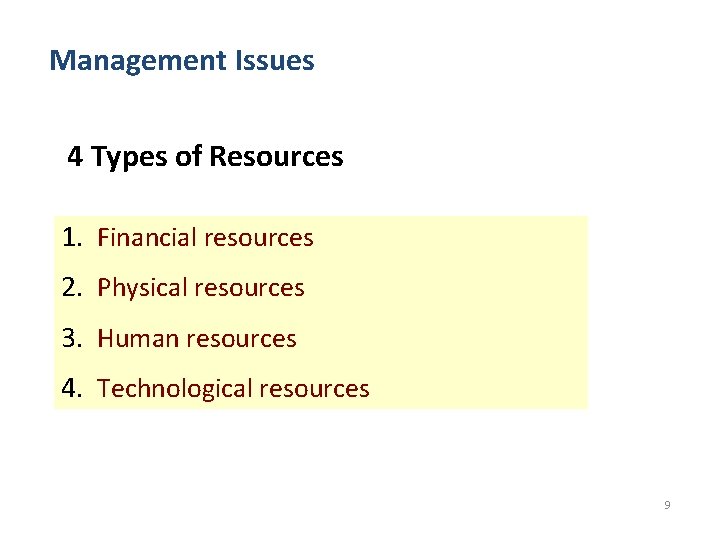
Management Issues 4 Types of Resources 1. Financial resources 2. Physical resources 3. Human resources 4. Technological resources 9
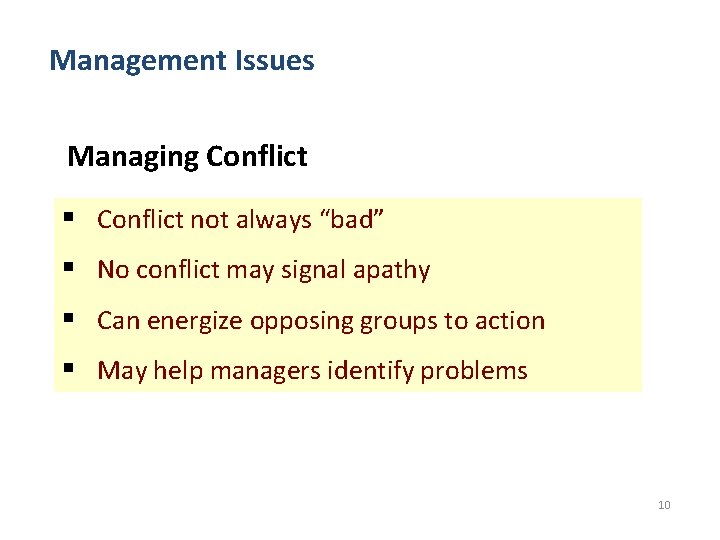
Management Issues Managing Conflict § Conflict not always “bad” § No conflict may signal apathy § Can energize opposing groups to action § May help managers identify problems 10
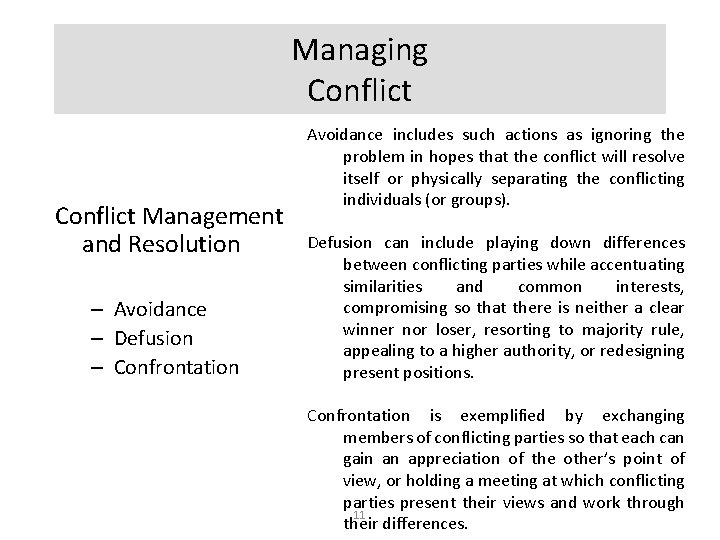
Managing Conflict Management and Resolution – Avoidance – Defusion – Confrontation Avoidance includes such actions as ignoring the problem in hopes that the conflict will resolve itself or physically separating the conflicting individuals (or groups). Defusion can include playing down differences between conflicting parties while accentuating similarities and common interests, compromising so that there is neither a clear winner nor loser, resorting to majority rule, appealing to a higher authority, or redesigning present positions. Confrontation is exemplified by exchanging members of conflicting parties so that each can gain an appreciation of the other’s point of view, or holding a meeting at which conflicting parties present their views and work through 11 their differences.
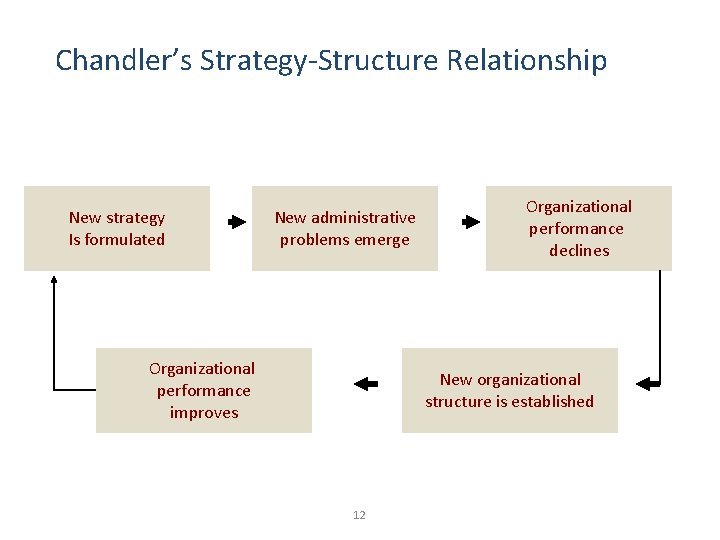
Chandler’s Strategy-Structure Relationship New strategy Is formulated New administrative problems emerge Organizational performance improves Organizational performance declines New organizational structure is established 12
Management Issues Basic Forms of Structure § Functional Structure § Divisional Structure § Strategic Business Unit Structure (SBU) § Matrix Structure 13
Management Issues Restructuring §Downsizing §Rightsizing §Delayering 14
Management Issues Reengineering §Process management §Process innovation §Process redesign 15
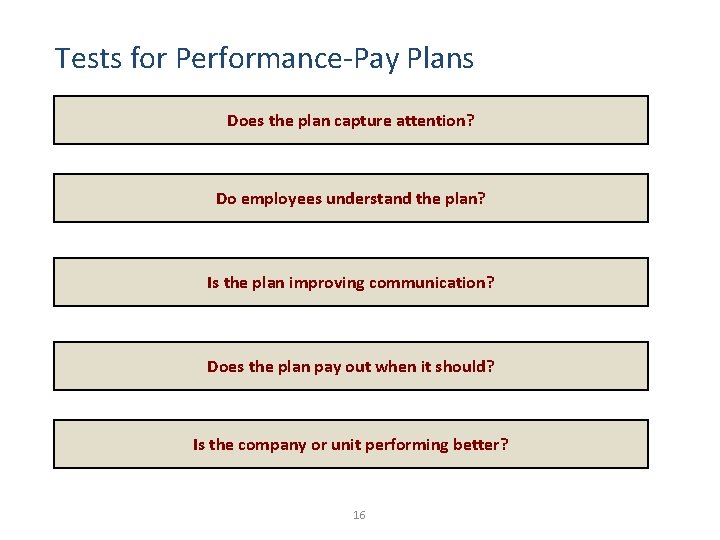
Tests for Performance-Pay Plans Does the plan capture attention? Do employees understand the plan? Is the plan improving communication? Does the plan pay out when it should? Is the company or unit performing better? 16
Management Issues Production/Operations Concerns -- Production processes typically constitute more than 70% of the firm’s total assets 17
Management Issues Production/Operations Decisions §Plant size §Inventory/Inventory control §Quality control §Cost control §Technological innovation 18
Management Issues Human Resource Strategic Responsibilities §Assessing staffing needs/costs §Developing performance incentives §ESOP’s §Child-care policies §Work-life balance issues 19
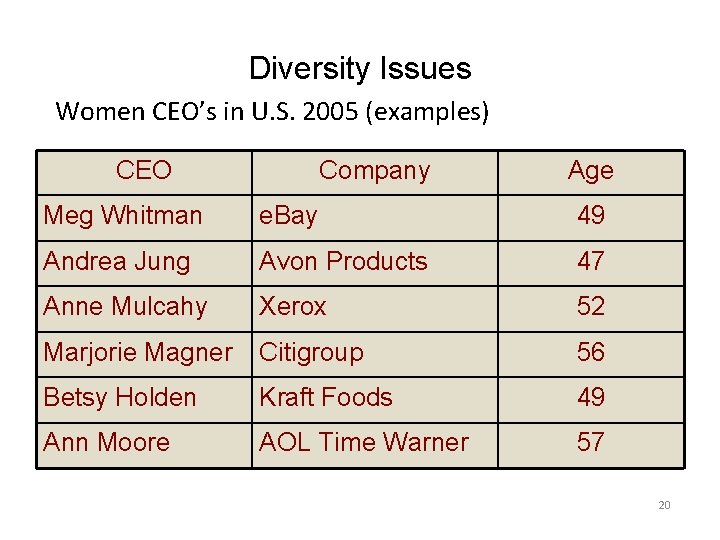
Diversity Issues Women CEO’s in U. S. 2005 (examples) CEO Company Age Meg Whitman e. Bay 49 Andrea Jung Avon Products 47 Anne Mulcahy Xerox 52 Marjorie Magner Citigroup 56 Betsy Holden Kraft Foods 49 Ann Moore AOL Time Warner 57 20
Benefits of a Diverse Workforce • • Improves corporate culture Improves employee morale Leads to a higher retention of employees Leads to easier recruitment of employees Decreases complaints and litigation Increases creativity Decreases interpersonal conflict 21
Benefits of a Diverse Workforce • Enables the organization to move into emerging markets • Improves client relations • Increases productivity • Improves the bottom line • Maximizes brand identity • Reduces training costs 22
Summary • IMPLEMENTING STRATEGIES: MANAGEMENT AND OPERATIONS ISSUES § Management Perspectives 1. ANNUAL OBJECTIVES 2. POLICIES 3. RESOURCE ALLOCATION 4. MANAGING CONFLICT 5. MATCHING STRATEGY WITH STRUCTURE 6. RESTRUCTURING, REENGINEERING, AND E-ENGINEERING 7. LINKING PERFORMANCE AND PAY TO STRATEGIES 8. MANAGING RESISTANCE TO CHANGE 9. MANAGING THE NATURAL ENVIRONMENT 10. CREATING A STRATEGY-SUPPORTIVE CULTURE 11. PRODUCTION/OPERATIONS CONCERNS 12. HUMAN RESOURCE CONCERNS 23
Next Lecture STRATEGY REVIEW, EVALUATION, AND CONTROL • CHAPTER OUTLINE – – – – The Nature of Strategy Evaluation A Strategy-Evaluation Framework The Balanced Scorecard Published Sources of Strategy-Evaluation Information Characteristics of an Effective Evaluation System Contingency Planning Auditing 21 st Century Challenges in Strategic Management 24
- Slides: 24