
Business Strategy and Policy Lecture 20 1 Recap
Business Strategy and Policy Lecture 20 1
Recap • THE INTERNAL FACTOR EVALUATION (IFE) MATRIX • The Nature of Long-Term Objectives • Financial versus Strategic Objectives • Not Managing by Objectives 2
Today’s Lecture • The Balanced Scorecard • Levels of Strategies 3
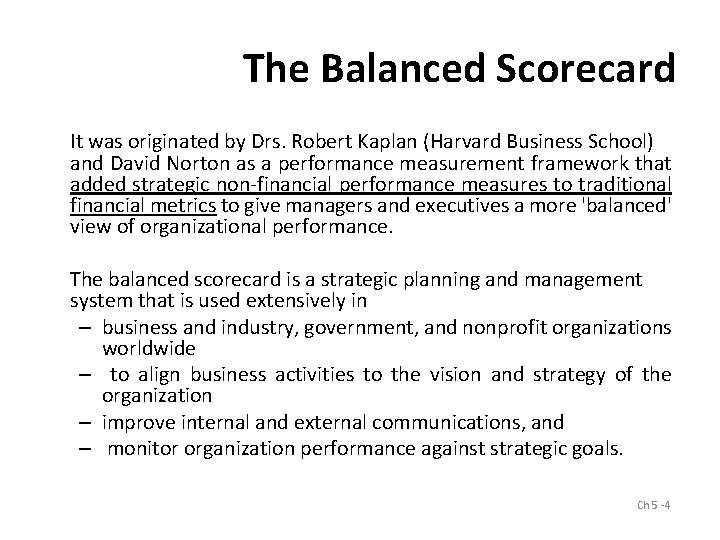
The Balanced Scorecard It was originated by Drs. Robert Kaplan (Harvard Business School) and David Norton as a performance measurement framework that added strategic non-financial performance measures to traditional financial metrics to give managers and executives a more 'balanced' view of organizational performance. The balanced scorecard is a strategic planning and management system that is used extensively in – business and industry, government, and nonprofit organizations worldwide – to align business activities to the vision and strategy of the organization – improve internal and external communications, and – monitor organization performance against strategic goals. Ch 5 -4
The Balanced Scorecard • The balanced scorecard is a management system (not only a measurement system) that enables – organizations to clarify their vision and strategy and translate them into action. – It provides feedback around both the internal business processes and external outcomes in order to continuously improve strategic performance and results. – When fully deployed, the balanced scorecard transforms strategic planning from an academic exercise into the nerve center of an enterprise. 5
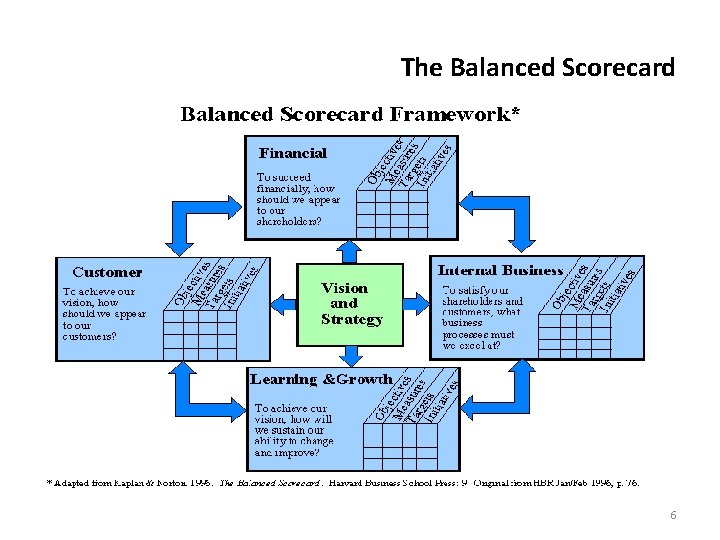
The Balanced Scorecard 6
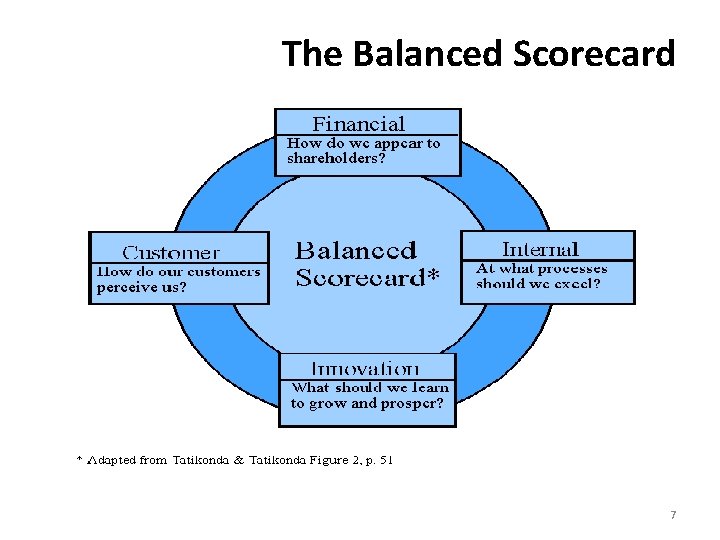
The Balanced Scorecard 7
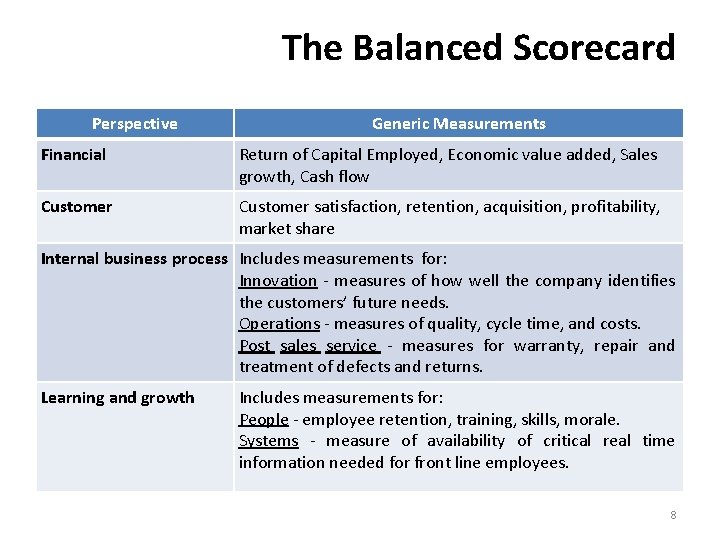
The Balanced Scorecard Perspective Generic Measurements Financial Return of Capital Employed, Economic value added, Sales growth, Cash flow Customer satisfaction, retention, acquisition, profitability, market share Internal business process Includes measurements for: Innovation - measures of how well the company identifies the customers’ future needs. Operations - measures of quality, cycle time, and costs. Post sales service - measures for warranty, repair and treatment of defects and returns. Learning and growth Includes measurements for: People - employee retention, training, skills, morale. Systems - measure of availability of critical real time information needed for front line employees. 8
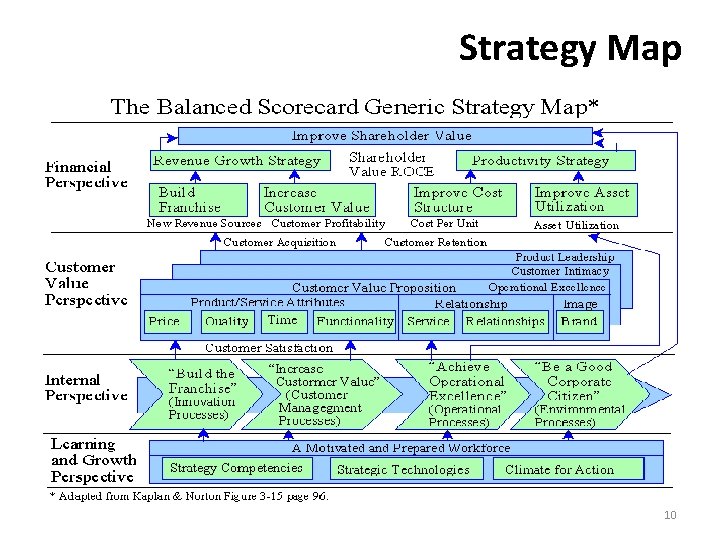
Strategy Map A strategy map is "a logical comprehensive architecture for describing strategy. It provides the foundation for designing a Balanced Scorecard that is the cornerstone of a strategic management system". Strategy Maps reveal the cause-andeffect linkages needed to transform intangible assets into tangible financial outcomes. Strategy Maps, if designed correctly, may provide the solution to the problems 9
Strategy Map 10
Levels of Strategies – Large Company 11
Levels of Strategies – Large Company • Corporate strategy—this strategy seeks to determine what businesses a company should be in or wants to be in. Corporate strategy determines the direction that the organization is going and the roles that each business unit in the organization will plan in pursuing that direction. • Four areas of focus – – Diversification management (acquisitions and divestitures) Synergy between units Investment priorities Business level strategy approval 12
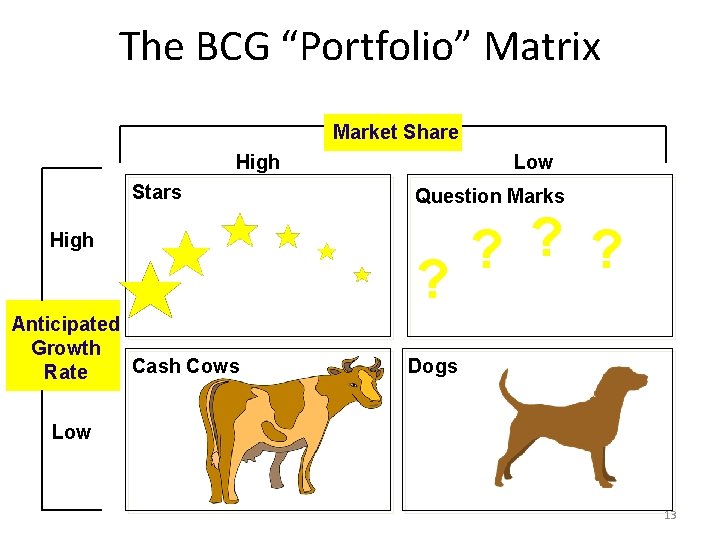
The BCG “Portfolio” Matrix Market Share High Stars High Anticipated Growth Cash Cows Rate Low Question Marks ? ? ? ? Dogs Low 13
Business Level Strategy • How do we support the corporate strategy? • How do we compete in a specific business arena? • Three types of business level strategies: – Low cost producer – Differentiator – Focus • Four areas of focus – – Generate sustainable competitive advantages Develop and nurture (potentially) valuable capabilities Respond to environmental changes Approval of functional level strategies 14
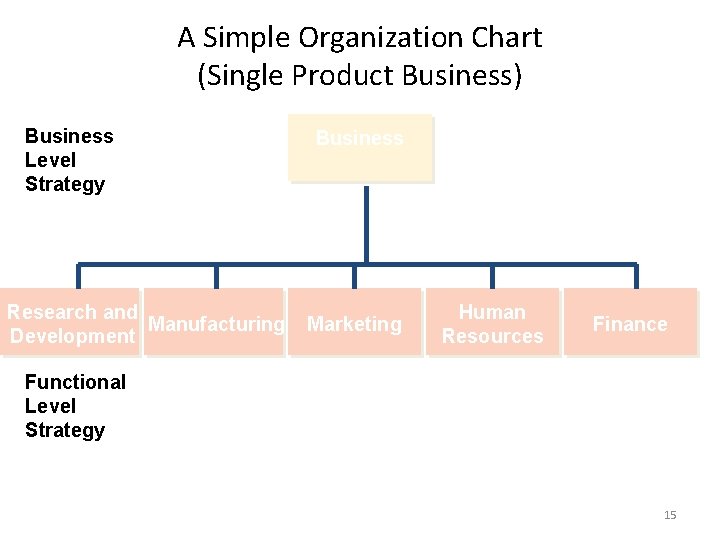
A Simple Organization Chart (Single Product Business) Business Level Strategy Research and Manufacturing Development Business Marketing Human Resources Finance Functional Level Strategy 15

Functional / Operational Level Strategy • Functional: How do we support the business level strategy? • Operational: How do we support the functional level strategy? 16
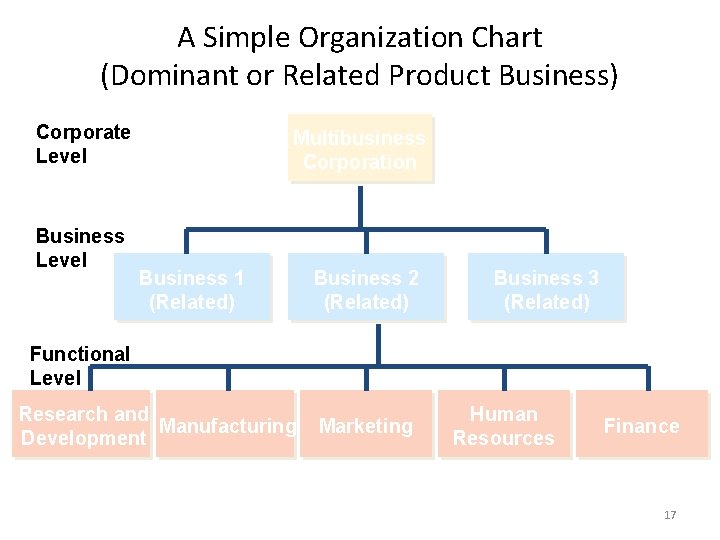
A Simple Organization Chart (Dominant or Related Product Business) Corporate Level Business Level Multibusiness Corporation Business 1 (Related) Business 2 (Related) Business 3 (Related) Functional Level Research and Manufacturing Development Marketing Human Resources Finance 17
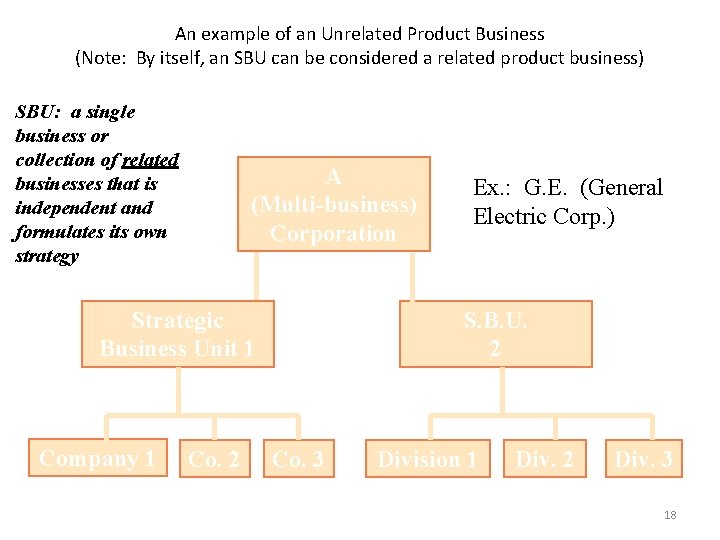
An example of an Unrelated Product Business (Note: By itself, an SBU can be considered a related product business) SBU: a single business or collection of related businesses that is independent and formulates its own strategy A (Multi-business) Corporation Strategic Business Unit 1 Company 1 Co. 2 Ex. : G. E. (General Electric Corp. ) S. B. U. 2 Co. 3 Division 1 Div. 2 Div. 3 18
Summary • The Balanced Scorecard • Levels of Strategies 19
Next Lecture • Types of Strategies – Forward Integration – Backward Integration – Horizontal Integration 20
- Slides: 20