
Business Strategy and ITenabled Business Capabilities Fits Misfits
Business Strategy and IT-enabled Business Capabilities: Fits, Misfits and Firm Performance Abhay Nath Mishra Visiting Assistant Professor David A. Tepper School of Business Carnegie Mellon University Seminar at American University March 24, 2008
Motivation • IT is the largest single component of capital investment in the US. • Businesses worldwide spend more than $2 trillion on IT every year. • Are organizations making their IT investment decisions judiciously? • Are these investments likely to impact firm performance? Business Strategy and IT-enabled Business Capabilities
Motivation • “IT Doesn’t Matter. ” (Carr 2003) • Generic IT may not matter, but firm-specific IT capabilities do (Barua et al. 2004, Bhardwaj 2000, Gurbaxani 2003). • Only when IT investments are converted into IT capabilities and put to use that they add value (Soh and Markus 1995, Zhu and Kraemer 2005) • Are firms making IT investments on capabilities that are likely to have the highest impact on their performance? Business Strategy and IT-enabled Business Capabilities
IT Capabilities • The importance of IT capabilities widely acknowledged • Implicit assumptions in the literature: – “More” is better (Bhatt and Grover 2005, Bhardwaj 2000) – “All” IT capabilities are important (Bhatt and Grover 2005) • The significance of firm strategy in IT capability development and deployment Business Strategy and IT-enabled Business Capabilities 4
Research Questions • Are the requirements for IT capabilities likely to vary systematically among firms following different business strategies? • How should firms determine the right level of IT investment in various IT capabilities? • Does the “fit” between the business strategies followed by a firm and its IT capabilities impact performance? Business Strategy and IT-enabled Business Capabilities
Empirical Observations • Different flavors of strategy and IT capabilities – Wal-mart – Kmart – Zara Business Strategy and IT-enabled Business Capabilities
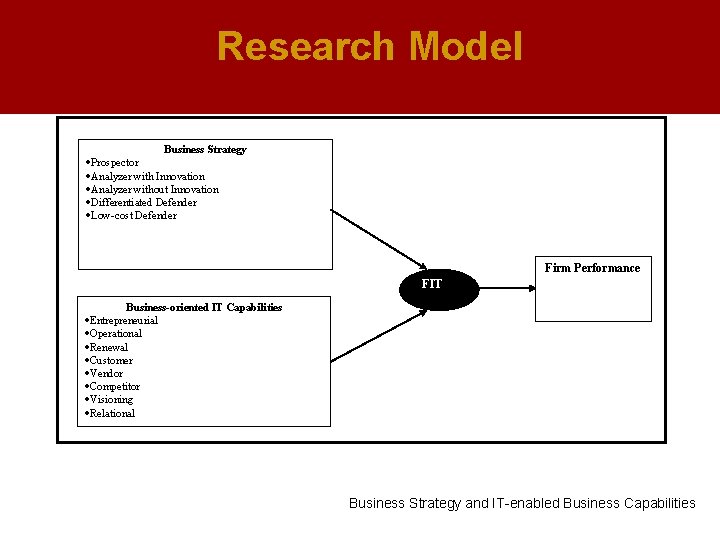
Research Model Business Strategy ·Prospector ·Analyzer with Innovation ·Analyzer without Innovation ·Differentiated Defender ·Low-cost Defender Firm Performance FIT Business-oriented IT Capabilities ·Entrepreneurial ·Operational ·Renewal ·Customer ·Vendor ·Competitor ·Visioning ·Relational Business Strategy and IT-enabled Business Capabilities
Business Strategy Archetypes • The Miles and Snow (1978) typology – Prospector, Analyzer, Defender and Reactor • Extensions to the Miles and Snow typology – Prospector, Analyzer with Innovation, Analyzer without Innovation, Low Cost Defender and Differentiated Defender • The need for extension: more nuanced strategies observed in contemporary firms (Ruekert and Walker 1987, Burton and Obel 1998, De. Sarbo et al. 2005) Business Strategy and IT-enabled Business Capabilities

IT Capabilities • Capabilities: “embedded” “routinized” “processes” that reflect “a firm’s ability to perform repeatedly a productive task which relates either directly or indirectly to a firm’s capacity for creating value” (Grant 1996). • IT Capabilities: the broad ability of firms to develop, diffuse, apply, and manage IT effectively to achieve firm objectives. • The focus in this study: business-oriented IT capabilities Business Strategy and IT-enabled Business Capabilities
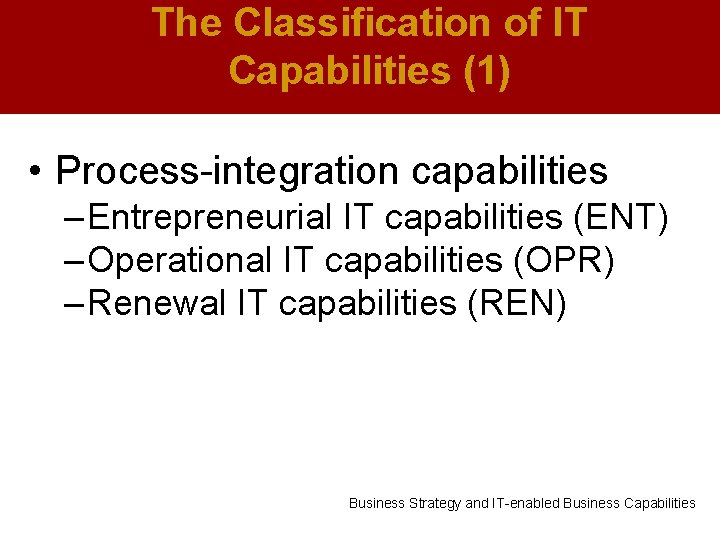
The Classification of IT Capabilities (1) • Process-integration capabilities – Entrepreneurial IT capabilities (ENT) – Operational IT capabilities (OPR) – Renewal IT capabilities (REN) Business Strategy and IT-enabled Business Capabilities
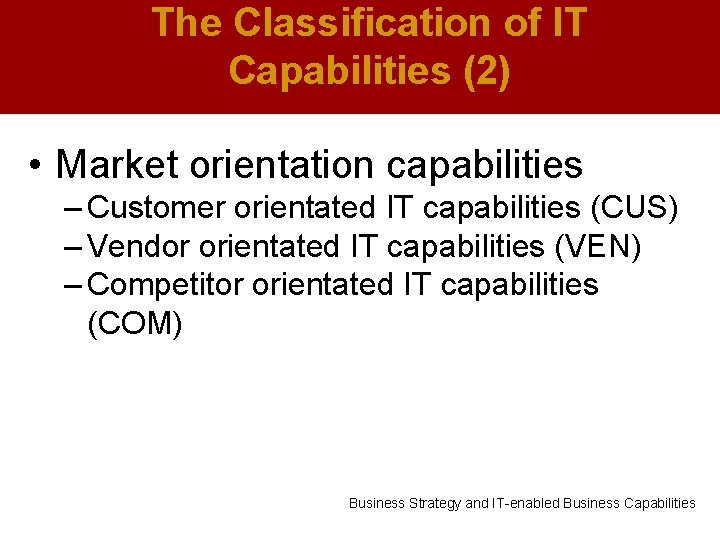
The Classification of IT Capabilities (2) • Market orientation capabilities – Customer orientated IT capabilities (CUS) – Vendor orientated IT capabilities (VEN) – Competitor orientated IT capabilities (COM) Business Strategy and IT-enabled Business Capabilities

The Classification of IT Capabilities (3) • Strategy and IT vision alignment capabilities – Business and IT visioning capabilities (VIS) – Business and IT relational capabilities (REL) Business Strategy and IT-enabled Business Capabilities
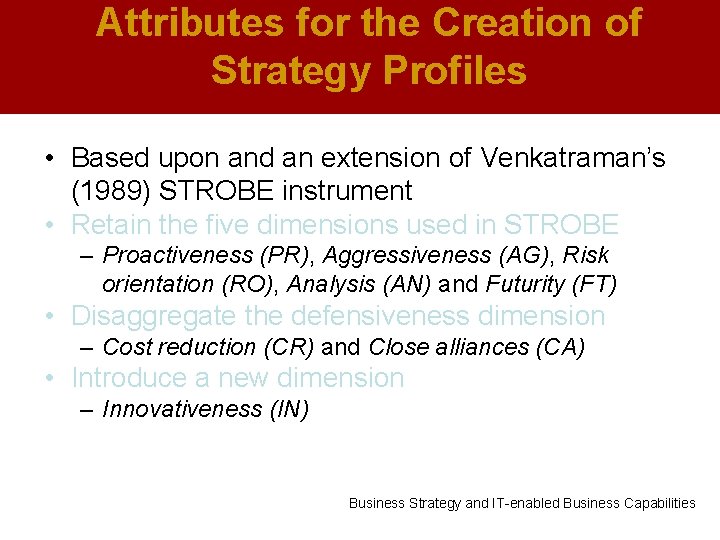
Attributes for the Creation of Strategy Profiles • Based upon and an extension of Venkatraman’s (1989) STROBE instrument • Retain the five dimensions used in STROBE – Proactiveness (PR), Aggressiveness (AG), Risk orientation (RO), Analysis (AN) and Futurity (FT) • Disaggregate the defensiveness dimension – Cost reduction (CR) and Close alliances (CA) • Introduce a new dimension – Innovativeness (IN) Business Strategy and IT-enabled Business Capabilities

Theoretical Underpinning: Configurational Theory • Basic tenets of Configurational theory – Organizational configurations are multidimensional constellation of distinct attributes that commonly occur together (Ketchen et al. 1993, Sabherwal and Chan 2001) – Configurational approach takes a step beyond the contingency approach by adopting a holistic stand – The identification of ideal profile types is central to the configurational theory – The closer a firm is to an ideal profile type and the better is the fit between different attributes, the better is firm performance (Doty et al. 1993, Meyer et al. 1993) – The concept of equifinality (Drazin and Van de Ven 1985) Business Strategy and IT-enabled Business Capabilities

Inductive and Deductive Approaches to Configuration Analysis • Inductive approach – Uses multivariate data analysis techniques to uncover patterns for top performing firms – These patterns are chosen as ideal profile types • Deductive approach – Uses theoretical perspectives to define ideal profile types and hypothesizes the relationship between configurations and performance • The extant literature has used the inductive approach predominantly Business Strategy and IT-enabled Business Capabilities
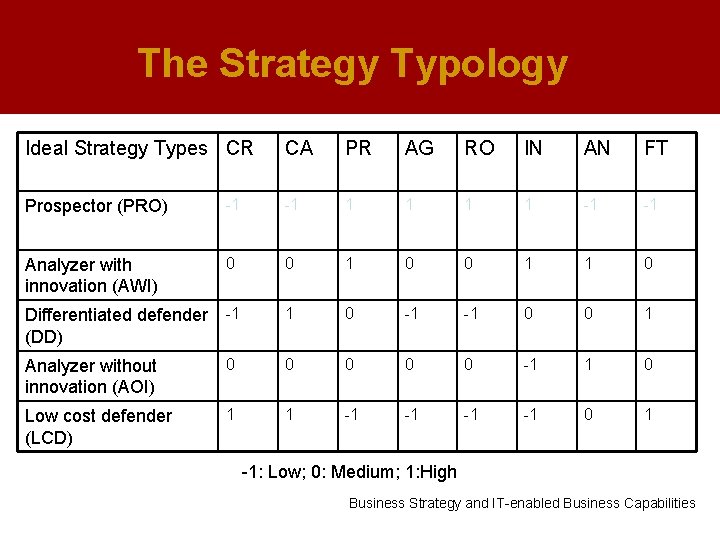
The Strategy Typology Ideal Strategy Types CR CA PR AG RO IN AN FT Prospector (PRO) -1 -1 1 1 -1 -1 Analyzer with innovation (AWI) 0 0 1 1 0 -1 -1 0 0 1 Differentiated defender -1 (DD) Analyzer without innovation (AOI) 0 0 0 -1 1 0 Low cost defender (LCD) 1 1 -1 -1 0 1 -1: Low; 0: Medium; 1: High Business Strategy and IT-enabled Business Capabilities
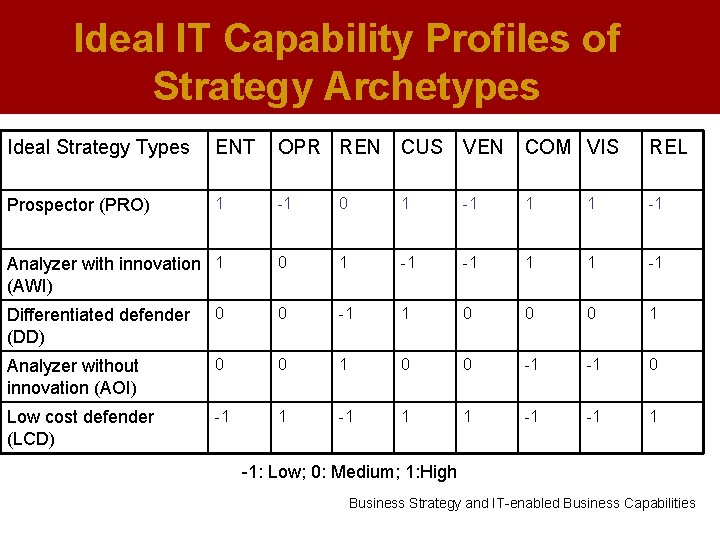
Ideal IT Capability Profiles of Strategy Archetypes Ideal Strategy Types ENT OPR REN CUS VEN COM VIS REL Prospector (PRO) 1 -1 0 1 -1 1 1 -1 Analyzer with innovation 1 (AWI) 0 1 -1 -1 1 1 -1 Differentiated defender (DD) 0 0 -1 1 0 0 0 1 Analyzer without innovation (AOI) 0 0 1 0 0 -1 -1 0 Low cost defender (LCD) -1 1 1 -1 -1: Low; 0: Medium; 1: High Business Strategy and IT-enabled Business Capabilities
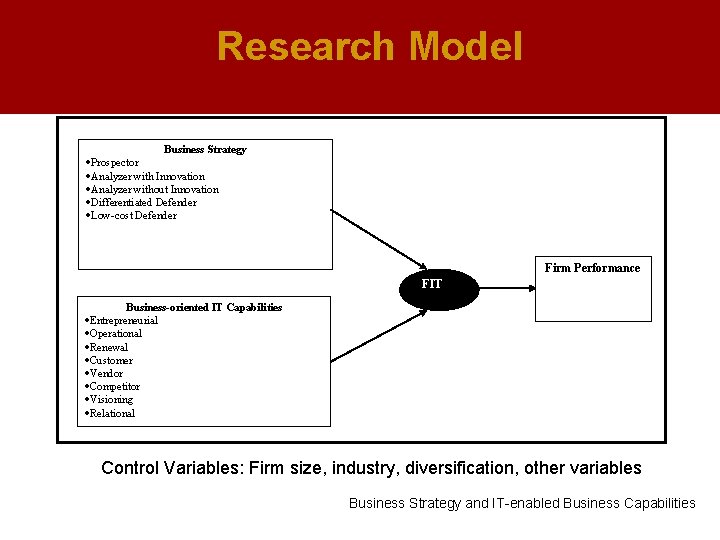
Research Model Business Strategy ·Prospector ·Analyzer with Innovation ·Analyzer without Innovation ·Differentiated Defender ·Low-cost Defender Firm Performance FIT Business-oriented IT Capabilities ·Entrepreneurial ·Operational ·Renewal ·Customer ·Vendor ·Competitor ·Visioning ·Relational Control Variables: Firm size, industry, diversification, other variables Business Strategy and IT-enabled Business Capabilities
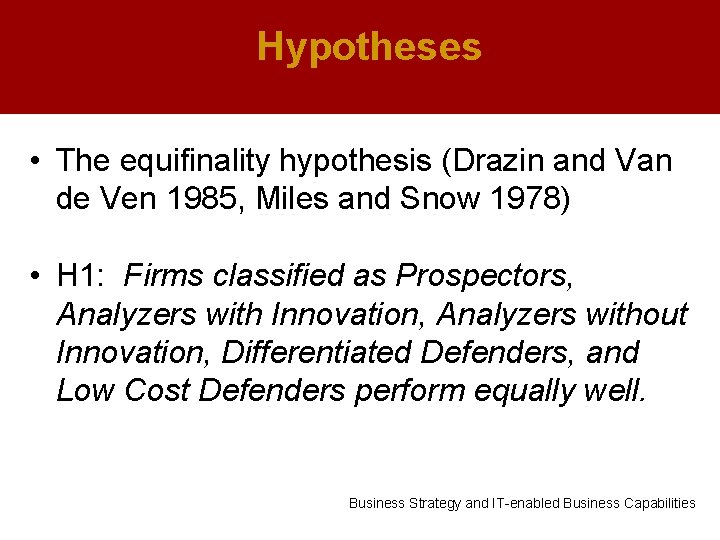
Hypotheses • The equifinality hypothesis (Drazin and Van de Ven 1985, Miles and Snow 1978) • H 1: Firms classified as Prospectors, Analyzers with Innovation, Analyzers without Innovation, Differentiated Defenders, and Low Cost Defenders perform equally well. Business Strategy and IT-enabled Business Capabilities
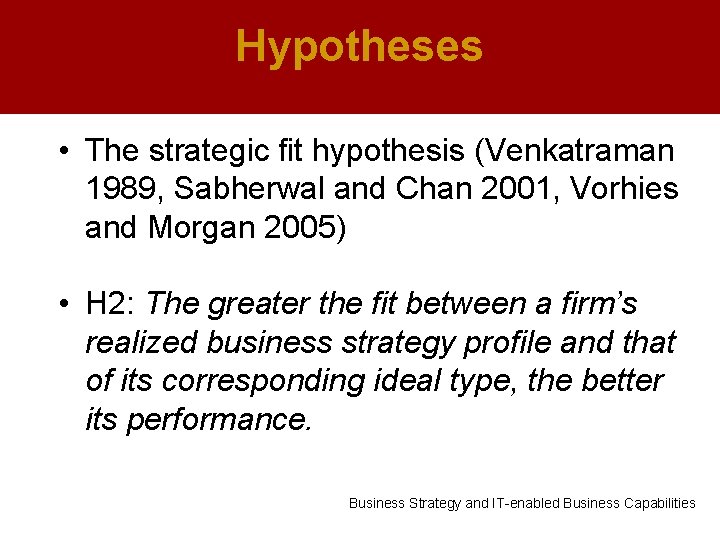
Hypotheses • The strategic fit hypothesis (Venkatraman 1989, Sabherwal and Chan 2001, Vorhies and Morgan 2005) • H 2: The greater the fit between a firm’s realized business strategy profile and that of its corresponding ideal type, the better its performance. Business Strategy and IT-enabled Business Capabilities
Hypotheses • The IT capability fit hypothesis • H 3: The greater the fit between a firm’s realized business-oriented IT capability profile and theoretically determined ideal profile for business-oriented IT capabilities corresponding to its strategy archetype, the better its performance. Business Strategy and IT-enabled Business Capabilities
Hypotheses • The IT capability fit hypotheses • H 4: The greater the fit between a firm’s realized business-oriented IT capability profile and the empirically derived ideal profile for business-oriented IT capabilities corresponding to its strategy archetype, the better its performance. Business Strategy and IT-enabled Business Capabilities
Hypotheses • The total fit hypotheses • H 5 a: The greater the total fit of a firm’s strategy profile and its business-oriented IT capability profile with its theoretically determined ideal archetype, the better its performance. • H 5 b: The greater the total fit of a firm’s strategy profile and its business-oriented IT capability profile with its empirically derived ideal archetype, the better its performance. Business Strategy and IT-enabled Business Capabilities
Data • Survey data from 2000 largest firms in the US • Surveys answered by a top business manager • 13 industries represented in the sample • Both public and private firms represented in the sample • Performance data obtained from secondary sources Business Strategy and IT-enabled Business Capabilities
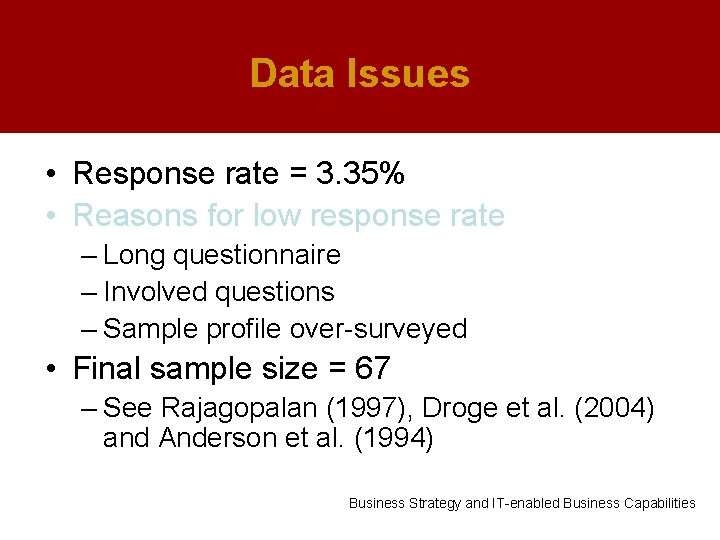
Data Issues • Response rate = 3. 35% • Reasons for low response rate – Long questionnaire – Involved questions – Sample profile over-surveyed • Final sample size = 67 – See Rajagopalan (1997), Droge et al. (2004) and Anderson et al. (1994) Business Strategy and IT-enabled Business Capabilities
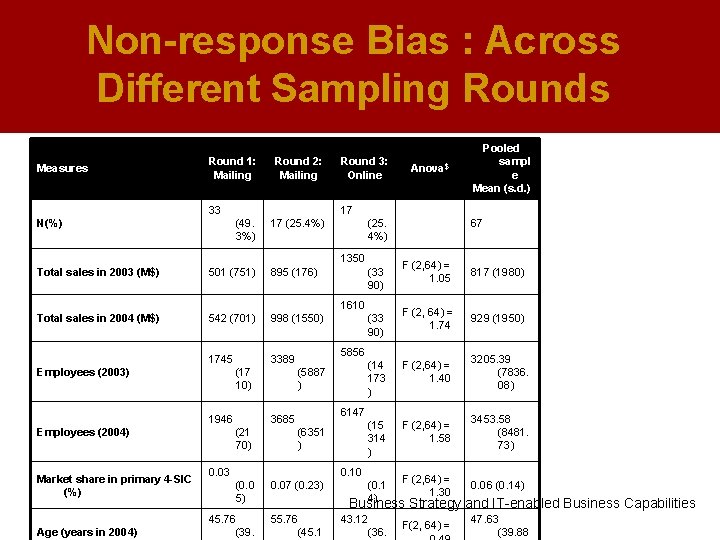
Non-response Bias : Across Different Sampling Rounds Measures Round 1: Mailing Round 2: Mailing 33 N(%) Round 3: Online 17 (49. 3%) 17 (25. 4%) 1350 Total sales in 2003 (M$) 501 (751) 895 (176) Total sales in 2004 (M$) 542 (701) 998 (1550) 1745 3389 (17 10) 1946 Employees (2004) Market share in primary 4 -SIC (%) Age (years in 2004) 67 F (2, 64) = 1. 05 817 (1980) F (2, 64) = 1. 74 929 (1950) (14 173 ) F (2, 64) = 1. 40 3205. 39 (7836. 08) (15 314 ) F (2, 64) = 1. 58 3453. 58 (8481. 73) F (2, 64) = 1. 30 0. 06 (0. 14) F(2, 64) = 47. 63 (39. 88 (33 90) 1610 Employees (2003) Anova$ Pooled sampl e Mean (s. d. ) (33 90) 5856 (5887 ) 6147 3685 (21 70) (6351 ) (0. 0 5) 0. 07 (0. 23) (0. 1 4) 45. 76 (39. 55. 76 (45. 1 43. 12 (36. 0. 03 0. 10 Business Strategy and IT-enabled Business Capabilities
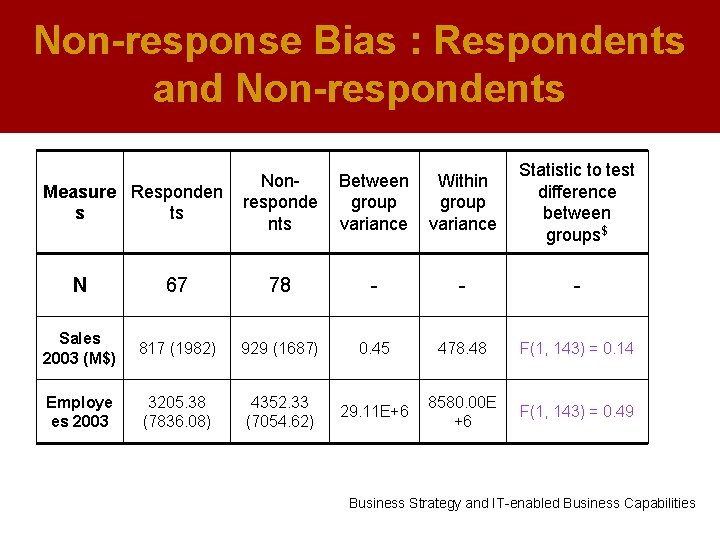
Non-response Bias : Respondents and Non-respondents Measure Responden s ts Nonresponde nts Between group variance Within group variance Statistic to test difference between groups$ N 67 78 - - - Sales 2003 (M$) 817 (1982) 929 (1687) 0. 45 478. 48 F(1, 143) = 0. 14 Employe es 2003 3205. 38 (7836. 08) 4352. 33 (7054. 62) 29. 11 E+6 8580. 00 E +6 F(1, 143) = 0. 49 Business Strategy and IT-enabled Business Capabilities
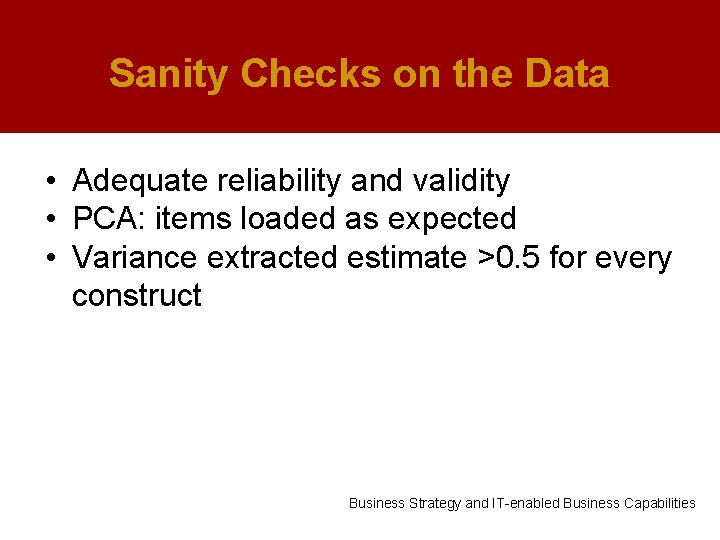
Sanity Checks on the Data • Adequate reliability and validity • PCA: items loaded as expected • Variance extracted estimate >0. 5 for every construct Business Strategy and IT-enabled Business Capabilities
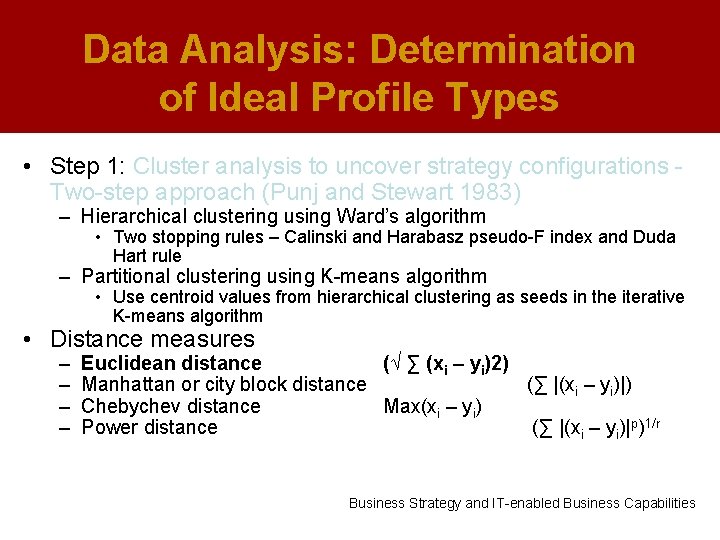
Data Analysis: Determination of Ideal Profile Types • Step 1: Cluster analysis to uncover strategy configurations Two-step approach (Punj and Stewart 1983) – Hierarchical clustering using Ward’s algorithm • Two stopping rules – Calinski and Harabasz pseudo-F index and Duda Hart rule – Partitional clustering using K-means algorithm • Use centroid values from hierarchical clustering as seeds in the iterative K-means algorithm • Distance measures – – Euclidean distance (√ ∑ (xi – yi)2) Manhattan or city block distance (∑ |(xi – yi)|) Chebychev distance Max(xi – yi) Power distance (∑ |(xi – yi)|p)1/r Business Strategy and IT-enabled Business Capabilities
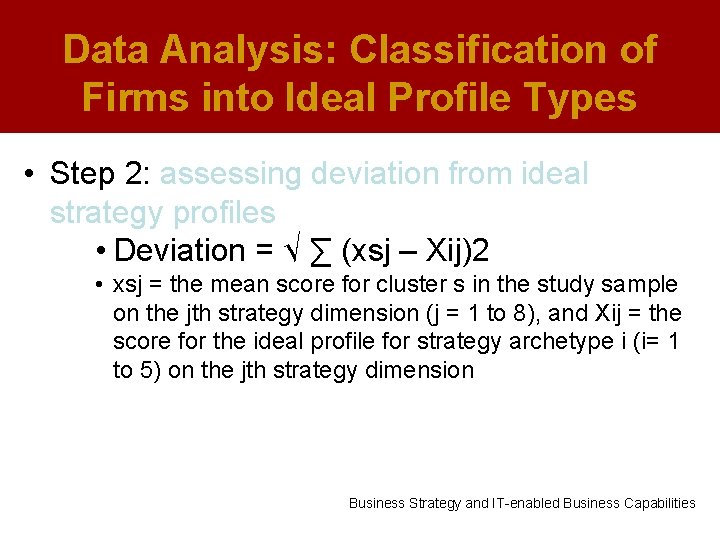
Data Analysis: Classification of Firms into Ideal Profile Types • Step 2: assessing deviation from ideal strategy profiles • Deviation = √ ∑ (xsj – Xij)2 • xsj = the mean score for cluster s in the study sample on the jth strategy dimension (j = 1 to 8), and Xij = the score for the ideal profile for strategy archetype i (i= 1 to 5) on the jth strategy dimension Business Strategy and IT-enabled Business Capabilities
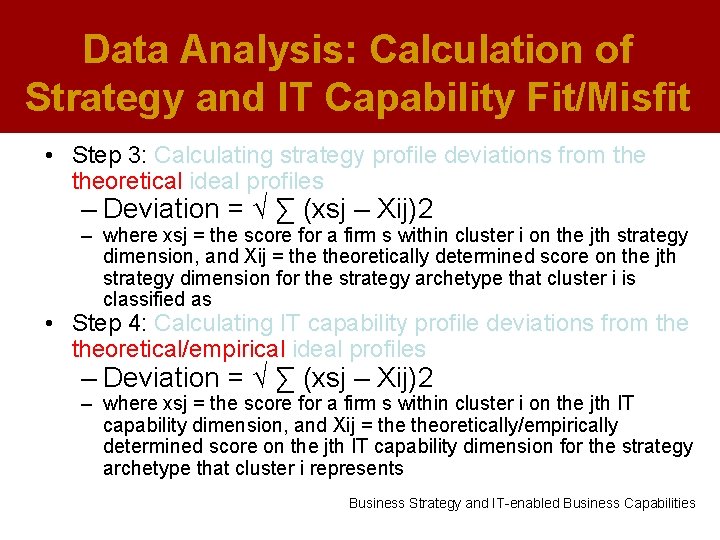
Data Analysis: Calculation of Strategy and IT Capability Fit/Misfit • Step 3: Calculating strategy profile deviations from theoretical ideal profiles – Deviation = √ ∑ (xsj – Xij)2 – where xsj = the score for a firm s within cluster i on the jth strategy dimension, and Xij = theoretically determined score on the jth strategy dimension for the strategy archetype that cluster i is classified as • Step 4: Calculating IT capability profile deviations from theoretical/empirical ideal profiles – Deviation = √ ∑ (xsj – Xij)2 – where xsj = the score for a firm s within cluster i on the jth IT capability dimension, and Xij = theoretically/empirically determined score on the jth IT capability dimension for the strategy archetype that cluster i represents Business Strategy and IT-enabled Business Capabilities
Data Analysis • Step 4: Regression Analysis – Regress performance on strategy deviation, capability deviation, sum of strategy capability deviations and control variables – Assumptions regarding normality of residuals, multicollinearity and homoscedasticity of error terms not violated Business Strategy and IT-enabled Business Capabilities
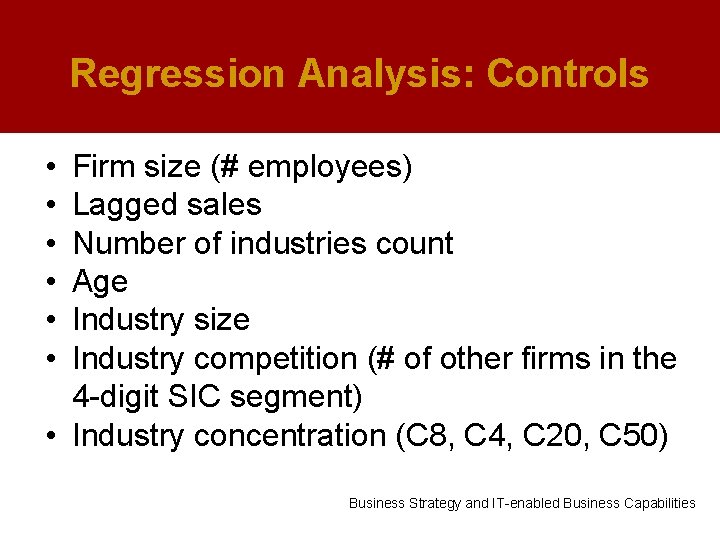
Regression Analysis: Controls • • • Firm size (# employees) Lagged sales Number of industries count Age Industry size Industry competition (# of other firms in the 4 -digit SIC segment) • Industry concentration (C 8, C 4, C 20, C 50) Business Strategy and IT-enabled Business Capabilities
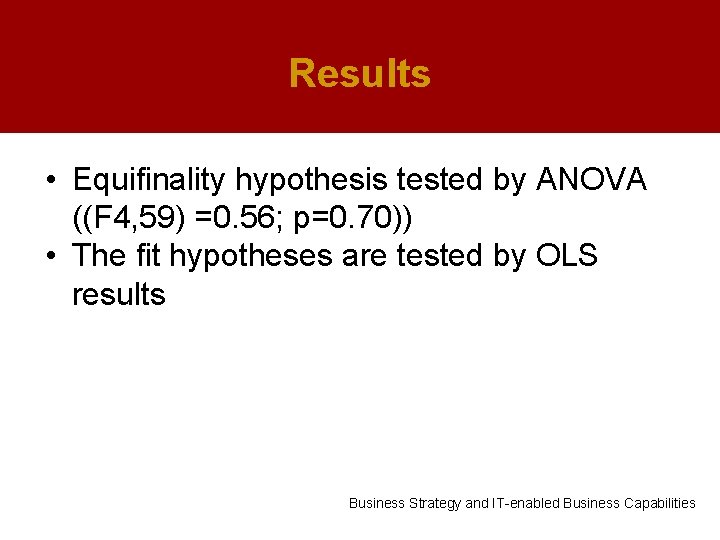
Results • Equifinality hypothesis tested by ANOVA ((F 4, 59) =0. 56; p=0. 70)) • The fit hypotheses are tested by OLS results Business Strategy and IT-enabled Business Capabilities
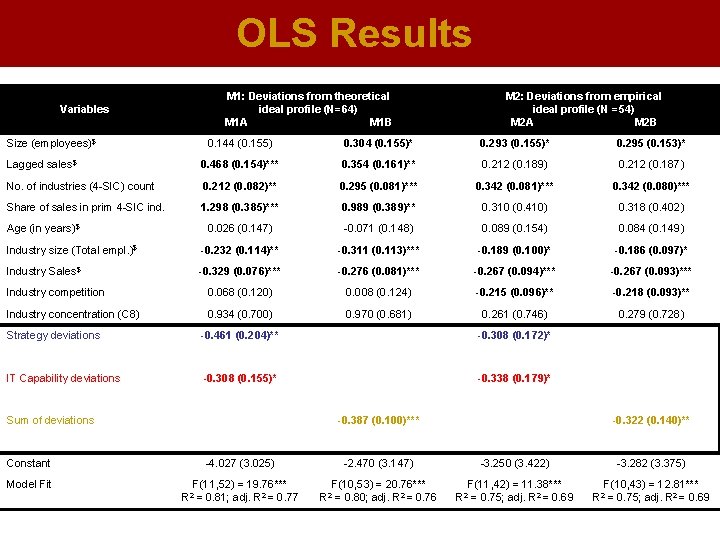
OLS Results Variables Size (employees)$ M 1: Deviations from theoretical ideal profile (N=64) M 1 A M 1 B M 2: Deviations from empirical ideal profile (N =54) M 2 A M 2 B 0. 144 (0. 155) 0. 304 (0. 155)* 0. 293 (0. 155)* 0. 295 (0. 153)* Lagged sales$ 0. 468 (0. 154)*** 0. 354 (0. 161)** 0. 212 (0. 189) 0. 212 (0. 187) No. of industries (4 -SIC) count 0. 212 (0. 082)** 0. 295 (0. 081)*** 0. 342 (0. 080)*** Share of sales in prim 4 -SIC ind. 1. 298 (0. 385)*** 0. 989 (0. 389)** 0. 310 (0. 410) 0. 318 (0. 402) 0. 026 (0. 147) -0. 071 (0. 148) 0. 089 (0. 154) 0. 084 (0. 149) Industry size (Total empl. )$ -0. 232 (0. 114)** -0. 311 (0. 113)*** -0. 189 (0. 100)* -0. 186 (0. 097)* Industry Sales$ -0. 329 (0. 076)*** -0. 276 (0. 081)*** -0. 267 (0. 094)*** -0. 267 (0. 093)*** Industry competition 0. 068 (0. 120) 0. 008 (0. 124) -0. 215 (0. 096)** -0. 218 (0. 093)** Industry concentration (C 8) 0. 934 (0. 700) 0. 970 (0. 681) 0. 261 (0. 746) 0. 279 (0. 728) Age (in years)$ Strategy deviations -0. 461 (0. 204)** -0. 308 (0. 172)* IT Capability deviations -0. 308 (0. 155)* -0. 338 (0. 179)* Sum of deviations -0. 387 (0. 100)*** -0. 322 (0. 140)** Constant -4. 027 (3. 025) -2. 470 (3. 147) -3. 250 (3. 422) -3. 282 (3. 375) Model Fit F(11, 52) = 19. 76*** R 2 = 0. 81; adj. R 2 = 0. 77 F(10, 53) = 20. 76*** R 2 = 0. 80; adj. R 2 = 0. 76 F(11, 42) = 11. 38*** R 2 = 0. 75; adj. R 2 = 0. 69 F(10, 43) = 12. 81*** R 2 = 0. 75; adj. R 2 = 0. 69
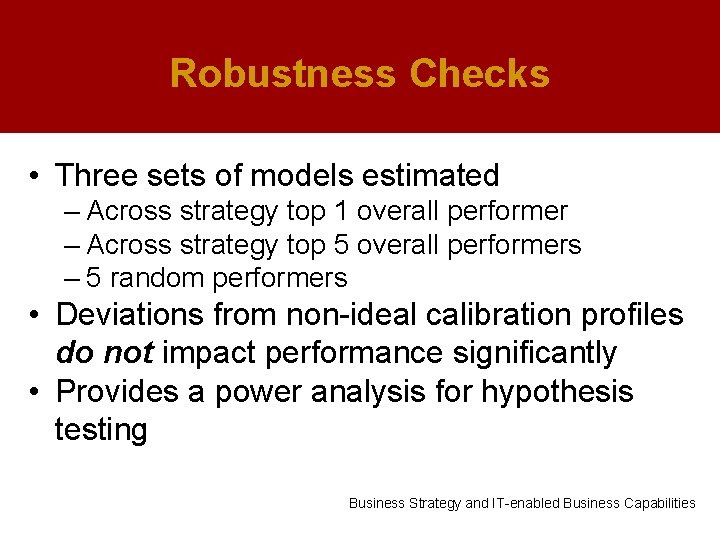
Robustness Checks • Three sets of models estimated – Across strategy top 1 overall performer – Across strategy top 5 overall performers – 5 random performers • Deviations from non-ideal calibration profiles do not impact performance significantly • Provides a power analysis for hypothesis testing Business Strategy and IT-enabled Business Capabilities
Limitations • Modest sample size • Cross sectional data • Dimensions of strategy and IT capability weighed equally • Lack of generalizability Business Strategy and IT-enabled Business Capabilities
Theoretical Contributions • Conceptualization of a key and multi-dimensional set of IT capabilities to support business strategies • Demonstration of the nuanced alignment of business strategy and IT capabilities • Examination of the alignment between business needs with business capabilities fostered by IT • Extension of Venkatraman’s STROBE instrument • Development and empirical validation of the extended Miles and Davis typology • The use of both deductive and inductive approaches to study profile deviations Business Strategy and IT-enabled Business Capabilities
Managerial Implications • The development and deployment of IT capabilities and IT investments should be contingent upon the business strategy • Select a few critical areas and invest in IT selectively to build capabilities • Focus on the profile of the strategy leader and not the industry leader; benchmark IT capabilities accordingly • Pay close attention to IT capabilities at the disaggregated level Business Strategy and IT-enabled Business Capabilities
Future Research in IT Strategy • Complementarity and substitutability of IT resources, capabilities and investments – Do certain IT resources, capabilities and investments provide higher benefits in association with other resources, capabilities and investments? How and why? – Can certain IT resources, capabilities and investments substitute for other resources, capabilities and investments? How and why? Business Strategy and IT-enabled Business Capabilities

Thanks!!
- Slides: 41