
Business Statistics Probabilities and Distributions Basic Probability Concepts

• • • • • • • • • Business Statistics Probabilities and Distributions

Basic Probability Concepts Probability • the chance that an uncertain event will occur (always between 0 and 1) Impossible Event • an event that has no chance of occurring (probability = 0) Certain Event • an event that is sure to occur (probability = 1)
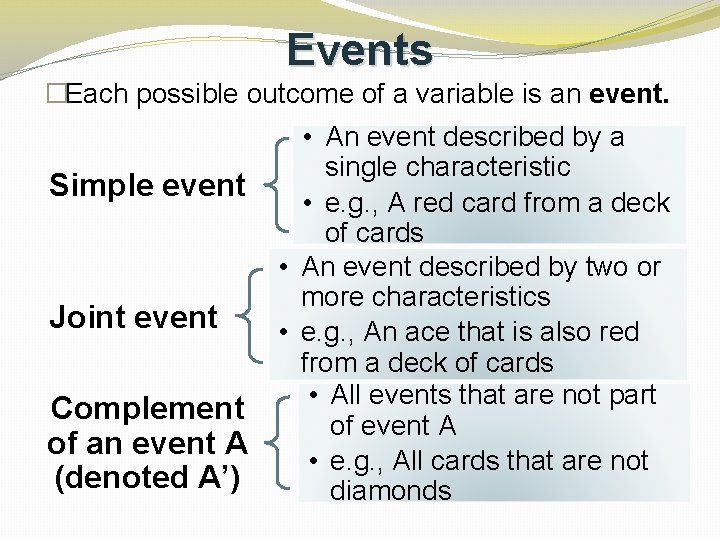
Events �Each possible outcome of a variable is an event. Simple event Joint event Complement of an event A (denoted A’) • An event described by a single characteristic • e. g. , A red card from a deck of cards • An event described by two or more characteristics • e. g. , An ace that is also red from a deck of cards • All events that are not part of event A • e. g. , All cards that are not diamonds

Simple Probability • refers to the probability of a simple event • ex. P(Ace) • ex. P(Red) Joint Probability • refers to the probability of an occurrence of two or more events (joint event) • ex. P(Ace and Red) • ex. P(Black and Not Ace)
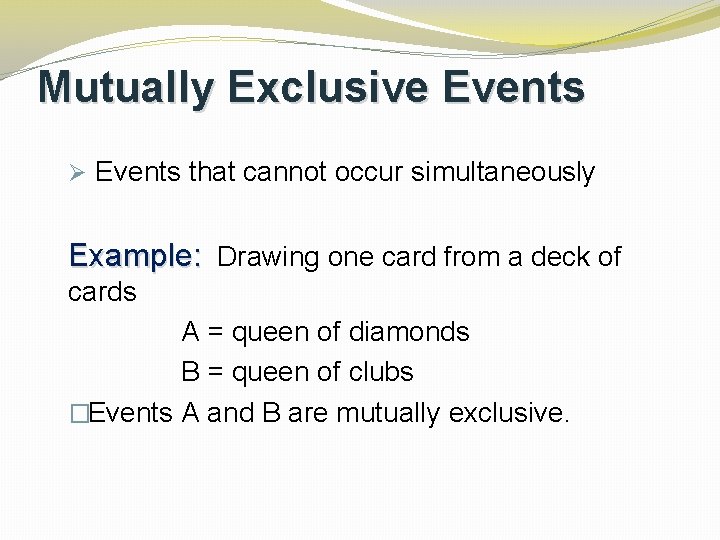
Mutually Exclusive Events Ø Events that cannot occur simultaneously Example: Drawing one card from a deck of cards A = queen of diamonds B = queen of clubs �Events A and B are mutually exclusive.

Collectively Exhaustive Events Ø One of the events must occur Ø The set of events covers the entire sample space Example: A = aces B = black cards C = diamonds D = hearts �Events A, B, C and D are collectively exhaustive (but not mutually exclusive – an ace may also be a heart). �Events B, C and D are collectively exhaustive and also mutually exclusive.
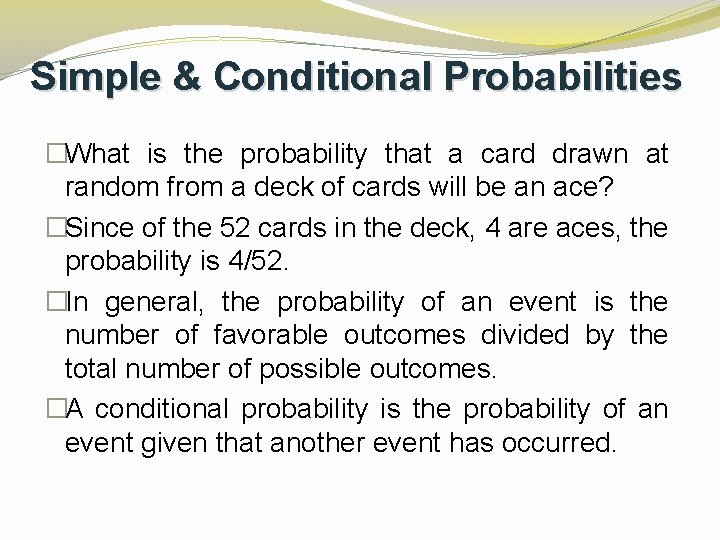
Simple & Conditional Probabilities �What is the probability that a card drawn at random from a deck of cards will be an ace? �Since of the 52 cards in the deck, 4 are aces, the probability is 4/52. �In general, the probability of an event is the number of favorable outcomes divided by the total number of possible outcomes. �A conditional probability is the probability of an event given that another event has occurred.

Mutually Exclusive or Collectively Exhaustive? For each of the following, state whether the events created are mutually exclusive and collective exhaustive. If they are not mutually exclusive and collectively exhaustive, either reword the categories to them mutually exclusive and collectively exhaustive, or explain why that would not be useful. �Registered voters in the United States were asked whether they are registered as Republications or Democrats. �Each respondent was classified by origin of the car he or she drives: American, European, Japanese, or none. �People were asked, “Do you currently live in (i) an apartment or (ii) a house? ” �A product was classified as defective or not defective.
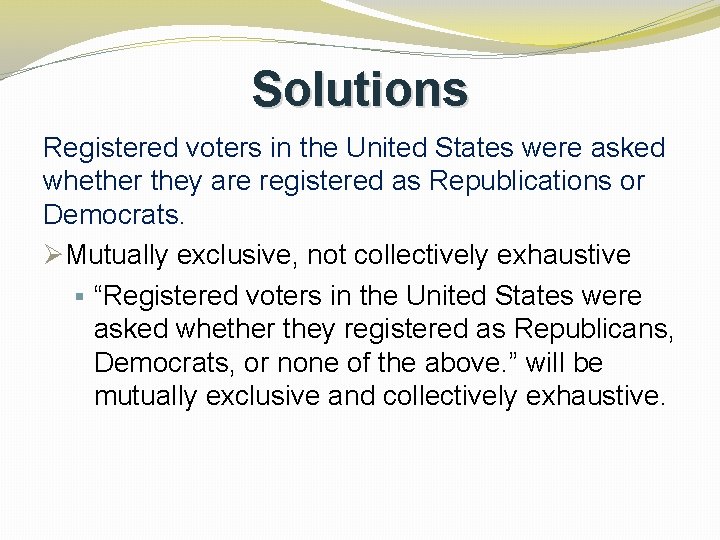
Solutions Registered voters in the United States were asked whether they are registered as Republications or Democrats. ØMutually exclusive, not collectively exhaustive § “Registered voters in the United States were asked whether they registered as Republicans, Democrats, or none of the above. ” will be mutually exclusive and collectively exhaustive.
Solutions Each respondent was classified by origin of the car he or she drives: American, European, Japanese, or none. Ø Not mutually exclusive, not collectively exhaustive § “Respondents were classified by country of manufacture of car owned and used for majority of their driving into the categories American, European, Japanese, or none of the above. ” will be mutually exclusive and collectively exhaustive. People can own more than one car but only one car can be used for majority of their driving.
Solutions People were asked, “Do you currently live in (i) an apartment or (ii) a house? ” ØMutually exclusive, not collectively exhaustive § “People were asked, “Do you currently live in (i) an apartment, (ii) a house or (iii) none of the above? ” will be mutually exclusive and collectively exhaustive. A product was classified as defective or not defective. Ø Mutually exclusive, collectively exhaustive
- Slides: 11