
Business Statistics 3 e by Ken Black Chapter
Business Statistics, 3 e by Ken Black Chapter 4 Probability Business Statistics: Contemporary Decision Making, 3 e, by Black. © 2001 South-Western/Thomson Learning 1
Learning Objectives • Comprehend the different ways of assigning probability. • Understand apply marginal, union, joint, and conditional probabilities. • Select the appropriate law of probability to use in solving problems. • Solve problems using the laws of probability including the laws of addition, multiplication and conditional probability • Revise probabilities using Bayes’ rule. Business Statistics: Contemporary Decision Making, 3 e, by Black. © 2001 South-Western/Thomson Learning 2
Methods of Assigning Probabilities • Classical method of assigning probability (rules and laws) • Relative frequency of occurrence (cumulated historical data) • Subjective Probability (personal intuition or reasoning) Business Statistics: Contemporary Decision Making, 3 e, by Black. © 2001 South-Western/Thomson Learning 3
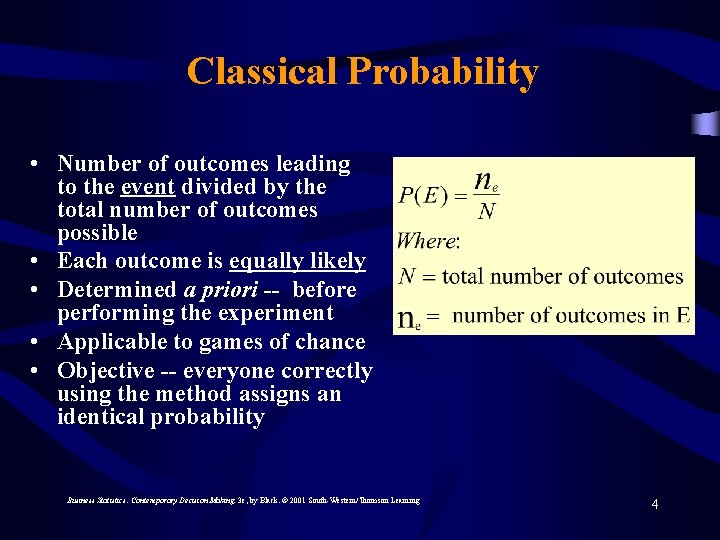
Classical Probability • Number of outcomes leading to the event divided by the total number of outcomes possible • Each outcome is equally likely • Determined a priori -- before performing the experiment • Applicable to games of chance • Objective -- everyone correctly using the method assigns an identical probability Business Statistics: Contemporary Decision Making, 3 e, by Black. © 2001 South-Western/Thomson Learning 4
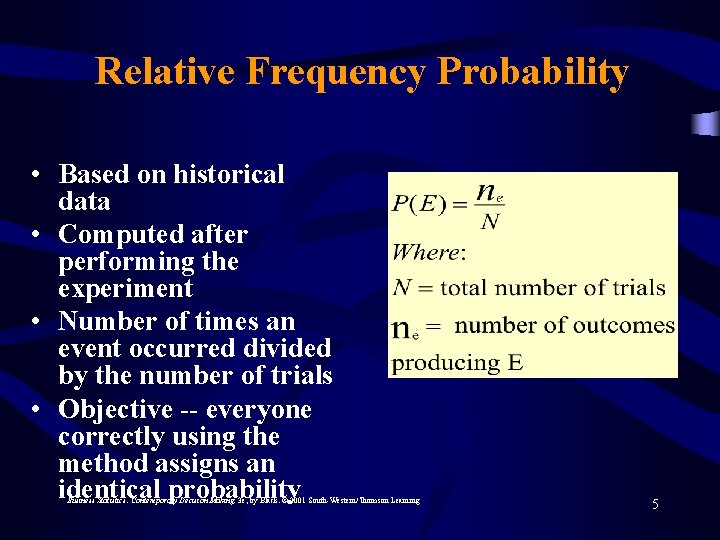
Relative Frequency Probability • Based on historical data • Computed after performing the experiment • Number of times an event occurred divided by the number of trials • Objective -- everyone correctly using the method assigns an identical probability Business Statistics: Contemporary Decision Making, 3 e, by Black. © 2001 South-Western/Thomson Learning 5
Subjective Probability • Comes from a person’s intuition or reasoning • Subjective -- different individuals may (correctly) assign different numeric probabilities to the same event • Degree of belief • Useful for unique (single-trial) experiments – New product introduction – Initial public offering of common stock – Site selection decisions – Sporting events Business Statistics: Contemporary Decision Making, 3 e, by Black. © 2001 South-Western/Thomson Learning 6
Structure of Probability • • • Experiment Event Elementary Events Sample Space Unions and Intersections Mutually Exclusive Events Independent Events Collectively Exhaustive Events Complementary Events Business Statistics: Contemporary Decision Making, 3 e, by Black. © 2001 South-Western/Thomson Learning 7
Experiment • Experiment: a process that produces outcomes – More than one possible outcome – Only one outcome per trial • Trial: one repetition of the process • Elementary Event: cannot be decomposed or broken down into other events • Event: an outcome of an experiment – may be an elementary event, or – may be an aggregate of elementary events – usually represented by an uppercase letter, e. g. , A, E 1 Business Statistics: Contemporary Decision Making, 3 e, by Black. © 2001 South-Western/Thomson Learning 8
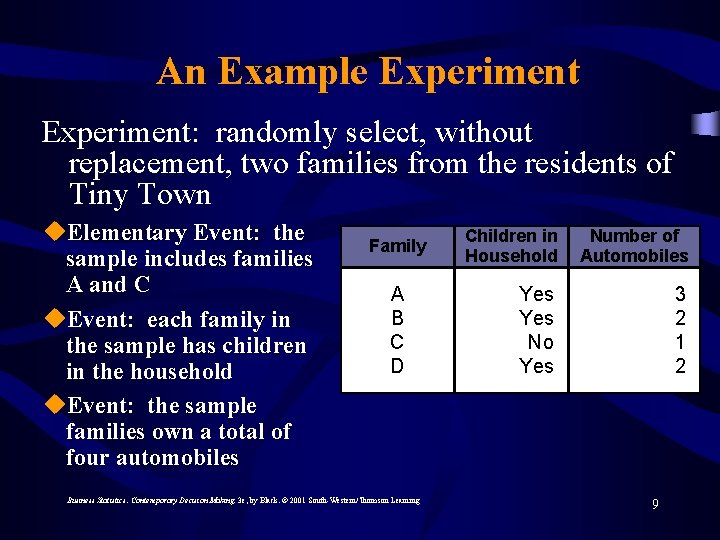
An Example Experiment: randomly select, without replacement, two families from the residents of Tiny Town u. Elementary Event: the sample includes families A and C u. Event: each family in the sample has children in the household u. Event: the sample families own a total of four automobiles Family A B C D Business Statistics: Contemporary Decision Making, 3 e, by Black. © 2001 South-Western/Thomson Learning Children in Household Number of Automobiles Yes No Yes 3 2 1 2 9
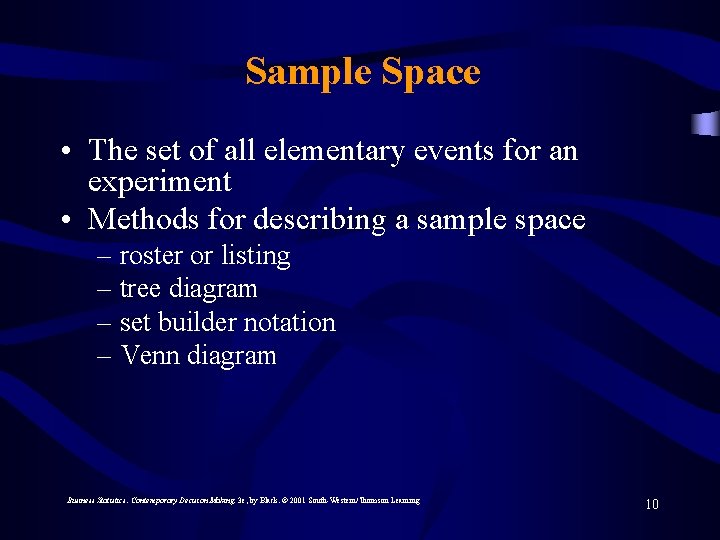
Sample Space • The set of all elementary events for an experiment • Methods for describing a sample space – roster or listing – tree diagram – set builder notation – Venn diagram Business Statistics: Contemporary Decision Making, 3 e, by Black. © 2001 South-Western/Thomson Learning 10
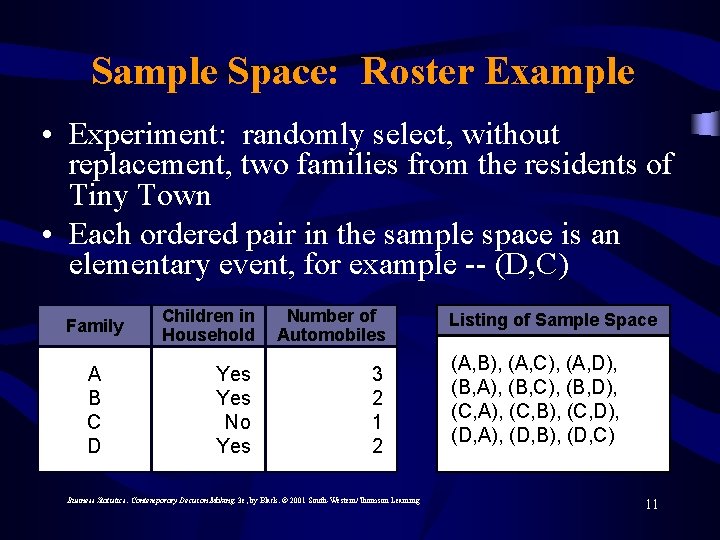
Sample Space: Roster Example • Experiment: randomly select, without replacement, two families from the residents of Tiny Town • Each ordered pair in the sample space is an elementary event, for example -- (D, C) Family A B C D Children in Household Number of Automobiles Yes No Yes 3 2 1 2 Business Statistics: Contemporary Decision Making, 3 e, by Black. © 2001 South-Western/Thomson Learning Listing of Sample Space (A, B), (A, C), (A, D), (B, A), (B, C), (B, D), (C, A), (C, B), (C, D), (D, A), (D, B), (D, C) 11
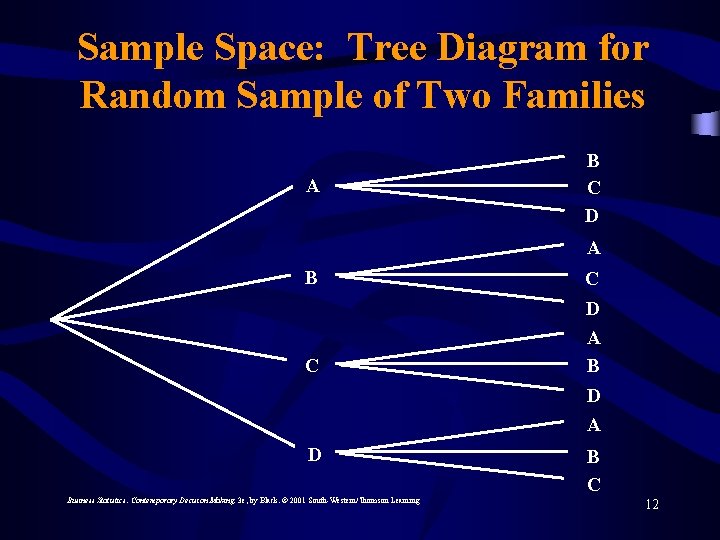
Sample Space: Tree Diagram for Random Sample of Two Families A B C D Business Statistics: Contemporary Decision Making, 3 e, by Black. © 2001 South-Western/Thomson Learning C D A B C 12
Sample Space: Set Notation for Random Sample of Two Families • S = {(x, y) | x is the family selected on the first draw, and y is the family selected on the second draw} • Concise description of large sample spaces Business Statistics: Contemporary Decision Making, 3 e, by Black. © 2001 South-Western/Thomson Learning 13
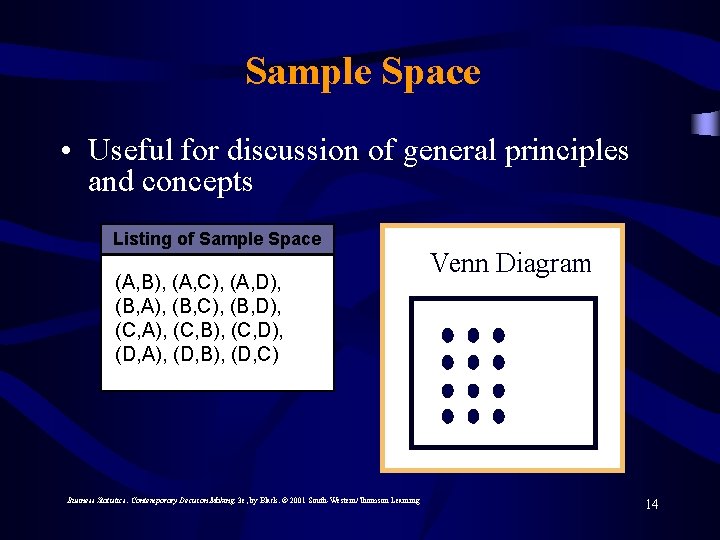
Sample Space • Useful for discussion of general principles and concepts Listing of Sample Space (A, B), (A, C), (A, D), (B, A), (B, C), (B, D), (C, A), (C, B), (C, D), (D, A), (D, B), (D, C) Business Statistics: Contemporary Decision Making, 3 e, by Black. © 2001 South-Western/Thomson Learning Venn Diagram 14
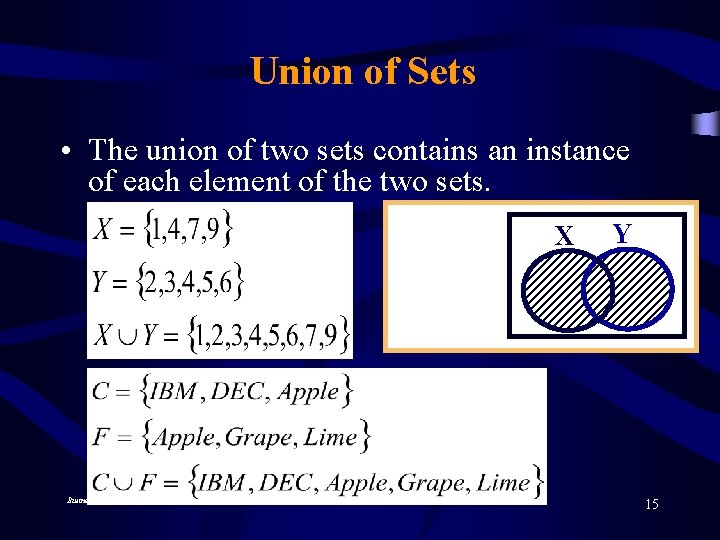
Union of Sets • The union of two sets contains an instance of each element of the two sets. X Business Statistics: Contemporary Decision Making, 3 e, by Black. © 2001 South-Western/Thomson Learning Y 15
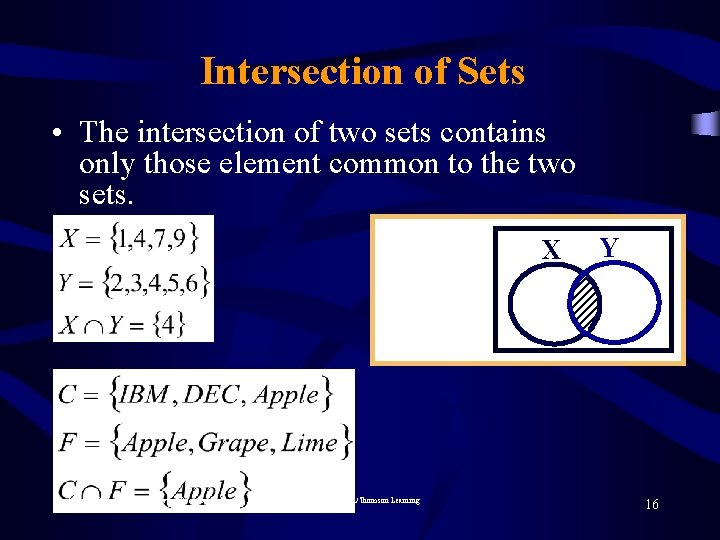
Intersection of Sets • The intersection of two sets contains only those element common to the two sets. X Business Statistics: Contemporary Decision Making, 3 e, by Black. © 2001 South-Western/Thomson Learning Y 16
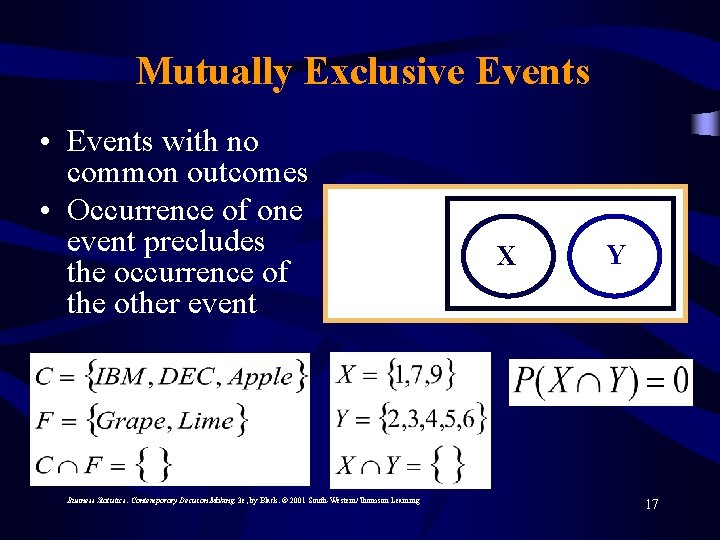
Mutually Exclusive Events • Events with no common outcomes • Occurrence of one event precludes the occurrence of the other event Business Statistics: Contemporary Decision Making, 3 e, by Black. © 2001 South-Western/Thomson Learning X Y 17
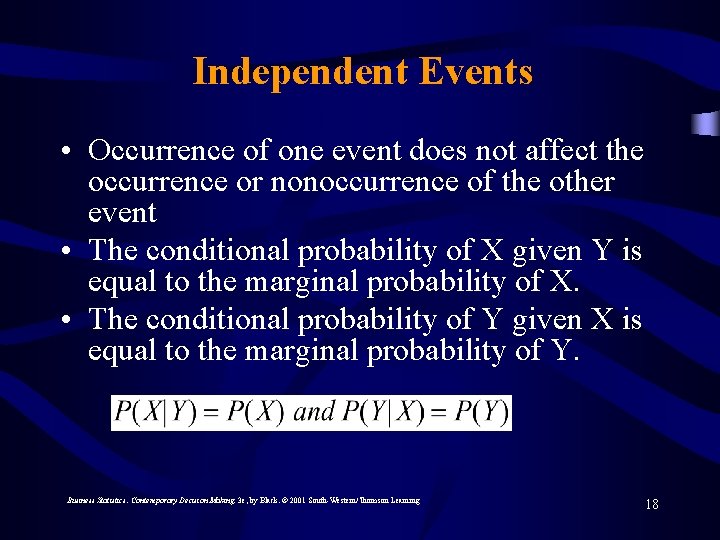
Independent Events • Occurrence of one event does not affect the occurrence or nonoccurrence of the other event • The conditional probability of X given Y is equal to the marginal probability of X. • The conditional probability of Y given X is equal to the marginal probability of Y. Business Statistics: Contemporary Decision Making, 3 e, by Black. © 2001 South-Western/Thomson Learning 18
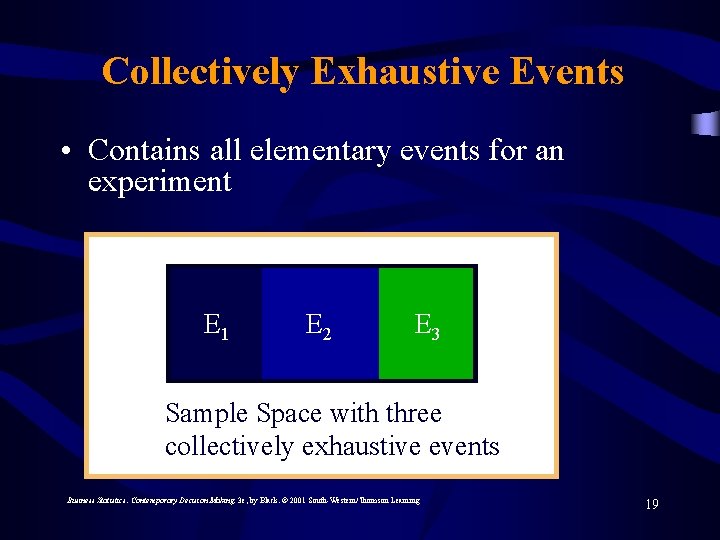
Collectively Exhaustive Events • Contains all elementary events for an experiment E 1 E 2 E 3 Sample Space with three collectively exhaustive events Business Statistics: Contemporary Decision Making, 3 e, by Black. © 2001 South-Western/Thomson Learning 19
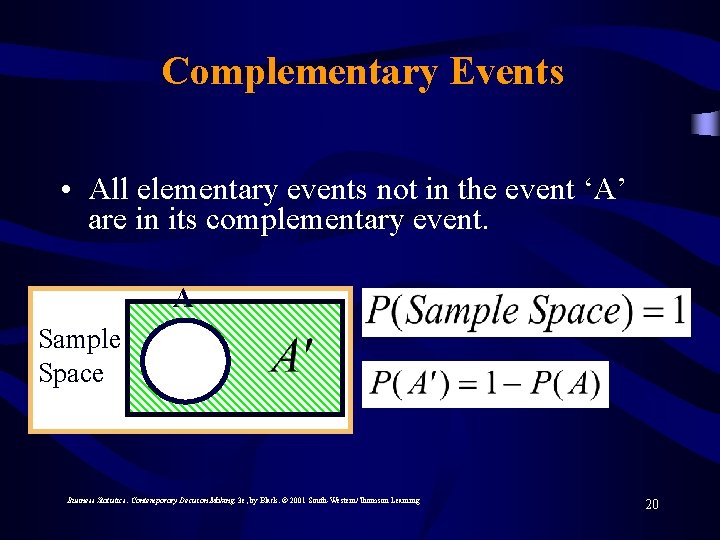
Complementary Events • All elementary events not in the event ‘A’ are in its complementary event. A Sample Space Business Statistics: Contemporary Decision Making, 3 e, by Black. © 2001 South-Western/Thomson Learning 20
Four Types of Probability • • Marginal Probability Union Probability Joint Probability Conditional Probability Business Statistics: Contemporary Decision Making, 3 e, by Black. © 2001 South-Western/Thomson Learning 21
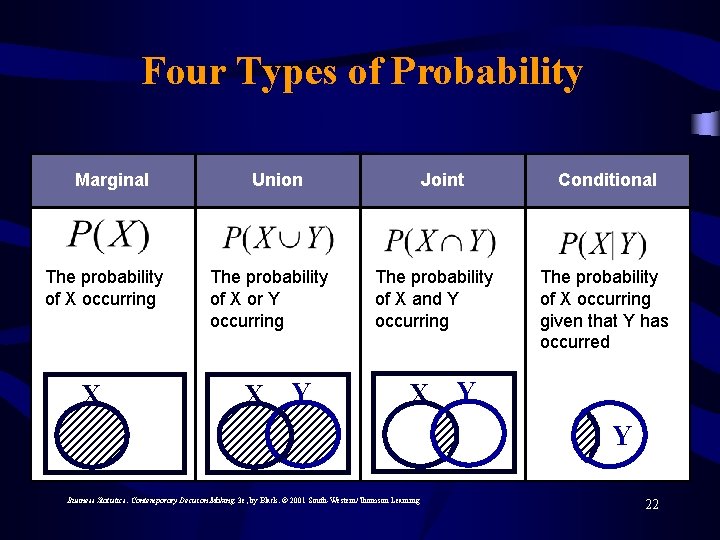
Four Types of Probability Marginal The probability of X occurring X Union The probability of X or Y occurring X Y Joint The probability of X and Y occurring Conditional The probability of X occurring given that Y has occurred X Y Y Business Statistics: Contemporary Decision Making, 3 e, by Black. © 2001 South-Western/Thomson Learning 22
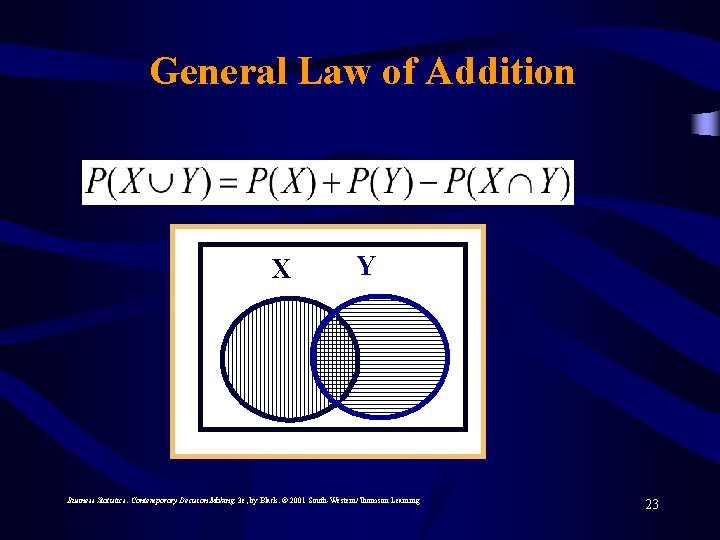
General Law of Addition X Y Business Statistics: Contemporary Decision Making, 3 e, by Black. © 2001 South-Western/Thomson Learning 23
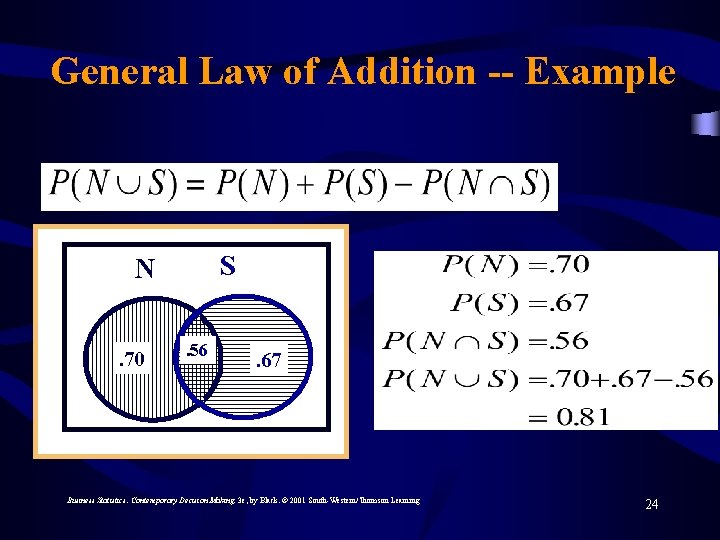
General Law of Addition -- Example S N. 70 . 56 . 67 Business Statistics: Contemporary Decision Making, 3 e, by Black. © 2001 South-Western/Thomson Learning 24
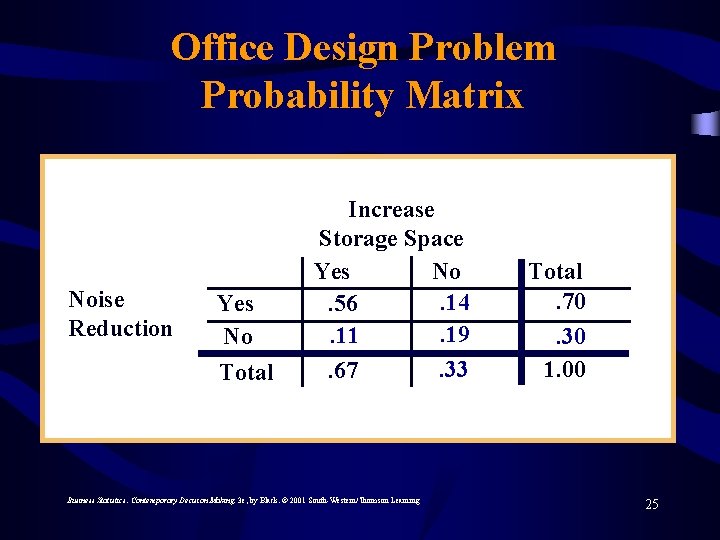
Office Design Problem Probability Matrix Noise Reduction Yes No Total Increase Storage Space Yes No. 14. 56. 19. 11. 33. 67 Business Statistics: Contemporary Decision Making, 3 e, by Black. © 2001 South-Western/Thomson Learning Total. 70. 30 1. 00 25
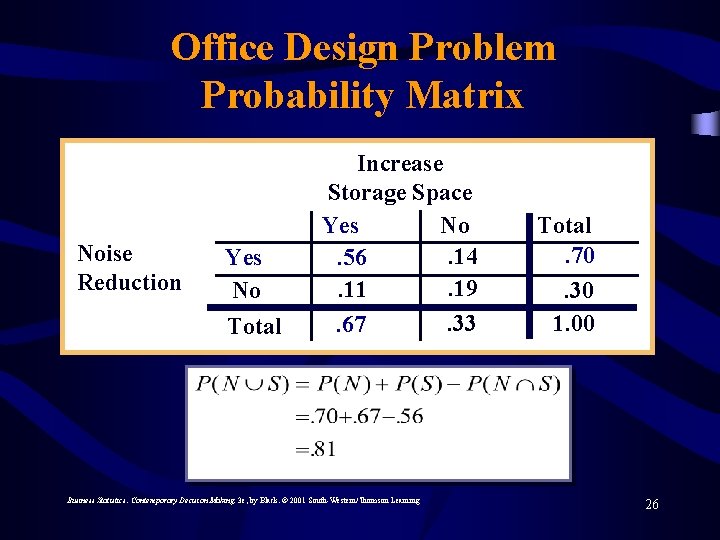
Office Design Problem Probability Matrix Noise Reduction Yes No Total Increase Storage Space Yes No. 14. 56. 19. 11. 33. 67 Business Statistics: Contemporary Decision Making, 3 e, by Black. © 2001 South-Western/Thomson Learning Total. 70. 30 1. 00 26
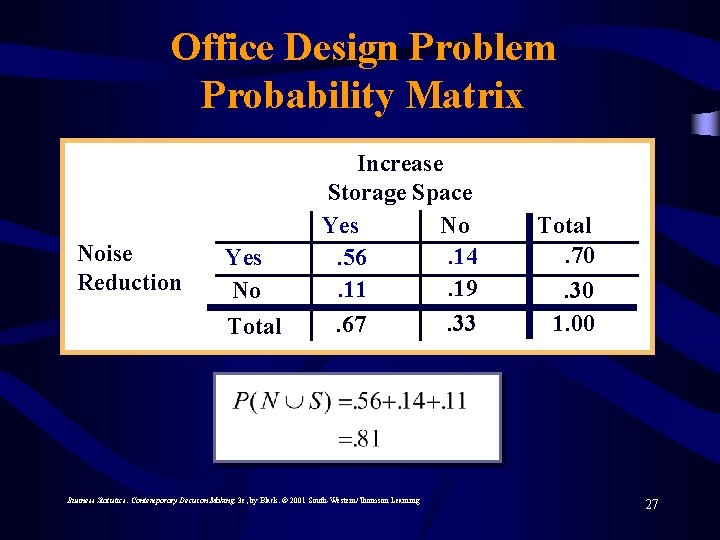
Office Design Problem Probability Matrix Noise Reduction Yes No Total Increase Storage Space Yes No. 14. 56. 19. 11. 33. 67 Business Statistics: Contemporary Decision Making, 3 e, by Black. © 2001 South-Western/Thomson Learning Total. 70. 30 1. 00 27
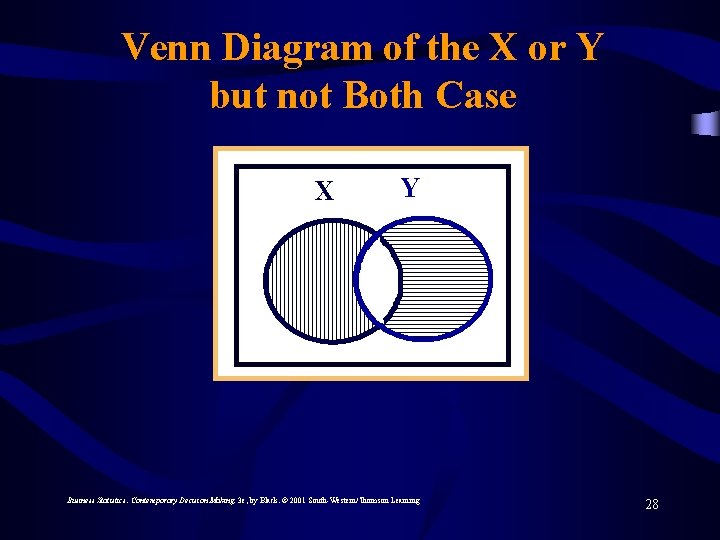
Venn Diagram of the X or Y but not Both Case X Y Business Statistics: Contemporary Decision Making, 3 e, by Black. © 2001 South-Western/Thomson Learning 28
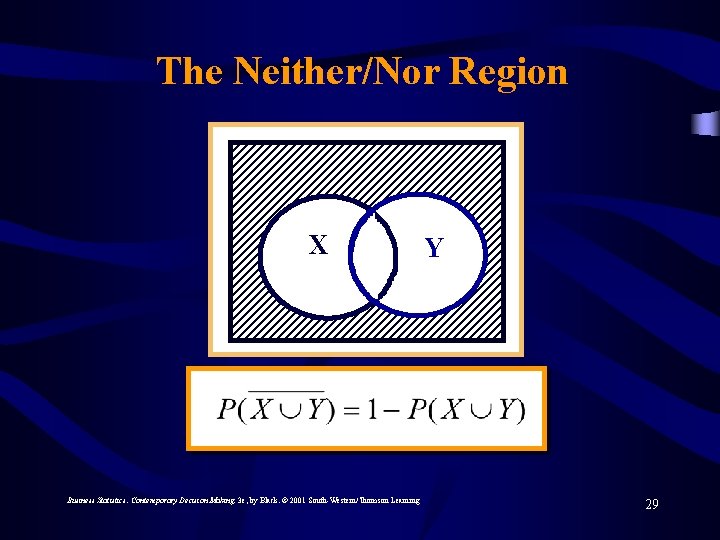
The Neither/Nor Region X Business Statistics: Contemporary Decision Making, 3 e, by Black. © 2001 South-Western/Thomson Learning Y 29
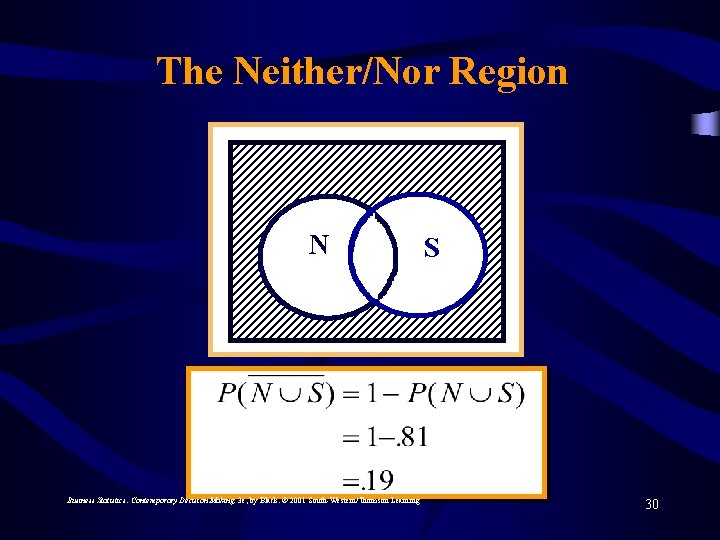
The Neither/Nor Region N Business Statistics: Contemporary Decision Making, 3 e, by Black. © 2001 South-Western/Thomson Learning S 30
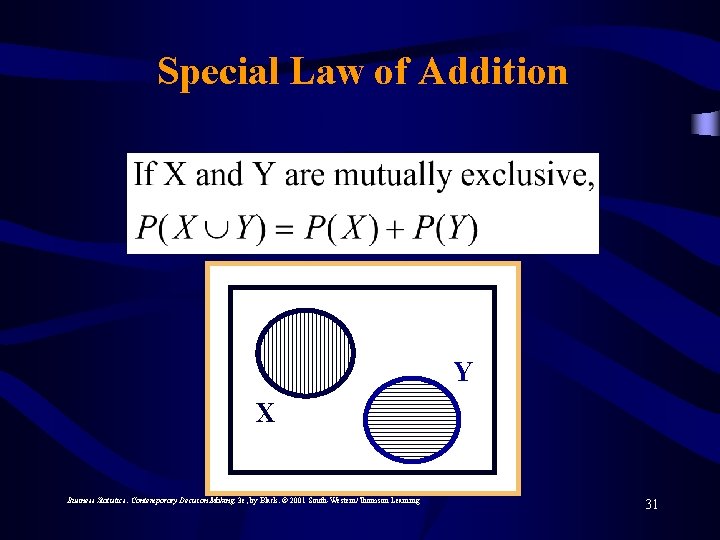
Special Law of Addition Y X Business Statistics: Contemporary Decision Making, 3 e, by Black. © 2001 South-Western/Thomson Learning 31
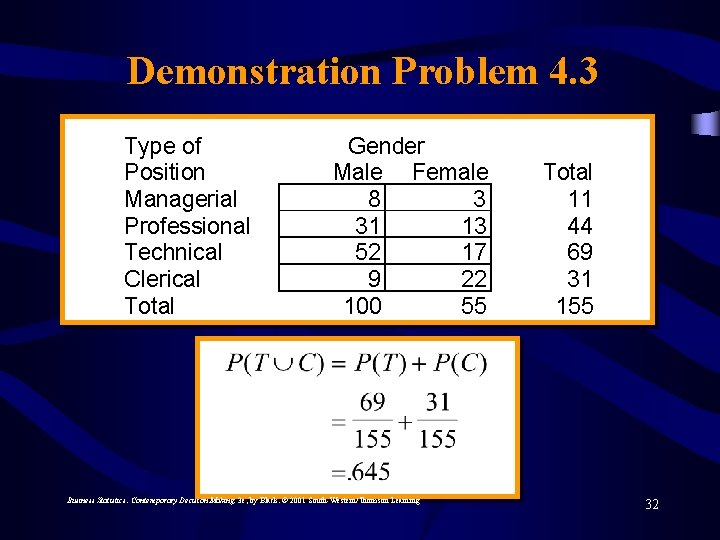
Demonstration Problem 4. 3 Type of Position Managerial Professional Technical Clerical Total Gender Male Female 8 3 31 13 52 17 9 22 100 55 Business Statistics: Contemporary Decision Making, 3 e, by Black. © 2001 South-Western/Thomson Learning Total 11 44 69 31 155 32
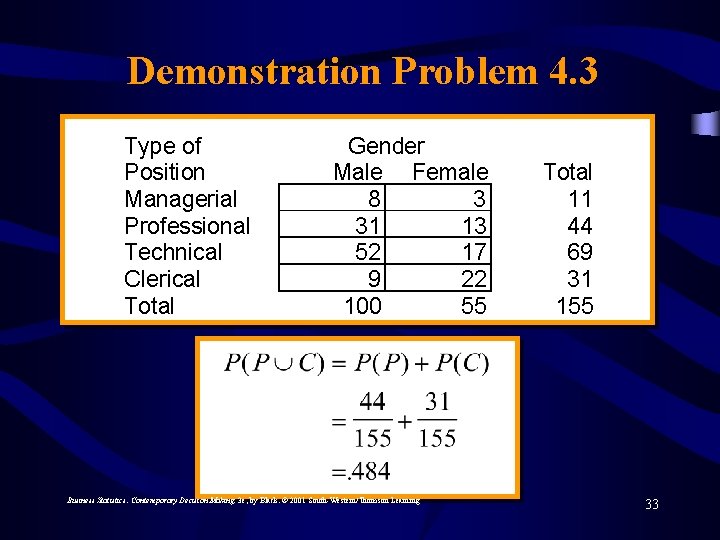
Demonstration Problem 4. 3 Type of Position Managerial Professional Technical Clerical Total Gender Male Female 8 3 31 13 52 17 9 22 100 55 Business Statistics: Contemporary Decision Making, 3 e, by Black. © 2001 South-Western/Thomson Learning Total 11 44 69 31 155 33
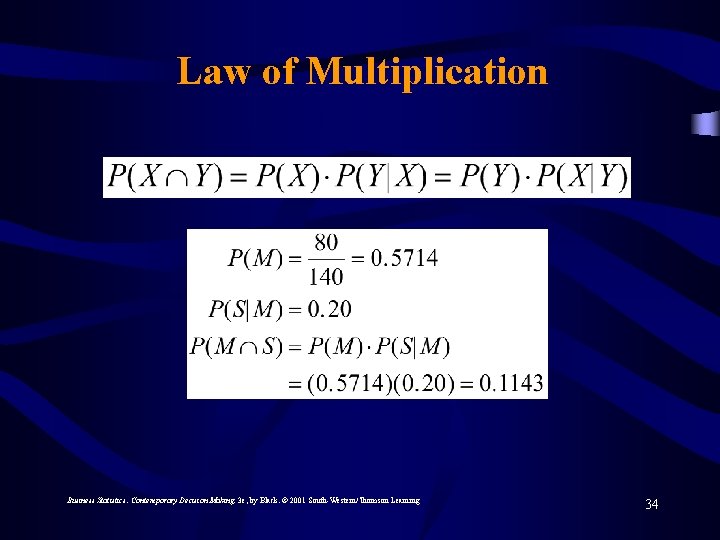
Law of Multiplication Business Statistics: Contemporary Decision Making, 3 e, by Black. © 2001 South-Western/Thomson Learning 34
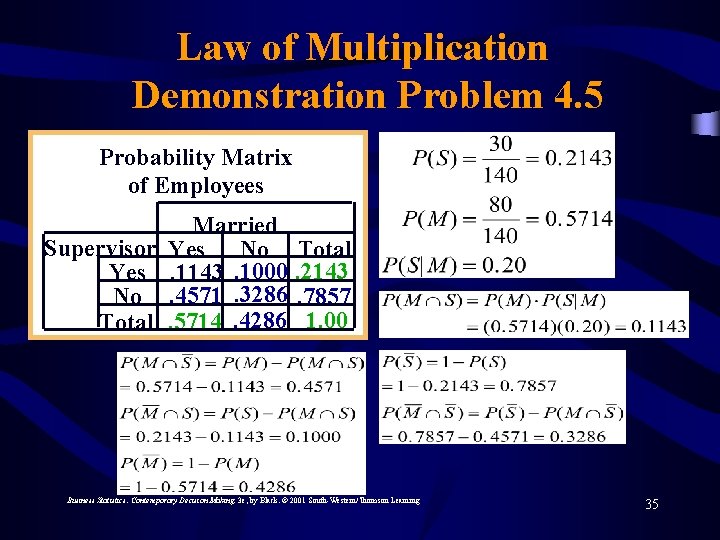
Law of Multiplication Demonstration Problem 4. 5 Probability Matrix of Employees Married Supervisor Yes No Total Yes. 1143. 1000. 2143 No. 4571. 3286. 7857 Total. 5714. 4286 1. 00 Business Statistics: Contemporary Decision Making, 3 e, by Black. © 2001 South-Western/Thomson Learning 35
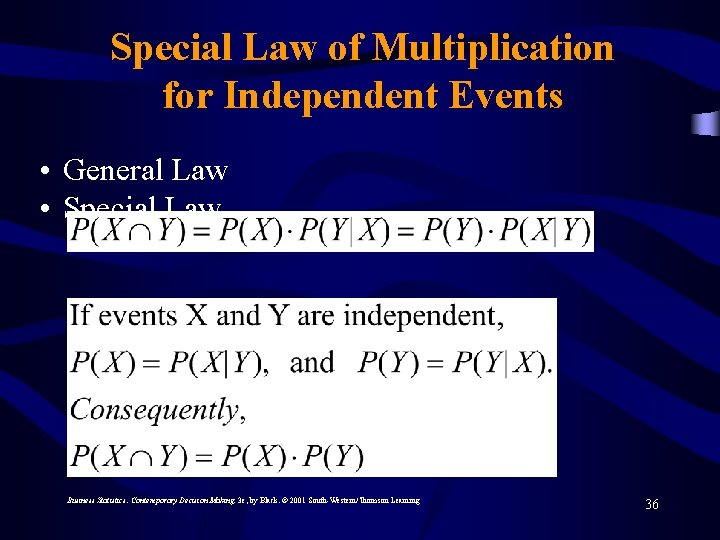
Special Law of Multiplication for Independent Events • General Law • Special Law Business Statistics: Contemporary Decision Making, 3 e, by Black. © 2001 South-Western/Thomson Learning 36
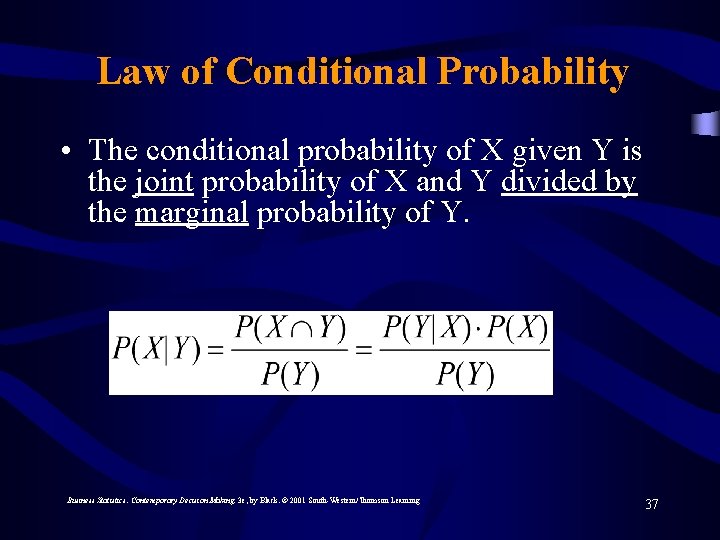
Law of Conditional Probability • The conditional probability of X given Y is the joint probability of X and Y divided by the marginal probability of Y. Business Statistics: Contemporary Decision Making, 3 e, by Black. © 2001 South-Western/Thomson Learning 37
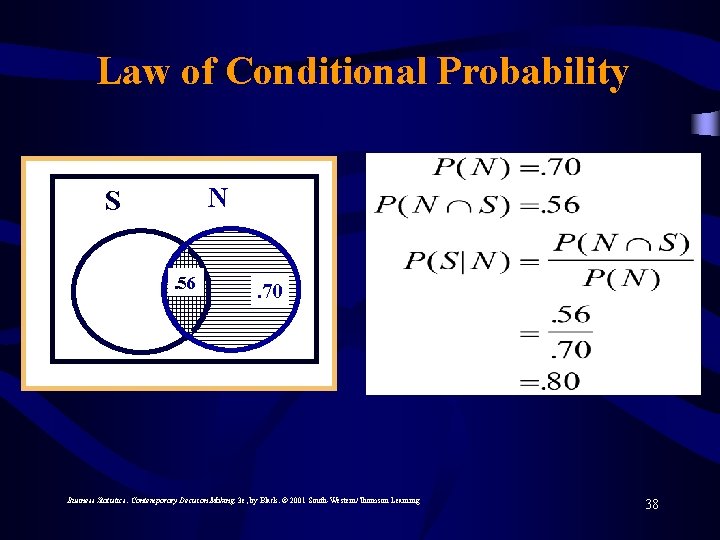
Law of Conditional Probability N S. 56 . 70 Business Statistics: Contemporary Decision Making, 3 e, by Black. © 2001 South-Western/Thomson Learning 38
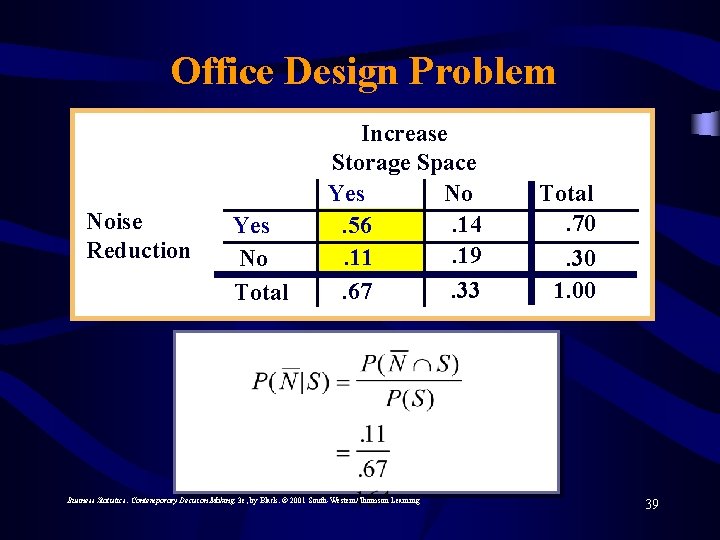
Office Design Problem Noise Reduction Yes No Total Increase Storage Space Yes No. 14. 56. 19. 11. 33. 67 Business Statistics: Contemporary Decision Making, 3 e, by Black. © 2001 South-Western/Thomson Learning Total. 70. 30 1. 00 39
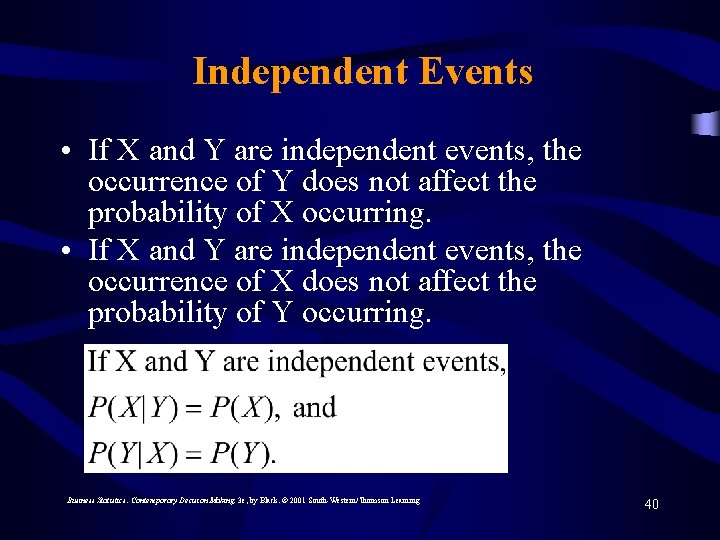
Independent Events • If X and Y are independent events, the occurrence of Y does not affect the probability of X occurring. • If X and Y are independent events, the occurrence of X does not affect the probability of Y occurring. Business Statistics: Contemporary Decision Making, 3 e, by Black. © 2001 South-Western/Thomson Learning 40
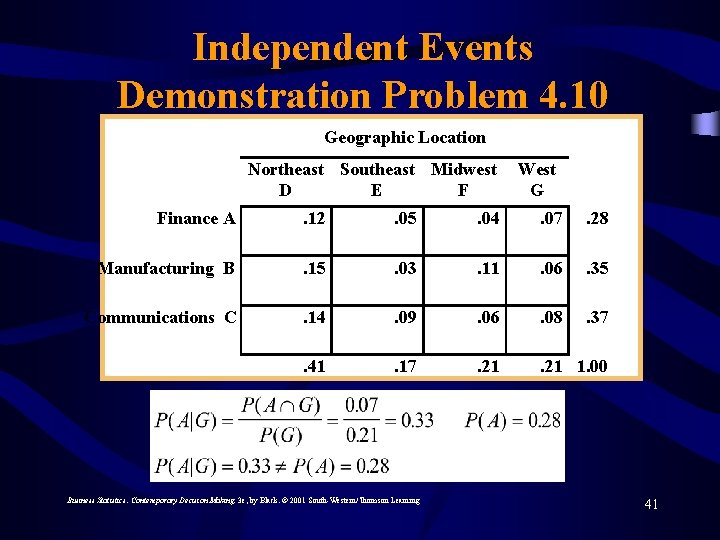
Independent Events Demonstration Problem 4. 10 Geographic Location Northeast Southeast Midwest D E F West G Finance A . 12 . 05 . 04 . 07 . 28 Manufacturing B . 15 . 03 . 11 . 06 . 35 Communications C . 14 . 09 . 06 . 08 . 37 . 41 . 17 . 21 1. 00 Business Statistics: Contemporary Decision Making, 3 e, by Black. © 2001 South-Western/Thomson Learning 41
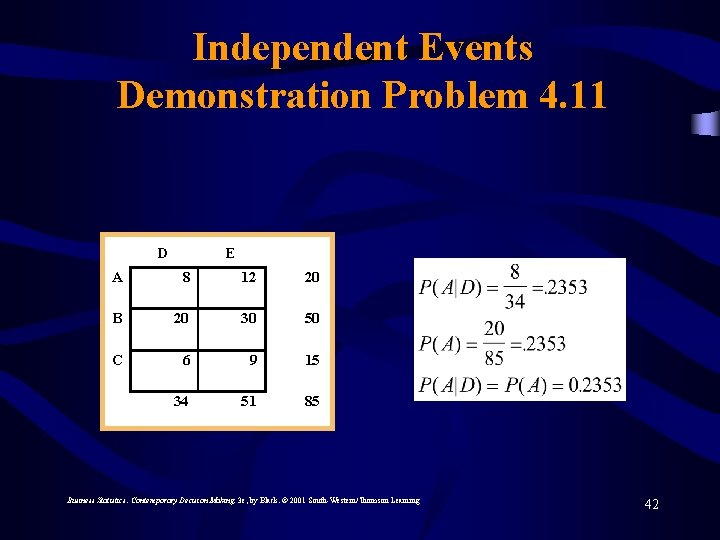
Independent Events Demonstration Problem 4. 11 D E A 8 12 20 B 20 30 50 C 6 9 15 34 51 85 Business Statistics: Contemporary Decision Making, 3 e, by Black. © 2001 South-Western/Thomson Learning 42
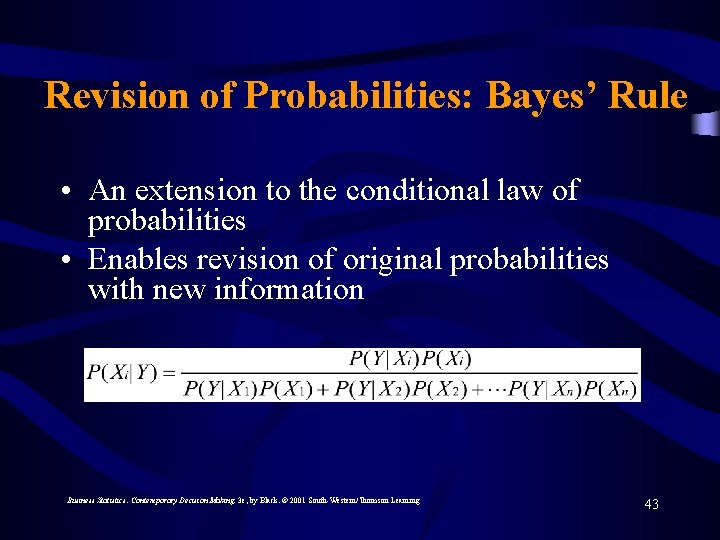
Revision of Probabilities: Bayes’ Rule • An extension to the conditional law of probabilities • Enables revision of original probabilities with new information Business Statistics: Contemporary Decision Making, 3 e, by Black. © 2001 South-Western/Thomson Learning 43
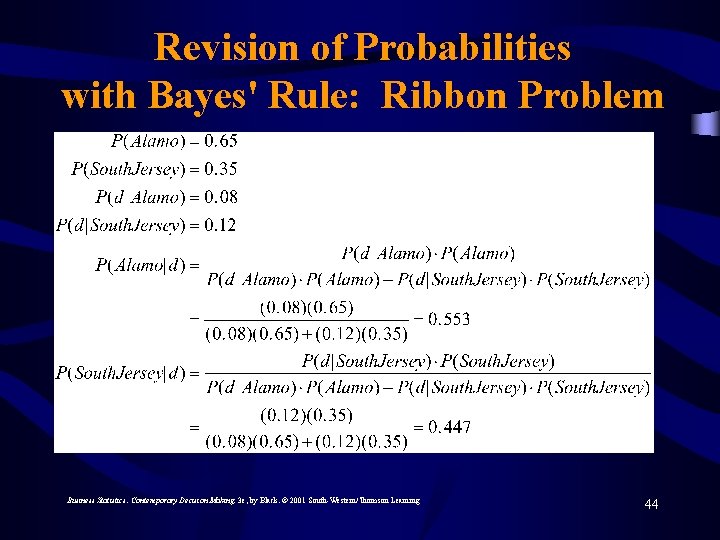
Revision of Probabilities with Bayes' Rule: Ribbon Problem Business Statistics: Contemporary Decision Making, 3 e, by Black. © 2001 South-Western/Thomson Learning 44
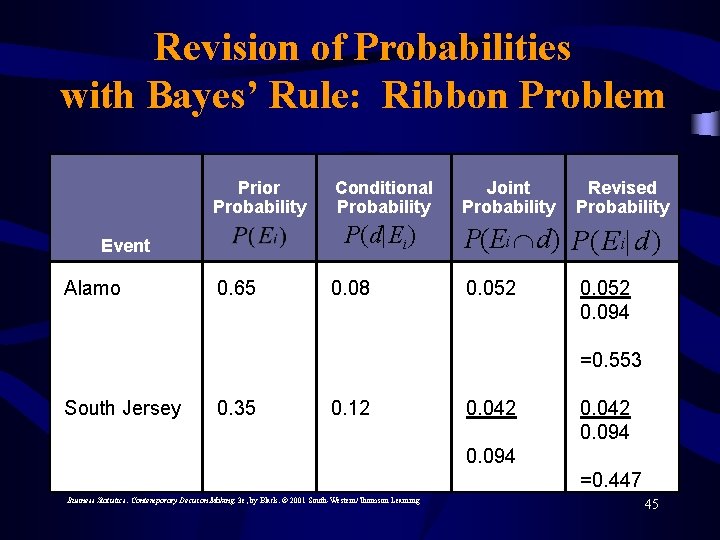
Revision of Probabilities with Bayes’ Rule: Ribbon Problem Prior Probability P(d| Ei ) Event Alamo Conditional Probability 0. 65 0. 08 Joint Probability Revised Probability P(Ei d) P( Ei| d ) 0. 052 0. 094 =0. 553 South Jersey 0. 35 0. 12 0. 042 0. 094 =0. 447 Business Statistics: Contemporary Decision Making, 3 e, by Black. © 2001 South-Western/Thomson Learning 45
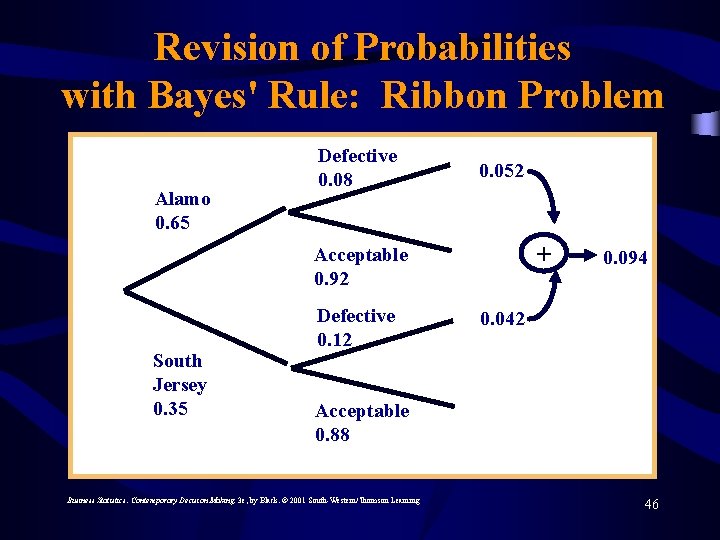
Revision of Probabilities with Bayes' Rule: Ribbon Problem Alamo 0. 65 Defective 0. 08 0. 052 + Acceptable 0. 92 South Jersey 0. 35 Defective 0. 12 0. 094 0. 042 Acceptable 0. 88 Business Statistics: Contemporary Decision Making, 3 e, by Black. © 2001 South-Western/Thomson Learning 46
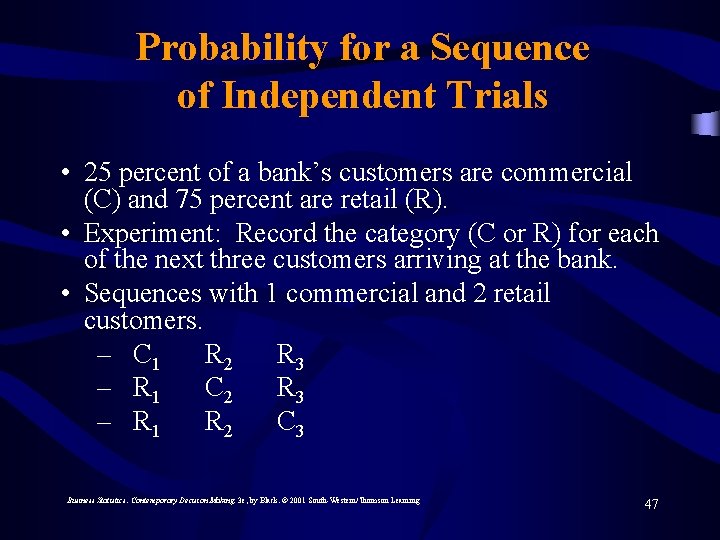
Probability for a Sequence of Independent Trials • 25 percent of a bank’s customers are commercial (C) and 75 percent are retail (R). • Experiment: Record the category (C or R) for each of the next three customers arriving at the bank. • Sequences with 1 commercial and 2 retail customers. – C 1 R 2 R 3 – R 1 C 2 R 3 – R 1 R 2 C 3 Business Statistics: Contemporary Decision Making, 3 e, by Black. © 2001 South-Western/Thomson Learning 47
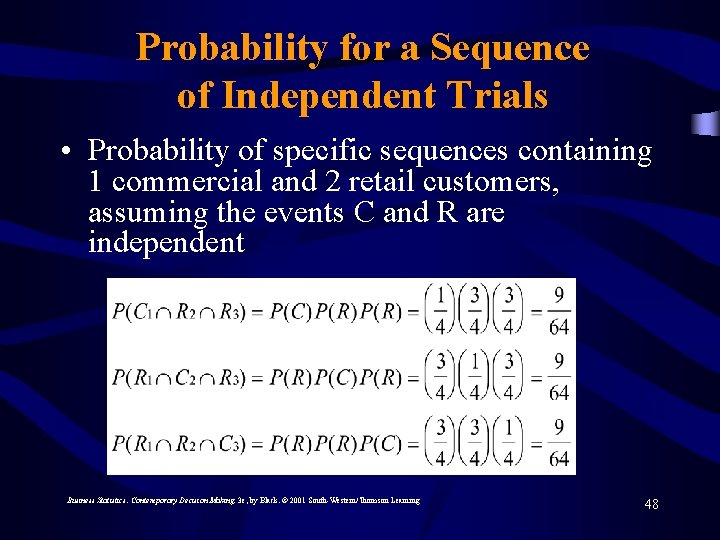
Probability for a Sequence of Independent Trials • Probability of specific sequences containing 1 commercial and 2 retail customers, assuming the events C and R are independent Business Statistics: Contemporary Decision Making, 3 e, by Black. © 2001 South-Western/Thomson Learning 48
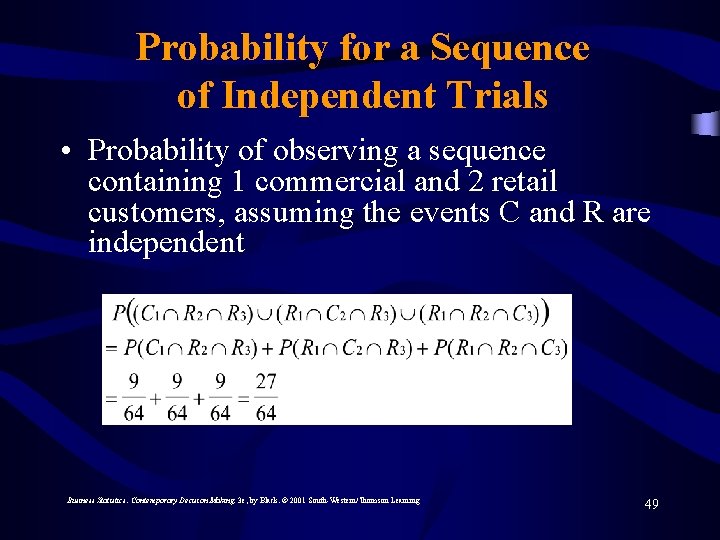
Probability for a Sequence of Independent Trials • Probability of observing a sequence containing 1 commercial and 2 retail customers, assuming the events C and R are independent Business Statistics: Contemporary Decision Making, 3 e, by Black. © 2001 South-Western/Thomson Learning 49
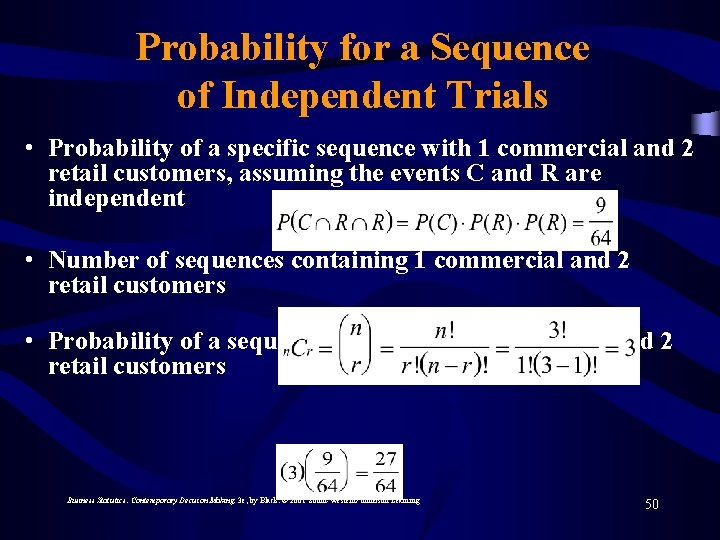
Probability for a Sequence of Independent Trials • Probability of a specific sequence with 1 commercial and 2 retail customers, assuming the events C and R are independent • Number of sequences containing 1 commercial and 2 retail customers • Probability of a sequence containing 1 commercial and 2 retail customers Business Statistics: Contemporary Decision Making, 3 e, by Black. © 2001 South-Western/Thomson Learning 50
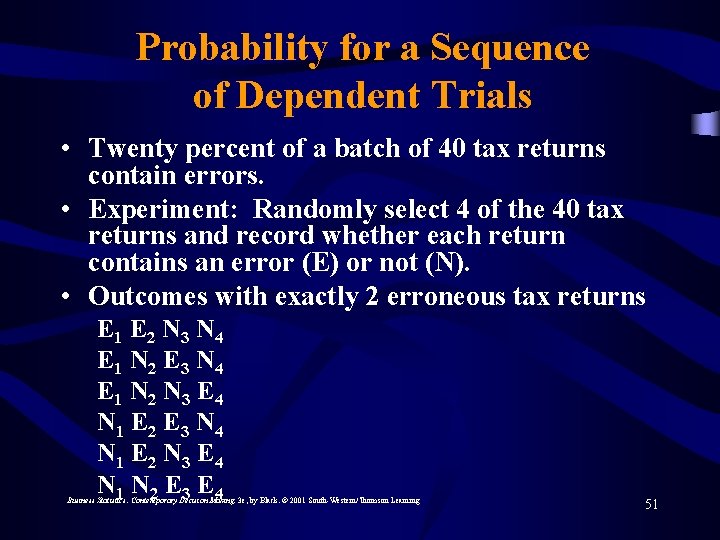
Probability for a Sequence of Dependent Trials • Twenty percent of a batch of 40 tax returns contain errors. • Experiment: Randomly select 4 of the 40 tax returns and record whether each return contains an error (E) or not (N). • Outcomes with exactly 2 erroneous tax returns E 1 E 2 N 3 N 4 E 1 N 2 E 3 N 4 E 1 N 2 N 3 E 4 N 1 E 2 E 3 N 4 N 1 E 2 N 3 E 4 N 1 N 2 E 3 E 4 Business Statistics: Contemporary Decision Making, 3 e, by Black. © 2001 South-Western/Thomson Learning 51
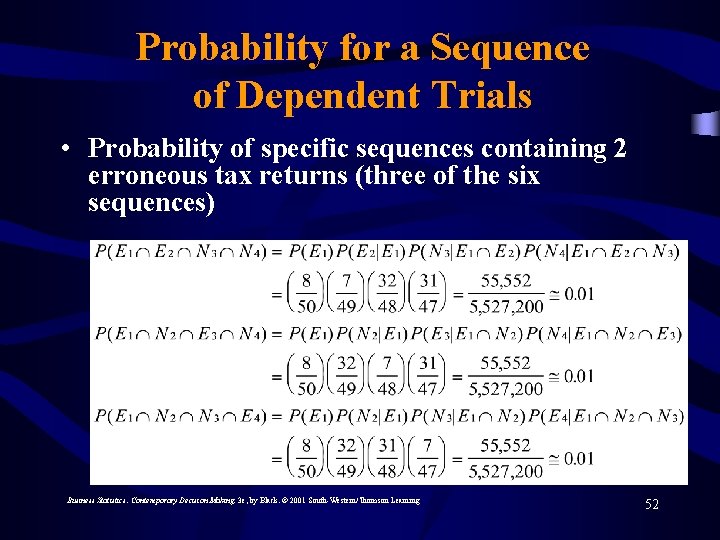
Probability for a Sequence of Dependent Trials • Probability of specific sequences containing 2 erroneous tax returns (three of the six sequences) Business Statistics: Contemporary Decision Making, 3 e, by Black. © 2001 South-Western/Thomson Learning 52
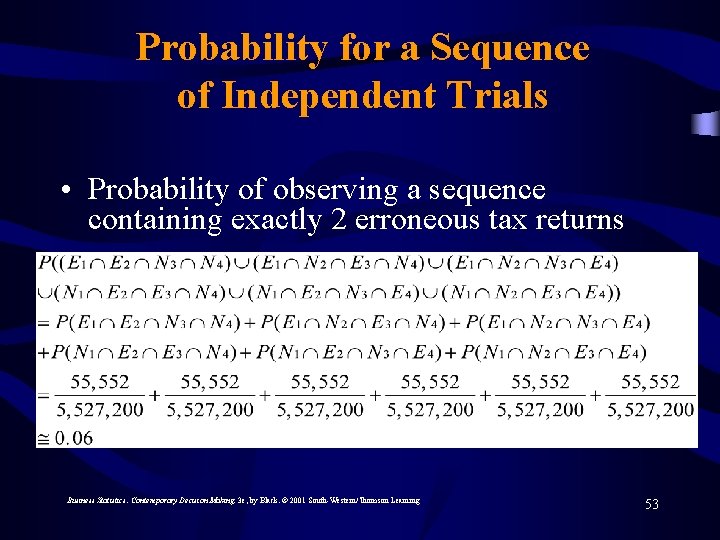
Probability for a Sequence of Independent Trials • Probability of observing a sequence containing exactly 2 erroneous tax returns Business Statistics: Contemporary Decision Making, 3 e, by Black. © 2001 South-Western/Thomson Learning 53
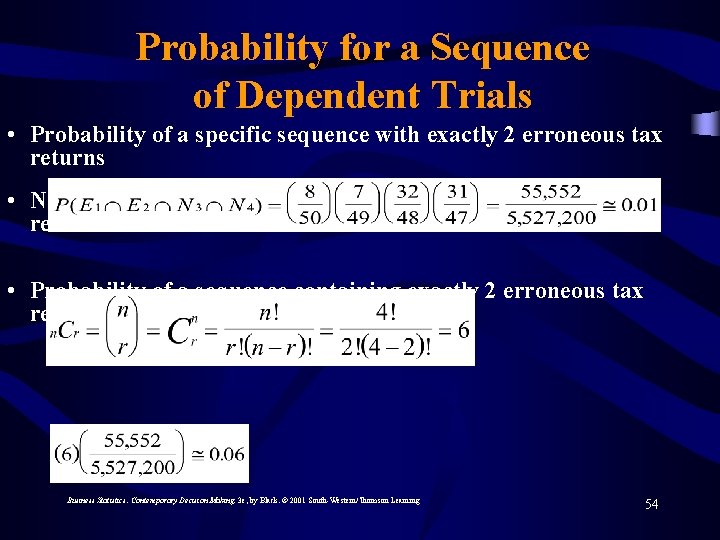
Probability for a Sequence of Dependent Trials • Probability of a specific sequence with exactly 2 erroneous tax returns • Number of sequences containing exactly 2 erroneous tax returns • Probability of a sequence containing exactly 2 erroneous tax returns Business Statistics: Contemporary Decision Making, 3 e, by Black. © 2001 South-Western/Thomson Learning 54
- Slides: 54