
BUSINESS SKILLS Investigate the structure of an organization
BUSINESS SKILLS Investigate the structure of an organization as a workplace UNIT STANDARD NUMBER : 14343 LEVEL ON THE NQF : 2 CREDITS : 8
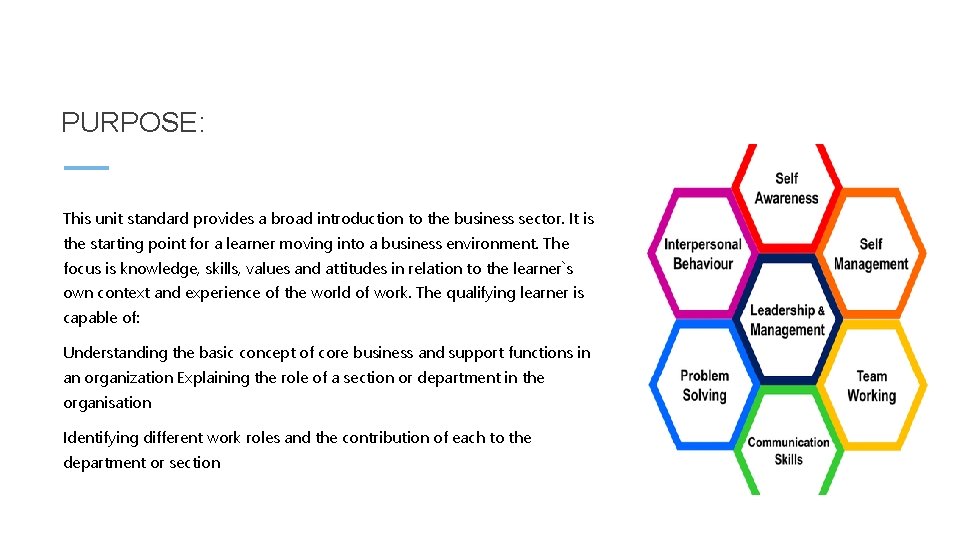
PURPOSE: This unit standard provides a broad introduction to the business sector. It is the starting point for a learner moving into a business environment. The focus is knowledge, skills, values and attitudes in relation to the learner`s own context and experience of the world of work. The qualifying learner is capable of: Understanding the basic concept of core business and support functions in an organization Explaining the role of a section or department in the organisation Identifying different work roles and the contribution of each to the department or section
SESSION 1 Identify the core business activities of a selected organisation The concept of core business is explained with an example from the relevant industry. Specific core business activities are named with reference to the selected organization. The relationships between the different activities are described for the selected organization. A system or process within a selected work unit is described in the correct sequence. Examples are listed of ways in which the core business adds value to the organization.
What is a business? Our purpose in business is to create wealth, to make money. For this to be possible, we must please our customers and enjoy the confidence of our shareholders and employees. We must make good profits, so that, after providing for taxes and dividends (and in present circumstances, financing inflation), there is enough money available to keep our factories and equipment modern and enable us to grow in strength and maintain or improve our market position. We endeavor to provide good, satisfying employment for our people. Creating wealth and building a better company is our contribution to a better standard of living.
The Corporate Report A business is an organisation/undertaking in which the owner/partners sell goods or render services to customers in order to gain a profit. Businesses exist: because a gap in the market is identified to meet needs and wants of potential customers to make a profit and create wealth Businesses contribute tremendously to the wealth creation process in our country. Wealth is created through the processing of resources into products and services, which are sold to customers who have a need for the product or service. For example, a contractor builds houses (a process) using bricks, sand cement (resources), and these houses are sold to people who have a need for houses (market). Businesses also create job opportunities, which is very important for the economic state of any country.
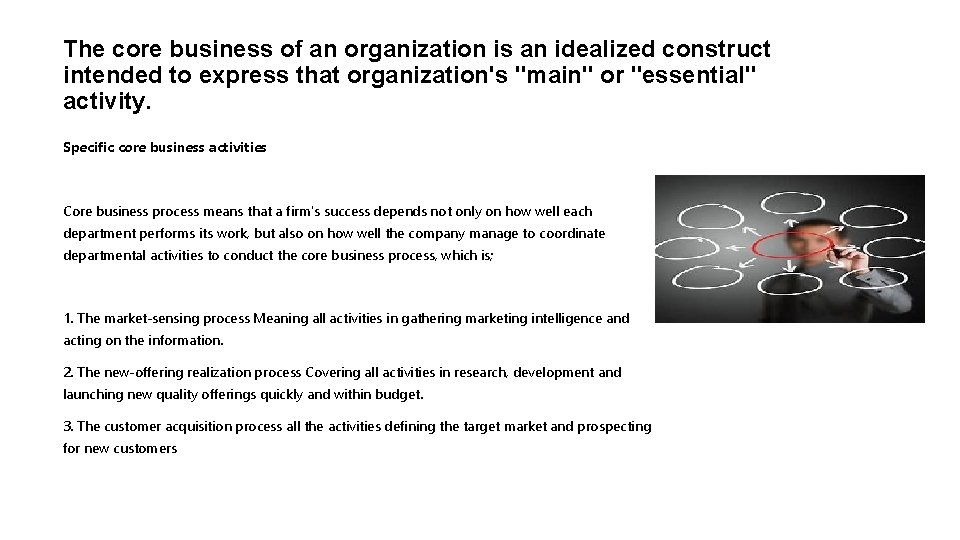
The core business of an organization is an idealized construct intended to express that organization's "main" or "essential" activity. Specific core business activities Core business process means that a firm's success depends not only on how well each department performs its work, but also on how well the company manage to coordinate departmental activities to conduct the core business process, which is; 1. The market-sensing process Meaning all activities in gathering marketing intelligence and acting on the information. 2. The new-offering realization process Covering all activities in research, development and launching new quality offerings quickly and within budget. 3. The customer acquisition process all the activities defining the target market and prospecting for new customers
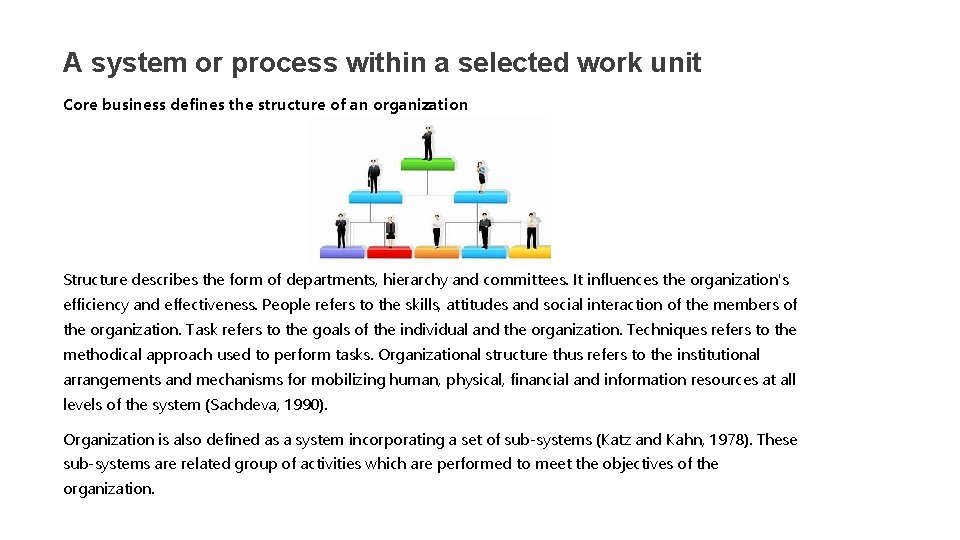
A system or process within a selected work unit Core business defines the structure of an organization Structure describes the form of departments, hierarchy and committees. It influences the organization's efficiency and effectiveness. People refers to the skills, attitudes and social interaction of the members of the organization. Task refers to the goals of the individual and the organization. Techniques refers to the methodical approach used to perform tasks. Organizational structure thus refers to the institutional arrangements and mechanisms for mobilizing human, physical, financial and information resources at all levels of the system (Sachdeva, 1990). Organization is also defined as a system incorporating a set of sub-systems (Katz and Kahn, 1978). These sub-systems are related group of activities which are performed to meet the objectives of the organization.
Organization has been viewed differently by numerous theorists. However, all definitions usually contain five common features: · composed of individuals and groups of individuals; · oriented towards achieving common goals; · differential functions; · intended rational coordination; and · continuity through time.
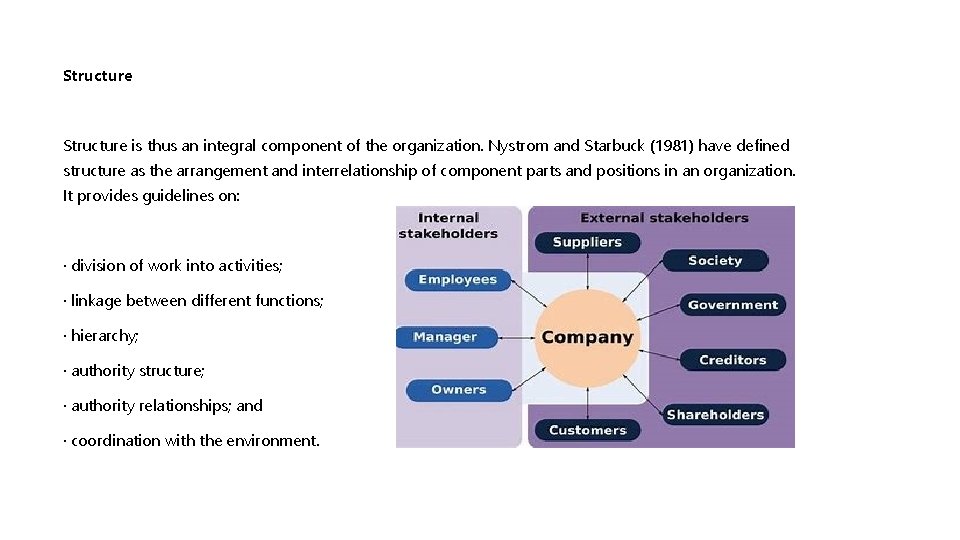
Structure is thus an integral component of the organization. Nystrom and Starbuck (1981) have defined structure as the arrangement and interrelationship of component parts and positions in an organization. It provides guidelines on: · division of work into activities; · linkage between different functions; · hierarchy; · authority structure; · authority relationships; and · coordination with the environment.
Organizational structure may differ within the same organization according to the particular requirements. Structure in an organization has three components (Robbins, 1989): · Complexity, referring to the degree to which activities within the organization are differentiated. This differentiation has three dimensions: - horizontal differentiation refers to the degree of differentiation between units based on the orientation of members, the nature of tasks they perform and their education and training, - vertical differentiation is characterized by the number of hierarchical levels in the organization, and - spatial differentiation is the degree to which the location of the organization's offices, facilities and personnel are geographically distributed; · Formalization refers to the extent to which jobs within the organization are specialized. The degree of formalization can vary widely between and within organizations; · Centralization refers to the degree to which decision making is concentrated at one point in the organization.
Designing organizational structures Some important considerations in designing an effective organizational structure are: · Clarity The structure of the organization should be such that there is no confusion about people's goals, tasks, style of functioning, reporting relationship and sources of information. · Understanding The structure of an organization should provide people with a clear picture of how their work fits into the organization. · De-centralization the design of an organization should compel discussions and decisions at the lowest possible level. · Stability and adaptability while the organizational structure should be adaptable to environmental changes, it should remain steady during unfavorable conditions. Principles of organization structure Modern organizational structures have evolved from several organizational theories, which have identified certain principles as basic to any organization.

Specialization facilitates division of work into units for efficient performance. According to the classical approach, work can be performed much better if it is divided into components and people are encouraged to specialize by components. Work can be specialized both horizontally and vertically (Anderson, 1988). Vertical specialization in a research organization refers to different kinds of work at different levels, such as project leader, scientist, researcher, field staff, etc. Horizontally, work is divided into departments like genetics, plant pathology, administration, accounts, etc. Specialization enables application of specialized knowledge which betters the quality of work and improves organizational efficiency. At the same time, it can also influence fundamental work attitudes, relationships and communication. This may make coordination difficult and obstruct the functioning of the organization.
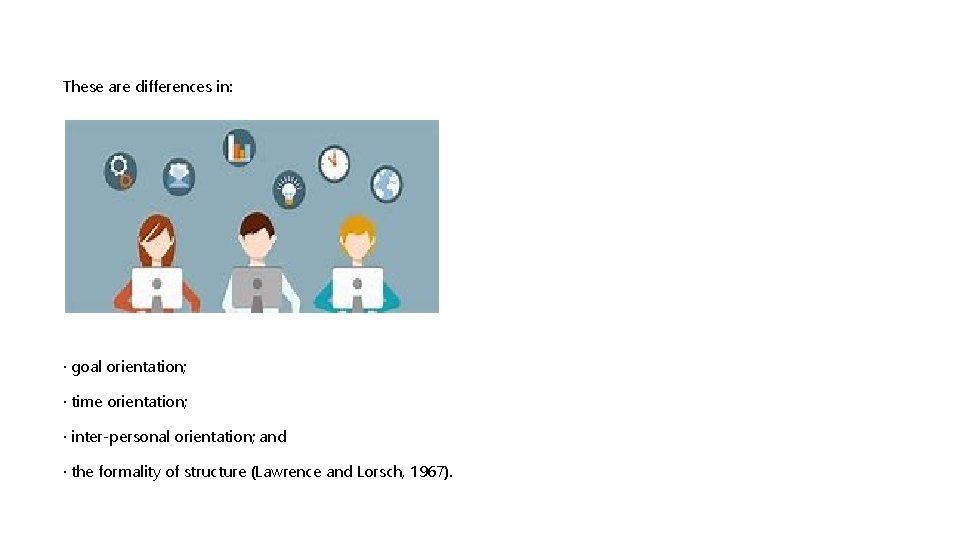
These are differences in: · goal orientation; · time orientation; · inter-personal orientation; and · the formality of structure (Lawrence and Lorsch, 1967).
Coordination refers to integrating the objectives and activities of specialized departments to realize broad strategic objectives of the organization. It includes two basic decisions pertaining to: (i) which units or groups should be placed together; and (ii) the patterns of relationships, information networks and communication (Anderson, 1988). In agricultural research institutions, where most of the research is multidisciplinary but involves specialization, coordination of different activities is important to achieve strategic objectives. Efficient coordination can also help in resolving conflicts and disputes between scientists in a research organization. Hierarchy facilitates vertical coordination of various departments and their activities. Organizational theorists have over the years developed several principles relating to the hierarchy of authority for coordinating various activities. Some of the important principles are discussed below.
Unity of Command Every person in an organization should be responsible to one superior and receive orders from that person only. Fayol (1949) considered this to be the most important principle for efficient working and increased productivity in an organization. The Scalar Principle Decision making authority and the chain of command in an organization should flow in a straight line from the highest level to the lowest. The principle evolves from the principle of unity of command. However, this may not always be possible, particularly in large organizations or in research institutions. Therefore Fayol (1949) felt that members in such organizations could also communicate directly at the same level of hierarchy, with prior intimation to their superiors.
Interaction Click the Interaction button to edit this object
SESSION 2 Identify support functions within a selected organisation The concept of support functions is explained with an example from the relevant industry. Specific support functions are named with reference to the selected organisation. The relationship between one support unit and the other business units of the selected organisation is explained at a basic level of understanding. Five examples are listed in which the support unit adds value to the organisation.
Concept of support functions Business functions are the activities carried out by an enterprise; they can be divided into core functions and support functions. Core business functions are activities of an enterprise yielding income: the production of final goods or services intended for the market or for third parties. Usually the core business functions make up the primary activity of the enterprise, but they may also include other (secondary) activities if the enterprise considers these as part of its core functions. Support business functions are ancillary (supporting) activities carried out by the enterprise in order to permit or to facilitate the core business functions, its production activity. The outputs (results) of support business functions are not themselves intended directly for the market or for third parties.
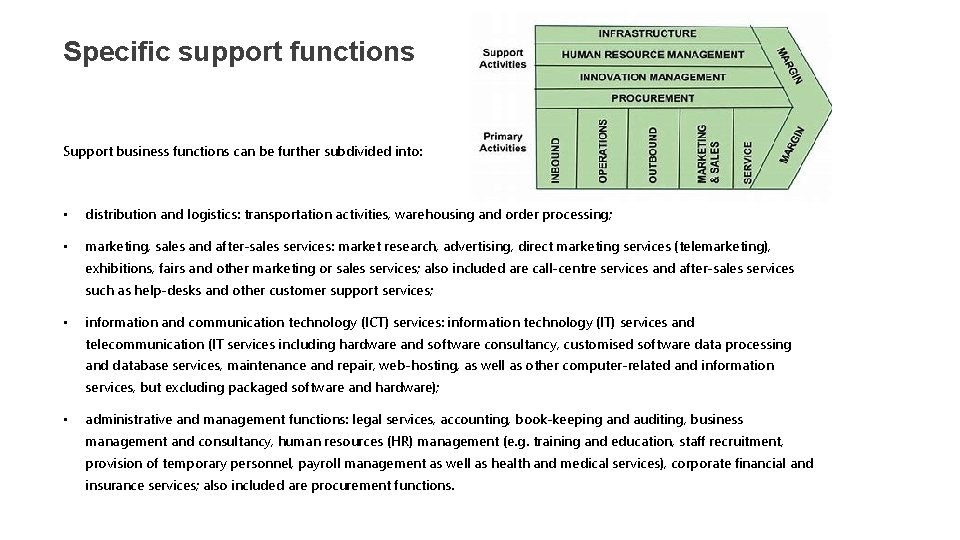
Specific support functions Support business functions can be further subdivided into: • distribution and logistics: transportation activities, warehousing and order processing; • marketing, sales and after-sales services: market research, advertising, direct marketing services (telemarketing), exhibitions, fairs and other marketing or sales services; also included are call-centre services and after-sales services such as help-desks and other customer support services; • information and communication technology (ICT) services: information technology (IT) services and telecommunication (IT services including hardware and software consultancy, customised software data processing and database services, maintenance and repair, web-hosting, as well as other computer-related and information services, but excluding packaged software and hardware); • administrative and management functions: legal services, accounting, book-keeping and auditing, business management and consultancy, human resources (HR) management (e. g. training and education, staff recruitment, provision of temporary personnel, payroll management as well as health and medical services), corporate financial and insurance services; also included are procurement functions.
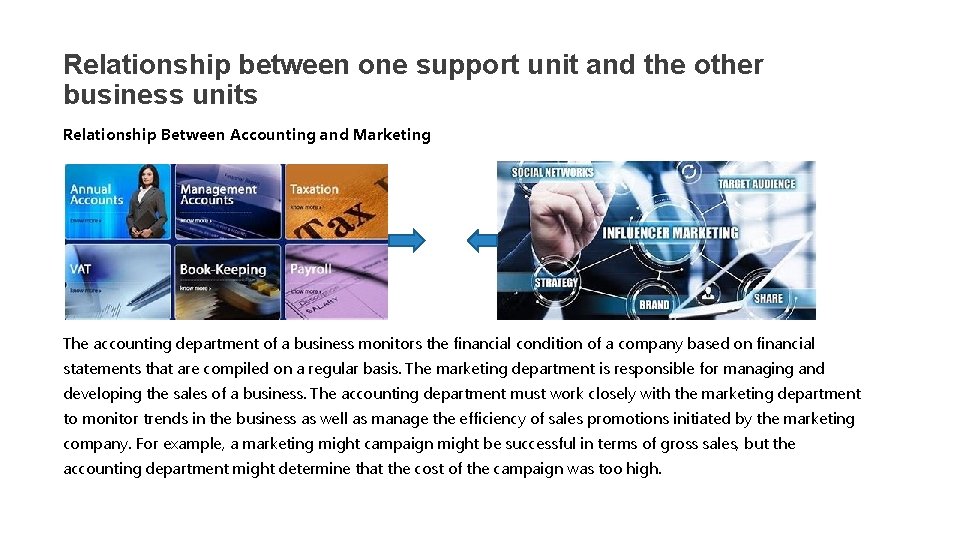
Relationship between one support unit and the other business units Relationship Between Accounting and Marketing The accounting department of a business monitors the financial condition of a company based on financial statements that are compiled on a regular basis. The marketing department is responsible for managing and developing the sales of a business. The accounting department must work closely with the marketing department to monitor trends in the business as well as manage the efficiency of sales promotions initiated by the marketing company. For example, a marketing might campaign might be successful in terms of gross sales, but the accounting department might determine that the cost of the campaign was too high.
Accounting Department and Financial Statements All businesses must keep some form of accounting system to monitor the financial results of a business. The financial statements help management gauge the profitability of a business within a given period. The accounting department is responsible for the preparation and analysis of the financial statements. They can monitor sales trends and expense trends in the business that can provide management with the information it needs to make plans for expansion or cost reductions. Some of the most important expenditures a business can make are in the areas of marketing and advertising. A business must be able to market its goods and services; however, they must also be able to manage the cost of the marketing and advertising efforts.
Marketing Reports The marketing department of a company sets up programs to increase sales via advertising and sales promotions. These can include direct advertising programs such as radio and television campaigns to indirect programs that include involvement in community and public organizations. The marketing department prepares a variety of reports designed to assist management in processes of determining sales strategies that work. Reports might include gross sales per campaign or even customer hits on a website advertisement. Marketing is always looking for the best way to promote a business within the confines of the company budget. Ratio Analysis Management is always looking at the relationship between sales and costs. These are called ratios. For example, a typical ratio is the gross-expense ratio. This measures the gross expenses of a company with the gross sales. For example, if the gross monthly expenses in a period are R 100, 000 and the gross income is R 200, 000, the gross expense ratio is 50 percent (R 100, 000 divided by R 200, 000. ) The gross expense ratio can be further broken down into expenses related to important departments in the company, such as marketing. Accounting and marketing should work closely to monitor the ratios of advertising and marketing expenses to gross sales. For example, if marketing expenses are increased in a period, but sales remain constant, management may decide that the marketing expenses were inefficient. This is called ratio analysis.
Considerations Marketing and accounting must work closely so that management can see where the marketing campaigns are successful. Another reason marketing and accounting work closely together is to prepare budgets for future expenditures in the fields of marketing and advertising. By looking at past financial results, management can budget future expenditures for the marketing campaigns. It’s then the accounting department’s role to measure the marketing departments adherence to budget limits and also the efficiency of the budgets that have been used The Relationship Between Marketing & Human Resources Marketing and human resources aren't as separate as you might think. A company needs to attract profitable customers to achieve decent sales numbers, but getting top talent interested in your company is also critical to long-term success. Whenever you're trying to convince people to help you, whether you're after their dollars or their working hours, you need to position and market your proposition so it looks attractive.
Employer Branding The word "branding" conjures up visions of market research reports, company logos and product positioning meetings. Your products and services aren't the only part of your company in need of promotion, though, especially if you want to attract and retain top talent. People want to work with a company that boasts a good reputation, that has a strong mission and vision. Showing people your company's personality is important, especially in the current economic climate. Lara Moroko and Mark D. Uncles, writers for The Wall Street Journal, point out that budget squeezes make hiring the right people more important than ever, since you don't have the funds to employ workers who don't pull their weight. Attracting the Right Talent Since small businesses almost always have tight budgets, even when times are good, it's even more critical for you to get your staffing decisions right the first time. The secret to attracting the people you want and need: align your HR strategy with your business plan. If you want to be a top application developer for smartphones, you need creative and educated talent. Start blogging about trends in the smartphone industry. Attend developer conferences. Hold information sessions at local colleges, and advertise HR policies that cater to young professionals, like flex time and the chance to brainstorm new ideas on company time.
Keeping People Happy One rule of marketing is that you should only promise what you can deliver. If your product fails to live up to customer standards, loyalty and trust wane and your brand collapses. Similarly, if you promise a work environment that you can't offer, you'll hurt employee morale. While creating an image to attract top talent is important, you also need to sustain it. If your business can't afford to promise tuition reimbursements, but you do want to attract employees committed to learning, work lower-cost education opportunities into your company culture. Have weekly lunch-and-learn sessions where employees take turns presenting to the group. Promise education funding on a smaller scale, agreeing to pay for one relevant conference each year. Keeping Up with Change Markets change, and so do employee expectations. Just like brands have to evolve to stay competitive, your employer brand has to change with employee expectations. You need to stay on top of basic trends, like salary data, but you also need to know what benefits your competitors are providing. Keep on top of news about the top places to work in your field. You may be too small to provide a gym in-house like a major corporate competitor, but maybe you could afford to offer fitness allowances.
SESSION 3 Explain the role of a selected department in an organisation and its contribution The main function of the selected department or section is explained in relation to core business or support. The roles of at least two other departments or sections that interact with the selected section or department are explained at a basic level of understanding. The most senior person in the department is identified with, where applicable, the title of his/her position. The line is identified from the senior person in the department or section to the Board of Directors. The effect on the organisation if the department or section did not function effectively is described with examples. The value that the department adds to the organisation is identified with examples.
Roles in departments Every organisation made up of more than one person will need some form of organisational structure. An organisational chart shows the way in which the chain of command works within the organisation. The way in which a company is organised can be illustrated for a packaging company. The company will be owned by shareholders that choose directors to look after their interests. The directors then appoint managers to run the business on a day-to-day basis: The Managing Director has the major responsibility for running of the company, including setting company targets and keeping an eye on all departments. The Distribution Manager is responsible for controlling the movement of goods in and out of the warehouse, supervising drivers and overseeing the transport of goods to and from the firm. The Production Manager is responsible for keeping a continuous supply of work flowing to all production staff and also for organising manpower to meet the customers' orders. The Sales Manager is responsible for making contact with customers and obtaining orders from those contacts. The Company Accountant controls all the financial dealings of the company and is responsible for producing management accounts and financial reports.
Organisations are structured in different ways: 1. by function as described above 2. by regional area - a geographical structure e. g. with a marketing manager North, marketing manager South etc. 3. by product e. g. marketing manager crisps, marketing manager drinks, etc. 4. into work teams, etc. Reporting in organisations often takes place down the line. An employee might be accountable to a supervisor, who is accountable to a junior manager, who is then accountable to a senior manager - communication and instructions can then be passed down the line.
Departmentalization is a process of horizontal clustering of different types of functions and activities on any one level of the hierarchy. It is closely related to the classical bureaucratic principle of specialization (Luthans, 1986). Departmentalization is conventionally based on purpose, product, process, function, personal things and place (Gullick and Urwick, 1937). Functional Departmentalization is the basic form of departmentalization. It refers to the grouping of activities or jobs involving common functions. In a research organization the groupings could be research, production, agricultural engineering, extension, rural marketing and administration. Product Departmentalization refers to the grouping of jobs and activities that are associated with a specific product. As organizations increase in size and diversify, functional departmentalization may not be very effective. The organization has to be further divided into separate units to limit the span of control of a manager to a manageable level (Luthans, 1986).
In an agricultural research institution, functional departments can be further differentiated by products and purpose or type of research. In contrast to functional departmentalization, product-based departmentalization has the advantage of: less conflict between major sub-units; easier communication between sub-units; less complex coordination mechanisms; providing a training ground for top management; more customer orientation; and greater concern for long-term issues.
In contrast, functional departmentalization has the strength of: easier communication with sub-units; application of higher technical knowledge for solving problems; greater group and professional identification; less duplication of staff activities; higher product quality; and increased organizational efficiency (Filley, 1978). Departmentalization by Users is grouping of both activities and positions to make them compatible with the special needs of some specific groups of users. Departmentalization by Territory or Geography involves grouping of activities and positions at a given location to take advantage of local participation in decision making. The territorial units are under the control of a manager who is responsible for operations of the organization at that location. In agricultural research institutions, regional research stations are set up to take advantage of specific agro-ecological environments. Such departmentalization usually offers economic advantage.
-centralization and Centralization De-centralization refers to decision making at lower levels in the hierarchy of authority. In contrast, decision making in a centralized type of organizational structure is at higher levels. The degree of centralization and decentralization depends on the number of levels of hierarchy, degree of coordination, specialization and span of control. According to Luthens (1986), centralization and de-centralization could be according to: geographical or territorial concentration or dispersion of operations; · functions; or extent of concentration or delegation of decision-making powers. Every organizational structure contains both centralization and de-centralization, but to varying degrees. The extent of this can be determined by identifying how much of the decision making is concentrated at the top and how much is delegated to lower levels. Modern organizational structures show a strong tendency towards decentralization.
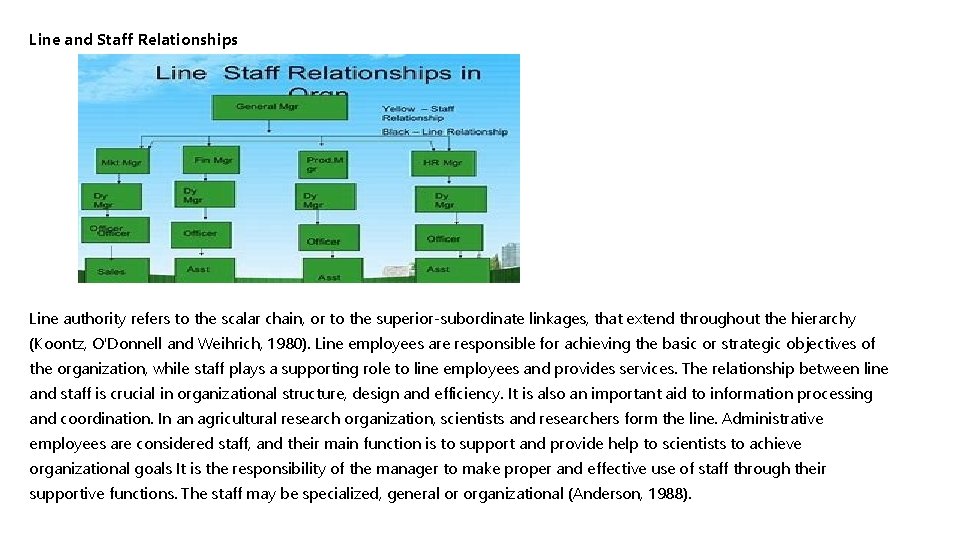
Line and Staff Relationships Line authority refers to the scalar chain, or to the superior-subordinate linkages, that extend throughout the hierarchy (Koontz, O'Donnell and Weihrich, 1980). Line employees are responsible for achieving the basic or strategic objectives of the organization, while staff plays a supporting role to line employees and provides services. The relationship between line and staff is crucial in organizational structure, design and efficiency. It is also an important aid to information processing and coordination. In an agricultural research organization, scientists and researchers form the line. Administrative employees are considered staff, and their main function is to support and provide help to scientists to achieve organizational goals It is the responsibility of the manager to make proper and effective use of staff through their supportive functions. The staff may be specialized, general or organizational (Anderson, 1988).
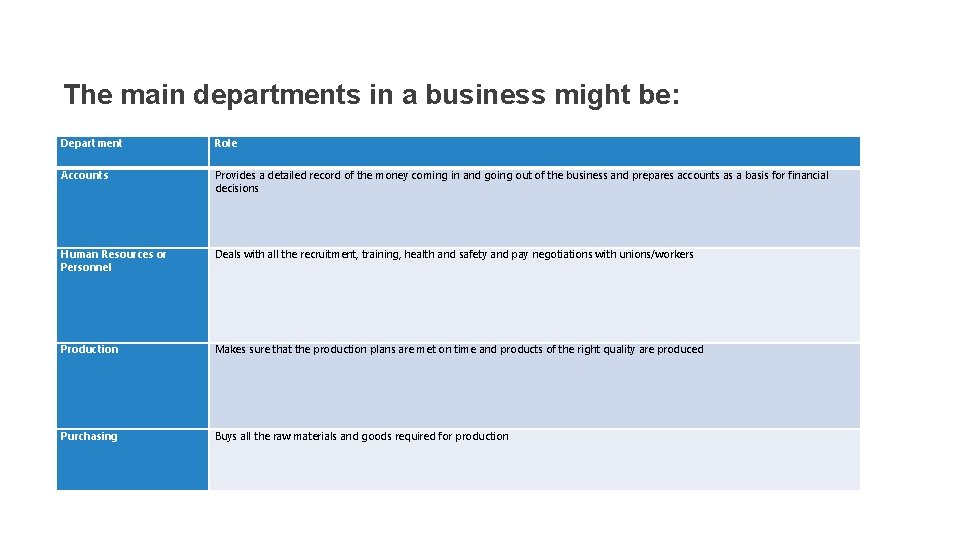
The main departments in a business might be: Department Role Accounts Provides a detailed record of the money coming in and going out of the business and prepares accounts as a basis for financial decisions Human Resources or Personnel Deals with all the recruitment, training, health and safety and pay negotiations with unions/workers Production Makes sure that the production plans are met on time and products of the right quality are produced Purchasing Buys all the raw materials and goods required for production
SESSION 4 Investigate the different types of work done in the department The different roles in the department are identified an outline is written of the kind of work done by three people. The work done in the department is categorised according to its purpose. The importance of each category of work is discussed with reference to the efficiency of the department. The work in the department is identified as a part of a set of related systems each with a role and a value.
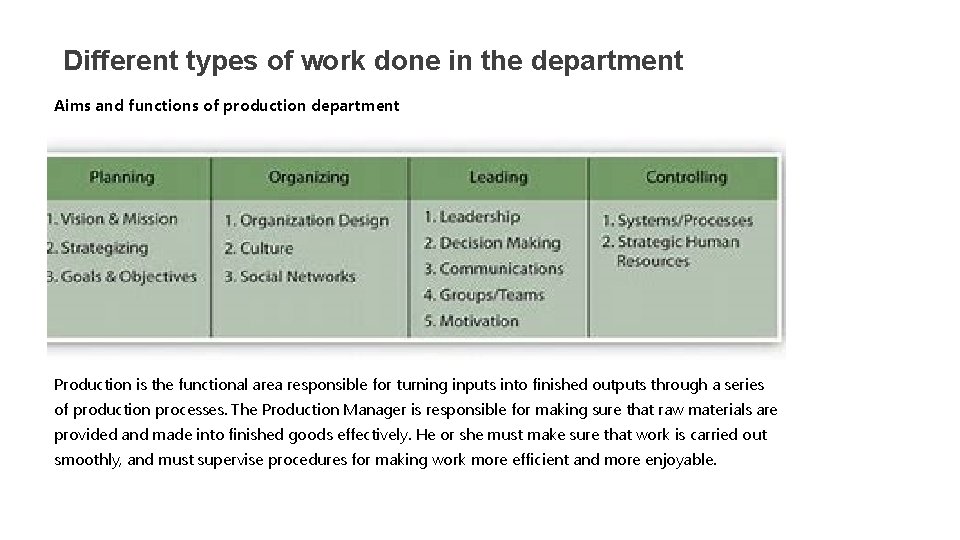
Different types of work done in the department Aims and functions of production department Production is the functional area responsible for turning inputs into finished outputs through a series of production processes. The Production Manager is responsible for making sure that raw materials are provided and made into finished goods effectively. He or she must make sure that work is carried out smoothly, and must supervise procedures for making work more efficient and more enjoyable.
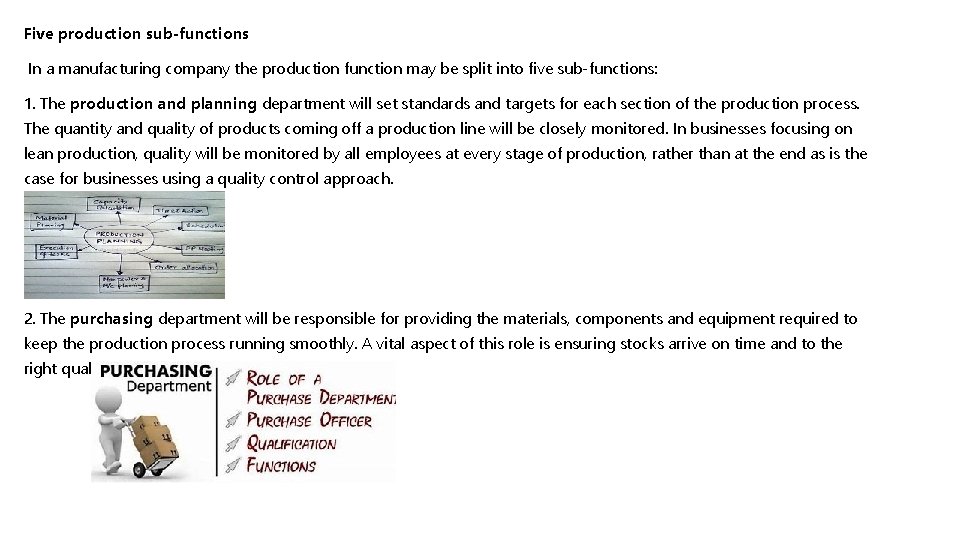
Five production sub-functions In a manufacturing company the production function may be split into five sub-functions: 1. The production and planning department will set standards and targets for each section of the production process. The quantity and quality of products coming off a production line will be closely monitored. In businesses focusing on lean production, quality will be monitored by all employees at every stage of production, rather than at the end as is the case for businesses using a quality control approach. 2. The purchasing department will be responsible for providing the materials, components and equipment required to keep the production process running smoothly. A vital aspect of this role is ensuring stocks arrive on time and to the right quality.
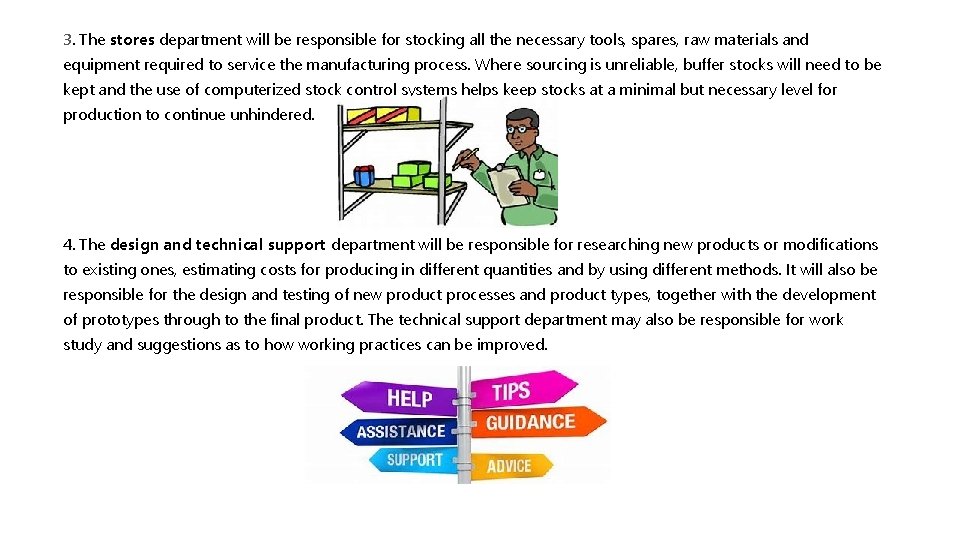
3. The stores department will be responsible for stocking all the necessary tools, spares, raw materials and equipment required to service the manufacturing process. Where sourcing is unreliable, buffer stocks will need to be kept and the use of computerized stock control systems helps keep stocks at a minimal but necessary level for production to continue unhindered. 4. The design and technical support department will be responsible for researching new products or modifications to existing ones, estimating costs for producing in different quantities and by using different methods. It will also be responsible for the design and testing of new product processes and product types, together with the development of prototypes through to the final product. The technical support department may also be responsible for work study and suggestions as to how working practices can be improved.
5. The works department will be concerned with the manufacture of products. This will include the maintenance of the production line and other necessary repairs. The works department may also have responsibility for quality control and inspection. A key aspect of modern production is ensuring quality. The term quality means fitness for purpose i. e. a product, process or service should do exactly what is expected of it. Work in the department is identified as a part of a set of related systems each with a role and a value. Metrics and key performance indicators for a department Some of the areas from which bank management may gain knowledge by using business performance management include: customer-related numbers: new customers acquired status of existing customers attrition of customers (including breakup by reason for attrition)
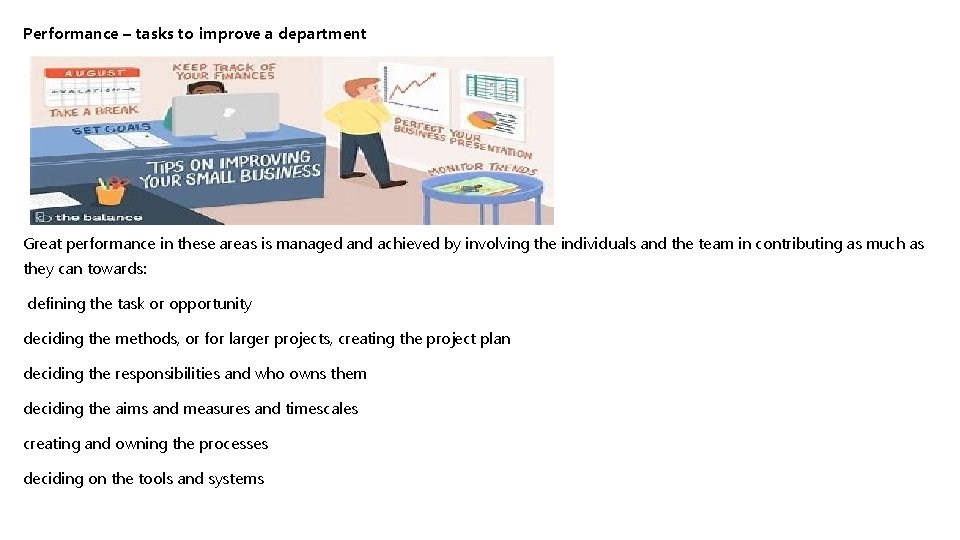
Performance – tasks to improve a department Great performance in these areas is managed and achieved by involving the individuals and the team in contributing as much as they can towards: defining the task or opportunity deciding the methods, or for larger projects, creating the project plan deciding the responsibilities and who owns them deciding the aims and measures and timescales creating and owning the processes deciding on the tools and systems
- Slides: 40