
Business Retention and Expansion Survey DesignImplementation and Firm
Business Retention and Expansion Survey Design/Implementation and Firm Selection
Why use a survey? �A survey can help to communicate the community’s feelings of appreciation about its businesses � Taking time for the visit � Asking businesses’ opinions about relevant concerns �A survey can provide insight into the actions and initiatives that the community/task force can use to address business-related issues �A survey should help to build the community’s capacity to initiate and sustain long-term growth as well as address the immediate and long-term concerns and needs of the business 2
Important points � The survey (also referred to as the “diagnostic tool” or “conversation guide”) is used differently when the volunteer visitor and the segregated/continuous models are examined The volunteer visitor model typically surveys a large number of firms in a short, specific time frame. Analysis is much more meaningful when survey questions are asked in exactly the same manner � The continuous/segregated model utilizes a different philosophy. A small set of firms are surveyed (or “diagnosed”) within a specific time frame, but these specific time frames are combined over a (probably) much longer horizon � These differences translate to a much different use of the diagnostic tool or survey instrument to achieve the desired result � 3
Use of the instrument/tool � First, it must be recognized that there is not a single BR&E program within the continuous/segregated concept � Therefore, it is likely that a variety of approaches, or even a blending of approaches, must be used � In a volunteer visitor model, the survey instrument should be followed carefully � In the continuous model, the survey instrument (diagnostic tool) should be used more as a guide to develop a long-term conversation � Since 4 one goal of the continuous model is to build a personal relationship with the company, an incomplete survey can be finished at a future date
Important point � It is of utmost importance that each account executive understand each question on the survey as well as each question’s importance � The survey questions should work together for a common theme and that each question contributes to that theme � Make sure that the data gathered from each question is needed, not just wanted � If the account executive doesn’t understand the importance of a particular question, the team need to determine whether that question is actually needed 5
Options for Survey Development � Use an existing survey � e-Synchronist or Executive Pulse � brei. org website � Internet � “Steal” one from someone/someplace else � Develop � Difficult one yourself to do � Requires a great deal of time, effort and resources 6
Using an existing survey � Since many in this class will be using an existing survey such as the ones designed by Executive Pulse or e. Synchronist, or one designed by their own organization, let’s focus on utilizing the survey instrument and response analysis �A key factor in the success of the survey effort is to understand the question and why it is being asked � This includes having an understanding of how a specific question relates to the rest of the survey instrument � Developing this understanding will increase the potential respondent’s confidence in your ability to understand the response 7
Developing a survey � Caution should be used when adopting another organization’s survey � Does the survey fit the targeted business sector? � Are the questions relevant for your geographic or political area? � Has the survey been tested for validity with your businesses? � Does the survey pose the questions that you need answered? 8
Developing a survey � Developing a survey from scratch is complicated � Question identification is key � Does the question address the targeted business sector? � Can the question produced credible information? � Can and will the respondent answer the question? � Operationalization – asking questions that provides data that can be meaningfully observed or measured � Facts � The versus behaviors versus beliefs survey should be tested (several times) to ensure validity 9
Introducing bias into the survey � Even though you will be using a pre-determined survey instrument, there is still a great deal of bias that can be introduced into the effort by the way that you ask the questions � Asking questions in an emotional way � Using inflection in asking the question � Changing the order of the questions � Interpreting a question to some respondents and not to others � Sharing a different interpretation to different respondents � While it may be difficult in the interview, try to ask questions in as consistent a manner as possible, in the order in which they are provided and with little explanation beyond what is given 10
Question Specificity � While most (if not all) of the questions on the diagnostic tool will be closed ended questions, you have the opportunity to add questions that are outside the tool � Question specificity typically refers to whether a question is open-ended or closed-ended � Open-ended question example � What effect will the current economic crisis have on your workforce? � Closed-ended � Will 11 question example (Yes/No question) you be more like to hire additional workers, reduce your workforce or maintain the same workforce level over the next year?
Characteristics of Open-Ended Questions � Easy � Not to write easy to answer � Produces very different types of responses that are not consistent across the sample � Not 12 easy (perhaps impossible) to answer
Characteristics of Close-Ended Questions � Difficult to write (well) � Easier to analyze � Limits responses (both good and bad) � Can 13 have ordered and unordered choices
Survey Design Points � Face-to-face Surveys � No need for the survey to necessarily look good � It is necessary for the survey to sound good � Keep questions short and simple � Ranking items is very difficult � Introduction of the interview by the interviewer is necessary � Use transitions, fillers, lead-ins, etc. , to let the respondent know that the interviewer is about to change topics � Remember that the interviewee only sees the face-to face survey if a copy is provided � This 14 is a good idea, but necessitates providing a separate copy of the instrument � Usually reserved for a volunteer visitor model approach
Survey Design Points � Internet Surveys � Typically used as an introductory effort to identify issues � The survey must look good � Survey must be kept short; internet attention spans are not long � Questions must be very clear to the participant (the survey should be tested exhaustively) � Conducive to answering multiple option questions � Keep questions short and simple; closed-ended questions are easier to answer (and analyze) � Ranking items is less difficult � Allow the user to exit the survey and pick up where they left off – this allows research into complicated issues 15
Survey Design Points � Phone � While Surveys many BR&E programs use phone calls to maintain contact with businesses, attempting a formal survey effort over the phone is usually not a good idea � A phone survey (especially if a cold call) could be viewed as a form of telemarketing � The interviewer should expect superficial answers to only one or two questions – adopt a conversational approach � Open-ended questions are probably the best for a conversational tone � No multiple option or ranking questions 16
Survey Design Points � Newspaper � Some Surveys BR&E programs have used a short survey in the newspaper to introduce the program to the community and gain an idea of overarching issues � This effort could be viewed as trivializing the program � Survey must be kept short � Questions must be very clear to the participant (the survey should be tested exhaustively) � Keep questions short and simple; closed-ended questions are easier to answer (and analyze) � Conducive to answering multiple option questions � Ranking items is less difficult 17
Firm Selection � Industry/sector should be identified at the beginning of the program � Often difficult to combine industries/sectors � Metal fabrication and retail sales have different issues, needs and concerns regarding customer base, workforce development/education, infrastructure, etc. � Once the industry/sector has been identified, the major sticking point for many BRE programs is sampling � Sampling is a method of choosing a select number of firms from the population so that analysis results can be generalized to the population 18
Sampling � Do you really need to sample? �A sample should obtain information from a few respondents to generalize to a population � If the population is small, you may want to survey the entire population � If the population is 250, then the number of respondents would need to be 200 � Marginal cost of the extra 50 is fairly low 19
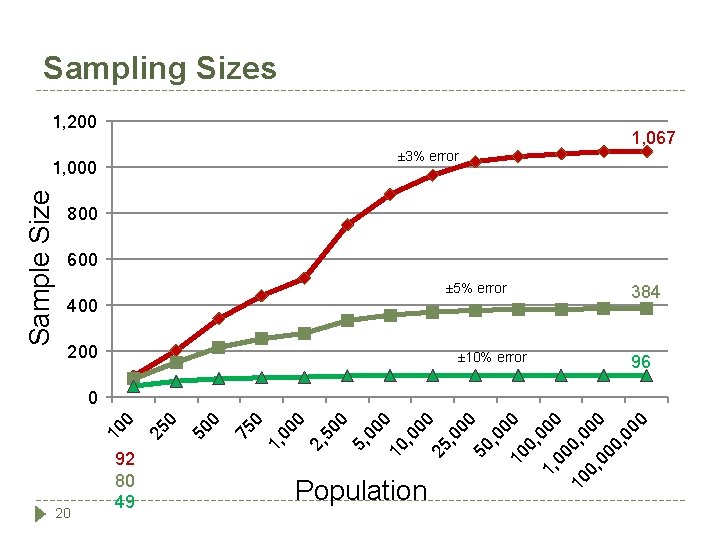
Sampling Sizes 1, 200 1, 067 ± 3% error 800 600 ± 5% error 400 200 ± 10% error 384 96 20 , 0 00 25 , 0 00 50 , 0 0 10 0 0, 1, 000 00 10 0, 00 0 0 10 5, 00 0 50 2, 0 00 75 0 50 0 0 1, 92 80 49 25 0 0 10 Sample Size 1, 000 Population
Questions 21
Creative Commons License � This work carries an attribution non-commercial share alike license. � http: //creativecommons. org/licenses/by-nc-sa/3. 0/ 22
- Slides: 22