
Business Research The Problem Asian School of Business
Business Research The Problem!! Asian School of Business, Trivandrum 2007 1
Principles of a good report • • Very objective and unbiased Provides a whole picture Easy to read and comprehend Refers a lot of reliable data. (You must always show the sources of data. ) E. g. . – It is estimated that Easy. Jet has losses of $3. 3 billion 2 and so…. . 2 Source: Businessworld Casebook 2003, pp 20 Asian School of Business, Trivandrum 2007 2
Overview • Problem Definition • Steps Involved • Components In Each Step Asian School of Business, Trivandrum 2007 3
Problem Definition • The most important step. • Problem has to be correctly understood and properly defined. That’s the key. • There is a specific approach to defining the problem. Asian School of Business, Trivandrum 2007 4
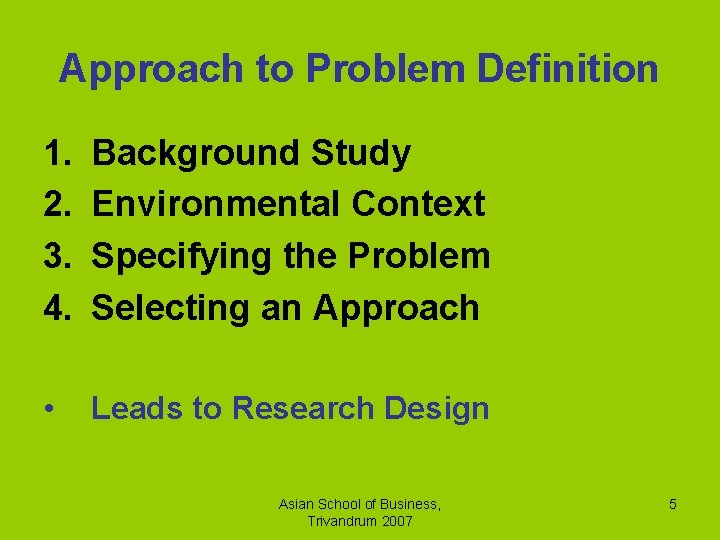
Approach to Problem Definition 1. 2. 3. 4. Background Study Environmental Context Specifying the Problem Selecting an Approach • Leads to Research Design Asian School of Business, Trivandrum 2007 5
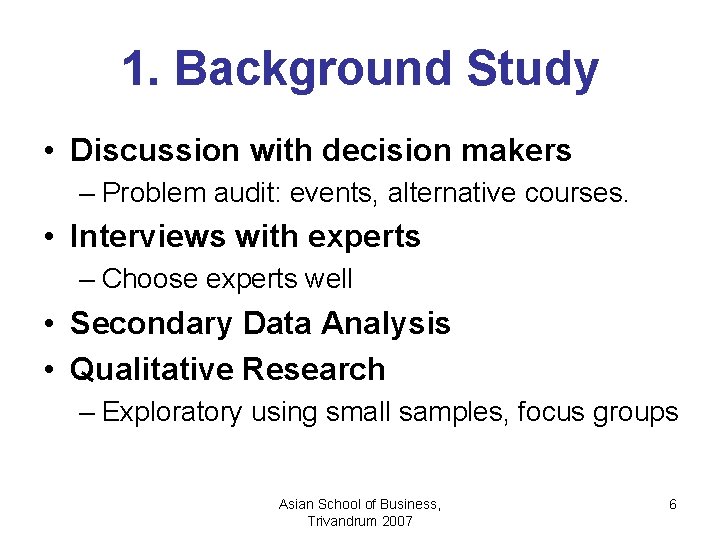
1. Background Study • Discussion with decision makers – Problem audit: events, alternative courses. • Interviews with experts – Choose experts well • Secondary Data Analysis • Qualitative Research – Exploratory using small samples, focus groups Asian School of Business, Trivandrum 2007 6
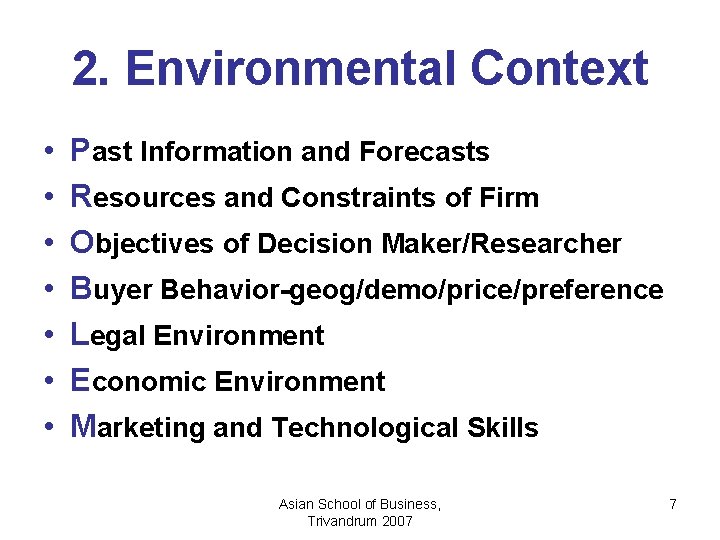
2. Environmental Context • • Past Information and Forecasts Resources and Constraints of Firm Objectives of Decision Maker/Researcher Buyer Behavior-geog/demo/price/preference Legal Environment Economic Environment Marketing and Technological Skills Asian School of Business, Trivandrum 2007 7
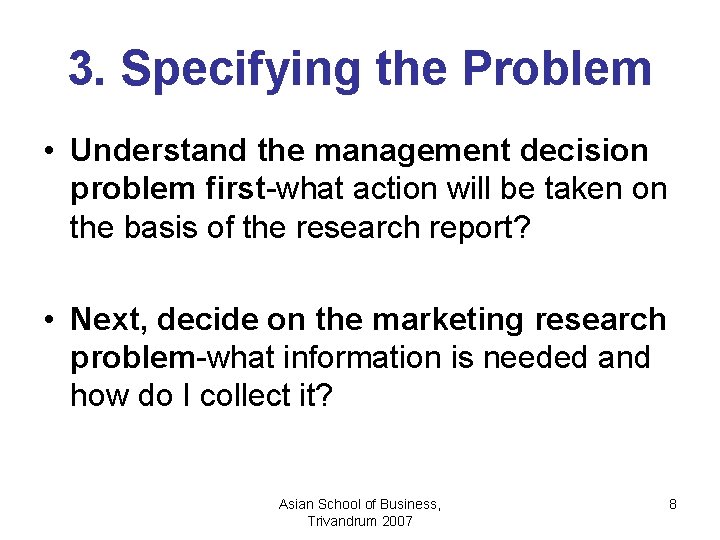
3. Specifying the Problem • Understand the management decision problem first-what action will be taken on the basis of the research report? • Next, decide on the marketing research problem-what information is needed and how do I collect it? Asian School of Business, Trivandrum 2007 8
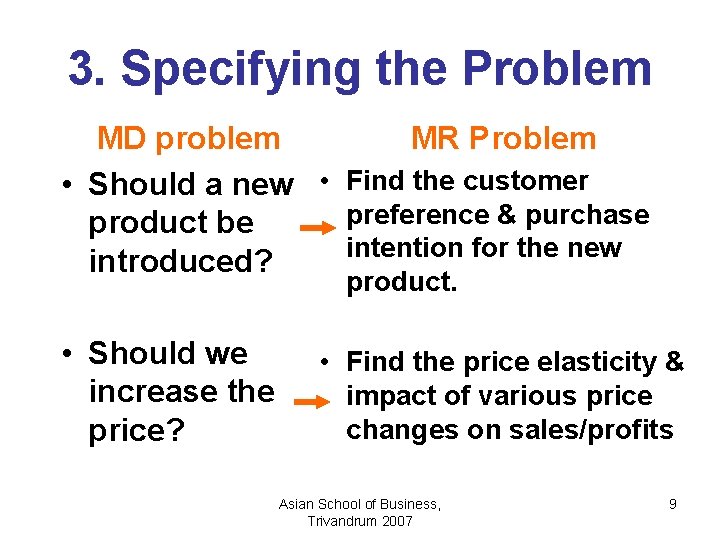
3. Specifying the Problem MD problem MR Problem • Should a new • Find the customer preference & purchase product be intention for the new introduced? product. • Should we increase the price? • Find the price elasticity & impact of various price changes on sales/profits Asian School of Business, Trivandrum 2007 9
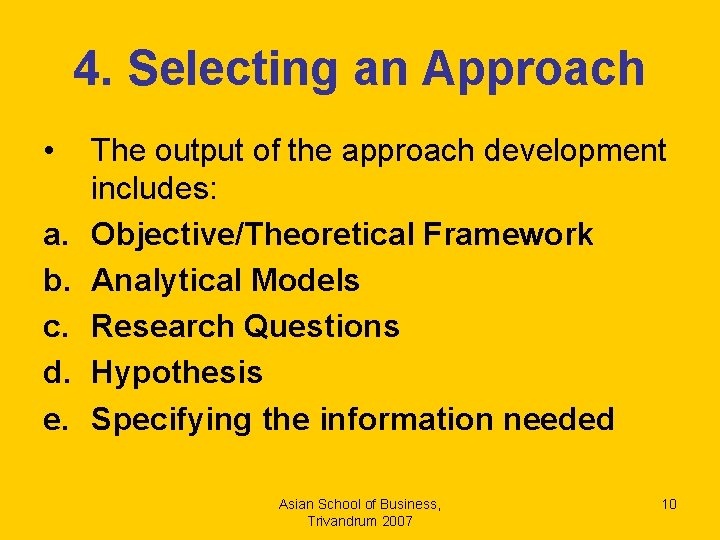
4. Selecting an Approach • a. b. c. d. e. The output of the approach development includes: Objective/Theoretical Framework Analytical Models Research Questions Hypothesis Specifying the information needed Asian School of Business, Trivandrum 2007 10
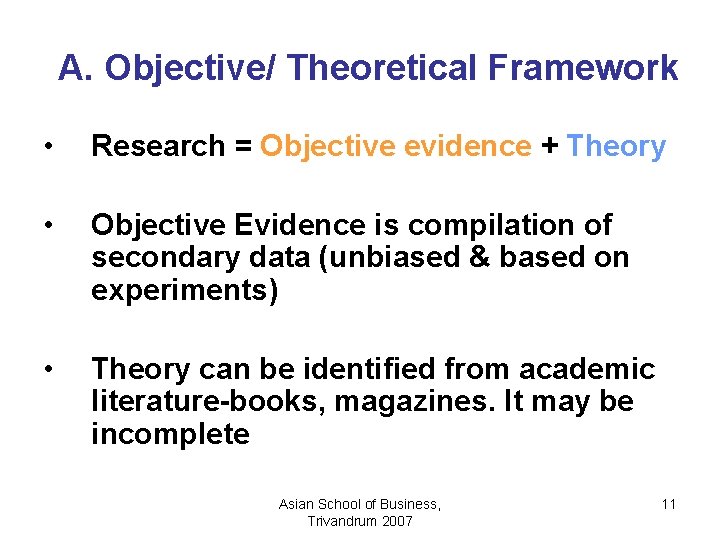
A. Objective/ Theoretical Framework • Research = Objective evidence + Theory • Objective Evidence is compilation of secondary data (unbiased & based on experiments) • Theory can be identified from academic literature-books, magazines. It may be incomplete Asian School of Business, Trivandrum 2007 11
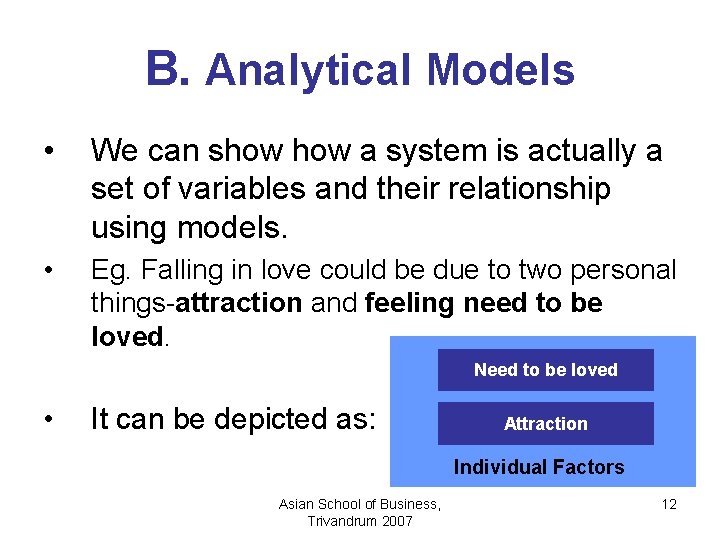
B. Analytical Models • We can show a system is actually a set of variables and their relationship using models. • Eg. Falling in love could be due to two personal things-attraction and feeling need to be loved. Need to be loved • It can be depicted as: Attraction Individual Factors Asian School of Business, Trivandrum 2007 12
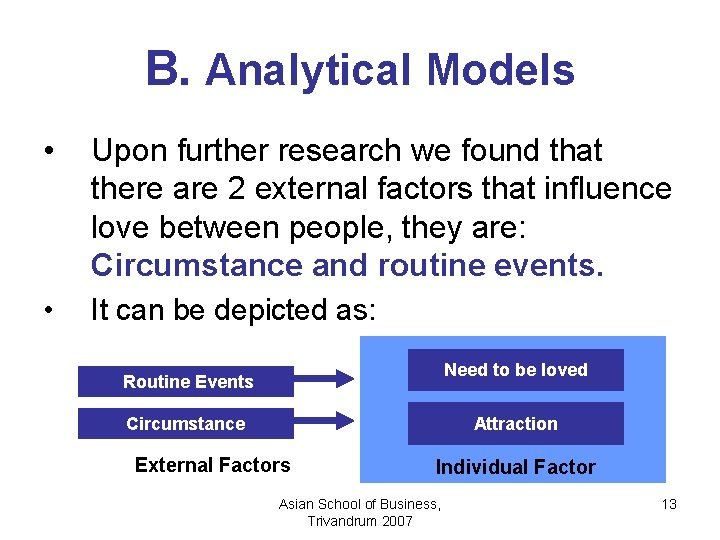
B. Analytical Models • Upon further research we found that there are 2 external factors that influence love between people, they are: Circumstance and routine events. • It can be depicted as: Need to be loved Routine Events Attraction Circumstance External Factors Individual Factor Asian School of Business, Trivandrum 2007 13
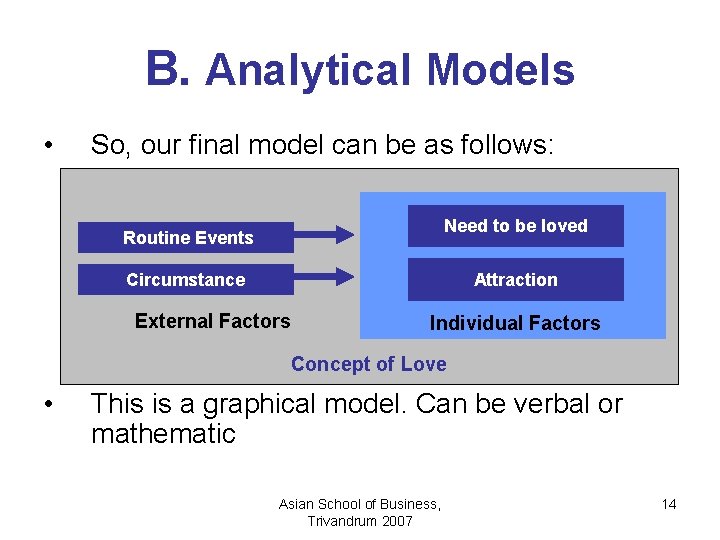
B. Analytical Models • So, our final model can be as follows: Need to be loved Routine Events Attraction Circumstance External Factors Individual Factors Concept of Love • This is a graphical model. Can be verbal or mathematic Asian School of Business, Trivandrum 2007 14

C. Research Questions • Problems must be broken down into specific research questions • Questions can be made using theoretical framework plus models • It can be further refined to hypothesis Asian School of Business, Trivandrum 2007 15
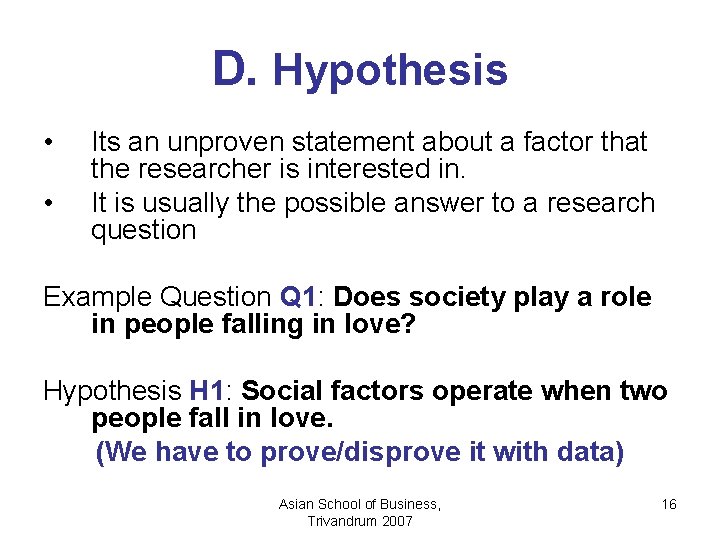
D. Hypothesis • • Its an unproven statement about a factor that the researcher is interested in. It is usually the possible answer to a research question Example Question Q 1: Does society play a role in people falling in love? Hypothesis H 1: Social factors operate when two people fall in love. (We have to prove/disprove it with data) Asian School of Business, Trivandrum 2007 16
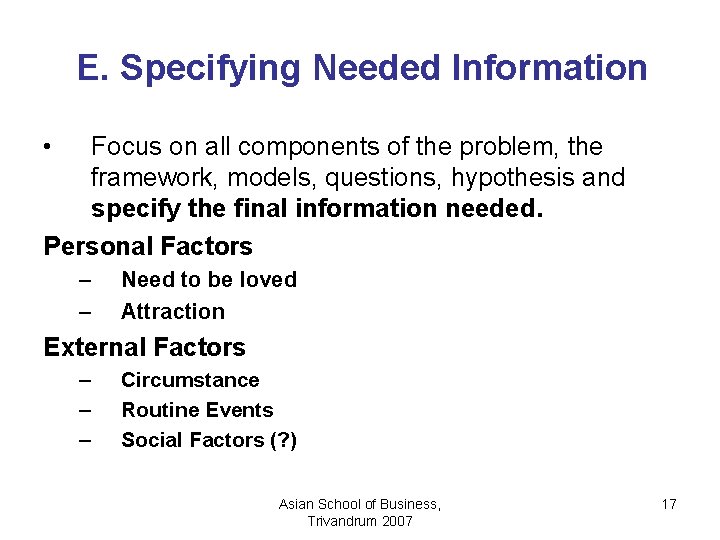
E. Specifying Needed Information • Focus on all components of the problem, the framework, models, questions, hypothesis and specify the final information needed. Personal Factors – – Need to be loved Attraction External Factors – – – Circumstance Routine Events Social Factors (? ) Asian School of Business, Trivandrum 2007 17
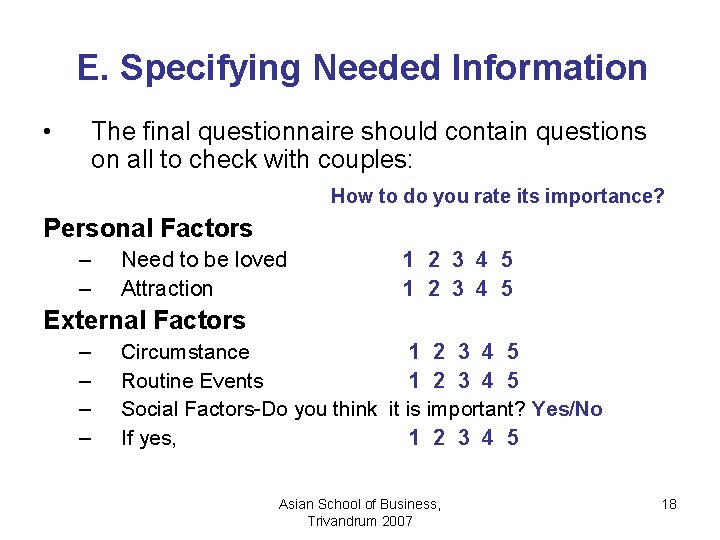
E. Specifying Needed Information • The final questionnaire should contain questions on all to check with couples: How to do you rate its importance? Personal Factors – – Need to be loved Attraction 1 2 3 4 5 External Factors – – Circumstance 1 2 3 4 5 Routine Events 1 2 3 4 5 Social Factors-Do you think it is important? Yes/No If yes, 1 2 3 4 5 Asian School of Business, Trivandrum 2007 18
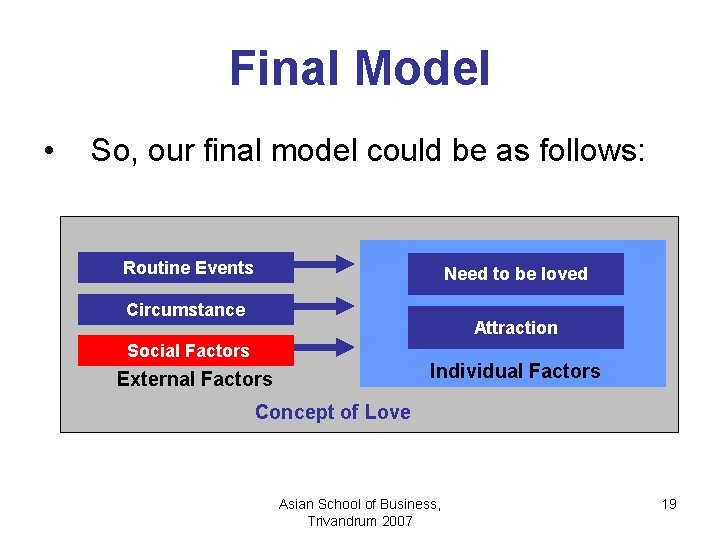
Final Model • So, our final model could be as follows: Routine Events Need to be loved Circumstance Attraction Social Factors Individual Factors External Factors Concept of Love Asian School of Business, Trivandrum 2007 19
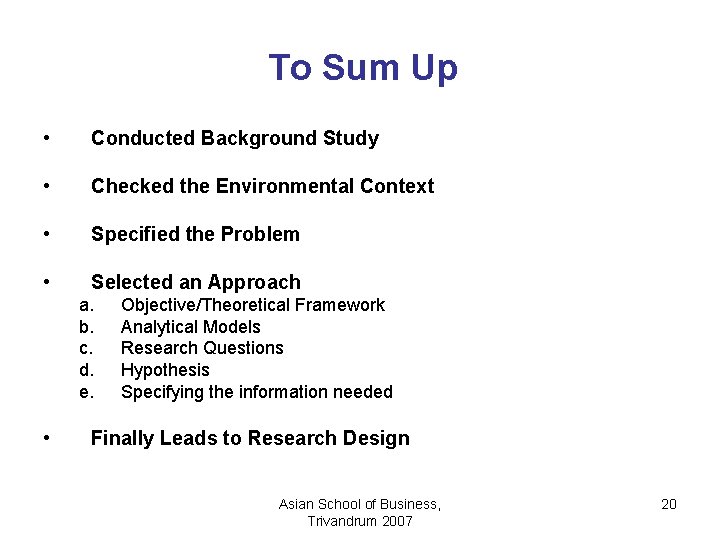
To Sum Up • Conducted Background Study • Checked the Environmental Context • Specified the Problem • Selected an Approach a. b. c. d. e. • Objective/Theoretical Framework Analytical Models Research Questions Hypothesis Specifying the information needed Finally Leads to Research Design Asian School of Business, Trivandrum 2007 20
Business Research Design: The Nuts and Bolts!! Asian School of Business, Trivandrum 2007 21
Overview • • Definition Components of RD Types Error Asian School of Business, Trivandrum 2007 22
Definition • Research Design is a framework or blueprint for conducting the research • We’ve already specified the approach, RD specifies the details-the nuts and bolts!! Asian School of Business, Trivandrum 2007 23
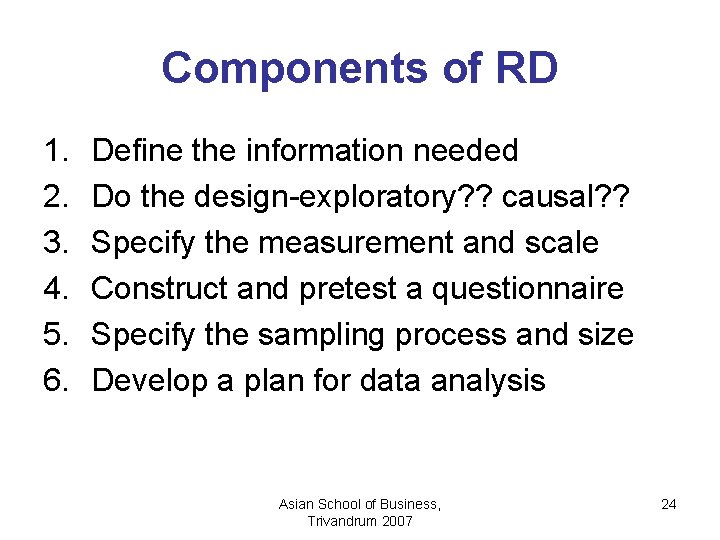
Components of RD 1. 2. 3. 4. 5. 6. Define the information needed Do the design-exploratory? ? causal? ? Specify the measurement and scale Construct and pretest a questionnaire Specify the sampling process and size Develop a plan for data analysis Asian School of Business, Trivandrum 2007 24
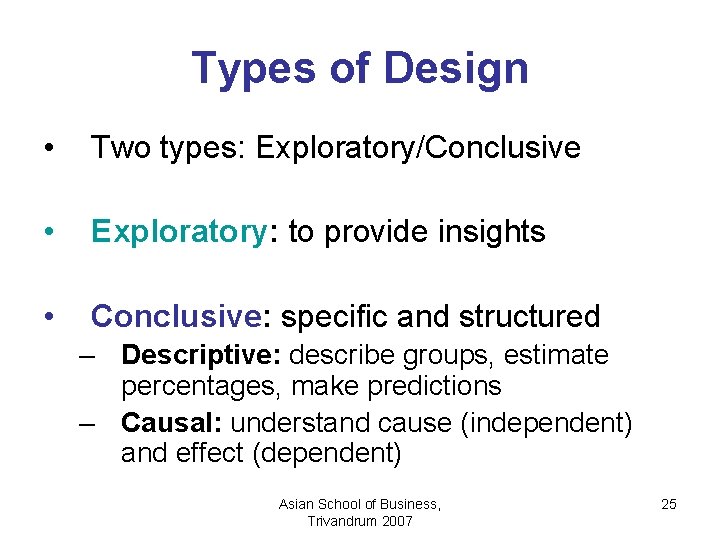
Types of Design • Two types: Exploratory/Conclusive • Exploratory: to provide insights • Conclusive: specific and structured – Descriptive: describe groups, estimate percentages, make predictions – Causal: understand cause (independent) and effect (dependent) Asian School of Business, Trivandrum 2007 25
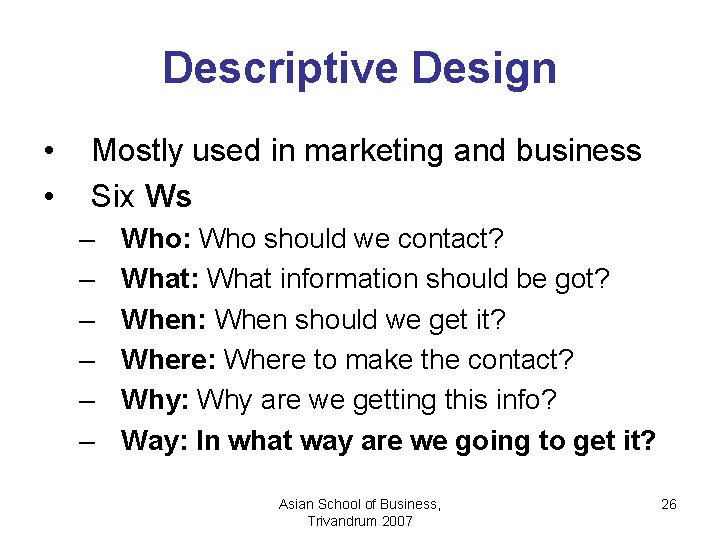
Descriptive Design • • Mostly used in marketing and business Six Ws – – – Who: Who should we contact? What: What information should be got? When: When should we get it? Where: Where to make the contact? Why: Why are we getting this info? Way: In what way are we going to get it? Asian School of Business, Trivandrum 2007 26
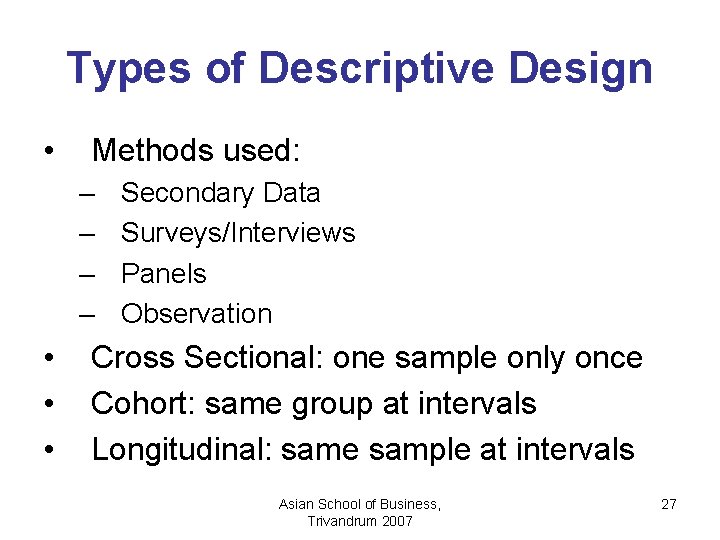
Types of Descriptive Design • Methods used: – – • • • Secondary Data Surveys/Interviews Panels Observation Cross Sectional: one sample only once Cohort: same group at intervals Longitudinal: same sample at intervals Asian School of Business, Trivandrum 2007 27
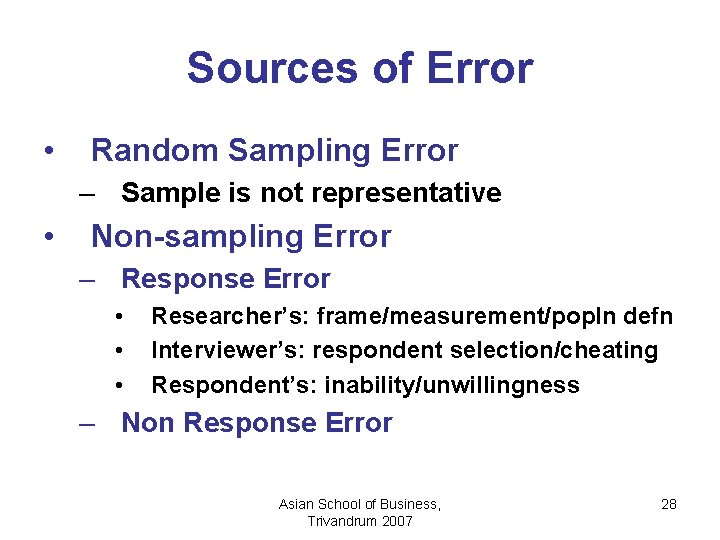
Sources of Error • Random Sampling Error – Sample is not representative • Non-sampling Error – Response Error • • • Researcher’s: frame/measurement/popln defn Interviewer’s: respondent selection/cheating Respondent’s: inability/unwillingness – Non Response Error Asian School of Business, Trivandrum 2007 28
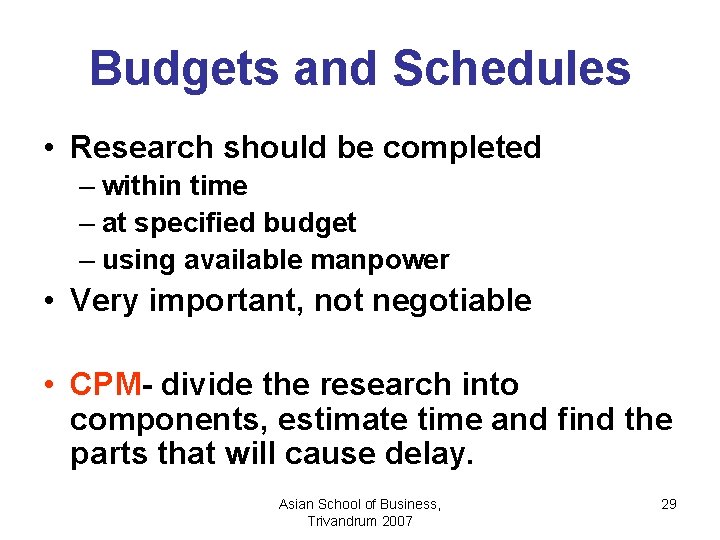
Budgets and Schedules • Research should be completed – within time – at specified budget – using available manpower • Very important, not negotiable • CPM- divide the research into components, estimate time and find the parts that will cause delay. Asian School of Business, Trivandrum 2007 29
Ethical Aspects • Respect all the rights of those who respond – hidden video/audio tape • Do not bluff- e. g longitudinal takes time, you cant do it in one day • Respondents have right to safety, right to privacy, right to chose Asian School of Business, Trivandrum 2007 30
Marketing Research Proposal • Format – – – – – Executive Summary: overview Background: including envt. Problem Definition/objectives Approach: theory/model/hypothesis Design Field Work/Data Collection Data Analysis Report and presentation Cost and Time Appendices Asian School of Business, Trivandrum 2007 31
Business Research Using mind maps Asian School of Business, Trivandrum 2007 32
Mind Maps • What is a mind map • How to map your mind • Uses of mind maps Asian School of Business, Trivandrum 2007 33
What is a mind map? • A diagram used to represent words, ideas, tasks or other items linked to and arranged radially around a central key word or idea. • The elements are arranged intuitively according to the importance of the concepts and they are organized into groupings, branches, or areas. Asian School of Business, Trivandrum 2007 34
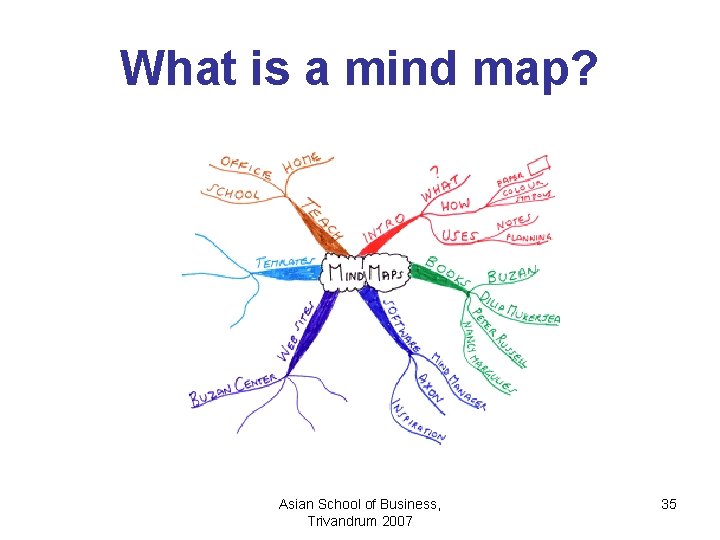
What is a mind map? Asian School of Business, Trivandrum 2007 35
Why mind map? • Human brain is very different from a computer • A computer works in a linear fashion • The brain works associatively as well as linearly - comparing, integrating and synthesizing Asian School of Business, Trivandrum 2007 36
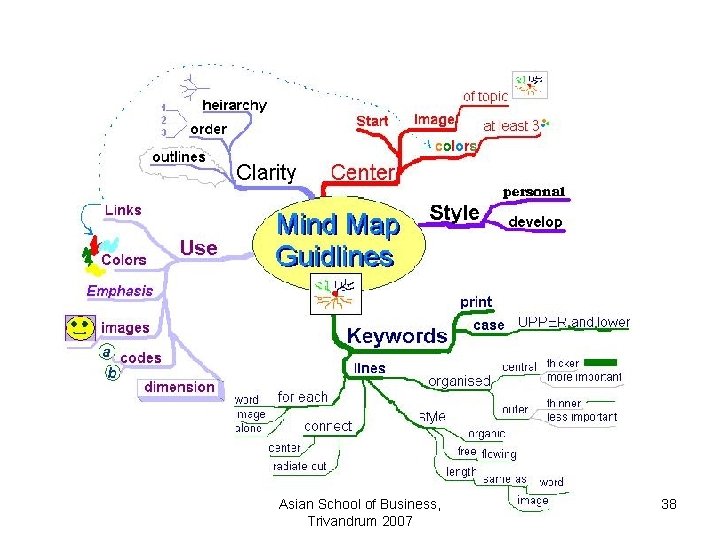
How to mind map? • • Start in the center with an image of the topic, using at least 3 colors. Use images, symbols, codes, and dimensions Select key words and write using upper or lower case letters. Each word/image must be alone and sitting on its own line. Asian School of Business, Trivandrum 2007 37
Asian School of Business, Trivandrum 2007 38
How to mind map? • • • The lines must be connected, starting from the central image. The central lines are thicker, organic and flowing, becoming thinner as they radiate out from the centre. Use colors – your own code and develop your own personal style of Mind Mapping. Asian School of Business, Trivandrum 2007 39
Six Thinking Hats • White Hat: facts, figures, information needs and gaps. – “Let's drop the arguments and proposals, and look at the data base. ” • Red Hat: intuition, feelings and emotions. – Allows the thinker to put forward an intuition without any need to justify it. "Putting on my red hat, I think this is a terrible proposal. " • Black Hat: judgment and caution-the negative hat. – Used to point out why a suggestion does not fit the facts or available experience. Always logical. Asian School of Business, Trivandrum 2007 40
Six Thinking Hats • • • Yellow Hat : logical positive. Why something will work and why it will offer benefits. – Used in looking forward to the results/value of some action Green Hat: creativity, alternatives, proposals, what is interesting, provocations and changes. Blue Hat : overview or process control hat. – It looks not at the subject itself but at the 'thinking' about the subject. Asian School of Business, Trivandrum 2007 41
Uses of mind maps • • Can be used in personal, family, educational, and business situations Note taking, brainstorming - ideas are inserted into the map radially around the center node, without prioritisation, grouping and organising is reserved for later stages Summarising, revising and general clarifying of thoughts Sorting out a complicated idea. Asian School of Business, Trivandrum 2007 42

End of Session Asian School of Business, Trivandrum 2007 43
- Slides: 43