
Business Research Methods Thirteenth Edition Pamela S Schindler
Business Research Methods Thirteenth Edition Pamela S. Schindler Chapter 3 STAGE 1: CLARIFY THE RESEARCH QUESTION explains the use of secondary data sources to develop and formulate research questions © 2019 Mc. Graw-Hill Education. All rights reserved. Authorized only for instructor use in the classroom. No reproduction or further distribution permitted without the prior written consent of Mc. Graw-Hill Education. 3 -1
Research Thought Leader “A beautiful question is an ambitious yet actionable question that can begin to shift the way we perceive or think about something—and that might serve as a catalyst to bring about change. ” Warren Berger, consultant and author, A More Beautiful Question © 2019 Mc. Graw-Hill Education. 3 -2
Learning Objectives Understand. . . The question hierarchy. The purposes and process of exploration. How internal and external exploration differ. The process and goal of research valuation. The process and justification needed to budget for research. Ethical issues at this stage of the process. © 2019 Mc. Graw-Hill Education. 3 -3
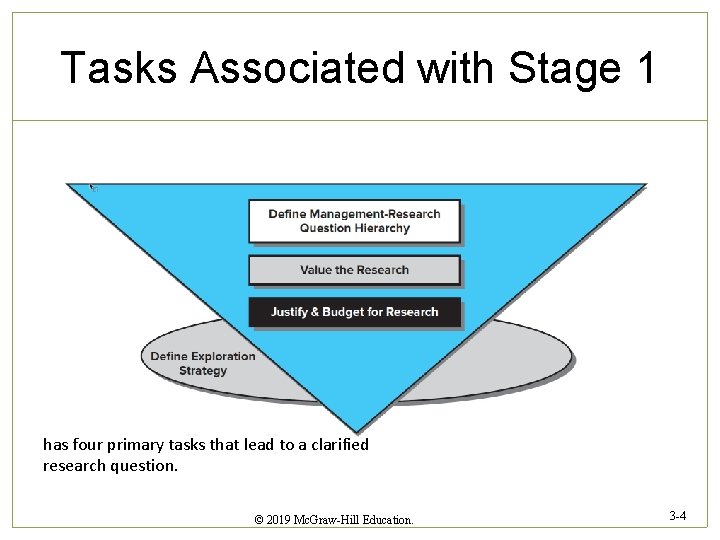
Tasks Associated with Stage 1 has four primary tasks that lead to a clarified research question. © 2019 Mc. Graw-Hill Education. 3 -4
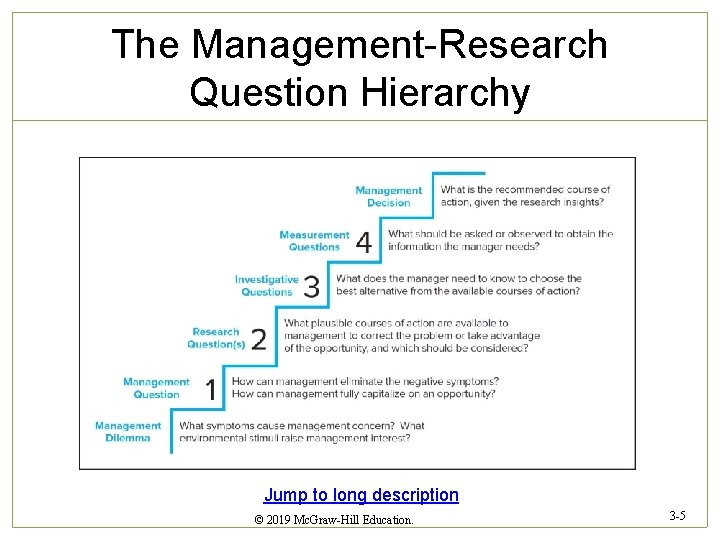
The Management-Research Question Hierarchy Jump to long description © 2019 Mc. Graw-Hill Education. 3 -5
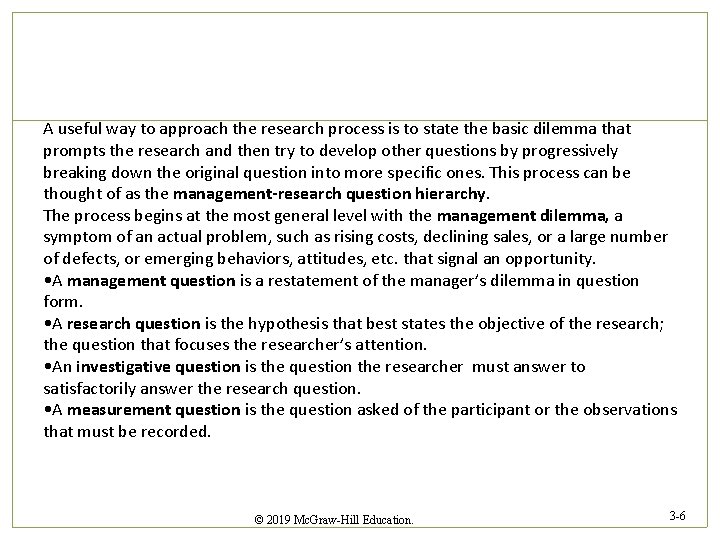
A useful way to approach the research process is to state the basic dilemma that prompts the research and then try to develop other questions by progressively breaking down the original question into more specific ones. This process can be thought of as the management-research question hierarchy. The process begins at the most general level with the management dilemma, a symptom of an actual problem, such as rising costs, declining sales, or a large number of defects, or emerging behaviors, attitudes, etc. that signal an opportunity. • A management question is a restatement of the manager’s dilemma in question form. • A research question is the hypothesis that best states the objective of the research; the question that focuses the researcher’s attention. • An investigative question is the question the researcher must answer to satisfactorily answer the research question. • A measurement question is the question asked of the participant or the observations that must be recorded. © 2019 Mc. Graw-Hill Education. 3 -6
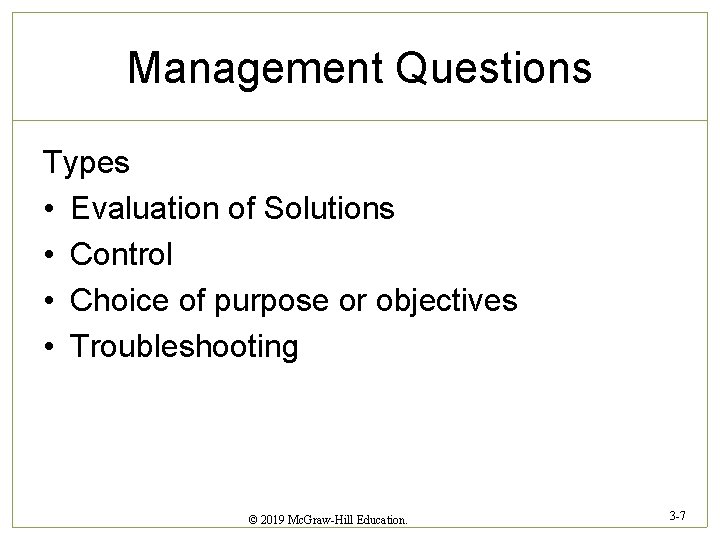
Management Questions Types • Evaluation of Solutions • Control • Choice of purpose or objectives • Troubleshooting © 2019 Mc. Graw-Hill Education. 3 -7
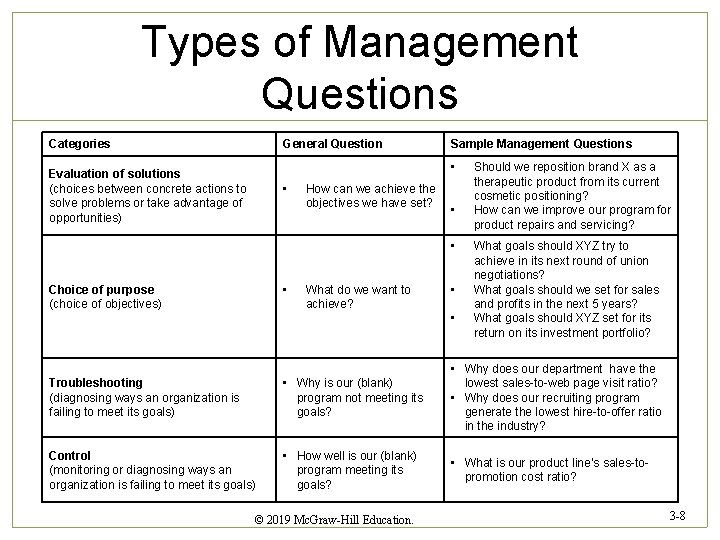
Types of Management Questions Categories General Question Sample Management Questions • Evaluation of solutions (choices between concrete actions to solve problems or take advantage of opportunities) • How can we achieve the objectives we have set? • • • Choice of purpose (choice of objectives) What do we want to achieve? • • Should we reposition brand X as a therapeutic product from its current cosmetic positioning? How can we improve our program for product repairs and servicing? What goals should XYZ try to achieve in its next round of union negotiations? What goals should we set for sales and profits in the next 5 years? What goals should XYZ set for its return on its investment portfolio? Troubleshooting (diagnosing ways an organization is failing to meet its goals) • Why is our (blank) program not meeting its goals? • Why does our department have the lowest sales-to-web page visit ratio? • Why does our recruiting program generate the lowest hire-to-offer ratio in the industry? Control (monitoring or diagnosing ways an organization is failing to meet its goals) • How well is our (blank) program meeting its goals? • What is our product line’s sales-topromotion cost ratio? © 2019 Mc. Graw-Hill Education. 3 -8
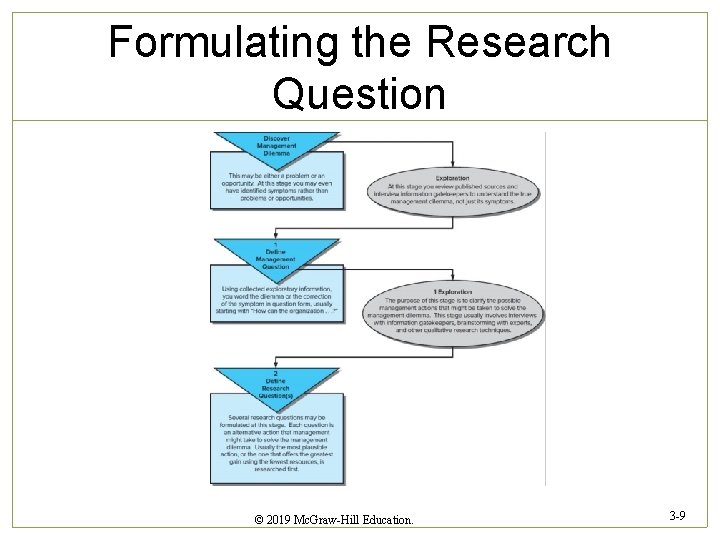
Formulating the Research Question © 2019 Mc. Graw-Hill Education. 3 -9
Tasks of Exploration (1 of 2) • Understand management dilemma, management problem and research question. • Discover how others have addressed or solved similar problems. • Establish priorities for addressing management dilemmas or management problems. • Identify action options and develop hypotheses. • Gather background information to refine research question. © 2019 Mc. Graw-Hill Education. 3 -10
Tasks of Exploration (2 of 2) • Identify information to formulate investigative questions. • Develop operational definitions for concepts, constructs, variables. • Provide evidence for justifying and budgeting research. • Set foundation for final research design. • Identify sources for sample frames & measurement questions. . © 2019 Mc. Graw-Hill Education. 3 -11
Desired Outcomes of Exploration (1 of 2) • Establish range and scope of possible management decisions. • Establish major dimensions of research task. • Define a set of subsidiary questions that can guide research design. © 2019 Mc. Graw-Hill Education. 3 -12
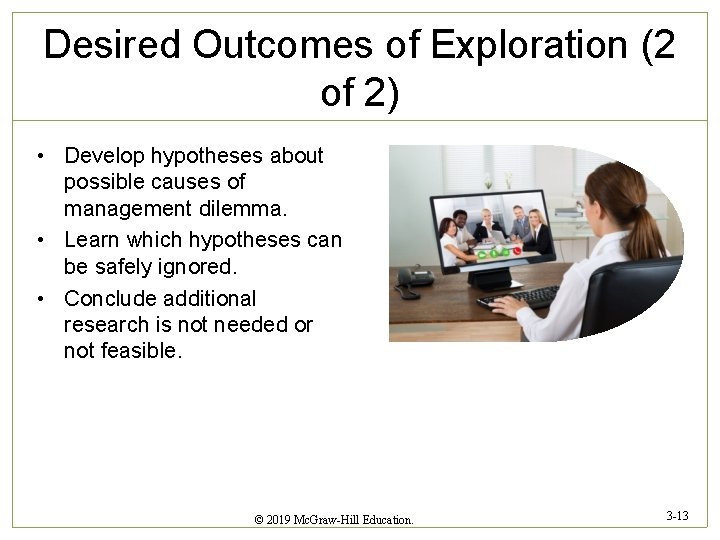
Desired Outcomes of Exploration (2 of 2) • Develop hypotheses about possible causes of management dilemma. • Learn which hypotheses can be safely ignored. • Conclude additional research is not needed or not feasible. © 2019 Mc. Graw-Hill Education. 3 -13
Exploration Strategy What information sources should be used? + What methods will be used to extract information from these sources? © 2019 Mc. Graw-Hill Education. 3 -14
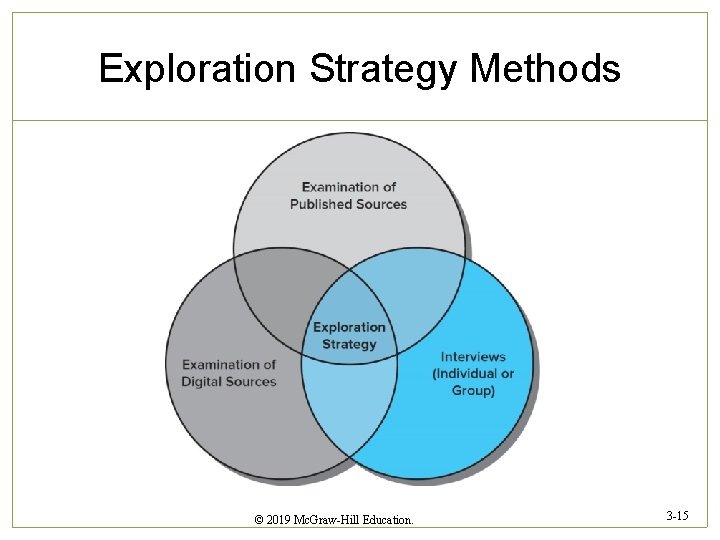
Exploration Strategy Methods © 2019 Mc. Graw-Hill Education. 3 -15
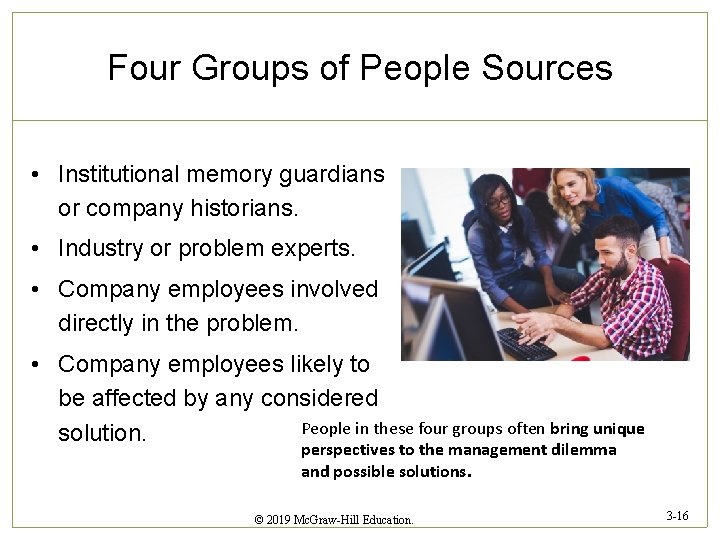
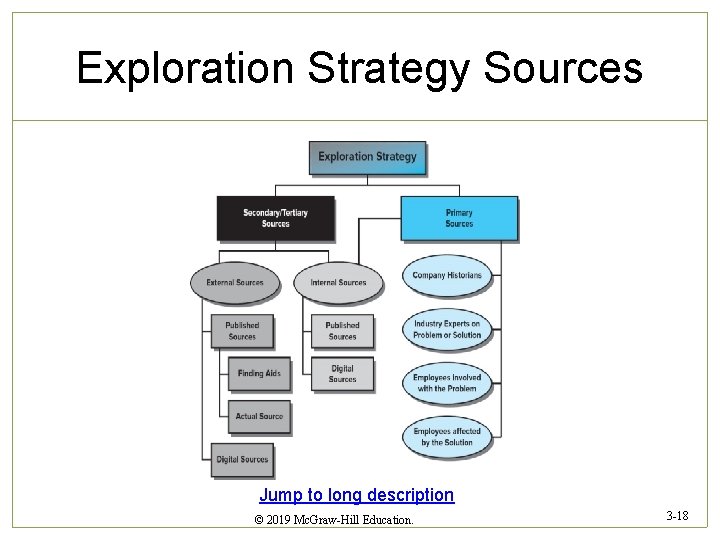
Four Groups of People Sources • Institutional memory guardians or company historians. • Industry or problem experts. • Company employees involved directly in the problem. • Company employees likely to be affected by any considered People in these four groups often bring unique solution. perspectives to the management dilemma and possible solutions. © 2019 Mc. Graw-Hill Education. 3 -16
Questions to Ask of People Sources What is being done? What has been tried in the past with or without success? How have things changed? Who is involved in the decisions? What problem areas can be seen? Whom can we count on to assist or participate in research on this issue/topic? © 2019 Mc. Graw-Hill Education. 3 -17
Exploration Strategy Sources Jump to long description © 2019 Mc. Graw-Hill Education. 3 -18
Levels of Published & Digital Sources Primary Sources: Memos Letters Interviews Speeches Laws Internal records Secondary Sources: Encyclopedias Textbooks Handbooks Magazines Newspapers Newscasts Tertiary Sources: Indexes Bibliographies Internet search engines Primary sources are original works of research or raw data without interpretation or pronouncements that represent an official opinion or position. Tertiary sources are aids to discover primary or secondary sources or an interpretation of a secondary source. © 2019 Mc. Graw-Hill Education. 3 -19
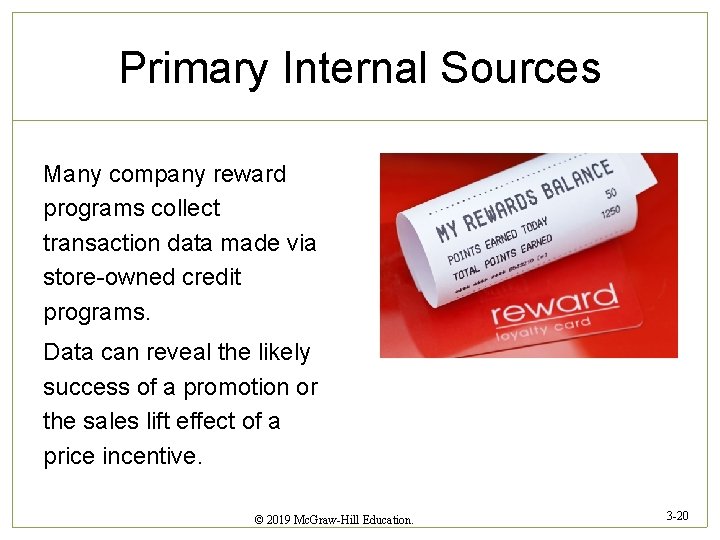
Primary Internal Sources Many company reward programs collect transaction data made via store-owned credit programs. Data can reveal the likely success of a promotion or the sales lift effect of a price incentive. © 2019 Mc. Graw-Hill Education. 3 -20
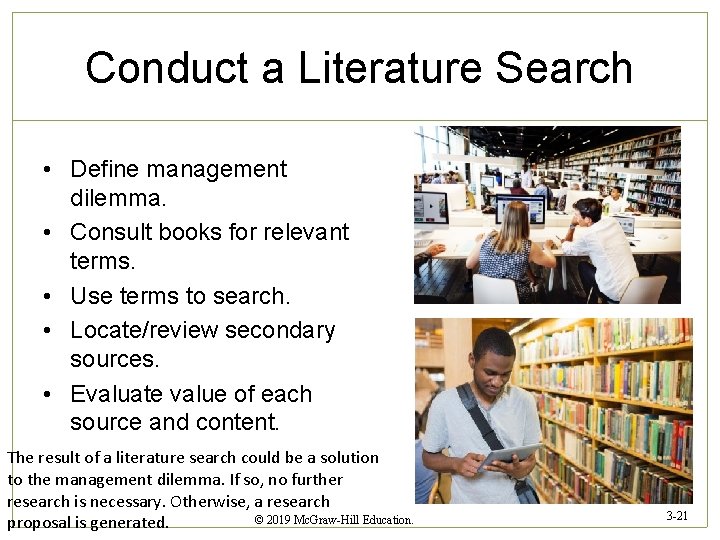
Conduct a Literature Search • Define management dilemma. • Consult books for relevant terms. • Use terms to search. • Locate/review secondary sources. • Evaluate value of each source and content. The result of a literature search could be a solution to the management dilemma. If so, no further research is necessary. Otherwise, a research © 2019 Mc. Graw-Hill Education. proposal is generated. 3 -21
Types of Secondary Sources TYPES • An index is a secondary data source that helps to identify and locate a single book, journal article, author, etc. from a larger set. • A bibliography is an information source that helps locate a single book, article, photograph, etc. • Dictionaries are secondary sources that define words, terms, and jargon. • Encyclopedias are secondary sources that provide background or historical information about a topic. • A handbook is a secondary source used to identify key terms, people, or events relevant to the management dilemma or management question. • Directories are reference sources used to identify contact information © 2019 Mc. Graw-Hill Education. 3 -22
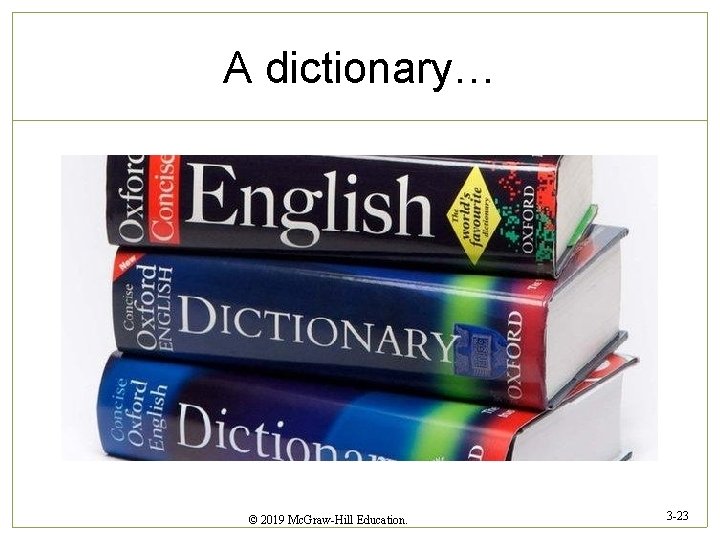
A dictionary… © 2019 Mc. Graw-Hill Education. 3 -23
Evaluate Published & Digital Sources Evaluation Factors • Purpose is the explicit or hidden agenda of the information source. • Scope is the breadth or depth of topic coverage, including time period, geographic limitations, and the criteria for information inclusion. • Authority is the level of the data (primary, secondary, tertiary) and the credentials of the source author. • Audience refers to the characteristics and background of the people or groups for whom the source was created. • Format refers to how the information is presented and the degree of ease in locating specific 3 -24 information within the source. © 2019 Mc. Graw-Hill Education.
Evaluating Internal Sources The quality and appropriateness of internal sources should not be assumed. Compatibility with the current management dilemma, problem, and research question (the more compatible the data, the more valuable the data). Timelessness (the more the data hasn’t been affected by time, the more valuable the data). Recentness (the more current the data, the more valuable the data. ) Quality of original research process (the more that standards of good research were applied in collecting the original data, the more valuable the data). Author(s) experience of the individual(s) compiling the source (the more experienced the individuals, the more valuable the 3 -25 data). © 2019 Mc. Graw-Hill Education.
Fine-Tuning the Research Question • In addition to fine-tuning the original question, other research question-related activities should be addressed in this phase to enhance the direction of the project. 1. Examine variables to be studied and assess whether they are operationally defined. 2. Review the research questions to break them down into second and third-level questions. 3. Evaluate hypotheses to be sure they meet the criteria for strong hypotheses. 4. Determine what evidence must be collected to answer the various questions and hypotheses. 5. Set the scope of the study by stating what is not a part of the research question. • . © 2019 Mc. Graw-Hill Education. 3 -26
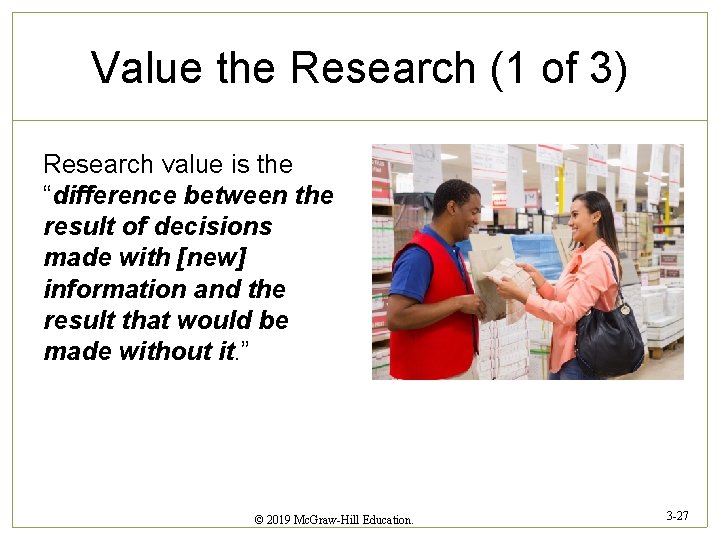
Value the Research (1 of 3) Research value is the “difference between the result of decisions made with [new] information and the result that would be made without it. ” © 2019 Mc. Graw-Hill Education. 3 -27
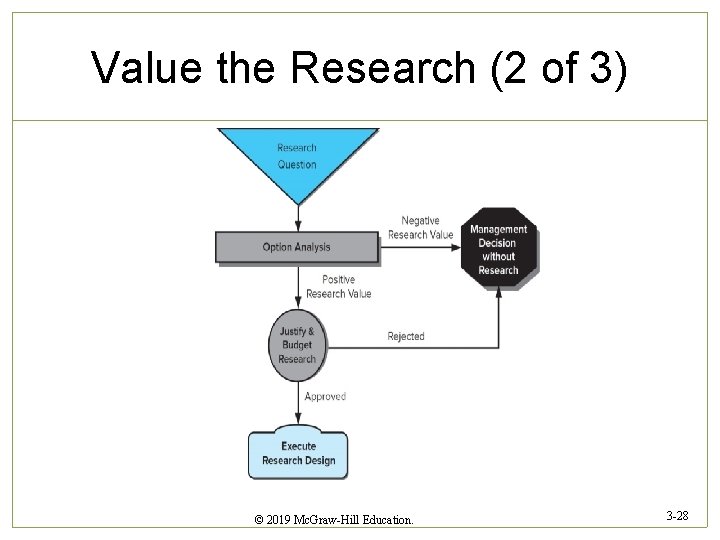
Value the Research (2 of 3) © 2019 Mc. Graw-Hill Education. 3 -28
Value the Research (3 of 3) • Option analysis: Managers conduct formal analysis of each alternative research project judged in terms of estimated costs and associated benefits and with managerial judgment playing a major role. • Decision theory: The focus is on trying to assess the outcomes of each action. The manager chooses the action that affords the best outcome – the action criteria that meets or exceeds whatever criteria are established. Each criterion is a combination of a decision rule and a decision variable. The decision rule is a criterion for judging the attractiveness of two or more alternatives when using a decision variable. The decision variable is a quantifiable characteristic, attribute, or outcome on which a choice decision will be made. The evaluation of alternatives requires that 1) 2) each alternative is explicitly stated, a decision variable is defined by an outcome that may be measured, and 3) a decision rule is determined by which outcomes may be compared. • Most research is valued after it is conducted (by determining how much money was saved or gained, how many employees were retained vs lost, etc. ). But over time, a savvy manager can estimate value of research based on prior experience. © 2019 Mc. Graw-Hill Education. 3 -29
Budget the Research • Task budget. Dollars are drawn from the discretionary reserves of an organization or the budget of an in-house research operation to fund a research project. A discretionary reserve might be based on a fixed percentage of projected or prior year’s sales. • Functional area budget. Dollars drawn from a portion of the manager’s business unit’s operational funds and allocated to research activities. The manager has the authority to spend budget dollars as he or she desires. This process is also competitive because, internally, the manager has numerous goals and priorities. Government agencies, not-for-profits, and businesses alike© frequently manage research 3 -30 2019 Mc. Graw-Hill Education. budgeting this way.
Key Terms Bibliography Data warehouse Decision rule Decision variable Dictionary Directory Encyclopedia Expert interview Exploration Strategy Handbook Index Investigative questions Literature search Management dilemma Management question Management-research question hierarchy Measurement questions Option Analysis Primary sources Research questions Secondary sources Source evaluation • Purpose • Scope • Authority • Audience • Format Tertiary sources © 2019 Mc. Graw-Hill Education. 3 -31
- Slides: 31