
BUSINESS RESEARCH METHODS LECTURE 3 A REVIEW OF
BUSINESS RESEARCH METHODS LECTURE 3 A REVIEW OF THE RELEVANT LITERATURE DRAWING ON THE PAST TO DEFINE THE FUTURE 1
MEANING OF THE LITERATURE REVIEW “The selection of available documents (both published and unpublished) on the topic, which contain information, ideas, data and evidence written from a particular standpoint to fulfill certain aims or express certain views on the nature of the topic and how it is to be investigated, and the effective evaluation of these documents in relation to the research being proposed” – Chris Hart (2010) 2
THOUGHTS ON WRITING THE LITERATURE REVIEW You are usually not the first one who considers the topic you selected, there are many other people who had done the research into what is engaging your present research attention Read their articles, specialised magazines, books, etc. to find out what has not been covered by them (that’s called Literature Review Remember that in the literature review you stand on the shoulders of others to see the world!
THE LITERATURE REVIEW PROCESS 1 The journal articles can be either theoretical or empirical Theoretical articles provide: �background knowledge �history �theories �concepts �definitions
THE LITERATURE REVIEW PROCESS 2 Empirical articles provide: � Reviews of previous studies � Research designs � Data instruments � Validity and reliability � Discussions of findings � Research implications You could discover empirical articles to be more helpful than theoretical articles for your research proposal

ARGUMENTATION IN LITERATURE REVIEW Argument suggests ‘putting forward reasons to influence someone’s belief that what you are proposing is the case’ Hart, 2010 p. 79 cf. Hinderer, 1992) Argument consists of ‘giving reasons for some conclusion: the reasons are put forward in order to establish, support, justify, prove or demonstrate the conclusion’ (Fisher 1993 p. 140) Arguments try to persuade others to see logic or the validity of how someone sees the world and convinces us to see it that way Argument has two elements: a point and a reason making a point (or the statement) � Providing sufficient reason (evidence) meant to convince others � 6
INFERENCE, ASSERTION AND SUPPOSITION DURING REVIEW Inference – An assertion made on the basis of something else observed or taken as knowledge; used in deductive and inductive arguments, e. g. someone slams a door can be inferred as an angry person Assertion – a declaration made on the existence or cause of something with or without the use of evidence, e. g. Theresa visits her grandmother during school vacation Supposition – An assumption made about what is or not a case or state of affairs, e. g. There is a popular view that GIMPA is publicly funded but their majority of their monies come from fees charged to students. 7
THE FOCUS OF THE REVIEW Choose a country (or a few countries for comparative studies) Choose an industry (or a few industries for comparative studies) Choose a company (or a few companies for comparative studies)
THE LITERATURE REVIEW There are two main reasons for conducting a literary review: The initial preliminary review which forms part of your research proposal helps you to generate your initial research ideas and objectives. It should justify the need for your research. Then second, normally defined as the critical review, is a part of your main research project. 9
THE PURPOSE OF THE CRITICAL REVIEW (1) To prove or reveal your library searching skills To demonstrate command authority of the subject area and appreciation of the problem To make a case for the research topic, design and methodology 10
THE PURPOSE OF THE CRITICAL REVIEW (2) To show evidence of your depth of reading undertaken and understanding of the issues influencing the research topic To prevent you from repeating work that has already been done To help you further refine your research questions and objectives – research is an iterative process 11
THE PURPOSE OF THE CRITICAL REVIEW (3) To establish the current relevant theory around your research topic – this will enable you make sense of the information you uncover To highlight research possibilities that have been overlooked in research to date –identifying anomalies and gaps in knowledge, and discovering recommendations for further research To provide an insight in the research strategies used to date that are appropriate to your research questions and objectives 12
CONCEPTS, FRAMEWORKS AND THEORY These are key to your critical review. The relationships between these can however be difficult to understand. In simple terms…… 13
MEANING OF A CONCEPT Concepts are ideas we use to impose meaning on our world We need to define our concepts Often expressed by joining words together social justice � global warming � single parent � emancipatory research � Information security � Data Protection/Privacy � Combined together to develop a conceptual framework 14
WHAT IS A CONCEPTUAL FRAMEWORK? A framework of concepts for helping to represent, make sense of or discuss a particular phenomenon – it is utilitarian May be represented as diagrams or analogies, for example, giving a ‘snapshot’ of the main components of a system – internal combustion engine showing the relationships of the departments within a business - organogram displaying the sequence of events and activities in a process flowchart showing the important influences within a competitive environment – Porter’s 5 forces Maslow’s hierarchy of needs Kolb’s learning cycle The Leavitt Diamond 15
THE NATURE OF A THEORY �Simply it expresses the cause and effect relationships between two or more variables Its key role is to Make predictions Provides a useful jumping off point for discovering new information, making new discoveries and generating new theory A set of assumptions, propositions, or accepted facts that attempt to provide a plausible or rational explanation of cause-and-effect, e. g. theory of evolution Media richness theory 16
THE ITERATIVE ROLE OF A THEORY Research does not happen in discrete stages, neither does it follow a linear path. It is a social process in which there is overlap in all areas of the investigation. Theory is integrated with method, data analysis, and interpretation There is an active relationship between theory and the research, in which research initiates, clarifies, and reformulates theory. 17
THE PROCESSES WITHIN THE CRITICAL REVIEW 1. Establishing the literary sources available 2. Critically evaluating that literature 3. Establishing where further research is needed 4. Recording the literature 18
THE STRUCTURE OF THE CRITICAL REVIEW (1) Traditionally it contains three elements: A critique of existing works on the topic Critically analyse the different research work through which the topic has been studied and the issues different authors have highlighted as a result of their work. Identify the different ways that key definitions, concepts, and models have been used to develop theory. 19
THE STRUCTURE OF THE CRITICAL REVIEW (2) Conclusions about work done to date on the topic Draw general conclusions about the overall direction of work on the topic. Draw specific conclusions by identifying gaps, fallacies and failures in previous work in order to show the legitimacy of your own approach. 20
THE STRUCTURE OF THE CRITICAL REVIEW (3) Justification of your proposed research Your literature review should end with a justification for your research and provides the link to the Research Plan 21
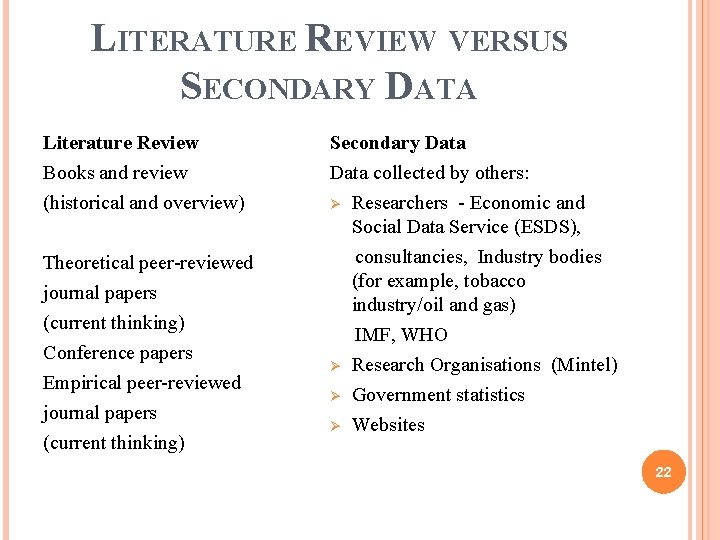
LITERATURE REVIEW VERSUS SECONDARY DATA Literature Review Books and review (historical and overview) Theoretical peer-reviewed journal papers (current thinking) Conference papers Empirical peer-reviewed journal papers (current thinking) Secondary Data collected by others: Ø Researchers - Economic and Social Data Service (ESDS), Ø Ø Ø consultancies, Industry bodies (for example, tobacco industry/oil and gas) IMF, WHO Research Organisations (Mintel) Government statistics Websites 22
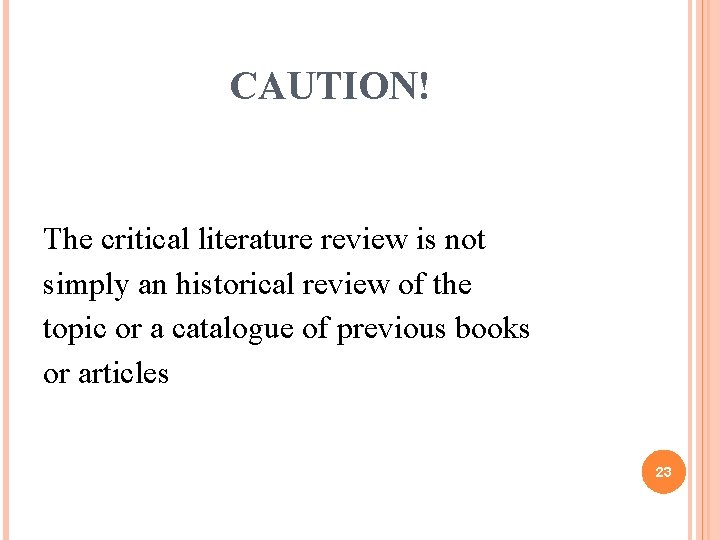
CAUTION! The critical literature review is not simply an historical review of the topic or a catalogue of previous books or articles 23
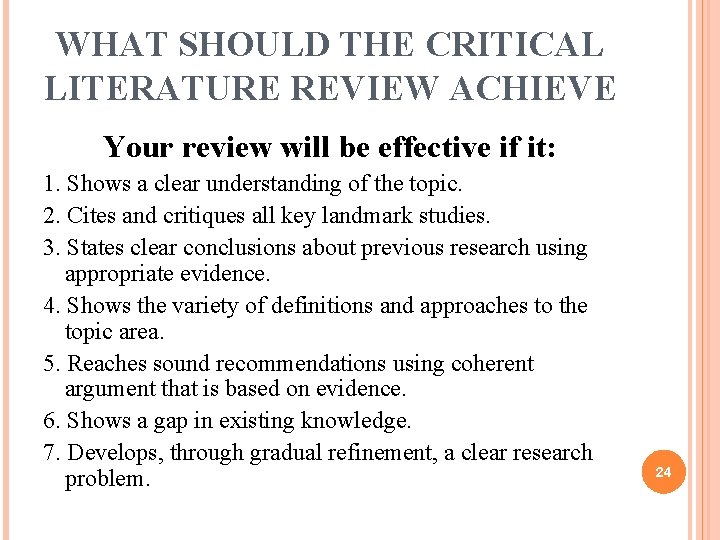
WHAT SHOULD THE CRITICAL LITERATURE REVIEW ACHIEVE Your review will be effective if it: 1. Shows a clear understanding of the topic. 2. Cites and critiques all key landmark studies. 3. States clear conclusions about previous research using appropriate evidence. 4. Shows the variety of definitions and approaches to the topic area. 5. Reaches sound recommendations using coherent argument that is based on evidence. 6. Shows a gap in existing knowledge. 7. Develops, through gradual refinement, a clear research problem. 24
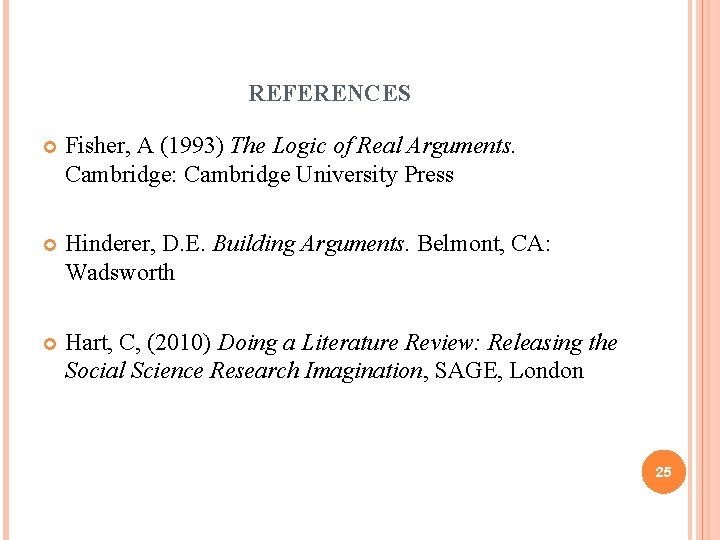
REFERENCES Fisher, A (1993) The Logic of Real Arguments. Cambridge: Cambridge University Press Hinderer, D. E. Building Arguments. Belmont, CA: Wadsworth Hart, C, (2010) Doing a Literature Review: Releasing the Social Science Research Imagination, SAGE, London 25
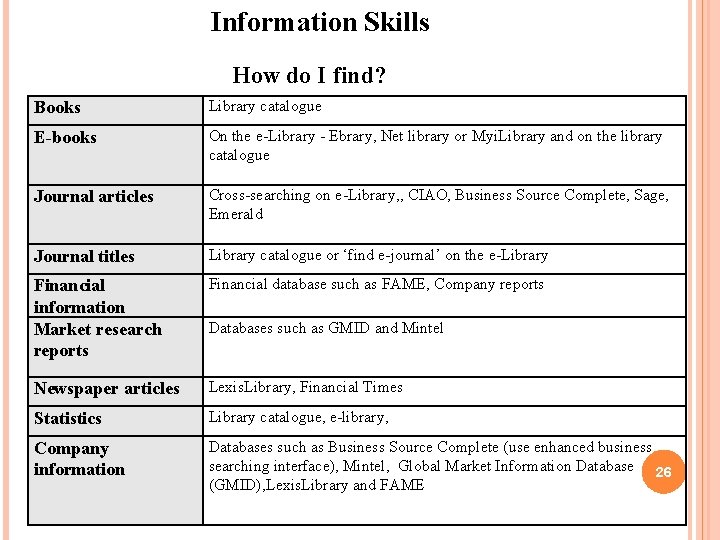
Information Skills How do I find? Books Library catalogue E-books On the e-Library - Ebrary, Net library or Myi. Library and on the library catalogue Journal articles Cross-searching on e-Library, , CIAO, Business Source Complete, Sage, Emerald Journal titles Library catalogue or ‘find e-journal’ on the e-Library Financial information Market research reports Financial database such as FAME, Company reports Newspaper articles Lexis. Library, Financial Times Statistics Library catalogue, e-library, Company information Databases such as Business Source Complete (use enhanced business searching interface), Mintel, Global Market Information Database 26 (GMID), Lexis. Library and FAME Databases such as GMID and Mintel
- Slides: 26