
BUSINESS RESEARCH METHODS ISD 353 Kofi Agyenim BOATENG
BUSINESS RESEARCH METHODS (ISD 353) Kofi Agyenim BOATENG, Ph. D Email: kaboateng. ksb@knust. edu. gh Office: TF 18 Office Hours: Tuesdays 4. 00 pm – 5. 30 pm (normally)
BUSINESS RESEARCH METHODS (ISD 353) LECTURE 1 INTRODUCTION
KEY COURSE MATERIAL Boateng, R (2018) Research Made Easy, Workbook Edition, Create. Space Independent Publishing Platform, Charleston, USA Bell, J (2014) Doing Your Research Project: A Guide for First-Time Researchers, 6 th Edn, Open University Press, Berkshire
RATIONALE FOR UNDERTAKING BUSINESS RESEARCH Research: The search for the truth Experience – by appealing the senses, e. g. sight, touch, feel, etc. Reasoning Faith – for example, critical analysis – by deferring to a higher authority (object)
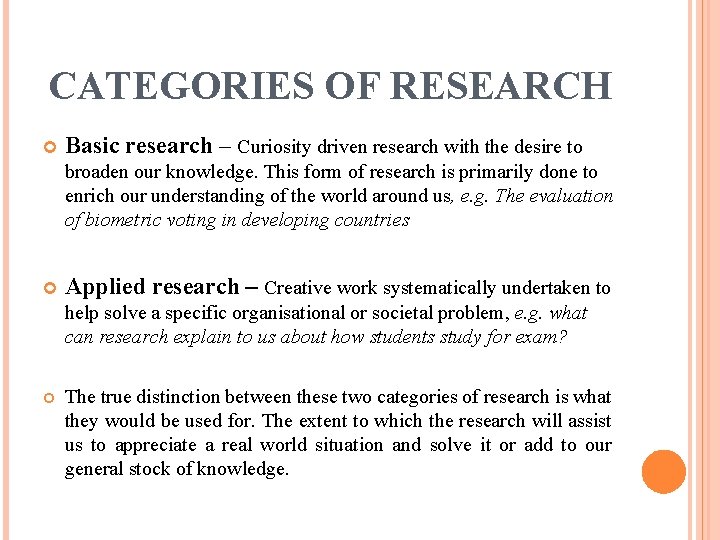
CATEGORIES OF RESEARCH Basic research – Curiosity driven research with the desire to broaden our knowledge. This form of research is primarily done to enrich our understanding of the world around us, e. g. The evaluation of biometric voting in developing countries Applied research – Creative work systematically undertaken to help solve a specific organisational or societal problem, e. g. what can research explain to us about how students study for exam? The true distinction between these two categories of research is what they would be used for. The extent to which the research will assist us to appreciate a real world situation and solve it or add to our general stock of knowledge.
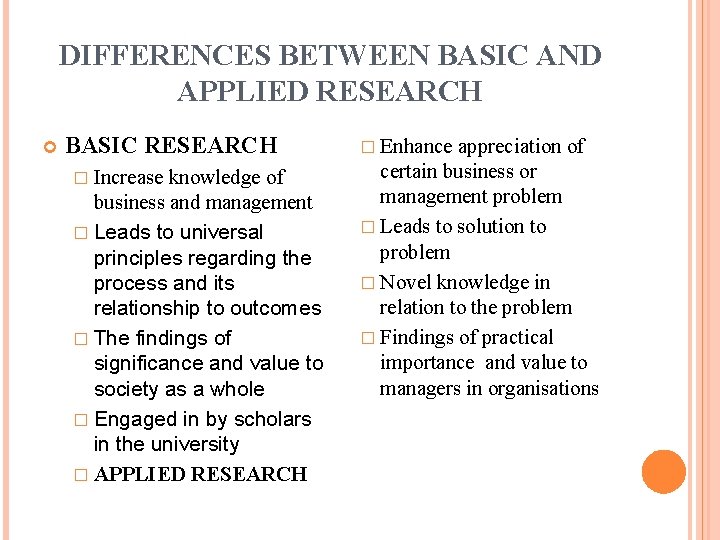
DIFFERENCES BETWEEN BASIC AND APPLIED RESEARCH BASIC RESEARCH � Increase knowledge of business and management � Leads to universal principles regarding the process and its relationship to outcomes � The findings of significance and value to society as a whole � Engaged in by scholars in the university � APPLIED RESEARCH � Enhance appreciation of certain business or management problem � Leads to solution to problem � Novel knowledge in relation to the problem � Findings of practical importance and value to managers in organisations
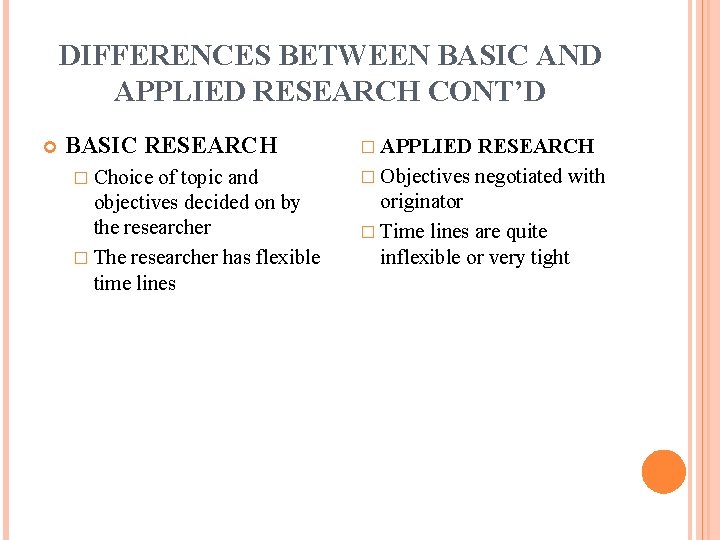
DIFFERENCES BETWEEN BASIC AND APPLIED RESEARCH CONT’D BASIC RESEARCH � Choice of topic and objectives decided on by the researcher � The researcher has flexible time lines � APPLIED RESEARCH � Objectives negotiated with originator � Time lines are quite inflexible or very tight
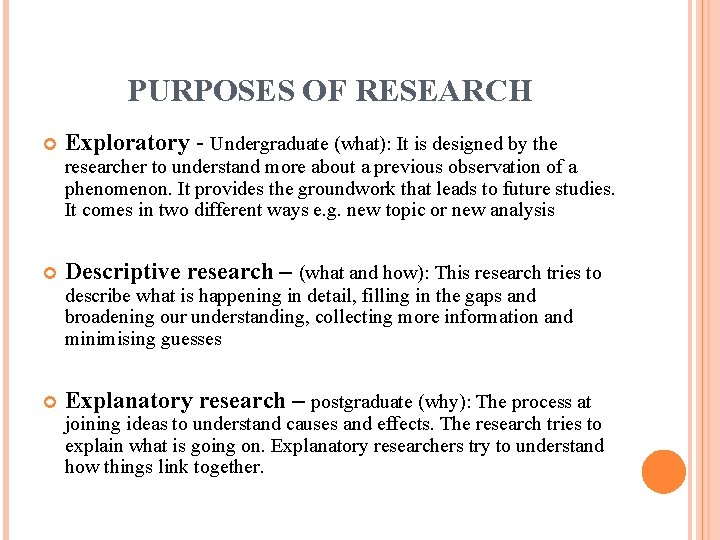
PURPOSES OF RESEARCH Exploratory - Undergraduate (what): It is designed by the researcher to understand more about a previous observation of a phenomenon. It provides the groundwork that leads to future studies. It comes in two different ways e. g. new topic or new analysis Descriptive research – (what and how): This research tries to describe what is happening in detail, filling in the gaps and broadening our understanding, collecting more information and minimising guesses Explanatory research – postgraduate (why): The process at joining ideas to understand causes and effects. The research tries to explain what is going on. Explanatory researchers try to understand how things link together.
WHY RESEARCH? Academic Research is undertaken for any of the following reasons. To: �Discover… �Explore… �Describe… �Explain… �Analyse �Understand… �Create… �Predict…
IMPORTANT PROCESSES IN WRITING A RESEARCH PROPOSAL Title • Aim or Objectives • Background/Introduction • Initial review of the relevant literature • Research Plan • Ethics • Planning • References • * Word count: between 1500 – 2000 words
APPROACH TO CHOOSING A DISSERTATION TOPIC You have one of your own Use the list of previous topics for inspiration Discussions with members of staff Use an area of interest from the course Read texts on working up a topic Discuss with fellow students (Trust is important!) Adopt a strategy
CLUES FOR THE CHOICE OF A TOPIC When choosing your dissertation topic, the following must be considered: � Do you have a strong interest in the topic? � Does it relate to your bachelors degree of study? � Have you got some background knowledge or experience? � Will you be able to get access to the information required? � Has the topic been studied by past researchers or not at all? � Is there a supervisor available for this topic at KSB?
STRATEGIES TO ADOPT The passion for the topic or a burning desire Fulfilling a career goals Replication: similar work to confirm the same findings Development of earlier work Practical problem Convenient access Lecturer driven
FINDING AN APPROPRIATE AND FEASIBLE RESEARCH TOPIC What is your specialism? � Marketing/Strategic � Financial Management/Entrepreneurship or Accounting � HRM � Information Systems/Logistics & Supply Chain
SCIS DEPARTMENT: MAIN AREAS OF POTENTIAL RESEARCH INTEREST Electronic banking Fin. Tech Business process reengineering E-commerce Internet advertising Mobile banking Database management systems Decision support systems Social networking platforms E-learning Computerisation or automation Supply Chain Management Systems
RESEARCH PROPOSAL CHECKLIST Objectives can be clearly stated Fascinates you (and your tutor) Has a clear contribution to make to the existing literature There are current literature resources Ability to get access to data required
- Slides: 16