
Business Processes Sales Order Management Aggregate Planning Master
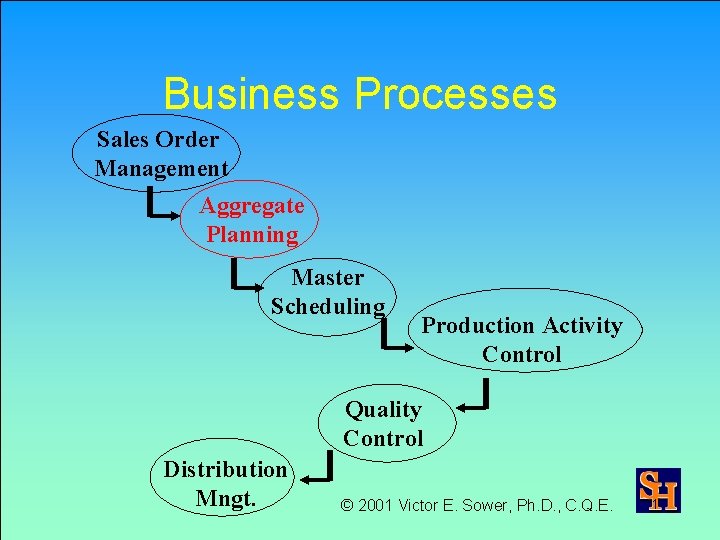
Business Processes Sales Order Management Aggregate Planning Master Scheduling Production Activity Control Quality Control Distribution Mngt. © 2001 Victor E. Sower, Ph. D. , C. Q. E. 1
Chapter 11 Capacity Planning And Aggregate Production Planning © 2000 by Prentice-Hall Inc 2000 by Prentice-Hall, Russell/Taylor Oper Mgt 3/e Inc

Capacity Planning • Establishes overall level of productive resources • Affects lead time responsiveness, cost & competitiveness • Determines when and how much to increase capacity © 2000 by Prentice-Hall Inc Russell/Taylor Oper Mgt 3/e 3 Ch 11 - 2
Capacity Expansion • Volume & certainty of anticipated demand • Strategic objectives for growth • Costs of expansion & operation • Incremental or one-step expansion © 2000 by Prentice-Hall Inc Russell/Taylor Oper Mgt 3/e 4 Ch 11 - 3

Capacity Expansion Strategies Capacity lead strategy Units Capacity lag strategy Demand Capacity Demand Time Average capacity strategy Units Incremental vs. one-step expansion Units Capacity One-step expansion Demand Time © 2000 by Prentice-Hall Inc Russell/Taylor Oper Mgt 3/e Incremental expansion Demand Time 5 Ch 11 - 4
Aggregate Production Planning (APP) • Matches market demand to company resources • Plans production 6 months to 12 months in advance • Expresses demand, resources, and capacity in general terms • Develops a strategy for economically meeting demand • Establishes a company-wide game plan for allocating resources © 2000 by Prentice-Hall Inc Russell/Taylor Oper Mgt 3/e 6 Ch 11 - 6
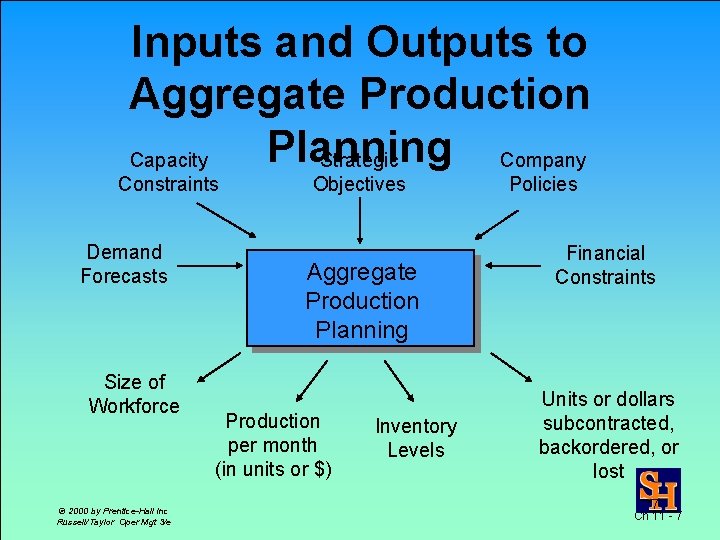
Inputs and Outputs to Aggregate Production Planning Capacity Strategic Company Constraints Demand Forecasts Size of Workforce © 2000 by Prentice-Hall Inc Russell/Taylor Oper Mgt 3/e Objectives Aggregate Production Planning Production per month (in units or $) Inventory Levels Policies Financial Constraints Units or dollars subcontracted, backordered, or lost 7 Ch 11 - 7
1. Strategies for Meeting Demand Use inventory to absorb fluctuations in demand (level production) 2. Hire and fire workers to match demand (chase demand) 3. Maintain resources for high demand levels 4. Increase or decrease working hours (over & undertime) 5. Subcontract work to other firms 6. Use part-time workers 7. Provide the service or product at a later time period (backordering) © 2000 by Prentice-Hall Inc Russell/Taylor Oper Mgt 3/e 8 Ch 11 - 8
Strategy Details • Level production - produce at constant rate & use inventory as needed to meet demand • Chase demand - change workforce levels so that production matches demand • Maintaining resources for high demand levels - ensures high levels of customer service • Overtime & undertime - common when demand fluctuations are not extreme © 2000 by Prentice-Hall Inc Russell/Taylor Oper Mgt 3/e 9 Ch 11 - 9
Strategy Details • Subcontracting - useful if supplier meets quality & time requirements • Part-time workers - feasible for unskilled jobs or if labor pool exists • Backordering - only works if customer is willing to wait for product/services © 2000 by Prentice-Hall Inc Russell/Taylor Oper Mgt 3/e 10 Ch 11 - 10
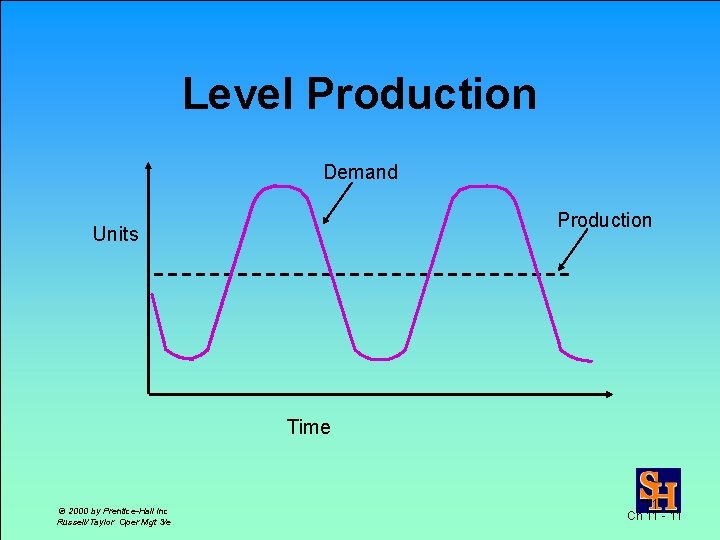
Level Production Demand Production Units Time © 2000 by Prentice-Hall Inc Russell/Taylor Oper Mgt 3/e 11 Ch 11 - 11
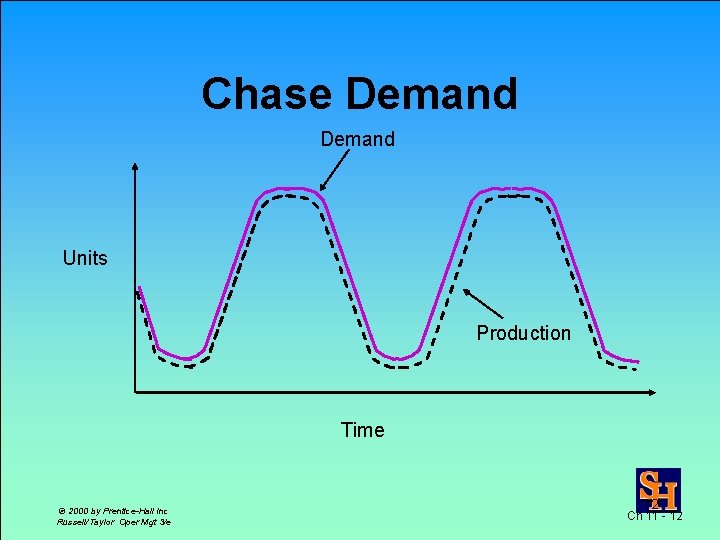
Chase Demand Units Production Time © 2000 by Prentice-Hall Inc Russell/Taylor Oper Mgt 3/e 12 Ch 11 - 12
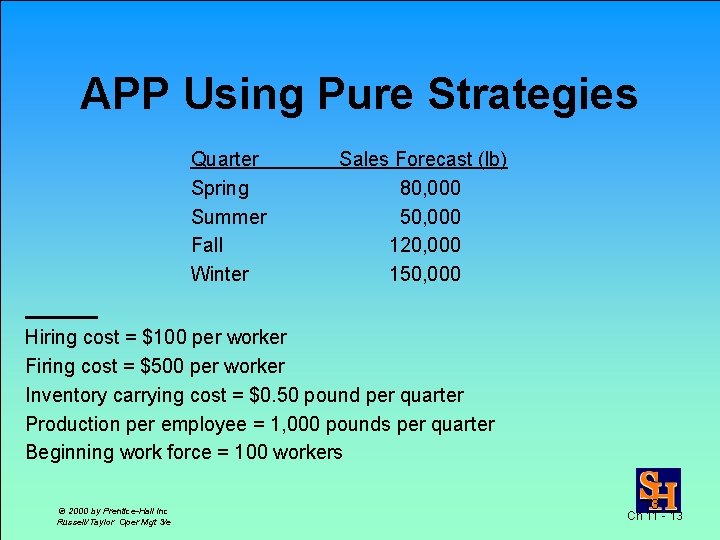
APP Using Pure Strategies Quarter Spring Summer Fall Winter Sales Forecast (lb) 80, 000 50, 000 120, 000 150, 000 Hiring cost = $100 per worker Firing cost = $500 per worker Inventory carrying cost = $0. 50 pound per quarter Production per employee = 1, 000 pounds per quarter Beginning work force = 100 workers © 2000 by Prentice-Hall Inc Russell/Taylor Oper Mgt 3/e 13 Ch 11 - 13
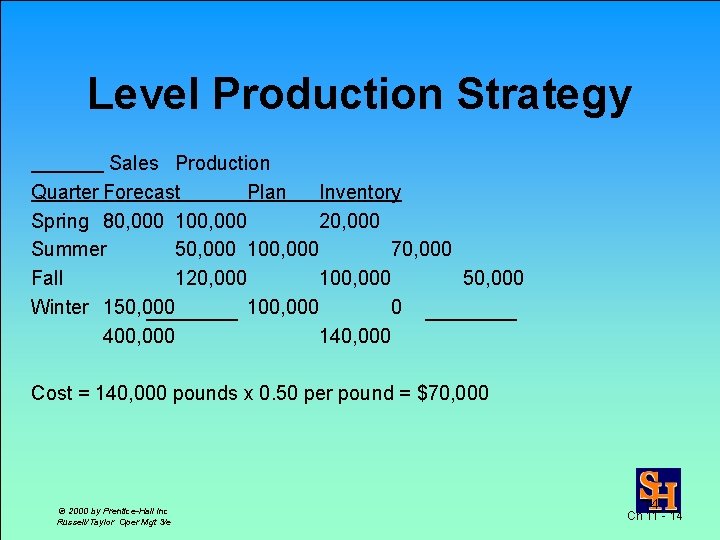
Level Production Strategy Sales Production Quarter Forecast Plan Inventory Spring 80, 000 100, 000 20, 000 Summer 50, 000 100, 000 70, 000 Fall 120, 000 100, 000 50, 000 Winter 150, 000 100, 000 0 400, 000 140, 000 Cost = 140, 000 pounds x 0. 50 per pound = $70, 000 © 2000 by Prentice-Hall Inc Russell/Taylor Oper Mgt 3/e 14 Ch 11 - 14
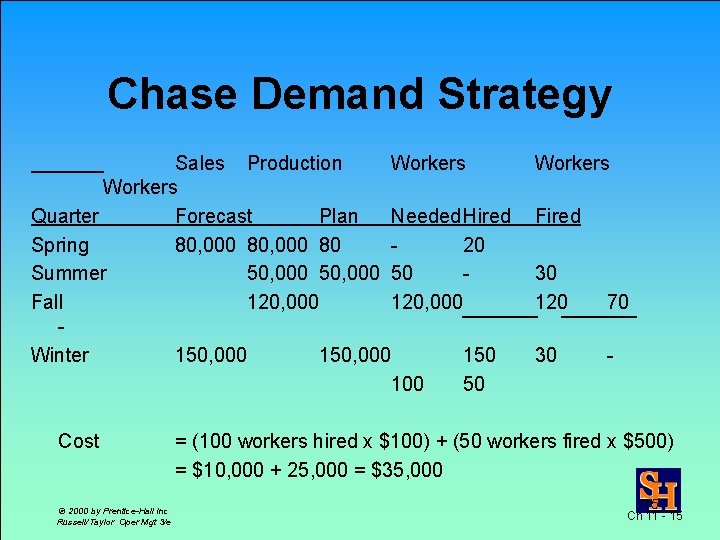
Chase Demand Strategy Sales Production Workers Quarter Forecast Plan Needed. Hired Spring 80, 000 80 20 Summer 50, 000 50 Fall 120, 000 Winter 150, 000 150 100 50 Cost © 2000 by Prentice-Hall Inc Russell/Taylor Oper Mgt 3/e Workers Fired 30 120 70 30 - = (100 workers hired x $100) + (50 workers fired x $500) = $10, 000 + 25, 000 = $35, 000 15 Ch 11 - 15
Strategies for Managing Demand • Shift demand into other periods – incentives, sales promotions, advertising campaigns • Offer product or services with countercyclical demand patterns – create demand for idle resources © 2000 by Prentice-Hall Inc Russell/Taylor Oper Mgt 3/e 16 Ch 11 - 21
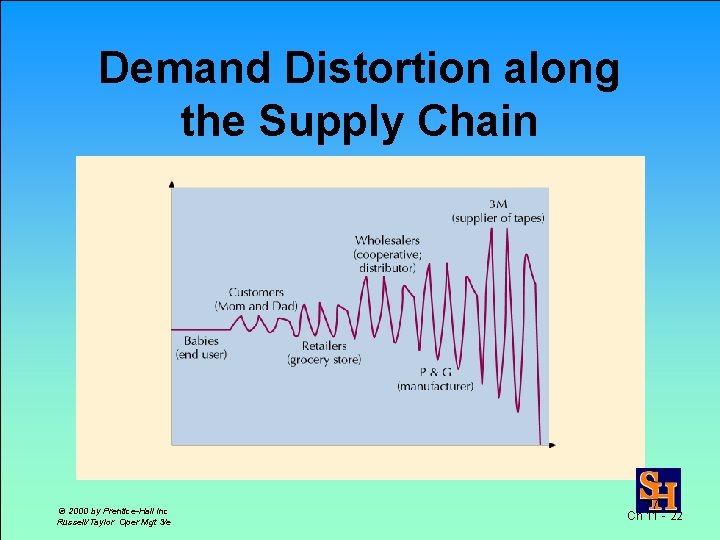
Demand Distortion along the Supply Chain © 2000 by Prentice-Hall Inc Russell/Taylor Oper Mgt 3/e 17 Ch 11 - 22
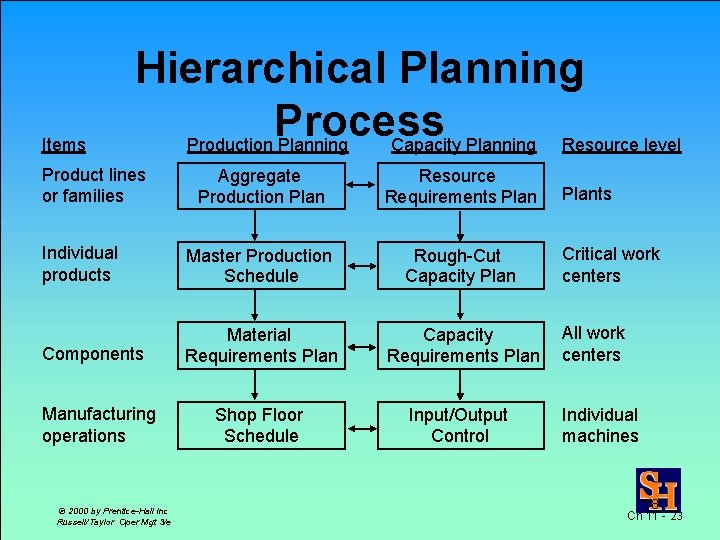
Items Hierarchical Planning Process Production Planning Capacity Planning Resource level Product lines or families Aggregate Production Plan Resource Requirements Plan Individual products Master Production Schedule Rough-Cut Capacity Plan Components Material Requirements Plan Capacity Requirements Plan Shop Floor Schedule Input/Output Control Manufacturing operations © 2000 by Prentice-Hall Inc Russell/Taylor Oper Mgt 3/e Plants Critical work centers All work centers Individual machines 18 Ch 11 - 23
Aggregate Planning for Services 1. Most services can’t be inventoried 2. Demand for services is difficult to predict 3. Capacity is also difficult to predict 4. Service capacity must be provided at the appropriate place and time 5. Labor is usually the most constraining resource for services © 2000 by Prentice-Hall Inc Russell/Taylor Oper Mgt 3/e 19 Ch 11 - 24
- Slides: 19