
Business Process Modelling Prof Marcello La Rosa BPM
Business Process Modelling Prof. Marcello La Rosa BPM Discipline Queensland University of Technology
Quick recap from Week 1 • What is a business process? • What’s so special about business processes? • What is BPM? • What is the value of BPM? © Marcello La Rosa

Why process modeling? “It’s like turning a lot of light bulbs on in the minds of managers” Process owner Defense Housing Authority Canberra, Australia Transparency © Marcello La Rosa
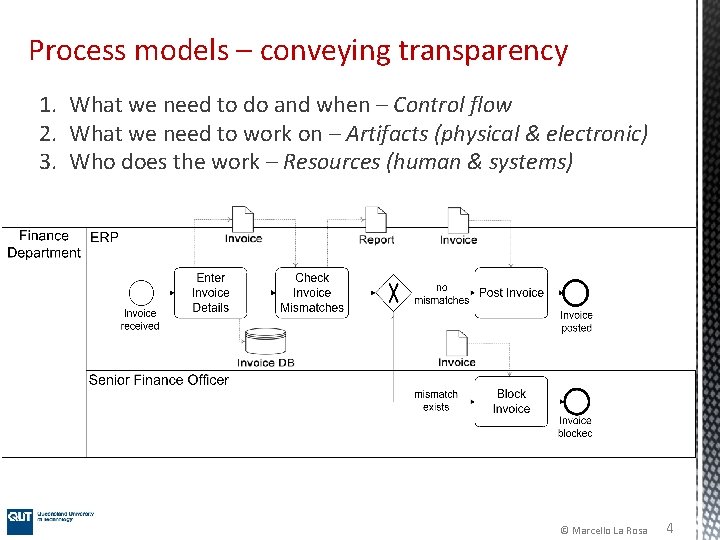
Process models – conveying transparency 1. What we need to do and when – Control flow 2. What we need to work on – Artifacts (physical & electronic) 3. Who does the work – Resources (human & systems) © Marcello La Rosa 4
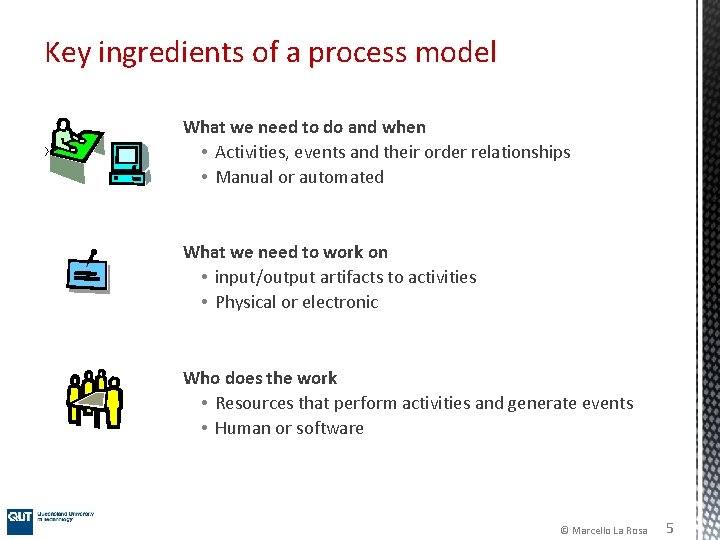
Key ingredients of a process model What we need to do and when • Activities, events and their order relationships • Manual or automated What we need to work on • input/output artifacts to activities • Physical or electronic Who does the work • Resources that perform activities and generate events • Human or software © Marcello La Rosa 5
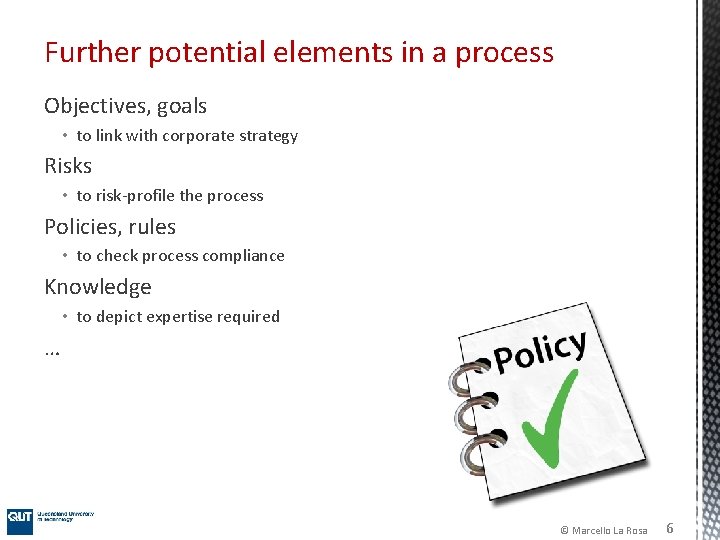
Further potential elements in a process Objectives, goals • to link with corporate strategy Risks • to risk-profile the process Policies, rules • to check process compliance Knowledge • to depict expertise required … © Marcello La Rosa 6
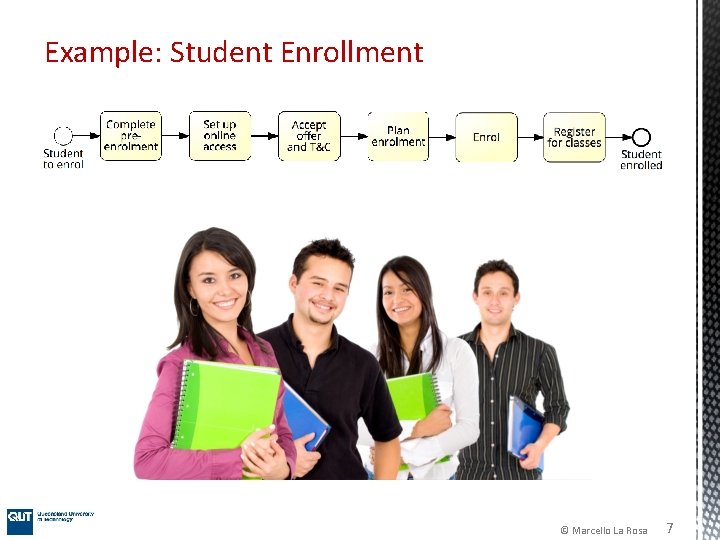
Example: Student Enrollment © Marcello La Rosa 7

What’s the right model? © Marcello La Rosa
How novices model Mark is going on a trip to Sydney. He decides to call a taxi from home to the airport. The taxi arrives after 10 minutes, and takes half an hour for the 20 kilometers to the airport. At the airport, Mark uses the online check-in counter and receives his boarding pass. Of course, he could have also used the ticket counter. He does not have to check-in any luggage, and so he proceeds straight to the security check, which is 100 meters down the hall on the right. The queue here is short and after 5 minutes he walks up to the departure gate. Mark decides not to go to the Frequent Flyer lounge and instead walks up and down the shops for 15 minutes and buys a newspaper before he returns to the gate. After ten minutes waiting, he boards the plane. Recker et al. , How novices model business processes, Proceedings of BPM, Springer, 2010 © Marcello La Rosa 9
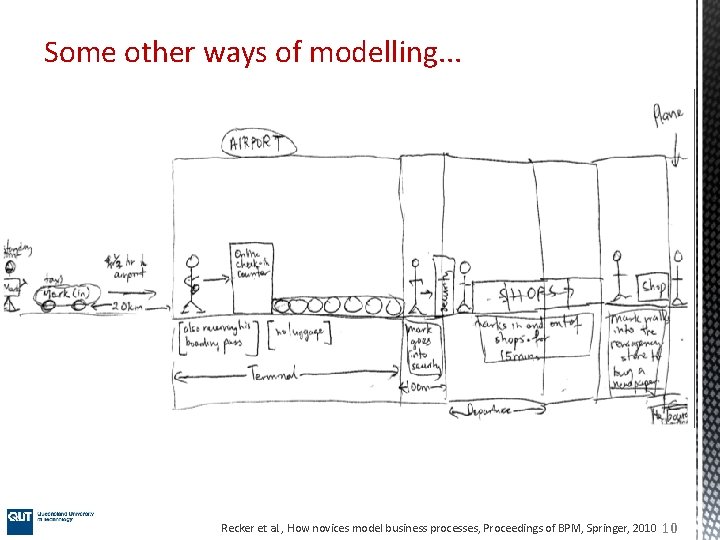
Some other ways of modelling. . . Recker et al. , How novices model business processes, Proceedings of BPM, Springer, 2010 © Marcello La Rosa 10
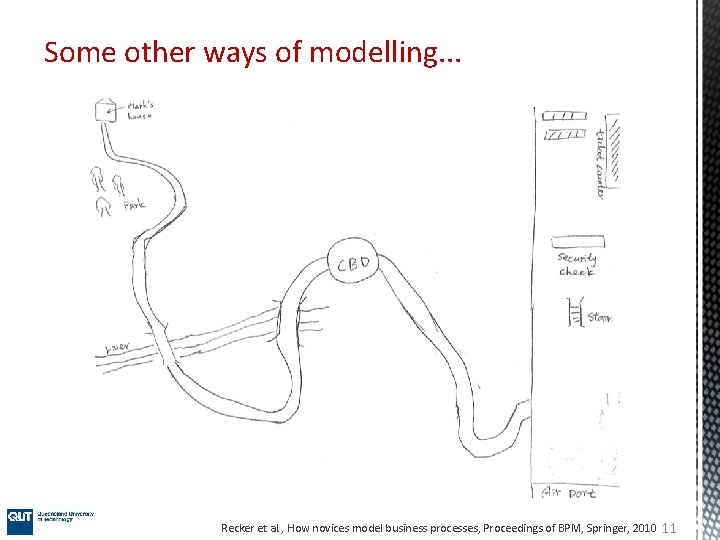
Some other ways of modelling. . . Recker et al. , How novices model business processes, Proceedings of BPM, Springer, 2010 © Marcello La Rosa 11

Some other ways of modelling. . . Recker et al. , How novices model business processes, Proceedings of BPM, Springer, 2010 © Marcello La Rosa 12

Some other ways of modelling. . . Recker et al. , How novices model business processes, Proceedings of BPM, Springer, 2010 © Marcello La Rosa 13

Some other ways of modelling. . . Recker et al. , How novices model business processes, Proceedings of BPM, Springer, 2010 © Marcello La Rosa 14
Issues? • Different representation of concepts • Different level of granularity • Different level of scope • Different terminology →What is the right process model? © Marcello La Rosa 15
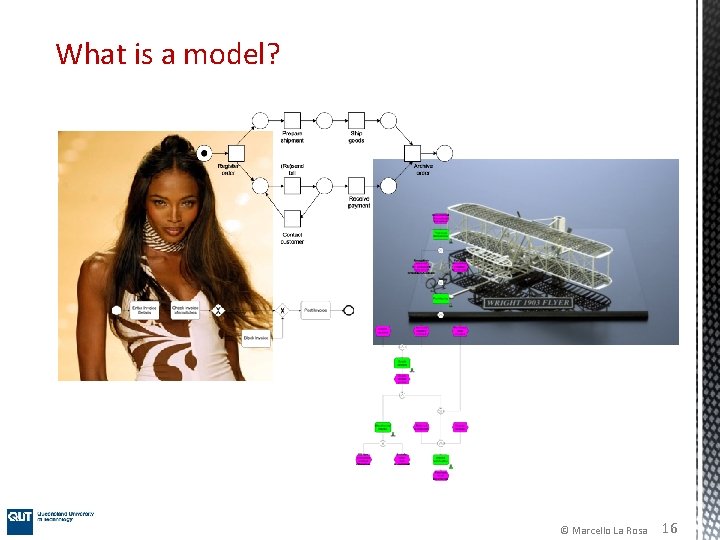
What is a model? © Marcello La Rosa 16
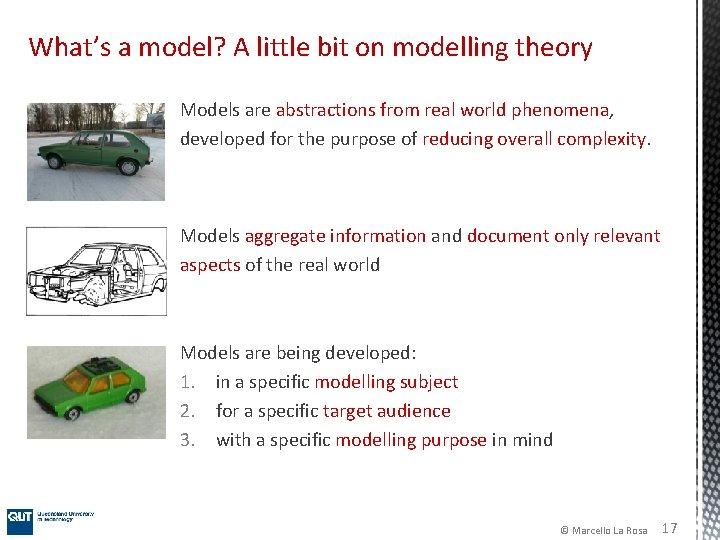
What’s a model? A little bit on modelling theory Models are abstractions from real world phenomena, developed for the purpose of reducing overall complexity. Models aggregate information and document only relevant aspects of the real world Models are being developed: 1. in a specific modelling subject 2. for a specific target audience 3. with a specific modelling purpose in mind © Marcello La Rosa 17
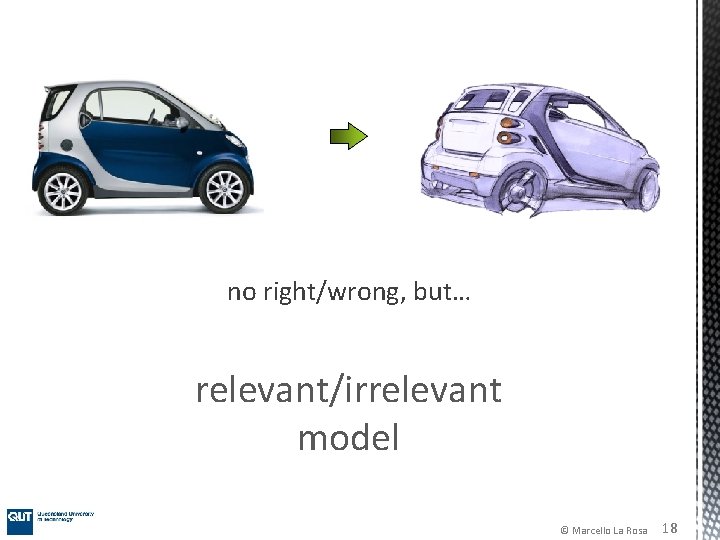
no right/wrong, but… relevant/irrelevant model © Marcello La Rosa 18
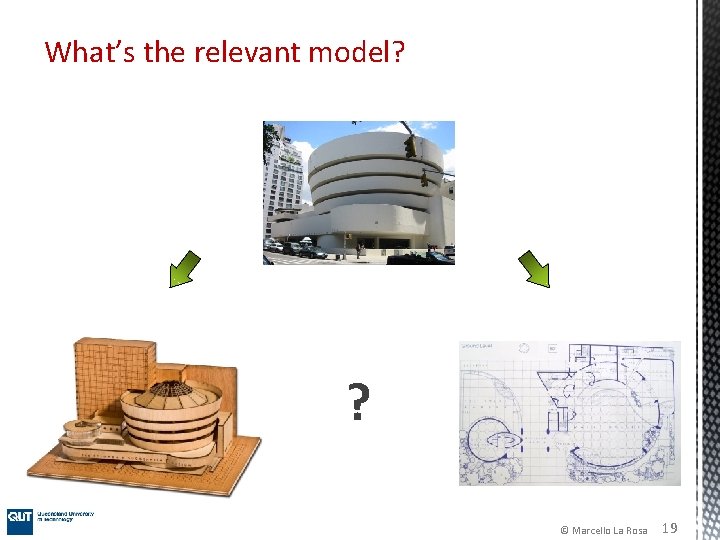
What’s the relevant model? ? © Marcello La Rosa 19
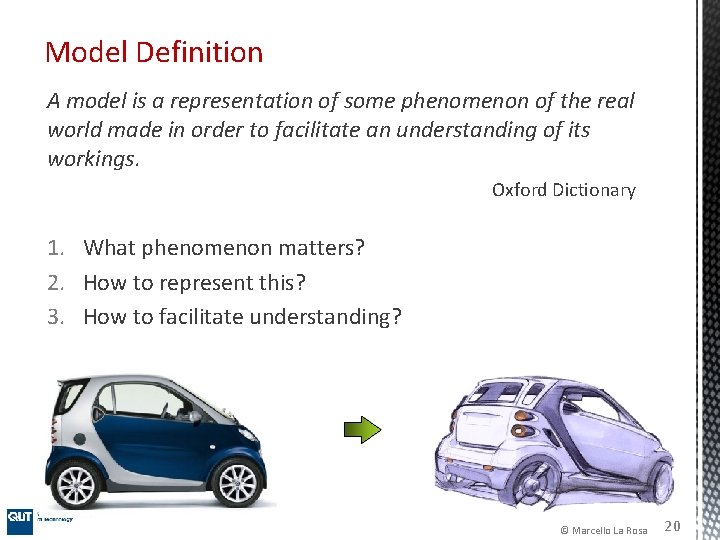
Model Definition A model is a representation of some phenomenon of the real world made in order to facilitate an understanding of its workings. Oxford Dictionary 1. What phenomenon matters? 2. How to represent this? 3. How to facilitate understanding? © Marcello La Rosa 20
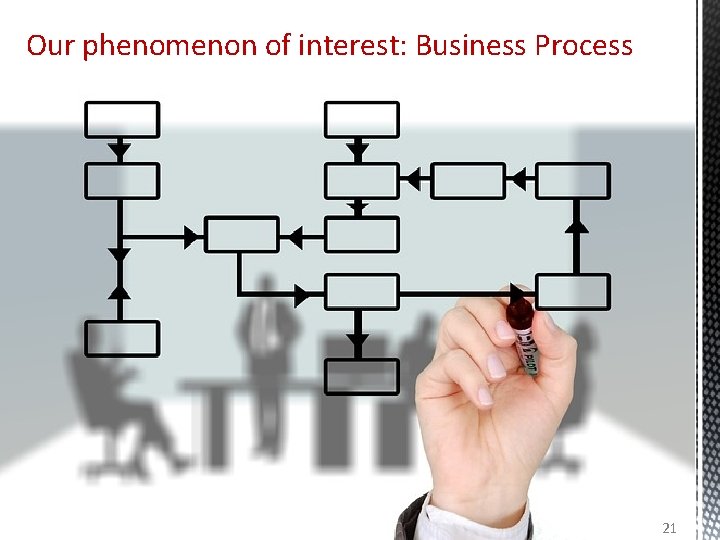
Our phenomenon of interest: Business Process © Marcello La Rosa 21
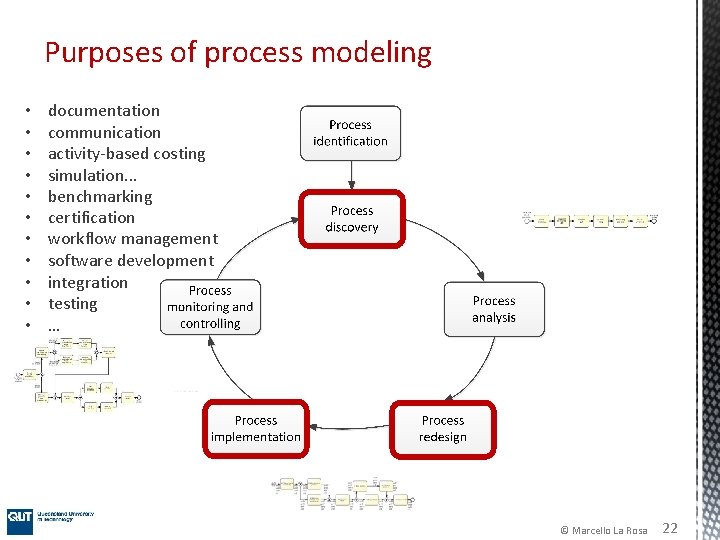
Purposes of process modeling • • • documentation communication activity-based costing simulation. . . benchmarking certification workflow management software development integration testing … © Marcello La Rosa 22

Purposes of Process Modeling Organization design documentation workflow management communication activitybased costing Application system design software development integration Transparency testing simulation … benchmarking certification … © Marcello La Rosa 23
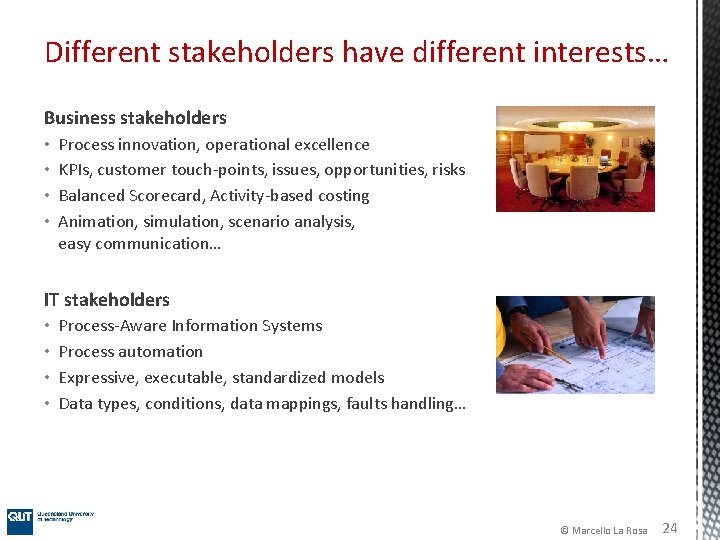
Different stakeholders have different interests… Business stakeholders • • Process innovation, operational excellence KPIs, customer touch-points, issues, opportunities, risks Balanced Scorecard, Activity-based costing Animation, simulation, scenario analysis, easy communication… IT stakeholders • • Process-Aware Information Systems Process automation Expressive, executable, standardized models Data types, conditions, data mappings, faults handling… © Marcello La Rosa 24
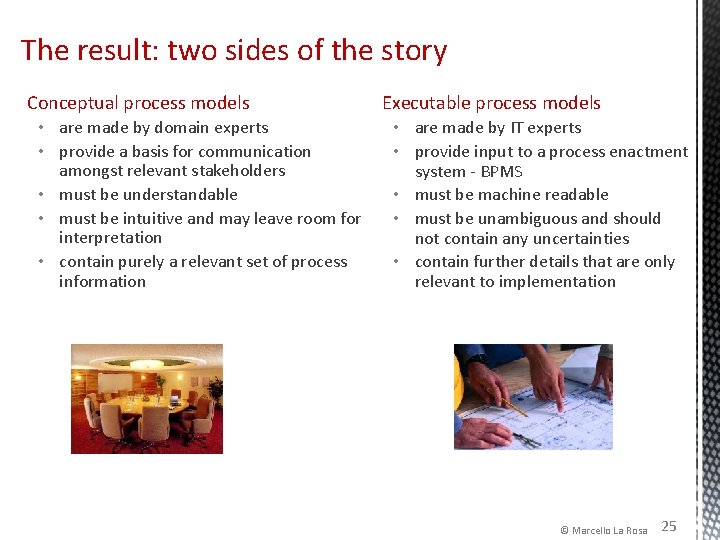
The result: two sides of the story Conceptual process models • are made by domain experts • provide a basis for communication amongst relevant stakeholders • must be understandable • must be intuitive and may leave room for interpretation • contain purely a relevant set of process information Executable process models • are made by IT experts • provide input to a process enactment system - BPMS • must be machine readable • must be unambiguous and should not contain any uncertainties • contain further details that are only relevant to implementation © Marcello La Rosa 25
How to model: the BPMN language
Business Process Model and Notation (BPMN) • OMG standard (nowadays BPMN 2. 0) • Supported by numerous tools: bpmn. org lists over 70 tools (Jan 15) • Both for conceptual and executable models © Marcello La Rosa
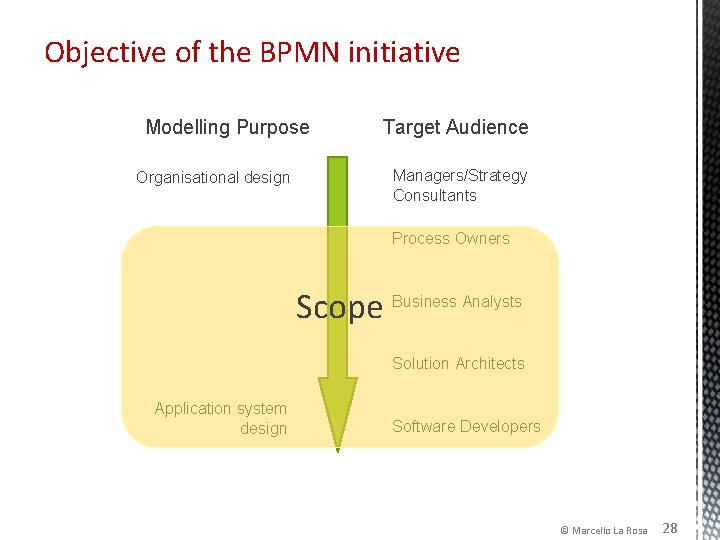
Objective of the BPMN initiative Modelling Purpose Organisational design Target Audience Managers/Strategy Consultants Process Owners Scope Business Analysts Solution Architects Application system design Software Developers © Marcello La Rosa 28
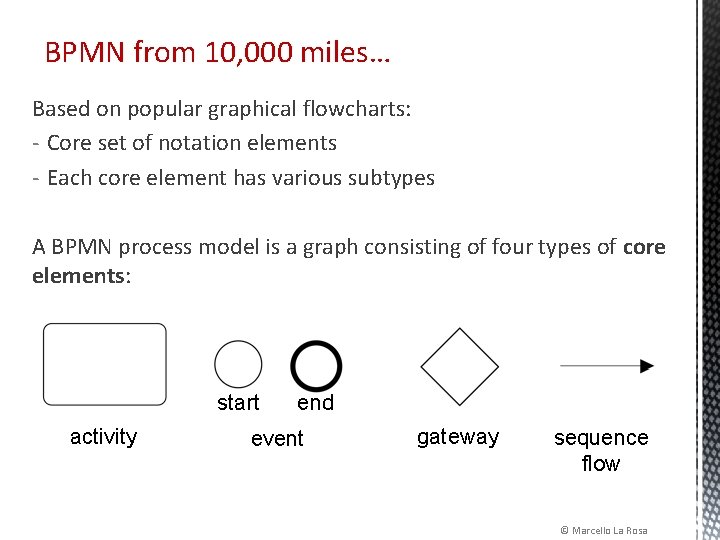
BPMN from 10, 000 miles… Based on popular graphical flowcharts: - Core set of notation elements - Each core element has various subtypes A BPMN process model is a graph consisting of four types of core elements: start activity end event gateway sequence flow © Marcello La Rosa
Let’s start modeling Order-to-cash A typical order-to-cash process is triggered by the receipt of a purchase order from a customer. The purchase order has to be checked against the stock regarding the availability of the item(s) requested. Depending on stock availability the purchase order may be confirmed or rejected. If the purchase order is confirmed, an invoice is emitted and the goods requested are shipped. The process completes by archiving the order or if the order is rejected. © Marcello La Rosa
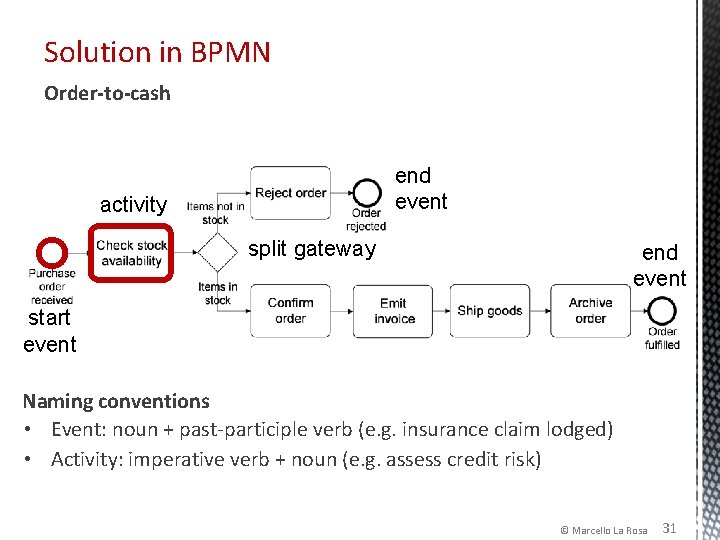
Solution in BPMN Order-to-cash end event activity split gateway end event start event Naming conventions • Event: noun + past-participle verb (e. g. insurance claim lodged) • Activity: imperative verb + noun (e. g. assess credit risk) © Marcello La Rosa 31
One more example Handle down payments This process starts when a request for down payment has been approved. It involves the entry and posting of a down payment in the form of a down payment request being entered into the system, the automatic subsequent payment, acquittal of the down payment through the processing of the direct invoice and the clearance of the vendor line items. The clearance of the vendor line items can result in a debit or credit balance. In case of debit balance, the arrears are processed, otherwise the remaining balance is paid. © Marcello La Rosa 32
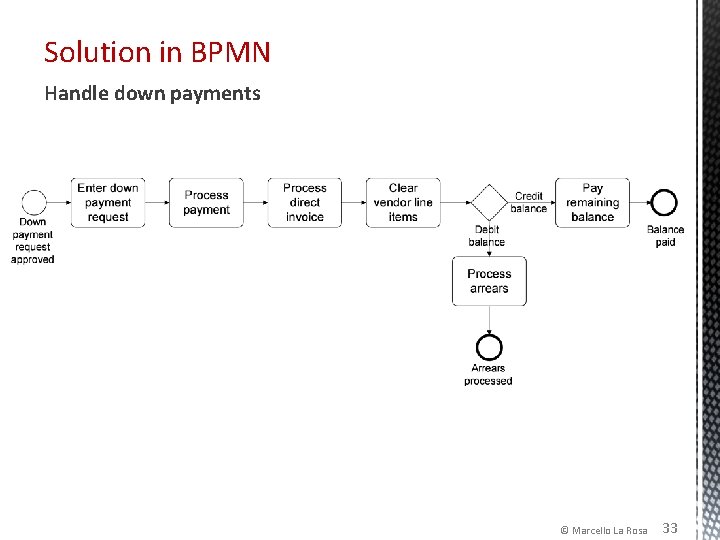
Solution in BPMN Handle down payments © Marcello La Rosa 33

BPMN core elements Activities capture work performed in a process activity start event end event • Different types of activities Events represent the process’ triggers (start event) and outcomes (end event). • Different types of events © Marcello La Rosa 34
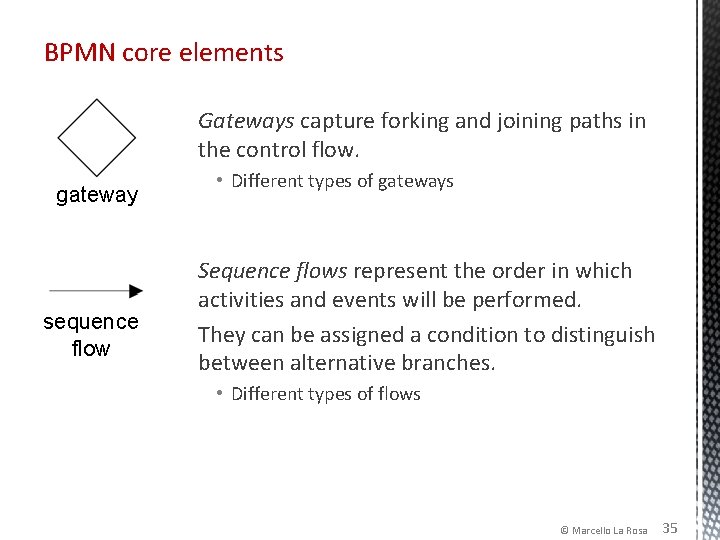
BPMN core elements Gateways capture forking and joining paths in the control flow. gateway sequence flow • Different types of gateways Sequence flows represent the order in which activities and events will be performed. They can be assigned a condition to distinguish between alternative branches. • Different types of flows © Marcello La Rosa 35
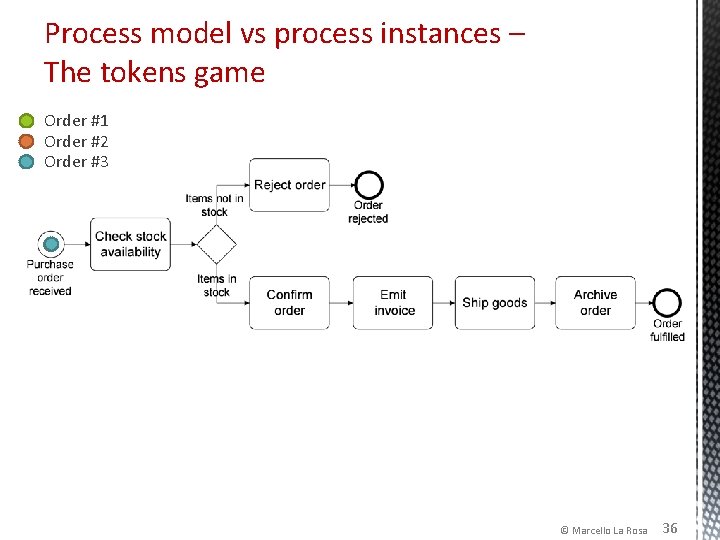
Process model vs process instances – The tokens game Order #1 Order #2 Order #3 © Marcello La Rosa 36
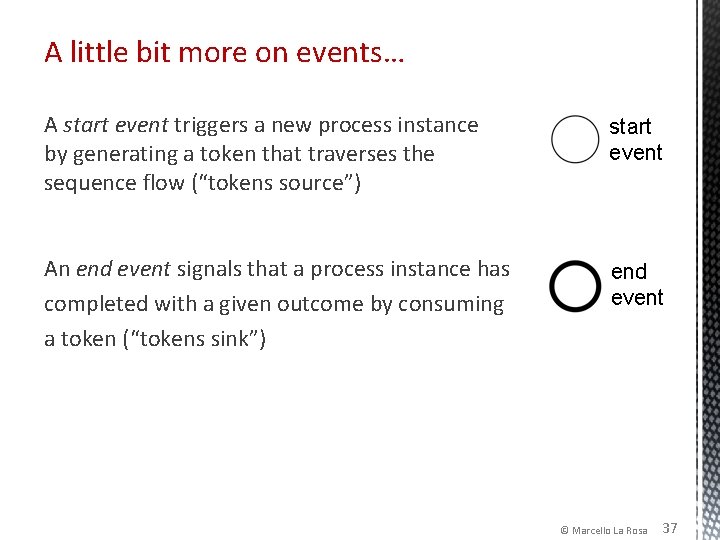
A little bit more on events… A start event triggers a new process instance by generating a token that traverses the sequence flow (“tokens source”) start event An end event signals that a process instance has completed with a given outcome by consuming a token (“tokens sink”) end event © Marcello La Rosa 37
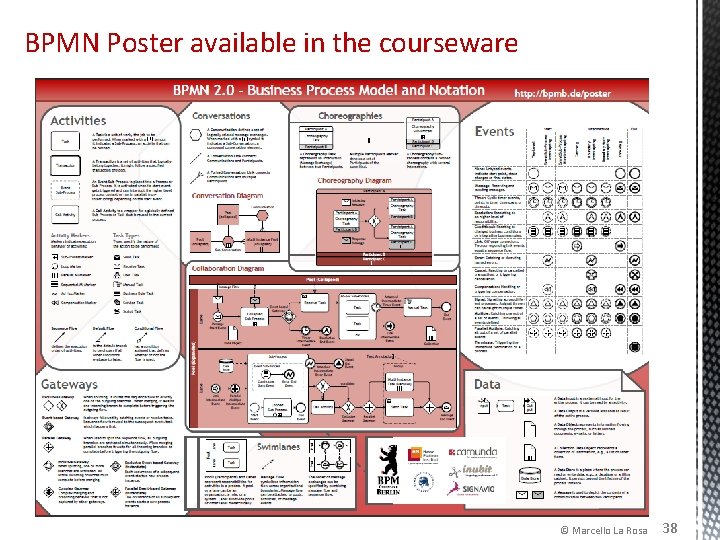
BPMN Poster available in the courseware © Marcello La Rosa 38
Readings for Week 2 Required • Dumas M. , La Rosa M. , Mendling J. , Reijers, H. (2013): Fundamentals of BPM. Chapter 3 Section 3. 1 (including box “A bit on modeling theory”) Recommended • Recker J. , Safrudin N. , Rosemann M. , How novices model business processes, Proceedings of BPM, Springer, 2010 © Marcello La Rosa 39

Prof. Marcello La Rosa IS School Academic Director (Corporate Programs and Partnerships) BPM Discipline, IS School Science & Engineering Faculty Queensland University of Technology 2 George Street Brisbane QLD 4000 Australia p +61 (0)7 3138 -9482 e m. larosa@qut. edu. au w www. marcellolarosa. com © Marcello La Rosa
- Slides: 40