
Business Process Modelling Prof Marcello La Rosa BPM
Business Process Modelling Prof. Marcello La Rosa BPM Discipline Queensland University of Technology
Quick recap from Week 6 • How do we react to external decisions? • What is the difference between message events and send/receive tasks? © Marcello La Rosa
Handling exceptions

Let’s extend our PO handling process PO handling A PO handling process starts when a PO is received. The PO is first registered. If the current date is not a working day, the process waits until the following working day before proceeding. Otherwise, an availability check is performed and a PO response is sent back to the customer. A PO change request may be received anytime after the PO is registered. This request includes a change in quantity or line items. When such a request is received, any processing related to the PO must be stopped. The PO change request is then registered. Thereafter, the process proceeds as it would do after a normal PO is registered. Further, if the customer sends a PO cancelation request after the PO registration, the PO processing must be stopped and the cancelation request must be handled. © Marcello La Rosa 4
Process abortion Exceptions are events that deviate a process from its “normal” course The simplest form of exception is to notify that there is an exception (negative outcome) This can be done via the Terminate end event: it forces the whole process to abort (“wipes off” all tokens left behind, if any) © Marcello La Rosa 5
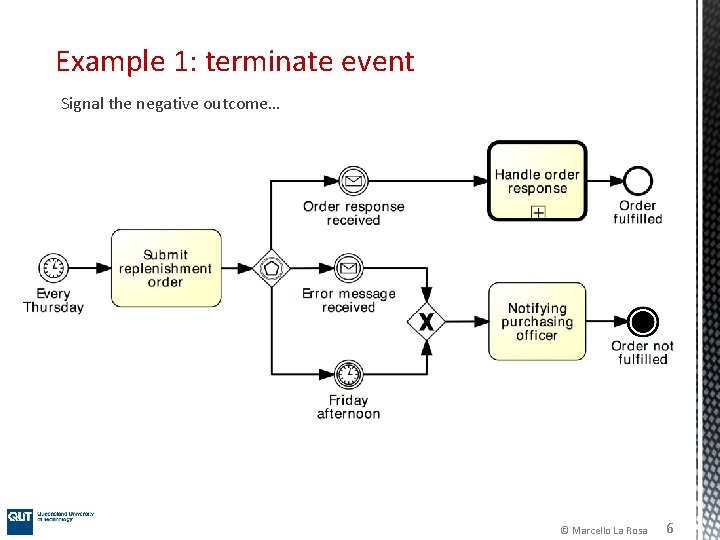
Example 1: terminate event Signal the negative outcome… © Marcello La Rosa 6
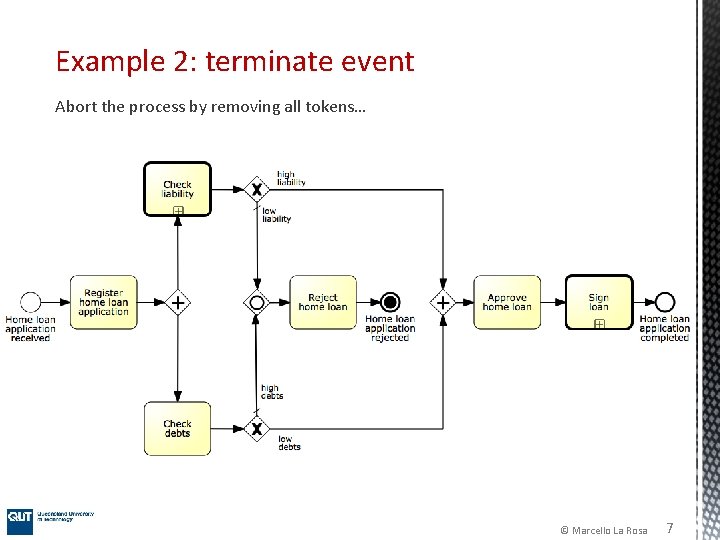
Example 2: terminate event Abort the process by removing all tokens… © Marcello La Rosa 7
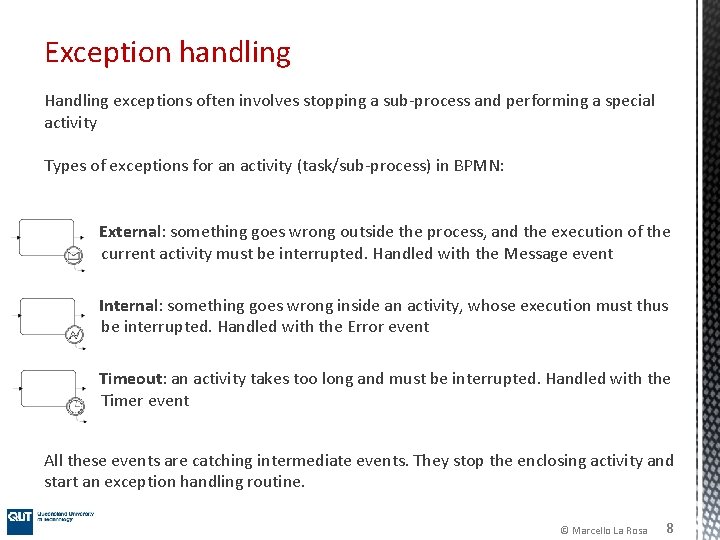
Exception handling Handling exceptions often involves stopping a sub-process and performing a special activity Types of exceptions for an activity (task/sub-process) in BPMN: External: something goes wrong outside the process, and the execution of the current activity must be interrupted. Handled with the Message event Internal: something goes wrong inside an activity, whose execution must thus be interrupted. Handled with the Error event Timeout: an activity takes too long and must be interrupted. Handled with the Timer event All these events are catching intermediate events. They stop the enclosing activity and start an exception handling routine. © Marcello La Rosa 8
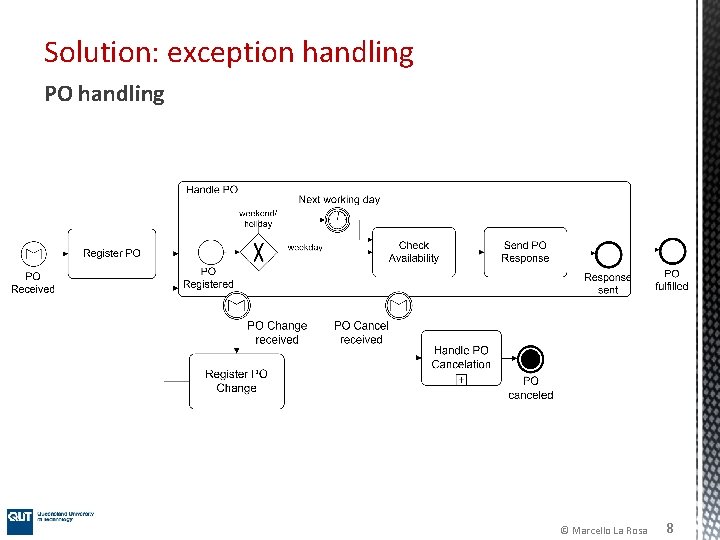
Solution: exception handling PO handling © Marcello La Rosa 8
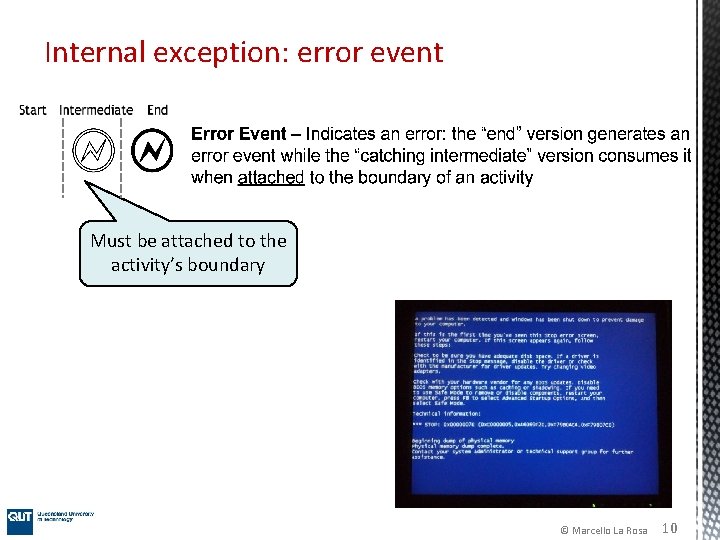
Internal exception: error event Must be attached to the activity’s boundary © Marcello La Rosa 10

Example: internal exception PO handling Consider again our “PO Handling process” example with the following extension: if an item is not available, any processing related to the PO must be stopped. Thereafter, the client needs to be notified that the PO cannot be further processed. © Marcello La Rosa 11
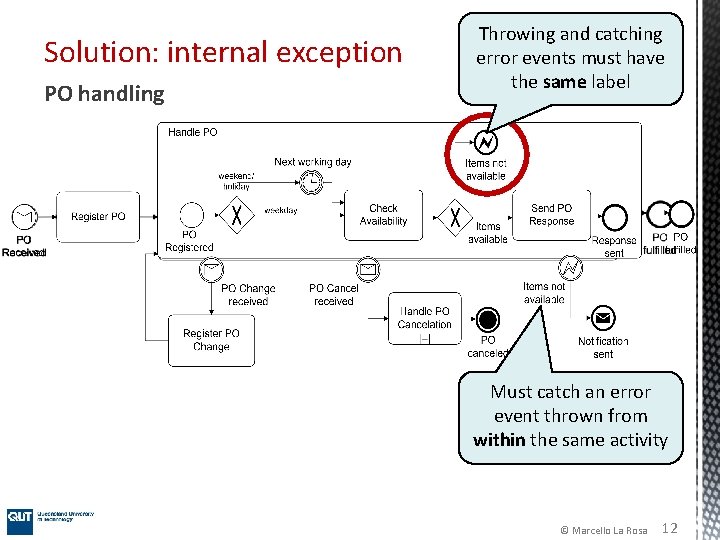
Solution: internal exception PO handling Throwing and catching error events must have the same label Must catch an error event thrown from within the same activity © Marcello La Rosa 12
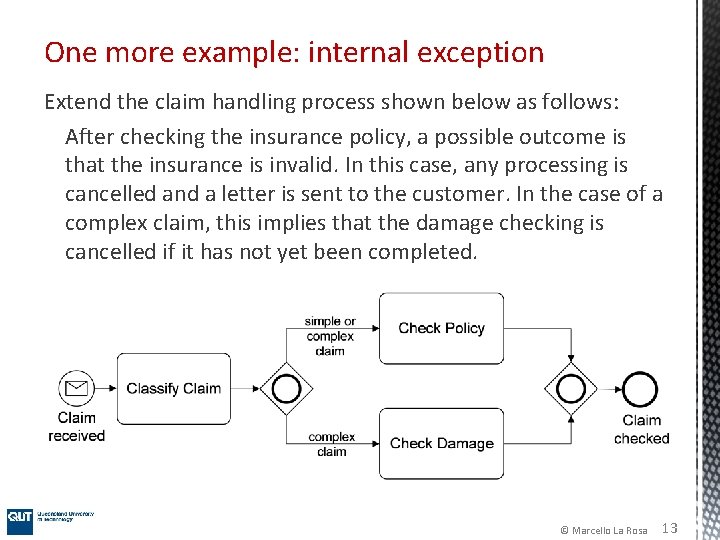
One more example: internal exception Extend the claim handling process shown below as follows: After checking the insurance policy, a possible outcome is that the insurance is invalid. In this case, any processing is cancelled and a letter is sent to the customer. In the case of a complex claim, this implies that the damage checking is cancelled if it has not yet been completed. © Marcello La Rosa 13
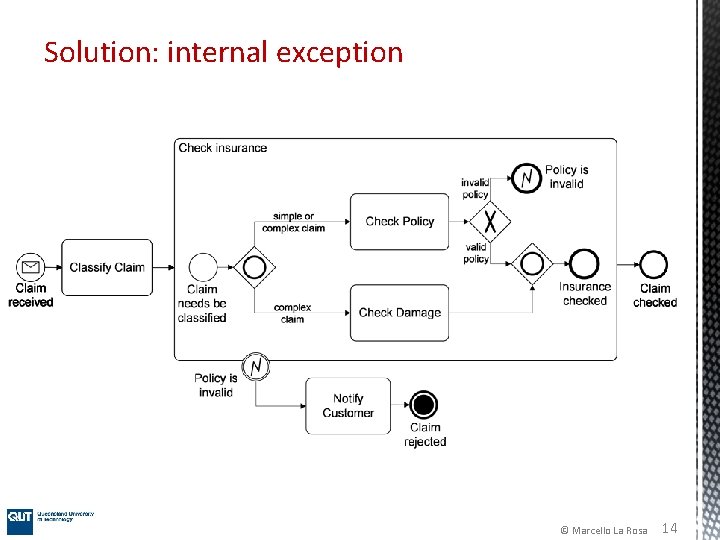
Solution: internal exception © Marcello La Rosa 14
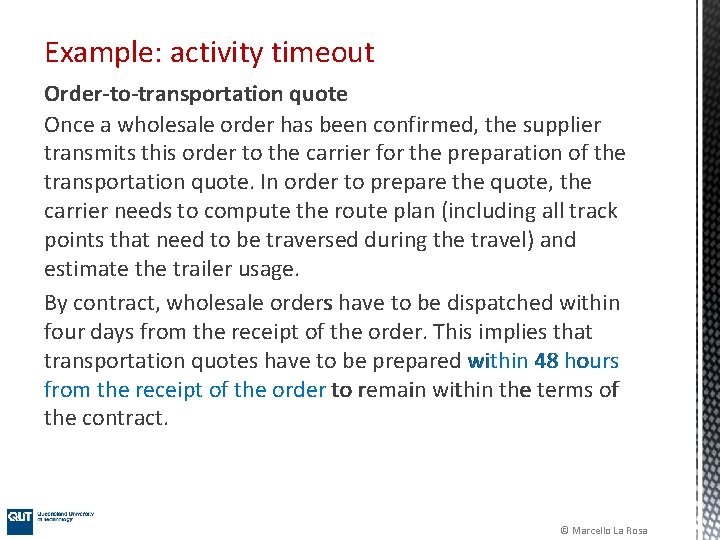
Example: activity timeout Order-to-transportation quote Once a wholesale order has been confirmed, the supplier transmits this order to the carrier for the preparation of the transportation quote. In order to prepare the quote, the carrier needs to compute the route plan (including all track points that need to be traversed during the travel) and estimate the trailer usage. By contract, wholesale orders have to be dispatched within four days from the receipt of the order. This implies that transportation quotes have to be prepared within 48 hours from the receipt of the order to remain within the terms of the contract. © Marcello La Rosa
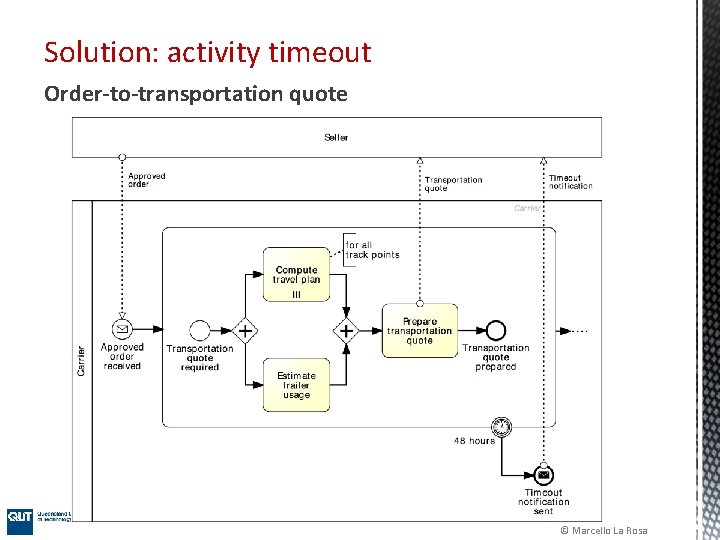
Solution: activity timeout Order-to-transportation quote © Marcello La Rosa
Non-interrupting events and complex exceptions
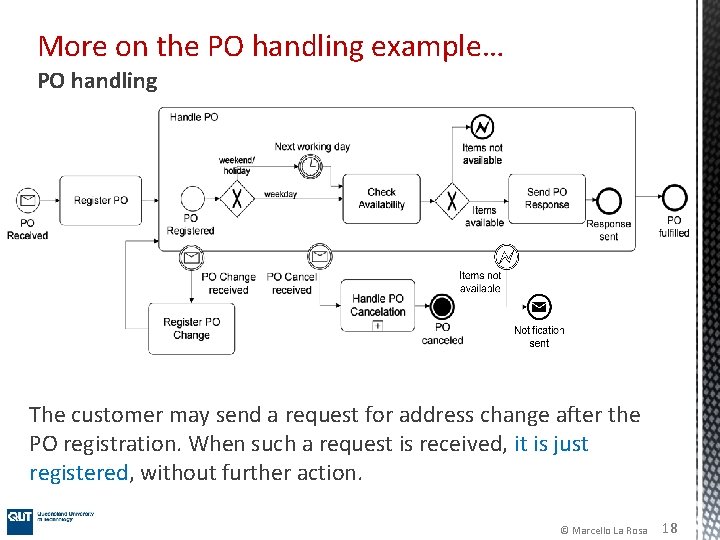
More on the PO handling example… PO handling The customer may send a request for address change after the PO registration. When such a request is received, it is just registered, without further action. © Marcello La Rosa 18
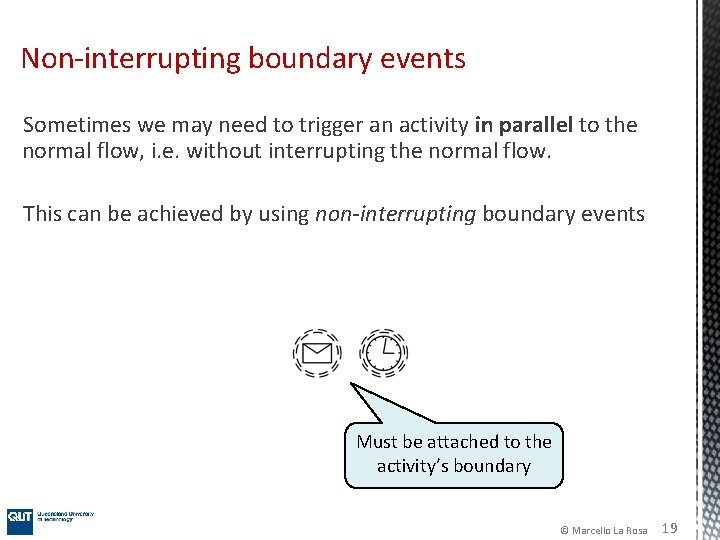
Non-interrupting boundary events Sometimes we may need to trigger an activity in parallel to the normal flow, i. e. without interrupting the normal flow. This can be achieved by using non-interrupting boundary events Must be attached to the activity’s boundary © Marcello La Rosa 19
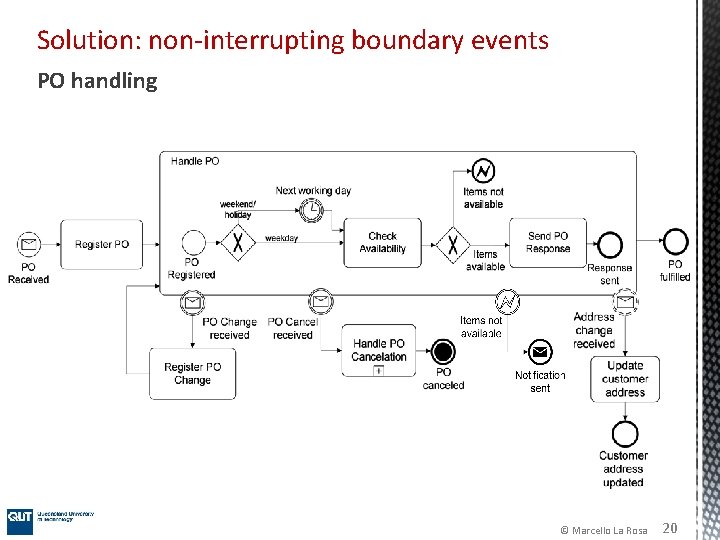
Solution: non-interrupting boundary events PO handling © Marcello La Rosa 20
![Let’s make it even more realistic PO handling […] Further, if the customer sends](http://slidetodoc.com/presentation_image_h/86837eb3d1f812b74fd3658d2d51c145/image-21.jpg "Let’s make it even more realistic PO handling […] Further, if the customer sends")
Let’s make it even more realistic PO handling […] Further, if the customer sends a PO cancelation request after the PO PO registration, the PO processing be stopped and the request is first must assessed. Based on the change request needshandling to be handled. progress of the order (e. g. if items have already been fetched from external warehouses) a penalty is determined and communicated to the customer. The customer has 48 hours to accept the penalty and go on with the cancelation or to stop the cancelation and continue with the order handling. © Marcello La Rosa 21
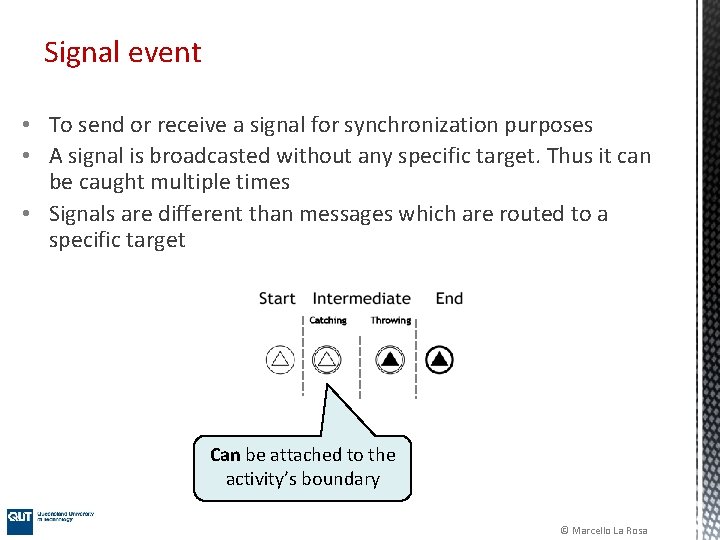
Signal event • To send or receive a signal for synchronization purposes • A signal is broadcasted without any specific target. Thus it can be caught multiple times • Signals are different than messages which are routed to a specific target Can be attached to the activity’s boundary © Marcello La Rosa
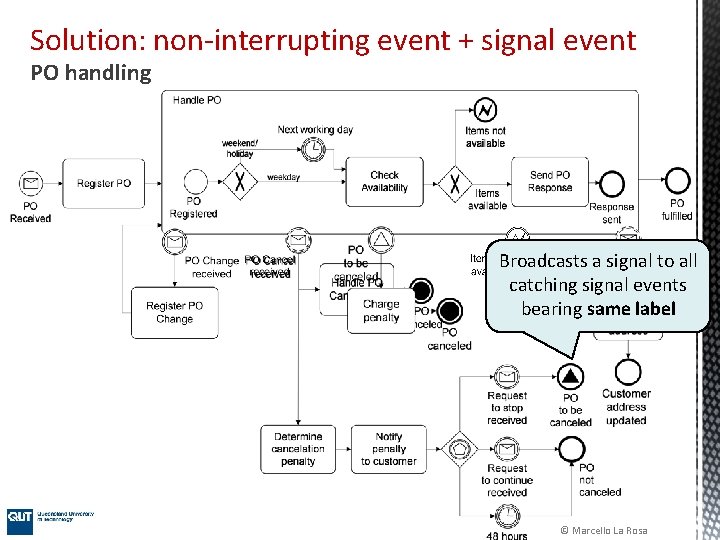
Solution: non-interrupting event + signal event PO handling Broadcasts a signal to all catching signal events bearing same label © Marcello La Rosa
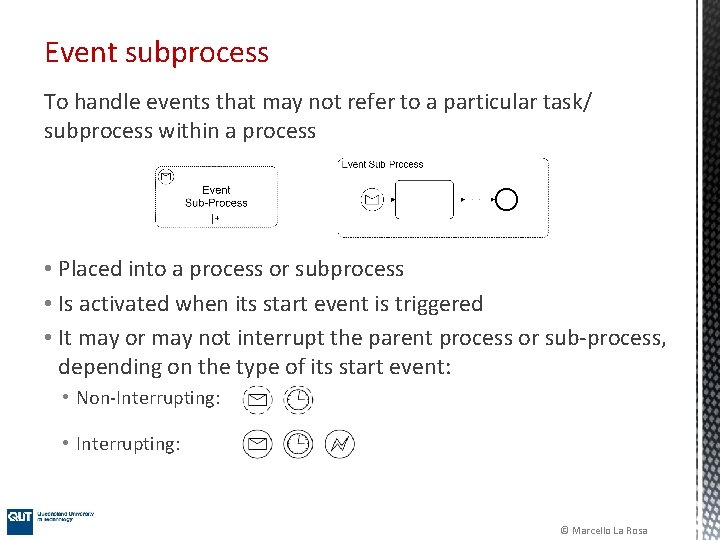
Event subprocess To handle events that may not refer to a particular task/ subprocess within a process • Placed into a process or subprocess • Is activated when its start event is triggered • It may or may not interrupt the parent process or sub-process, depending on the type of its start event: • Non-Interrupting: • Interrupting: © Marcello La Rosa
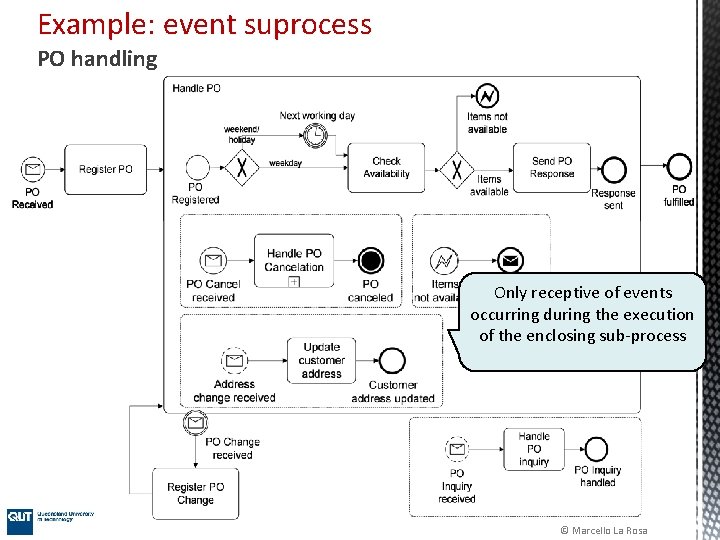
Example: event suprocess PO handling Only receptive of events occurring during the execution of the enclosing sub-process © Marcello La Rosa
Activity compensation
Example: activity compensation PO handling After a PO has been registered, checked, and a response has been sent back, a payment sub-process and a fulfilment subprocess are started. During these two sub-processes, a PO cancellation may be received from the customer. In this case, both sub-processes are stopped, and their effects are reverted (e. g. reimbursement and/or goods return may need to occur). © Marcello La Rosa 27
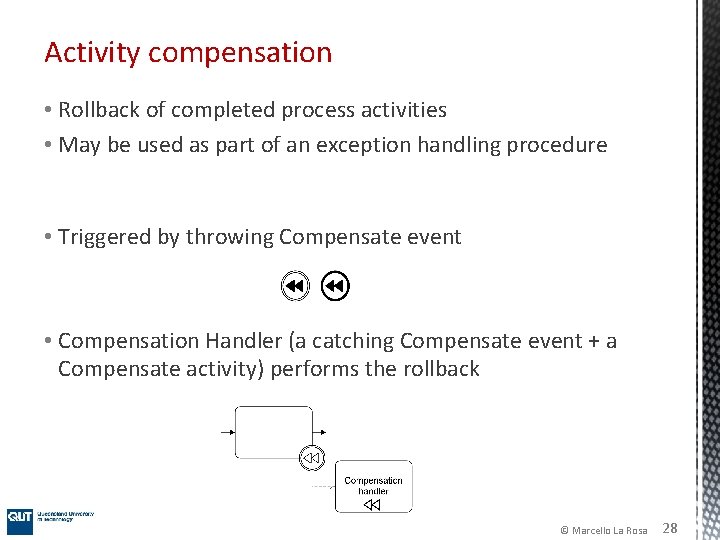
Activity compensation • Rollback of completed process activities • May be used as part of an exception handling procedure • Triggered by throwing Compensate event • Compensation Handler (a catching Compensate event + a Compensate activity) performs the rollback © Marcello La Rosa 28
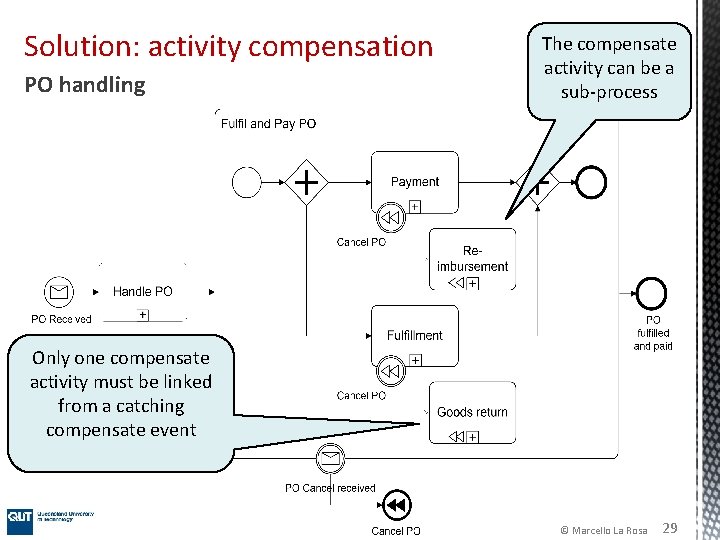
Solution: activity compensation PO handling The compensate activity can be a sub-process Only one compensate activity must be linked from a catching compensate event © Marcello La Rosa 29
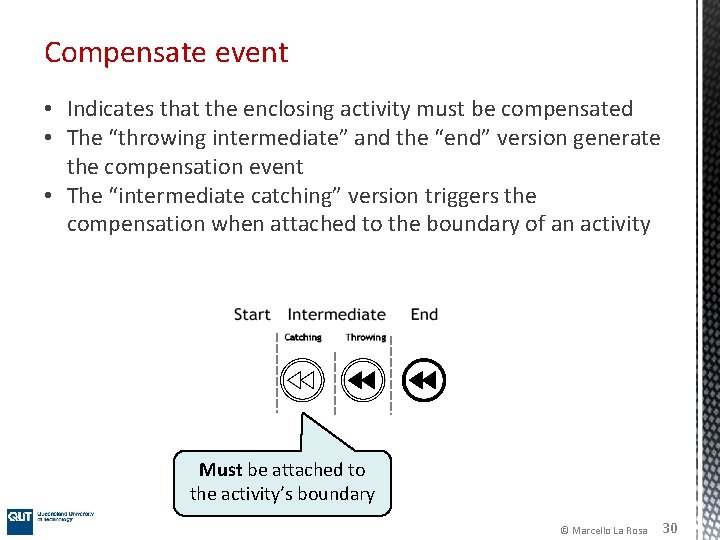
Compensate event • Indicates that the enclosing activity must be compensated • The “throwing intermediate” and the “end” version generate the compensation event • The “intermediate catching” version triggers the compensation when attached to the boundary of an activity Must be attached to the activity’s boundary © Marcello La Rosa 30
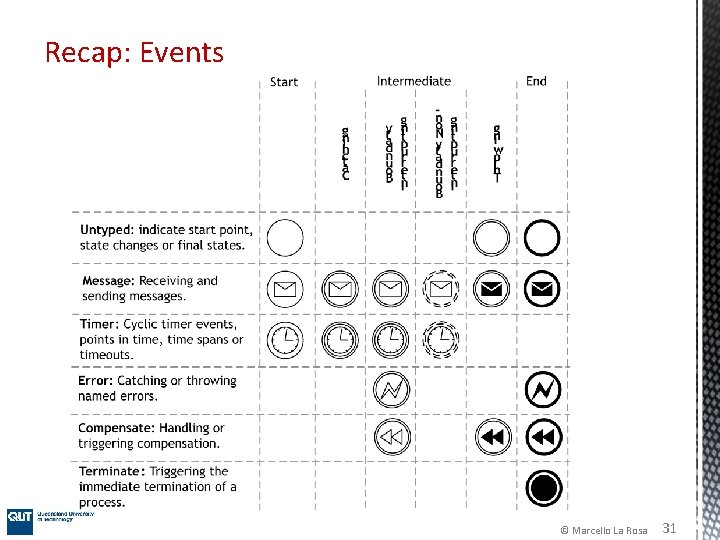
Recap: Events © Marcello La Rosa 31
Readings for Week 7 • Dumas M. , La Rosa M. , Mendling J. , Reijers, H. (2013): Fundamentals of BPM. Chapter 4. 5 © Marcello La Rosa 32

Prof. Marcello La Rosa IS School Academic Director (Corporate Programs and Partnerships) BPM Discipline, IS School Science & Engineering Faculty Queensland University of Technology 2 George Street Brisbane QLD 4000 Australia p +61 (0)7 3138 -9482 e m. larosa@qut. edu. au w www. marcellolarosa. com
- Slides: 33