
Business Process Modelling 7 22012 Marcello La Rosa

Business Process Modelling -7. 2/2012 - Marcello La Rosa Queensland University of Technology Brisbane, 5 September 2013
Quick Repeat from Week 6 • What’s BPMN’s context and main goal? • What are the main differences between BPMN and EPCs? • How can we represent data objects and resources in a BPMN model? © INB/INN 320 7. 2/2013 – 5 September 2013
Assignment 1 common mistakes: Process Model Generally good quality models, but: • Missing labels on (X)OR-split conditions, message flows, start/end events • Two actions in one task (e. g. “Ship goods and invoice customer”) – decompose into 2 tasks instead • Too low level tasks such as “click X button” or “continue to X page on website” – aggregate when performed by same resource (e. g. “Fill out form”) • Normal sequence flow crossing pools’ boundaries © INB/INN 320 7. 2/2013 – 5 September 2013
Assignment 1 common mistakes: Process Modelling “without knowing”: • You are only required to use the elements we have explained before the deadline. If you venture yourself into advanced BPMN elements which we haven’t explained, you will still be marked if these are used improperly. • Our advice: don’t venture yourself into new stuff. © INB/INN 320 7. 2/2013 – 5 September 2013
Assignment 1 common mistakes: Format/Presentation Most marks lost in format/presentation: the textual documentation is meant to help understand the process models. Do not undervalue its importance and be diligent: • Refer to diagram labels in textual description, e. g. “Figure 1 below shows the high-level process model of xxx” • Use abbreviations consistently – BPM for Business Process Management, not for Business Process Modelling • Use professional language, do not shorten words: e. g. use “do not” instead of “don’t” • Present report structure succinctly in one paragraph in the Introduction before proceeding into core of report © INB/INN 320 7. 2/2013 – 5 September 2013
Assignment 1 common mistakes: Format/Presentation • Process models must be included in body of report, NOT in appendices: appendices only used to provide additional (i. e. non-core) information • Appendices need to be referenced in body of report • Concepts, benefits and challenges need explanation – do not assume readers know what you mean, e. g. “standardisation of notation”, “model-driven process execution” • Ensure process models are readable – it is ok to have one process model per page (vertical) instead of squeezing 3 models in one page • Significance of process modelling not stressed enough © INB/INN 320 7. 2/2013 – 5 September 2013
Agenda Today • • Organisation of this Subject Process Modelling Foundations of process modelling: Petri Nets Event-driven Process Chains (EPCs) Business Process Model and Notation (BPMN 2. 0) Business Process Identification Business Process Discovery Methods Managing process modelling projects © INB/INN 320 7. 2/2013 – 5 September 2013
BPMN Modelling - Advanced Concepts (Part I) -
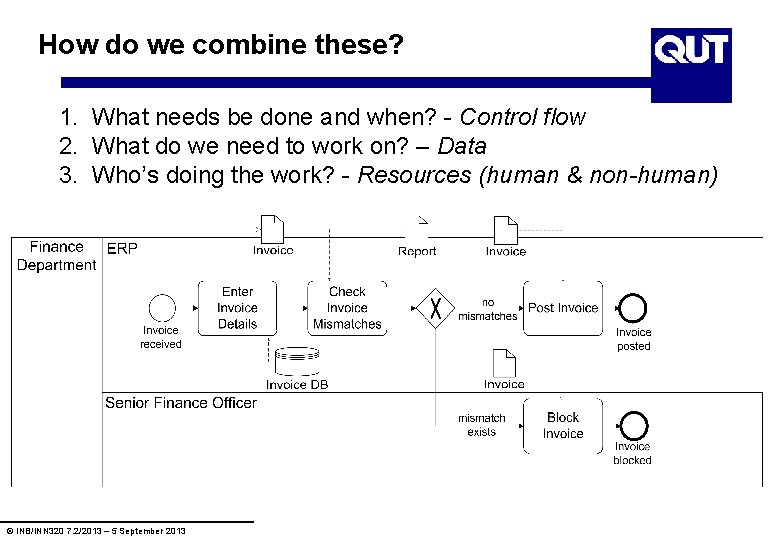
How do we combine these? 1. What needs be done and when? - Control flow 2. What do we need to work on? – Data 3. Who’s doing the work? - Resources (human & non-human) © INB/INN 320 7. 2/2013 – 5 September 2013
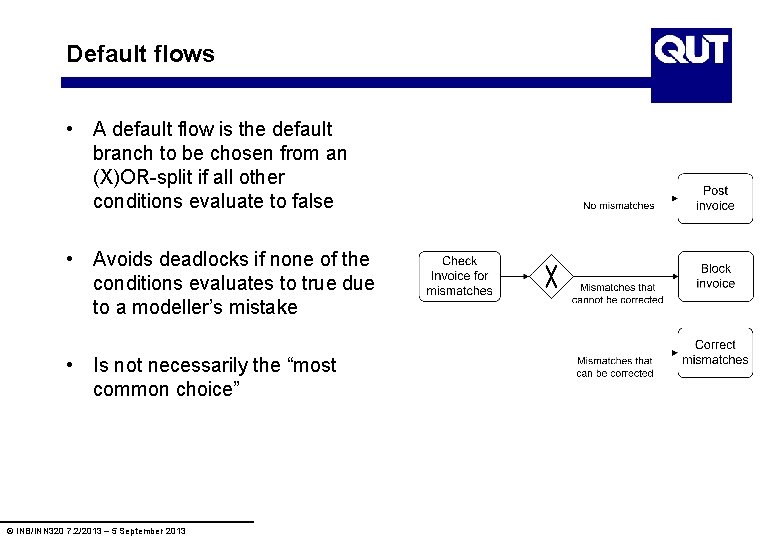
Default flows • A default flow is the default branch to be chosen from an (X)OR-split if all other conditions evaluate to false • Avoids deadlocks if none of the conditions evaluates to true due to a modeller’s mistake • Is not necessarily the “most common choice” © INB/INN 320 7. 2/2013 – 5 September 2013
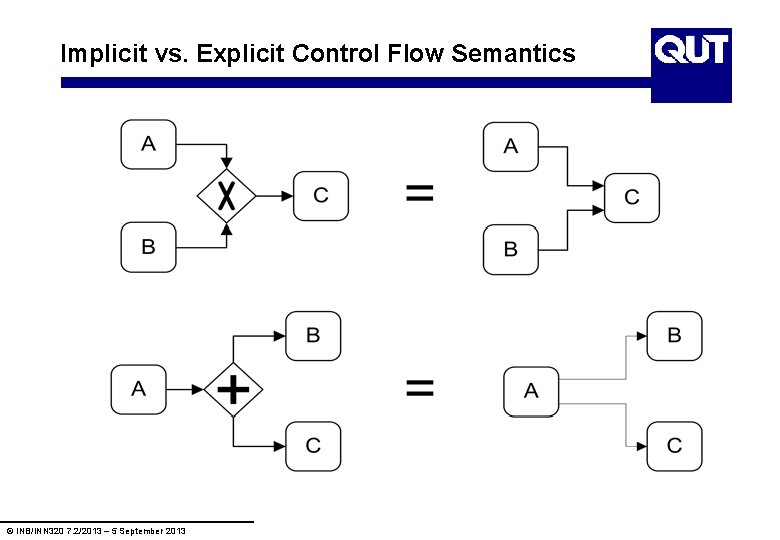
Implicit vs. Explicit Control Flow Semantics © INB/INN 320 7. 2/2013 – 5 September 2013
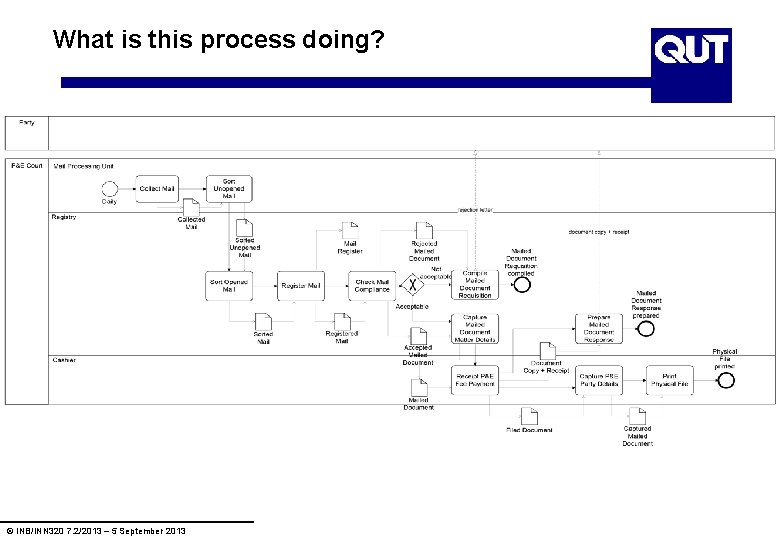
What is this process doing? © INB/INN 320 7. 2/2013 – 5 September 2013

Process Decomposition • An activity in a process can be decomposed into a “subprocess”. • Use this feature to: – Break down large models into smaller ones, making them easier to understand to explain – Identify parts of a process model that should be: • • repeated executed multiple times in parallel cancelled, or compensated. © INB/INN 320 7. 2/2013 – 5 September 2013 Activities
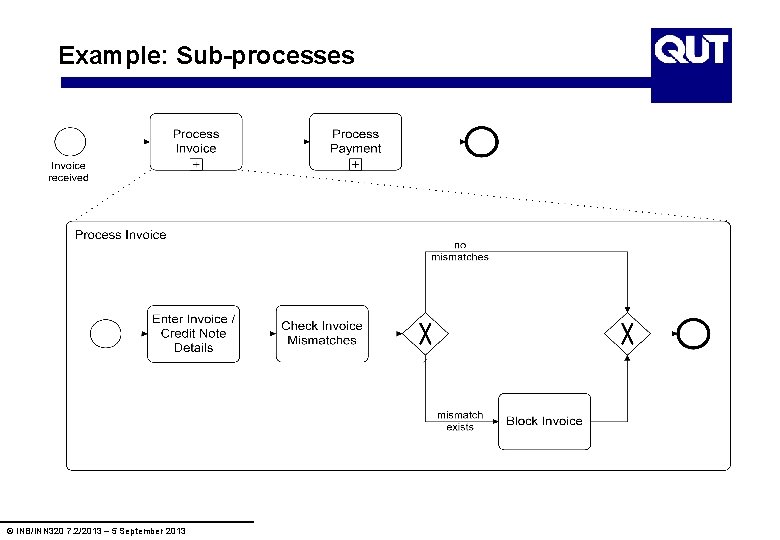
Example: Sub-processes © INB/INN 320 7. 2/2013 – 5 September 2013
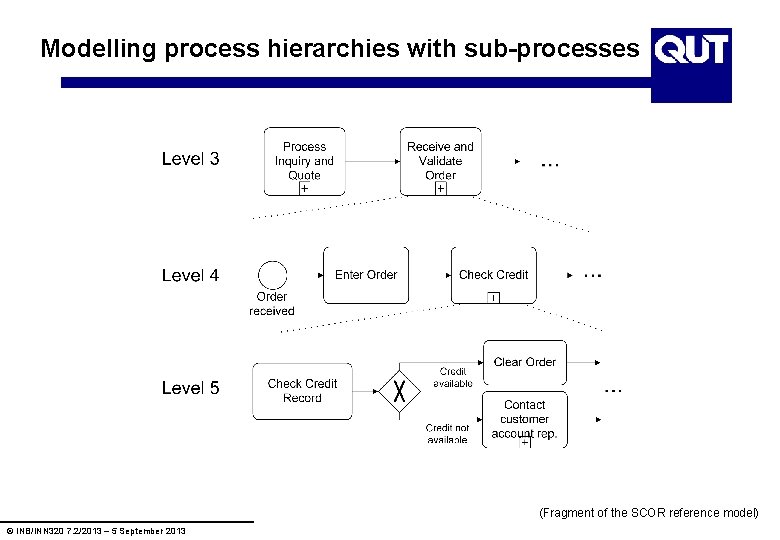
Modelling process hierarchies with sub-processes (Fragment of the SCOR reference model) © INB/INN 320 7. 2/2013 – 5 September 2013
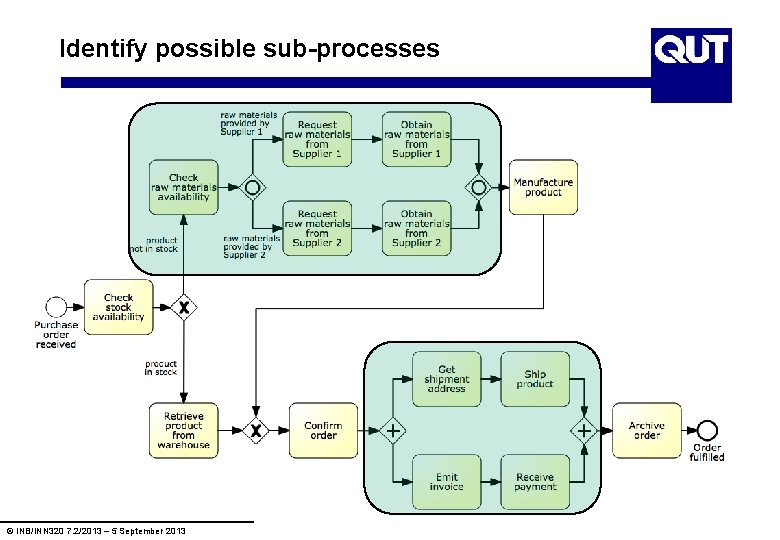
Identify possible sub-processes © INB/INN 320 7. 2/2013 – 5 September 2013
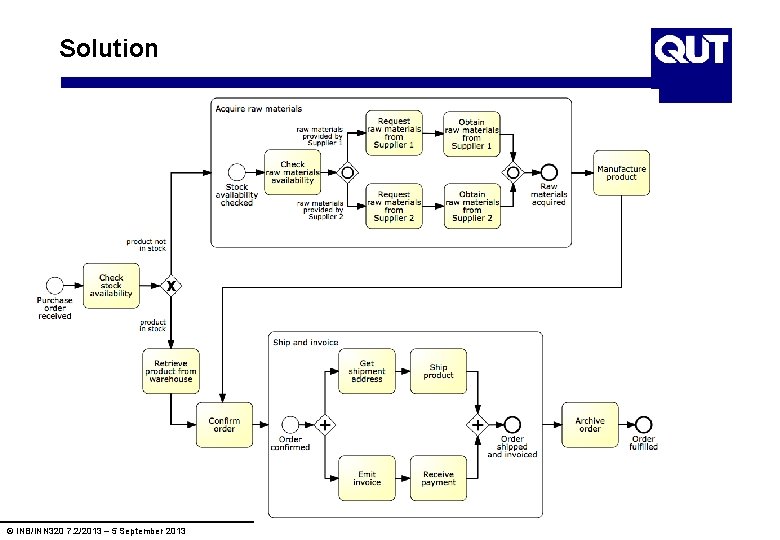
Solution © INB/INN 320 7. 2/2013 – 5 September 2013
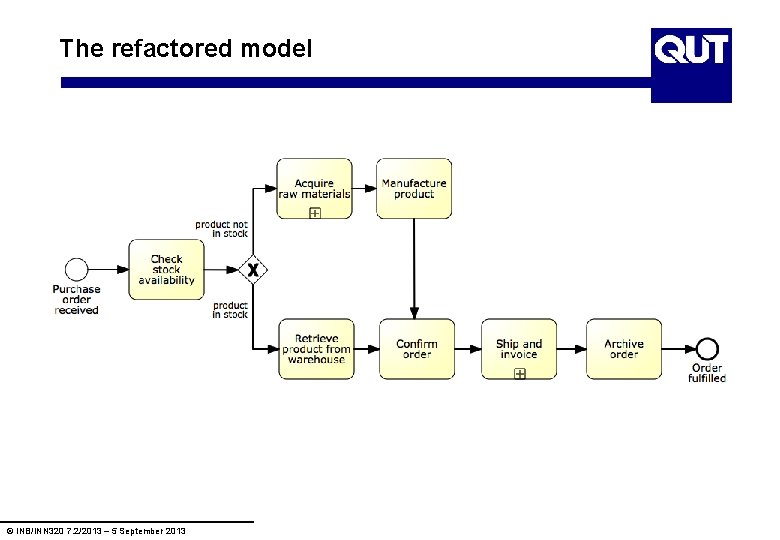
The refactored model © INB/INN 320 7. 2/2013 – 5 September 2013
Question When should we decompose a process model into subprocesses? When the model becomes too large: – Hard to understand – Increased error probability Rule of thumb: no more than 30 flow objects (activities, events, gateways) © INB/INN 320 7. 2/2013 – 5 September 2013
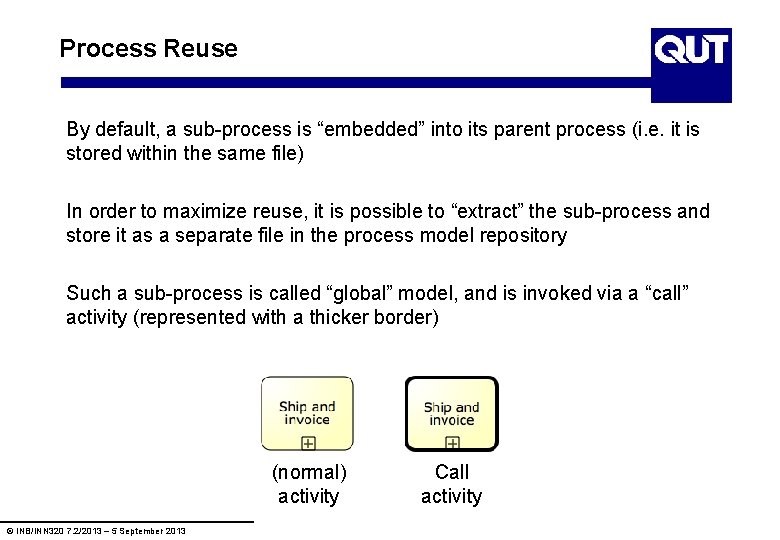
Process Reuse By default, a sub-process is “embedded” into its parent process (i. e. it is stored within the same file) In order to maximize reuse, it is possible to “extract” the sub-process and store it as a separate file in the process model repository Such a sub-process is called “global” model, and is invoked via a “call” activity (represented with a thicker border) (normal) activity © INB/INN 320 7. 2/2013 – 5 September 2013 Call activity
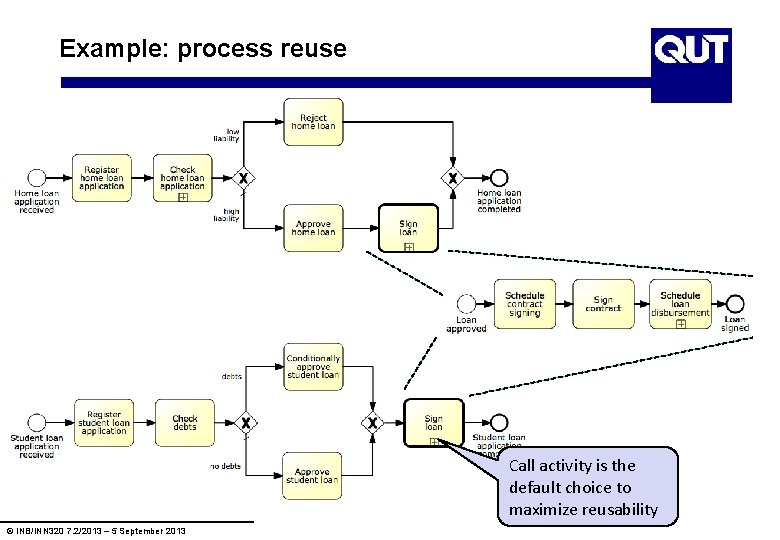
Example: process reuse Call activity is the default choice to maximize reusability © INB/INN 320 7. 2/2013 – 5 September 2013
Syntactical rules for sub-processes • Start with at least one start event – If multiple, first occurring will trigger the sub-process • Finish with at least one end event – The sub-process will complete once all tokens have reached an end event. May need an (X)OR-split after sub-process to understand what end event(s) have been reached • Sequence flows cannot cross sub-process boundaries – Use start/end events • Message flows can cross sub-process boundaries – To indicate messages emanating from/incoming into the subprocess © INB/INN 320 7. 2/2013 – 5 September 2013
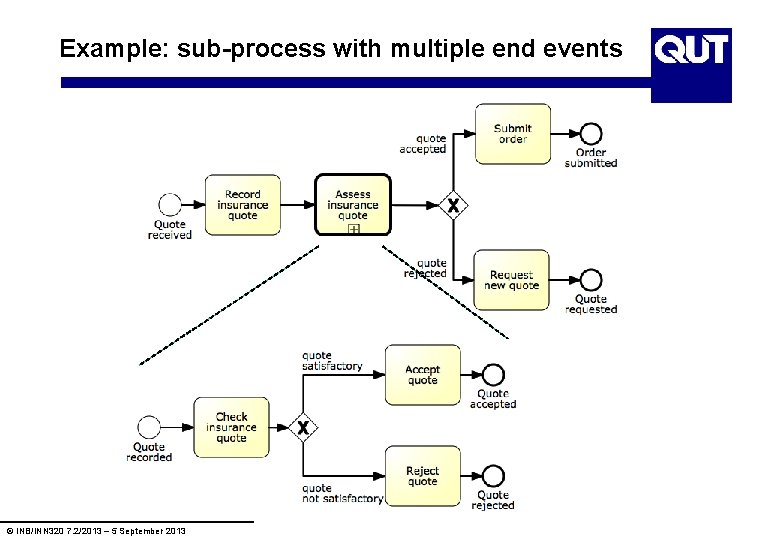
Example: sub-process with multiple end events © INB/INN 320 7. 2/2013 – 5 September 2013
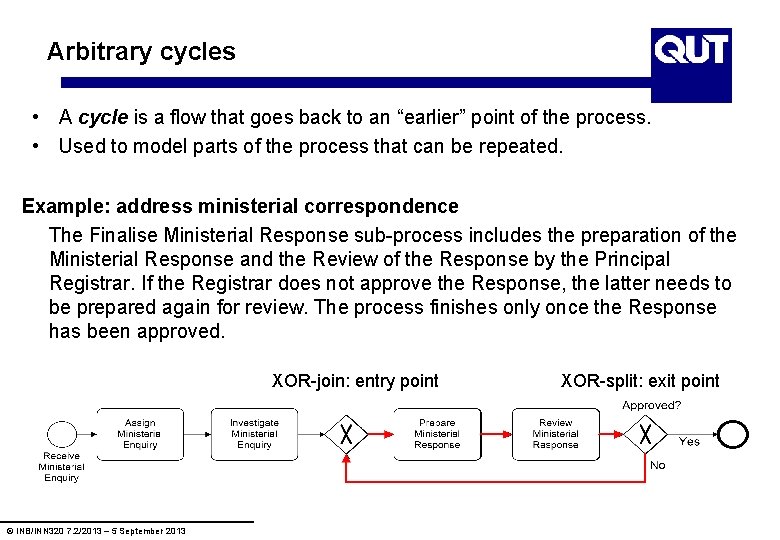
Arbitrary cycles • A cycle is a flow that goes back to an “earlier” point of the process. • Used to model parts of the process that can be repeated. Example: address ministerial correspondence The Finalise Ministerial Response sub-process includes the preparation of the Ministerial Response and the Review of the Response by the Principal Registrar. If the Registrar does not approve the Response, the latter needs to be prepared again for review. The process finishes only once the Response has been approved. XOR-join: entry point © INB/INN 320 7. 2/2013 – 5 September 2013 XOR-split: exit point
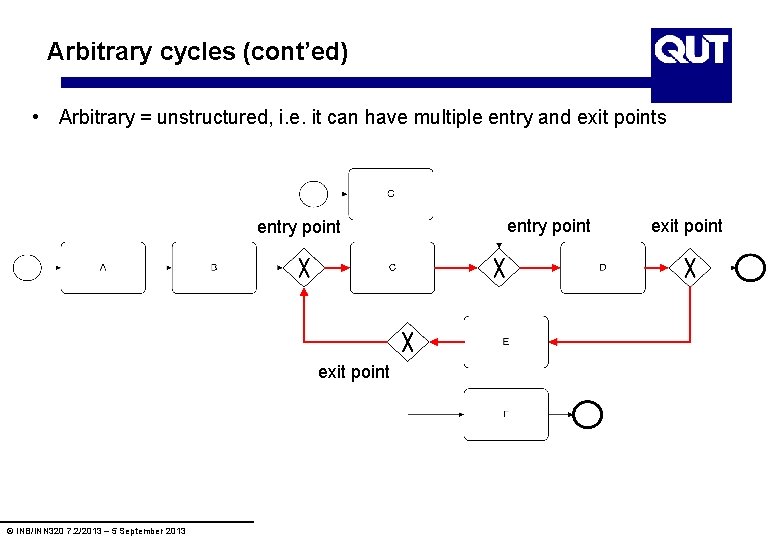
Arbitrary cycles (cont’ed) • Arbitrary = unstructured, i. e. it can have multiple entry and exit points entry point exit point © INB/INN 320 7. 2/2013 – 5 September 2013 entry point exit point
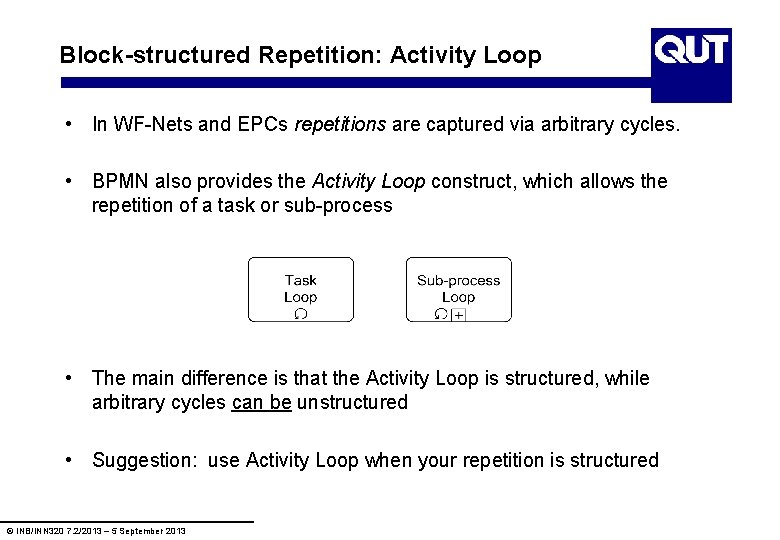
Block-structured Repetition: Activity Loop • In WF-Nets and EPCs repetitions are captured via arbitrary cycles. • BPMN also provides the Activity Loop construct, which allows the repetition of a task or sub-process • The main difference is that the Activity Loop is structured, while arbitrary cycles can be unstructured • Suggestion: use Activity Loop when your repetition is structured © INB/INN 320 7. 2/2013 – 5 September 2013
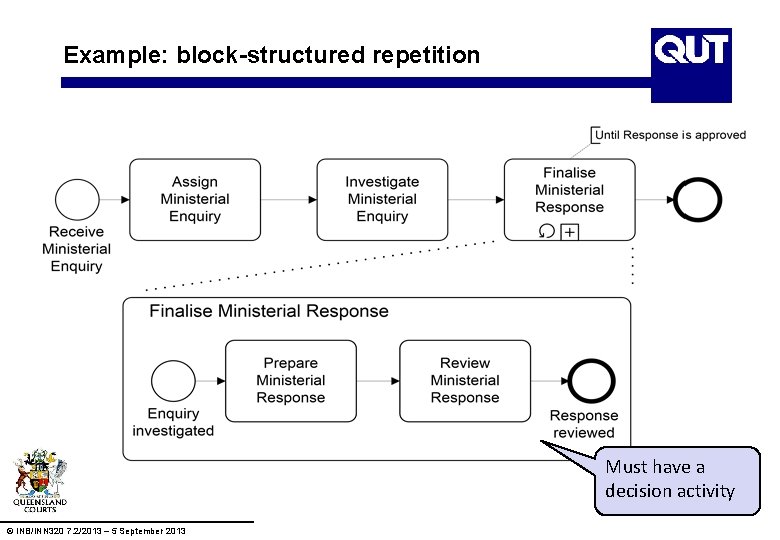
Example: block-structured repetition Must have a decision activity © INB/INN 320 7. 2/2013 – 5 September 2013
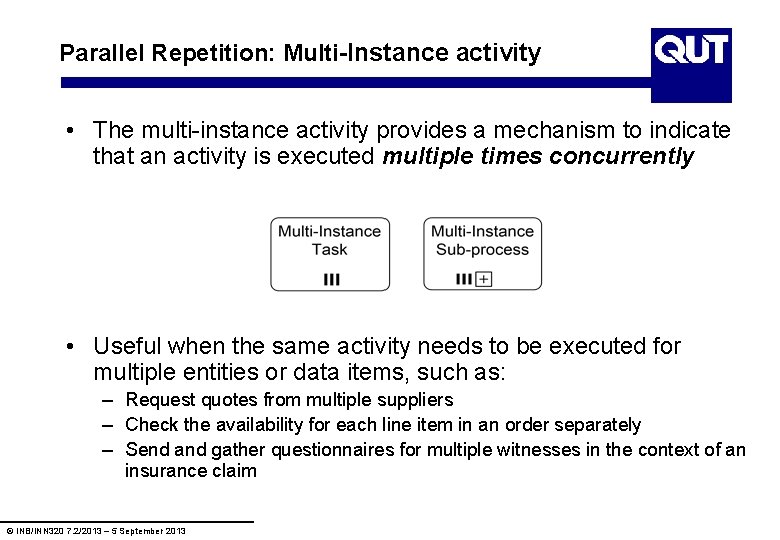
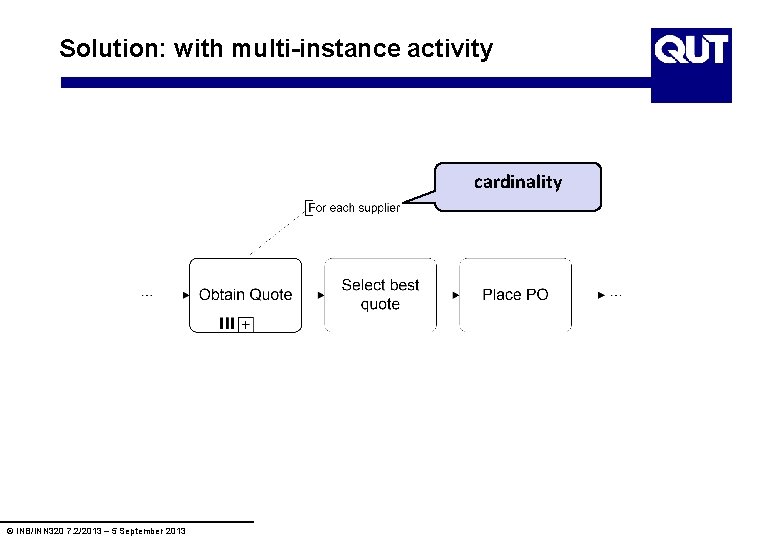
Parallel Repetition: Multi-Instance activity • The multi-instance activity provides a mechanism to indicate that an activity is executed multiple times concurrently • Useful when the same activity needs to be executed for multiple entities or data items, such as: – Request quotes from multiple suppliers – Check the availability for each line item in an order separately – Send and gather questionnaires for multiple witnesses in the context of an insurance claim © INB/INN 320 7. 2/2013 – 5 September 2013
Example: multi-instance activity In procurement, typically a quote is to be obtained from all preferred suppliers (assumption: five preferred suppliers exist). After all quotes are received, they are evaluated and the best quote is selected. A corresponding purchase order is then placed. © INB/INN 320 7. 2/2013 – 5 September 2013
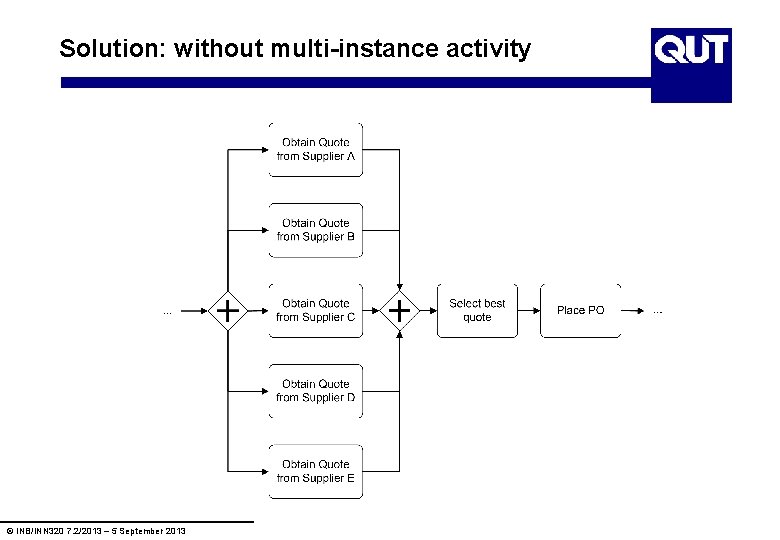
Solution: without multi-instance activity © INB/INN 320 7. 2/2013 – 5 September 2013
Solution: with multi-instance activity cardinality © INB/INN 320 7. 2/2013 – 5 September 2013
Example: multi-instance activity After a car accident, a statement is sought from the witnesses that were present, in order to lodge the insurance claim. As soon as the first two statements are received, the claim can be lodged to the insurance company without waiting for the other statements. PS: all people involved in the accident survived! © INB/INN 320 7. 2/2013 – 5 September 2013
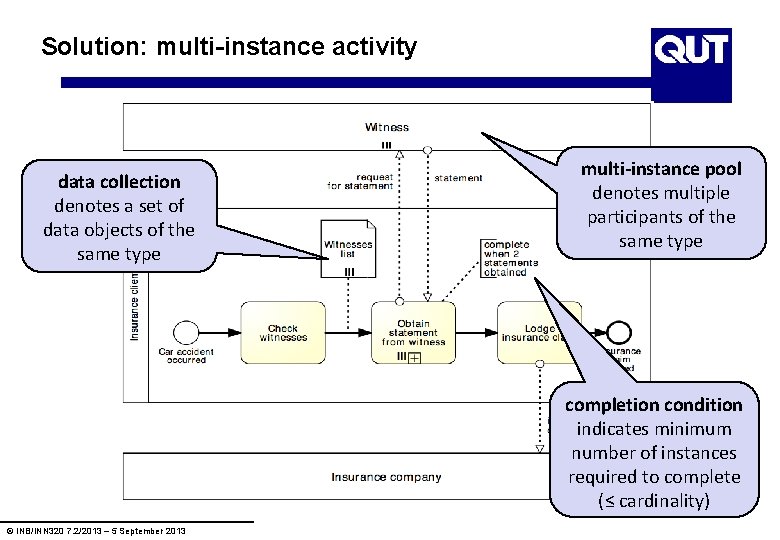
Solution: multi-instance activity data collection denotes a set of data objects of the same type multi-instance pool denotes multiple participants of the same type completion condition indicates minimum number of instances required to complete (≤ cardinality) © INB/INN 320 7. 2/2013 – 5 September 2013
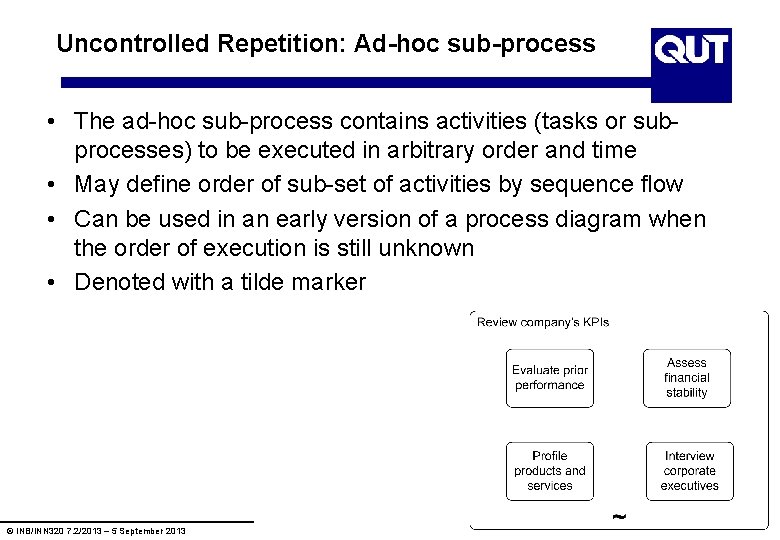
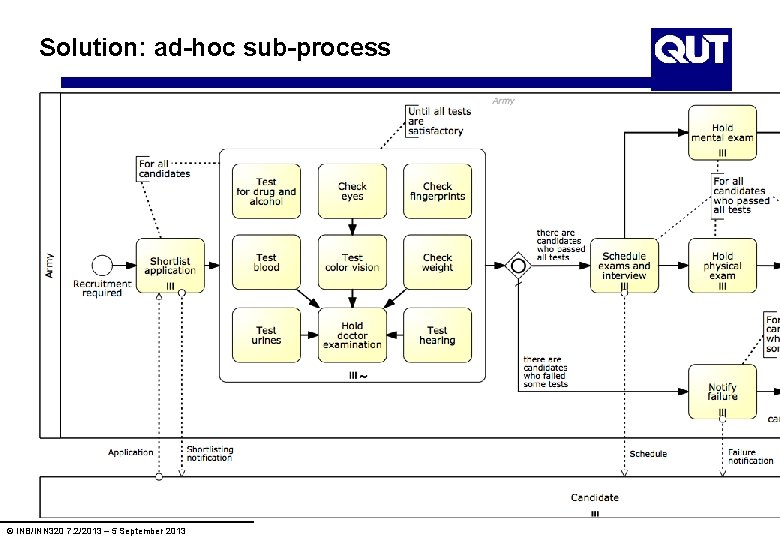
Uncontrolled Repetition: Ad-hoc sub-process • The ad-hoc sub-process contains activities (tasks or subprocesses) to be executed in arbitrary order and time • May define order of sub-set of activities by sequence flow • Can be used in an early version of a process diagram when the order of execution is still unknown • Denoted with a tilde marker © INB/INN 320 7. 2/2013 – 5 September 2013
Example: ad-hoc sub-process A typical army selection process starts by shortlisting all candidates’ applications. Those shortlisted are then called to sit the following tests: drug and alcohol, eye, color vision, hearing, blood, urine, weight, fingerprinting and doctor examination. The color vision can only be done after the eye test, while the doctor examination can only be done after color vision, hearing, blood, urine and weight have been tested. Moreover, it may be required for some candidates to repeat some of these tests multiple times in order to get a correct assessment, e. g. the blood test may need be repeated if the candidate has taken too much sugar in the previous 24 hours. The candidates that pass all tests are asked to sit a mental exam and a physical exam, followed by an interview. Only those that also pass these two exams and perform well in the interview can be recruited in the army. © INB/INN 320 7. 2/2013 – 5 September 2013
Solution: ad-hoc sub-process © INB/INN 320 7. 2/2013 – 5 September 2013
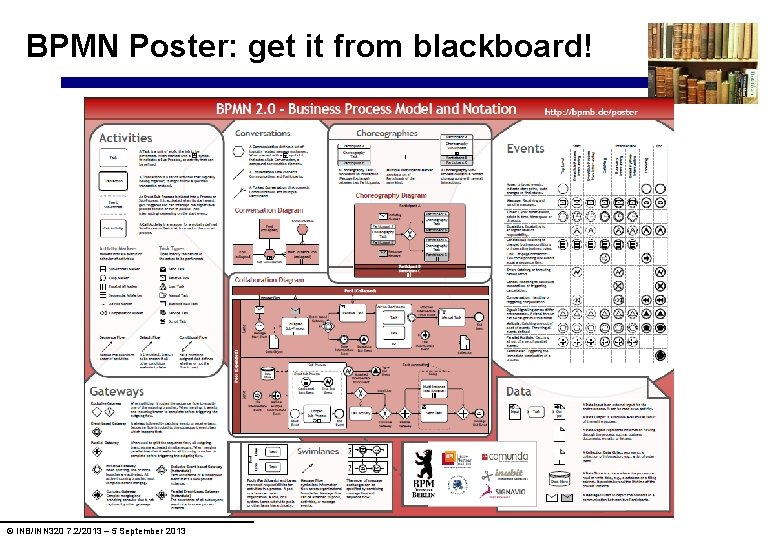
BPMN Poster: get it from blackboard! © INB/INN 320 7. 2/2013 – 5 September 2013
References Required • Sections 4. 1 - 4. 3. 1 of Chapter 4 of textbook “Fundamentals of BPM” Recommended • OMG (2011): BPMN 2. 0 Specification • BPM Offensive (2011): BPMN 2. 0 Poster • OGM (2010): BPMN 2. 0 By Example Web References • OMG BPM Initiative • BPMN Community Books on BPMN • Silver B. (2011): “BPMN Method & Style” 2 nd Edition, Cody-Cassidy © INB/INN 320 7. 2/2013 – 5 September 2013

A/Prof. Marcello La Rosa BPM Discipline Information Systems School Science & Engineering Faculty Queensland University of Technology P block, GP campus Brisbane QLD 4000 Australia p +61 (0)7 3138 -9482 e m. larosa@qut. edu. au w www. marcellolarosa. com © INB/INN 320 7. 2/2013 – 5 September 2013
- Slides: 39