
Business Process Management Unit 5 Dr R Umarani
Business Process Management Unit 5 Dr. R. Umarani Assistant Professor 1
Quality Process Analysis 2
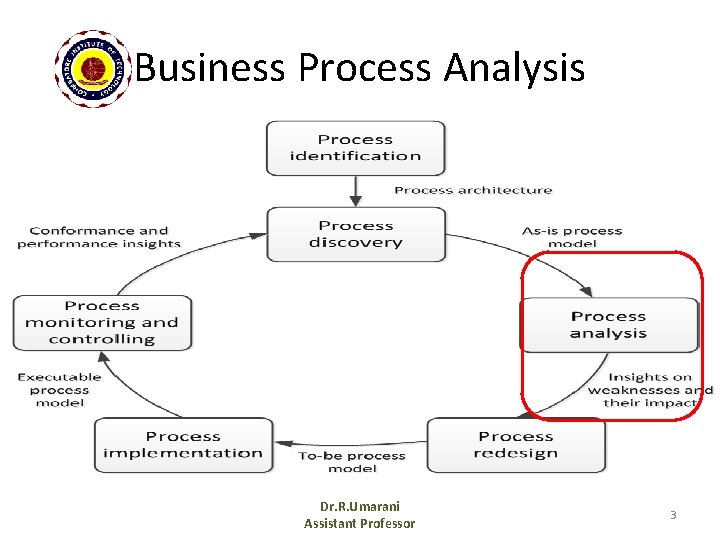
Business Process Analysis Dr. R. Umarani Assistant Professor 3
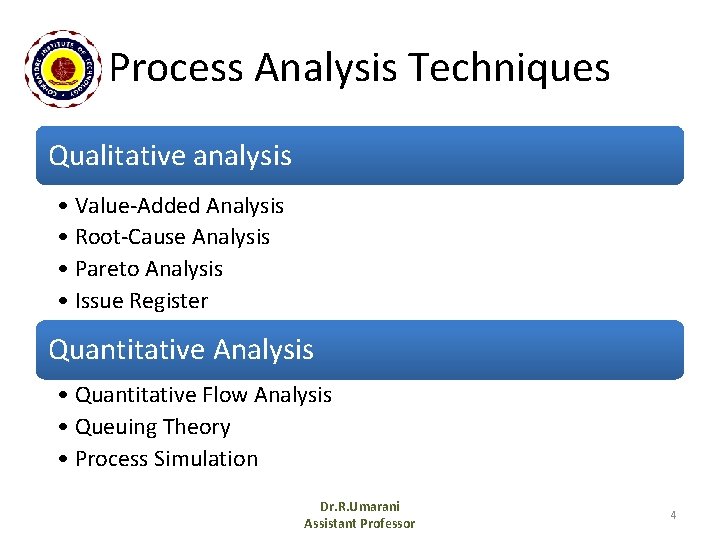
Process Analysis Techniques Qualitative analysis • Value-Added Analysis • Root-Cause Analysis • Pareto Analysis • Issue Register Quantitative Analysis • Quantitative Flow Analysis • Queuing Theory • Process Simulation Dr. R. Umarani Assistant Professor 4
Purposes of Qualitative Analysis Identify and eliminate waste • Valued-added analysis Identify, understand prioritize issues • Issue register • Root-cause analysis (e. g. cause-effect diagrams) • Pareto analysis Dr. R. Umarani Assistant Professor 5
Eliminating Waste "All we are doing is looking at the time line, from the moment the customer gives us an order to the point when we collect the cash. And we are reducing the time line by reducing the non-value-adding wastes ” Taiichi Ohno Dr. R. Umarani Assistant Professor 6
7+1 Sources of Waste 1. 2. 3. 4. 5. Unnecessary Transportation (send, receive) Inventory (large work-in-process) Motion (drop-off, pick-up, go to) Waiting (waiting time between tasks) Over-Processing (performing what is not yet needed or might not be needed) 6. Over-Production (unnecessary cases) 7. Defects (rework to fix defects) 8. Resource underutilization (idle resources) Dr. R. Umarani Assistant Professor 7
Value-Added Analysis 1. Decorticate the process into steps 2. Classify each step into: – Value-adding (VA): Produces value or satisfaction to the customer. • Is the customer willing to pay for this step? – Business value-adding (BVA): Necessary or useful for the business to run smoothly, or required due to the regulatory environment, e. g. checks, controls • Would the business potentially suffer in the long-term if this step was removed? – Non-value-adding (NVA) – everything else including handovers, delays and rework Dr. R. Umarani Assistant Professor 8
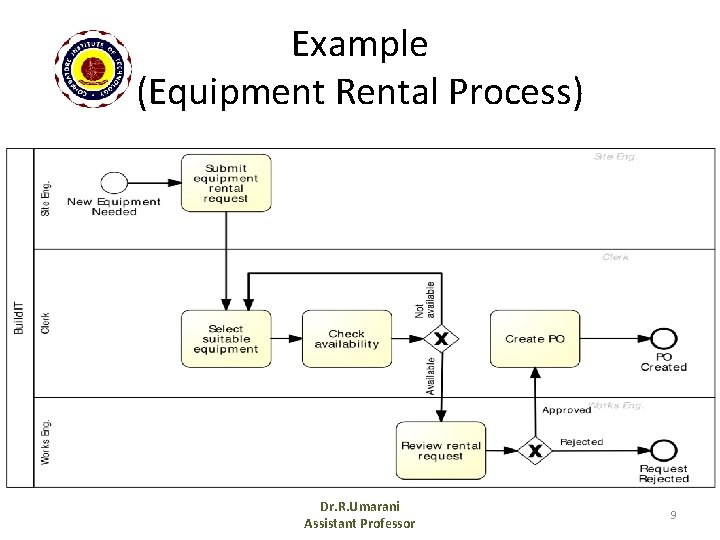
Example (Equipment Rental Process) Dr. R. Umarani Assistant Professor 9
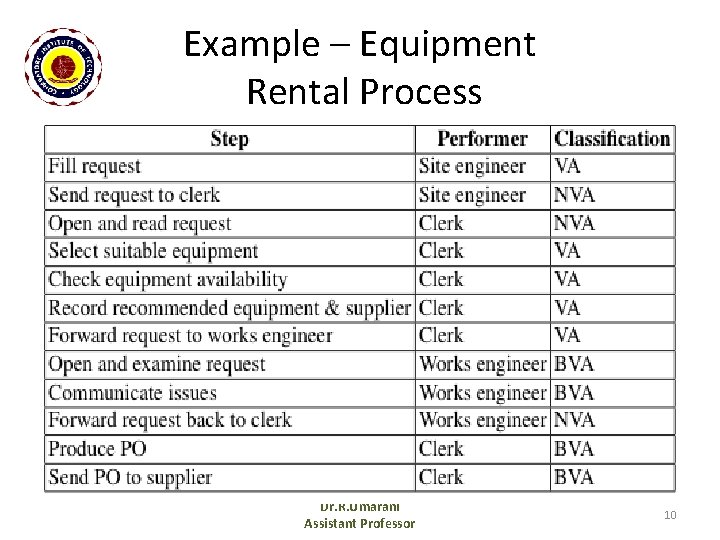
Example – Equipment Rental Process Dr. R. Umarani Assistant Professor 10

Admission Process Consider the following process for the admission of graduate students at a university. In order to apply for admission, students first fill in an online form. Online applications are recorded in an information system to which all staff members involved in the admissions process have access to. After a student has submitted the online form, a PDF document is generated and the student is requested to download it, sign it, and send it by post together with the required documents, which include: 1. Certified copies of previous degree and academic transcripts. 2. Results of English language test. 3. Curriculum vitae. When these documents are received by the admissions office, an officer checks the completeness of the documents. If any document is missing, an e-mail is sent to the student. The student has to send the missing documents by post. Assuming the application is complete, the admissions office sends the certified copies of the degrees to an academic recognition agency, which checks the degrees and gives an assessment of their validity and equivalence in terms local education standards. This agency requires that all documents be sent to it by post, and all documents must be certified copies of the originals. The agency sends back its assessment to the university by post as well. Assuming the degree verification is successful, the English language test results are then checked online by an officer at the admissions office. If the validity of the English language test results cannot be verified, the application is rejected (such notifications of rejection are sent by e-mail). Once all documents of a given student have been validated, the admission office forwards these documents by internal mail to the corresponding academic committee responsible for deciding whether to offer admission or not. The committee makes its decision based on the academic transcripts and the CV. The committee meets once every 2 to 3 weeks and examines all applications that are ready for academic assessment at the time of the meeting. At the end of the committee meeting, the chair of the committee notifies the admissions office of the selection outcomes. This notification includes a list of admitted and rejected candidates. A few days later, the admission office notifies the outcome to each candidate via e-mail. Additionally, successful candidates are sent a confirmation letter by post. Dr. R. Umarani Assistant Professor 11
Techniques for issue analysis • Cause-effect diagrams • Why-why diagrams • Pareto charts Dr. R. Umarani Assistant Professor 12
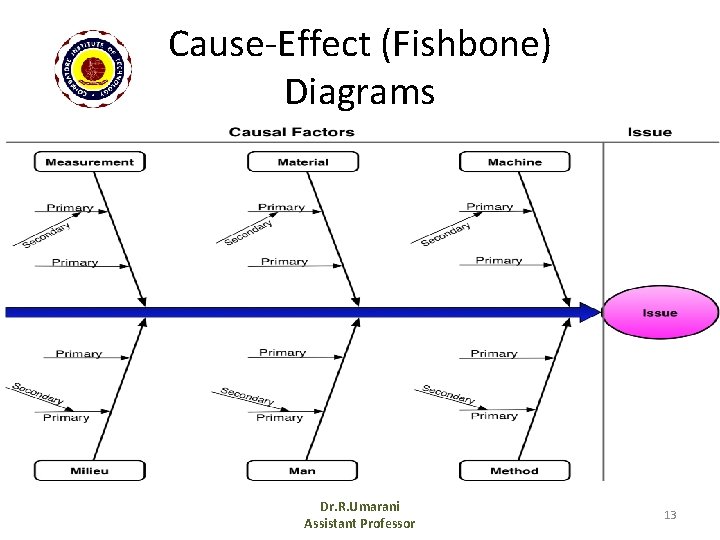
Cause-Effect (Fishbone) Diagrams Dr. R. Umarani Assistant Professor 13
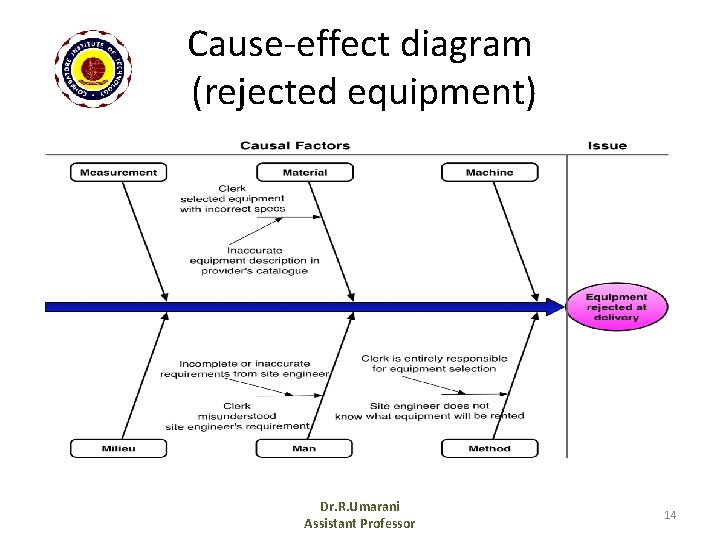
Cause-effect diagram (rejected equipment) Dr. R. Umarani Assistant Professor 14
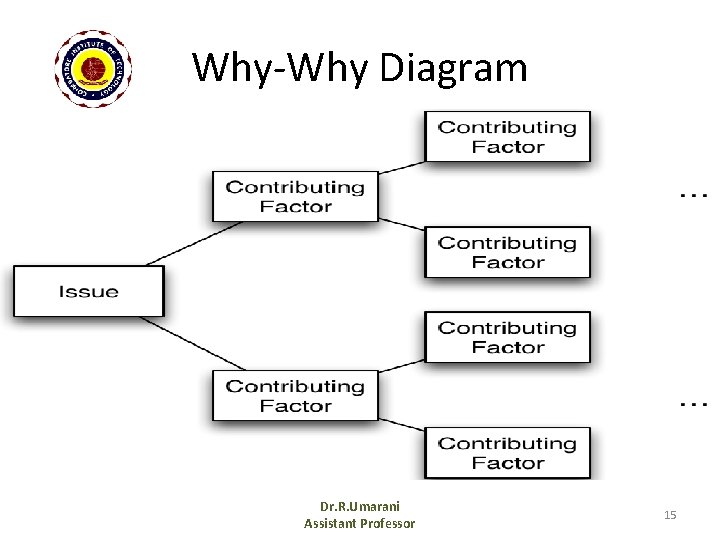
Why-Why Diagram Dr. R. Umarani Assistant Professor 15
Why-why diagram (equipment rental) Site engineers keep equipment longer, why? • Site engineer fears that equipment will not be available later when needed, why? – time between request and delivery too long, why? • excessive time spent in finding a suitable equipment and approving the request, why? – time spent by clerk contacting possibly multiple suppliers sequentially; – time spent waiting for works engineer to check the requests; Dr. R. Umarani Assistant Professor 16
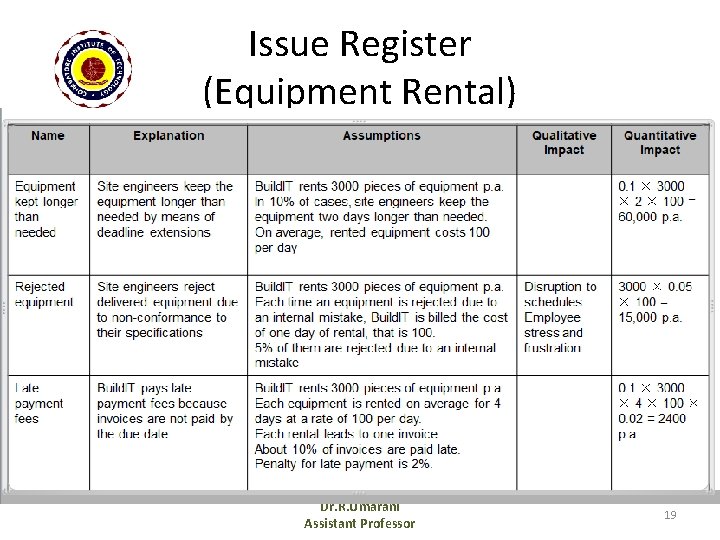
Issue Documentation and Impact Assessment -Issue Register • Purpose: to categorise identified issues as part of asis process modelling • Output of root cause analysis by providing a more detailed analysis of individual issues and their impact. • The impact of issue is measured quantitatively and qualitatively • Quantitative – time or money lost • Qualitative – perceived nuisances to the customer Dr. R. Umarani Assistant Professor 17
Issue Register 1. 2. 3. 4. Name of the issue : 2 -5 words Description : 1 -2 sentences Priority : 1, 2, 3 Assumptions or input data: made in impact 5. Qualitative impact 6. Quantitative impact Dr. R. Umarani Assistant Professor 18
Issue Register (Equipment Rental) Dr. R. Umarani Assistant Professor 19
Pareto Analysis - Issue register will serve for Pareto analysis - Aim of Pareto analysis is to identify which issues or which causal factors of an issue should be given priority - Sometimes this principle is also called the 80 -20 principle ie. 20% of issues are responsible for 80% of the effect Dr. R. Umarani Assistant Professor 20
Pareto Analysis – Typical approach - Define the effect to be analysed and the measure via which of this effect will be quantified like financial loss for the customer or business, time loss, no. of occurrences. - Identify all relevant issues that contribute to the effect to be analysed - Quantify each issue according to the chosen measure - Sort the issues from highest to lowest - Draw a Pareto chart Dr. R. Umarani Assistant Professor 21
Pareto chart • Useful to prioritize a collection of issues or factors behind an issue • Bar chart where the height of the bar denotes the impact of each issue • Bars sorted by impact • Superposed curve where the y-axis represents the cumulative percentage impact Dr. R. Umarani Assistant Professor 22
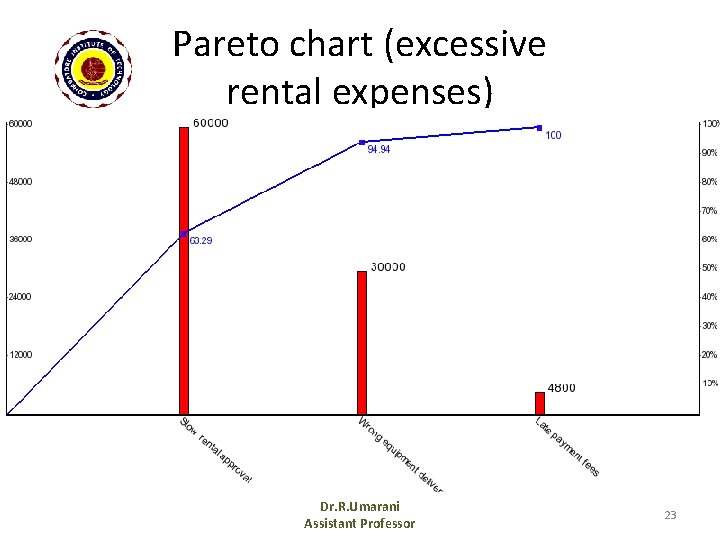
Pareto chart (excessive rental expenses) Dr. R. Umarani Assistant Professor 23
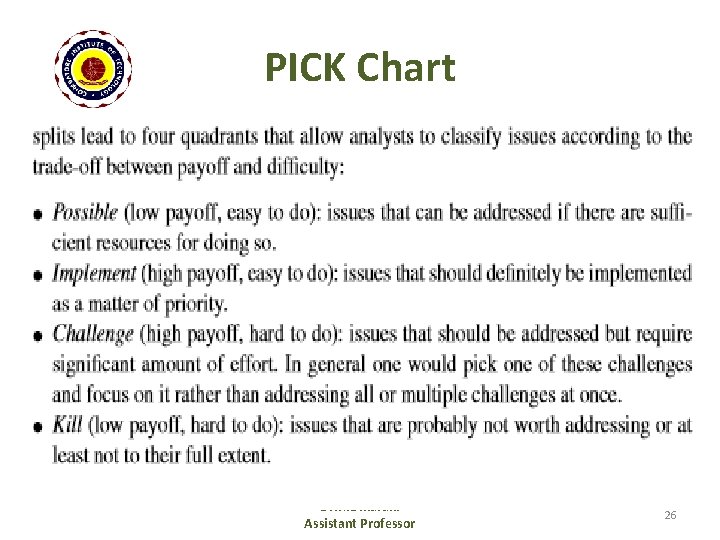
PICK Chart - A type of chart that can be used as a complement to Pareto charts in order to take into account the difficult dimension is the PICK chart. Dr. R. Umarani Assistant Professor 24
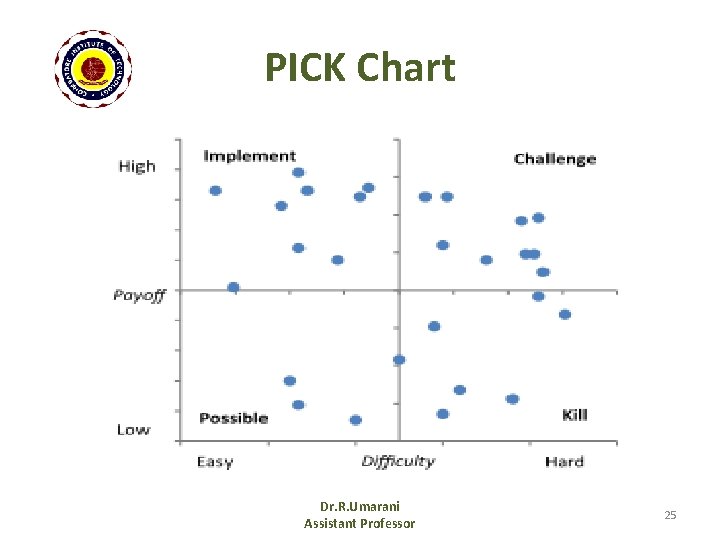
PICK Chart Dr. R. Umarani Assistant Professor 25
PICK Chart Dr. R. Umarani Assistant Professor 26
Quantitative Process Analysis - Is Valuable tool to gain systematic insights into a process. Dr. R. Umarani Assistant Professor 27
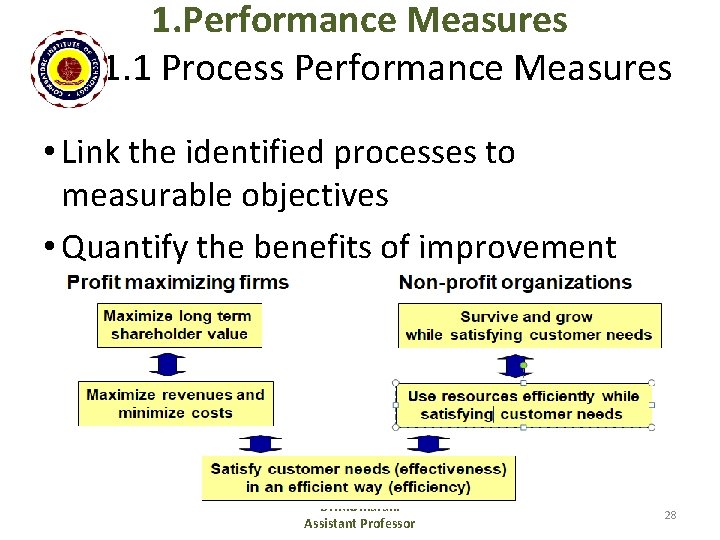
1. Performance Measures 1. 1 Process Performance Measures • Link the identified processes to measurable objectives • Quantify the benefits of improvement Dr. R. Umarani Assistant Professor 28
Fill in the blanks If you had to choose between two services, you would typically choose the one that is: • F… • B… • C… Dr. R. Umarani Assistant Professor 29
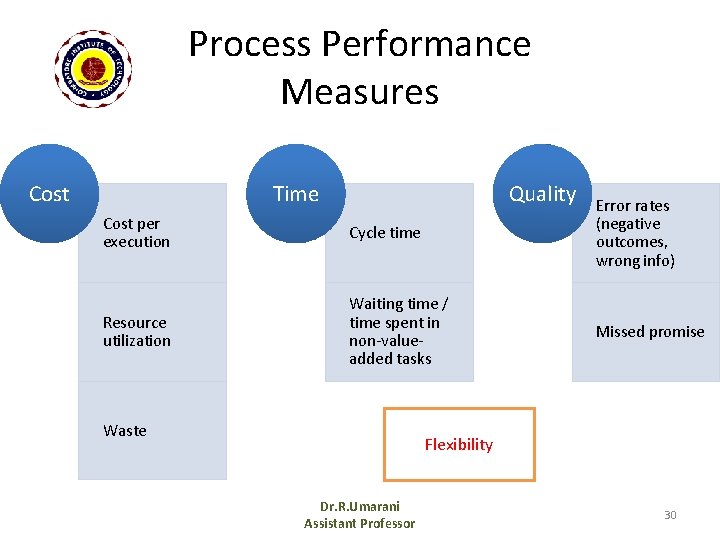
Process Performance Measures Cost Time Quality Cost per execution Cycle time Error rates (negative outcomes, wrong info) Resource utilization Waiting time / time spent in non-valueadded tasks Missed promise Waste Flexibility Dr. R. Umarani Assistant Professor 30
Key Performance Indicators (KPI) • • Time Cost Quality Flexibility Dr. R. Umarani Assistant Professor 31

Let’s start with time Dr. R. Umarani Assistant Professor 32
Cycle Time Analysis • Cycle time: Difference between a job’s start and end time • Cycle time analysis: the task of calculating the average cycle time for an entire process or process fragment – Assumes that the average activity times for all involved activities are available (activity time = waiting time + processing time) • In the simplest case a process consists of a sequence of activities on a sequential path – The average cycle time is the sum of the average activity times • … but in general we must be able to account for – Alternative paths (XOR splits) – Parallel paths (AND splits) – Rework (cycles) Dr. R. Umarani Assistant Professor 33
Cost - Performance measure in analysing and redesigning a business process that has financial nature - Fixed Cost - Variable Cost - Operating Cost Dr. R. Umarani Assistant Professor 34
Quality - Client side Process participant side External quality Internal quality Dr. R. Umarani Assistant Professor 35
Flexibility - Ability of resources to execute different tasks within a business process setting - Ability of a business process as a whole to handle various cases and changing workloads - Ability of the management in charge to change the used structure and allocation rules - Ability to change the structure and responsiveness of the business process Ø Run time flexibility Ø Build time flexibility Dr. R. Umarani Assistant Professor 36
1. 2. Balanced Score Card • Financial Measures • Internal Business Measures • Innovation and Learning Measures • Customer Measure Top Down Procedure ØCorporate ØDepartment ØLower Dr. R. Umarani Assistant Professor 37
Case Scenario A restaurant has recently lost many customers due to poor customer service. The management team has decided to address this issue first of by focusing on the delivery of meals. The team gathered data by asking customers about how quickly they liked to receive their meals and what they considered as an acceptable wait. The data suggested that half of the customers would prefer their meals to be served in 15 minutes or less. All Customers agreed that a waiting time of 30 minutes or more is unacceptable. Dr. R. Umarani Assistant Professor 38
1. 3. Reference Models and Industry Benchmarks • Supply chain operations reference model(SCOR) ØPurchase order cycle time ØInventory management • Process classification framework ØStandardised names and definitions for the process Dr. R. Umarani Assistant Professor 39
2. Flow Analysis • Family of techniques that allow us to estimate the overall performance of a process given some knowledge about the performance of its activities Dr. R. Umarani Assistant Professor 40
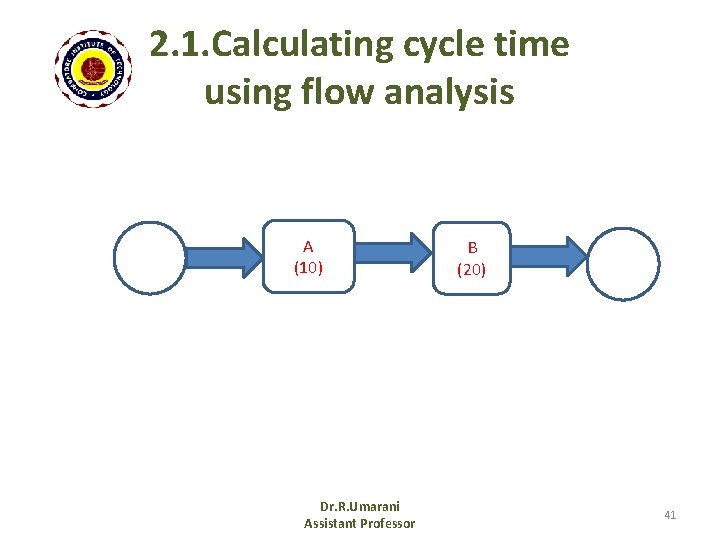
2. 1. Calculating cycle time using flow analysis A (10) Dr. R. Umarani Assistant Professor B (20) 41
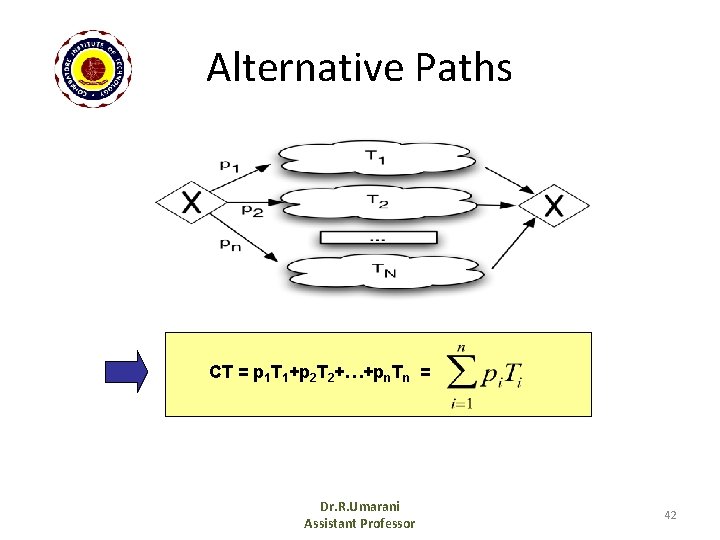
Alternative Paths CT = p 1 T 1+p 2 T 2+…+pn. Tn = Dr. R. Umarani Assistant Professor 42
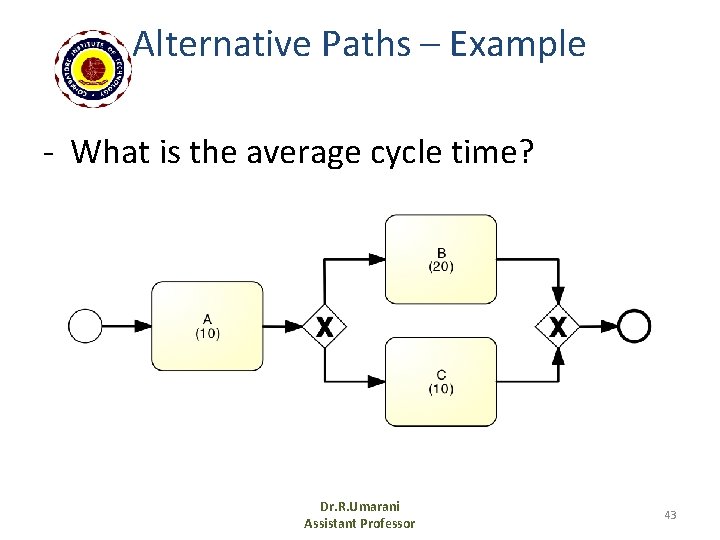
Alternative Paths – Example - What is the average cycle time? Dr. R. Umarani Assistant Professor 43
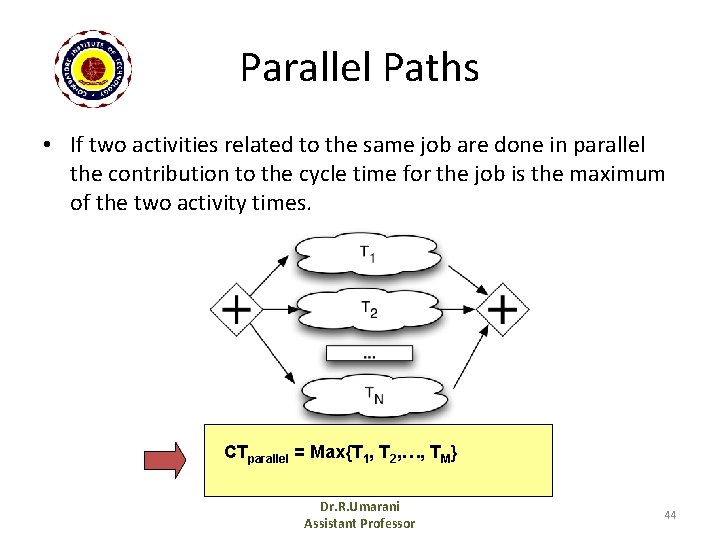
Parallel Paths • If two activities related to the same job are done in parallel the contribution to the cycle time for the job is the maximum of the two activity times. CTparallel = Max{T 1, T 2, …, TM} Dr. R. Umarani Assistant Professor 44
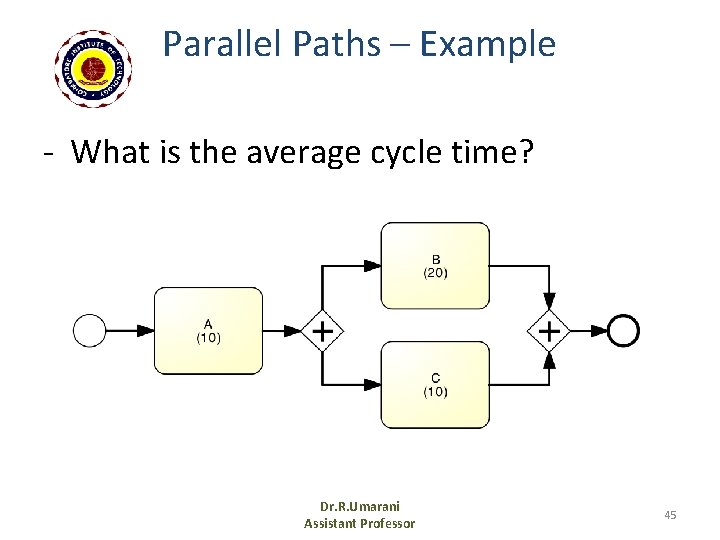
Parallel Paths – Example - What is the average cycle time? Dr. R. Umarani Assistant Professor 45
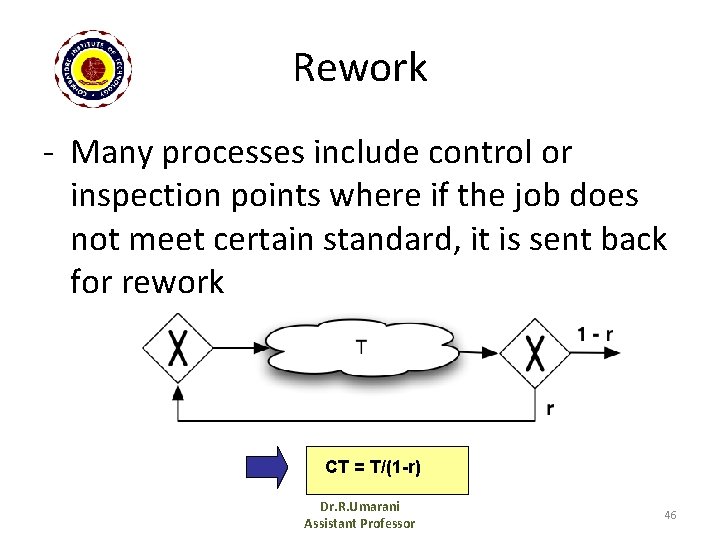
Rework - Many processes include control or inspection points where if the job does not meet certain standard, it is sent back for rework CT = T/(1 -r) Dr. R. Umarani Assistant Professor 46
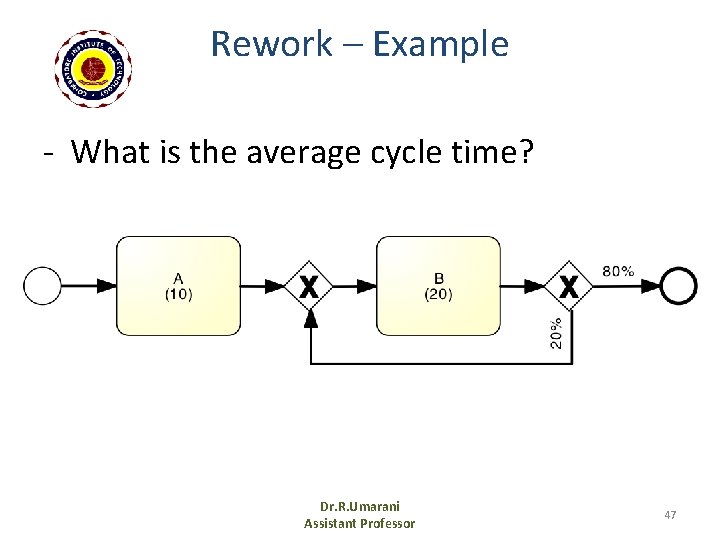
Rework – Example - What is the average cycle time? Dr. R. Umarani Assistant Professor 47
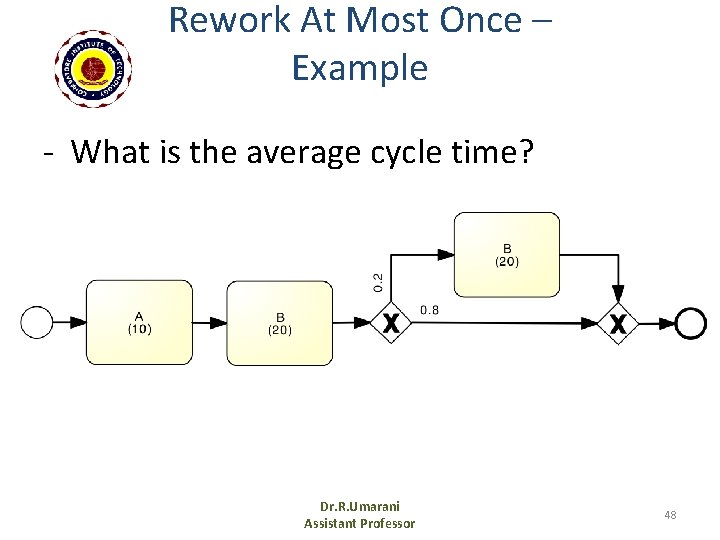
Rework At Most Once – Example - What is the average cycle time? Dr. R. Umarani Assistant Professor 48
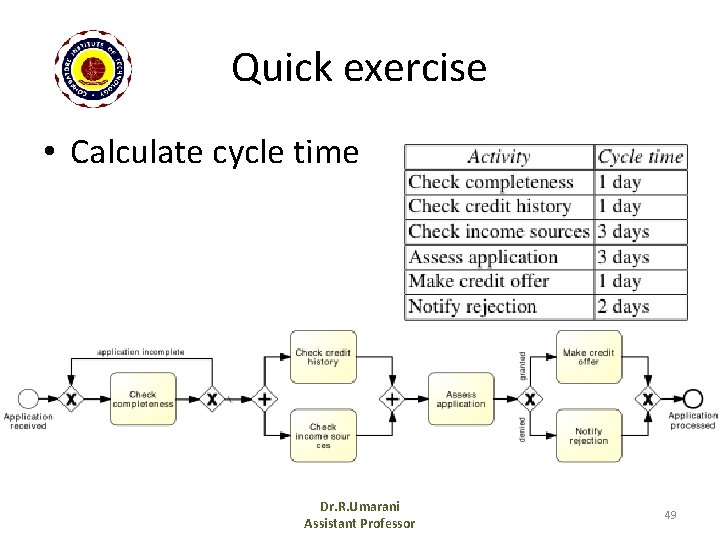
Quick exercise • Calculate cycle time Dr. R. Umarani Assistant Professor 49
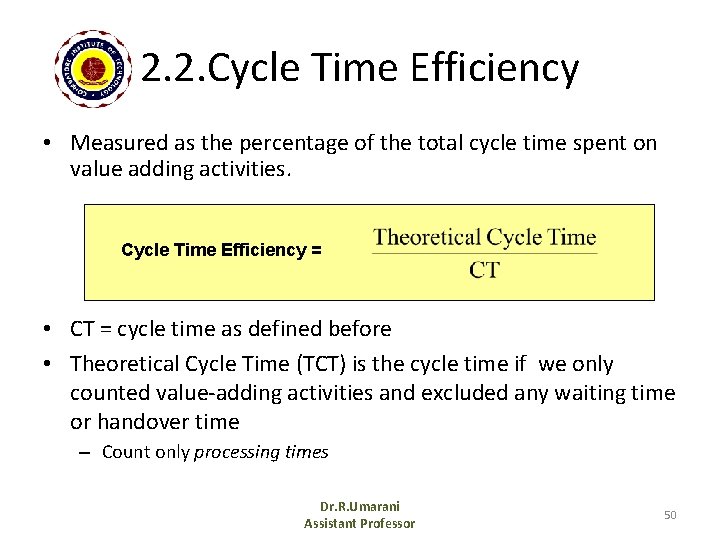
2. 2. Cycle Time Efficiency • Measured as the percentage of the total cycle time spent on value adding activities. Cycle Time Efficiency = • CT = cycle time as defined before • Theoretical Cycle Time (TCT) is the cycle time if we only counted value-adding activities and excluded any waiting time or handover time – Count only processing times Dr. R. Umarani Assistant Professor 50
2. 3. Cycle Time and WIP - CT related to arrival rate and WIP - WIP = Arrival rate * CT Dr. R. Umarani Assistant Professor 51
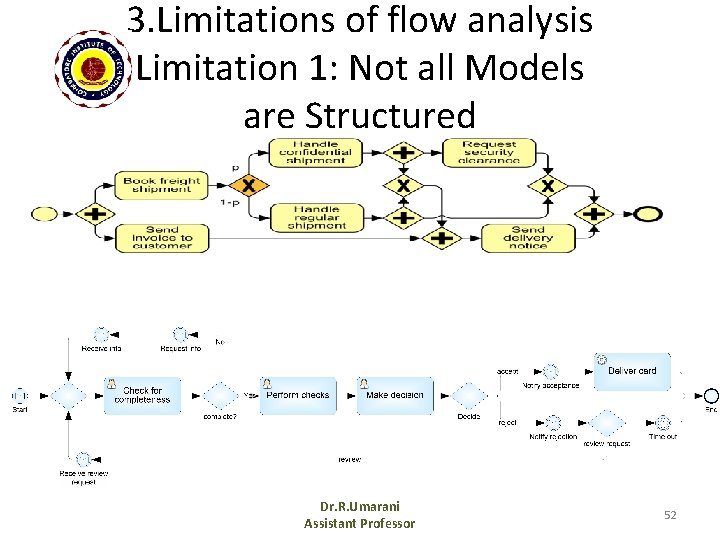
3. Limitations of flow analysis Limitation 1: Not all Models are Structured Dr. R. Umarani Assistant Professor 52
Limitation 2: Fixed load + fixed resource capacity • Cycle time analysis does not consider waiting times due to resource contention • Queuing analysis and simulation address these limitations and have a broader applicability Dr. R. Umarani Assistant Professor 53
Cycle Time & Work-In-Progress • WIP = (average) Work-In-Process – Number of cases that are running (started but not yet completed) – E. g. # of active and unfilled orders in an order-to-cash process • WIP is a form of waste (cf. 7+1 sources of waste) • Little’s Formula: WIP = ·CT – = arrival rate (number of new cases per time unit) – CT = cycle time Dr. R. Umarani Assistant Professor 54
Exercise A fast-food restaurant receives on average 1200 customers per day (between 10: 00 and 22: 00). During peak times (12: 0015: 00 and 18: 00 -21: 00), the restaurant receives around 900 customers in total, and 90 customers can be found in the restaurant (on average) at a given point in time. At non-peak times, the restaurant receives 300 customers in total, and 30 customers can be found in the restaurant (on average) at a given point in time. 1. What is the average time that a customer spends in the restaurant during peak times? 2. What is the average time that a customer spends in the restaurant during non-peak times? Dr. R. Umarani Assistant Professor 55
Exercise (cont. ) - The restaurant plans to launch a marketing campaign to attract more customers. However, the restaurant’s capacity is limited and becomes too full during peak times. What can the restaurant do to address this issue without investing in extending its building? Dr. R. Umarani Assistant Professor 56
Why flow analysis is not enough? Flow analysis does not consider waiting times due to resource contention Queuing analysis and simulation address these limitations and have a broader applicability Dr. R. Umarani Assistant Professor 57
Why is Queuing Analysis Important? • Capacity problems are very common in industry and one of the main drivers of process redesign – Need to balance the cost of increased capacity against the gains of increased productivity and service • Queuing and waiting time analysis is particularly important in service systems – Large costs of waiting and of lost sales due to waiting Prototype Example – ER at a Hospital • • • Ø Patients arrive by ambulance or by their own accord One doctor is always on duty More patients seeks help longer waiting times Question: Should another MD position be instated? Dr. R. Umarani Assistant Professor 58
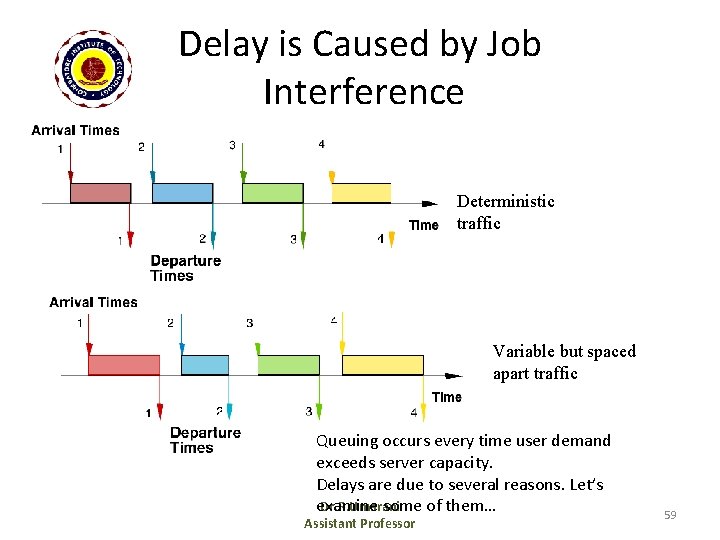
Delay is Caused by Job Interference Deterministic traffic Variable but spaced apart traffic Queuing occurs every time user demand exceeds server capacity. Delays are due to several reasons. Let’s Dr. R. Umarani examine some of them… Assistant Professor 59
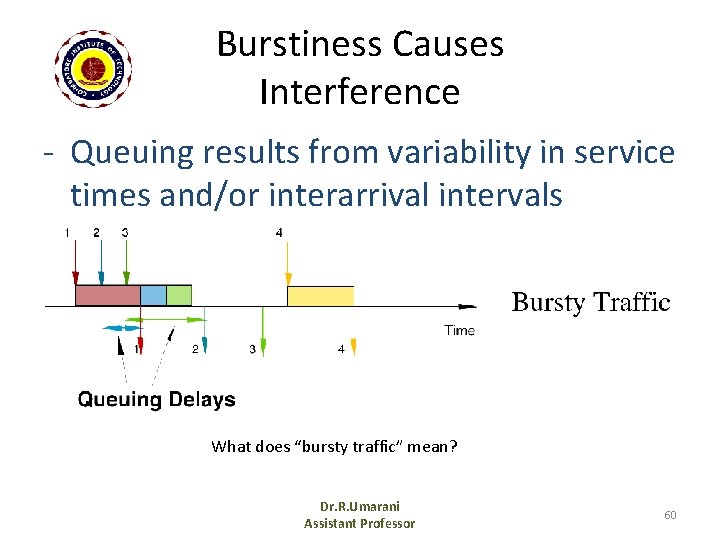
Burstiness Causes Interference - Queuing results from variability in service times and/or interarrival intervals What does “bursty traffic” mean? Dr. R. Umarani Assistant Professor 60
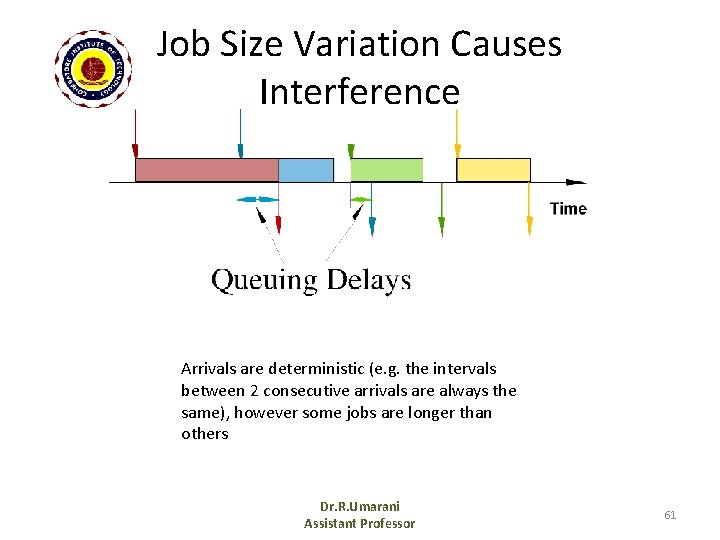
Job Size Variation Causes Interference Arrivals are deterministic (e. g. the intervals between 2 consecutive arrivals are always the same), however some jobs are longer than others Dr. R. Umarani Assistant Professor 61
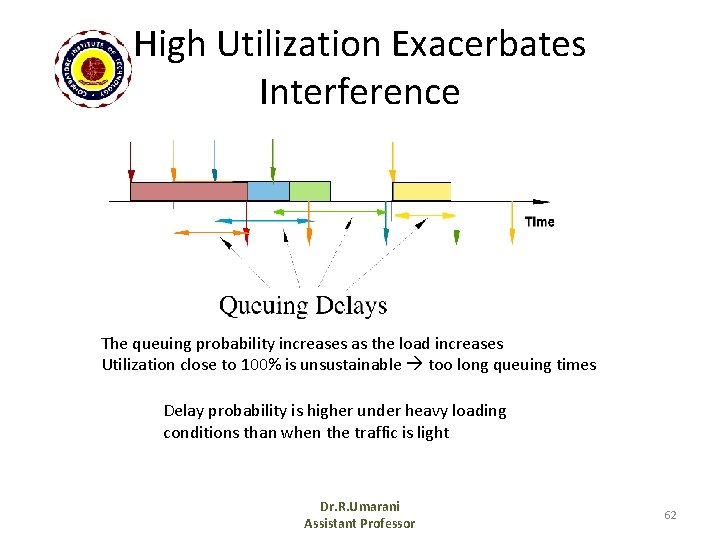
High Utilization Exacerbates Interference The queuing probability increases as the load increases Utilization close to 100% is unsustainable too long queuing times Delay probability is higher under heavy loading conditions than when the traffic is light Dr. R. Umarani Assistant Professor 62
The Poisson Process • Common arrival assumption in many queuing and simulation models • The times between arrivals are independent, identically distributed and exponential – P (arrival < t) = 1 – e-λt • Key property: The fact that a certain event has not happened tells us nothing about how long it will take before it happens – e. g. , P(X > 40 | X >= 30) = P (X > 10) Dr. R. Umarani Assistant Professor 63
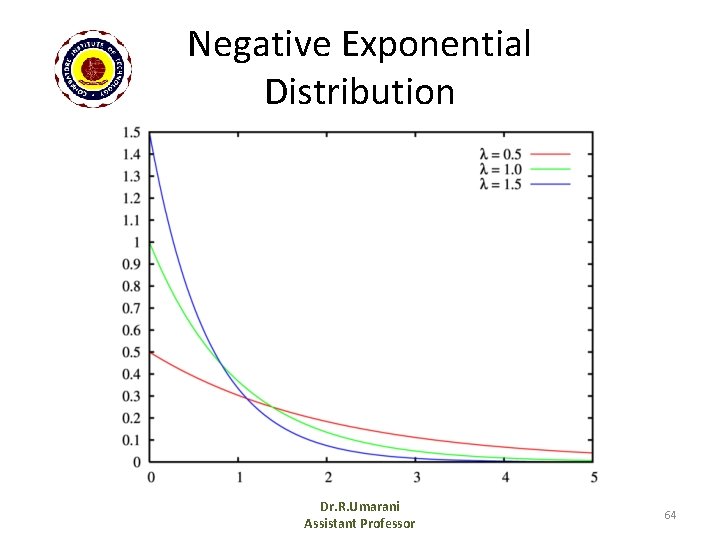
Negative Exponential Distribution Dr. R. Umarani Assistant Professor 64
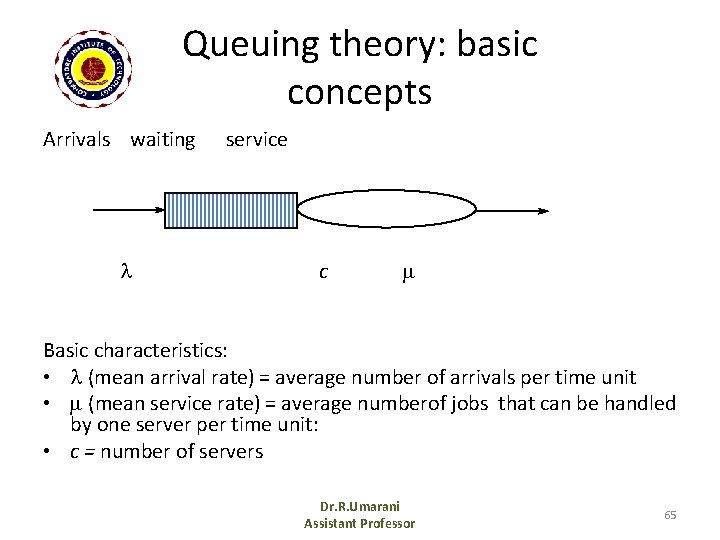
Queuing theory: basic concepts Arrivals waiting service c Basic characteristics: • (mean arrival rate) = average number of arrivals per time unit • (mean service rate) = average numberof jobs that can be handled by one server per time unit: • c = number of servers Dr. R. Umarani Assistant Professor 65
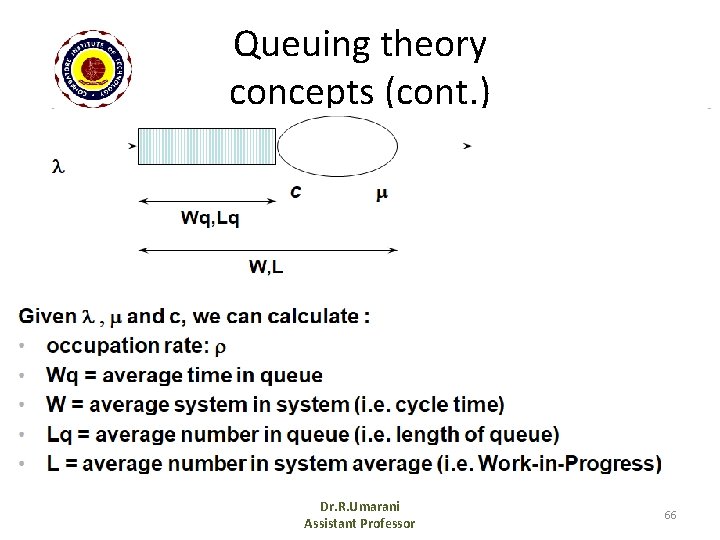
Queuing theory concepts (cont. ) Dr. R. Umarani Assistant Professor 66
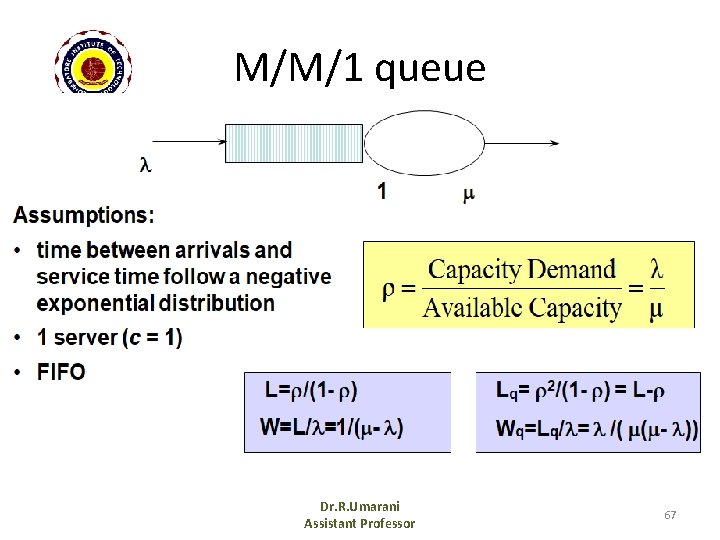
M/M/1 queue Dr. R. Umarani Assistant Professor 67
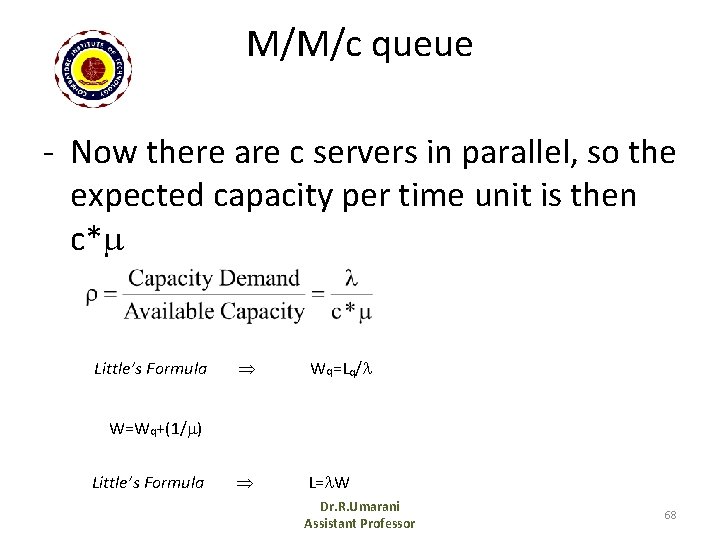
M/M/c queue - Now there are c servers in parallel, so the expected capacity per time unit is then c* Little’s Formula Wq=Lq/ L= W W=Wq+(1/ ) Little’s Formula Dr. R. Umarani Assistant Professor 68
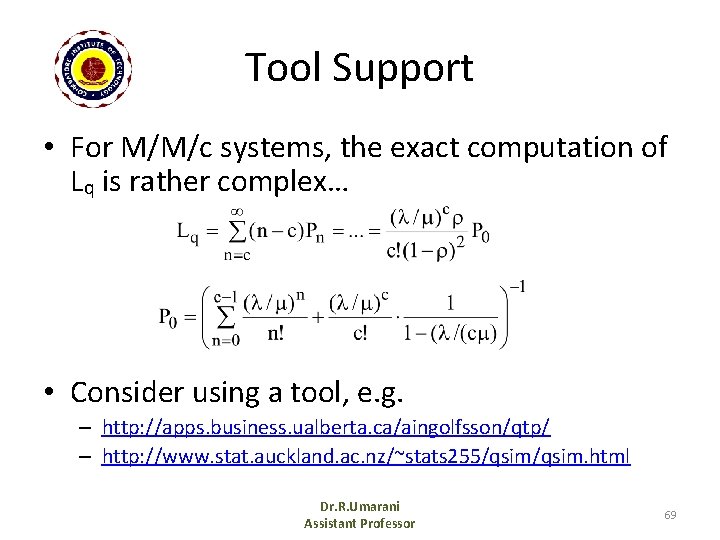
Tool Support • For M/M/c systems, the exact computation of Lq is rather complex… • Consider using a tool, e. g. – http: //apps. business. ualberta. ca/aingolfsson/qtp/ – http: //www. stat. auckland. ac. nz/~stats 255/qsim. html Dr. R. Umarani Assistant Professor 69
Example – ER at County Hospital Ø Situation – Patients arrive according to a Poisson process with intensity ( the time between arrivals is exp( ) distributed. – The service time (the doctor’s examination and treatment time of a patient) follows an exponential distribution with mean 1/ (=exp( ) distributed) The ER can be modeled as an M/M/c system where c=the number of doctors Ø Data gathering = 2 patients per hour = 3 patients per hour v Question – Should the capacity be increased from 1 to 2 doctors? Dr. R. Umarani Assistant Professor 70
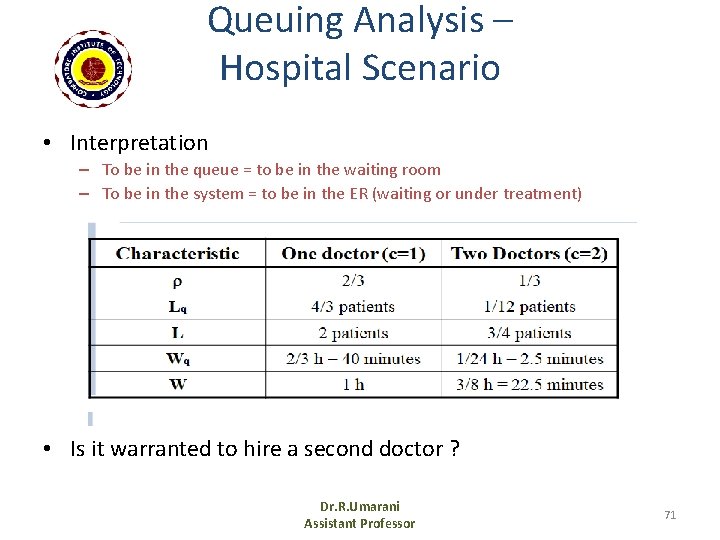
Queuing Analysis – Hospital Scenario • Interpretation – To be in the queue = to be in the waiting room – To be in the system = to be in the ER (waiting or under treatment) • Is it warranted to hire a second doctor ? Dr. R. Umarani Assistant Professor 71
Process Simulation • Drawbacks of queuing theory: – Generally not applicable when system includes parallel activities – Requires case-by-case mathematical analysis – Assumes “steady-state” (valid only for “long-term” analysis) • Process simulation is more versatile (also more popular) • Process simulation = run a large number of process instances, gather data (cost, duration, resource usage) and calculate statistics from the output Dr. R. Umarani Assistant Professor 72
Process Simulation Steps in evaluating a process with simulation 1. Model the process (e. g. BPMN) 2. Enhance the process model with simulation info simulation model • Based on assumptions or better based on data (logs) 3. Run the simulation 4. Analyze the simulation outputs 1. Process duration and cost stats and histograms 2. Waiting times (per activity) 3. Resource utilization (per resource) 5. Repeat for alternative scenarios Dr. R. Umarani Assistant Professor 73
Elements of a simulation model • The process model including: – Events, activities, control-flow relations (flows, gateways) – Resource classes (i. e. lanes) • Resource assignment – Mapping from activities to resource classes • Processing times – Per activity or per activity-resource pair • Costs – Per activity and/or per activity-resource pair • Arrival rate of process instances • Conditional branching probabilities (XOR gateways) Dr. R. Umarani Assistant Professor 74
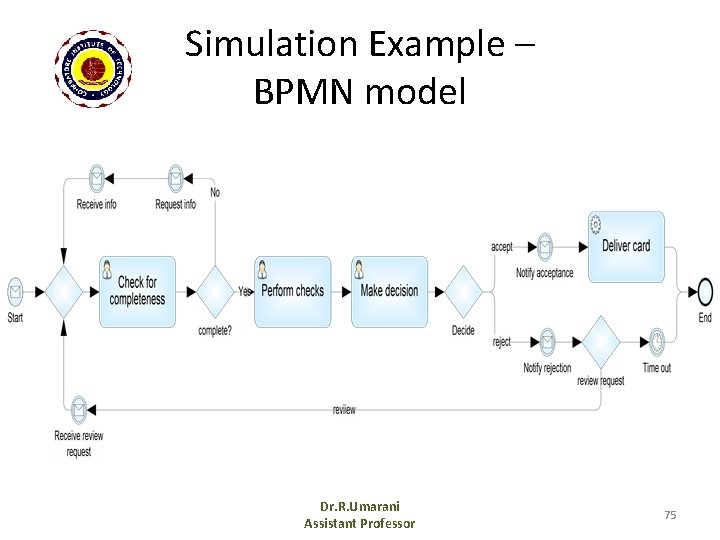
Simulation Example – BPMN model Dr. R. Umarani Assistant Professor 75
Resource Pools (Roles) • Two options to define resource pools – Define individual resources of type clerk – Or assign a number of “anonymous” resources all with the same cost • E. g. – 3 anonymous clerks with cost of € 10 per hour, 8 hours per day – 2 individually named clerks • Jim: € 12. 4 per hour • Mike: € 14. 8 per hour – 1 manager John at € 20 per hour, 8 hours per day Dr. R. Umarani Assistant Professor 76
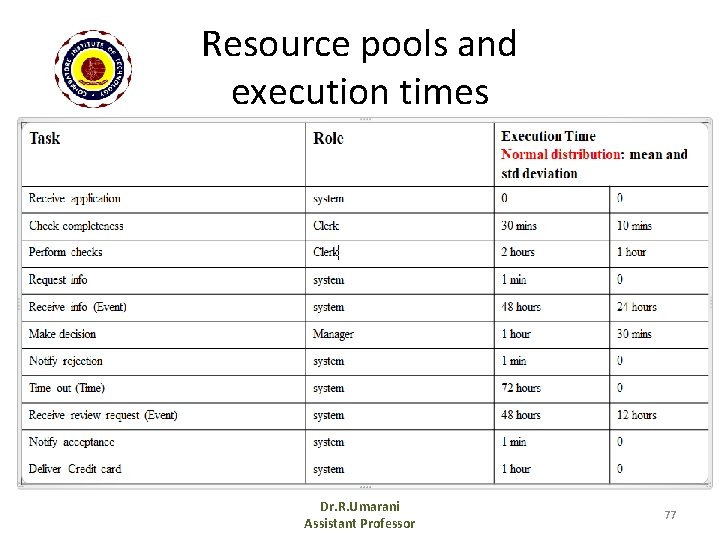
Resource pools and execution times Dr. R. Umarani Assistant Professor 77
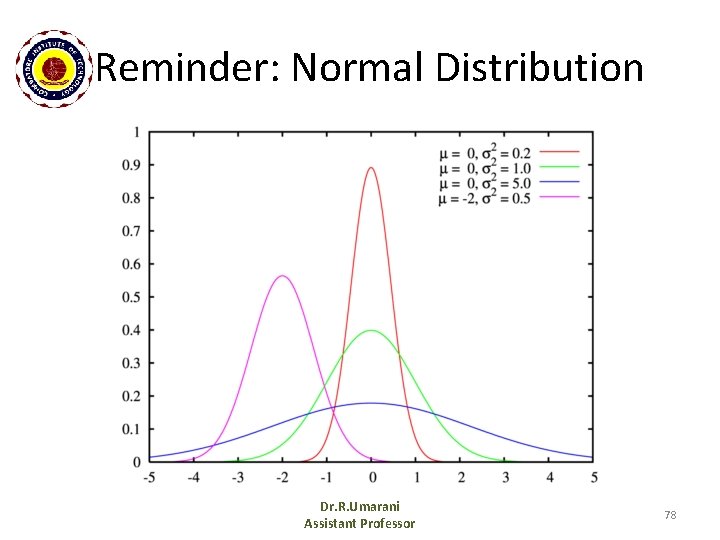
Reminder: Normal Distribution Dr. R. Umarani Assistant Professor 78
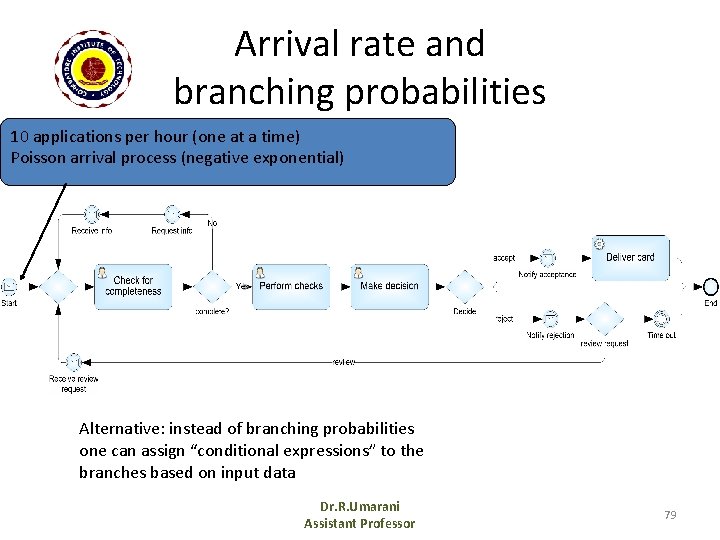
Arrival rate and branching probabilities 10 applications per hour (one at a time) Poisson arrival process (negative exponential) Alternative: instead of branching probabilities one can assign “conditional expressions” to the branches based on input data Dr. R. Umarani Assistant Professor 79
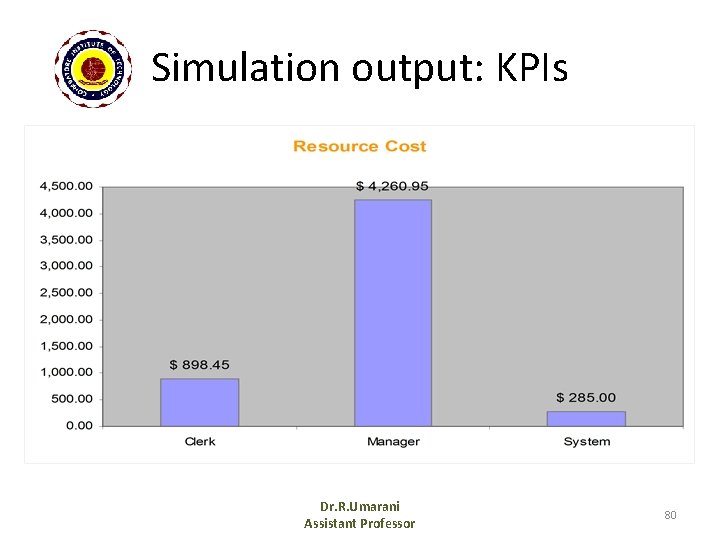
Simulation output: KPIs Dr. R. Umarani Assistant Professor 80
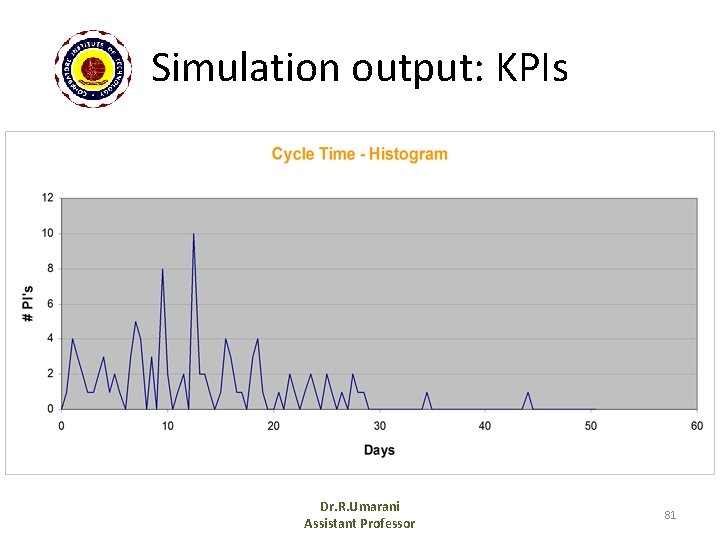
Simulation output: KPIs Dr. R. Umarani Assistant Professor 81
Tools for Process Simulation Listed in no specific order: • ITP Commerce Process Modeler for Visio – Models presented earlier are made with ITP Commerce • • • Progress Savvion Process Modeler IBM Websphere Business Modeler Oracle BPA ARIS Pro. Sim Dr. R. Umarani Assistant Professor 82
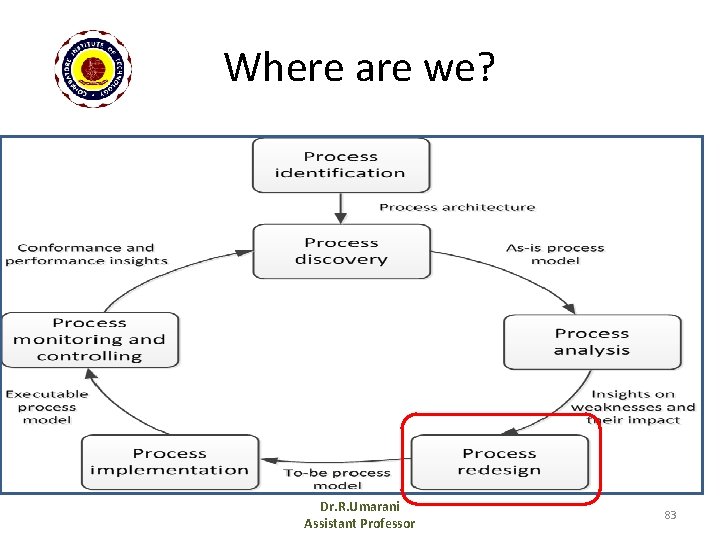
Where are we? Dr. R. Umarani Assistant Professor 83
Process Redesign - Rethinking and Reorganising business processes with the specific purpose of making them perform better. Dr. R. Umarani Assistant Professor 84
1. The Essence of Process Redesign 1. 1. Why Redesign? -Business process creates and delivers a certain product or service that customers are after. -If someone like to improve the quality of such a product or service from the perspective of a customer, arguably the best way to do that is to improve the related business process. - For Eg. - clerk forgets to carry out a particular quality check - Marketing department introduces a special offer for a particular type of customers - Internal auditing department demands at some point that the monetary value of certain financial activities are reported when it is carried out Dr. R. Umarani Assistant Professor 85
1. 2. What is Redesign? Important reasons for redesign; - Internal and external customers of the business process - Business process operation view - Business process behaviour view - Organisation and participants in the business process - Information that the business process uses or creates - Technology the business process uses - External environment the process is situated Dr. R. Umarani Assistant Professor 86
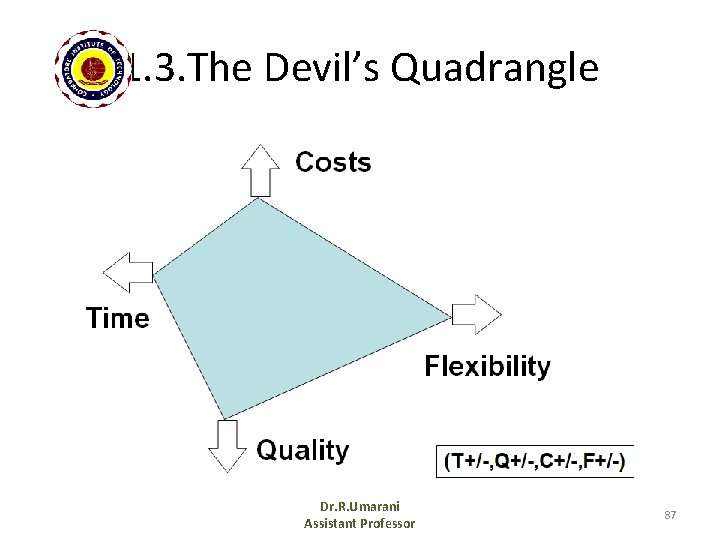
1. 3. The Devil’s Quadrangle Dr. R. Umarani Assistant Professor 87
Devil’s Quadrangle - Ideally a business process redesign decreases the time required to handle a case, it lowers the required cost of executing the process, it improves the quality of the service delivered and it increases the ability of the business process to deal with variation Dr. R. Umarani Assistant Professor 88
1. 4. How to Redesign? Methodology : as a collection of problem solving methods governed by a set of principles and a common philosophy for solving targeted problems. Technique: a set of precisely described procedures for achieving a standard task. Tool: Computer software package to support one or more techniques. Dr. R. Umarani Assistant Professor 89
1. 4. How to Redesign? a) Clean slate approach – starting from scratch b) From the traits of the existing process that is to be redesigned c) Blue print or reference model Dr. R. Umarani Assistant Professor 90
2. Heuristic Process Redesign - Technical challenge of generating a new process design - Stages in heuristic process redesign: ØInitiate – redesign project is set up ØDesign – list of redesign heuristics ØEvaluate – qualitative way - A redesign heuristic is a rule of thumb for deriving a different process Dr. R. Umarani Assistant Professor 91
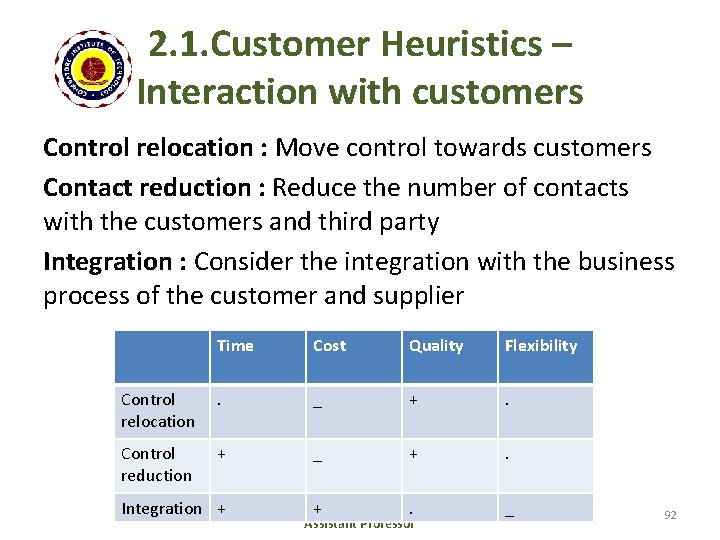
2. 1. Customer Heuristics – Interaction with customers Control relocation : Move control towards customers Contact reduction : Reduce the number of contacts with the customers and third party Integration : Consider the integration with the business process of the customer and supplier Time Cost Quality Flexibility Control relocation . _ + . Control reduction + _ + . +Dr. R. Umarani. _ Integration + Assistant Professor 92
2. 2. Business Process Operation Heuristics Case types : determine whether activities are related to the same type of case and if necessary distinguish new business processes Activity elimination: eliminate unnecessary activities from a business process Case based work : consider removing batch processing and periodic activities from a business process Triage: consider the division of a general activity into two or more alternative activities Activity composition: combine small activities into composite activities and divide large activities into smaller activities Dr. R. Umarani Assistant Professor 93
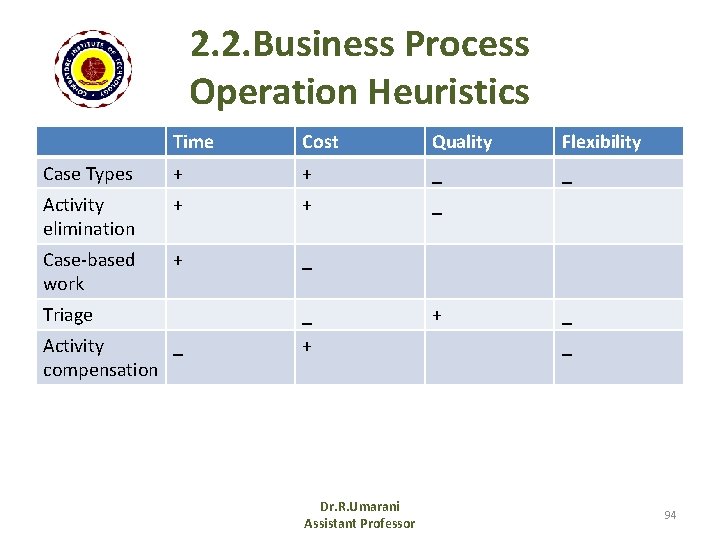
2. 2. Business Process Operation Heuristics Time Cost Quality Flexibility Case Types + + _ _ Activity elimination + + _ Case-based work + _ Triage _ Activity _ compensation + Dr. R. Umarani Assistant Professor + _ _ 94
2. 3. Business Process Behaviour Heuristics - Re-Sequencing : move activities to more appropriate places - Parallelism: consider whether activities may be executed in parallel - Knock-out: order knock-outs in an increasing order of effort and in a decreasing order of termination probability - Exception: design business processes for typical cases and isolate exceptional cases from the normal flow Dr. R. Umarani Assistant Professor 95
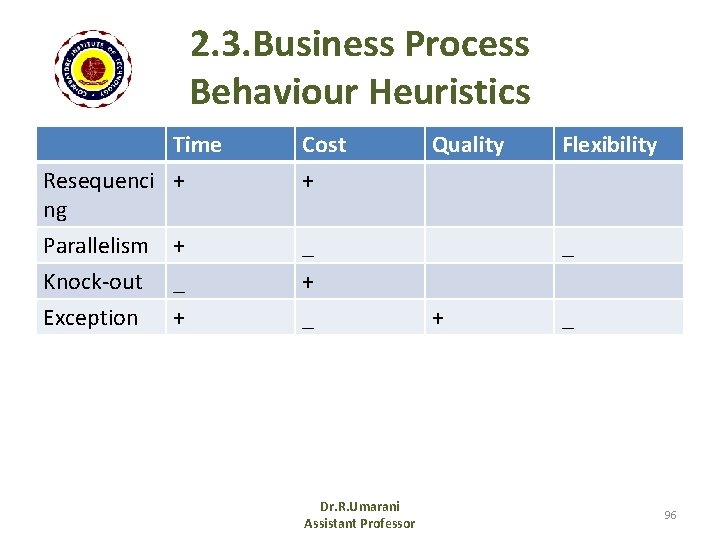
2. 3. Business Process Behaviour Heuristics Time Resequenci + ng Cost + Parallelism + Knock-out _ Exception + _ Dr. R. Umarani Assistant Professor Quality Flexibility _ + _ 96
2. 4. Organisation Heuristics - Case assignment: let workers perform as many steps as possible for single cases Flexible assignment: assign work in such a way that maximal flexibility is preserved for the near future Centralisation: treat geographically dispersed resources as if they are centralised Split responsibilities: avoid shared responsibilities for tasks by people from different functional units Customer teams: consider to compose work teams of people from different departments that will take care of the complete handling of specific sorts of cases Numerical involvement: minimise the number of departments, groups and persons involved in a business process Case manager: appoint one person to be responsible for handling of each type of case, the case manager Dr. R. Umarani Assistant Professor 97
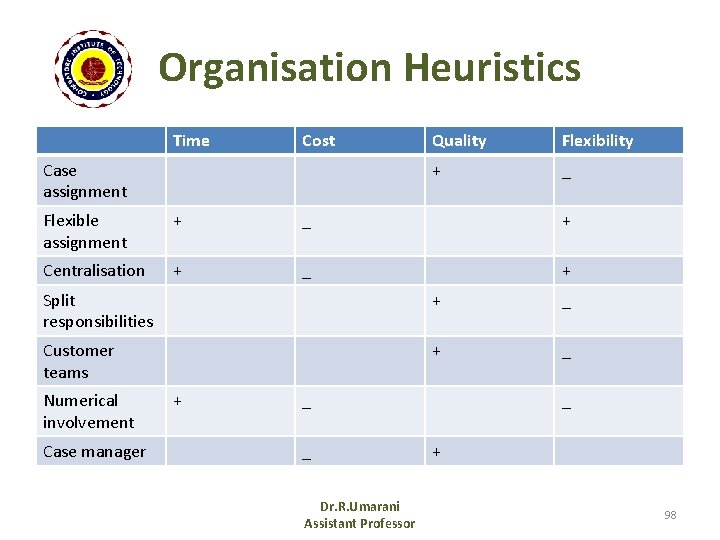
Organisation Heuristics Time Cost Case assignment Quality Flexibility + _ Flexible assignment + _ + Centralisation + _ + Split responsibilities + _ Customer teams + _ Numerical involvement Case manager + _ _ Dr. R. Umarani Assistant Professor _ + 98
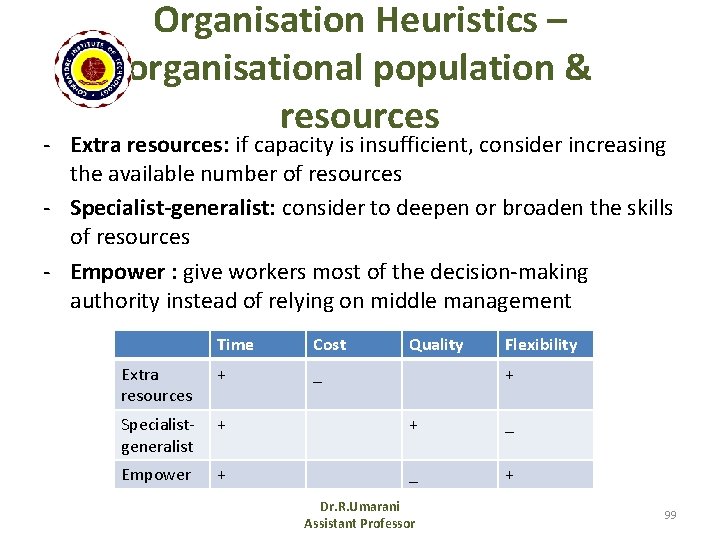
Organisation Heuristics – organisational population & resources - Extra resources: if capacity is insufficient, consider increasing the available number of resources - Specialist-generalist: consider to deepen or broaden the skills of resources - Empower : give workers most of the decision-making authority instead of relying on middle management Time Cost Quality Flexibility Extra resources + _ Specialistgeneralist + + _ Empower + _ + + Dr. R. Umarani Assistant Professor 99
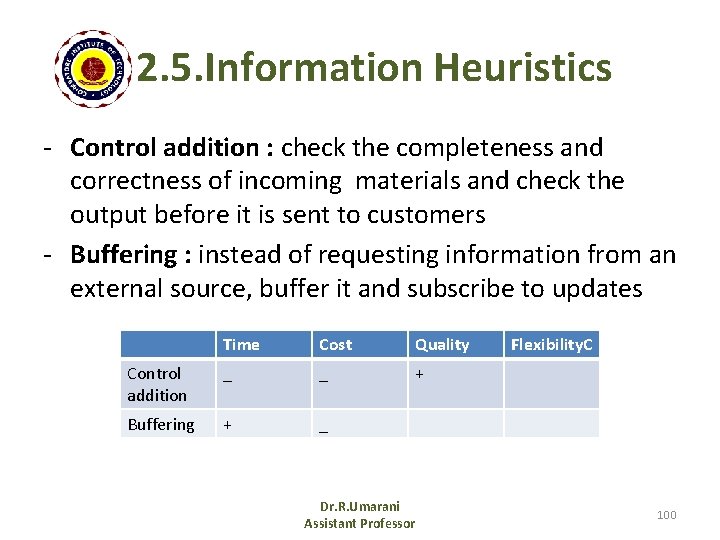
2. 5. Information Heuristics - Control addition : check the completeness and correctness of incoming materials and check the output before it is sent to customers - Buffering : instead of requesting information from an external source, buffer it and subscribe to updates Time Cost Quality Control addition _ _ + Buffering + _ Dr. R. Umarani Assistant Professor Flexibility. C 100
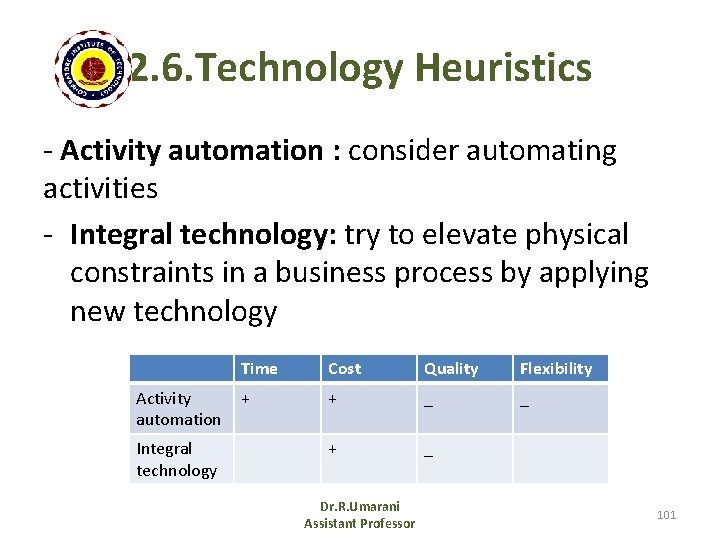
2. 6. Technology Heuristics - Activity automation : consider automating activities - Integral technology: try to elevate physical constraints in a business process by applying new technology Activity automation Integral technology Time Cost Quality Flexibility + + _ _ + _ Dr. R. Umarani Assistant Professor 101
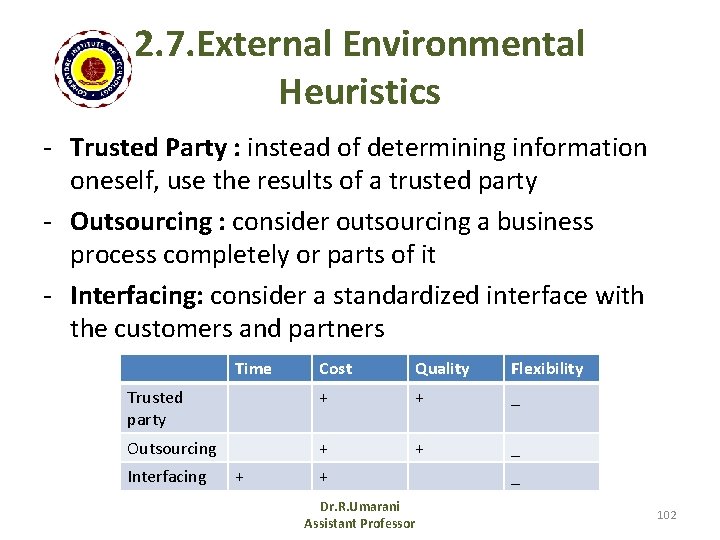
2. 7. External Environmental Heuristics - Trusted Party : instead of determining information oneself, use the results of a trusted party - Outsourcing : consider outsourcing a business process completely or parts of it - Interfacing: consider a standardized interface with the customers and partners Time Cost Quality Flexibility Trusted party + + _ Outsourcing + + _ Interfacing + + Dr. R. Umarani Assistant Professor _ 102
3. The Case of a Health Care Institution - Intake process for elderly patients with mental problems in a region - Notice by telephone at the secretarial office of health care institute - Family doctor of the patient - Name and address of the patient - Nursing officer in the region Dr. R. Umarani Assistant Professor 103
3. The Case of a Health Care Institution - Nursing officer asks about ØMental, health and social status ØRecord in registration form ØForm given to secretarial officer ØInformation stored in the system ØFile is created ØRegistration card is given Dr. R. Umarani Assistant Professor 104
3. The Case of a Health Care Institution - Half way during the week a staff meeting is conducted - team leader assigns new patients - Team consists of Social-medical workers, Physicians and psychiatrist - Social worker – first intaker - Physicians – second in taker Dr. R. Umarani Assistant Professor 105
3. The Case of a Health Care Institution - Secretarial office stores information frequently - Checklist for patient Dr. R. Umarani Assistant Professor 106
3. The Case of a Health Care Institution - Three alternatives to the process; ØSending medical files by post 1. wait time to get the file through post 2. integration and technology – medical files available online 3. use of technology 4. doctors store patient information electronically and communicates Dr. R. Umarani Assistant Professor 107
3. The Case of a Health Care Institution ØPeriodic Messages 1. New cases, first and second intakers 2. Treatment plans Case based work ØRequesting Medical files 1. Contact reduction 2. Exception heuristic 3. Resequencing heuristic Dr. R. Umarani Assistant Professor 108
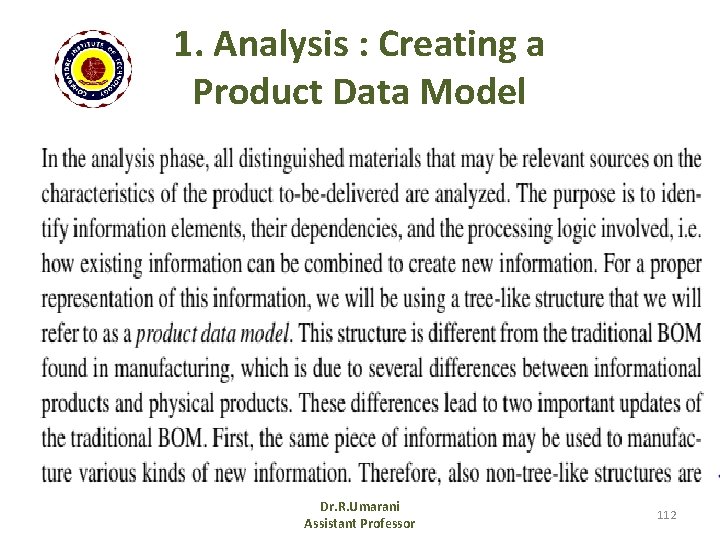
Product Based Design - It aims at radically rethinking how a particular product or service can be created instead of using an incremental approach. - The characteristics of the particular product that the process-to-be is expected to deliver are used to in fact reason back what that process should look like Dr. R. Umarani Assistant Professor 109
Steps in product based design 1. Scoping – Business process subject to the redesign is selected 2. Analysis – study of the product specifications leads to its decomposition into information elements and their logical dependencies in the form of a product data model. Dr. R. Umarani Assistant Professor 110
Steps in product based design 3. Design – One or more designs are derived that best match the design goals 4. Evaluation – The process designs are verified, validated with the end-users and their estimated performance is analysed in more detail. Dr. R. Umarani Assistant Professor 111
1. Analysis : Creating a Product Data Model - Pro Dr. R. Umarani Assistant Professor 112
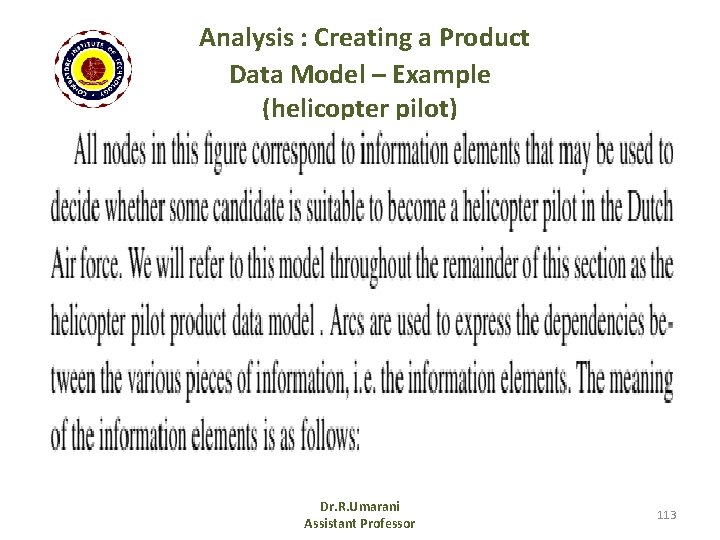
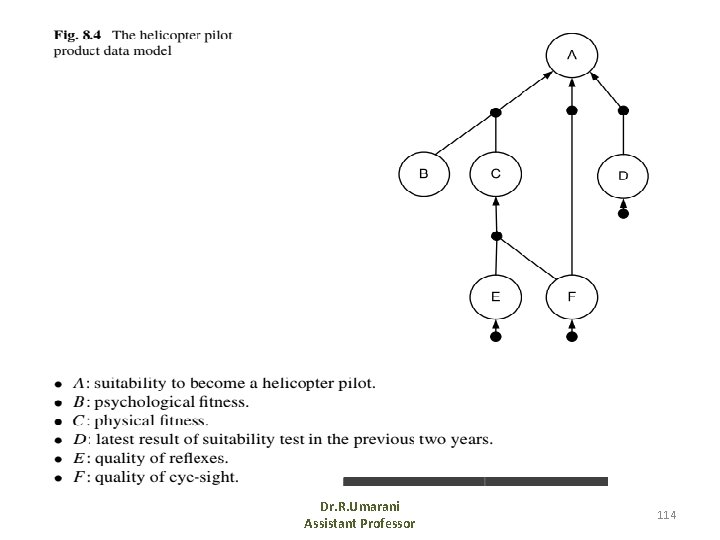
Analysis : Creating a Product Data Model – Example (helicopter pilot) Dr. R. Umarani Assistant Professor 113
Dr. R. Umarani Assistant Professor 114
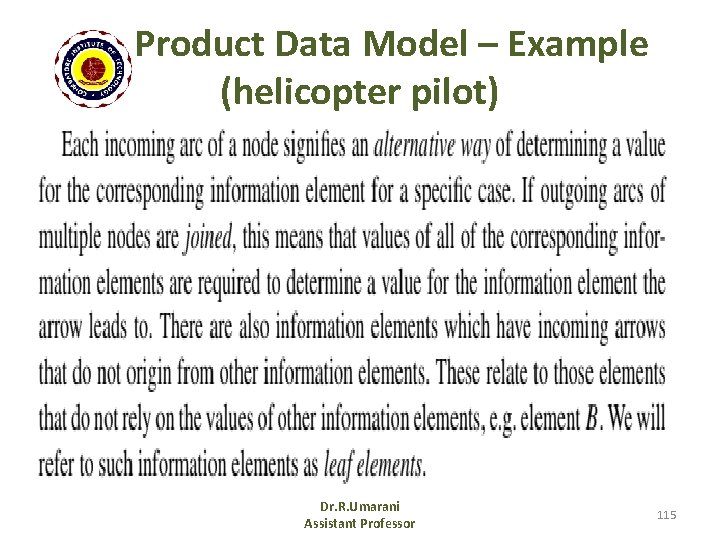
Product Data Model – Example (helicopter pilot) Dr. R. Umarani Assistant Professor 115
Steps in Analysis 1. Source analysis: Is aimed at identifying the sources of all leaf elements in the product data model. 2. Production analysis: Focuses on the identified production rules with the aim to estimate the involved cost, speed and quality of producing new information. 3. Fraction analysis: Involves the study of the distribution of information element values Dr. R. Umarani Assistant Professor 116
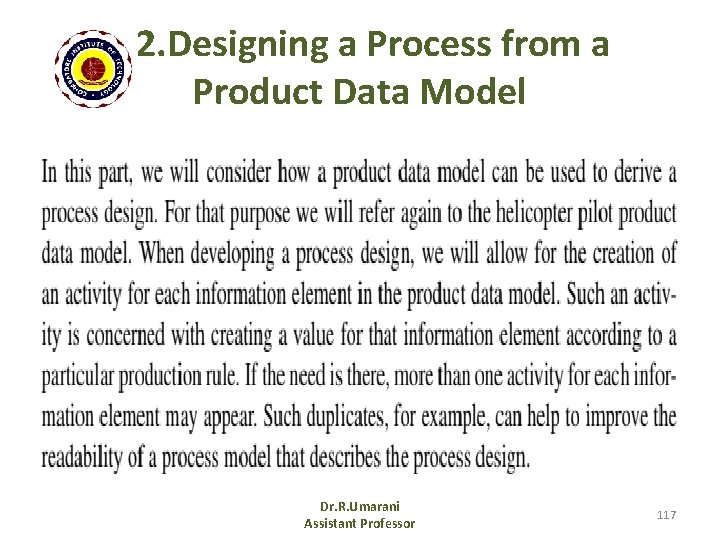
2. Designing a Process from a Product Data Model Dr. R. Umarani Assistant Professor 117
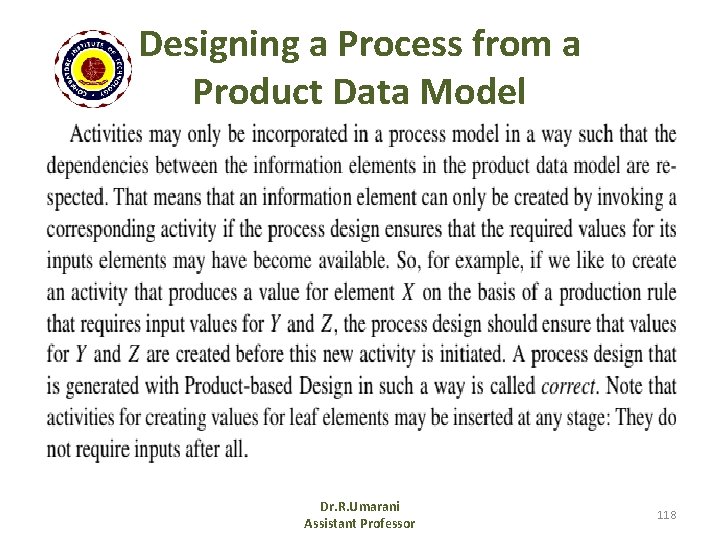
Designing a Process from a Product Data Model Dr. R. Umarani Assistant Professor 118
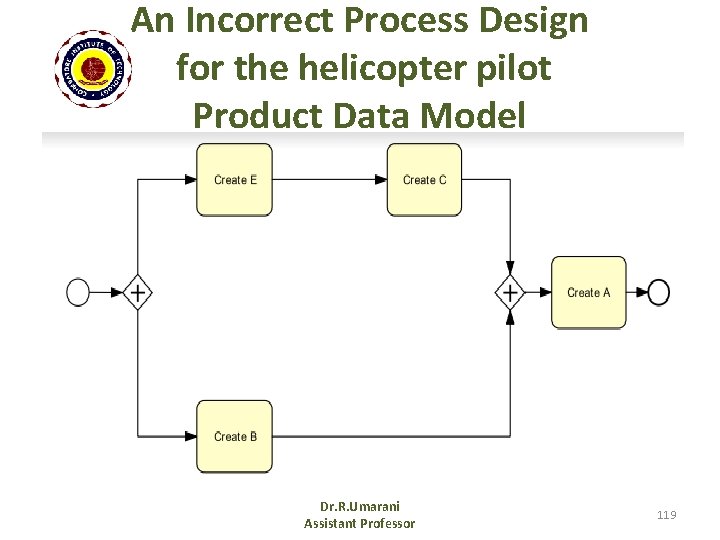
An Incorrect Process Design for the helicopter pilot Product Data Model Dr. R. Umarani Assistant Professor 119
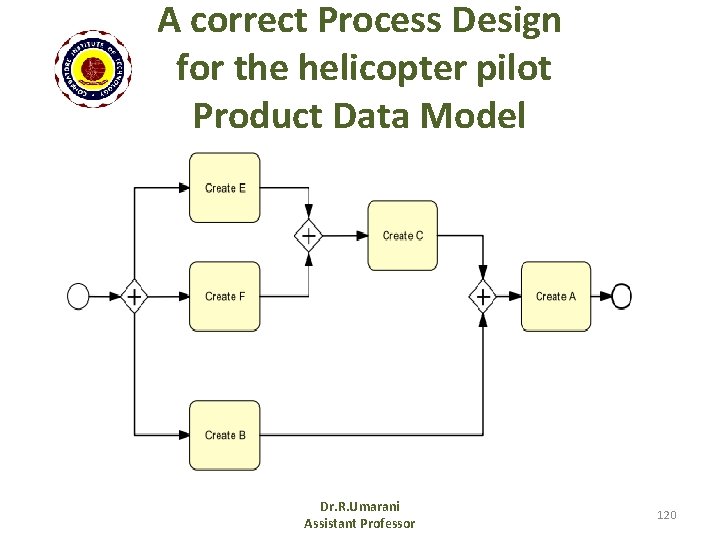
A correct Process Design for the helicopter pilot Product Data Model Dr. R. Umarani Assistant Professor 120
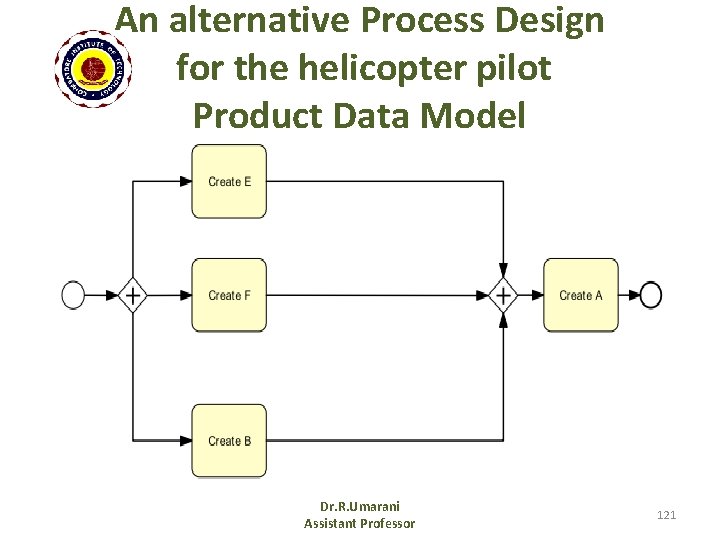
An alternative Process Design for the helicopter pilot Product Data Model Dr. R. Umarani Assistant Professor 121
- Slides: 121