
Business Process Analysis What IS it BPA enables
Business Process Analysis

What IS it?
BPA enables staff to: • Better understand the work they do in specific case types • Simplify and improve their own processes and improve coordination with processes of other relevant entities • Identify new processes that can improve case handling and provide additional capabilities • Assign appropriate tasks to clients/litigants and to staff other than lawyers • Apply the best available technology to substitute for or augment the work of staff and lawyers • Increase understanding of, engagement with, and adoption of best practices and technology through the analysis process itself, which is inherently collaborative across staff and stakeholders • Reduce costs, handle more cases, and meet the needs of more clients/litigants by ensuring that each case is handled efficiently http: //www. lsc. gov/media/in-the-spotlight/report-summit-use-technology-expand-access-justice
BPA enables staff to: • Increase transparency and collective understanding • Gain consensus • Increase capacity; reduce costs • Improve efficiency • Ensure that limited resources are put to their best use
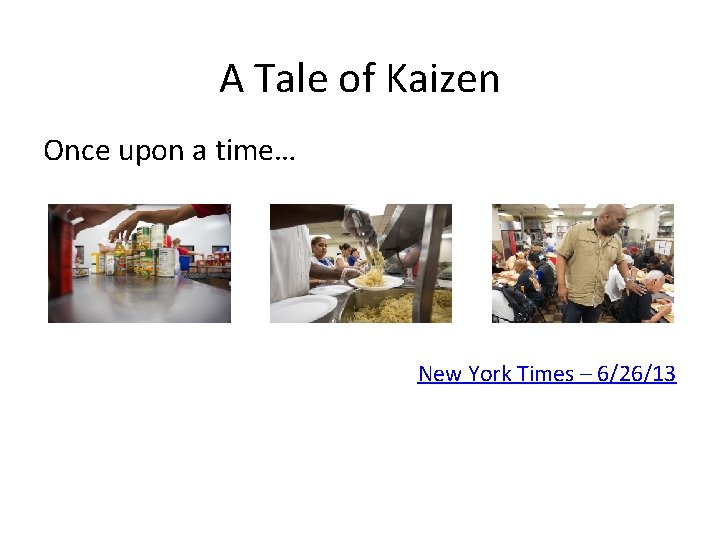
A Tale of Kaizen Once upon a time… New York Times – 6/26/13
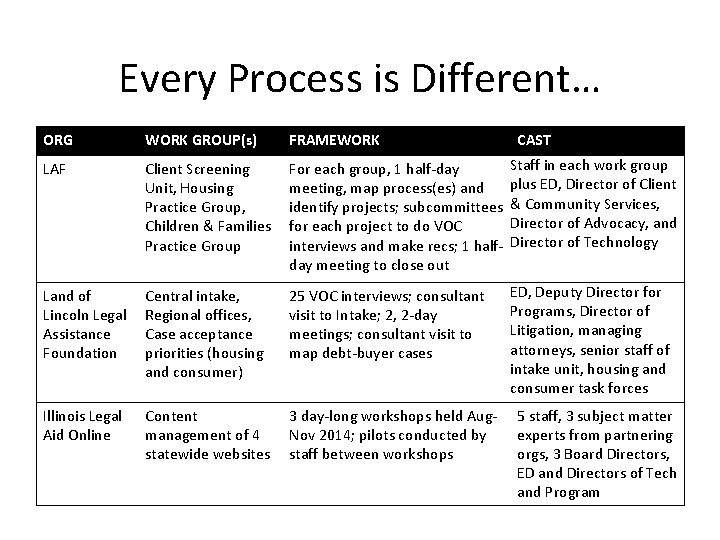
Every Process is Different… ORG WORK GROUP(s) FRAMEWORK CAST LAF Client Screening Unit, Housing Practice Group, Children & Families Practice Group For each group, 1 half-day meeting, map process(es) and identify projects; subcommittees for each project to do VOC interviews and make recs; 1 halfday meeting to close out Staff in each work group plus ED, Director of Client & Community Services, Director of Advocacy, and Director of Technology Land of Lincoln Legal Assistance Foundation Central intake, Regional offices, Case acceptance priorities (housing and consumer) 25 VOC interviews; consultant visit to Intake; 2, 2 -day meetings; consultant visit to map debt-buyer cases ED, Deputy Director for Programs, Director of Litigation, managing attorneys, senior staff of intake unit, housing and consumer task forces Illinois Legal Aid Online Content management of 4 statewide websites 3 day-long workshops held Aug. Nov 2014; pilots conducted by staff between workshops 5 staff, 3 subject matter experts from partnering orgs, 3 Board Directors, ED and Directors of Tech and Program
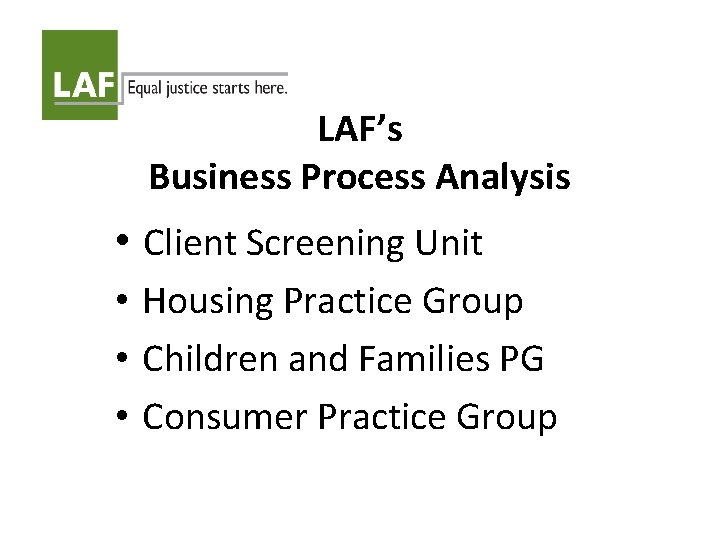
LAF’s Business Process Analysis • Client Screening Unit • Housing Practice Group • Children and Families PG • Consumer Practice Group
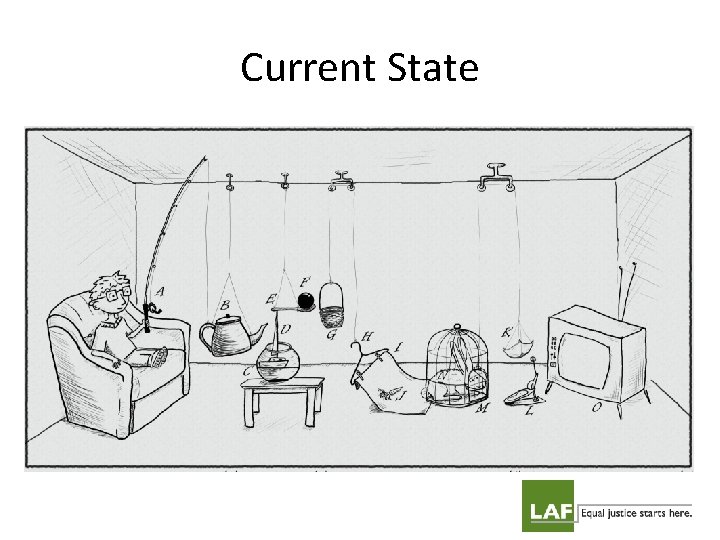
Current State
Improve Effectiveness
Business Process Analysis DMAIC • Define the Problem • Measure • Analyze • Improve • Control
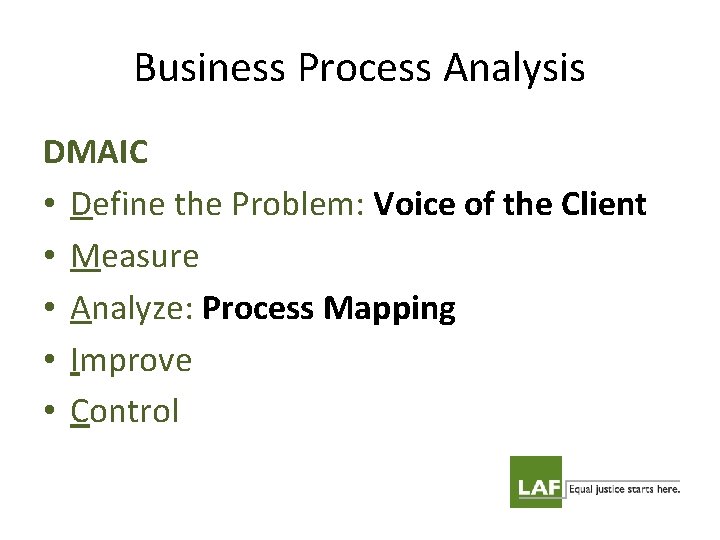
Business Process Analysis DMAIC • Define the Problem: Voice of the Client • Measure • Analyze: Process Mapping • Improve • Control
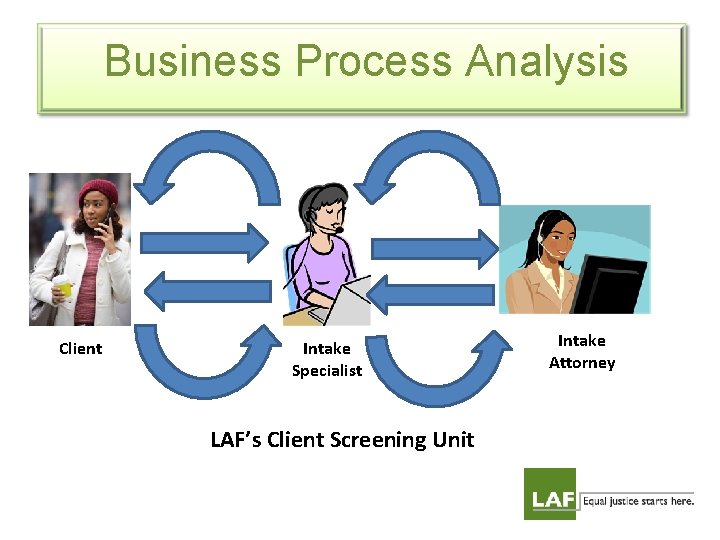
Former State of Communication between Client, Intake Specialist, and Intake Attorney Business Process Analysis Client Intake Specialist LAF’s Client Screening Unit Intake Attorney
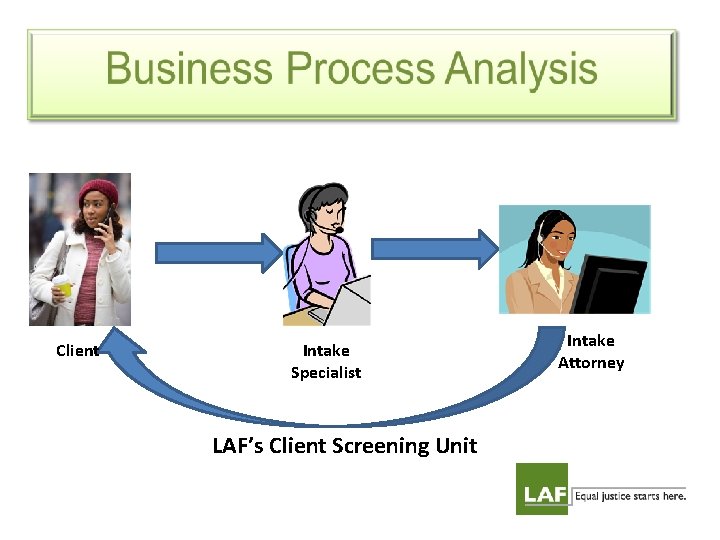
Current State of Communication between Client, Intake Specialist, and Intake Attorney Client Intake Specialist LAF’s Client Screening Unit Intake Attorney
Business Process Analysis LAF’s Education Law Team in the Children and Families Practice Group.
BPA Consultant
Metrics
Cultural Resistance

Lack of Time
Monitor Solutions
Share Your Results!
Land of Lincoln Process Improvement Project (or how to get unstuck)
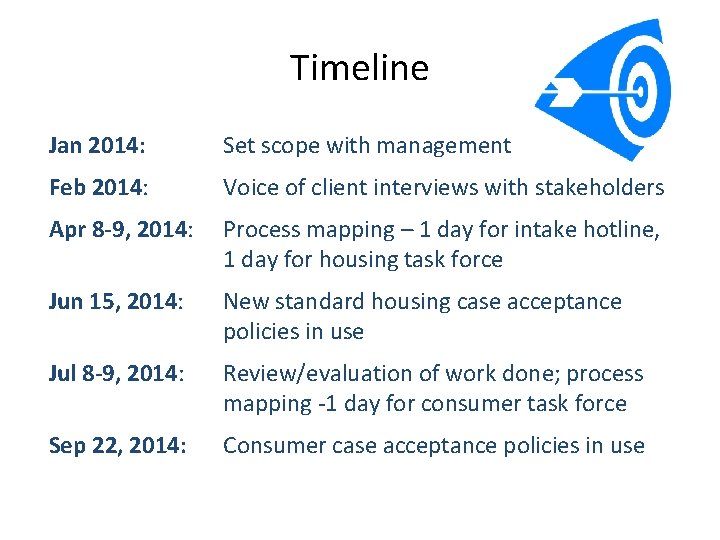
Timeline Jan 2014: Set scope with management Feb 2014: Voice of client interviews with stakeholders Apr 8 -9, 2014: Process mapping – 1 day for intake hotline, 1 day for housing task force Jun 15, 2014: New standard housing case acceptance policies in use Jul 8 -9, 2014: Review/evaluation of work done; process mapping -1 day for consumer task force Sep 22, 2014: Consumer case acceptance policies in use
Legal Advice & Referral Center (LARC) Goals: • Process calls in a consistent and efficient manner; • Ensure caller’s info is efficiently gathered and documented in a standard and concise format; • Transfer cases appropriate for extended representation to the regional offices and handle all other cases at LARC with advice; and • Improve regional office case referrals through development of standardized Case Acceptance Policies (CAPs)
Description of the Current State • Every intake was printed • Every case was reviewed • Every letter to callers was printed, signed and filed • Managing attorney proof read and signed all correspondence • Each attorney used his/her own canned advice notes, and each regional office drafted its own case acceptance policies and changed them at will
Approach and activities • Voice of Client Interviews • Day-long onsite meeting with LARC • Process Mapping – Current State Process Map – Review with Managing Attorney/Senior Intake Atty – Streamline process steps and prepare new future state process map – Review with LARC and other stakeholders
Notable accomplishments • Managing Attorney no longer signs correspondence • Team no longer prints intakes • Implemented a new case review protocol based on experience and error reports • Revised case reports to track all new cases and call backs from prior clients • Assisted with revision and review of standardized CAPs • Implemented new court date alert procedure
Notable accomplishments • Feedback from Staff has been very positive – Canned notes have been very helpful – Scripts have been especially helpful to newer intake attorneys • Standardized CAPs – So much easier to work with (especially noticeable when compared to areas of law other than Housing and Consumer) • Less Paper – Eliminated some file cabinets – freed up space – Redesigned the entire office to accommodate additional work stations for new staff attorneys • Added dual monitors for the attorneys – more of the needed information is always on screen
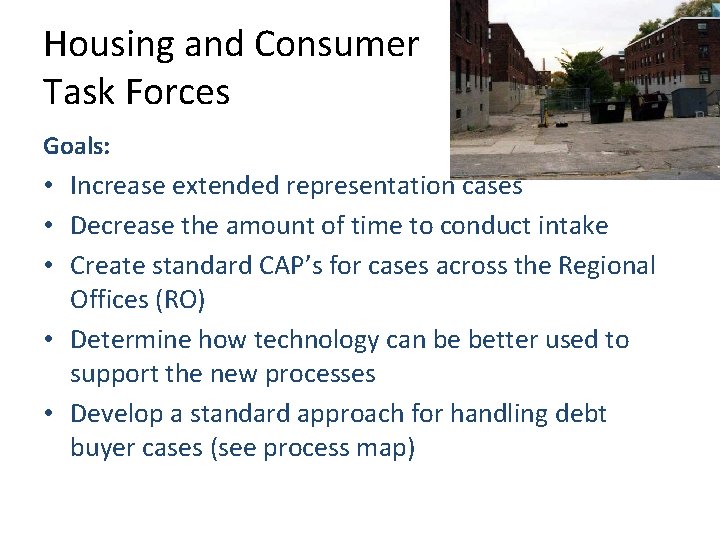
Housing and Consumer Task Forces Goals: • Increase extended representation cases • Decrease the amount of time to conduct intake • Create standard CAP’s for cases across the Regional Offices (RO) • Determine how technology can be better used to support the new processes • Develop a standard approach for handling debt buyer cases (see process map)
Description of Current State • Each Regional Office used its own set of CAPs (started out in 1997 with standard language) • The CAPs were not clear; difficult for LARC to determine which cases to refer; resulting in calls to office • CAPs e-mailed by RO to LARC, printed and kept in binders – 5 sets of CAPs for each problem code • Lack of uniform set of questions for intake • Intake information in case notes varies by intake person
Notable Accomplishments • One CAPs Document for all offices (for now an Excel spreadsheet updated by RO for ‘open or closed’ only, on shared network) • CAPs approved by all Regional Offices • All offices are using the same language
Technology Implications • Create searchable CAP’s using Share. Point (by age, county, and type of legal problem) • Integrate intake scripts into Legal Server • Use SPO document management features to access and maintain up to date canned notes • Use SPO document management features to access and maintain “best practice” pleadings to support extended representation
Lessons Learned • Legal aid can learn from big law/business • Good consultants can engage staff and motivate the change process in a way management can’t • Don’t get stuck on “we’ve always done it that way” • Naysayers exist – engage them, don’t ignore them • Establish metrics to evaluate improvement and consistently review progress and adjust
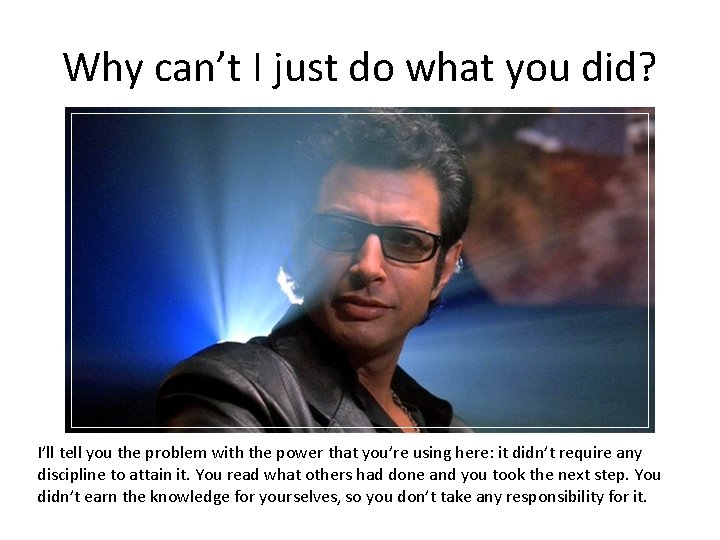
Why can’t I just do what you did? I’ll tell you the problem with the power that you’re using here: it didn’t require any discipline to attain it. You read what others had done and you took the next step. You didn’t earn the knowledge for yourselves, so you don’t take any responsibility for it.

No way around; must go through
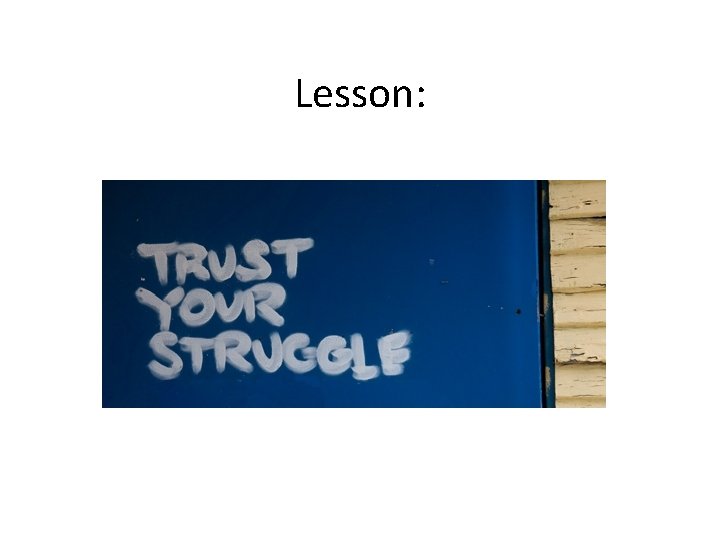
Lesson:

Lesson: Don’t jump ahead

Lesson: Don’t skimp

Lesson: Expect emotion … even drama

Lesson: Get comfortable with being uncomfortable

Lesson: Expect exposure

Lesson: Measurement is everyone’s job

Lesson: Pilot

Lesson: Facilitation is key

Lesson: Beware the creep x 2

Lesson: Nothing is ever done (except this slideshow)
- Slides: 45