
Business Potentials and Practical Operational Aspects of Alien
Business Potentials and Practical Operational Aspects of Alien Wavelength Services TNC 16, 12 -16 June 2016, Prague, Czech Republic Bjarke Skjoldstrup Project Manager, TDC A/S, Denmark 1
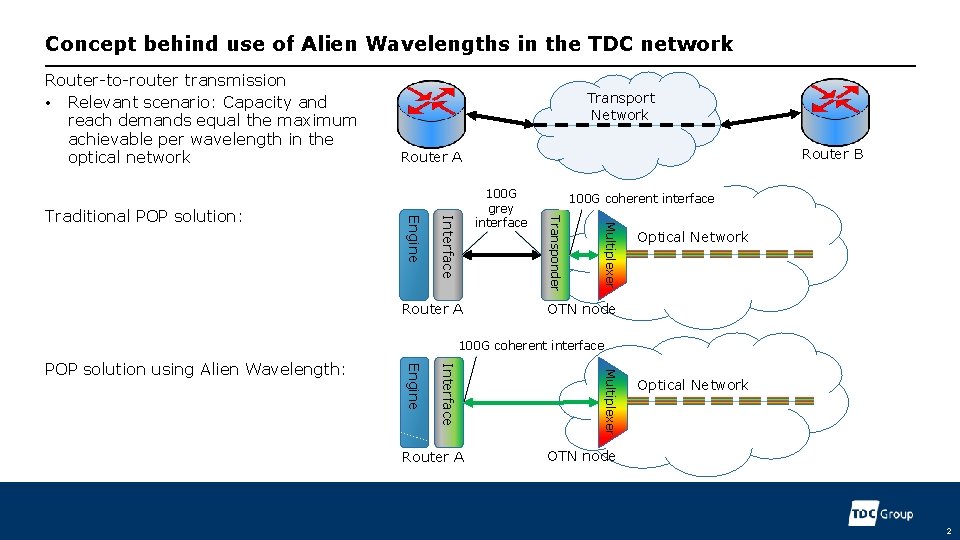
Concept behind use of Alien Wavelengths in the TDC network Router-to-router transmission • Relevant scenario: Capacity and reach demands equal the maximum achievable per wavelength in the optical network Router B Router A Multiplexer Router A 100 G coherent interface Transponder 100 G grey interface Interface Engine Traditional POP solution: Transport Network Optical Network OTN node 100 G coherent interface Router A Multiplexer Interface Engine POP solution using Alien Wavelength: Optical Network OTN node 2
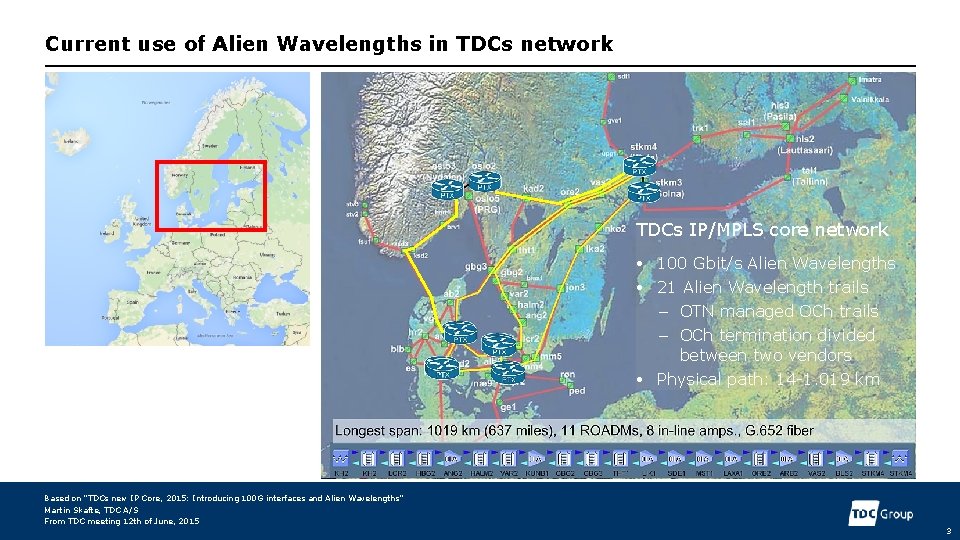
Current use of Alien Wavelengths in TDCs network TDCs IP/MPLS core network • 100 Gbit/s Alien Wavelengths • 21 Alien Wavelength trails − OTN managed OCh trails − OCh termination divided between two vendors • Physical path: 14 -1. 019 km Based on “TDCs new IP Core, 2015: Introducing 100 G interfaces and Alien Wavelengths” Martin Skafte, TDC A/S From TDC meeting 12 th of June, 2015 3
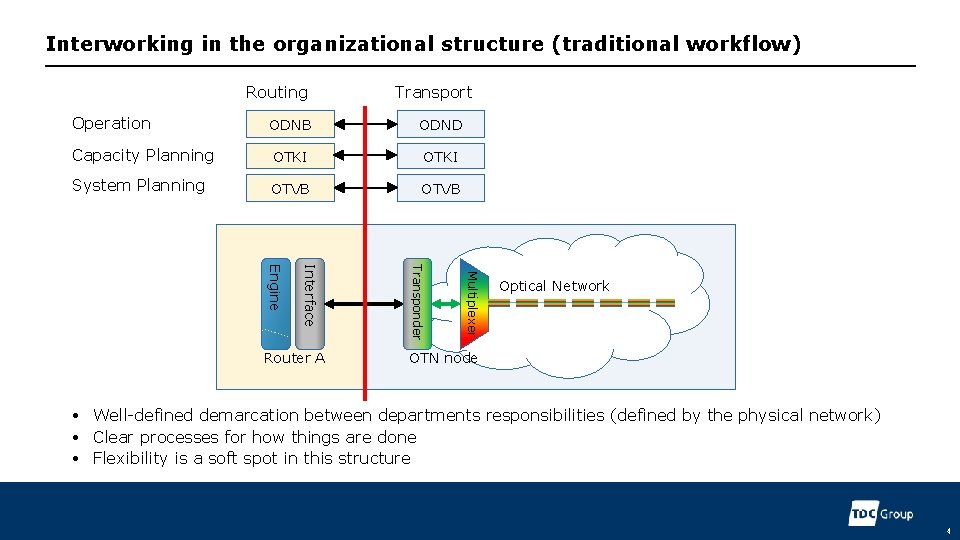
Interworking in the organizational structure (traditional workflow) Routing Transport Operation ODNB ODND Capacity Planning OTKI System Planning OTVB Multiplexer Transponder Interface Engine Router A Optical Network OTN node • Well-defined demarcation between departments responsibilities (defined by the physical network) • Clear processes for how things are done • Flexibility is a soft spot in this structure 4
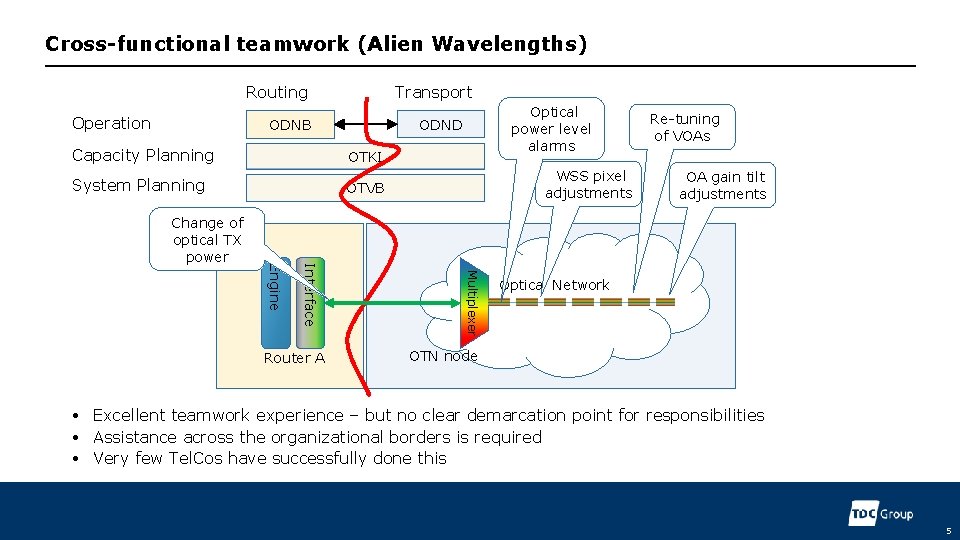
Cross-functional teamwork (Alien Wavelengths) Routing Operation Transport Capacity Planning OTKI System Planning OTVB Router A WSS pixel adjustments Multiplexer Interface Engine Change of optical TX power Optical power level alarms ODND ODNB Re-tuning of VOAs OA gain tilt adjustments Optical Network OTN node • Excellent teamwork experience – but no clear demarcation point for responsibilities • Assistance across the organizational borders is required • Very few Tel. Cos have successfully done this 5
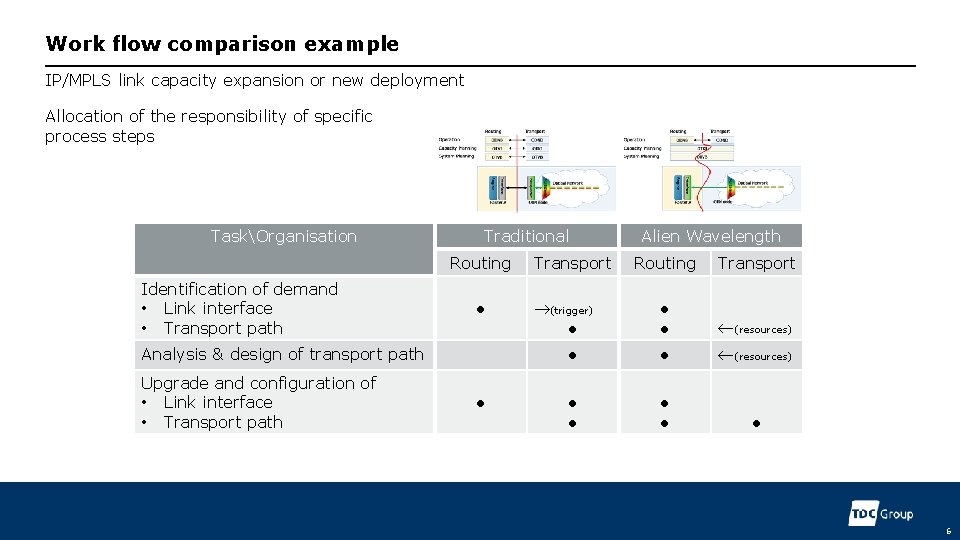
Work flow comparison example IP/MPLS link capacity expansion or new deployment Allocation of the responsibility of specific process steps TaskOrganisation Traditional Routing Identification of demand • Link interface • Transport path ● Analysis & design of transport path Upgrade and configuration of • Link interface • Transport path ● Transport Alien Wavelength Routing Transport ● ● (resources) ● ● ● (trigger) ● 6
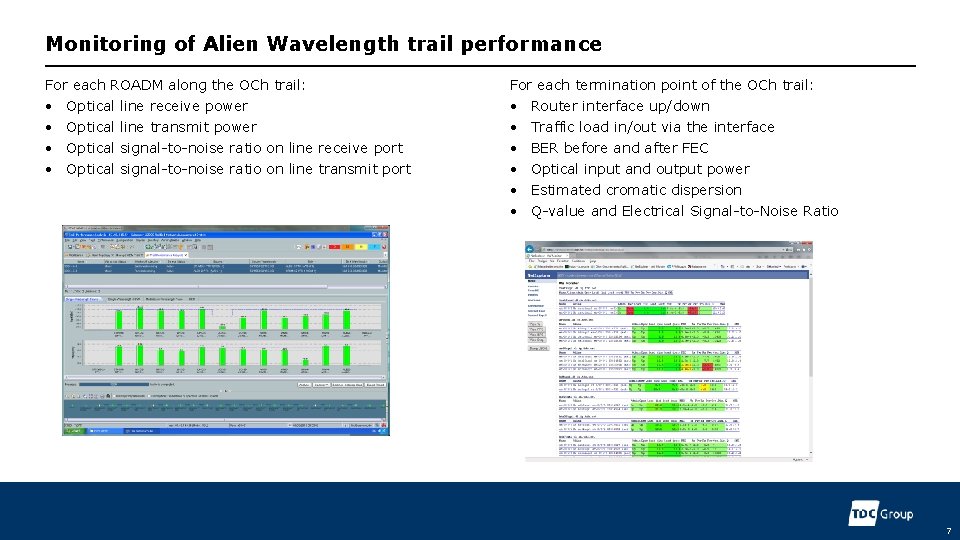
Monitoring of Alien Wavelength trail performance For each ROADM along the OCh trail: For each termination point of the OCh trail: Optical line receive power • Optical line transmit power • Optical signal-to-noise ratio on line receive port • Optical signal-to-noise ratio on line transmit port • • Router interface up/down Traffic load in/out via the interface BER before and after FEC Optical input and output power Estimated cromatic dispersion Q-value and Electrical Signal-to-Noise Ratio 7
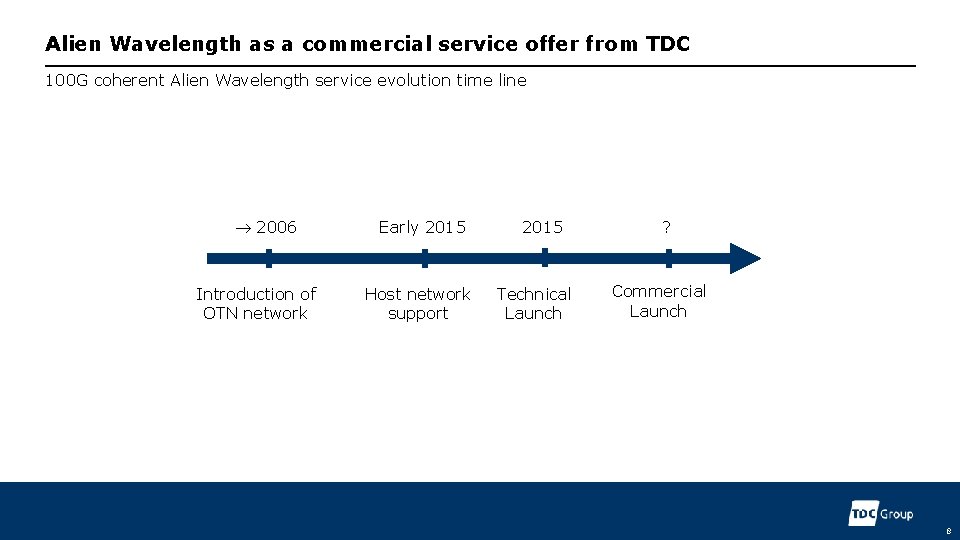
Alien Wavelength as a commercial service offer from TDC 100 G coherent Alien Wavelength service evolution time line 2006 Introduction of OTN network Early 2015 Host network support 2015 Technical Launch ? Commercial Launch 8
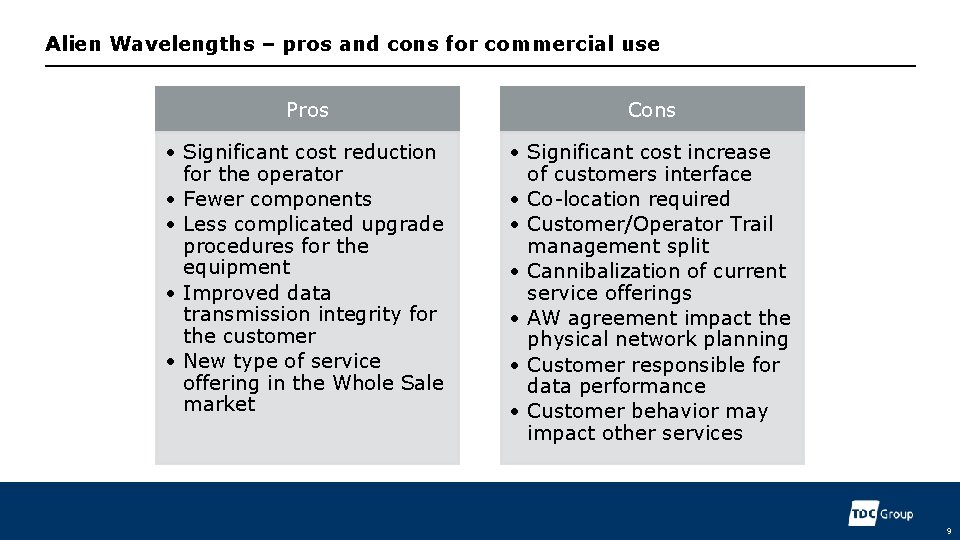
Alien Wavelengths – pros and cons for commercial use Pros Cons • Significant cost reduction for the operator • Fewer components • Less complicated upgrade procedures for the equipment • Improved data transmission integrity for the customer • New type of service offering in the Whole Sale market • Significant cost increase of customers interface • Co-location required • Customer/Operator Trail management split • Cannibalization of current service offerings • AW agreement impact the physical network planning • Customer responsible for data performance • Customer behavior may impact other services 9
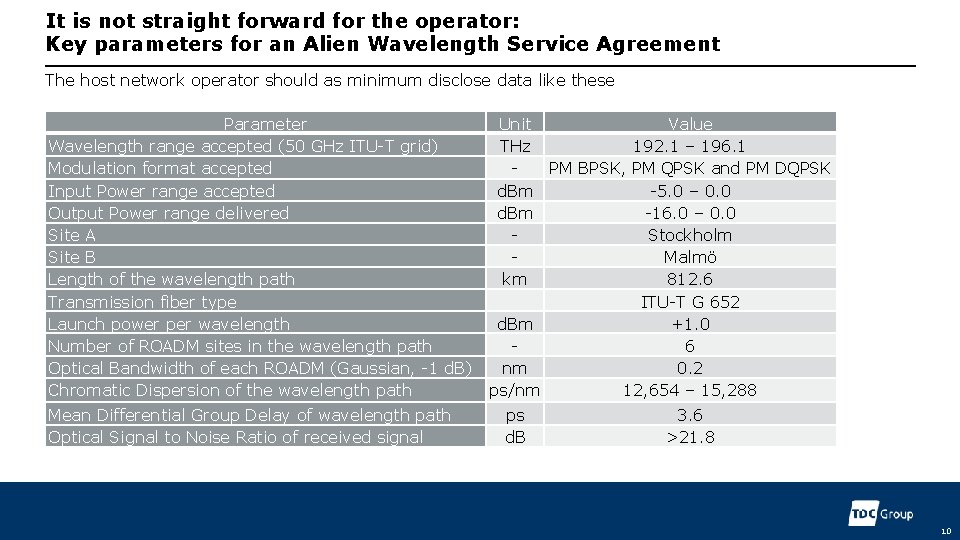
It is not straight forward for the operator: Key parameters for an Alien Wavelength Service Agreement The host network operator should as minimum disclose data like these Parameter Wavelength range accepted (50 GHz ITU-T grid) Modulation format accepted Input Power range accepted Output Power range delivered Site A Site B Length of the wavelength path Transmission fiber type Launch power per wavelength Number of ROADM sites in the wavelength path Optical Bandwidth of each ROADM (Gaussian, -1 d. B) Chromatic Dispersion of the wavelength path Mean Differential Group Delay of wavelength path Optical Signal to Noise Ratio of received signal Unit THz d. Bm km Value 192. 1 – 196. 1 PM BPSK, PM QPSK and PM DQPSK -5. 0 – 0. 0 -16. 0 – 0. 0 Stockholm Malmö 812. 6 ITU-T G 652 d. Bm +1. 0 6 nm 0. 2 ps/nm 12, 654 – 15, 288 ps d. B 3. 6 >21. 8 10
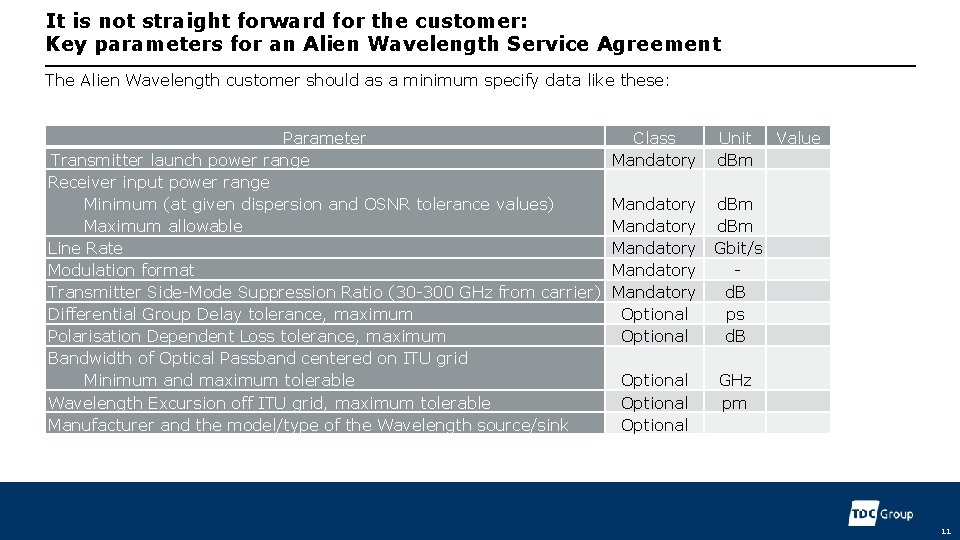
It is not straight forward for the customer: Key parameters for an Alien Wavelength Service Agreement The Alien Wavelength customer should as a minimum specify data like these: Parameter Transmitter launch power range Receiver input power range Minimum (at given dispersion and OSNR tolerance values) Maximum allowable Line Rate Modulation format Transmitter Side-Mode Suppression Ratio (30 -300 GHz from carrier) Differential Group Delay tolerance, maximum Polarisation Dependent Loss tolerance, maximum Bandwidth of Optical Passband centered on ITU grid Minimum and maximum tolerable Wavelength Excursion off ITU grid, maximum tolerable Manufacturer and the model/type of the Wavelength source/sink Class Mandatory Unit d. Bm Value Mandatory d. Bm Mandatory Gbit/s Mandatory d. B Optional ps Optional d. B Optional GHz pm 11
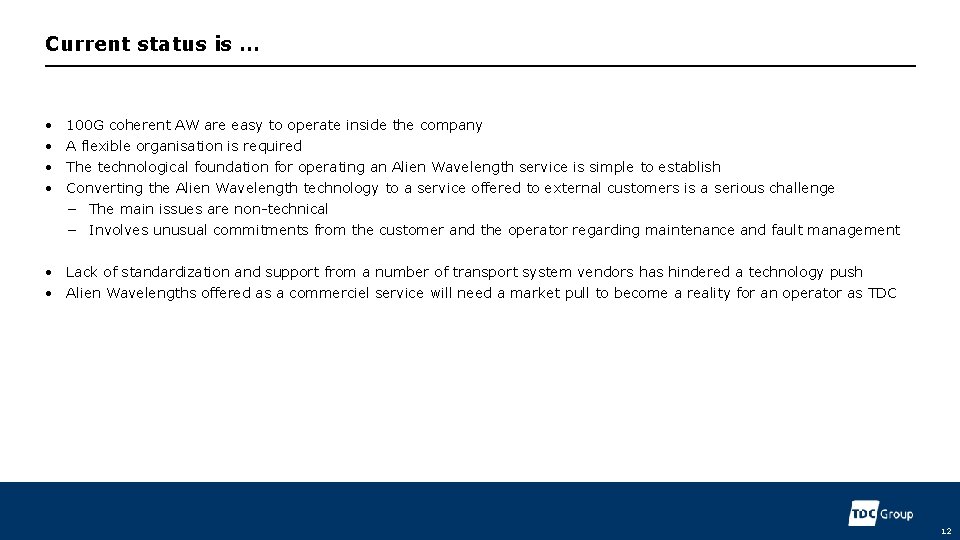
Current status is … • 100 G coherent AW are easy to operate inside the company A flexible organisation is required • The technological foundation for operating an Alien Wavelength service is simple to establish • Converting the Alien Wavelength technology to a service offered to external customers is a serious challenge − The main issues are non-technical − Involves unusual commitments from the customer and the operator regarding maintenance and fault management • Lack of standardization and support from a number of transport system vendors has hindered a technology push • Alien Wavelengths offered as a commerciel service will need a market pull to become a reality for an operator as TDC • 12
- Slides: 12