
Business of Insights Series Data Science Analytics Foundation
Business of Insights ! Series : Data Science & Analytics Foundation Course : Python for Data Science
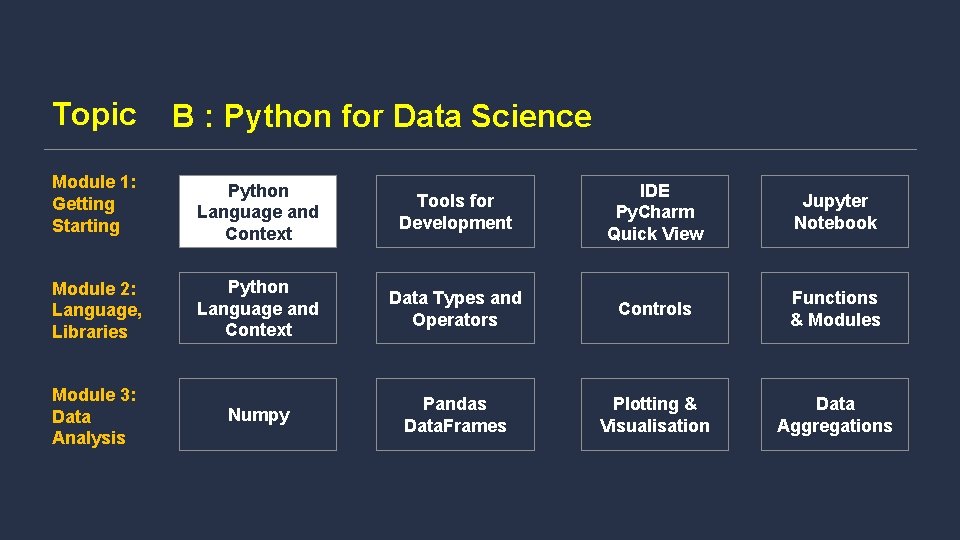
Topic B : Python for Data Science Module 1: Getting Starting Python Language and Context Tools for Development IDE Py. Charm Quick View Jupyter Notebook Module 2: Language, Libraries Python Language and Context Data Types and Operators Controls Functions & Modules Module 3: Data Analysis Numpy Pandas Data. Frames Plotting & Visualisation Data Aggregations
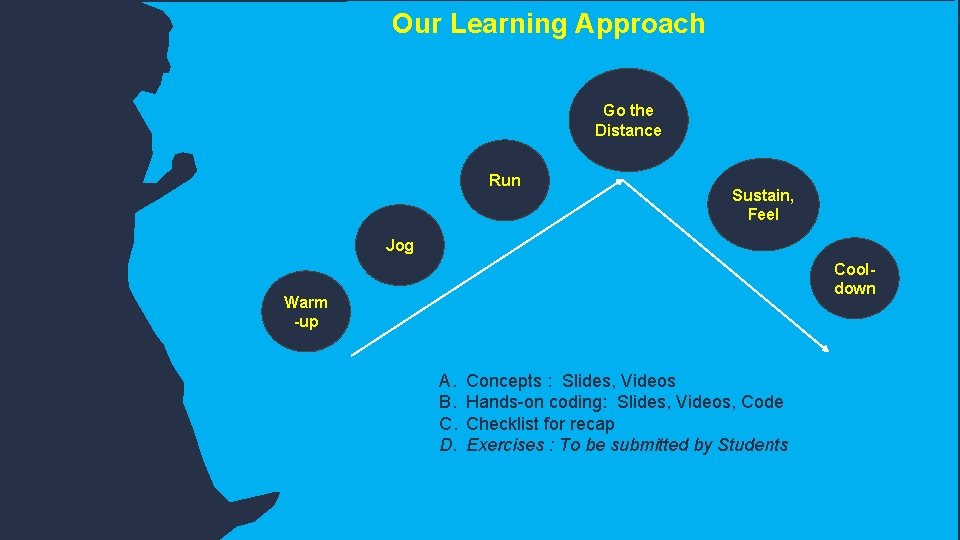
Our Learning Approach Go the Distance Run Sustain, Feel Jog Cooldown Warm -up A. B. C. D. Concepts : Slides, Videos Hands-on coding: Slides, Videos, Code Checklist for recap Exercises : To be submitted by Students
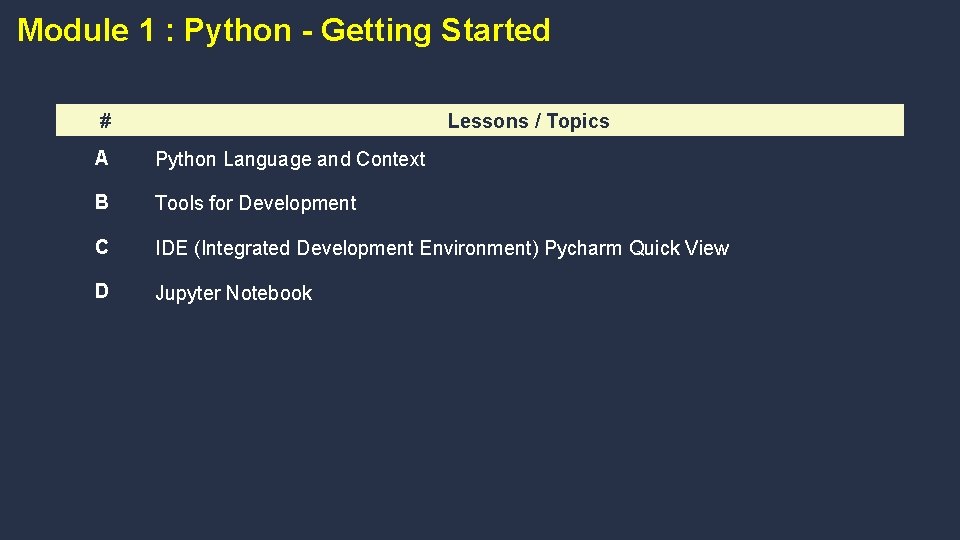
Module 1 : Python - Getting Started # Lessons / Topics A Python Language and Context B Tools for Development C IDE (Integrated Development Environment) Pycharm Quick View D Jupyter Notebook
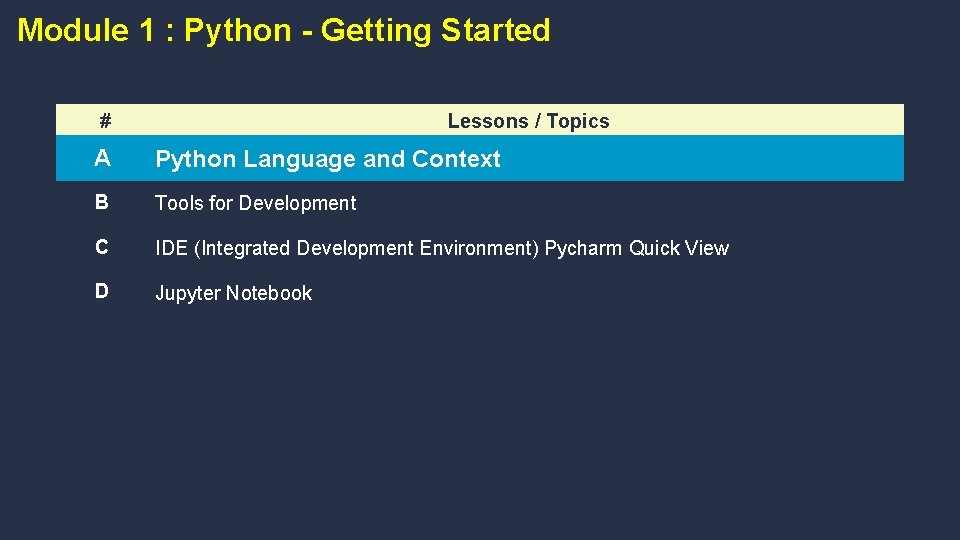
Module 1 : Python - Getting Started # Lessons / Topics A Python Language and Context B Tools for Development C IDE (Integrated Development Environment) Pycharm Quick View D Jupyter Notebook
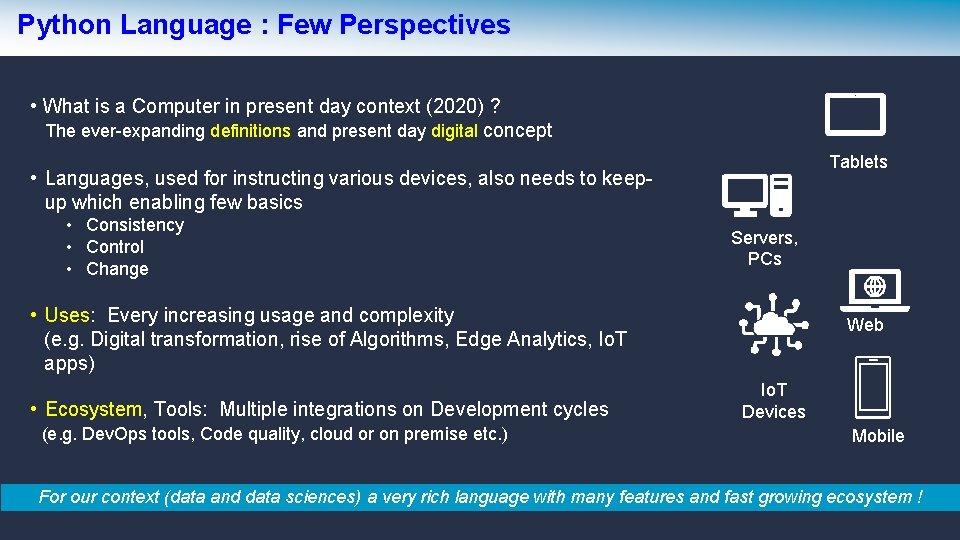
Python Language : Few Perspectives • What is a Computer in present day context (2020) ? The ever-expanding definitions and present day digital concept Tablets • Languages, used for instructing various devices, also needs to keepup which enabling few basics • Consistency • Control • Change Servers, PCs • Uses: Every increasing usage and complexity (e. g. Digital transformation, rise of Algorithms, Edge Analytics, Io. T apps) • Ecosystem, Tools: Multiple integrations on Development cycles (e. g. Dev. Ops tools, Code quality, cloud or on premise etc. ) Web Io. T Devices Mobile For our context (data and data sciences) a very rich language with many features and fast growing ecosystem !
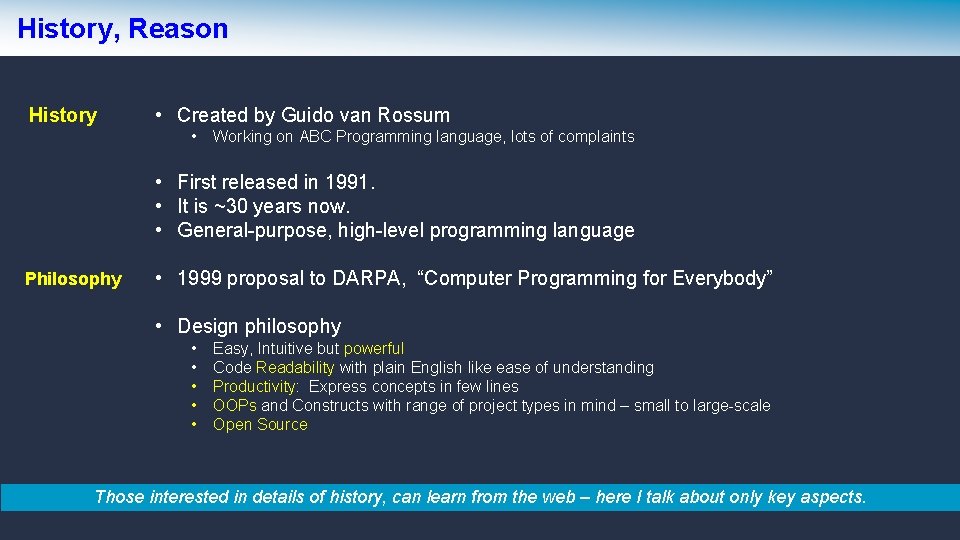
History, Reason History • Created by Guido van Rossum • Working on ABC Programming language, lots of complaints • First released in 1991. • It is ~30 years now. • General-purpose, high-level programming language Philosophy • 1999 proposal to DARPA, “Computer Programming for Everybody” • Design philosophy • • • Easy, Intuitive but powerful Code Readability with plain English like ease of understanding Productivity: Express concepts in few lines OOPs and Constructs with range of project types in mind – small to large-scale Open Source Those interested in details of history, can learn from the web – here I talk about only key aspects.

Python Language : Pros and Cons PROS CONS A. Easy to use Object Oriented Language (benefits like modularity, reuse, flexibility, large problems) • Speed : Not the fastest Language B. Expressive (few lines of code, easy to maintain). • High-concurrency Multi-threading at language level C. Interpret, interact and learn • Libraries (e. g. Not Native to Mobile) D. Cross-Platform Compatible • Not strong on Type binding E. Expanding set of Libraries for various need: Example. Scientific, UI, App development, Data Science…. For our context, data and data sciences, a very rich language with many features and fast growing ecosystem !
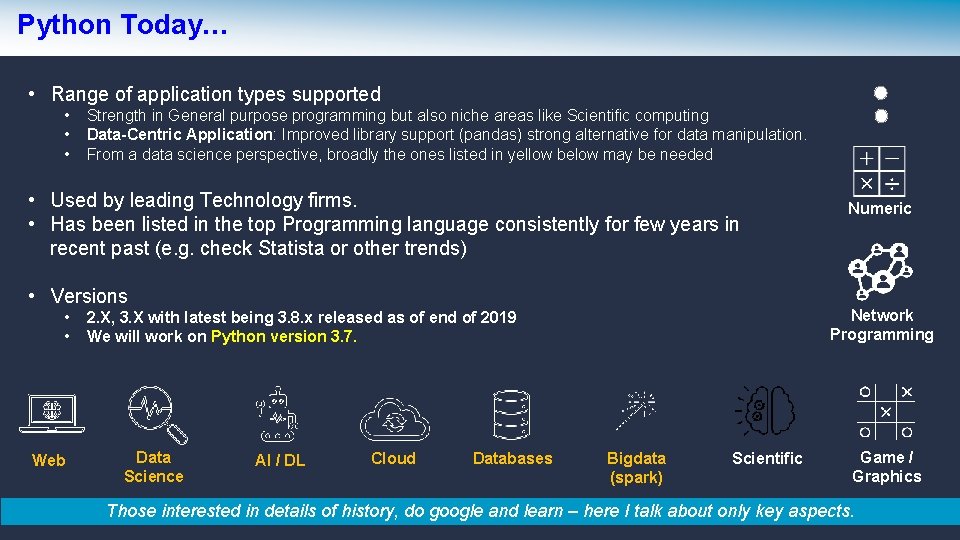
Python Today… • Range of application types supported • • • Strength in General purpose programming but also niche areas like Scientific computing Data-Centric Application: Improved library support (pandas) strong alternative for data manipulation. From a data science perspective, broadly the ones listed in yellow below may be needed • Used by leading Technology firms. • Has been listed in the top Programming language consistently for few years in recent past (e. g. check Statista or other trends) • Versions • • Web Network Programming 2. X, 3. X with latest being 3. 8. x released as of end of 2019 We will work on Python version 3. 7. Data Science AI / DL Cloud Databases Numeric Bigdata (spark) Scientific Game / Graphics Those interested in details of history, do google and learn – here I talk about only key aspects.
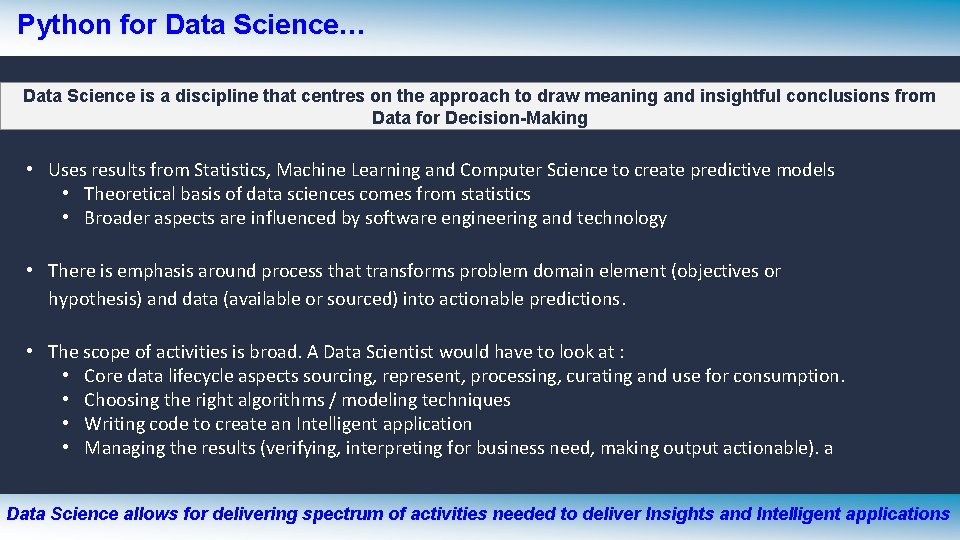
Python for Data Science… Data Science is a discipline that centres on the approach to draw meaning and insightful conclusions from Data for Decision-Making • Uses results from Statistics, Machine Learning and Computer Science to create predictive models • Theoretical basis of data sciences comes from statistics • Broader aspects are influenced by software engineering and technology • There is emphasis around process that transforms problem domain element (objectives or hypothesis) and data (available or sourced) into actionable predictions. • The scope of activities is broad. A Data Scientist would have to look at : • Core data lifecycle aspects sourcing, represent, processing, curating and use for consumption. • Choosing the right algorithms / modeling techniques • Writing code to create an Intelligent application • Managing the results (verifying, interpreting for business need, making output actionable). a Data Science allows for delivering spectrum of activities needed to deliver Insights and Intelligent applications
Thank you ! www. Business. Of. Insights. com Insights Community Sharing Blogs Perspectives Formal Learning (Courses) Latest Happenings Balaji S. Thiruvenkatachari stbalaji@business. Of. Insights. com 9840768200 AI for Good Giving back
- Slides: 11