
Business Models Part 2 CPS 181 s Lecture
Business Models - Part 2 CPS 181 s Lecture #6
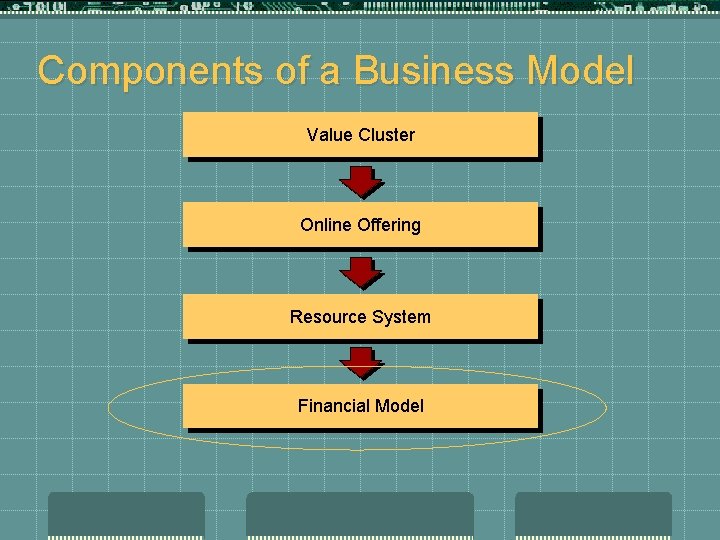
Components of a Business Model Value Cluster Online Offering Resource System Financial Model
What are the Financial Models Available to e. Commerce Firms? t Financial models that derive from the resource system t t t A review of the revenue models Nine approaches to shareholder value/profit models Growth models and how to pursue revenue growth
Revenue vs Shareholder Value/Profit t. Revenue Models clearly identify the flow of cash into the organization (the “pipeline”) t. Shareholder Value/Profit Models identify how the company will generate cash or ultimately make a profit (the quantity)
Types of Revenue Models?
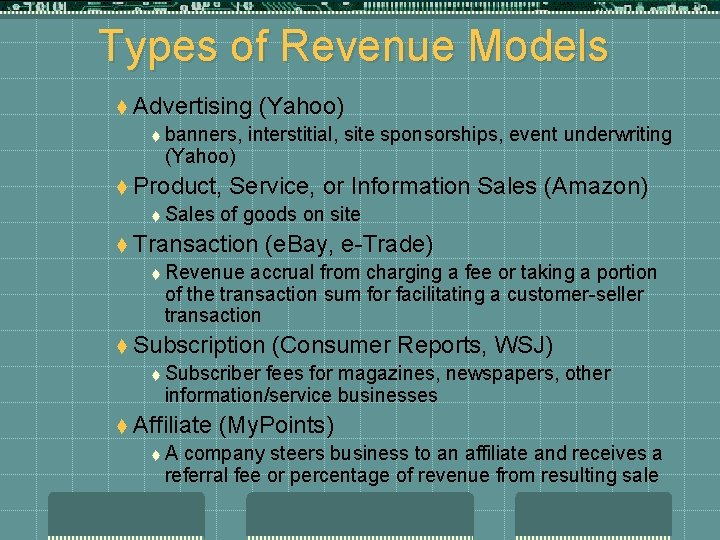
Types of Revenue Models t Advertising t banners, (Yahoo) t Product, t Sales (Yahoo) interstitial, site sponsorships, event underwriting Service, or Information Sales (Amazon) of goods on site t Transaction (e. Bay, e-Trade) t Revenue accrual from charging a fee or taking a portion of the transaction sum for facilitating a customer-seller transaction t Subscription (Consumer Reports, WSJ) t Subscriber fees for magazines, newspapers, other information/service businesses t Affiliate t. A (My. Points) company steers business to an affiliate and receives a referral fee or percentage of revenue from resulting sale
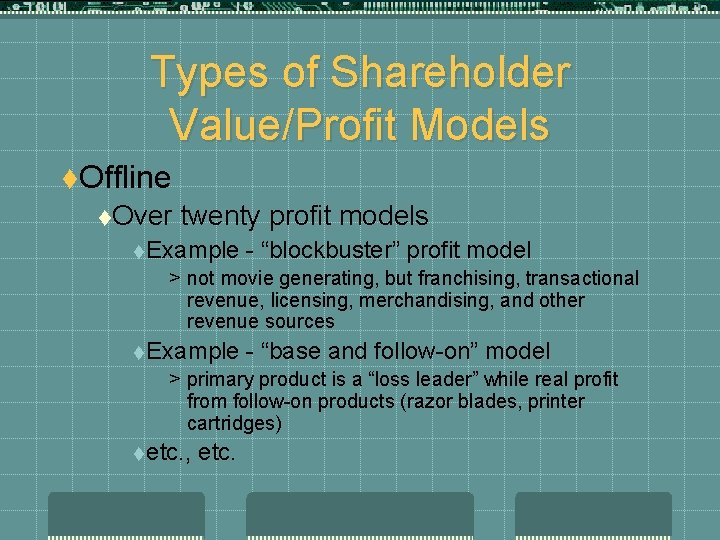
Types of Shareholder Value/Profit Models t. Offline t. Over twenty profit models t. Example - “blockbuster” profit model > not movie generating, but franchising, transactional revenue, licensing, merchandising, and other revenue sources t. Example - “base and follow-on” model > primary product is a “loss leader” while real profit from follow-on products (razor blades, printer cartridges) tetc. , etc.

Characteristics of Shareholder Value/Profit Models…. t. Online t. Nine Profit Models t. Differ from traditional company valuations t. Shift from Profit to Shareholder-Value Focus > market capitalization, rather than profit (share price times the number of shares outstanding) t. Shift from Supply-Side Language to Demand-Side Language > Significant financial gain (price of offering or price of shares) > Focus on core benefits a customer is looking for t. Introduce New Ways of Creating Value > reflect evolution of e. Commerce
Initially Do Profits Matter? t. Begin by building profit……. t. Begin by building user base…. .
Point-Counterpoint: Does Profit Matter? Build Profit Or Build User Base?

On-Line Profit Models?

Online Profit Models t Company and User-Derived Value Creation t Metamarkets Portal t Traditional and Reverse Auctions t Category-Specific Portal t Company-Derived t Best Value Creation Information t Widest Assortment t Lowest Prices t Broadcast User Network t Best Experience t Most Personalized
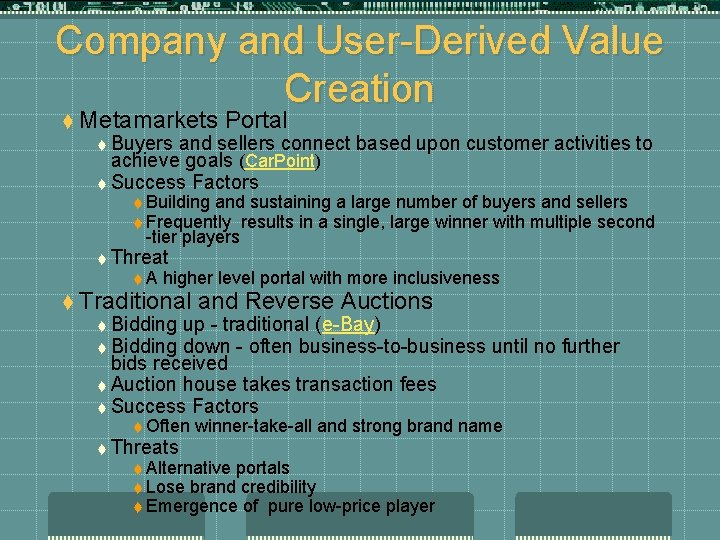
Company and User-Derived Value Creation t Metamarkets t Buyers Portal and sellers connect based upon customer activities to achieve goals (Car. Point) t Success Factors t Building and sustaining a large number of buyers and sellers t Frequently results in a single, large winner with multiple second -tier players t Threat t. A higher level portal with more inclusiveness t Traditional t Bidding and Reverse Auctions up - traditional (e-Bay) down - often business-to-business until no further bids received t Auction house takes transaction fees t Success Factors t Often t Threats winner-take-all and strong brand name t Alternative portals t Lose brand credibility t Emergence of pure low-price player
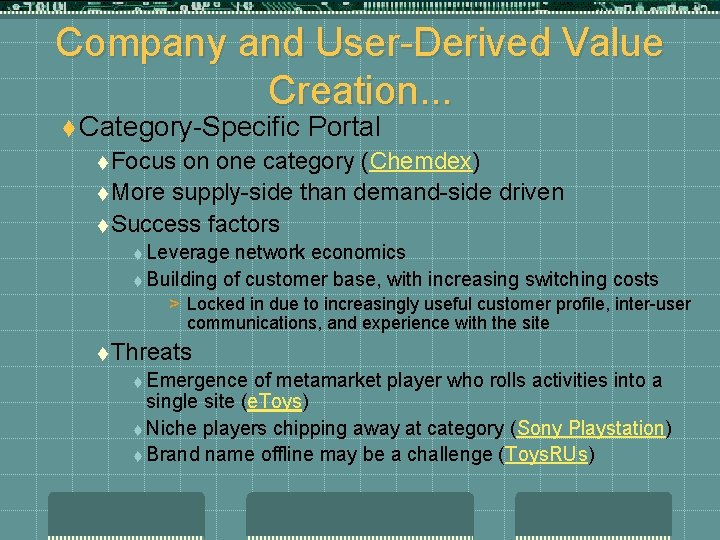
Company and User-Derived Value Creation. . . t Category-Specific Portal t Focus on one category (Chemdex) t More supply-side than demand-side driven t Success factors t Leverage network economics t Building of customer base, with increasing switching costs > Locked in due to increasingly useful customer profile, inter-user communications, and experience with the site t Threats t Emergence of metamarket player who rolls activities into a single site (e. Toys) t Niche players chipping away at category (Sony Playstation) t Brand name offline may be a challenge (Toys. RUs)
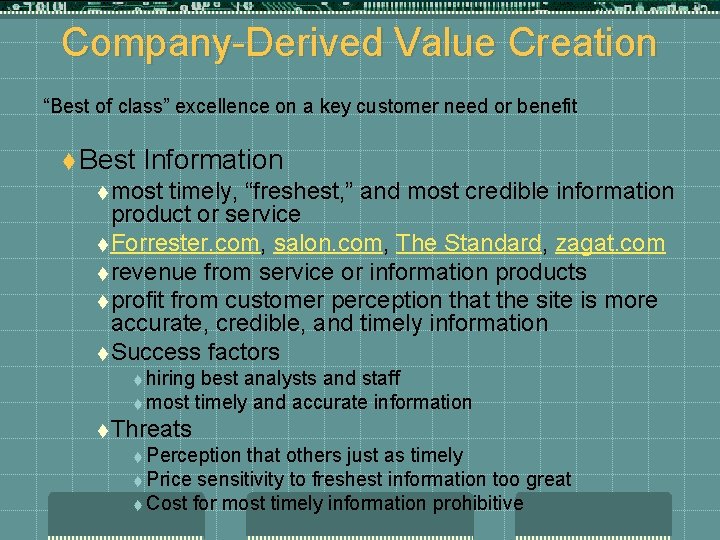
Company-Derived Value Creation “Best of class” excellence on a key customer need or benefit t Best Information t most timely, “freshest, ” and most credible information product or service t Forrester. com, salon. com, The Standard, zagat. com t revenue from service or information products t profit from customer perception that the site is more accurate, credible, and timely information t Success factors t hiring best analysts and staff t most timely and accurate information t Threats t Perception that others just as timely t Price sensitivity to freshest information too great t Cost for most timely information prohibitive
Company-Derived Value Creation. . . t Widest Assortment t breadth of product, service, and information coverage or inventory in the chosen product category t CDNow. com, Artist. Direct. com, Second. Spin. com t revenue derived from product sales, with selective premium pricing on the most desirable products t Success Factors ¨ ¨ ¨ reducing customer uncertainty building a strong brand presence repeating buying and spreading word quality of additional information Inventory must be complemented with value-added services t Threats ¨ ¨ further specialization in the product category megabrands attempt to aggregate consumers at a higher level
Company-Derived Value Creation. . . t. Lowest Prices ¨ promises lowest prices online ¨ maybe specific to a product category ¨ Lowest. Fare. com, All. Books 4 Less. com, buy. com t. Success ¨ ¨ ¨ Factors Margins minimal or non-existent, requiring strong back office systems Leverage scale economies Requires outstanding supply chain management, procurement, operational excellence t. Threats ¨ ¨ Emergence of shop bots (my. Simon. com) Strong brand players who create uncertainty, creating niche players
Company-Derived Value Creation. . . t. Broadcast User Network ¨ pure demand based model relies on the fast buildup of the user network ¨ ICQ, Real. Networks. com, mercata. com, Mobshop. com t. Success ¨ factors building of strong customer base, customer's extent of viral marketing, trademarked software or patents t. Threats ¨ ¨ ¨ emergence of alternative standards fundamental technology shift backward or forward integration of complementary players
Company-Derived Value Creation. . . t Best Experience ¨ ¨ Best experience regardless of price FAOSwartz. com, Ashford. com Revenue expected to originate from products, services, or information Profit maintained by premium prices across entire range of products t Success ¨ ¨ ¨ factors Sourcing of best products Outstanding service A shift in customer preferences to brand labels t Threats ¨ ¨ ¨ Emergence of lower priced offerings that have similar benefits Lack of perceived value in higher priced goods A shift to emergent brand labels, as compared to historic favorites
Company-Derived Value Creation. . . t Most personalized ¨ Best customization of the consumer experience ¨ Reflect. com t Success ¨ ¨ ¨ factors deep customer knowledge ability to continual refresh and mine the customer database consumer’s ability to feel complete ability to customize experience t Threats ¨ ¨ Emergence of new players who offer a newer, richer, more personalized experience New technologies that displace older technologies that allow other companies to catch up and match the older company’s customer experience
3) Financial Growth Models t Third component of a financial model is the firm’s revenue growth strategy or growth model t. Revenue growth can come from a deeper penetration in the current market, new product development, new market development, complete new products and markets
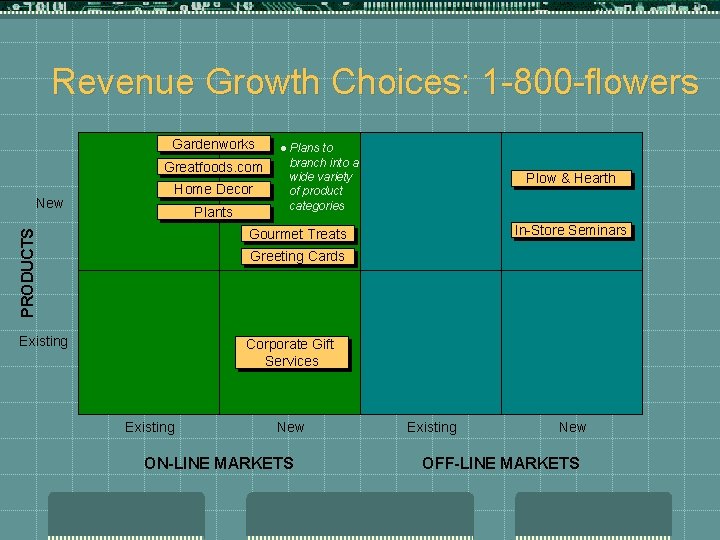
Revenue Growth Choices: 1 -800 -flowers Gardenworks Greatfoods. com Plants Plans to branch into a wide variety of product categories PRODUCTS New Home Decor l Gourmet Treats Existing Corporate Gift Services Plow & Hearth In-Store Seminars Greeting Cards Existing New ON-LINE MARKETS Existing New OFF-LINE MARKETS
Would You Rather Start as: A Dot-Com Or Brick-And-Mortar Business?
Would You Rather Start as: A Dot-Com Or Brick. And-Mortar Business?
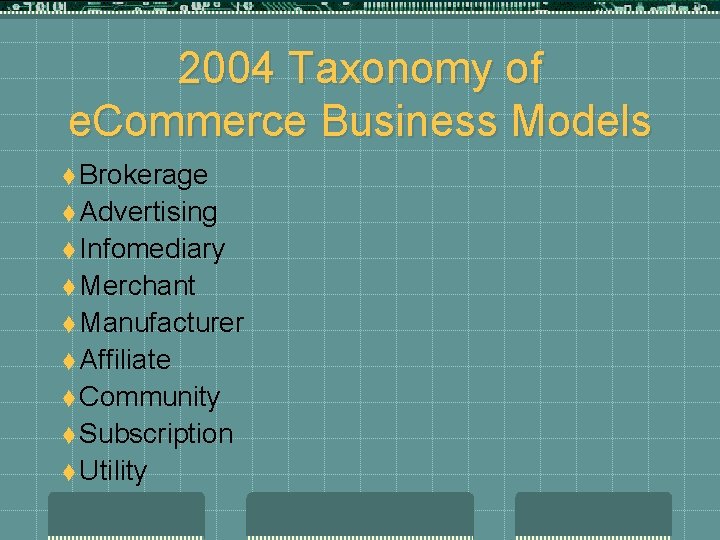
2004 Taxonomy of e. Commerce Business Models t Brokerage t Advertising t Infomediary t Merchant t Manufacturer t Affiliate t Community t Subscription t Utility
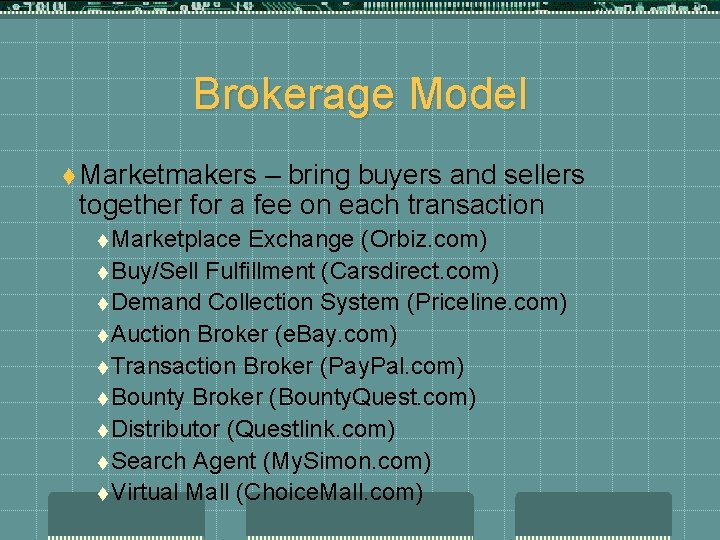
Brokerage Model t Marketmakers – bring buyers and sellers together for a fee on each transaction t Marketplace Exchange (Orbiz. com) t Buy/Sell Fulfillment (Carsdirect. com) t Demand Collection System (Priceline. com) t Auction Broker (e. Bay. com) t Transaction Broker (Pay. Pal. com) t Bounty Broker (Bounty. Quest. com) t Distributor (Questlink. com) t Search Agent (My. Simon. com) t Virtual Mall (Choice. Mall. com)
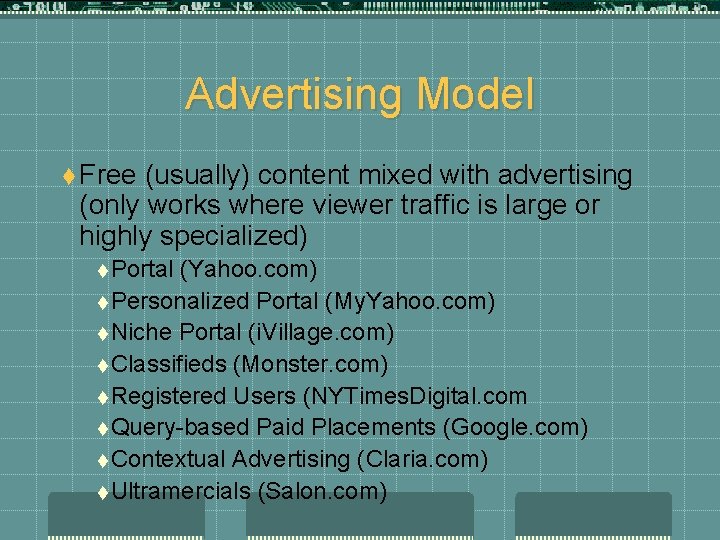
Advertising Model t Free (usually) content mixed with advertising (only works where viewer traffic is large or highly specialized) t Portal (Yahoo. com) t Personalized Portal (My. Yahoo. com) t Niche Portal (i. Village. com) t Classifieds (Monster. com) t Registered Users (NYTimes. Digital. com t Query-based Paid Placements (Google. com) t Contextual Advertising (Claria. com) t Ultramercials (Salon. com)
Infomediary Model t. Assist buyers or sellers to understand a given market t. Advertising Networks (Double. Click. com) t. Audience Measurement Services (Nielson. com) t. Incentive Marketing (My. Points. com) t. Metamediary (Edmunds. com)
Merchant Model t. Wholesalers or retailers of goods and services t. Virtual Merchant (Amazon. com) t. Catalog Merchant (Frontgate. com) t. Click & Mortar (Barnes & Noble) t. Bit Vendor (Eyewire. com)
Manufacturer Model t. Direct sales to compress the distribution channels t. Brand Integrated Content (bmwfilms. com)
Affiliate Model t. Provides purchase opportunity wherever people may be surfing (pay for performance) (Amazon. com) t. Banner Exchange t. Pay per Click t. Revenue Sharing
Community Model t. Based on user loyalty. Users usually make a significant investment of time and emotion. t. Voluntary Contributor Model (WCPE. org) t. Knowledge Networks (Web. Monkey. com)
Subscription Model t. Subscription t. Content fee for service Services (Listen. com, Netflix. com) t. Person-to-Person Networking Services (Classmates. com) t. Trust Services (Truste. com) t. Internet Service Providers (AOL, Earthlink)

Utility Model t. On-demand, pay as you go metered services t. Metered Subscriptions (Slashdot. com)
Migrating to Profitable e. Commerce Business Models t t t e. Business is evolutionary rather than disruptive Success = compelling value proposition. Firms learn thru constant experimentation and feedback e. Business can both leverage intangible assets such as customer perceptions, but also exposes associated weaknesses Firms discovering they must build more centralized infrastructure Requires three management imperatives: t IT Governance to insure strategic positioning t Human resource alignment t Customer connectedness for market experiments t t Strategic Partnerships for agile response Firms struggling to find metrics for making sound business decisions Jeanne Ross, Michael Vitale, and Peter Weill: FROM PLACE TO SPACE: Migrating to Profitable Electronic Commerce Business Models, MIT Sloan School of Management working Paper No. 4358 -01
- Slides: 35