
BUSINESS MODELS for the real world TRADITIONAL BUSINESS
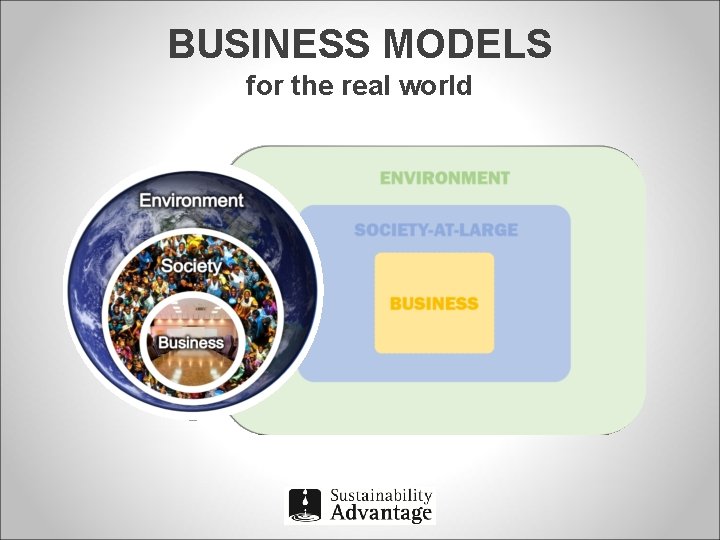
BUSINESS MODELS for the real world

TRADITIONAL BUSINESS MODEL BUSINESS Governance Purpose / Vision / Mission / Policies / Strategies People Social licence & other income HUMAN RESOURCES Reputation & revenue Supplies $ Capital Activities & Processes Products & Services FINANCIAL ASSETS, FACILITIES, EQUIPMENT, INTELLECTUAL PROPERTY Channels Customers
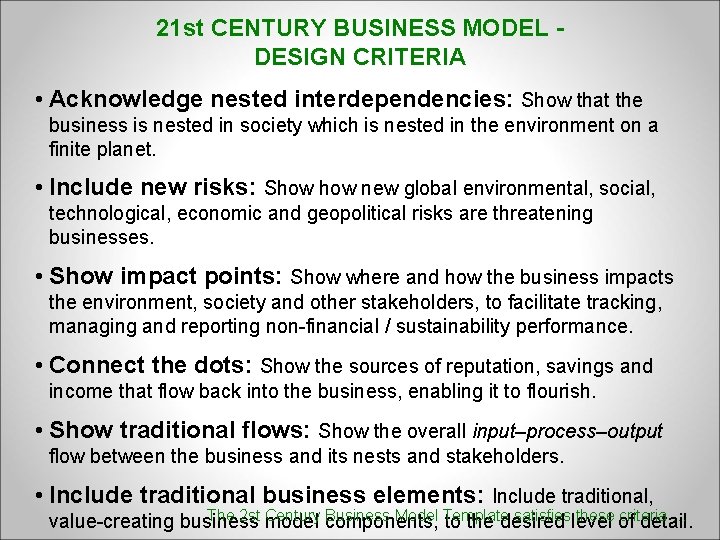
21 st CENTURY BUSINESS MODEL DESIGN CRITERIA • Acknowledge nested interdependencies: Show that the business is nested in society which is nested in the environment on a finite planet. • Include new risks: Show new global environmental, social, technological, economic and geopolitical risks are threatening businesses. • Show impact points: Show where and how the business impacts the environment, society and other stakeholders, to facilitate tracking, managing and reporting non-financial / sustainability performance. • Connect the dots: Show the sources of reputation, savings and income that flow back into the business, enabling it to flourish. • Show traditional flows: Show the overall input‒process‒output flow between the business and its nests and stakeholders. • Include traditional business elements: Include traditional, The 2 st model Century components, Business Model Template satisfieslevel these of criteria … value-creating business to the desired detail.

21 st CENTURY BUSINESS MODEL TEMPLATE – GENERIC ENVIRONMENT 21 st century environmental risks ry tu cal n e gi ic st c lo m 21 hno no o c te ec isks & r 21 s t so ce ge cie ntu op tal ry o ris litic & ks al BUSINESS Governance Purpose / Vision / Mission / Policies / Strategies People Impacts Reputation & savings $ Capital Community Impacts Social licence & other income Other stakeholders HUMAN RESOURCES Reputation & savings Supplies SOCIETYAT-LARGE Reputation & revenue Activities & Processes Products & Services FINANCIAL ASSETS, FACILITIES, EQUIPMENT, INTELLECTUAL PROPERTY Channels Customers Usage & end-of-life impacts Reputation & savings Operational impacts Reputation & savings Circular economy
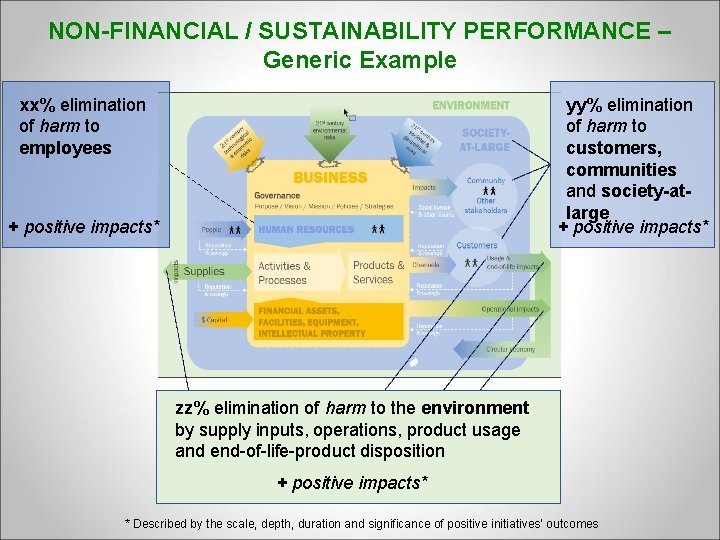
NON-FINANCIAL / SUSTAINABILITY PERFORMANCE – Generic Example xx% elimination of harm to employees yy% elimination of harm to customers, communities and society-atlarge + positive impacts* zz% elimination of harm to the environment by supply inputs, operations, product usage and end-of-life-product disposition + positive impacts* * Described by the scale, depth, duration and significance of positive initiatives’ outcomes
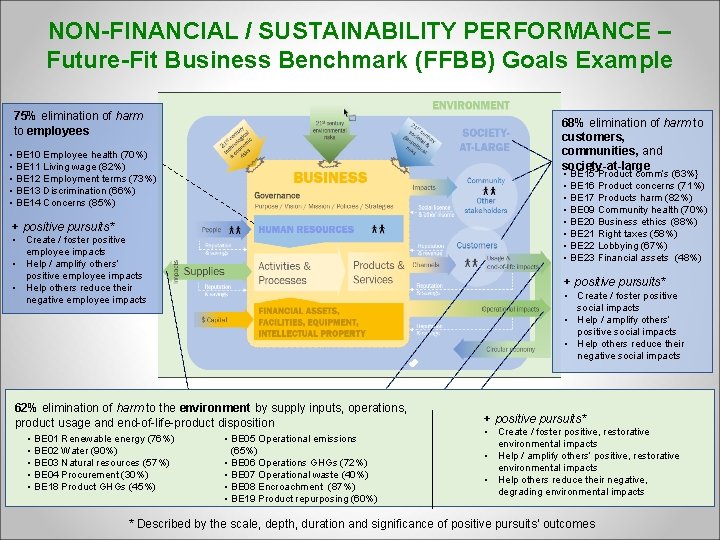
NON-FINANCIAL / SUSTAINABILITY PERFORMANCE – Future-Fit Business Benchmark (FFBB) Goals Example 75% elimination of harm to employees • • • 68% elimination of harm to customers, communities, and society-at-large BE 10 Employee health (70%) BE 11 Living wage (82%) BE 12 Employment terms (73%) BE 13 Discrimination (66%) BE 14 Concerns (85%) • • + positive pursuits* • Create / foster positive employee impacts • Help / amplify others’ positive employee impacts • Help others reduce their negative employee impacts + positive pursuits* • Create / foster positive social impacts • Help / amplify others’ positive social impacts • Help others reduce their negative social impacts 62% elimination of harm to the environment by supply inputs, operations, product usage and end-of-life-product disposition • • • BE 01 Renewable energy (76%) BE 02 Water (90%) BE 03 Natural resources (57%) BE 04 Procurement (30%) BE 18 Product GHGs (45%) BE 15 Product comm’s (63%} BE 16 Product concerns (71%) BE 17 Products harm (82%) BE 09 Community health (70%) BE 20 Business ethics (88%) BE 21 Right taxes (58%) BE 22 Lobbying (67%) BE 23 Financial assets (48%) • BE 05 Operational emissions (65%) • BE 06 Operations GHGs (72%) • BE 07 Operational waste (40%) • BE 08 Encroachment (87%) • BE 19 Product repurposing (60%) + positive pursuits* • Create / foster positive, restorative environmental impacts • Help / amplify others’ positive, restorative environmental impacts • Help others reduce their negative, degrading environmental impacts * Described by the scale, depth, duration and significance of positive pursuits’ outcomes
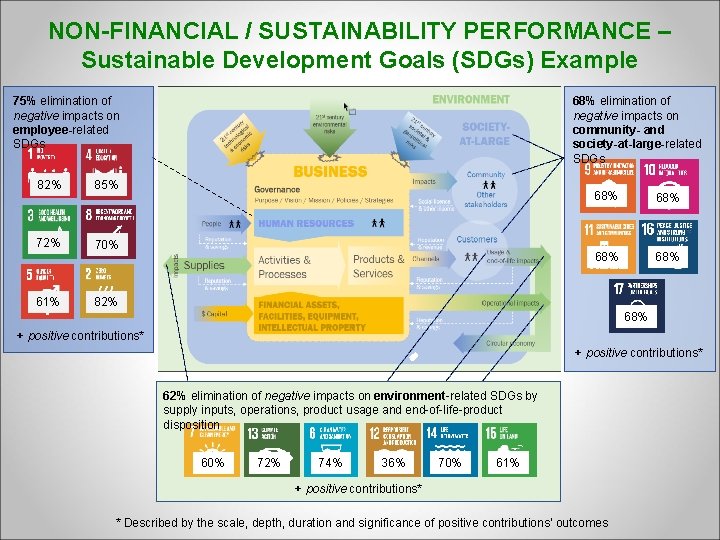
NON-FINANCIAL / SUSTAINABILITY PERFORMANCE – Sustainable Development Goals (SDGs) Example 75% elimination of negative impacts on employee-related SDGs 82% 72% 61% 68% elimination of negative impacts on community- and society-at-large-related SDGs 85% 70% 68% 68% 82% 68% + positive contributions* 62% elimination of negative impacts on environment-related SDGs by supply inputs, operations, product usage and end-of-life-product disposition 60% 72% 74% 36% 70% 61% + positive contributions* * Described by the scale, depth, duration and significance of positive contributions’ outcomes
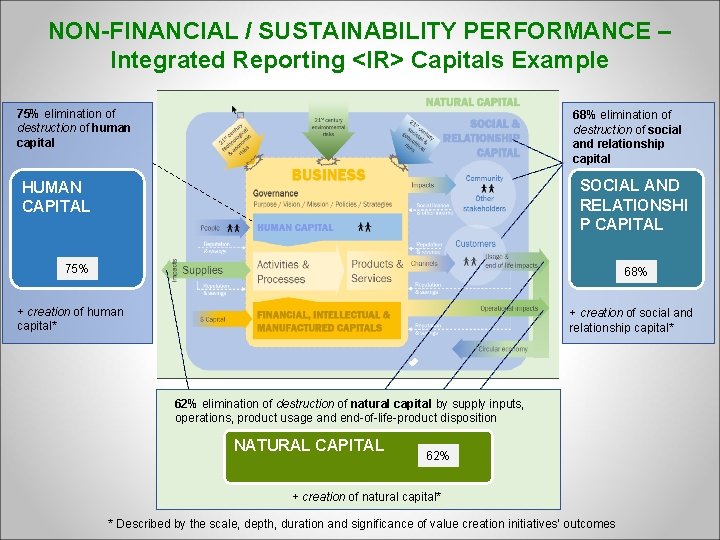
NON-FINANCIAL / SUSTAINABILITY PERFORMANCE – Integrated Reporting <IR> Capitals Example 75% elimination of destruction of human capital 68% elimination of destruction of social and relationship capital SOCIAL AND RELATIONSHI P CAPITAL HUMAN CAPITAL 75% 68% + creation of human capital* + creation of social and relationship capital* 62% elimination of destruction of natural capital by supply inputs, operations, product usage and end-of-life-product disposition NATURAL CAPITAL 62% + creation of natural capital* * Described by the scale, depth, duration and significance of value creation initiatives’ outcomes
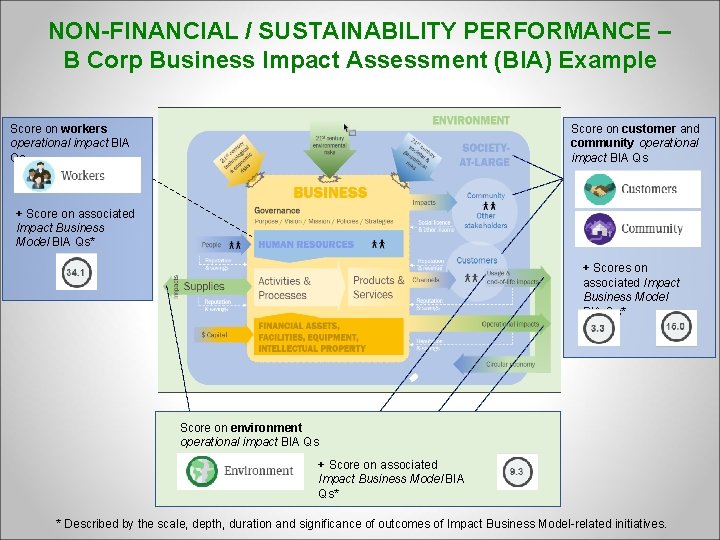
NON-FINANCIAL / SUSTAINABILITY PERFORMANCE – B Corp Business Impact Assessment (BIA) Example Score on customer and community operational impact BIA Qs Score on workers operational impact BIA Qs + Score on associated Impact Business Model BIA Qs* + Scores on associated Impact Business Model BIA Qs* Score on environment operational impact BIA Qs + Score on associated Impact Business Model BIA Qs* * Described by the scale, depth, duration and significance of outcomes of Impact Business Model-related initiatives.
- Slides: 9