
Business Models for Integrated eInfrastructures with Commercial Clouds
Business Models for Integrated e-Infrastructures with Commercial Clouds September 2012, Julia Doll (Mick Symonds, actually)
Agenda q Business Model Definition q Task 7. 1: Framework for Potential Business Models q Task 7. 2: Analyze and Design Business Models q Methods to Design Business Models q Define Evaluation Criteria for Business Model Options q Task 7. 3: Business Case Calculation © 2011 SAP AG. All rights reserved. Internal 2
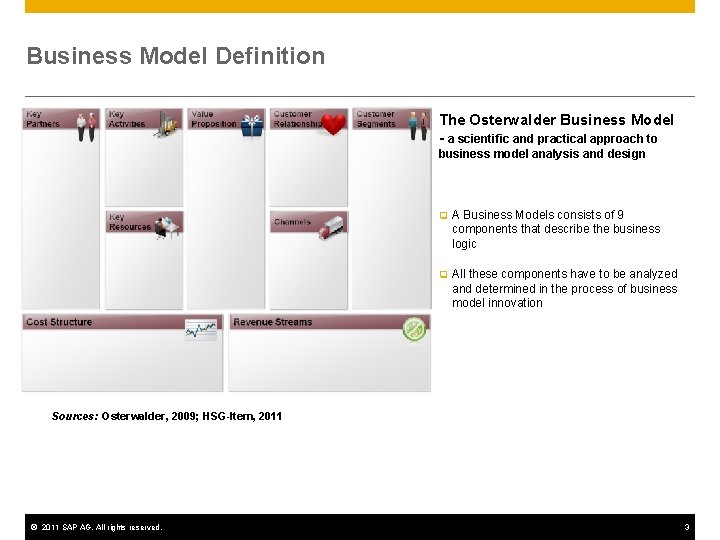
Business Model Definition The Osterwalder Business Model - a scientific and practical approach to business model analysis and design q A Business Models consists of 9 components that describe the business logic q All these components have to be analyzed and determined in the process of business model innovation Sources: Osterwalder, 2009; HSG-Item, 2011 © 2011 SAP AG. All rights reserved. Internal 3

Task 7. 1: Framework for Potential Business Models Timeline: v Survey (deadline: 14 of September!) v Initial results of survey evaluation planed for 14 of Oct v Interview based on results: tbd ~ Oct. , (Dates will be send via email/Doodle) Tasks: q Analyze budgeting, accounting and procurement procedures (demand) q Investigate cost and offer creation (supply ) Potential WP 6 Collaboration: Gather all possible scenarios of how public funded Infrastructures could collaborate with commercial providers to deliver the science cloud & Fill out the survey (separate deadline), take part in interview © 2011 SAP AG. All rights reserved. Cost structures will be determined by supply side results The offer creation process of the supply side will limit possible value propositions Demand side results will restrict potential pricing models (related to revenues) Internal 4
Task 7. 2 Analyze and Design Business Models Analysis To design a suitable business model first the following business models have to be analyzed to develop an understanding of the requirements of the market q Competitive business models in cloud computing in any industry (e. g. Amazon) q Business models used in similar contexts such as online services, platforms etc. q Existing business models on the market implementing a broker role Potential WP 6 Collaboration: Give insights on public funded business models in a similar context or different industries plus analysis if available © 2011 SAP AG. All rights reserved. Internal 5
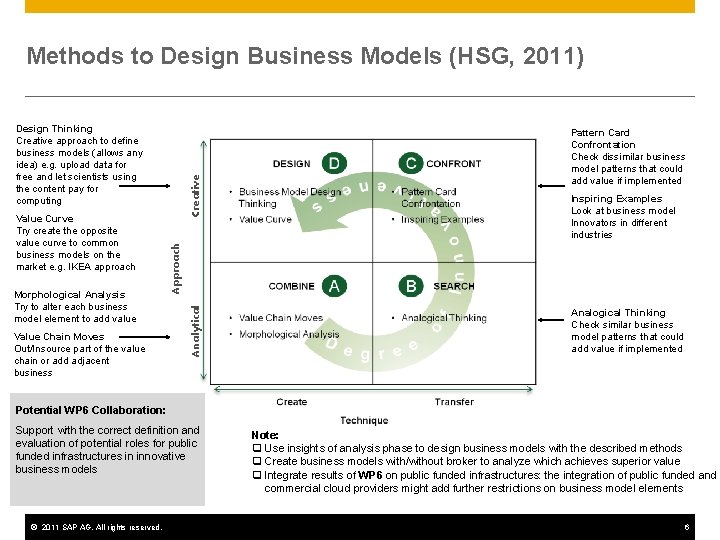
Methods to Design Business Models (HSG, 2011) Value Chain Moves Out/Insource part of the value chain or add adjacent business Analytical Morphological Analysis Try to alter each business model element to add value Pattern Card Confrontation Check dissimilar business model patterns that could add value if implemented Inspiring Examples Look at business model Innovators in different industries Approach Value Curve Try create the opposite value curve to common business models on the market e. g. IKEA approach Creative Design Thinking Creative approach to define business models (allows any idea) e. g. upload data for free and let scientists using the content pay for computing Analogical Thinking Check similar business model patterns that could add value if implemented Potential WP 6 Collaboration: Support with the correct definition and evaluation of potential roles for public funded infrastructures in innovative business models © 2011 SAP AG. All rights reserved. Note: q Use insights of analysis phase to design business models with the described methods q Create business models with/without broker to analyze which achieves superior value q Integrate results of WP 6 on public funded infrastructures: the integration of public funded and commercial cloud providers might add further restrictions on business model elements Internal 6
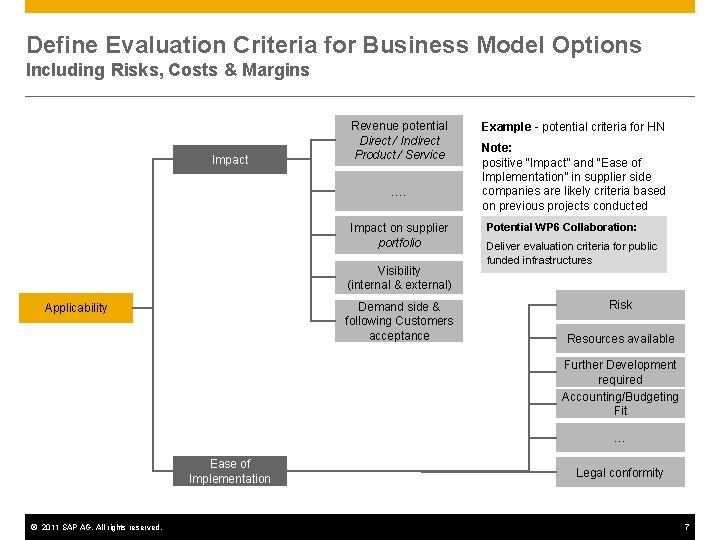
Define Evaluation Criteria for Business Model Options Including Risks, Costs & Margins Impact Revenue potential Direct / Indirect Product / Service …. Impact on supplier portfolio Visibility (internal & external) Demand side & following Customers acceptance Applicability Example - potential criteria for HN Note: positive “Impact” and “Ease of Implementation” in supplier side companies are likely criteria based on previous projects conducted Potential WP 6 Collaboration: Deliver evaluation criteria for public funded infrastructures Risk Resources available Further Development required Accounting/Budgeting Fit … Ease of Implementation © 2011 SAP AG. All rights reserved. Legal conformity Internal 7
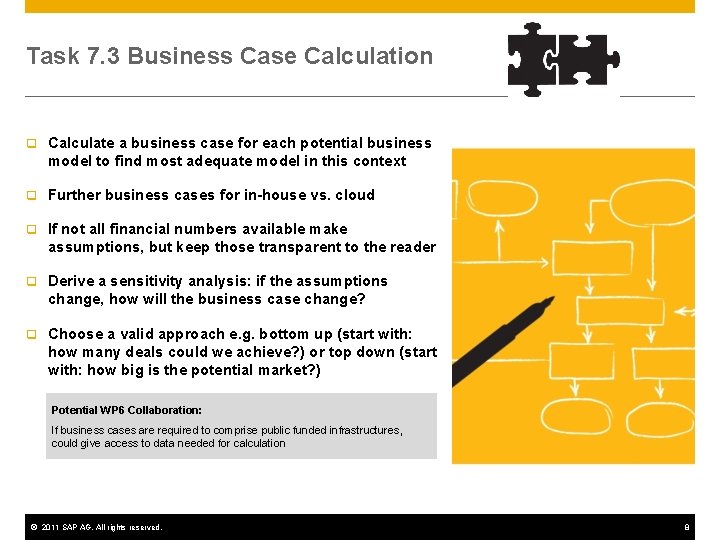
Task 7. 3 Business Case Calculation q Calculate a business case for each potential business model to find most adequate model in this context q Further business cases for in-house vs. cloud q If not all financial numbers available make assumptions, but keep those transparent to the reader q Derive a sensitivity analysis: if the assumptions change, how will the business case change? q Choose a valid approach e. g. bottom up (start with: how many deals could we achieve? ) or top down (start with: how big is the potential market? ) Potential WP 6 Collaboration: If business cases are required to comprise public funded infrastructures, could give access to data needed for calculation © 2011 SAP AG. All rights reserved. Internal 8
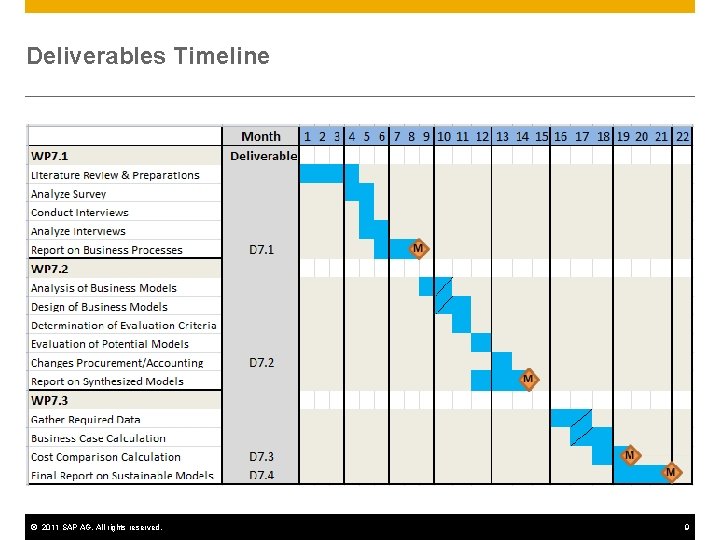
Deliverables Timeline © 2011 SAP AG. All rights reserved. Internal 9
Key Points q Survey and Interviews in Task 7. 1 require participation of supply and demand side (interviews tbd) q There are several issues, which could involve collaboration of WP 6 and WP 7 q Established methods can be applied for the analysis, design and evaluation of business models © 2011 SAP AG. All rights reserved. Internal 10
Thank You! Contact Information: Not me, thus. ; o) Julia Doll SAP Research – Business Model Innovation ju. doll@sap. com
- Slides: 11