
Business Models 1 Strategic alignment theory REF Henderson
Business Models
1 Strategic alignment theory REF: Henderson &Venkatraman IBM SYSTEMS JOURNAL, VOL 38, NO 4, 1999 http: //researchweb. watson. ibm. com/journal/sj/382/henderson. pdf
1. 1 Strategic alignment Model Answer to the question: “How to reconcile the dramatic increase in the role of IT in organisations and markets with the evidence of minimal productivity gains at a aggregate level of the economy? ”
1. 1 Strategic alignment Model(cont’d) Inability to realize value from IT-investments is due to the lack of alignment between the business and the IT strategies of the organisations(companies)
1. 1 Strategic alignment Model(cont’d) The model is based on two fundamental assumptions: Ø Ø the economic performance is related to the ability of management to create a strategic fit between the external position of an organisation in the competitive market and the internal appropriate administrative structure to support its execution This strategic fit is a dynamic process
1. 2 Concept of Strategic Fit Business Strategy : Ø external domain(view) company versus competitive market n n n products make or buy decision partnership distribution channels. . .
1. 2 Concept of Strategic Fit(cont’d) Ø Internal domain How do we support the external domain? n n n Business processes product development customer services human resource skills … IT-strategy: same concept as for the business strategy: internal and external views
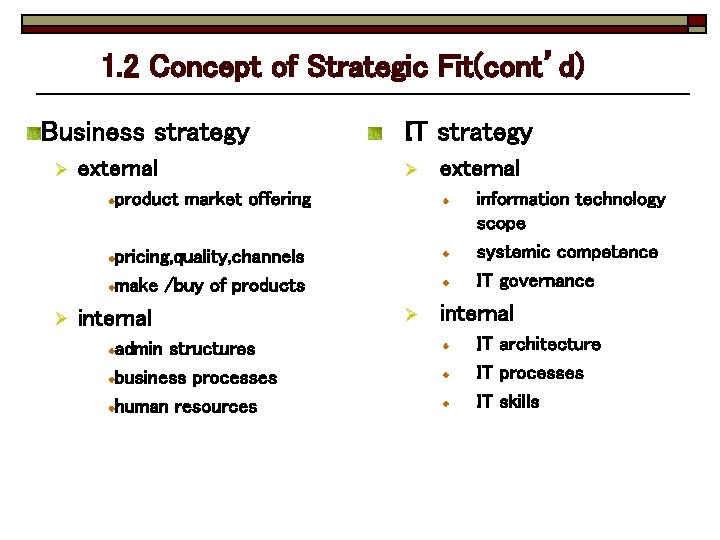
1. 2 Concept of Strategic Fit(cont’d) Business strategy Ø external IT strategy Ø product market offering information technology scope systemic competence IT governance pricing, quality, channels make /buy of products Ø internal admin structures business processes human resources external Ø internal IT architecture IT processes IT skills
1. 2. 1 IT strategy: External Information technology scope I. e specific information technologies that support current business initiatives or could shape new business strategy initiatives for the company n n n electronic imaging internet business expert systems E-business Wireless communications …
1. 2. 1 IT strategy: External (cont’d) Systemic competence Ø the attributes of the IT -strategy which can be used as a competitive weapon to support actual or future business strategies system reliability cost performance interconnectivity Flexibility …
1. 2. 1 IT strategy: External (cont’d) IT governance Ø selection and use of mechanisms for obtaining the required IT competencies joint ventures with vendors, competitors outsourcing joint research alliances. . .
1. 2. 2 IT strategy: Internal IT architecture Ø Ø Ø portfolio applications configuration of HW/SW data model IT processes Ø Ø Ø operations development monitoring and control systems
1. 2. 2 IT strategy: Internal(cont’d) IT skills Ø Ø Ø extern/intern training knowledge level

1. 3 Functional integration Strategy integration Ø business strategy IT strategy Operational integration Ø organisational infrastructure see fig 1 IT infrastructure
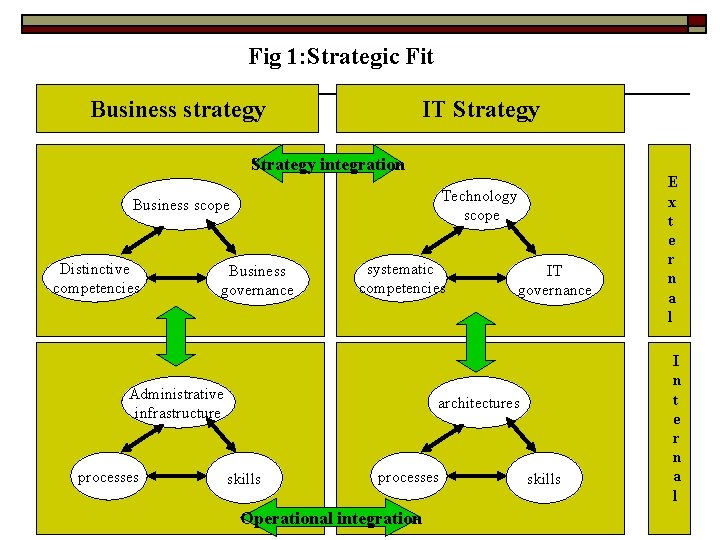
Fig 1: Strategic Fit Business strategy IT Strategy integration Technology scope Business scope Distinctive competencies Business governance systematic competencies Administrative infrastructure processes IT governance architectures skills processes Operational integration skills E x t e r n a l I n t e r n a l
Dominant alignment perspectives
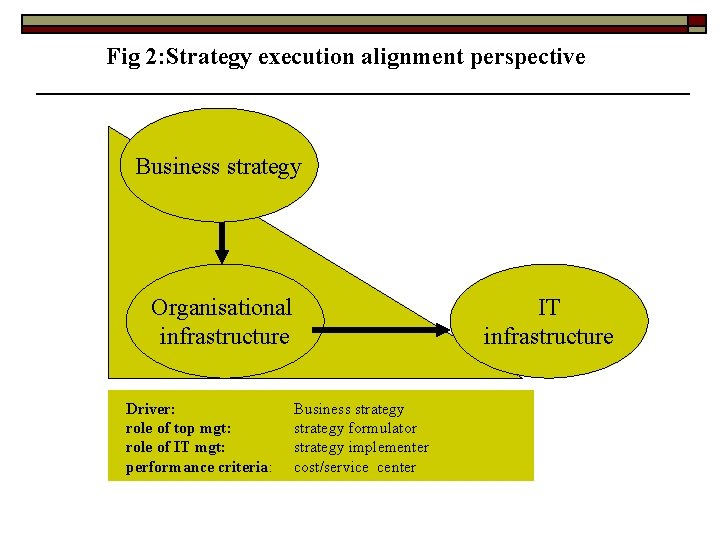
Fig 2: Strategy execution alignment perspective Business strategy Organisational infrastructure Driver: role of top mgt: role of IT mgt: performance criteria: IT infrastructure Business strategy formulator strategy implementer cost/service center
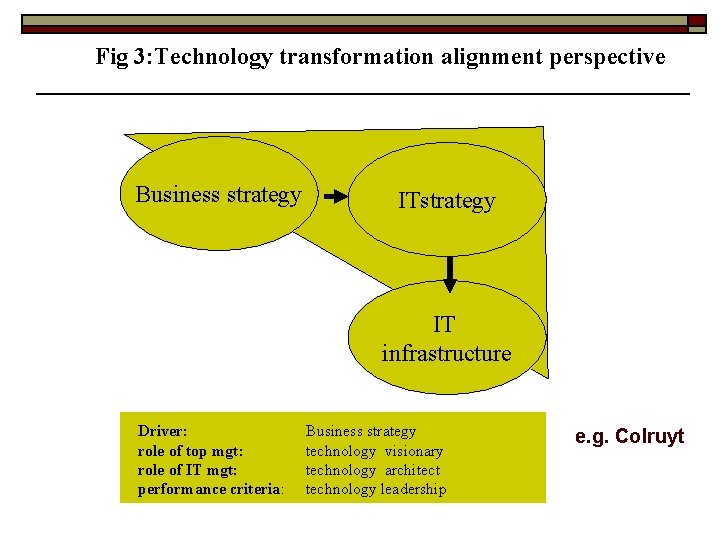
Fig 3: Technology transformation alignment perspective Business strategy IT infrastructure Driver: role of top mgt: role of IT mgt: performance criteria: Business strategy technology visionary technology architect technology leadership e. g. Colruyt
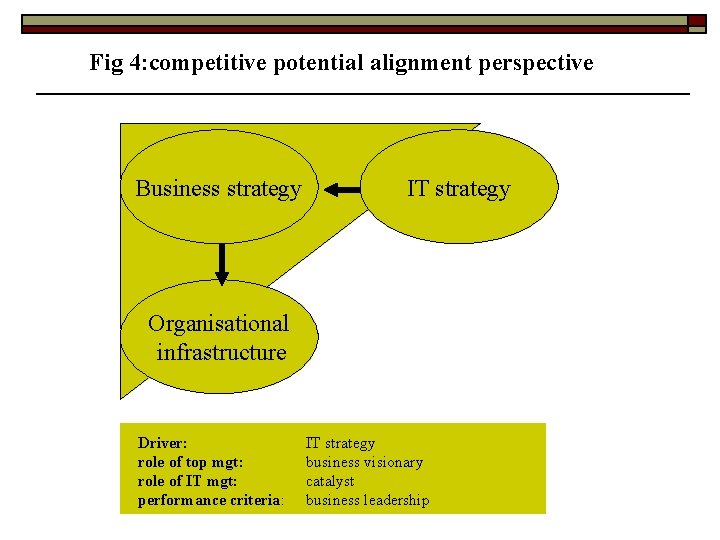
Fig 4: competitive potential alignment perspective Business strategy IT strategy Organisational infrastructure Driver: role of top mgt: role of IT mgt: performance criteria: IT strategy business visionary catalyst business leadership
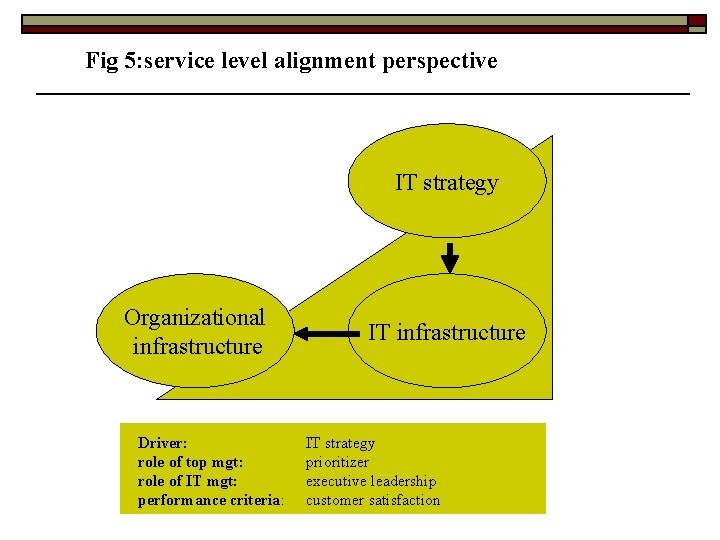
Fig 5: service level alignment perspective IT strategy Organizational infrastructure Driver: role of top mgt: role of IT mgt: performance criteria: IT infrastructure IT strategy prioritizer executive leadership customer satisfaction
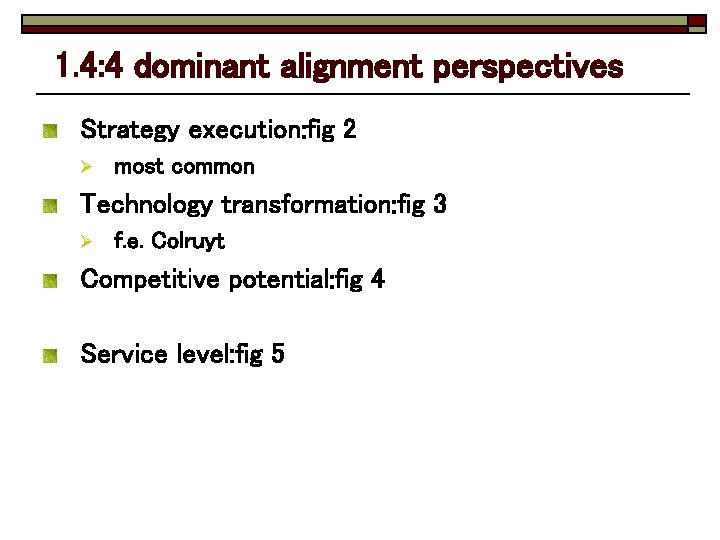
1. 4: 4 dominant alignment perspectives Strategy execution: fig 2 Ø most common Technology transformation: fig 3 Ø f. e. Colruyt Competitive potential: fig 4 Service level: fig 5
1. 5 Comments External and internal IT strategy Companies have to realize that the source of IT competencies is not entirely within the company but involves a complex area of alliances and partnerships with a wide ranging set of firms in the marketplace dynamic model: changes in time based on shifts in the business environment
1. 5 Comments(cont’d) Performance criteria of IT should be reconceptualized= mix of 4 criteria Ø Ø costcenter: competition with outsourcing service center: offered SLA versus best- inindustry profitcenter: revenue +outside delivery investment center: possibility to reinvest+R&D
1. 6 conclusions External focus becomes very important Field research proves that the inadequate fit between external and internal domains of IT is a major reason for failure to derive benefits from IT investments
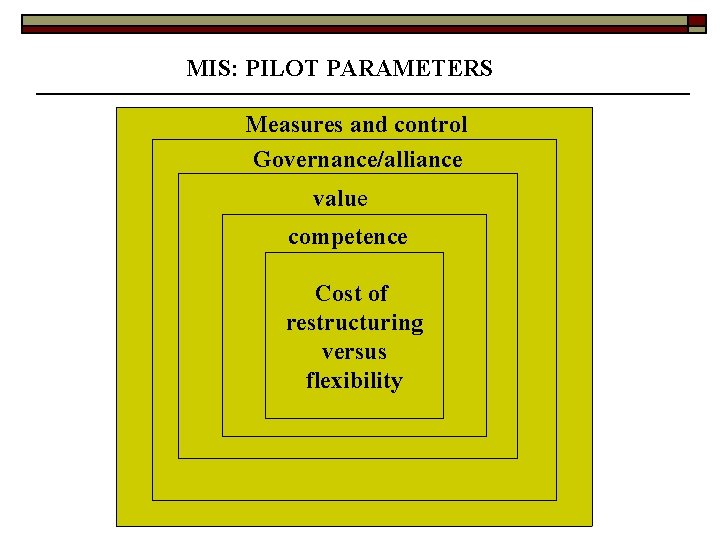
MIS: PILOT PARAMETERS Measures and control Governance/alliance value competence Cost of restructuring competence versus flexibility
Business concepts in a networked world Ref: CORPORATE INFORMATION SYSTEMS MANAGEMENT 6 th edition Lynda Applegate, F. Warren Mc Farlan, James Mc Kenney Chapter 2
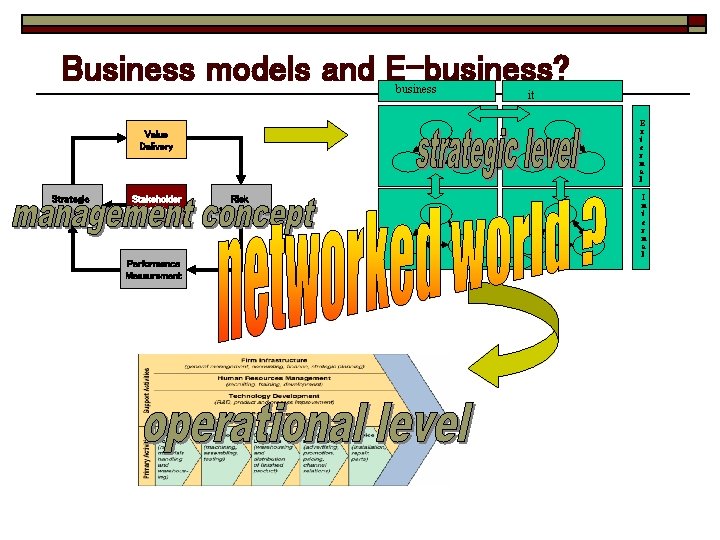
Business models and E-business? business E x t e r n a l Value Delivery Strategic Alignment Stakeholder Value Performance Measurement it Risk Management I n t e r n a l
business concepts in a networked world Introduction Classifying business capabilities Evolving business capabilities
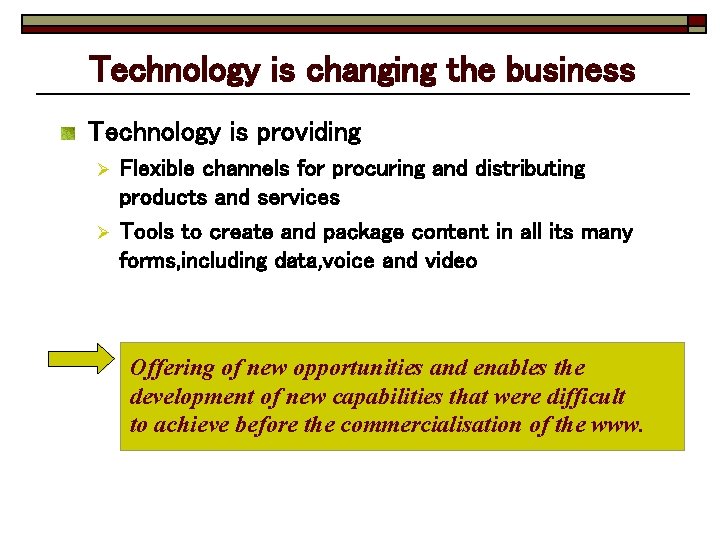
Technology is changing the business Technology is providing Ø Ø Flexible channels for procuring and distributing products and services Tools to create and package content in all its many forms, including data, voice and video Offering of new opportunities and enables the development of new capabilities that were difficult to achieve before the commercialisation of the www.
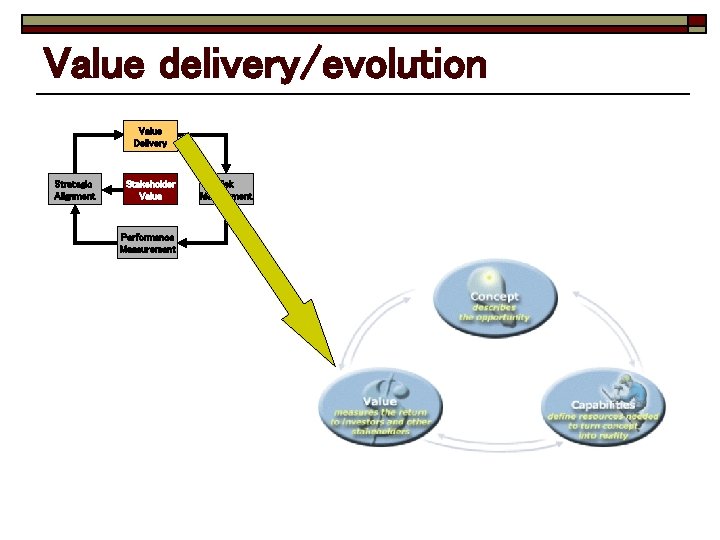
Value delivery/evolution Value Delivery Strategic Alignment Stakeholder Value Performance Measurement Risk Management
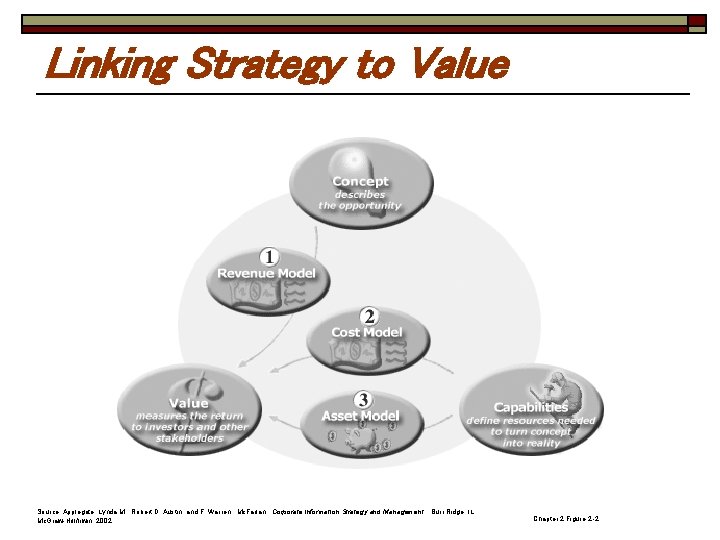
Linking Strategy to Value Source: Applegate, Lynda M. , Robert D. Austin, and F. Warren Mc. Farlan , Corporate Information Strategy and Management. Burr Ridge, IL: Mc. Graw-Hill/Irwin, 2002. Chapter 2 Figure 2 -2
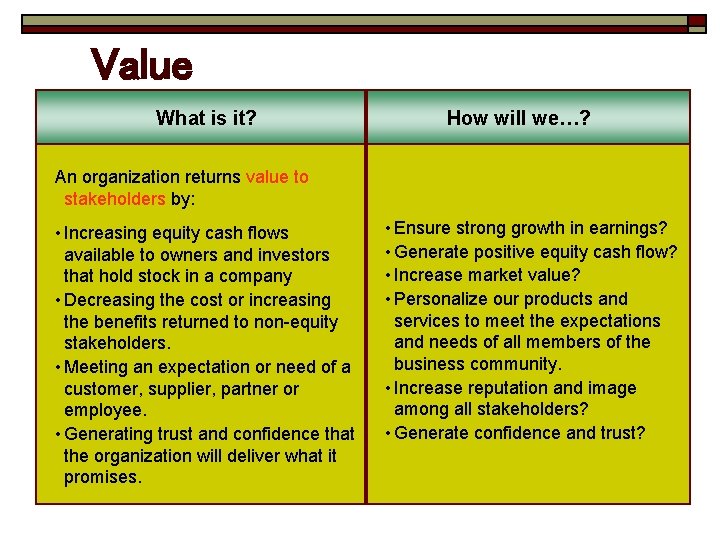
Value What is it? How will we…? An organization returns value to stakeholders by: • Increasing equity cash flows available to owners and investors that hold stock in a company • Decreasing the cost or increasing the benefits returned to non-equity stakeholders. • Meeting an expectation or need of a customer, supplier, partner or employee. • Generating trust and confidence that the organization will deliver what it promises. • Ensure strong growth in earnings? • Generate positive equity cash flow? • Increase market value? • Personalize our products and services to meet the expectations and needs of all members of the business community. • Increase reputation and image among all stakeholders? • Generate confidence and trust?
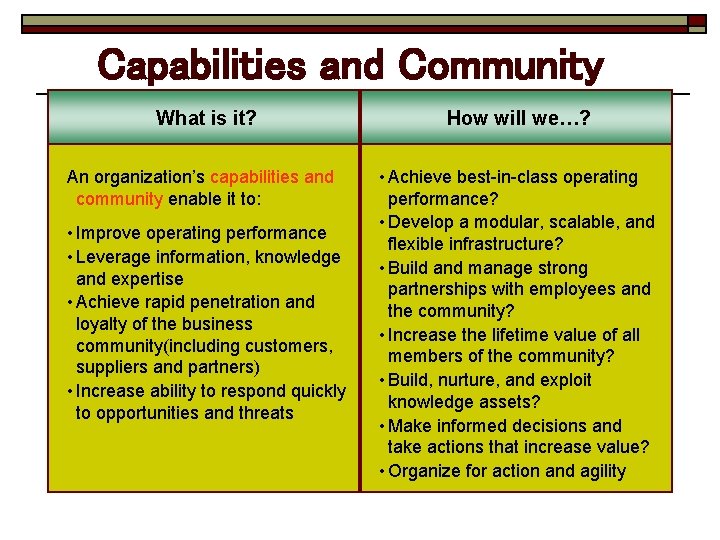
Capabilities and Community What is it? An organization’s capabilities and community enable it to: • Improve operating performance • Leverage information, knowledge and expertise • Achieve rapid penetration and loyalty of the business community(including customers, suppliers and partners) • Increase ability to respond quickly to opportunities and threats How will we…? • Achieve best-in-class operating performance? • Develop a modular, scalable, and flexible infrastructure? • Build and manage strong partnerships with employees and the community? • Increase the lifetime value of all members of the community? • Build, nurture, and exploit knowledge assets? • Make informed decisions and take actions that increase value? • Organize for action and agility
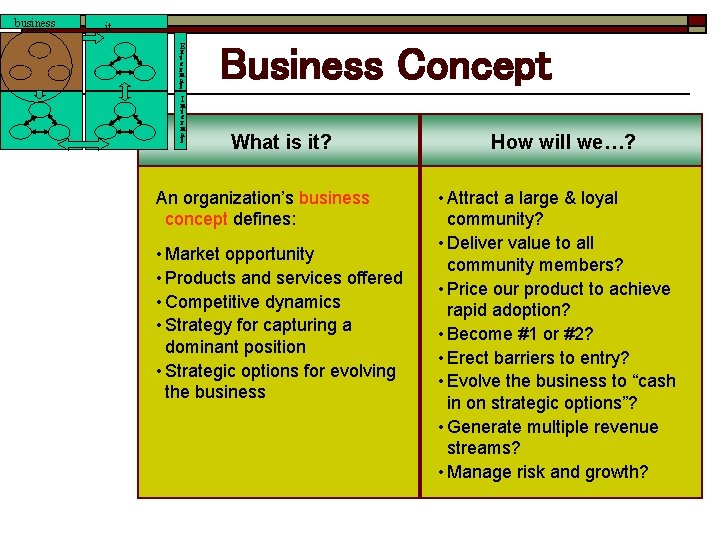
business it E x t e r n a l I n t e r n a l Business Concept What is it? An organization’s business concept defines: • Market opportunity • Products and services offered • Competitive dynamics • Strategy for capturing a dominant position • Strategic options for evolving the business How will we…? • Attract a large & loyal community? • Deliver value to all community members? • Price our product to achieve rapid adoption? • Become #1 or #2? • Erect barriers to entry? • Evolve the business to “cash in on strategic options”? • Generate multiple revenue streams? • Manage risk and growth?
business concepts in a networked world Introduction Classifying business capabilities Evolving business capabilities
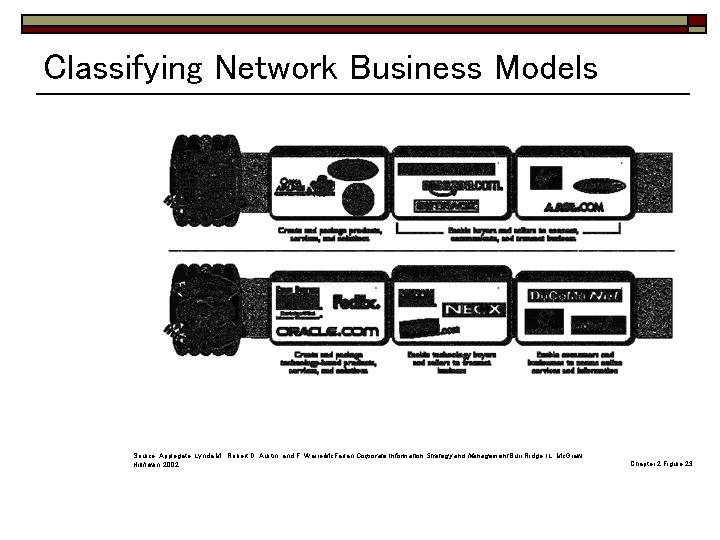
Classifying Network Business Models Source: Applegate, Lynda M. , Robert D. Austin, and F. Warren. Mc. Farlan, Corporate Information Strategy and Management. Burr Ridge, IL: Mc. Graw. Hill/Irwin, 2002. Chapter 2 Figure 2 -3
Classifying business capabilities Business build on a networked infrastructure Ø Ø Ø Focused distributors Portals producers Business providing the network infrastructure Ø Ø Infrastructure distributors portals producers service providers
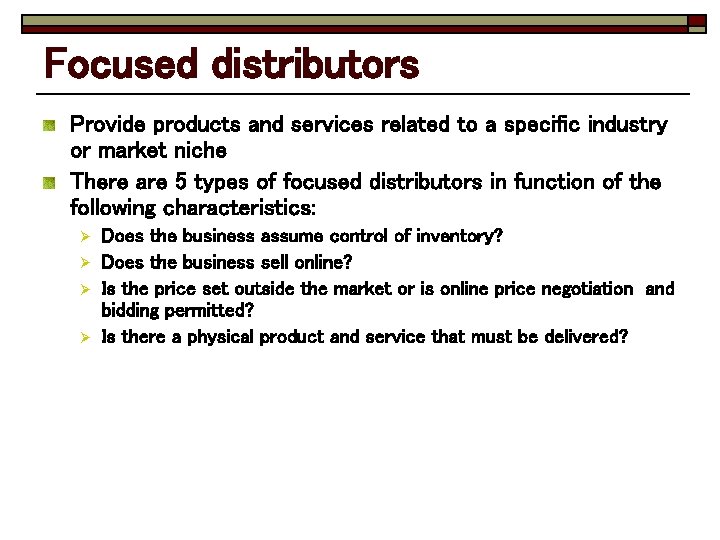
Focused distributors Provide products and services related to a specific industry or market niche There are 5 types of focused distributors in function of the following characteristics: Ø Ø Does the business assume control of inventory? Does the business sell online? Is the price set outside the market or is online price negotiation and bidding permitted? Is there a physical product and service that must be delivered?
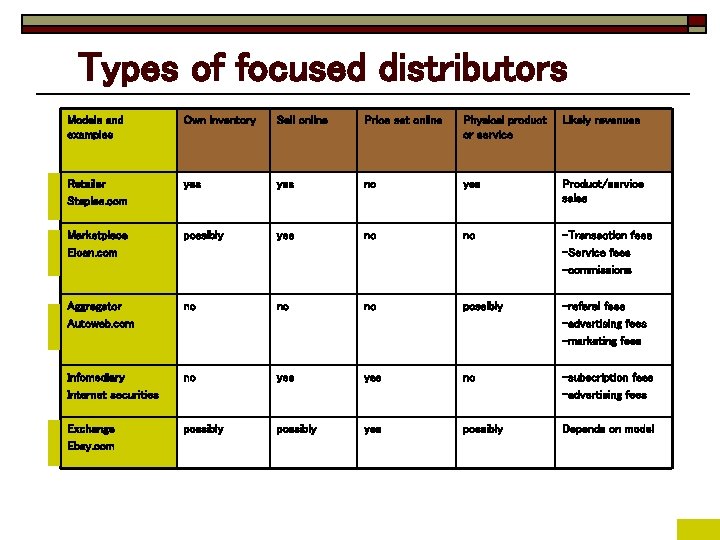
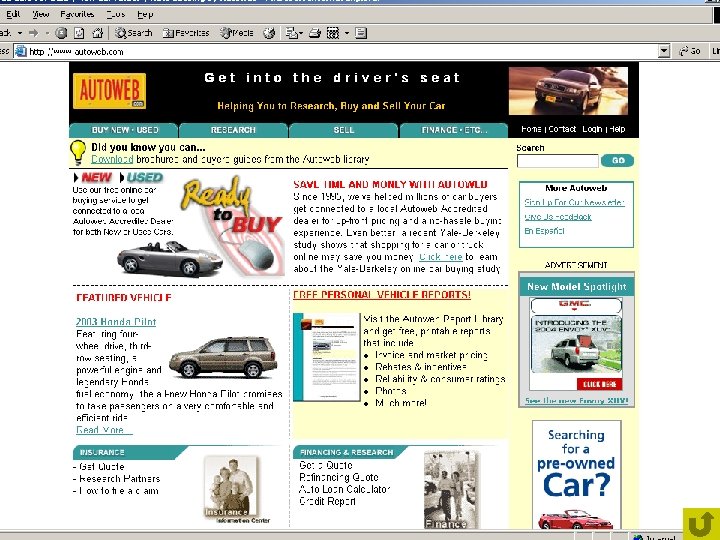
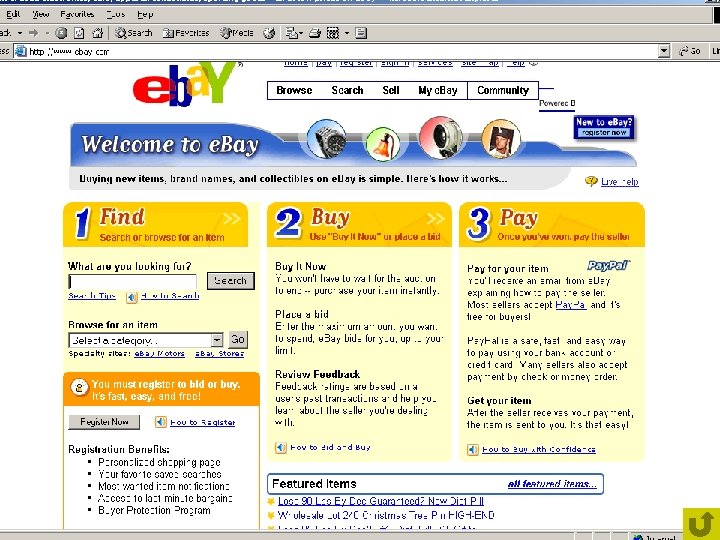
Types of focused distributors Models and examples Own inventory Sell online Price set online Physical product or service Likely revenues Retailer Staples. com yes no yes Product/service sales Marketplace Eloan. com possibly yes no no -Transaction fees -Service fees -commissions Aggregator Autoweb. com no no no possibly -referal fees -advertising fees -marketing fees Infomediary Internet securities no yes no -subscription fees -advertising fees Exchange Ebay. com possibly yes possibly Depends on model
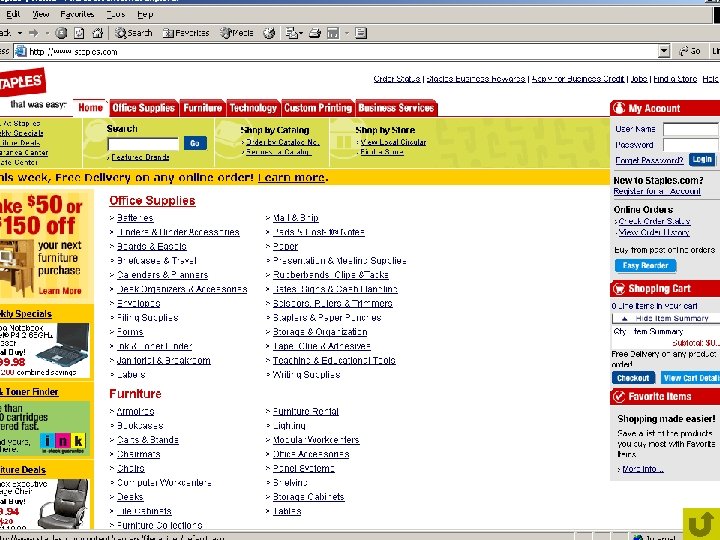
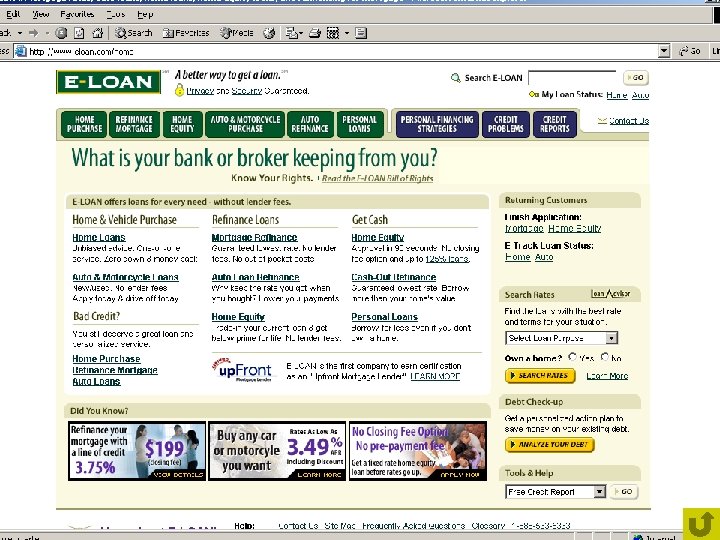
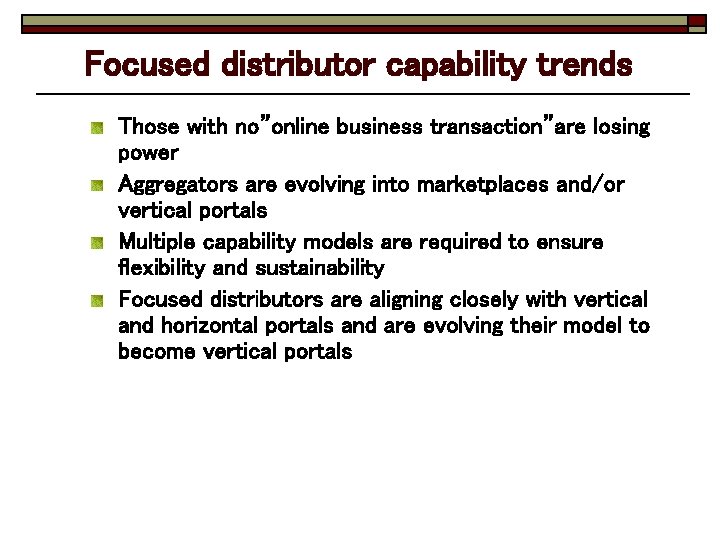
Focused distributor capability trends Those with no”online business transaction”are losing power Aggregators are evolving into marketplaces and/or vertical portals Multiple capability models are required to ensure flexibility and sustainability Focused distributors are aligning closely with vertical and horizontal portals and are evolving their model to become vertical portals
Classifying business capabilities Business build on a networked infrastructure Ø Ø Ø Focused distributors Portals producers Business providing the network infrastructure Ø Ø Infrastructure distributors portals producers service providers
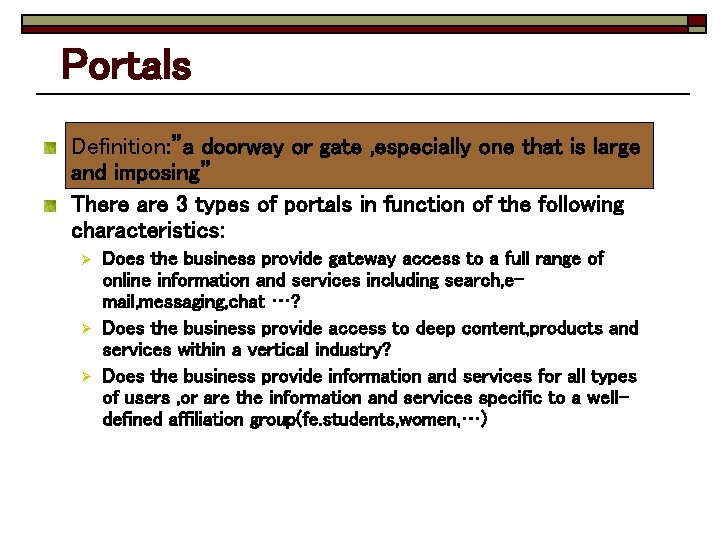
Portals Definition: ”a doorway or gate , especially one that is large and imposing” There are 3 types of portals in function of the following characteristics: Ø Ø Ø Does the business provide gateway access to a full range of online information and services including search, email, messaging, chat …? Does the business provide access to deep content, products and services within a vertical industry? Does the business provide information and services for all types of users , or are the information and services specific to a welldefined affiliation group(fe. students, women, …)
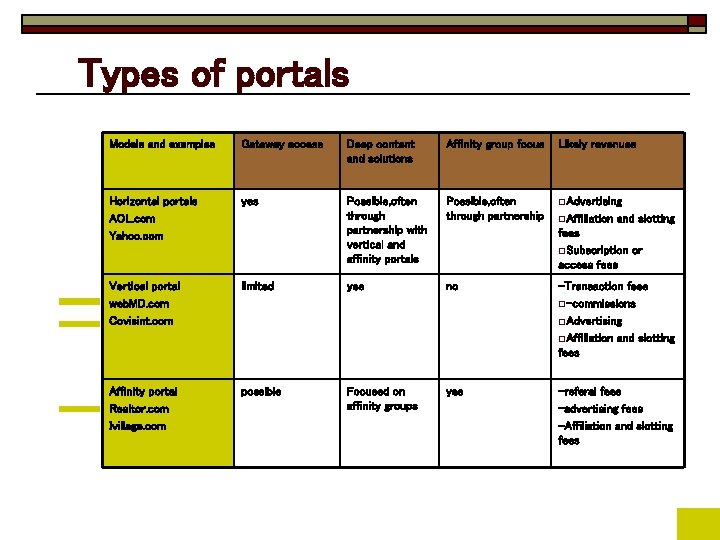
Types of portals Models and examples Gateway access Deep content and solutions Affinity group focus Likely revenues Horizontal portals AOL. com Yahoo. com yes Possible, often through partnership with vertical and affinity portals Possible, often through partnership o. Advertising Vertical portal web. MD. com Covisint. com limited yes no -Transaction fees o-commissions o. Advertising o. Affiliation and slotting fees Affinity portal Realtor. com Ivillage. com possible Focused on affinity groups yes -referal fees -advertising fees -Affiliation and slotting fees o. Subscription or access fees

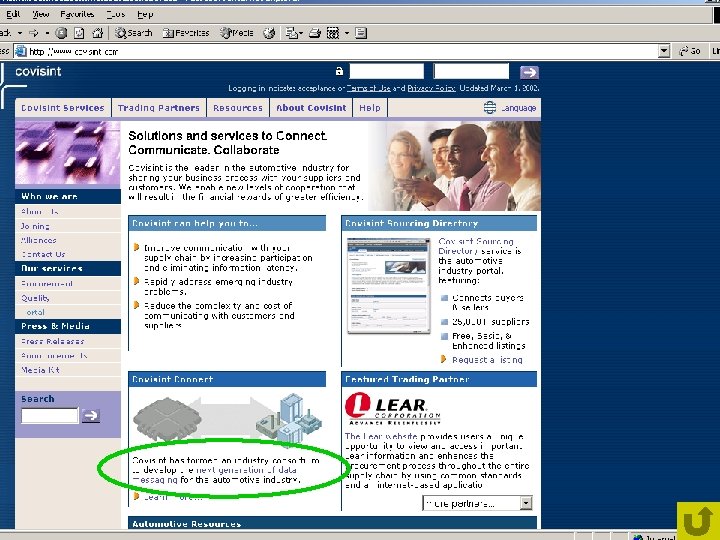
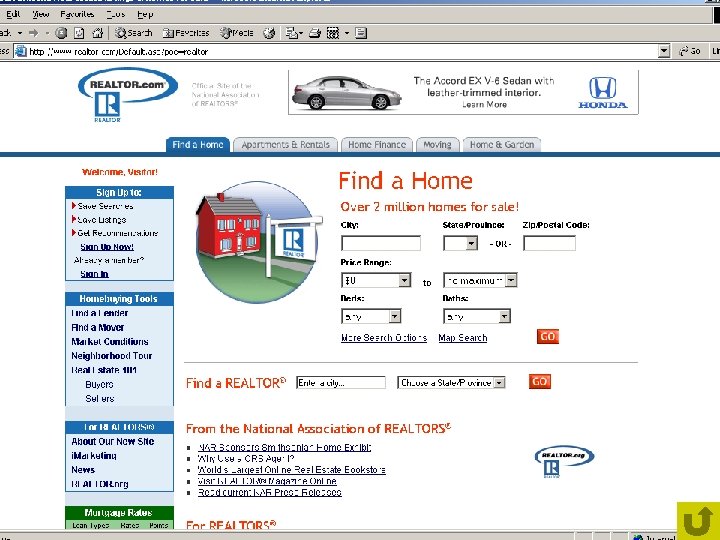
Portal trends Horizontal and vertical portals are emerging as dominant sources of power within consumer and business markets Horizontal portals are joining forces with horizontal infrastructure portals to provide not just access to content and services but also access to network and hosting services Large media and entertainment portals that represent the convergence of data , telephone, television and radio networks are emerging in the consumer space. These portals unite content development, packaging and distribution components of the value chain B 2 B portals provide both horizontal access to business networks and vertical industry wide solutions
Classifying business capabilities Business build on a networked infrastructure Ø Ø Ø Focused distributors Portals producers Business providing the network infrastructure Ø Ø Infrastructure distributors portals producers service providers
producers Producers design and make and also may directly market, sell and distribute products, services and solutions There are 3 types of producers in function of the following characteristics: Ø Does the business sell physical products and/or provide face-to-face services? Ø Does the business sell information-based products and/or services? Ø Does the business provide customised products and/or services?
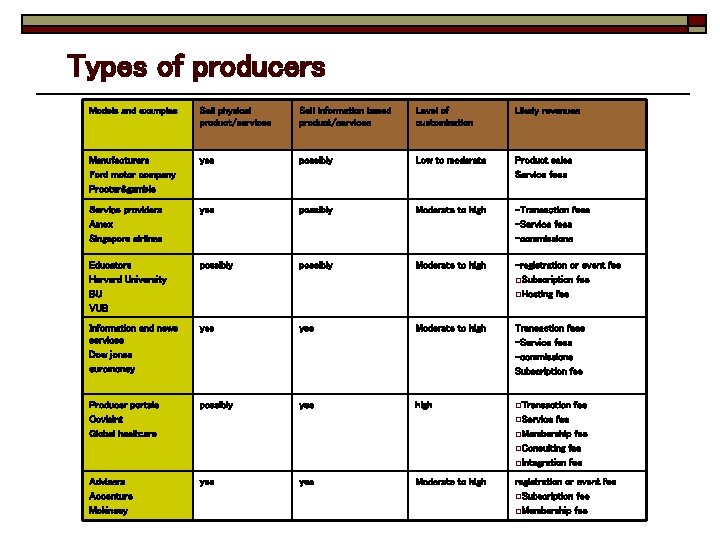
Types of producers Models and examples Sell physical product/services Sell information based product/services Level of customisation Likely revenues Manufacturers Ford motor company Procter&gamble yes possibly Low to moderate Product sales Service fees Service providers Amex Singapore airlines yes possibly Moderate to high -Transaction fees -Service fees -commissions Educators Harvard University BU VUB possibly Moderate to high -registration or event fee o. Subscription fee o. Hosting fee Information and news services Dow jones euromoney yes Moderate to high Transaction fees -Service fees -commissions Subscription fee Producer portals Covisint Global healtcare possibly yes high o. Transaction Advisers Accenture Mckinsey yes fee o. Membership fee o. Consulting fee o. Integration fee o. Service yes Moderate to high registration or event fee o. Subscription fee o. Membership fee
Producer capability trends Producers must be best in class to survive Some large full-service producers (amex, citigroup, . . )are acquiring a full range of services and products and then integrating them to provide vertical solutions required by the customers. These solutions are offered through company-owned portals and also through a wide variety of distribution agreements Industry supplier coalitions are forming to enable virtually integrated B 2 B commerce within and across industry groups
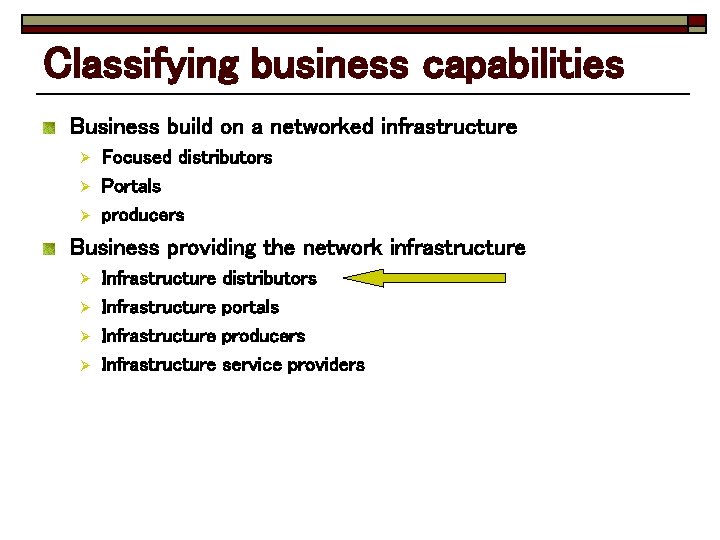
Classifying business capabilities Business build on a networked infrastructure Ø Ø Ø Focused distributors Portals producers Business providing the network infrastructure Ø Ø Infrastructure distributors portals producers service providers
Infrastructure distributors Enable technology buyers and sellers to transact business There are 4 types of infrastructure distributors in function of the following characteristics: Ø Ø Ø Does the business assume control of inventory? Does the business sell online? Is the price set outside the market oris the price negotiation and bidding permitted?
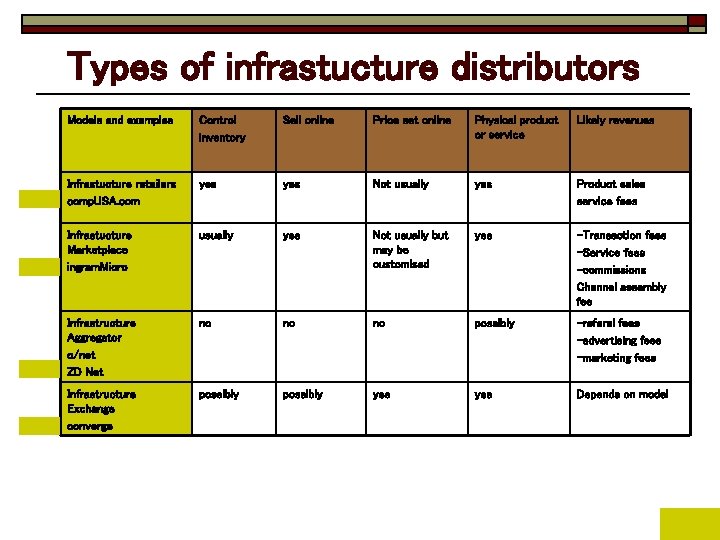
Types of infrastucture distributors Models and examples Control inventory Sell online Price set online Physical product or service Likely revenues Infrastucture retailers comp. USA. com yes Not usually yes Product sales service fees Infrastucture Marketplace ingram. Micro usually yes Not usually but may be customised yes -Transaction fees -Service fees -commissions Channel assembly fee Infrastructure Aggregator c/net ZD Net no no no possibly -referal fees -advertising fees -marketing fees Infrastructure Exchange converge possibly yes Depends on model

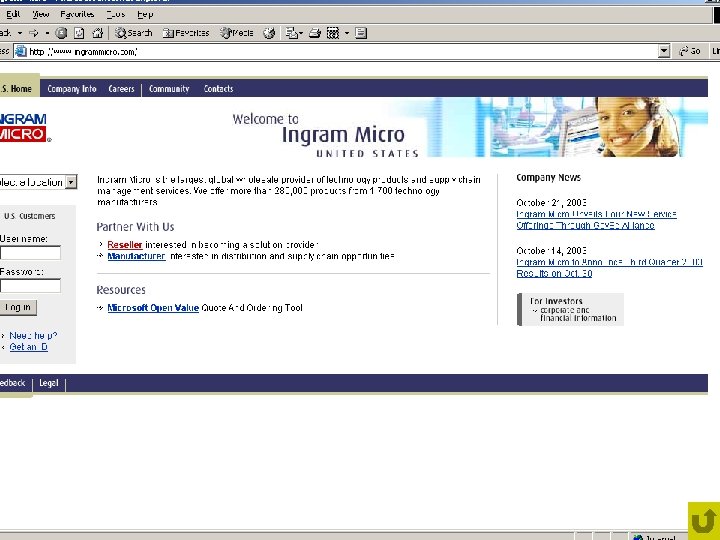
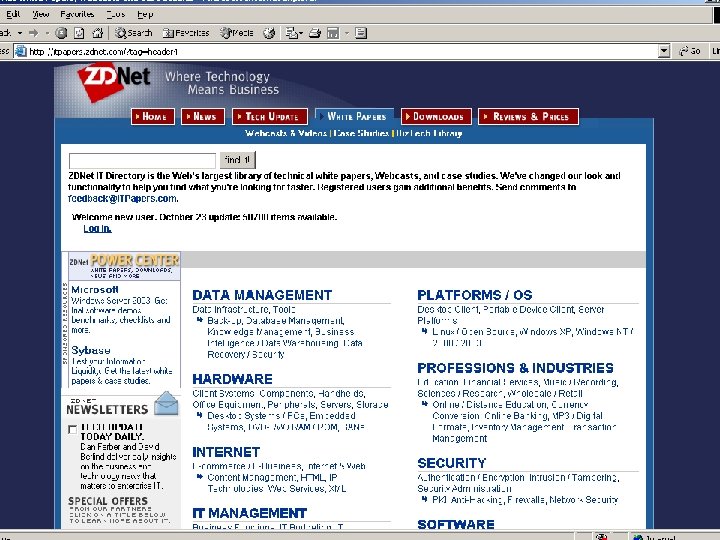
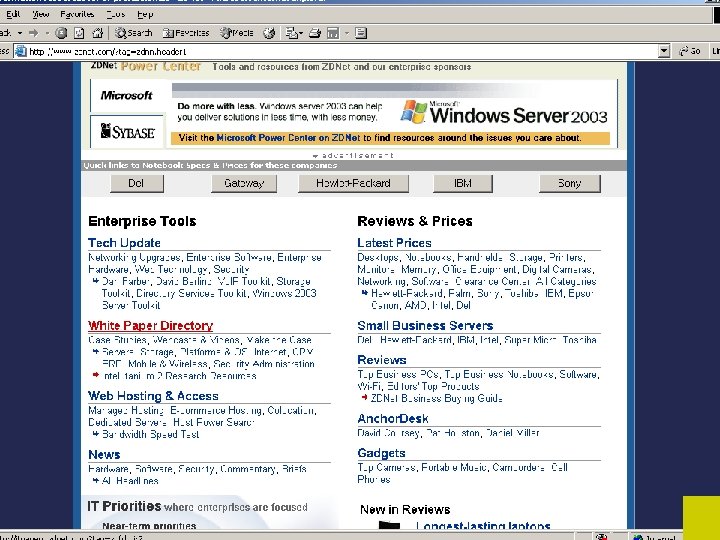
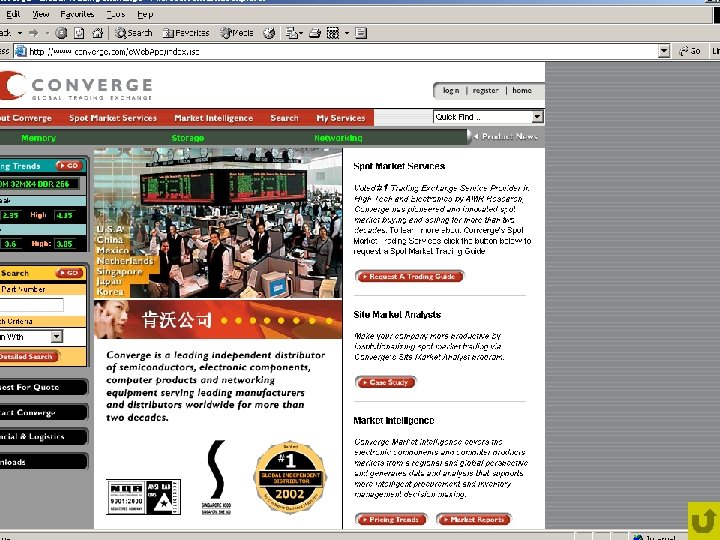
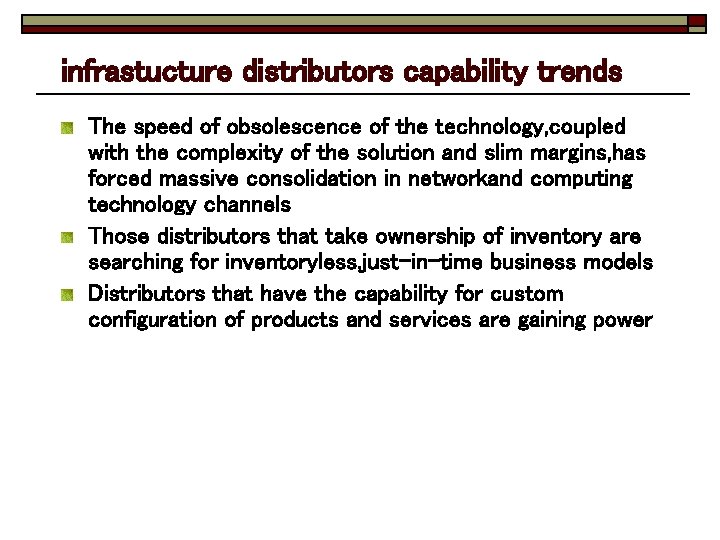
infrastucture distributors capability trends The speed of obsolescence of the technology, coupled with the complexity of the solution and slim margins, has forced massive consolidation in networkand computing technology channels Those distributors that take ownership of inventory are searching for inventoryless, just-in-time business models Distributors that have the capability for custom configuration of products and services are gaining power
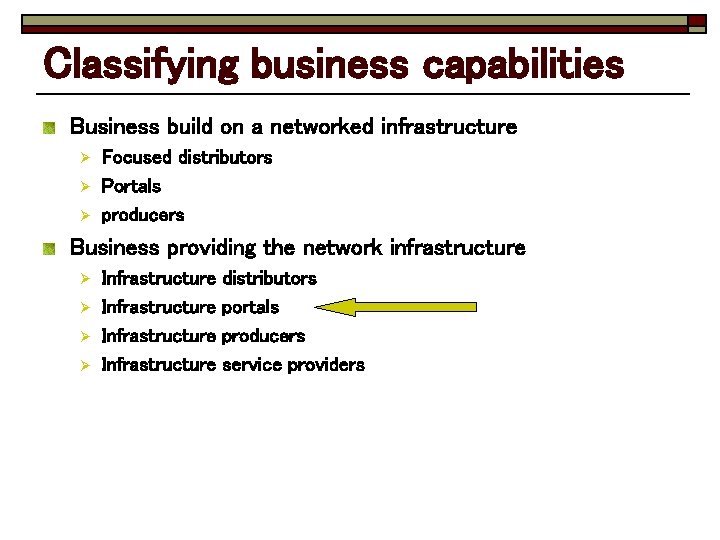
Classifying business capabilities Business build on a networked infrastructure Ø Ø Ø Focused distributors Portals producers Business providing the network infrastructure Ø Ø Infrastructure distributors portals producers service providers
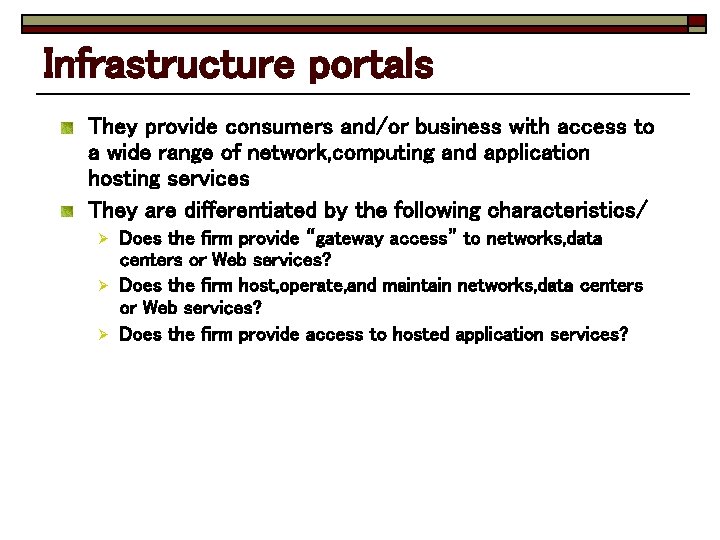
Infrastructure portals They provide consumers and/or business with access to a wide range of network, computing and application hosting services They are differentiated by the following characteristics/ Ø Ø Ø Does the firm provide “gateway access” to networks, data centers or Web services? Does the firm host, operate, and maintain networks, data centers or Web services? Does the firm provide access to hosted application services?
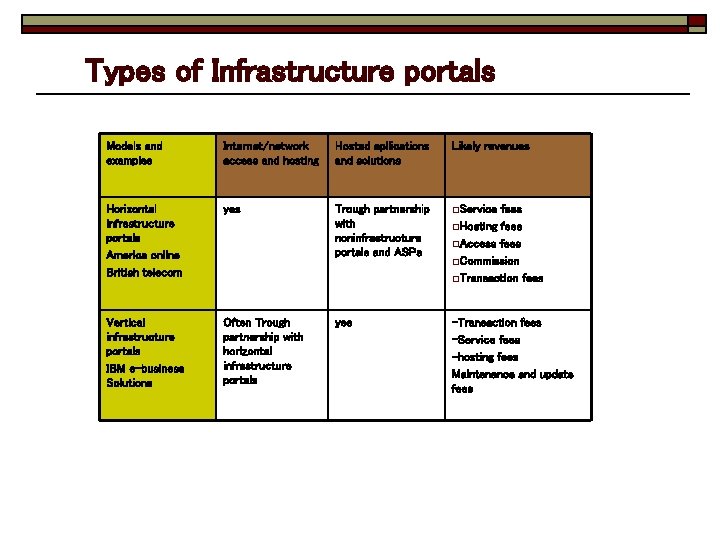
Types of Infrastructure portals Models and examples Internet/network access and hosting Hosted apllications and solutions Likely revenues Horizontal infrastructure portals America online British telecom yes Trough partnership with noninfrastructure portals and ASPs o. Service Vertical infrastructure portals IBM e-business Solutions Often Trough partnership with horizontal infrastructure portals yes -Transaction fees -Service fees -hosting fees Maintenance and update fees o. Hosting fees o. Access fees o. Commission o. Transaction fees
Infrastructure portals trends Horizontal infrastructure portals are merging or partnering with horizontal content portals to increase value created through intangible assets such as information, community and brand Convergence of voice, data, and video channels and global acceptance of a common set of standards are leading to global industry convergence at the content and the infrastructure level
Classifying business capabilities Business build on a networked infrastructure Ø Ø Ø Focused distributors Portals producers Business providing the network infrastructure Ø Ø Infrastructure distributors portals producers service providers
Infrastructure producers They design, build, market and sell technology hardware, software, solutions and services They are differentiated by the following characteristics: Ø Ø Ø Does the business manufacture computer or network components or equipment? Does the business develop packaged software? Does the business provide infrastructure services or consulting?
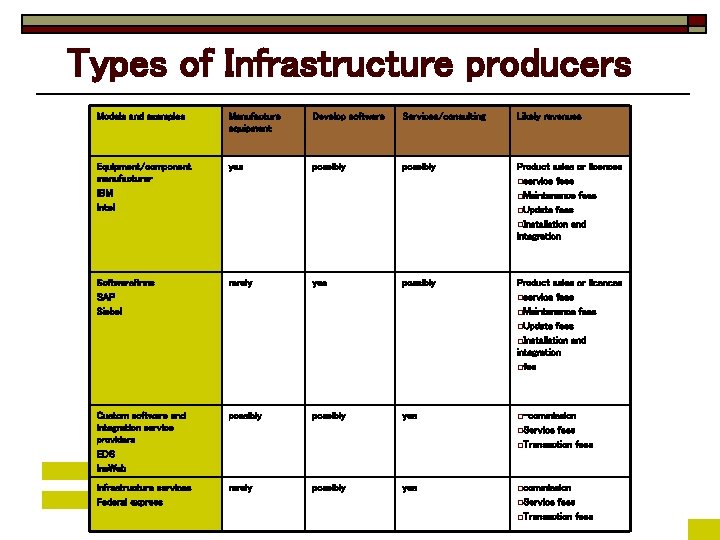
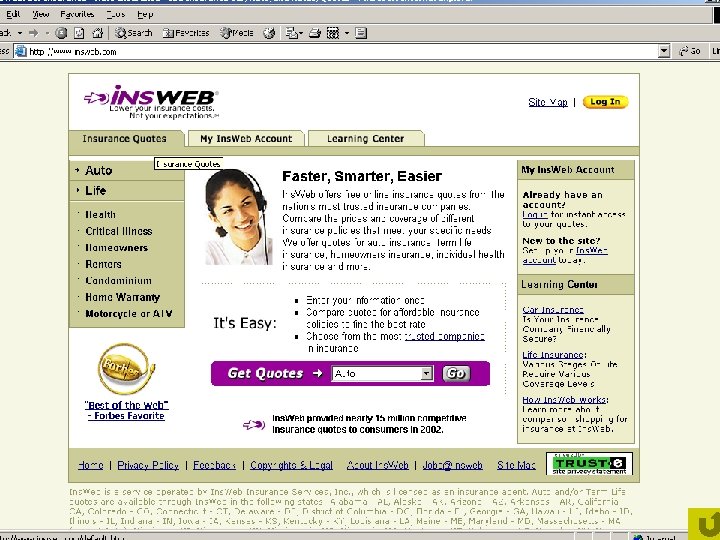
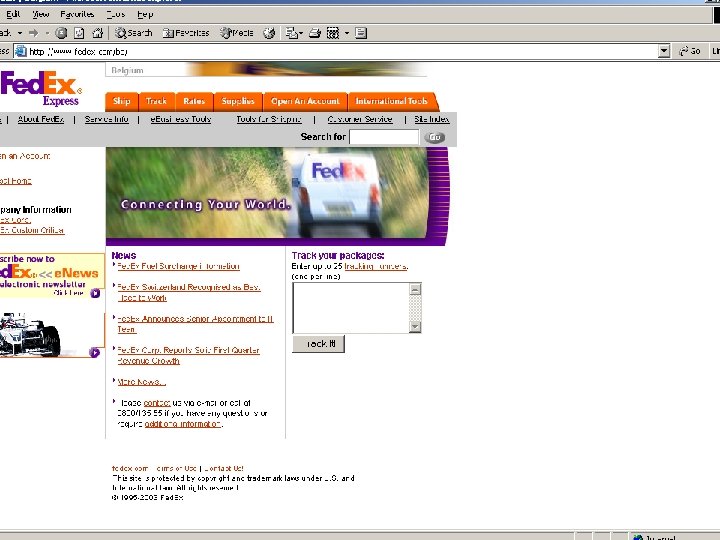
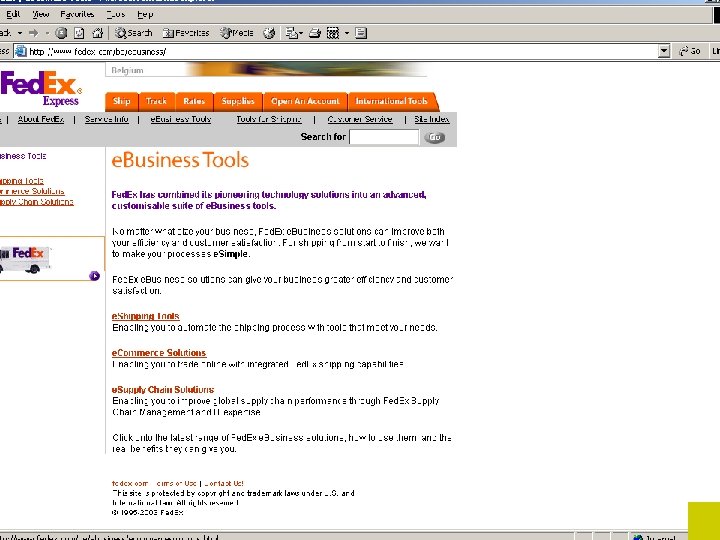
Types of Infrastructure producers Models and examples Manufacture equipment Develop software Services/consulting Likely revenues Equipment/component manufacturer IBM Intel yes possibly Product sales or licences oservice fees o. Maintenance fees o. Update fees o. Installation and integration Softwarefirms SAP Siebel rarely yes possibly Product sales or licences oservice fees o. Maintenance fees o. Update fees o. Installation and integration ofee Custom software and integration service providers EDS Ins. Web possibly yes o-commission Infrastructure services Federal express rarely o. Service fees o. Transaction possibly yes fees ocommission o. Service fees o. Transaction fees
business concepts in a networked world Introduction Classifying business capabilities Evolving business capabilities
Evolving business capabilities Networked businesses are built by combining a variety of business models Value: Ø Ø Ø Efficiently use of resources Integrated solutions/products for the customer Additional value for the same level of investment Creation of business communities
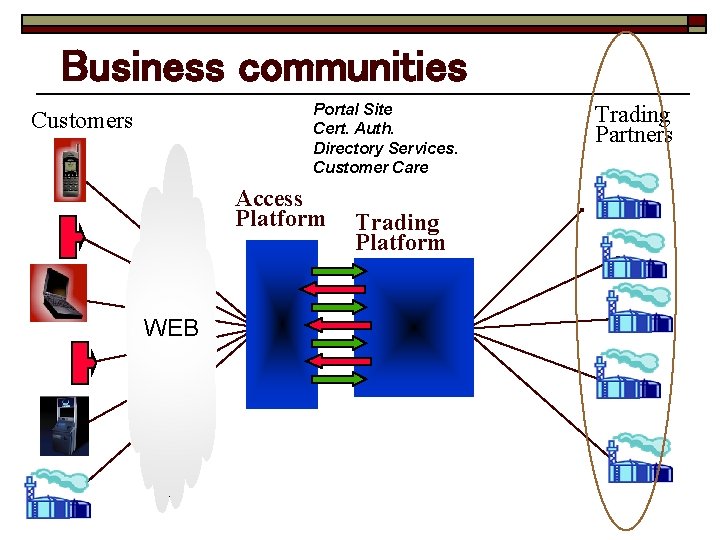
Business communities Portal Site Cert. Auth. Directory Services. Customer Care Customers Access Platform WEB Trading Platform Trading Partners
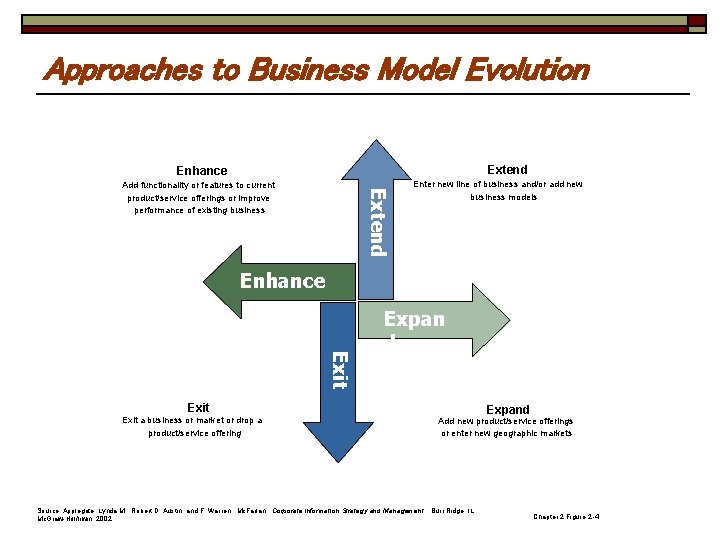
Approaches to Business Model Evolution Extend Enhance Extend Add functionality or features to current product/service offerings or improve performance of existing business Enter new line of business and/or add new business models Enhance Exit Expand Expan d Exit a business or market or drop a product/service offering Expand Add new product/service offerings or enter new geographic markets Source: Applegate, Lynda M. , Robert D. Austin, and F. Warren Mc. Farlan , Corporate Information Strategy and Management. Burr Ridge, IL: Mc. Graw-Hill/Irwin, 2002. Chapter 2 Figure 2 -4
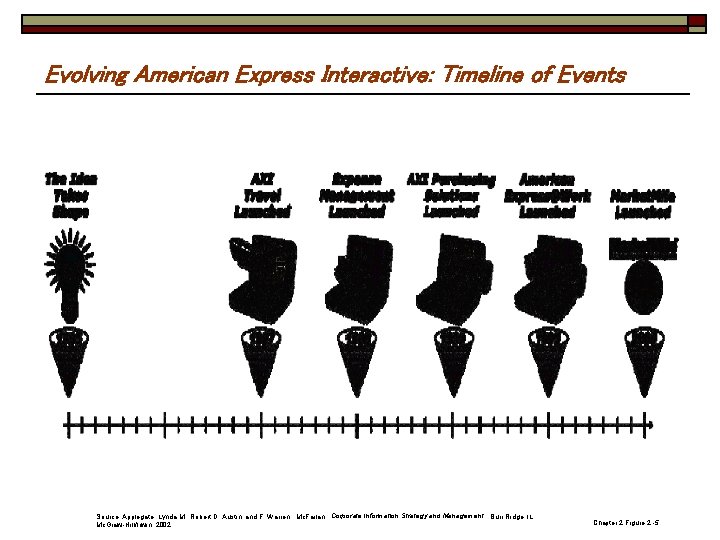
Evolving American Express Interactive: Timeline of Events Source: Applegate, Lynda M. , Robert D. Austin, and F. Warren Mc. Farlan , Corporate Information Strategy and Management. Burr Ridge, IL: Mc. Graw-Hill/Irwin, 2002. Chapter 2 Figure 2 -5
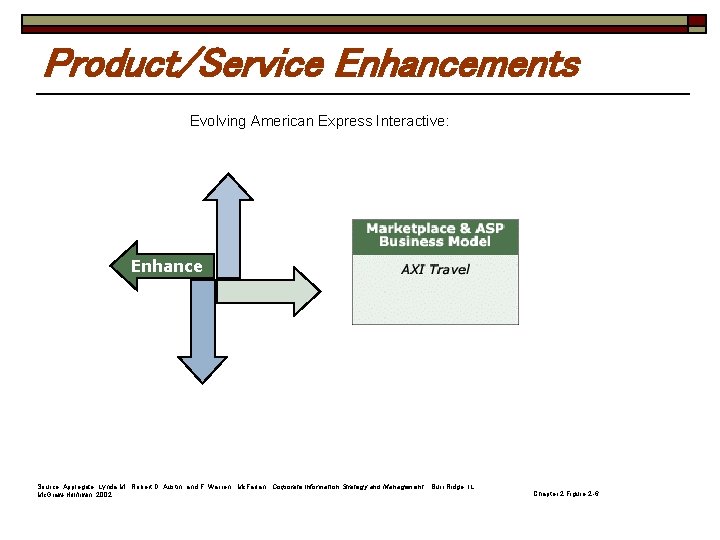
Product/Service Enhancements Evolving American Express Interactive: Enhance Source: Applegate, Lynda M. , Robert D. Austin, and F. Warren Mc. Farlan , Corporate Information Strategy and Management. Burr Ridge, IL: Mc. Graw-Hill/Irwin, 2002. Chapter 2 Figure 2 -6
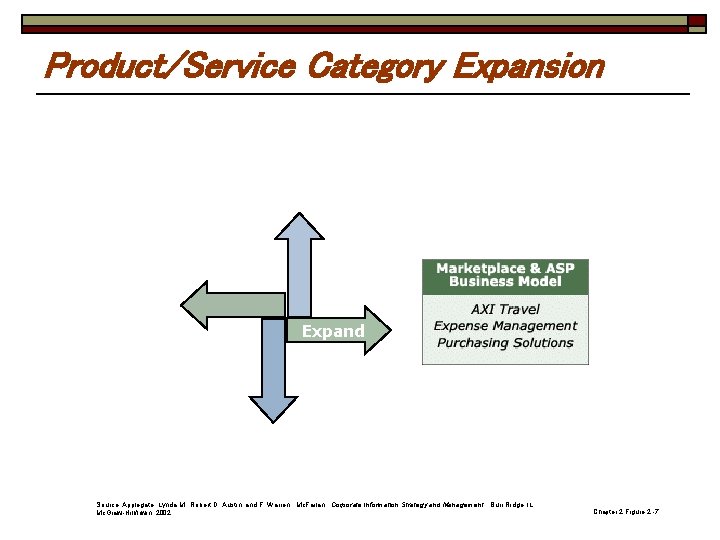
Product/Service Category Expansion Expand Source: Applegate, Lynda M. , Robert D. Austin, and F. Warren Mc. Farlan , Corporate Information Strategy and Management. Burr Ridge, IL: Mc. Graw-Hill/Irwin, 2002. Chapter 2 Figure 2 -7
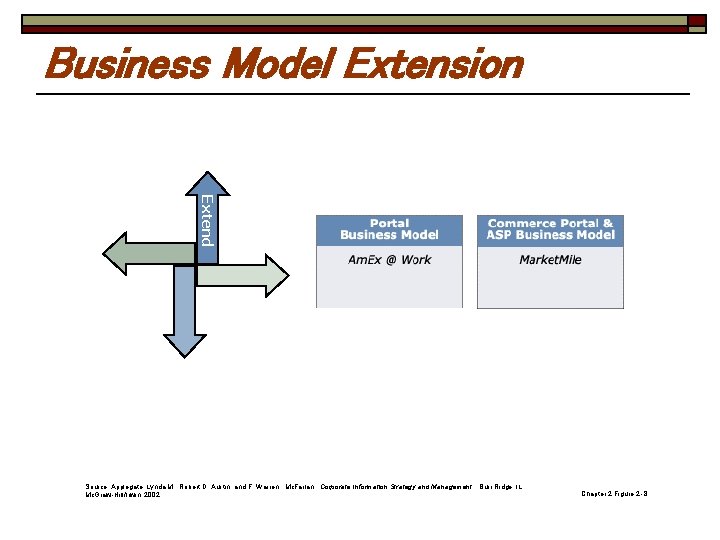
Business Model Extension Extend Source: Applegate, Lynda M. , Robert D. Austin, and F. Warren Mc. Farlan , Corporate Information Strategy and Management. Burr Ridge, IL: Mc. Graw-Hill/Irwin, 2002. Chapter 2 Figure 2 -8
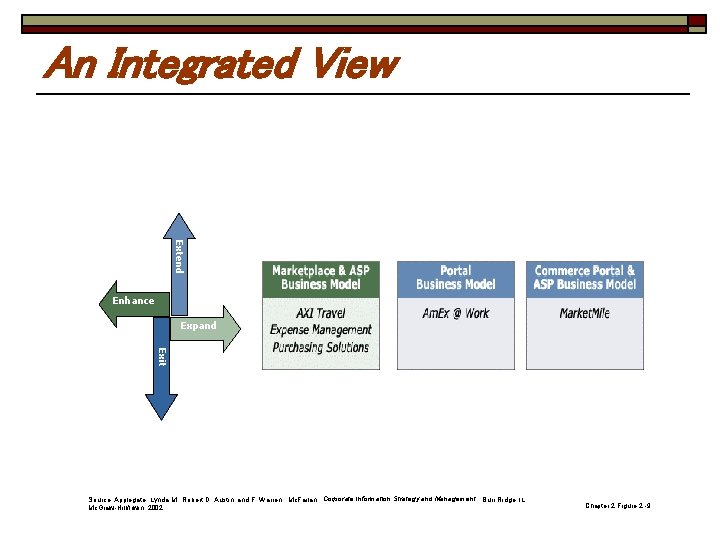
An Integrated View Extend Enhance Expand Exit Source: Applegate, Lynda M. , Robert D. Austin, and F. Warren Mc. Farlan , Corporate Information Strategy and Management. Burr Ridge, IL: Mc. Graw-Hill/Irwin, 2002. Chapter 2 Figure 2 -9
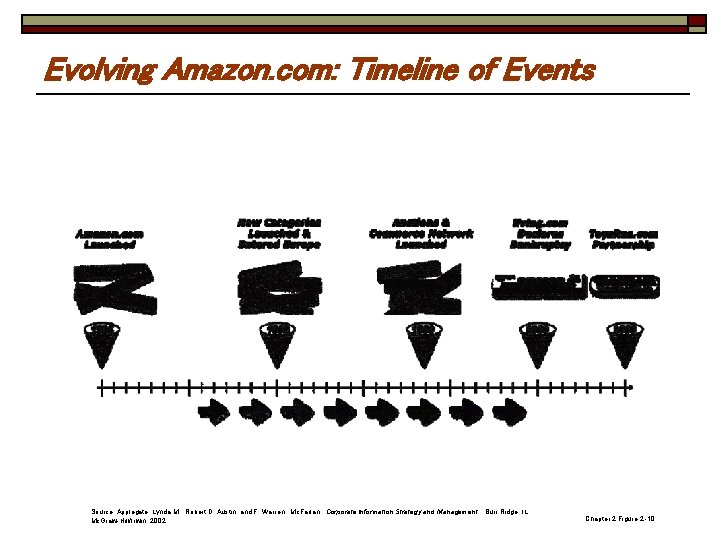
Evolving Amazon. com: Timeline of Events Source: Applegate, Lynda M. , Robert D. Austin, and F. Warren Mc. Farlan , Corporate Information Strategy and Management. Burr Ridge, IL: Mc. Graw-Hill/Irwin, 2002. Chapter 2 Figure 2 -10
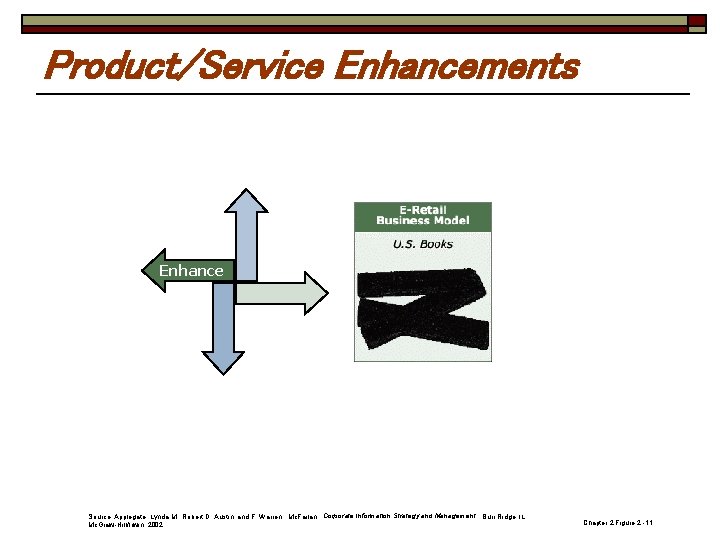
Product/Service Enhancements Enhance Source: Applegate, Lynda M. , Robert D. Austin, and F. Warren Mc. Farlan , Corporate Information Strategy and Management. Burr Ridge, IL: Mc. Graw-Hill/Irwin, 2002. Chapter 2 Figure 2 -11
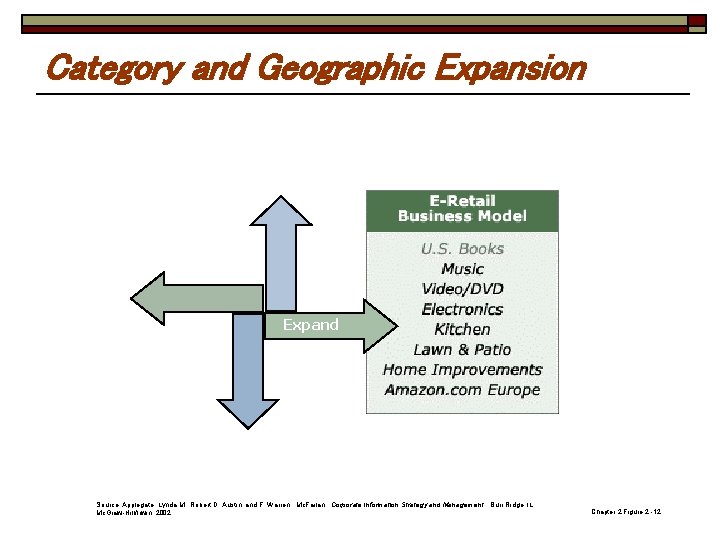
Category and Geographic Expansion Expand Source: Applegate, Lynda M. , Robert D. Austin, and F. Warren Mc. Farlan , Corporate Information Strategy and Management. Burr Ridge, IL: Mc. Graw-Hill/Irwin, 2002. Chapter 2 Figure 2 -12
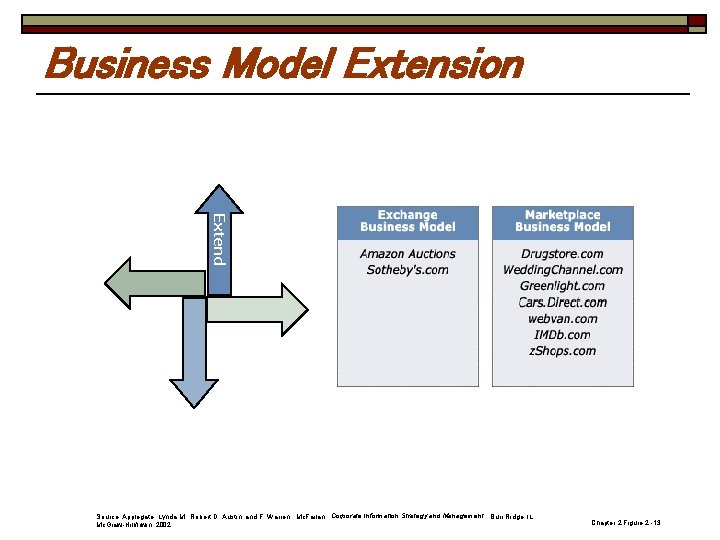
Business Model Extension Extend Source: Applegate, Lynda M. , Robert D. Austin, and F. Warren Mc. Farlan , Corporate Information Strategy and Management. Burr Ridge, IL: Mc. Graw-Hill/Irwin, 2002. Chapter 2 Figure 2 -13
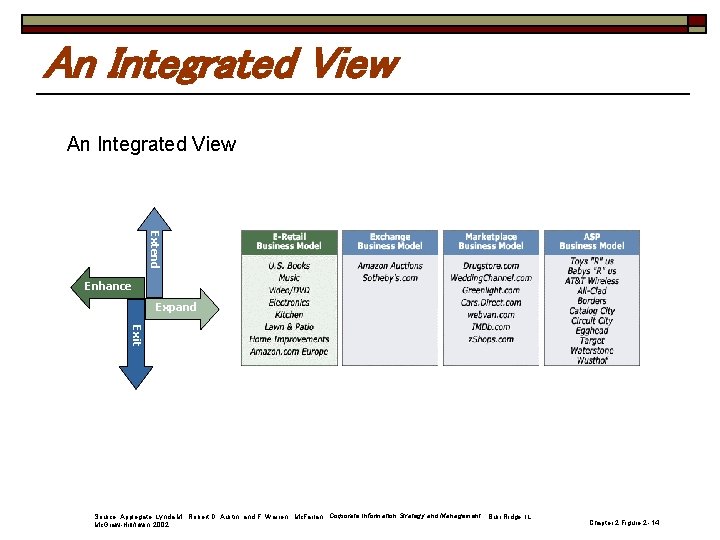
An Integrated View Extend Enhance Expand Exit Source: Applegate, Lynda M. , Robert D. Austin, and F. Warren Mc. Farlan , Corporate Information Strategy and Management. Burr Ridge, IL: Mc. Graw-Hill/Irwin, 2002. Chapter 2 Figure 2 -14
- Slides: 88