
Business Model Canvas Introduction 2020 Business model canvas
Business Model Canvas Introduction 2020
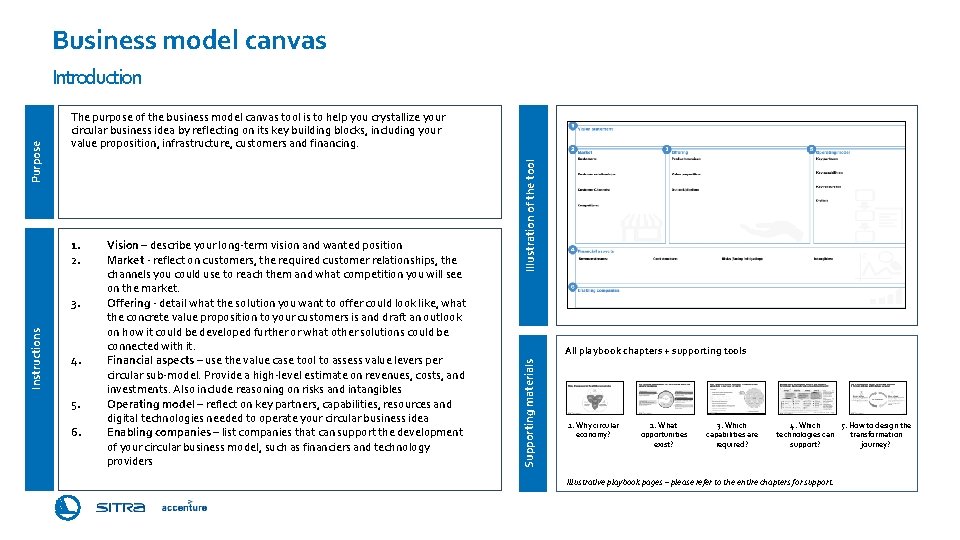
Business model canvas 1. 2. Instructions 3. 4. 5. 6. Vision – describe your long-term vision and wanted position Market - reflect on customers, the required customer relationships, the channels you could use to reach them and what competition you will see on the market. Offering - detail what the solution you want to offer could look like, what the concrete value proposition to your customers is and draft an outlook on how it could be developed further or what other solutions could be connected with it. Financial aspects – use the value case tool to assess value levers per circular sub-model. Provide a high-level estimate on revenues, costs, and investments. Also include reasoning on risks and intangibles Operating model – reflect on key partners, capabilities, resources and digital technologies needed to operate your circular business idea Enabling companies – list companies that can support the development of your circular business model, such as financiers and technology providers Illustration of the tool The purpose of the business model canvas tool is to help you crystallize your circular business idea by reflecting on its key building blocks, including your value proposition, infrastructure, customers and financing. All playbook chapters + supporting tools Supporting materials Purpose Introduction 1. Why circular economy? 2. What opportunities exist? 3. Which capabilities are required? 4. Which 5. How to design the technologies can transformation support? journey? Illustrative playbook pages – please refer to the entire chapters for support.
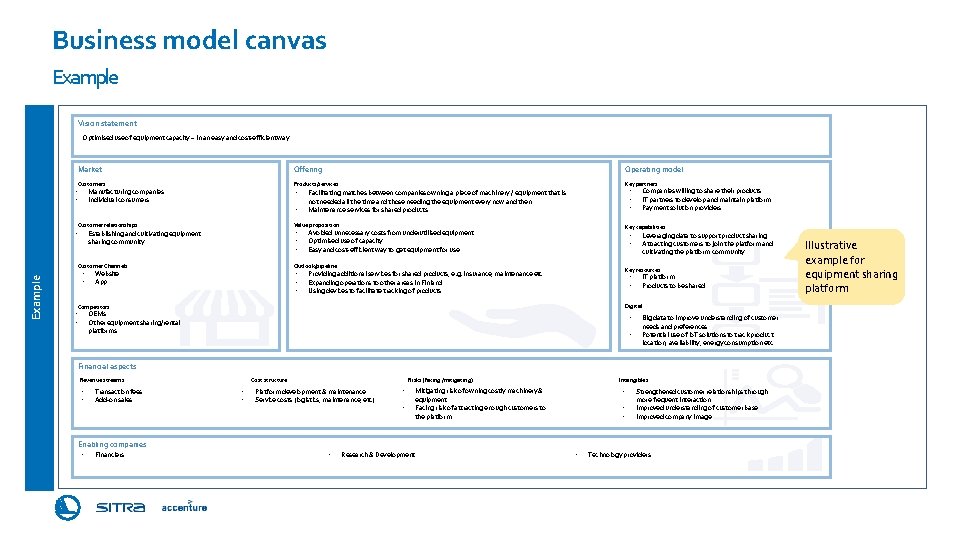
Business model canvas Example Vision statement Optimised use of equipment capacity – in an easy and cost-efficient way • • Market Offering Operating model Customers: Products/services: Key partners: Manufacturing companies Individual consumers • • Customer relationships: • Value proposition: • • • Establishing and cultivating equipment sharing community Example Customer Channels: • • Facilitating matches between companies owning a piece of machinery / equipment that is not needed all the time and those needing the equipment every now and then Maintenance services for shared products Key capabilities: Avoided unnecessary costs from underutilised equipment Optimised use of capacity Easy and cost-efficient way to get equipment for use • • Outlook/pipeline: Website App • • • Companies willing to share their products IT partners to develop and maintain platform Payment solution providers Leveraging data to support product sharing Attracting customers to join the platform and cultivating the platform community Key resources: Providing additional services for shared products, e. g. insurance, maintenance etc Expanding operations to other areas in Finland Using devices to facilitate tracking of products • • IT platform Products to be shared Digital: Competitors: OEMs Other equipment sharing/rental platforms • • Big data to improve understanding of customer needs and preferences Potential use of Io. T solutions to track product location, availability, energy consumption etc Financial aspects Revenue streams: • • Transaction fees Add-on sales Cost structure: • • Risks (facing /mitigating): Platform development & maintenance Service costs (logistics, maintenance, etc) • • Intangibles: Mitigating risk of owning costly machinery & equipment Facing risk of attracting enough customers to the platform • • • Strengthened customer relationships through more frequent interaction Improved understanding of customer base Improved company image Enabling companies • Financiers • Research & Development • Technology providers Illustrative example for equipment sharing platform
Business Model Canvas Tool 2020
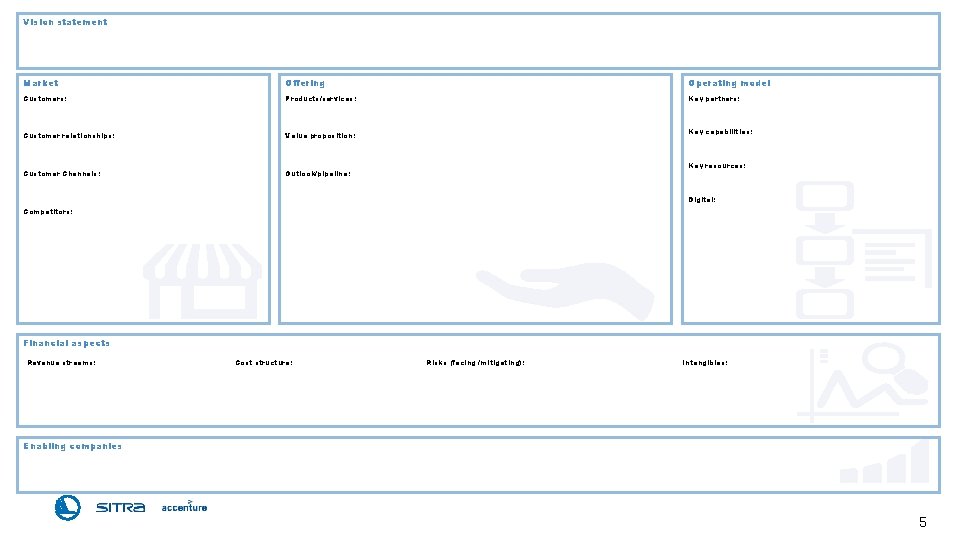
Vision statement Market Offering Operating model Customers: Products/services: Key partners: Customer relationships: Value proposition: Customer Channels: Outlook/pipeline: Key capabilities: Key resources: Digital: Competitors: Financial aspects Revenue streams: Cost structure: Risks (facing /mitigating): Intangibles: Enabling companies 5
- Slides: 5