
Business Management Lecture 2 Practical 2 Dr Mahmoud
Business Management Lecture 2 Practical 2 Dr. Mahmoud Arafa Lecturer at Agric. Economic Dep. Website: http: //scholar. cu. edu. eg/mahmoudarafa E-Mail: mahmoud. arafa@agr. cu. edu. eg
Part#2 Practical Goals And Objectives The creation of meaningful business goals is an important activity in every organization. Too often, goals are poorly crafted and fail to lead to the achievement of the intended results

Goals And Objectives • Properly created goals should cascade from the organization’s strategic plan, business unit goals and / or from departmental goals. • After the top-lines goals are identified, the next level down has to translate these goals into sub-objectives that at meaningful to employees at each successive level. • When objective setting is completed for the year, the goals created at the individual level should fully support the goals of the next level up.
Goals And Objectives • Depending on the number of levels, this hierarchical objective structure should be consistent up through the strategic goals of the organization • Properly established goals provide a roadmap for organizational success and move the organization and its workforce toward meaningful accomplishments.
Planning to Write Goals There are three components that make up well-written goals. Each of these components has a different purpose, but they work together in a collaborative fashion.

Planning to Write Goals The “what” is the objective itself, which defines its purpose and scope. The “why” is the set of benefits to be gained, which explains the motivation for accomplishment. The “when” is the roadmap that provides direction and achievement markers.
Objective Subject Matter The subject matter or topics for goals are typically formulated around Products, Processes, People, Performance and / or Profits. We think of these as the “ 5 Ps”. When creating goals, they will involve action around changing, improving, fixing, increasing or enhancing one of the following:
“ 5 Ps” 1. Products – goods and services provided. 2. Processes – Policies, procedures, methodologies and equipment which is used to produce products or administer the organization. 3. People – Employees, Customers and / or Clients. 4. Performance – The quality and quantity of individual and / or organizational output. 5. Profits – The revenue and financial goals of the organization, business unit or department.
Writing SMART Goals After the Objective components (what, why and when) and subject matter (5 Ps) have been identified on a broader level, the actual specifics of each objective can be written.
S – Specific Goals need to be specific to help focus and define the overall effort and tasks involved. Ambiguous goals only lead to ambiguous results. Goals need to provide the answers to the following questions: • Who is involved? • What needs to be accomplished? • Where will it be accomplished? • When should it be accomplished? • What conditions need to be met?
M – Measurable Goals need to have concrete metrics for gauging progress and evaluating performance. This helps employees stay on track and reach their targets. Progress point measurements might also be included into the goals. By successfully reaching progress points, a cycle is created that provides added motivation to put forth the continued effort toward reaching the final destination.
A – Attainable Goals need to stretch and challenge current capabilities, but they must be attainable. Goals that are perceived to be unreachable will lead to frustration. Employees may feel “what’s the use in trying – it can’t be done. ” Attainable does not mean easy. Often goals that might seem overwhelming can become more manageable if they can be broken out into attainable steps.
R –Realistic Like unattainable, unrealistic goals will lead to negative experience and frustration. Often personal and situational factors influence the ability to reach objectives. These should be considered when defining the objective to be certain that an objective can be achieved. Goals that involve steep learning curves should also be avoided unless there is adequate time to come up to speed. The bar should be set high enough for satisfying outcomes and to encourage a positive cycle of achievement.
T – Time bound At a minimum, starting and end points should be written into every objective. Day-to-day crises and other priorities will quickly supersede goals without timelines or schedules. Timelines and deadlines create a powerful and necessary sense of urgency to take action. Goals with long time spans should be broken out into attainable steps with progress check points.
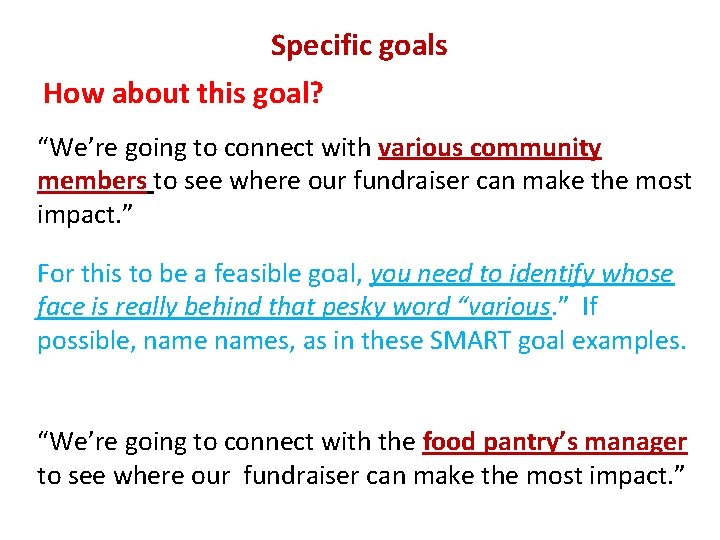
Specific goals How about this goal? “We’re going to connect with various community members to see where our fundraiser can make the most impact. ” For this to be a feasible goal, you need to identify whose face is really behind that pesky word “various. ” If possible, names, as in these SMART goal examples. “We’re going to connect with the food pantry’s manager to see where our fundraiser can make the most impact. ”
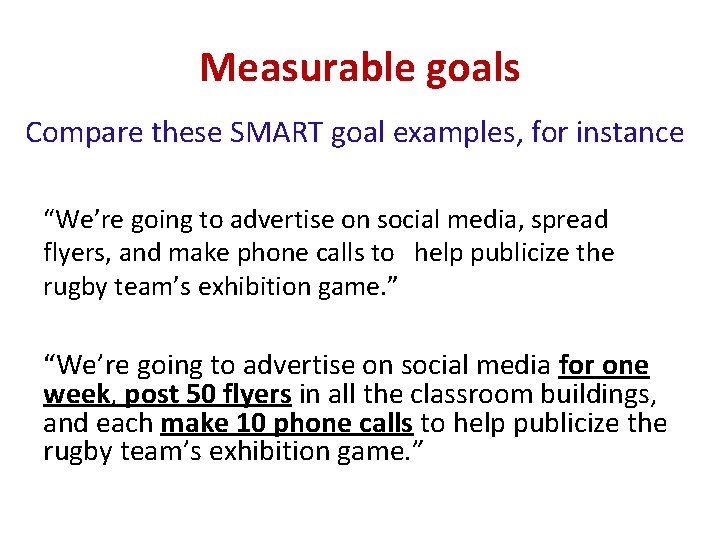
Measurable goals Compare these SMART goal examples, for instance “We’re going to advertise on social media, spread flyers, and make phone calls to help publicize the rugby team’s exhibition game. ” “We’re going to advertise on social media for one week, post 50 flyers in all the classroom buildings, and each make 10 phone calls to help publicize the rugby team’s exhibition game. ”
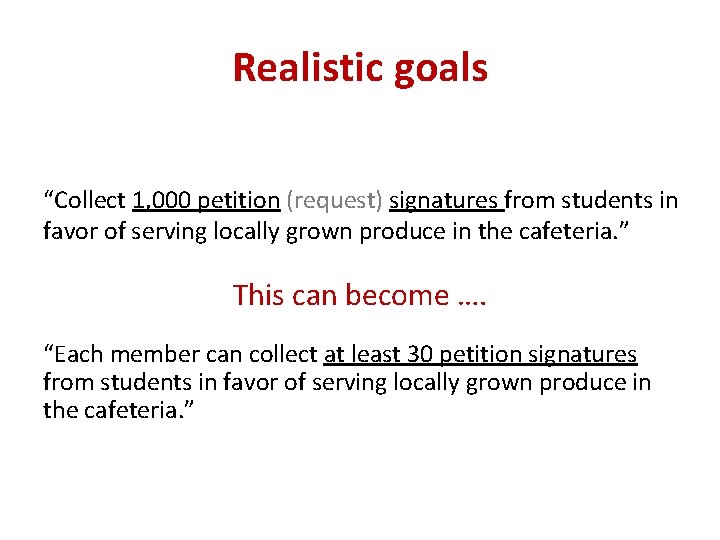
Realistic goals “Collect 1, 000 petition (request) signatures from students in favor of serving locally grown produce in the cafeteria. ” This can become …. “Each member can collect at least 30 petition signatures from students in favor of serving locally grown produce in the cafeteria. ”
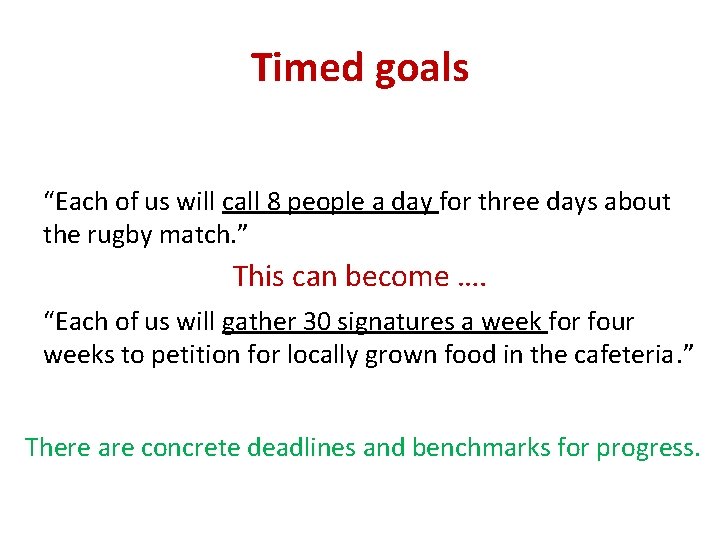
Timed goals “Each of us will call 8 people a day for three days about the rugby match. ” This can become …. “Each of us will gather 30 signatures a week for four weeks to petition for locally grown food in the cafeteria. ” There are concrete deadlines and benchmarks for progress.
Company Description This section of your business plan provides a high-level review of the different elements of your business. This is akin to an extended elevator pitch and can help readers and potential investors quickly understand the goal of your business and its unique proposition.
What to Include in Your Company Description Describe the nature of your business and list the marketplace needs that you are trying to satisfy. Explain how your products/services meet these needs. List the specific consumers, organizations or businesses that your company serves or will serve. Explain the competitive advantages that you believe will make your business a success such as your location, expert personnel, efficient operations, or ability to bring value to your customers.
- Slides: 20