
Business Logistics 420 Public Transportation Lecture 26 Transit
Business Logistics 420 Public Transportation Lecture 26: Transit Pricing

Lecture Objectives • Understand the three components of transit pricing strategy -- fare level, structure, collection techniques • Understand the role of transit pricing in marketing, and policy decisions • Understand be able to calculate simple transit price elasticity factors

Pricing Strategy -- Three Parts • Fare Level • Fare Structure • Fare Collection Technique
Role of Pricing Strategy • Directly increase ridership through fare reductions • Indirectly increase ridership through higher fares and improved service • Independent of marketing -- fares set to minimize deficit or meet other financial/political objective
Private Vs. Public Sector Pricing Strategy • Private Sector -- profit maximization • Public sector – Equity concerns (income transfer) – Maintain low fares to increase ridership to address other social objectives
Fare Level • The absolute amount of the fare, e. g. , a base fare of $1. 00 • Determined by: – Financial considerations -- maximize revenue – Marketing consideration -- increasing ridership – Political Considerations -- balance between public and rider contributions
Fare Structure • Fare structure is often a better marketing tool than fare level • Types of fare structures – distance-based Vs. flat fare – bulk purchase Vs. individual trip – peak Vs. off-peak fares – multi-stop fares – prepaid or “free” fare
Fare Collection • On-vehicle – non-registering fareboxes – registering, electronic fareboxes, may accept credit or smart card • Off-vehicle – ticket or token dispensers – farecard machine – honor system
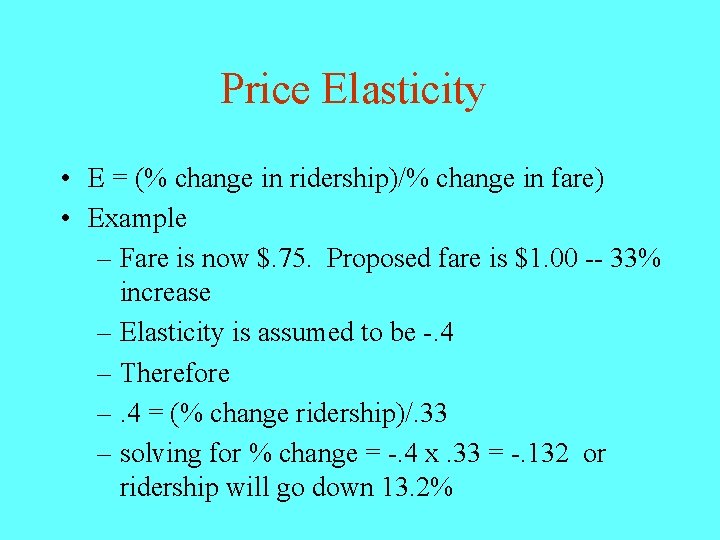
Price Elasticity • E = (% change in ridership)/% change in fare) • Example – Fare is now $. 75. Proposed fare is $1. 00 -- 33% increase – Elasticity is assumed to be -. 4 – Therefore –. 4 = (% change ridership)/. 33 – solving for % change = -. 4 x. 33 = -. 132 or ridership will go down 13. 2%
Price Elasticity • Measures the response of demand to change in price • Several ways to calculate – Point elasticity – Arc Elasticity • Estimating elasticity – Preference surveys – Shrinkage analysis (most common) – Econometric studies
Elasticity • Varies significantly by: – quality of service (higher-quality service less price sensitive) – Location -- city to city variations – User category – Trip purpose -- work Vs social/shopping
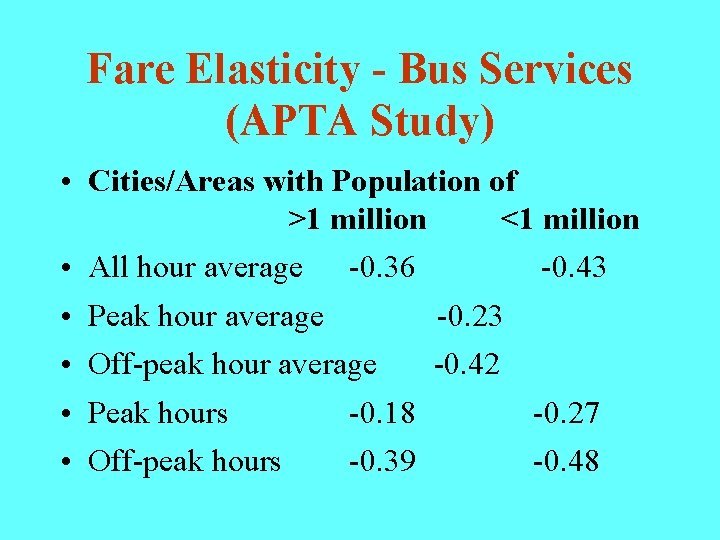
Fare Elasticity - Bus Services (APTA Study) • Cities/Areas with Population of >1 million <1 million • All hour average -0. 36 -0. 43 • Peak hour average -0. 23 • Off-peak hour average -0. 42 • Peak hours -0. 18 -0. 27 • Off-peak hours -0. 39 -0. 48
Price Discrimination • Respond to different elasticity of demand for different groups by practicing price discrimination -- charging different amounts for the same service • Examples – Peak-off peak price – Passes -- for regular users
“Free” Transit • Many experts advocate “free” transit as a way to maximize the benefits of transit that depend on high levels of ridership • No really “free” -- just prepaid
Benefits of “Free” or Prepaid Transit • • Increased ridership Reduced fare collection costs Faster boarding/alighting No need for transfers or other impediments to using multiple vehicles/modes • Fewer distractions for bus drivers
Disadvantages of “Free” or Prepaid Transit • Expense may exceed community’s ability to pay • Encourages “unnecessary” trips, e. g. , trips on the Campus Loop replace walking trips • Requires major expansion of service that may be beyond provider • “Undesirables” could ride all day • Equity -- not all residents could use the service but would have to pay for it
Examples of Limited “Free” Transit • • CATA/PSU Campus Loops Apartment Passes Penn. DOT Free Transit for Senior Citizens Downtown Free Zones in a number of cities -- Seattle, Denver, Pasadena • UPASS systems at a number of universities – U. of Washington, U. of Wisc - Milwaukee, Pitt, Carnegie Mellon, U. of Minn.
The Seattle Proposal • Sound Transit, a regional transit system created to promote high-capacity transit, has proposed light rail lines • Citizen proposal instead of light rail -- free bus service -- cheaper, faster to implement • 400 more buses, 4 x the ridership gain as the light rail
The Clemson System • Clemson, SC, home of Clemson University has region-wide free system • Paid for by parking fees on campus, and state and federal transit funds • Saves money on fare collection • Increases ridership
Study Questions • What are three elements of a pricing strategy? • Define price elasticity • How does price elasticity vary by city size, trip purpose, time of day, quality of service? • What are the pros and cons of “free” or prepaid transit?
- Slides: 20