
Business Logistics 420 Public Transportation Lecture 20 Transit
Business Logistics 420 Public Transportation Lecture 20: Transit System Design
Lecture Objectives • To understand the basic elements of transit system design • To appreciate the different transit system route configurations • To know the basic principles of good route design • To understand other aspects of system design such as schedules, stop location

Elements of Transit System Design • • • Overall system -- route interrelationship Individual route design Scheduling Stop locations Vehicle Selection
System Considerations • Service area definition • Location of major generators • Route pattern -- network – – Radial -- circumferential Grid -- rectangular Combination Irregular • Route spacing • Transfers -- inter and intra modal • Marketing considerations

Chicago Loop -- Grid Network
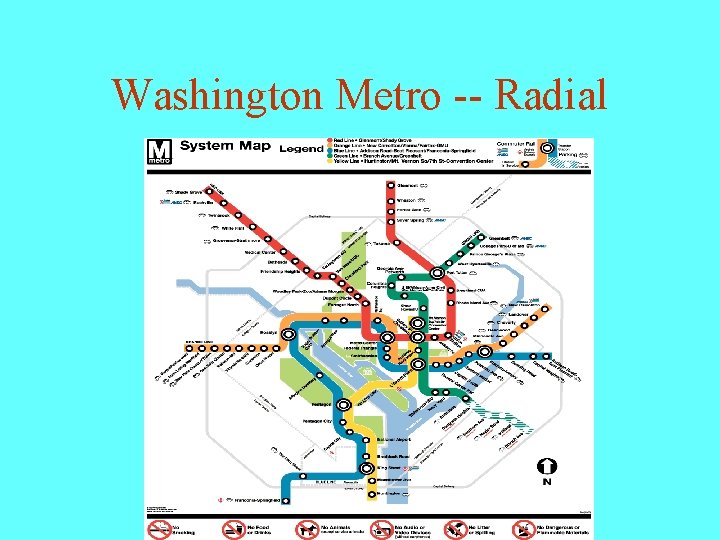
Washington Metro -- Radial

CATA -- Radial System
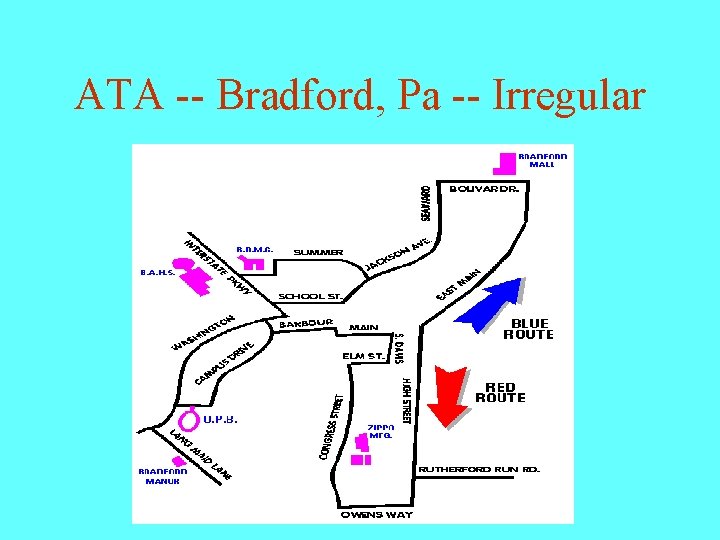
ATA -- Bradford, Pa -- Irregular
Route Design Guidelines • Use direct routing where possible • Through routing is preferred to cycle routing • Reverse or loop routing should be used sparingly • Routes should begin and end at major generators
Route Design Guidelines (Continued) • Routes should be spaced about 1/2 mile apart • Routes should provide direct service -circuity ratio (actual route miles/direct auto travel) should not exceed 1. 33 • Initial route design assumes average speed of 12 miles per hour
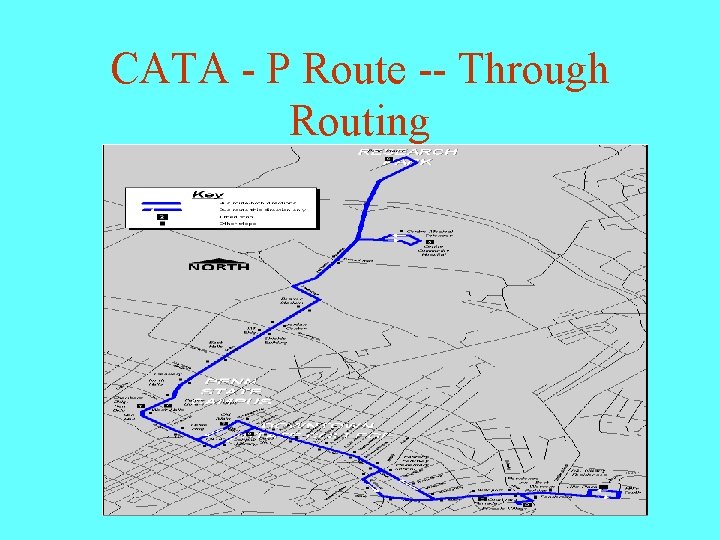
CATA - P Route -- Through Routing

CATA C Route -- Poor Circuity
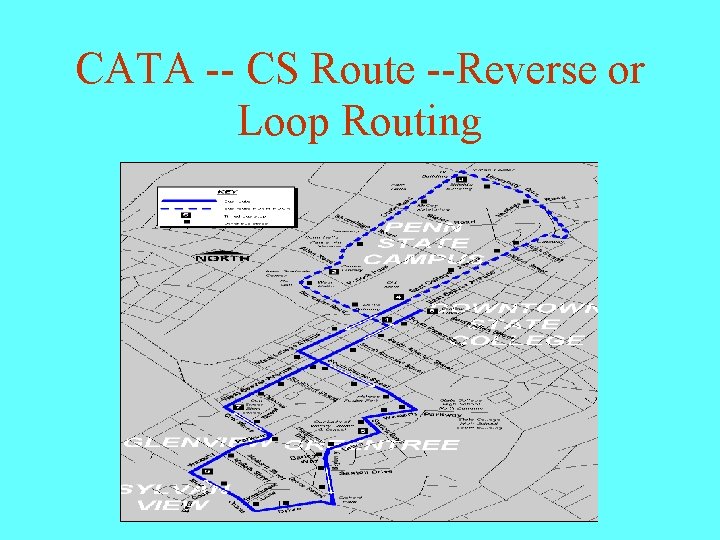
CATA -- CS Route --Reverse or Loop Routing
Factors Influencing Route Design • Demand – spatial arrangement – special generators • Urban environment – street network (one-way streets) – congestion • Management Considerations – driver scheduling – labor rules
Factors Influencing Route Design (Continued) • Intermodal Coordination – Rail/bus/paratransit – Intercity facilities (rail, bus, air) • Political Considerations – Equity – Pressure
Scheduling Considerations • Two major issues – Headway – time between vehicles Ex: 15 minute headway represents four buses per hour – Timing of arrivals at points along the route • Factors to consider – – quality of service (frequency) transfers easy memorization driver labor requirements
Scheduling Considerations (Continued) • Setting headways – Maximum headway (fewest minutes between vehicles) set based on capacity needed to meet demand – Minimum headway based on policy decisions, e. g. , all routes should have no less frequent service than 30 minutes in the peak and 60 minutes off peak
Scheduling Considerations (Continued) • Setting arrival times – Independent scheduling • Most common approach • OK if short headways, but may cause transfer problems if long headways – Pulse scheduling – timed transfers • Attractive approach for systems with long headways • Improves service quality • Hard to implement due to space constraints at stops and variability of travel times
Stop Locations • Operations – location (Near side, far side, mid block) – peak number of buses at stop at any given time • Quality of service – near destinations – spaced 750 ft or more apart to maintain operating speed – adequate waiting area -- shelter
Stop Locations (Continued) • The urban environment – parking restrictions – turns • Special concerns in “Edge City, ” “big box” environment – bus stop near store entrances rather than across sea of parking – circuity concerns if store too far from road
Vehicle Selection • Size of vehicle – Peak loads (goal to provide 5 sq ft/psgr so 8 x 40 ft bus = 320 sq ft or 64 passengers max. – Traffic conditions • street width • turning radius • Number of vehicles – Peak hour requirement plus 10% spares
Miscellaneous System Design Issues • Special service types – “freeway flyers” – skip stop operation – local vs express • New service types – service routes (fixed-route with deviations) – paratransit feeder services
Study Questions • What are the major aspects of transit system design? • What are the basic types of transit route network configurations? • What are the basic route design guidelines? • What are “good” route designs? What are “poor” designs? • What factors influence scheduling decisions?
Study Questions (Continued) • What factors are important when selecting vehicle size and numbers? • Pick up a CATA Ride Guide in the HUB, Kern, or inside the doors to Willard (“new” building side on Pollock Rd. ) to serve as reference for this lecture
- Slides: 24