
Business Laws by Dattaram P Shinde Copyrights reserved
Business Laws by Dattaram P Shinde © Copyrights reserved - 2012 1
What (is Law) ? Law is a system of rules, usually enforced through a set of institutions. The Greek philosopher Aristotle (in 350 BC) declared, "The rule of law is better than the rule of any individual. " In the words of Salmond (a legal scholar & Judge in New Zealand), “Law is the body of principles recognized and applied by the State in the administration of Justice. ” It shapes politics, economics and society in numerous ways and serves as a primary social mediator of relations between people. 2
Why (do you need law)? n n n Do you need law to run the business? Isn’t the law of dd & ss not strike the balance in society? The object of law is order Result of order is that men are enabled to look ahead with some sort of security as to the future Ignorentia juris non excusat (ignorance of law is no excuse) 3
Where (applicable)? Branches of law Contract law regulates everything from buying a bus ticket to trading on derivatives markets. Property law defines rights and obligations related to the transfer and title of personal (often referred to as chattel) and real property. Trust law applies to assets held for investment and financial security, while tort law allows claims for compensation if a person's rights or property are harmed. If the harm is criminalized in a statute, criminal law offers means by which the state can prosecute the perpetrator. 4
Where ? Constitutional law provides a framework for the creation of law, the protection of human rights and the election of political representatives. Administrative law is used to review the decisions of government agencies, while international law governs affairs between sovereign nation states in activities ranging from trade to environmental regulation or military action. Law is not static. As circumstances and conditions in the society change, laws are changed to fit the requirements of the society. (i. e. amendments) 5
Who (frames system of rules)? Sources of Law n Constitution & Statute Law (as passed by the Parliament) n Customs & usages q Requirements of a valid custom n n Reasonableness (Practice of Sati) Immemorial antiquity Obligatory & not optional Conformity with statute law e. g. Hindu Law, Islamic Law n Judicial decisions or the system of precedents (ratio decidendi and obiter dicta) 6
Who frames? ratio decidendi & obiter dicta n Ratio decidendi : The dictionary meaning of this Latin expression, is the ‘rule of law on which a judicial decision is made’, or ‘reason for deciding’. n Every decision has 3 basic postulates – q q q n Findings of facts both direct and inferential Statement of principles applicable to the legal problems as disclosed by facts Judgment based on the combined effect of the above. Obiter dicta is ‘a judge’s expression of opinion uttered in court, or while giving judgment, but not essential to the decision and not part of the ratio decidendi. ’ 7
How (to interpret)? General Rules of Interpretation of Statutes n n n Preamble Applicability Definitions Sections Rules Case Laws & Citations 8
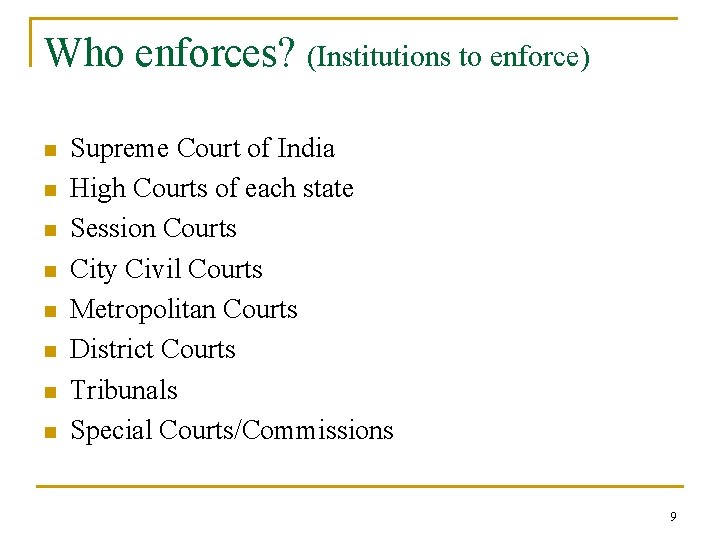
Who enforces? (Institutions to enforce) n n n n Supreme Court of India High Courts of each state Session Courts City Civil Courts Metropolitan Courts District Courts Tribunals Special Courts/Commissions 9
What are these ? n Getting into taxi/auto/public transport? n M mops L’s lawn without being asked by L to do so. L watches M do the work but does not attempt to stop him. Is L bound to pay any charges to M? n A promises to pay B Rs. 500/- if he beats C. B beats C, but A refuses to pay. Can B recover the amount from A? 10
Question 1. Ram invites Madhuri (a well-known film actress) to his daughter’s engagement and dinner party. Madhuri accepts the invitation and promised to attend. Ram made special arrangements for Madhuri at the party but she did not turn up. Ram enraged with Madhuri’s behaviour, wanted to sue for the loss incurred in making special arrangements. Ram is seeking your advice 11
Books for Reference n Elements of Merchantile Law by N. D. Kapoor (Sultan Chand & Sons Publication) 12
Dattaram P Shinde n n n n B. Com (HR College) Law Graduate (KC Law College, Mumbai University) Fellow Company Secretary (ICSI) Graduate Cost Accountant (ICWA) Executive MBA from Symbiosis, Pune Worked with Unichem Laboratories & Godrej Group Currently heading Legal & Secretarial Dept of Eureka Forbes Ltd. Contact : e-mail Cell : dattaramps@gmail. com : 9833725552 13
The Indian Contract Act, 1872 Act IX of 1872 14
The Indian Contract Act, 1872 n All of us enter into a number of contracts everyday knowingly or unknowingly n Each contract creates some rights duties/obligations upon the contracting parties n Indian Contact Act, 1872 deals with the enforcement of these rights and duties of the parties and 15
Meaning n Salmond - Law of contract is “not the whole law of agreements, nor is it the whole law of obligations. It is the law of those agreements which creates obligations, and those obligations which have their sources in the agreements” n It excludes from its purview all obligations which are not contractual in nature and agreements which are social in nature 16
Features of the Indian Contract Act q q q Effective from September 1, 1872 Applies to the whole of India except the state of Jammu & Kashmir Enactments repealed Total sections : 238 Sections divided into 10 Chapters on Sale of Goods and Partnership repealed as separate Acts are formed in both areas. 17
Features n Defines the remedies that are available in a court of law against a person who fails to perform his contract and the conditions under which the remedies are available n Of great importance to people engaged in trade commerce and industry as bulk of their business transactions are based on contracts n So long as they do not infringe some legal prohibition, they can make what rules they like in respect of the subject matter of their agreement and the law will give effect to their decisions 18
Features n Jus in personam (right against or in respect of specific person) e. g. A owes Rs. 500/- to B. B has right to recover Rs. 500/from A. This right can be exercised by B alone and no one else. B’s right against A is jus in personam n Not jus in rem (right against or in respect of a thing) e. g. X owns a plot of land. X has right to enjoy quiet possession against every member of public. Every person is under obligation not to disturb X’s possession. X’s right against whole world in jus in rem 19
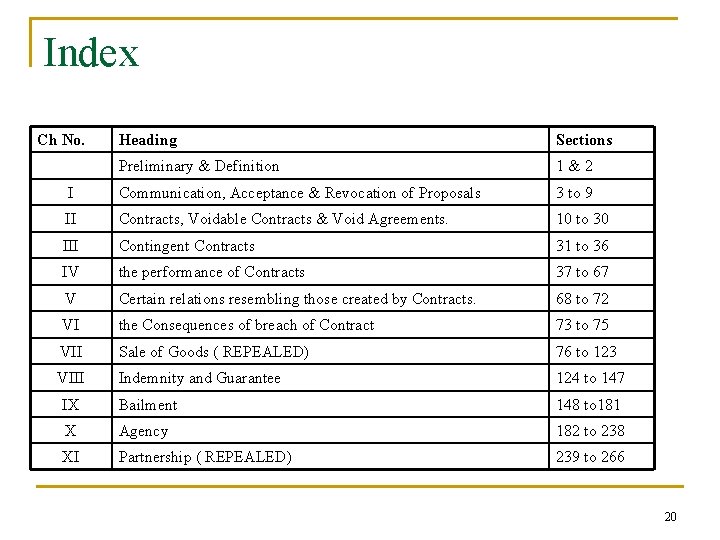
Index Ch No. Heading Sections Preliminary & Definition 1&2 I Communication, Acceptance & Revocation of Proposals 3 to 9 II Contracts, Voidable Contracts & Void Agreements. 10 to 30 III Contingent Contracts 31 to 36 IV the performance of Contracts 37 to 67 V Certain relations resembling those created by Contracts. 68 to 72 VI the Consequences of breach of Contract 73 to 75 VII Sale of Goods ( REPEALED) 76 to 123 VIII Indemnity and Guarantee 124 to 147 IX Bailment 148 to 181 X Agency 182 to 238 XI Partnership ( REPEALED) 239 to 266 20
Preamble n Whereas it is expedient to define and amend certain parts of the law relating to contract; it is hereby enacted as follows : - 21
Short Title & Applicability (Sec 1) Short title : This Act may be called be the Indian Contract Act, 1872. Extent, commencement – It extends to the whole of except the State of Jammu and Kashmir; and it shall come into force on the first day of September, 1872. Enactment repealed – Nothing herein contained shall affect the provisions of any Statute, Act or Regulation not hereby expressly repealed, nor any usage or customs of trade, nor any incident of any contract, not inconsistent with the provisions of this Act. 22
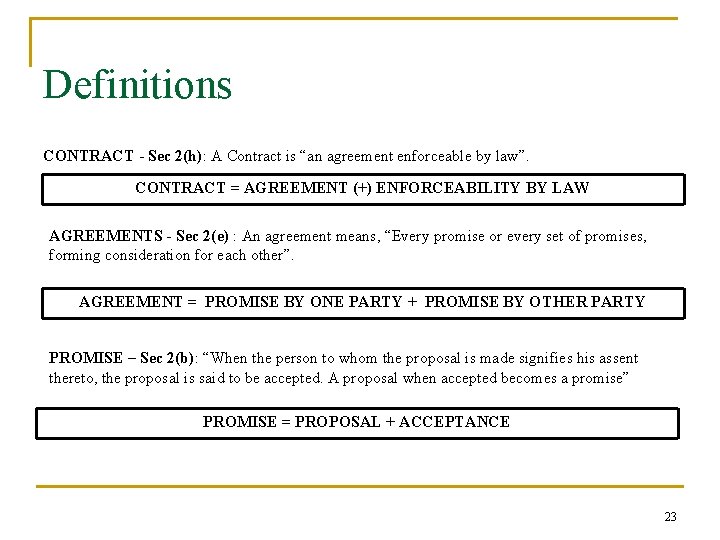
Definitions CONTRACT - Sec 2(h): A Contract is “an agreement enforceable by law”. CONTRACT = AGREEMENT (+) ENFORCEABILITY BY LAW AGREEMENTS - Sec 2(e) : An agreement means, “Every promise or every set of promises, forming consideration for each other”. AGREEMENT = PROMISE BY ONE PARTY + PROMISE BY OTHER PARTY PROMISE – Sec 2(b): “When the person to whom the proposal is made signifies his assent thereto, the proposal is said to be accepted. A proposal when accepted becomes a promise” PROMISE = PROPOSAL + ACCEPTANCE 23
n Consensus ad idem (meeting of minds) n Parties agree upon subject matter of the agreement in same sense and at same time. q q Hansraj & Rajhans A says to B, “will you purchase my red colour Honda City car for Rs. 5 Lac? B says “Yes” to it. 24
Obligation n An agreement to become a contract, must give rise to a legal obligation or duty. n Obligation is a legal tie which imposes upon a definite person or persons the necessity of doing or abstaining from doing a definite act or acts. q q A says to B, “will you purchase my red colour Honda City car for Rs. 5 Lac? And B says “Yes” to it. A is under obligation to deliver his car & B is under obligation to pay Rs. 5 Lac 25
Social Agreements vs Legal Agreement CONTRACT = AGREEMENT (+) ENFORCEABILITY BY LAW VOID AGREEMENT = AGREEMENT (-) ENFORCEABILITY BY LAW Only those agreements which are enforceable in a court of law are contracts n Agreements which gives rise to social obligations are not contracts and hence void n All contracts are agreements but all agreements are not necessarily contracts n 26
Question 1. Ram invites Madhuri (a well-known film actress) to his daughter’s engagement and dinner party. Madhuri accepts the invitation and promised to attend. Ram made special arrangements for Madhuri at the party but she did not turn up. Ram enraged with Madhuri’s behaviour, wanted to sue for the loss incurred in making special arrangements. Ram is seeking your advice No. ‘Ram’ cannot sue ‘Madhuri’ for his loss. Because the agreement was a kind of social nature and lacked the intention to create legal relationship. 27

ESSENTIAL ELEMENTS OF A VALID CONTRACT 28
Section 10 All agreements are contracts if they are made by free consent of parties, competent to contract, for a lawful consideration and with a lawful object and are not hereby expressly declared to be void 29
The essential elements of a valid contract 1. Offer & Acceptance : To constitute a contract there must be an agreement. There must be two parties to an agreement, i. e. one party making an offer (offeror) and the other party accepting the offer (offeree). The terms of the offer must be definite and acceptance must be absolute and unconditional. The acceptance must be according to the mode prescribed and must be communicated to the offeror. 2. Intention to create legal relationship: When the two parties enter into an agreement, there must be an intention by both parties to legally bind the other as a result of such agreement. Thus, agreements of social or household nature are not contracts. q Balfour Vs Balfour q Rose & Frank Co Vs Crompton Bros 30
Question q q q Agreement between R Co and C Co wherein R was appointed as agent of C. One of the clause of agency agreement read “this agreement is not entered into…. As a formal or legal agreement, and shall not be subject to legal jurisdiction in the law of courts” Is this agreement binding on parties? There was no binding contract as there was no intention to create legal relationship Rose & Frank Co v Crompton Bros 31
The essential elements of a valid contract 3. Lawful Consideration : An agreement to form a valid contract should be supported by consideration. Consideration means “something in return” (quid pro quo). It can be cash, kind, an act or abstinence. It can be past, present or future. However, consideration should be real and lawful. Sec 2(d) and 25 4. Capacity of parties (competence): The parties to the agreement must be capable of entering into a valid contract. According to Section 11, every person is competent to contract if he or she : • is of the age of majority; • is of sound mind; and • is not disqualified from contracting by any law to which he is subject to Flaw in capacity may arise from minority, lunacy, idiocy, drunkenness etc. 32
The essential elements of a valid contract 5. Free & genuine consent (consensus ad idem) : To constitute a valid contract there must be free and genuine consent of the parties to the contract. It should not be obtained by misrepresentation, fraud, coercion, undue influence or mistake. Sec 13 & 14 6. Lawful object : The object of the agreement must not be illegal or unlawful. According to Section 23, the consideration or object of an agreement must not be : n Illegal; n Immoral; n Opposed to public policy 33
Question n A promises to pay B Rs. 500/- if he beats C. B beats C, but A refuses to pay. Can B recover the amount from A? No. B can not recover the amount from A as the agreement is illegal 34
The essential elements of a valid contract 7. Agreement not declared void : Agreements which have been expressly declared void by law in force in the country (Sec 24 to 30 & 56) 8. Certainty and possibility of performance : The terms of agreement must be certain and not vague or indefinite (Sec 29) If it is not possible to ascertain the meaning of the agreement, it is not enforceable at law. Also, agreements to do impossible acts cannot be enforced e. g. A agrees to with B to put life into B’s dead wife, the agreement is void as it is impossible of performance 35
The essential elements of a valid contract 9. Legal Formalities : A contract can be made by words spoken or written. Other formalities to be complied in order to make the agreement legally enforceable. Examples of such formalities could be affixing proper stamp, to be in writing, registered e. g. Government Contracts, Tenders etc. 36

TYPES OF CONTRACTS 37
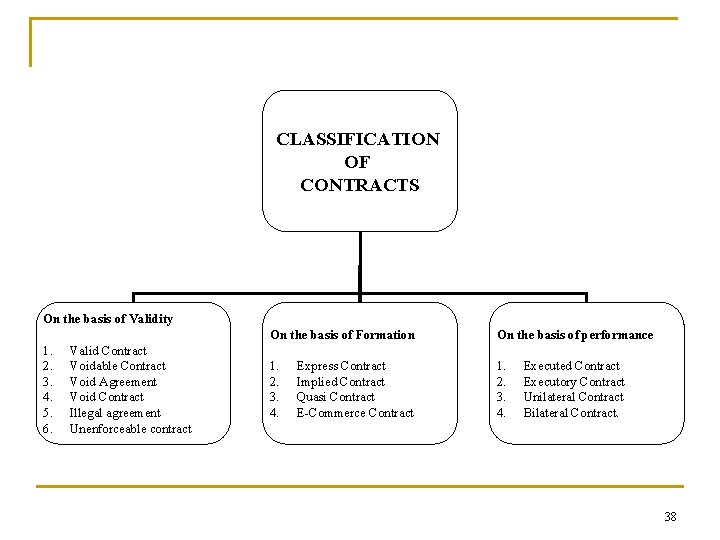
CLASSIFICATION OF CONTRACTS On the basis of Validity 1. 2. 3. 4. 5. 6. Valid Contract Voidable Contract Void Agreement Void Contract Illegal agreement Unenforceable contract On the basis of Formation On the basis of performance 1. 2. 3. 4. Express Contract Implied Contract Quasi Contract E-Commerce Contract Executed Contract Executory Contract Unilateral Contract Bilateral Contract. 38
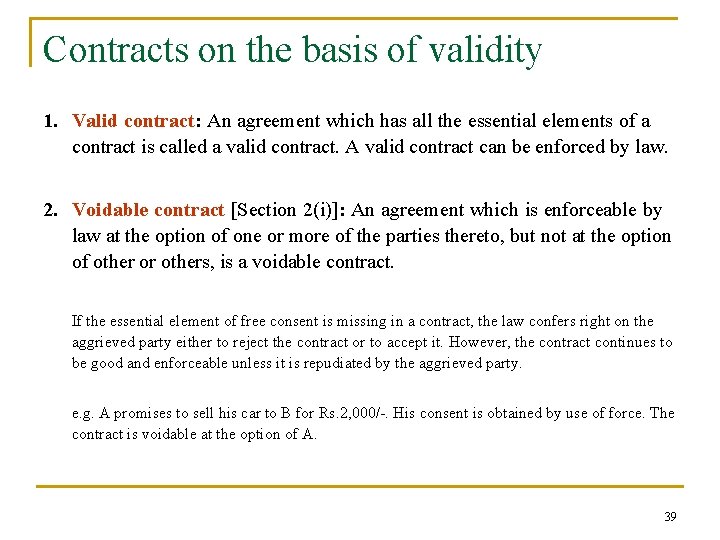
Contracts on the basis of validity 1. Valid contract: An agreement which has all the essential elements of a contract is called a valid contract. A valid contract can be enforced by law. 2. Voidable contract [Section 2(i)]: An agreement which is enforceable by law at the option of one or more of the parties thereto, but not at the option of other or others, is a voidable contract. If the essential element of free consent is missing in a contract, the law confers right on the aggrieved party either to reject the contract or to accept it. However, the contract continues to be good and enforceable unless it is repudiated by the aggrieved party. e. g. A promises to sell his car to B for Rs. 2, 000/-. His consent is obtained by use of force. The contract is voidable at the option of A. 39
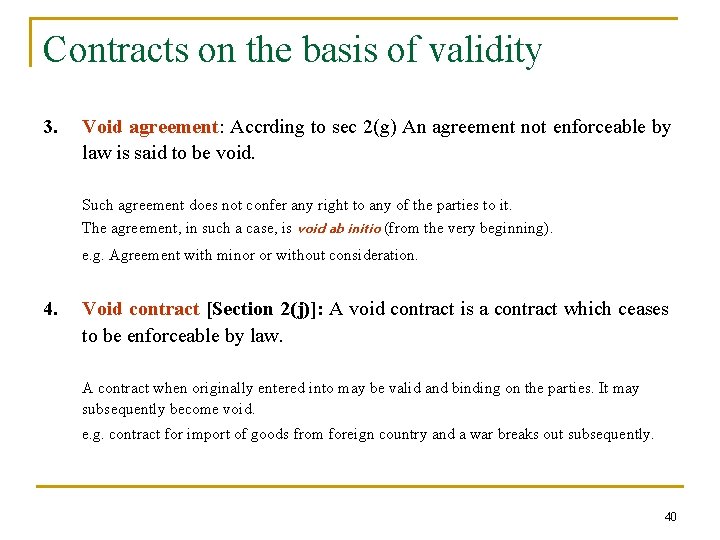
Contracts on the basis of validity 3. Void agreement: Accrding to sec 2(g) An agreement not enforceable by law is said to be void. Such agreement does not confer any right to any of the parties to it. The agreement, in such a case, is void ab initio (from the very beginning). e. g. Agreement with minor or without consideration. 4. Void contract [Section 2(j)]: A void contract is a contract which ceases to be enforceable by law. A contract when originally entered into may be valid and binding on the parties. It may subsequently become void. e. g. contract for import of goods from foreign country and a war breaks out subsequently. 40
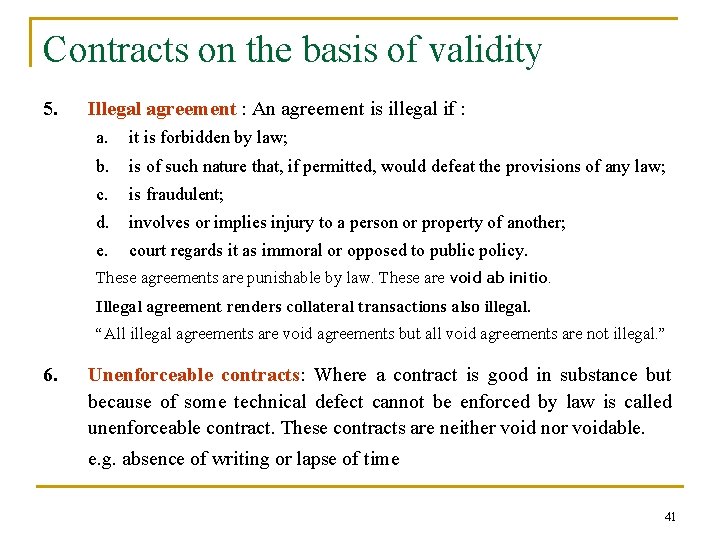
Contracts on the basis of validity 5. Illegal agreement : An agreement is illegal if : a. it is forbidden by law; b. is of such nature that, if permitted, would defeat the provisions of any law; c. is fraudulent; d. involves or implies injury to a person or property of another; e. court regards it as immoral or opposed to public policy. These agreements are punishable by law. These are void ab initio. Illegal agreement renders collateral transactions also illegal. “All illegal agreements are void agreements but all void agreements are not illegal. ” 6. Unenforceable contracts: Where a contract is good in substance but because of some technical defect cannot be enforced by law is called unenforceable contract. These contracts are neither void nor voidable. e. g. absence of writing or lapse of time 41
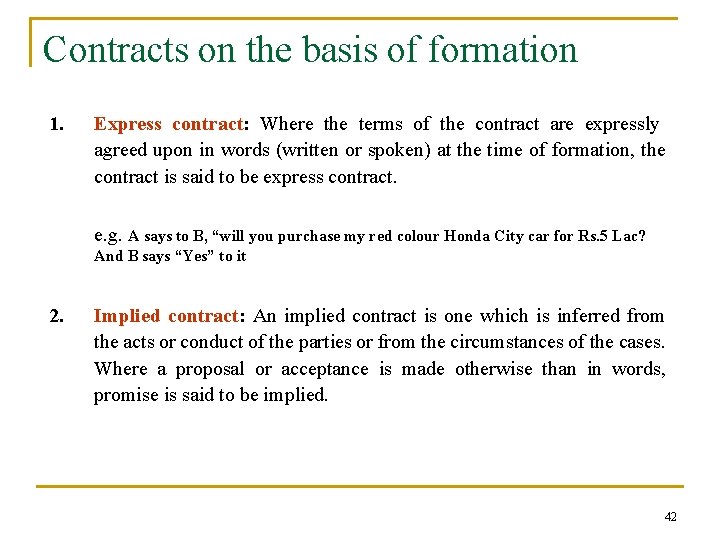
Contracts on the basis of formation 1. Express contract: Where the terms of the contract are expressly agreed upon in words (written or spoken) at the time of formation, the contract is said to be express contract. e. g. A says to B, “will you purchase my red colour Honda City car for Rs. 5 Lac? And B says “Yes” to it 2. Implied contract: An implied contract is one which is inferred from the acts or conduct of the parties or from the circumstances of the cases. Where a proposal or acceptance is made otherwise than in words, promise is said to be implied. 42
Questions n Getting into taxi/auto/public transport? n M mops L’s lawn without being asked by L to do so. L watches M do the work but does not attempt to stop him. Is L bound to pay any charges to M? 43
Contracts on the basis of formation 3. Quasi contracts: A quasi contract is created by law. Quasi contracts are strictly not contracts as there is no intention of parties to enter into a contract. It is legal obligation which is imposed on a party who is required to perform it. A quasi contract is based on the principle that a person shall not be allowed to enrich himself at the expense of another. e. g. T leaves his cow at the residence of U his neighbor. The cow delivery a calf, T is under obligation to deliver cow as well as the calf. 4. E-Commerce Contracts : Contract entered into via internet. In modern days, this is the widely practiced area of contract. 44
Contracts on the basis of performance 1. Executed contract: An executed contract is one in which both the parties have performed their respective obligation. 2. Executory contract: An executory contract is one where one or both the parties to the contract have still to perform their obligations in future. Thus, a contract which is partially performed or wholly unperformed is termed as executory contract. 45
Contracts on the basis of performance 3. Unilateral contract: A unilateral contract is one in which only one party has to perform his obligation at the time of the formation of the contract, the other party having fulfilled his obligation at the time o the contract or before the contract comes into existence. e. g. Promissory Note, Bill of Exchange, Offer of a reward for the return of lost property etc. 4. Bilateral contract: A bilateral contract is one in which the obligation on both the parties to the contract is outstanding at the time of the formation of the contract. Bilateral contracts are also known as contracts with executory consideration. e. g. A promises to pay Rs. 10, 000/- to B and in return B promises to sell his car to A. 46
- Slides: 46