
Business Intelligence and Analytics Systems for Decision Support
Business Intelligence and Analytics: Systems for Decision Support (10 th Edition) Chapter 11: Automated Decision Systems and Expert Systems
Learning Objectives n n n Understand the concept and applications of automated rule-based decision systems Understand the importance of knowledge in decision support Describe the concept and evolution of rulebased expert systems (ES) Understand the architecture of rule-based ES Learn the knowledge engineering process used to build ES (Continued…) 11 -2 Copyright © 2014 Pearson Education, Inc.
Learning Objectives n n n 11 -3 Explain the benefits and limitations of rulebased systems for decision support Identify proper applications of ES Learn about tools and technologies for developing rule-based DSS Copyright © 2014 Pearson Education, Inc.
Opening Vignette… Inter. Continental Hotel Group Uses Decision Rules for Optimal Hotel Room Rates n n n 11 -4 Company background Problem description Proposed solution Results Answer & discuss the case questions. . . Copyright © 2014 Pearson Education, Inc.
Questions for the Opening Vignette Describe the challenges faced by IHG during development of their retail price optimization system. 2. Besides the hotel business in the hospitality industry, explain at least three other areas where an optimization model could be used. 3. What other methods could be used to solve IHG’s price optimization problem? 1. 11 -5 Copyright © 2014 Pearson Education, Inc.

Automated Decision Systems n n n A relatively new approach to supporting decision making a. k. a. Decision Automation Systems (DAS) Often a rule-based system that provides a solution in a functional area n n 11 -6 “If only 70 percent of the seats on a flight from LA to NY are sold 3 days prior to departure, offer a discount of x to nonbusiness travelers” Applies to repetitive/structured decisions Copyright © 2014 Pearson Education, Inc.
Application Case 11. 1 Giant Food Stores Prices the Entire Store Company background n Problem description n Proposed solution n Results n 11 -7 Copyright © 2014 Pearson Education, Inc.
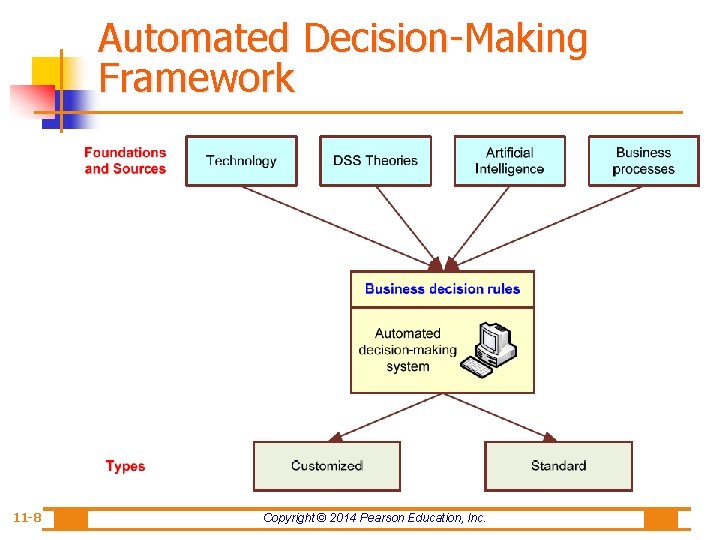
Automated Decision-Making Framework 11 -8 Copyright © 2014 Pearson Education, Inc.
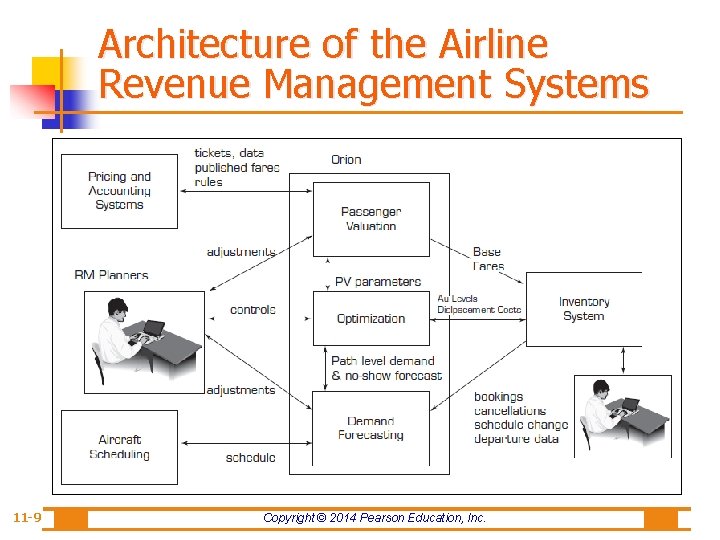
Architecture of the Airline Revenue Management Systems 11 -9 Copyright © 2014 Pearson Education, Inc.
Artificial Intelligence (AI) n Artificial intelligence (AI) n n A subfield of computer science, concerned with symbolic reasoning and problem solving AI has many definitions… Behavior by a machine that, if performed by a human being, would be considered intelligent n “…study of how to make computers do things at which, at the moment, people are better n Theory of how the human mind works n 11 -10 Copyright © 2014 Pearson Education, Inc.
AI Objectives n Make machines smarter (primary goal) Understand what intelligence is Make machines more intelligent & useful n Signs of intelligence… n n n n 11 -11 Learn or understand from experience Make sense out of ambiguous situations Respond quickly to new situations Use reasoning to solve problems Apply knowledge to manipulate the environment Copyright © 2014 Pearson Education, Inc.
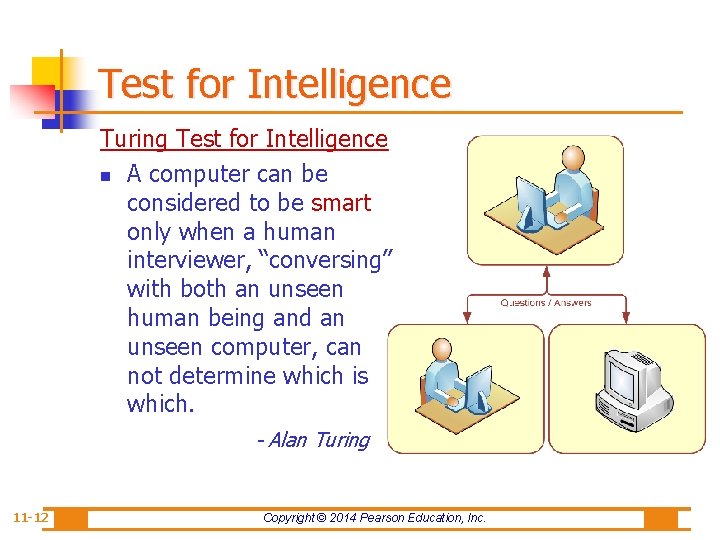
Test for Intelligence Turing Test for Intelligence n A computer can be considered to be smart only when a human interviewer, “conversing” with both an unseen human being and an unseen computer, can not determine which is which. - Alan Turing 11 -12 Copyright © 2014 Pearson Education, Inc.

The AI Field… The Disciplines and Applications of AI. n AI provides the scientific foundation for many commercial technologies
AI Areas n Major… Expert Systems n Natural Language Processing n Robotics and Sensory Systems n Computer Vision and Scene Recognition n Intelligent Computer-Aided Instruction n Automated Programming, Neural Computing n n Additional… Fuzzy Logic, Genetic Algorithms n Game Playing, Intelligent Software Agents … n 11 -14 Copyright © 2014 Pearson Education, Inc.
AI is Often Transparent in Many Commercial Products n n Anti-lock Braking Systems (ABS) Automatic Transmissions Video Camcorders Appliances n n 11 -15 Washers, Toasters, Stoves, … Help Desk Software Subway Control … Copyright © 2014 Pearson Education, Inc.
Expert Systems (ES) n n Is a computer program that attempts to imitate expert’s reasoning processes and knowledge in solving specific problems Most Popular Applied AI Technology n n Works best with narrow problem areas/tasks Expert systems do not replace experts, but n n 11 -16 Enhance Productivity Augment Work Forces Make their knowledge and experience more widely available, and thus Permit non-experts to work better Copyright © 2014 Pearson Education, Inc.
Important Concepts in ES n Expert A human being who has developed a high level of proficiency in making judgments in a specific domain n Expertise The set of capabilities that underlines the performance of human experts, including ü ü 11 -17 extensive domain knowledge, heuristic rules that simplify and improve approaches to problem solving, meta-knowledge and meta-cognition, and compiled forms of behavior that afford great economy in a skilled performance Copyright © 2014 Pearson Education, Inc.
Features and Concepts in ES n Experts / Expertise Degrees or levels of expertise n Ratio of non-experts to experts 100 to 1 n n Transferring Expertise n n n 11 -18 From expert to computer to nonexperts via acquisition, representation, inferencing, transfer Symbolic Reasoning / Inferencing Deep Knowledge / Self Knowledge Copyright © 2014 Pearson Education, Inc.
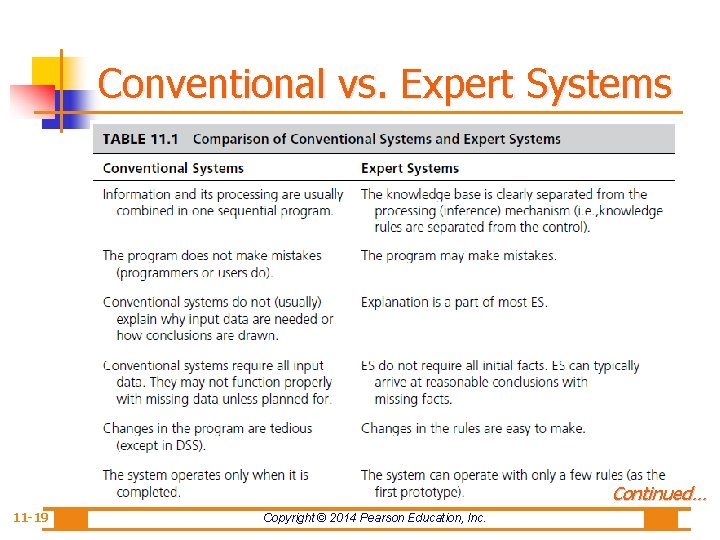
Conventional vs. Expert Systems Continued… 11 -19 Copyright © 2014 Pearson Education, Inc.
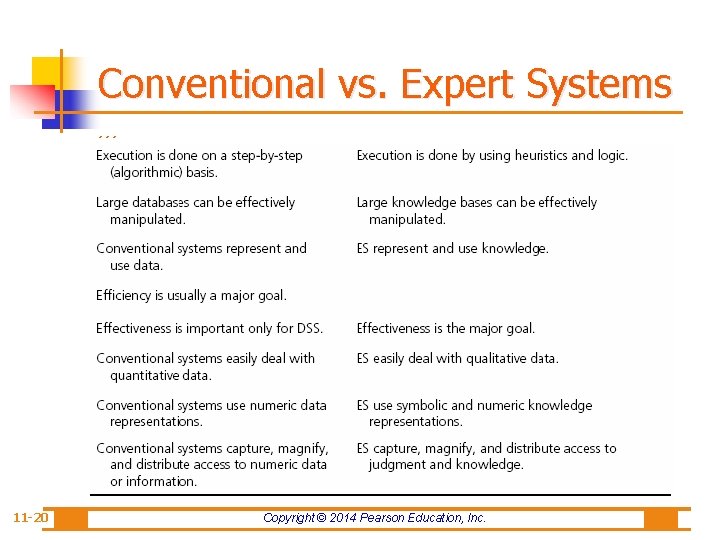
Conventional vs. Expert Systems … 11 -20 Copyright © 2014 Pearson Education, Inc.
Application Case 11. 2 Expert System Helps in Identifying Sport Talents Background n Problem description n Proposed solution n Results n 11 -21 Copyright © 2014 Pearson Education, Inc.
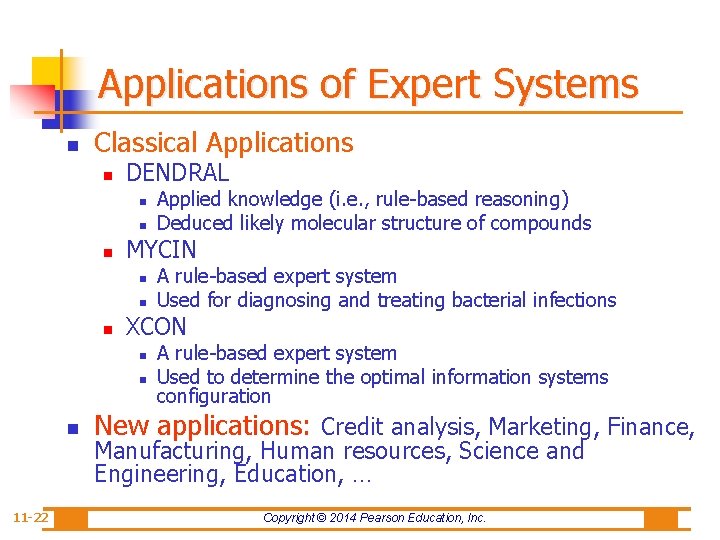
Applications of Expert Systems n Classical Applications n DENDRAL n n n MYCIN n n 11 -22 A rule-based expert system Used for diagnosing and treating bacterial infections XCON n n Applied knowledge (i. e. , rule-based reasoning) Deduced likely molecular structure of compounds A rule-based expert system Used to determine the optimal information systems configuration New applications: Credit analysis, Marketing, Finance, Manufacturing, Human resources, Science and Engineering, Education, … Copyright © 2014 Pearson Education, Inc.
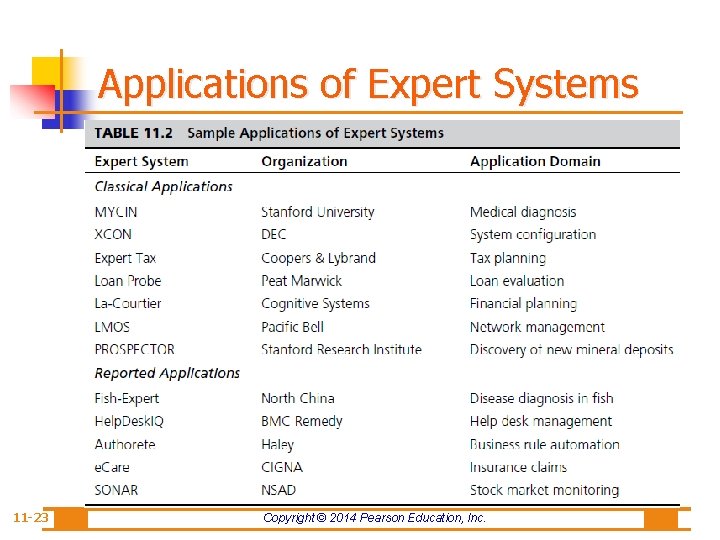
Applications of Expert Systems 11 -23 Copyright © 2014 Pearson Education, Inc.
Application Case 11. 3 Expert System Aids in Identification of Chemical, Biological, and Radiological Agents Questions for Discussion How can CBR Advisor assist in making quick decisions? 2. What characteristics of CBR Advisor make it an expert system? 3. What could be other situations where such expert systems can be employed? 1. 11 -24 Copyright © 2014 Pearson Education, Inc.
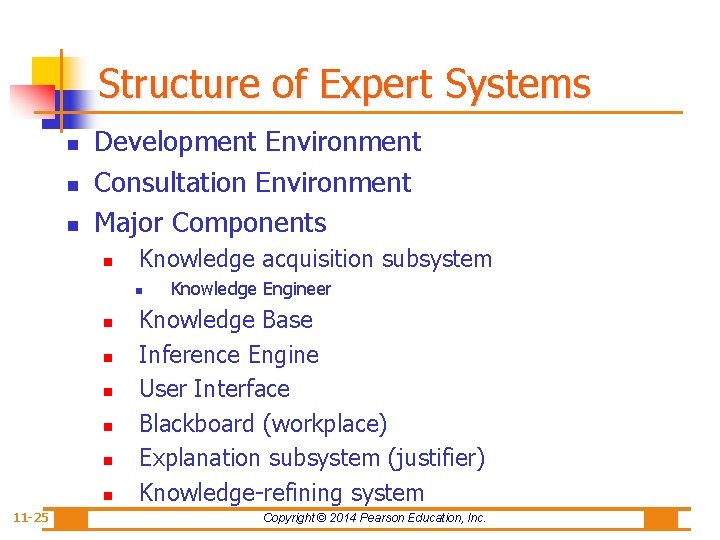
Structure of Expert Systems n n n Development Environment Consultation Environment Major Components n Knowledge acquisition subsystem n n n n 11 -25 Knowledge Engineer Knowledge Base Inference Engine User Interface Blackboard (workplace) Explanation subsystem (justifier) Knowledge-refining system Copyright © 2014 Pearson Education, Inc.
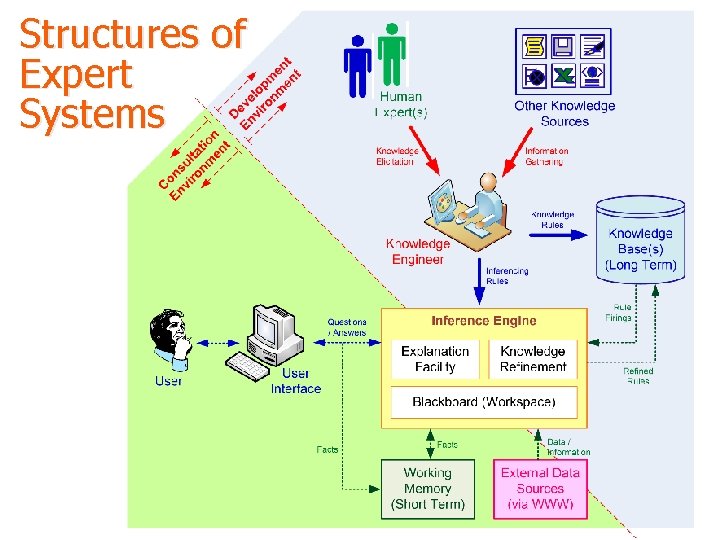
Structures of Expert Systems
Application Case 11. 4 Diagnosing Heart Diseases by Signal Processing Questions for Discussion List the major components involved in building SIPMES and briefly comment on them. 2. Do expert systems like SIPMES eliminate the need for human decision making? 3. How often do you think that the existing expert systems, once built, should be changed? 1. 11 -27 Copyright © 2014 Pearson Education, Inc.
Knowledge Engineering (KE) n n A set of intensive activities encompassing the acquisition of knowledge from human experts (and other information sources) and converting this knowledge into a repository (commonly called a knowledge base) The primary goal of KE is to n n n 11 -28 help experts articulate how they do what they do, and to document this knowledge in a reusable form Narrow versus Broad definition of KE? Copyright © 2014 Pearson Education, Inc.
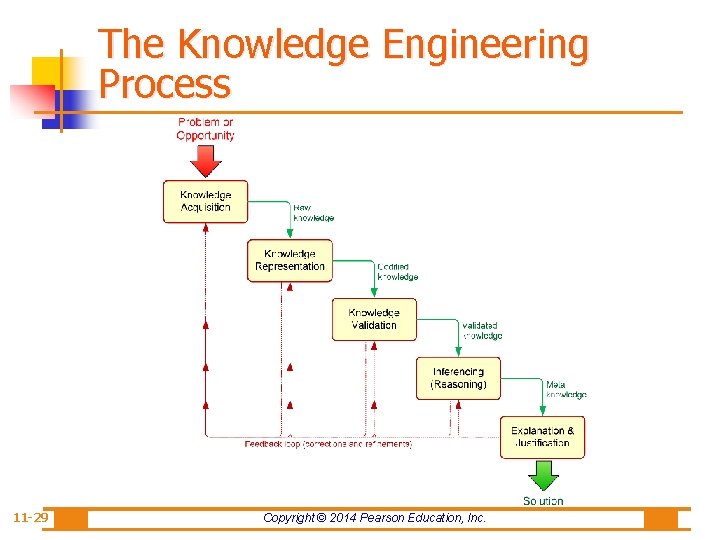
The Knowledge Engineering Process 11 -29 Copyright © 2014 Pearson Education, Inc.
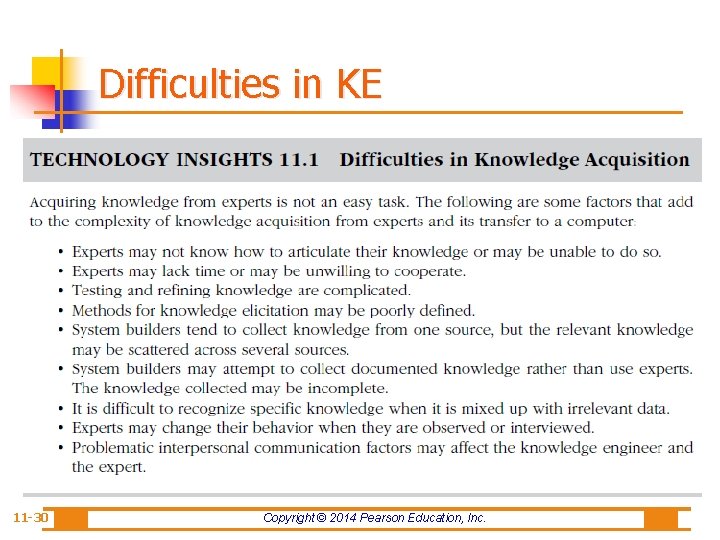
Difficulties in KE 11 -30 Copyright © 2014 Pearson Education, Inc.
Knowledge Engineering Knowledge Validation/Verification n Evaluation is a broad concept - its objective is to assess an ES’s overall value Validation versus Verification n Validation is the part of evaluation that deals with the performance of the system n Verification is building the system right or substantiating that the system is correctly implemented to its specifications 11 -31 Copyright © 2014 Pearson Education, Inc.
Knowledge Representation in ES n n Expert knowledge must be represented in a computer-understandable format and organized properly in the knowledge base The most common/popular way to represent human knowledge: n Production rules n n 11 -32 Condition-Action pairs IF … THEN … ELSE … Copyright © 2014 Pearson Education, Inc.
Forms of Production Rules n IF premise, THEN conclusion n n Conclusion, IF premise n n 11 -33 Your chance of being audited is high, IF your income is high Inclusion of ELSE n n IF your income is high, THEN your chance of being audited by the IRS is high IF your income is high, OR your deductions are unusual, THEN your chance of being audited by the IRS is high, ELSE your chance of being audited is low More complex rules… Copyright © 2014 Pearson Education, Inc.
Knowledge and Inference Rules n Knowledge rules (declarative rules), state all the facts and relationships about a problem n n Knowledge rules are stored in the knowledge base Inference rules (procedural rules), advise on how to solve a problem, given that certain facts are known n Inference rules contain rules about rules (metarules) Inference rules become part of the inference engine Example: n n 11 -34 IF needed data is not known THEN ask the user IF more than one rule applies THEN fire the one with the highest priority value first Copyright © 2014 Pearson Education, Inc.
Inferencing in ES Inference is the process of chaining multiple rules together based on available data n n 11 -35 Forward chaining A data-driven search in a rule-based system. If the premise clauses match the situation, then the process attempts to assert the conclusion. Backward chaining A goal-driven search in a rule-based system. It begins with the action clause of a rule and works backward through a chain of rules in an attempt to find a verifiable set of condition clauses. Copyright © 2014 Pearson Education, Inc.
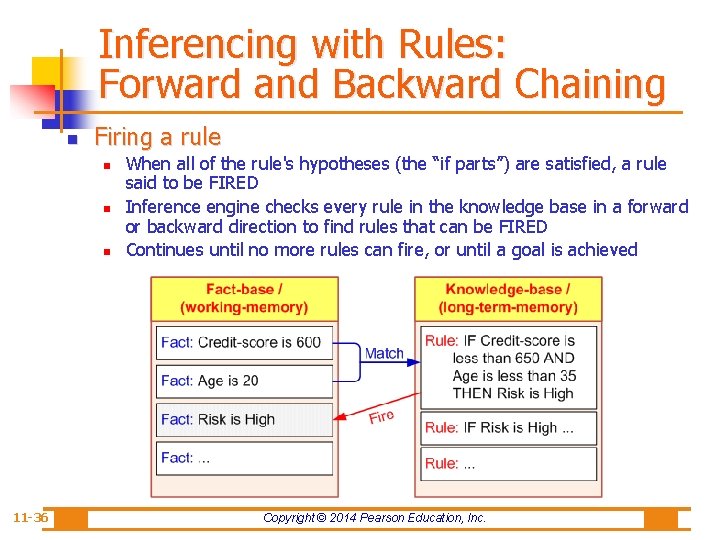
Inferencing with Rules: Forward and Backward Chaining n Firing a rule n n n 11 -36 When all of the rule's hypotheses (the “if parts”) are satisfied, a rule said to be FIRED Inference engine checks every rule in the knowledge base in a forward or backward direction to find rules that can be FIRED Continues until no more rules can fire, or until a goal is achieved Copyright © 2014 Pearson Education, Inc.
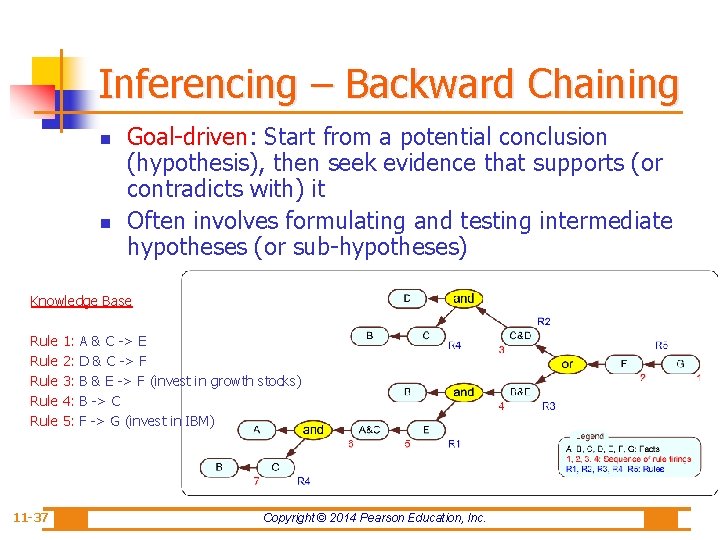
Inferencing – Backward Chaining n n Goal-driven: Start from a potential conclusion (hypothesis), then seek evidence that supports (or contradicts with) it Often involves formulating and testing intermediate hypotheses (or sub-hypotheses) Investment Decision: Variable Definitions n A = Have $10, 000 n B = Younger than 30 Rule 1: A & C -> E n C = Education at college level Rule 2: D & C -> F Rule 3: B & E -> F (invest in growth stocks) n D = Annual income > $40, 000 Rule 4: B -> C n E = Invest in securities Rule 5: F -> G (invest in IBM) n F = Invest in growth stocks n G = Invest in IBM stock Knowledge Base 11 -37 n Copyright © 2014 Pearson Education, Inc.
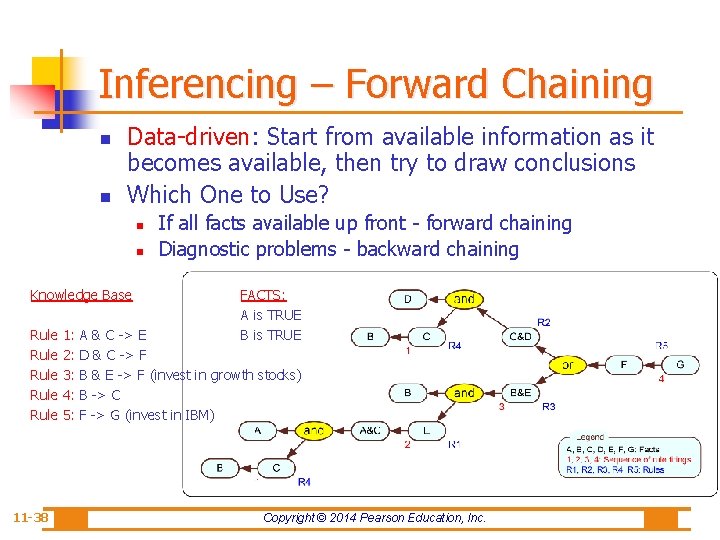
Inferencing – Forward Chaining n n Data-driven: Start from available information as it becomes available, then try to draw conclusions Which One to Use? n n Knowledge Base Rule Rule 11 -38 1: 2: 3: 4: 5: If all facts available up front - forward chaining Diagnostic problems - backward chaining FACTS: A is TRUE B is TRUE A & C -> E D & C -> F B & E -> F (invest in growth stocks) B -> C F -> G (invest in IBM) Copyright © 2014 Pearson Education, Inc.
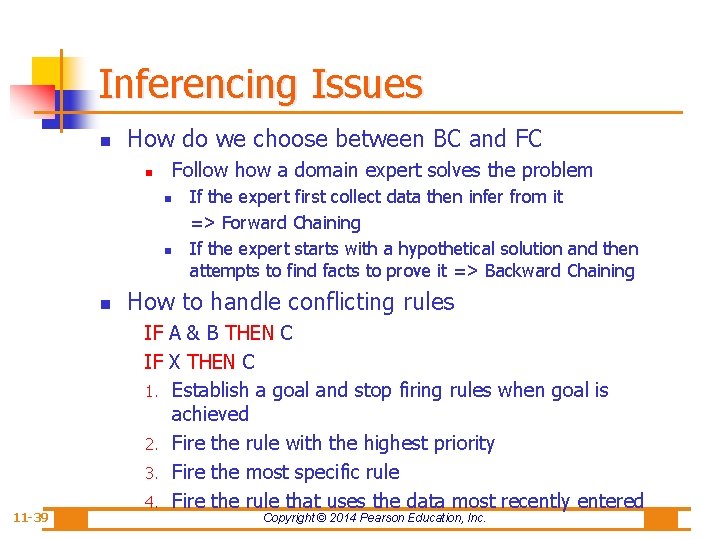
Inferencing Issues n How do we choose between BC and FC Follow how a domain expert solves the problem n n 11 -39 If the expert first collect data then infer from it => Forward Chaining If the expert starts with a hypothetical solution and then attempts to find facts to prove it => Backward Chaining How to handle conflicting rules IF A & B THEN C IF X THEN C 1. Establish a goal and stop firing rules when goal is achieved 2. Fire the rule with the highest priority 3. Fire the most specific rule 4. Fire the rule that uses the data most recently entered Copyright © 2014 Pearson Education, Inc.
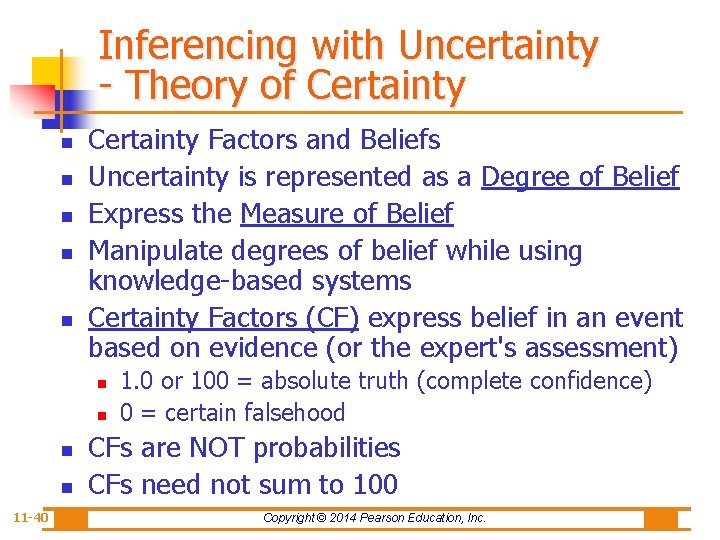
Inferencing with Uncertainty - Theory of Certainty n n n Certainty Factors and Beliefs Uncertainty is represented as a Degree of Belief Express the Measure of Belief Manipulate degrees of belief while using knowledge-based systems Certainty Factors (CF) express belief in an event based on evidence (or the expert's assessment) n n 11 -40 1. 0 or 100 = absolute truth (complete confidence) 0 = certain falsehood CFs are NOT probabilities CFs need not sum to 100 Copyright © 2014 Pearson Education, Inc.
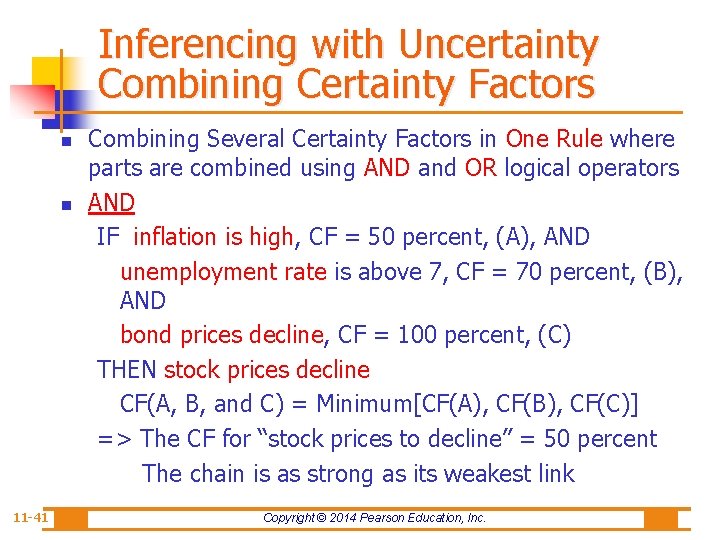
Inferencing with Uncertainty Combining Certainty Factors n n 11 -41 Combining Several Certainty Factors in One Rule where parts are combined using AND and OR logical operators AND IF inflation is high, CF = 50 percent, (A), AND unemployment rate is above 7, CF = 70 percent, (B), AND bond prices decline, CF = 100 percent, (C) THEN stock prices decline CF(A, B, and C) = Minimum[CF(A), CF(B), CF(C)] => The CF for “stock prices to decline” = 50 percent The chain is as strong as its weakest link Copyright © 2014 Pearson Education, Inc.
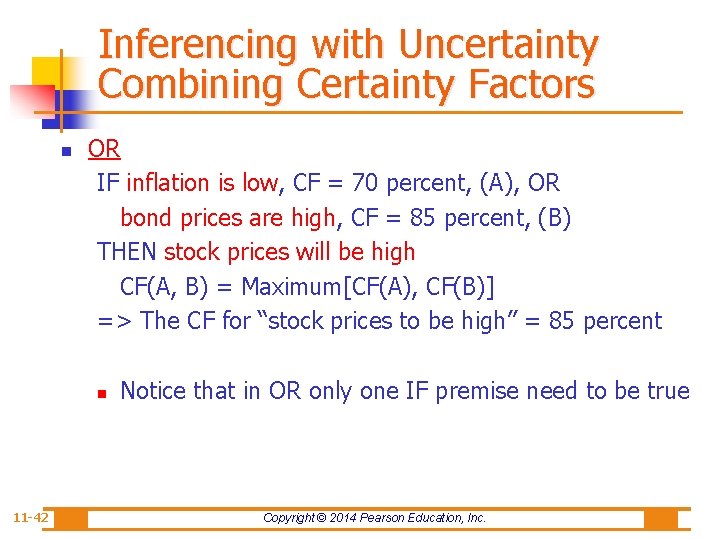
Inferencing with Uncertainty Combining Certainty Factors n OR IF inflation is low, CF = 70 percent, (A), OR bond prices are high, CF = 85 percent, (B) THEN stock prices will be high CF(A, B) = Maximum[CF(A), CF(B)] => The CF for “stock prices to be high” = 85 percent n 11 -42 Notice that in OR only one IF premise need to be true Copyright © 2014 Pearson Education, Inc.
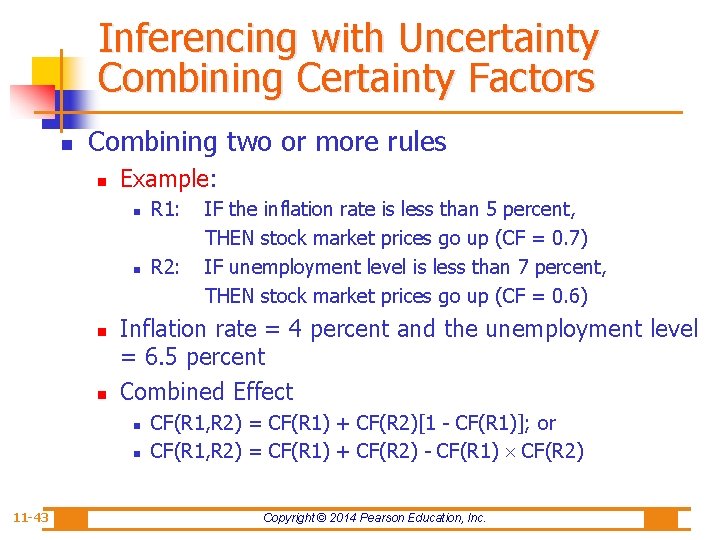
Inferencing with Uncertainty Combining Certainty Factors n Combining two or more rules n n n Example: n R 1: n R 2: Inflation rate = 4 percent and the unemployment level = 6. 5 percent Combined Effect n n 11 -43 IF the inflation rate is less than 5 percent, THEN stock market prices go up (CF = 0. 7) IF unemployment level is less than 7 percent, THEN stock market prices go up (CF = 0. 6) CF(R 1, R 2) = CF(R 1) + CF(R 2)[1 - CF(R 1)]; or CF(R 1, R 2) = CF(R 1) + CF(R 2) - CF(R 1) CF(R 2) Copyright © 2014 Pearson Education, Inc.
Explanation as a Metaknowledge n Explanation n n Explanation Purposes… n n 11 -44 Human experts justify and explain their actions … so should ES Explanation: an attempt by an ES to clarify reasoning, recommendations, other actions (asking a question) Explanation facility = Justifier Make the system more intelligible Uncover shortcomings of the knowledge bases Explain unanticipated situations Satisfy users’ psychological and/or social needs, … Copyright © 2014 Pearson Education, Inc.
Two Basic Explanations n n Why Explanations - Why is a fact requested? How Explanations - To determine how a certain conclusion or recommendation was reached n n 11 -45 Some simple systems - only at the final conclusion Most complex systems provide the chain of rules used to reach the conclusion Explanation is essential in ES Used for training and evaluation Copyright © 2014 Pearson Education, Inc.
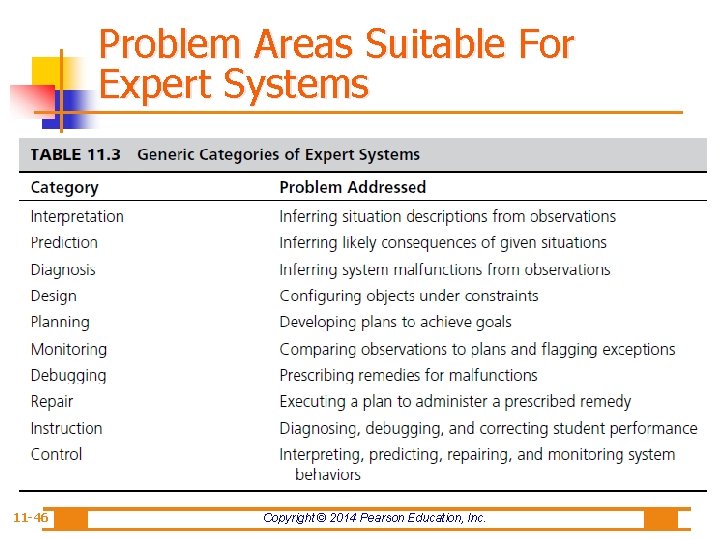
Problem Areas Suitable For Expert Systems 11 -46 Copyright © 2014 Pearson Education, Inc.
Development of ES n n n Defining the nature and scope of the problem Identifying proper experts Acquiring knowledge n n Selecting the Building Tools n n n 11 -47 Knowledge engineer Shells versus Complete Development Coding the system Evaluating and Launching the System Copyright © 2014 Pearson Education, Inc.
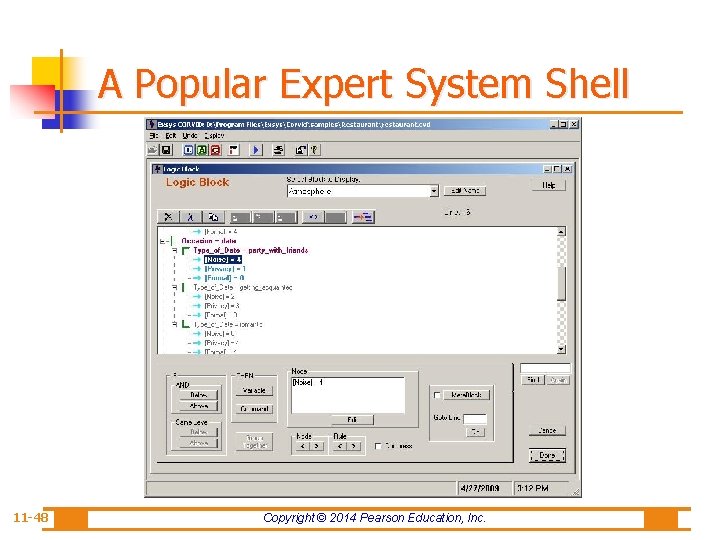
A Popular Expert System Shell 11 -48 Copyright © 2014 Pearson Education, Inc.
Application Case 11. 5 Clinical Decision Support System for Tendon Injuries Questions for Discussion 1. Research other expert systems in other domains and list a few of them. 2. Why is important to evaluate the expert systems before they are put into use? 11 -49 Copyright © 2014 Pearson Education, Inc.
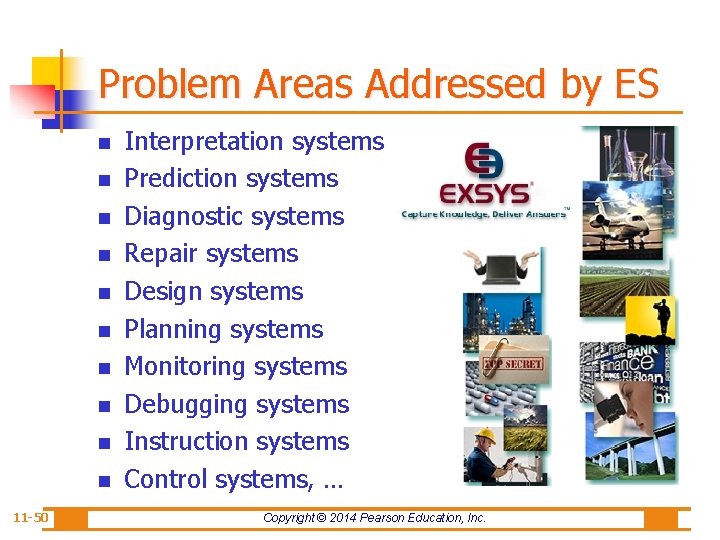
Problem Areas Addressed by ES n n n n n 11 -50 Interpretation systems Prediction systems Diagnostic systems Repair systems Design systems Planning systems Monitoring systems Debugging systems Instruction systems Control systems, … Copyright © 2014 Pearson Education, Inc.
End of the Chapter n 11 -51 Questions, comments Copyright © 2014 Pearson Education, Inc.

All rights reserved. No part of this publication may be reproduced, stored in a retrieval system, or transmitted, in any form or by any means, electronic, mechanical, photocopying, recording, or otherwise, without the prior written permission of the publisher. Printed in the United States of America. Copyright © 2014 Pearson Education, Inc. 11 -52 Copyright © 2014 Pearson Education, Inc.
- Slides: 52