
Business Intelligence and Analytics Systems for Decision Support
Business Intelligence and Analytics: Systems for Decision Support (10 th Edition) Chapter 9: Model-Based Decision Making: Optimization and Multi-Criteria Systems
Learning Objectives n n n 9 -2 Understand the basic concepts of analytical decision modeling Describe how prescriptive models interact with data and the user Understand some different, well-known model classes Understand how to structure decision making with a few alternatives Describe how spreadsheets can be used for analytical modeling and solution (Continued…) Copyright © 2014 Pearson Education, Inc.
Learning Objectives n n n 9 -3 Explain the basic concepts of optimization and when to use them Describe how to structure a linear programming model Describe how to handle multiple goals Explain what is meant by sensitivity analysis, what-if analysis, and goal seeking Describe the key issues of multi-criteria decision making Copyright © 2014 Pearson Education, Inc.

Opening Vignette… Midwest ISO Saves Billions by Better Planning of Power Plant Operations and Capacity Planning n n n 9 -4 Company background Problem description Proposed solution Results Answer & discuss the case questions. . . Copyright © 2014 Pearson Education, Inc.
Questions for the Opening Vignette In what ways were the individual companies in Midwest ISO better off being part of MISO as opposed to operating independently? 2. The dispatch problem was solved with a linear programming method. Explain the need of such method in light of the problem discussed in the case. 3. What were the two main optimization algorithms used? Briefly explain the use of each algorithm. 1. 9 -5 Copyright © 2014 Pearson Education, Inc.
Decision Support Systems Modeling n DSS modeling (optimization & simulation) contribute to organizational success. Examples include: n n n 9 -6 Pillowtex (see Pro. Model, 2013), Fiat (see Pro. Model, 2006), Procter & Gamble (see Camm et al. , 1997), and others. INFORMS publications such as Interfaces, ORMS Today, and Analytics magazine have plenty of such example cases Copyright © 2014 Pearson Education, Inc.
Application Case 9. 1 Optimal Transport for Exxon. Mobil Downstream Through a DSS Questions for Discussion 1. List three ways in which manual scheduling of ships could result in more operational cost as compared to the tool developed. 2. In what other ways can Exxon. Mobil leverage the decision support tool developed to expand optimize their other business operations? 3. What are some strategic decisions that could be made by decision makers using the tool developed? 9 -7 Copyright © 2014 Pearson Education, Inc.
Major Modeling Issues n n Problem identification and environmental analysis (information collection) Variable identification n n Forecasting/predicting n n 9 -8 More information leads to better prediction Multiple models: An MSS can include several models, each of which represents a different part of the decision-making problem n n Influence diagrams, cognitive maps Categories of models >>> Model management – DBMS vs. MBDM Copyright © 2014 Pearson Education, Inc.
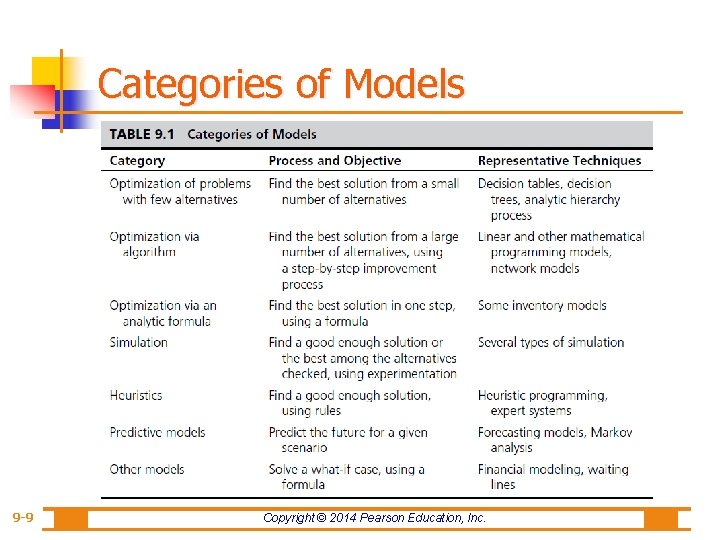
Categories of Models 9 -9 Copyright © 2014 Pearson Education, Inc.
Model Categories Static and Dynamic Models n Static Analysis n n Dynamic Analysis n n n 9 -10 Single snapshot of the situation Single interval Steady state Dynamic models Evaluate scenarios that change over time Time dependent Represents trends and patterns over time More realistic: Extends static models Copyright © 2014 Pearson Education, Inc.
Application Case 9. 2 Optimal Transport for Exxon. Mobil Downstream Through a DSS Company n Problem description n Proposed solution n Results n 9 -11 Copyright © 2014 Pearson Education, Inc.
Model Categories Current Trends in Modeling n Development of Model/Solution Libraries n n n 9 -12 NEOS Server for Optimization neos. mcs. anl. gov/neos/index. html Resources link at informs. org lionhrtpub. com/ORMS. shtml Web-based modeling (optimization/simulation/…) Multidimensional analysis (modeling) Influence Diagrams Copyright © 2014 Pearson Education, Inc.
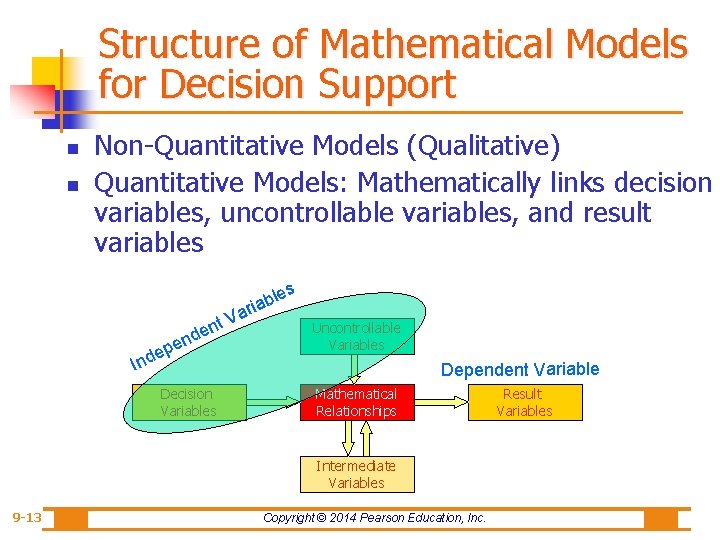
Structure of Mathematical Models for Decision Support n n Non-Quantitative Models (Qualitative) Quantitative Models: Mathematically links decision variables, uncontrollable variables, and result variables nt e d n e p e nd V les b a ari Uncontrollable Variables I Decision Variables Dependent Variable Mathematical Relationships Intermediate Variables 9 -13 Copyright © 2014 Pearson Education, Inc. Result Variables
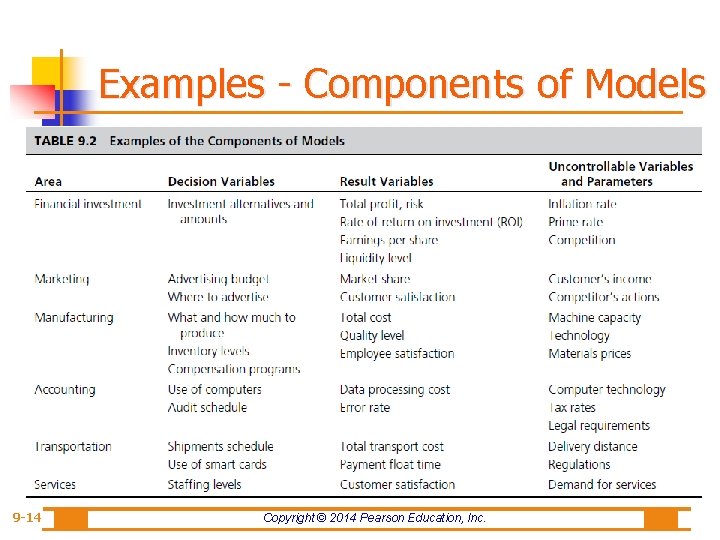
Examples - Components of Models 9 -14 Copyright © 2014 Pearson Education, Inc.
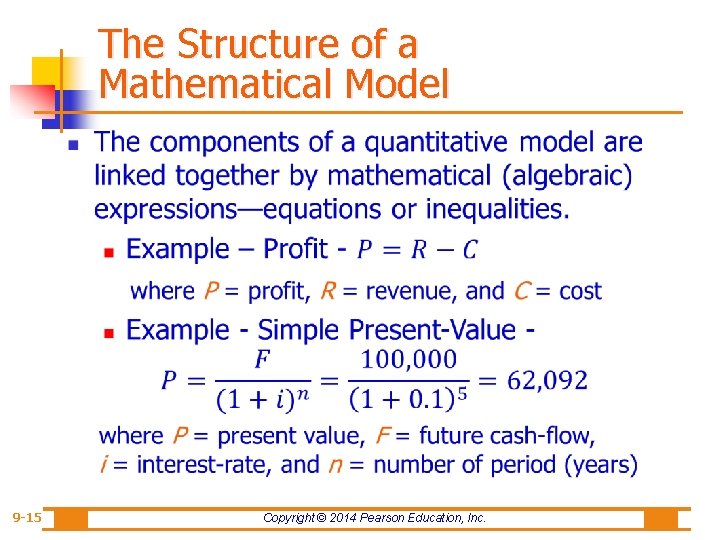
The Structure of a Mathematical Model 9 -15 Copyright © 2014 Pearson Education, Inc.
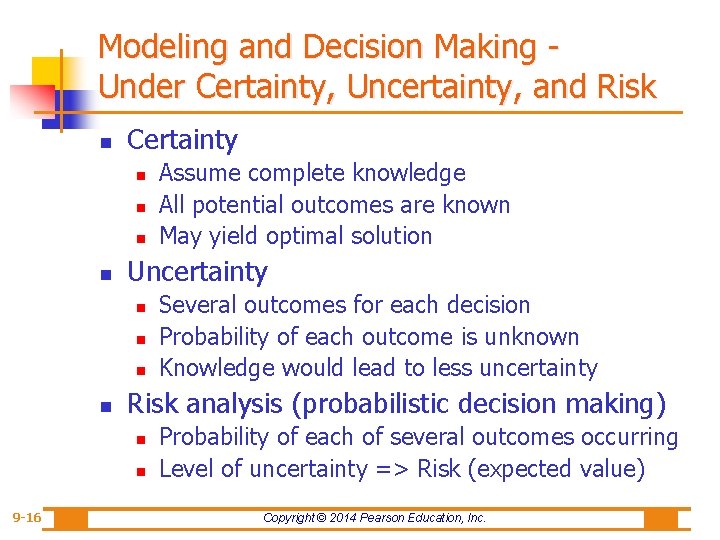
Modeling and Decision Making Under Certainty, Uncertainty, and Risk n Certainty n n Uncertainty n n Several outcomes for each decision Probability of each outcome is unknown Knowledge would lead to less uncertainty Risk analysis (probabilistic decision making) n n 9 -16 Assume complete knowledge All potential outcomes are known May yield optimal solution Probability of each of several outcomes occurring Level of uncertainty => Risk (expected value) Copyright © 2014 Pearson Education, Inc.
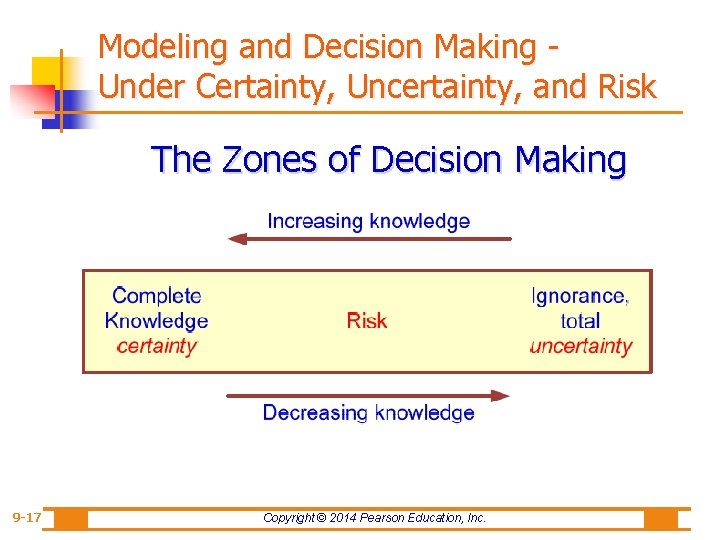
Modeling and Decision Making Under Certainty, Uncertainty, and Risk The Zones of Decision Making 9 -17 Copyright © 2014 Pearson Education, Inc.
Application Case 9. 3 American Airlines Uses Should-Cost Modeling to Assess the Uncertainty of Bids for Shipment Routes Questions for Discussion Besides reducing the risk of overpaying or underpaying suppliers, what are some other benefits AA would derive from its “should be” model? 2. Can you think of other domains besides air transportation where such a model could be used? 3. Discuss other possible methods with which AA could have solved its bid overpayment and underpayment problem. 1. 9 -18 Copyright © 2014 Pearson Education, Inc.
Decision Modeling with Spreadsheets n Spreadsheet n n n n n 9 -19 Most popular end-user modeling tool Flexible and easy to use Powerful functions (add-in functions) Programmability (via macros) What-if analysis and goal seeking Simple database management Seamless integration of model and data Incorporates both static and dynamic models Examples: Microsoft Excel, Lotus 1 -2 -3 Copyright © 2014 Pearson Education, Inc.
Application Case 9. 4 Showcase Scheduling at Fred Astaire East Side Dance Studio Company n Problem description n Proposed solution n Results n 9 -20 Copyright © 2014 Pearson Education, Inc.
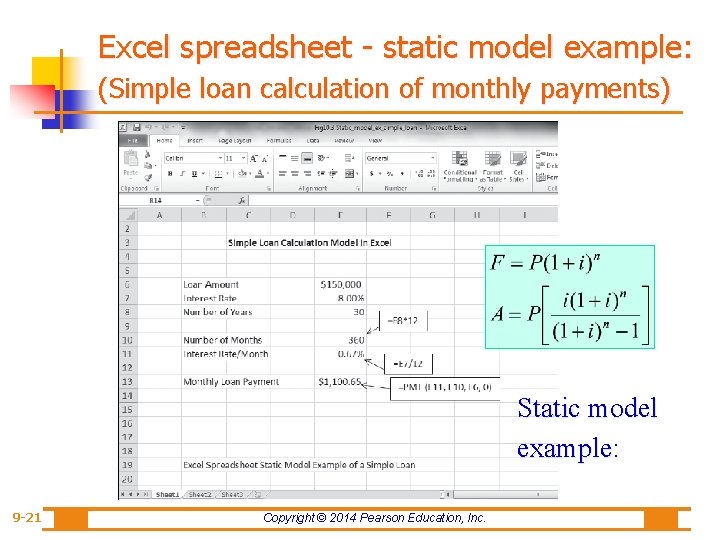
Excel spreadsheet - static model example: (Simple loan calculation of monthly payments) Static model example: 9 -21 Copyright © 2014 Pearson Education, Inc.
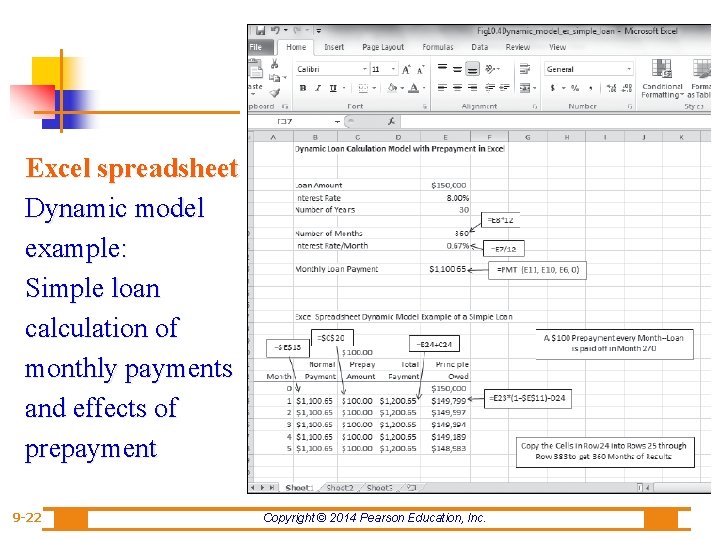
Excel spreadsheet Dynamic model example: Simple loan calculation of monthly payments and effects of prepayment 9 -22 Copyright © 2014 Pearson Education, Inc.
Optimization via Mathematical Programming n Mathematical Programming A family of tools designed to help solve managerial problems in which the decision maker must allocate scarce resources among competing activities to optimize a measurable goal n Optimal solution: The best possible solution to a modeled problem n 9 -23 Linear programming (LP): A mathematical model for the optimal solution of resource allocation problems. All the relationships are linear. Copyright © 2014 Pearson Education, Inc.
Application Case 9. 5 Spreadsheet Model Helps Assign Medical Residents Company n Problem description n Proposed solution n Results n 9 -24 Copyright © 2014 Pearson Education, Inc.
LP Problem Characteristics 1. 2. 3. 4. 5. 9 -25 Limited quantity of economic resources Resources are used in the production of products or services Two or more ways (solutions, programs) to use the resources Each activity (product or service) yields a return in terms of the goal Allocation is usually restricted by constraints Copyright © 2014 Pearson Education, Inc.
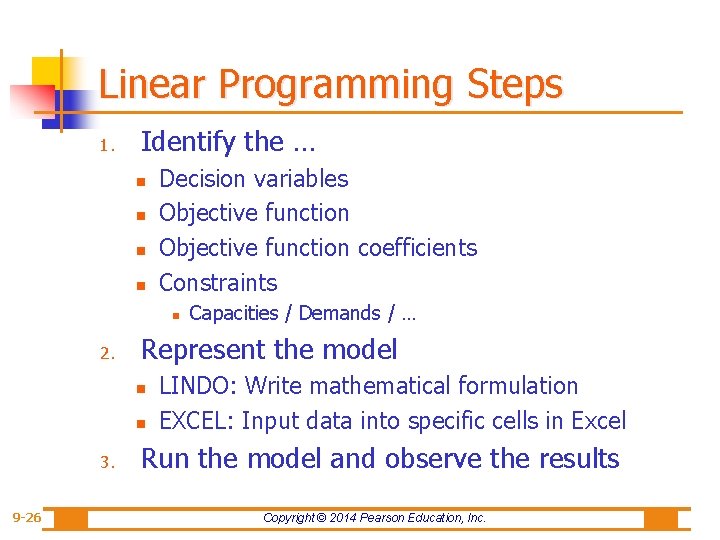
Linear Programming Steps 1. Identify the … n n Decision variables Objective function coefficients Constraints n 2. Represent the model n n 3. 9 -26 Capacities / Demands / … LINDO: Write mathematical formulation EXCEL: Input data into specific cells in Excel Run the model and observe the results Copyright © 2014 Pearson Education, Inc.
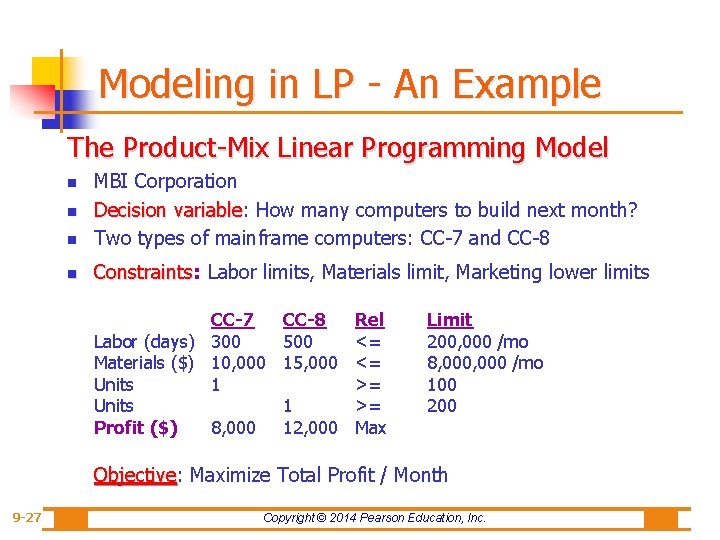
Modeling in LP - An Example The Product-Mix Linear Programming Model n MBI Corporation Decision variable: variable How many computers to build next month? Two types of mainframe computers: CC-7 and CC-8 n Constraints: Constraints Labor limits, Materials limit, Marketing lower limits n n CC-7 CC-8 Labor (days) 300 500 Materials ($) 10, 000 15, 000 Units 1 Profit ($) 8, 000 12, 000 Rel <= <= >= >= Max Limit 200, 000 /mo 8, 000 /mo 100 200 Objective: Objective Maximize Total Profit / Month 9 -27 Copyright © 2014 Pearson Education, Inc.
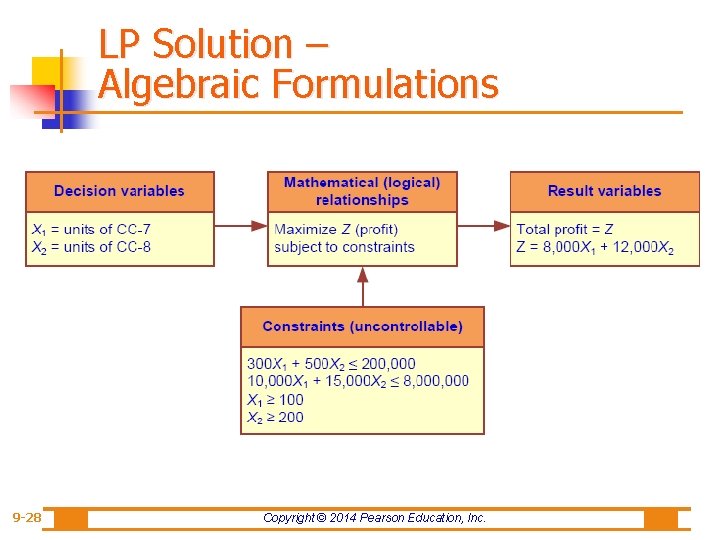
LP Solution – Algebraic Formulations 9 -28 Copyright © 2014 Pearson Education, Inc.
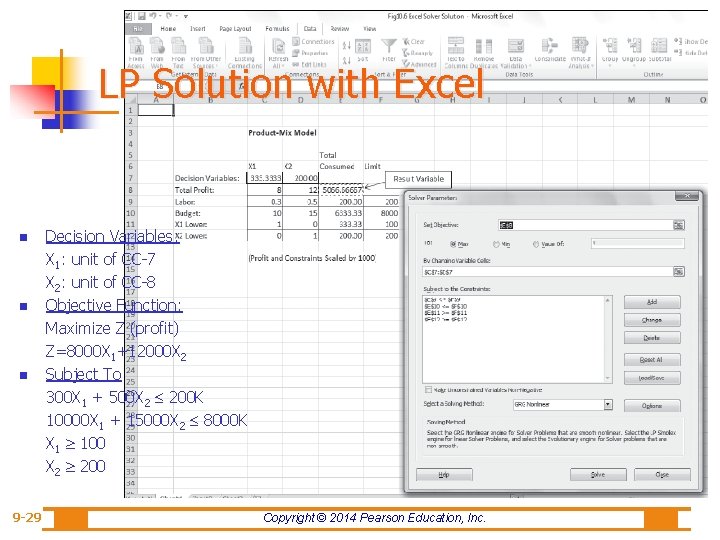
LP Solution with Excel n n n 9 -29 Decision Variables: X 1: unit of CC-7 X 2: unit of CC-8 Objective Function: Maximize Z (profit) Z=8000 X 1+12000 X 2 Subject To 300 X 1 + 500 X 2 200 K 10000 X 1 + 15000 X 2 8000 K X 1 100 X 2 200 Copyright © 2014 Pearson Education, Inc.
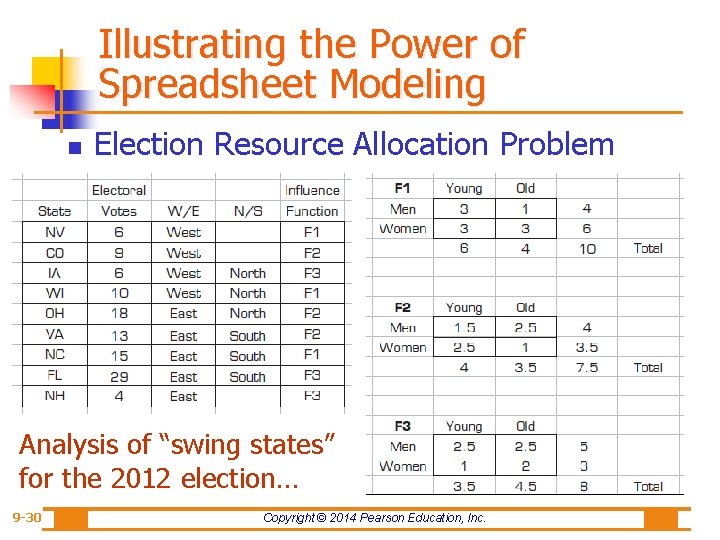
Illustrating the Power of Spreadsheet Modeling n Election Resource Allocation Problem Analysis of “swing states” for the 2012 election… 9 -30 Copyright © 2014 Pearson Education, Inc.
Common Optimization Models n n n 9 -31 Product-mix problems (how many of each product to produce for max profit) Transportation (minimize cost of shipments) Assignment (best matching of objects) Investment (maximizing rate of return) Network optimization models for planning and scheduling Replacement (capital budgeting), … Copyright © 2014 Pearson Education, Inc.
Multiple Goals, Sensitivity Analysis, What-If Analysis, and Goal Seeking n Multiple Goals n n Simple-goal vs. multiple goals Vast majority of managerial problems has multiple goals (objectives) to achieve n n Methods of handling multiple goals n n 9 -32 Attaining simultaneous goals Utility theory Goal programming Expression of goals as constraints, using LP A points system Copyright © 2014 Pearson Education, Inc.
Multiple Goals, Sensitivity Analysis, What-If Analysis, and Goal Seeking n Certain difficulties may arise when analyzing multiple goals n n n n 9 -33 Difficult to obtain a single organizational goal The importance of goals change over time Goals and sub-goals are viewed differently Goals change in response to other changes Dynamics of groups of decision makers Assessing the importance (priorities) … Copyright © 2014 Pearson Education, Inc.
Multiple Goals, Sensitivity Analysis, What-If Analysis, and Goal Seeking n Sensitivity analysis n n It is the process of assessing the impact of change in inputs on outputs Helps to … n n n n 9 -34 eliminate (or reduce) variables revise models to eliminate too-large sensitivities adding details about sensitive variables or scenarios obtain better estimates of sensitive variables alter a real-world system to reduce sensitivities … Can be automatic or trial and error Copyright © 2014 Pearson Education, Inc.
Multiple Goals, Sensitivity Analysis, What-If Analysis, and Goal Seeking n What-if analysis n n n Assesses solutions based on changes in variables or assumptions (scenario analysis) What if we change our capacity at the milling station by 40% [what would be the impact] Goal seeking n n Backwards approach, starts with the goal and determines values of inputs needed Example is break-even point determination n 9 -35 In-order to break even (profit = 0), how many products do we have to sell each month Copyright © 2014 Pearson Education, Inc.
Decision Analysis with Decision Tables and Decision Trees n n Decision Tables – a tabular representation of the decision situation (alternatives) Investment Example n n Goal: maximize the yield after one year Yield depends on the status of the economy (the state of nature) n n n 9 -36 Solid growth Stagnation Inflation Copyright © 2014 Pearson Education, Inc.
Decision Table Investment Example: Possible Situations 1. If solid growth in the economy, bonds yield 12%; stocks 15%; time deposits 6. 5% 2. If stagnation, bonds yield 6%; stocks 3%; time deposits 6. 5% 3. If inflation, bonds yield 3%; stocks lose 2%; time deposits yield 6. 5% 9 -37 Copyright © 2014 Pearson Education, Inc.
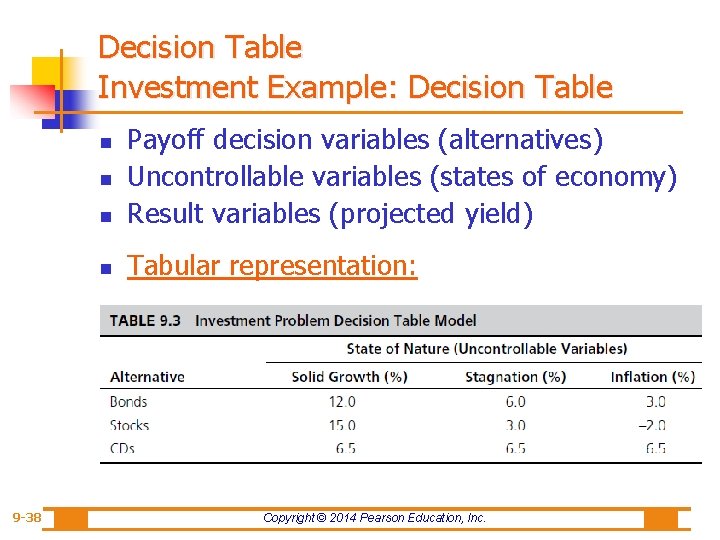
Decision Table Investment Example: Decision Table n Payoff decision variables (alternatives) Uncontrollable variables (states of economy) Result variables (projected yield) n Tabular representation: n n 9 -38 Copyright © 2014 Pearson Education, Inc.
Decision Table Investment Example: Treating Uncertainty n n n Optimistic approach Pessimistic approach Treating Risk/Uncertainty: n n 9 -39 Use known probabilities Expected values Copyright © 2014 Pearson Education, Inc.
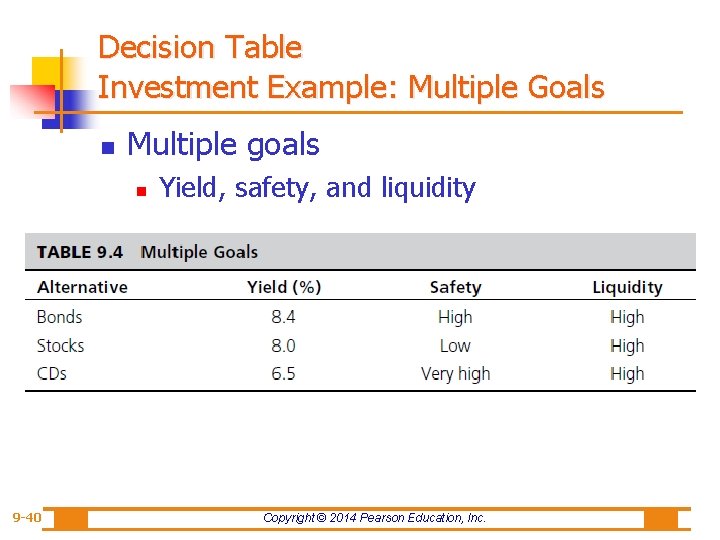
Decision Table Investment Example: Multiple Goals n Multiple goals n 9 -40 Yield, safety, and liquidity Copyright © 2014 Pearson Education, Inc.
Decision Trees n n n Graphical representation of relationships Multiple criteria approach Demonstrates complex relationships Cumbersome, if many alternatives exists Tools include n n n 9 -41 Mind Tools Ltd. , mindtools. com Tree. Age Software Inc. , treeage. com Palisade Corp. , palisade. com Copyright © 2014 Pearson Education, Inc.
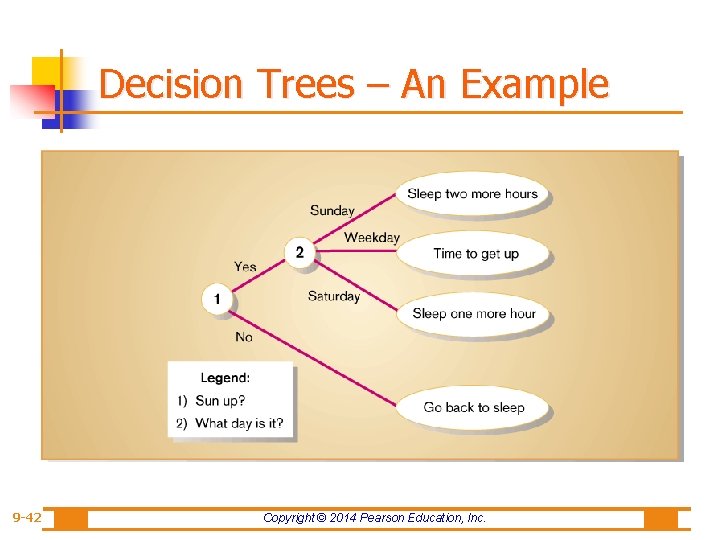
Decision Trees – An Example 9 -42 Copyright © 2014 Pearson Education, Inc.
Multi-Criteria Decision Making with Pairwise Comparisons n n n Having more than one criterion makes decision-making process complicated Usually some type of weighing algorithm is used to analyze such problems The Analytic Hierarchy Process n n 9 -43 Developed by Thomas Saaty (1995, 1996) A very popular technique for MCDM Popular Tools - Expert. Choice. com Web-based Tools - Web-HIPRE (hipre. aalto. fi) Copyright © 2014 Pearson Education, Inc.
Application Case 9. 6 U. S. HUD Saves the House by Using AHP for Selecting IT Projects Company n Problem description n Proposed solution n Results n 9 -44 Copyright © 2014 Pearson Education, Inc.
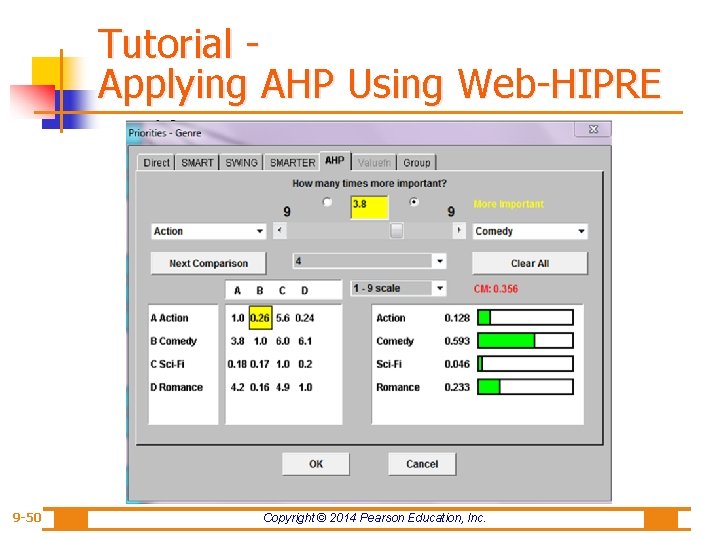
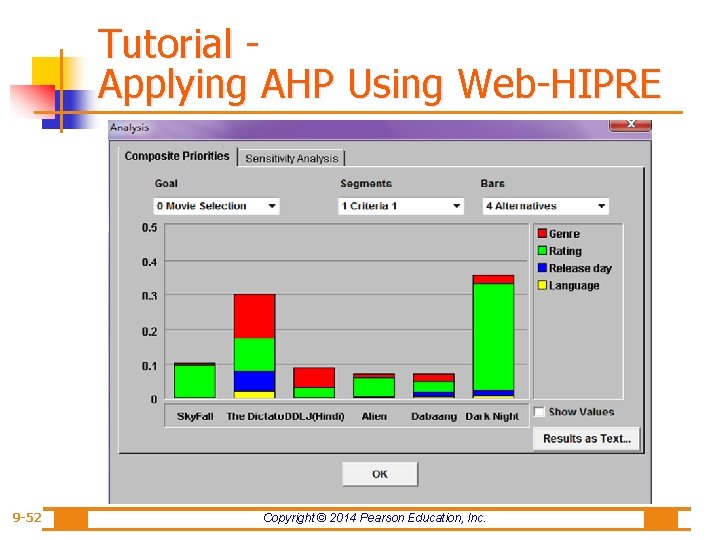
Tutorial Applying AHP Using Web-HIPRE n n n Goal: select the most appropriate movie Identify some criteria for making this decision The main and sub-criteria for movie selection are n n n Alternatives are the following current movies: n 9 -45 a. Genre: Action, Comedy, Sci-Fi, Romance b. Language: English, Hindi c. Day of Release: weekday, weekend d. User/Critics Rating: High, Average, Low Sky. Fall, The Dark Knight Rises, The Dictator, Dabaang, Alien, and DDL Copyright © 2014 Pearson Education, Inc.
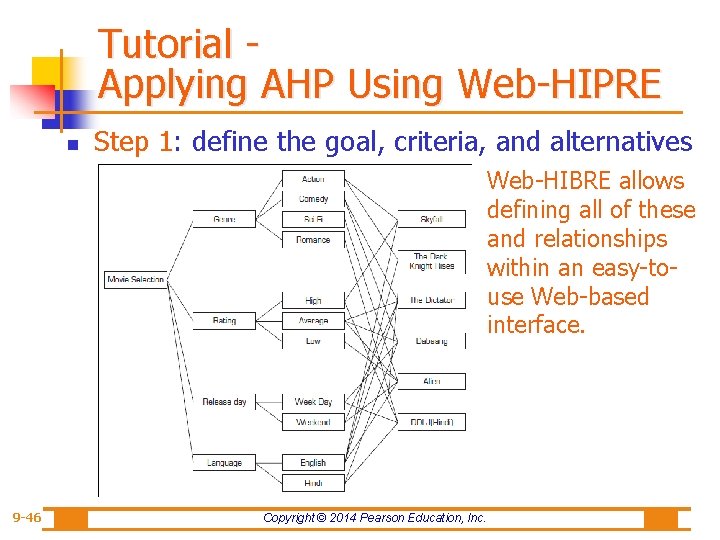
Tutorial Applying AHP Using Web-HIPRE n Step 1: define the goal, criteria, and alternatives Web-HIBRE allows defining all of these and relationships within an easy-touse Web-based interface. 9 -46 Copyright © 2014 Pearson Education, Inc.
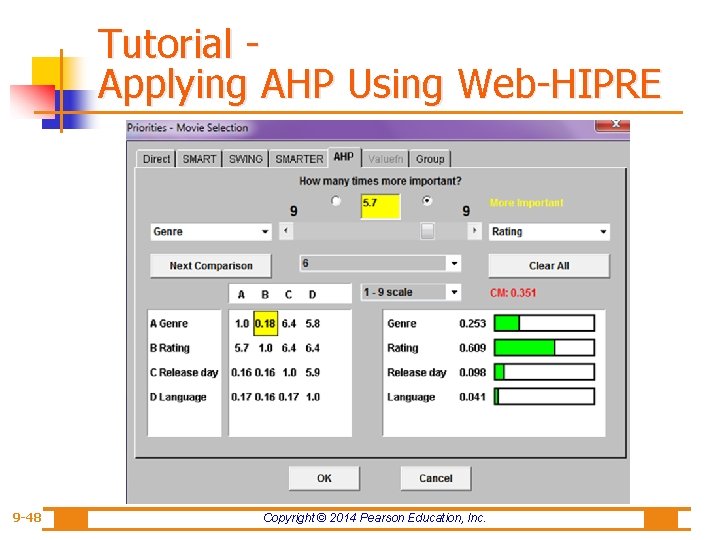
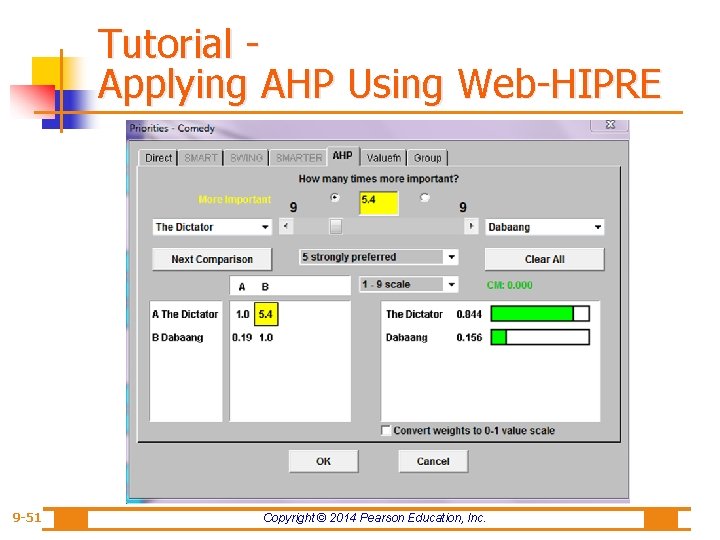
Tutorial Applying AHP Using Web-HIPRE n Step 2: the main criteria are then ranked as they relate to the goal n n n 9 -47 A comparative ranking scale from 1 to 9 (with ascending order of importance) is used The ranking is done using a Pairwise comparison procedure (i. e. , divide-and-concur) between any two criteria for all combinations of twos The tool readily normalizes the rankings of each of the main criteria over one another to a scale ranging from 0 to 1 and then calculates the row averages to arrive at an overall importance rating ranging from 0 to 1 Copyright © 2014 Pearson Education, Inc.
Tutorial Applying AHP Using Web-HIPRE 9 -48 Copyright © 2014 Pearson Education, Inc.
Tutorial Applying AHP Using Web-HIPRE n n n 9 -49 Step 3: All of the subcriteria related to each of the main criteria are then ranked with their relative importance over one another Step 4: Each alternative is ranked with respect to all of the subcriteria that are linked with the alternatives in a similar fashion using the relative scale of 0– 9; then the overall importance of each alternative is calculated Step 5: The final result are obtained from the composite priority analysis involving all the subcriteria and main criteria Copyright © 2014 Pearson Education, Inc.
Tutorial Applying AHP Using Web-HIPRE 9 -50 Copyright © 2014 Pearson Education, Inc.
Tutorial Applying AHP Using Web-HIPRE 9 -51 Copyright © 2014 Pearson Education, Inc.
Tutorial Applying AHP Using Web-HIPRE 9 -52 Copyright © 2014 Pearson Education, Inc.
End of the Chapter n 9 -53 Questions, comments Copyright © 2014 Pearson Education, Inc.
All rights reserved. No part of this publication may be reproduced, stored in a retrieval system, or transmitted, in any form or by any means, electronic, mechanical, photocopying, recording, or otherwise, without the prior written permission of the publisher. Printed in the United States of America. 9 -54 Copyright © 2014 Pearson Education, Inc.
- Slides: 54