
Business Integration Part 2 EXTERNAL GROWTH Objectives 1
Business Integration – Part 2

EXTERNAL GROWTH Objectives: 1. To define the different types of business integration in some detail 2. Explain the advantages and disadvantages of each type of business integration
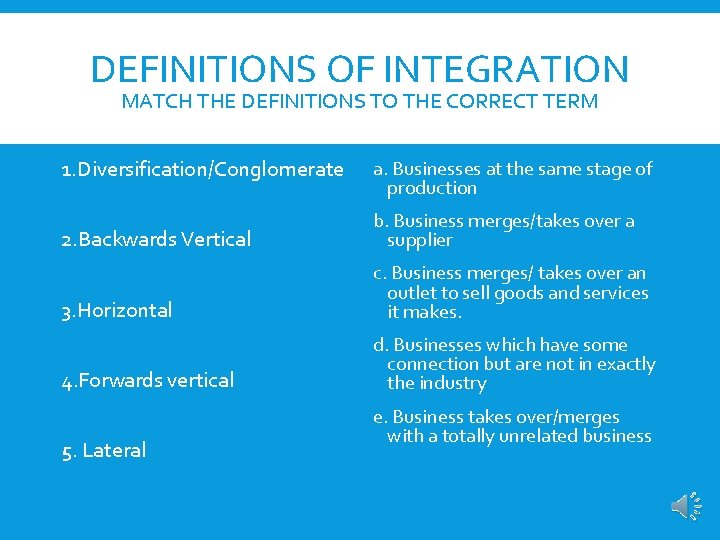
DEFINITIONS OF INTEGRATION MATCH THE DEFINITIONS TO THE CORRECT TERM 1. Diversification/Conglomerate a. Businesses at the same stage of production 2. Backwards Vertical b. Business merges/takes over a supplier 3. Horizontal c. Business merges/ takes over an outlet to sell goods and services it makes. 4. Forwards vertical d. Businesses which have some connection but are not in exactly the industry 5. Lateral e. Business takes over/merges with a totally unrelated business
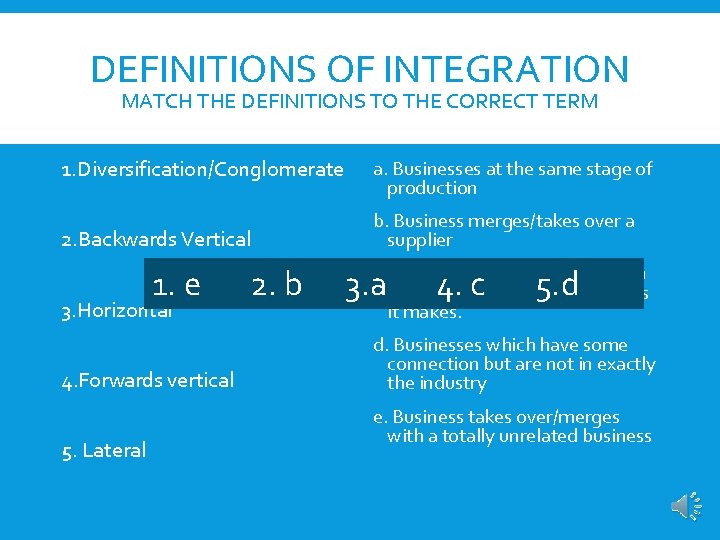
DEFINITIONS OF INTEGRATION MATCH THE DEFINITIONS TO THE CORRECT TERM 1. Diversification/Conglomerate a. Businesses at the same stage of production 2. Backwards Vertical b. Business merges/takes over a supplier 1. e 3. Horizontal 4. Forwards vertical 5. Lateral 2. b c. Business merges/ takes over an outlet to sell goods and services it makes. 3. a 4. c 5. d d. Businesses which have some connection but are not in exactly the industry e. Business takes over/merges with a totally unrelated business
TYPES OF INTEGRATION On the following slide are a number of different images of different businesses / industries. Your task: Can you get to Level 3? Level 1: You will be given 2 businesses and asked which type of integration it is: 1. Photos 1 to 4 2. Photos 19 to 8 3. Photos 14 to 11
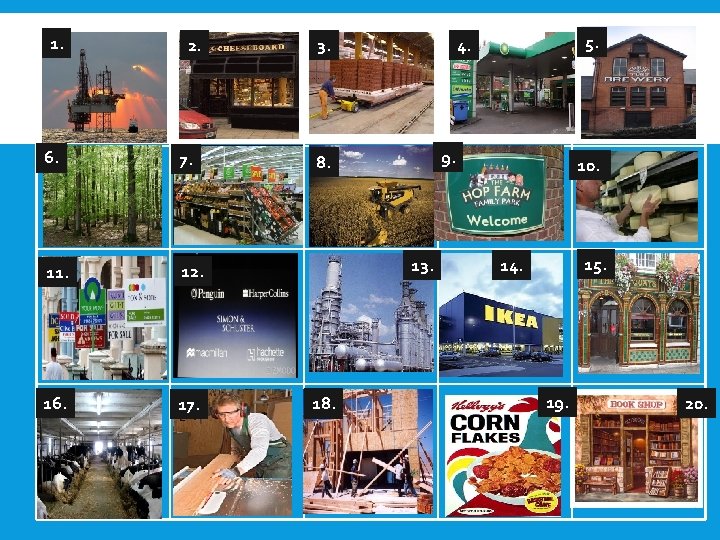
1. 2. 6. 7. 11. 12. 16. 17. 3. 9. 8. 13. 18. 5. 4. 10. 15. 14. 19. 20.
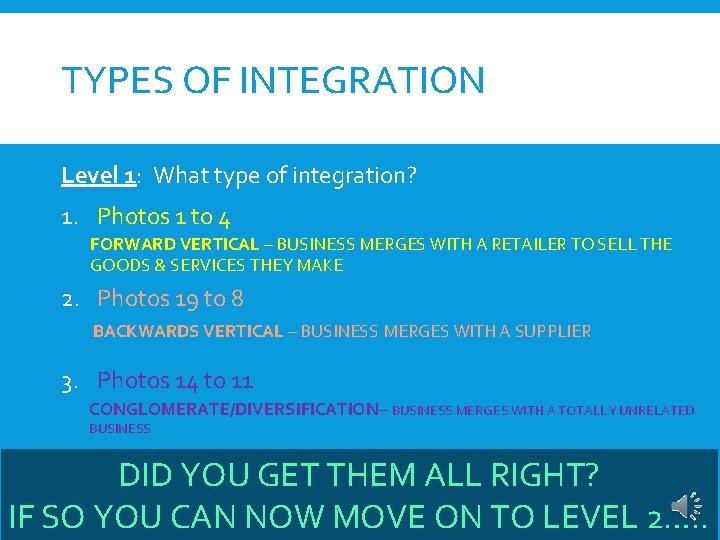
TYPES OF INTEGRATION Level 1: What type of integration? 1. Photos 1 to 4 FORWARD VERTICAL – BUSINESS MERGES WITH A RETAILER TO SELL THE GOODS & SERVICES THEY MAKE 2. Photos 19 to 8 BACKWARDS VERTICAL – BUSINESS MERGES WITH A SUPPLIER 3. Photos 14 to 11 CONGLOMERATE/DIVERSIFICATION– BUSINESS MERGES WITH A TOTALLY UNRELATED BUSINESS DID YOU GET THEM ALL RIGHT? IF SO YOU CAN NOW MOVE ON TO LEVEL 2…. .

TYPES OF INTEGRATION Level 2: Choose 2 different businesses that show: 1. Backward vertical integration 2. Horizontal integration 3. Forward Vertical integration Make sure you choose different examples from the Level 1 photos! DO YOU THINK YOU GOT THEM ALL RIGHT? IF SO YOU CAN NOW MOVE ON TO LEVEL 3…. .

TYPES OF INTEGRATION Level 3: Choose 2 different businesses and describe the type of integration involved & why
TYPES OF INTEGRATION Level 3: Choose 2 different business and describe the type of integration involved & why DID YOU GET THEM ALL RIGHT? YIPPEE YOU ARE A WINNER! Well done.
ADVANTAGES AND DISADVANTAGES OF INTEGRATION The following 3 slides show facts about different types of integration. YOUR TASK: 1. read each of the slides 2. Create a table with 2 columns – advantages and disadvantages 3. Add information into your table to show the advantages & disadvantages of each type of integration for a business
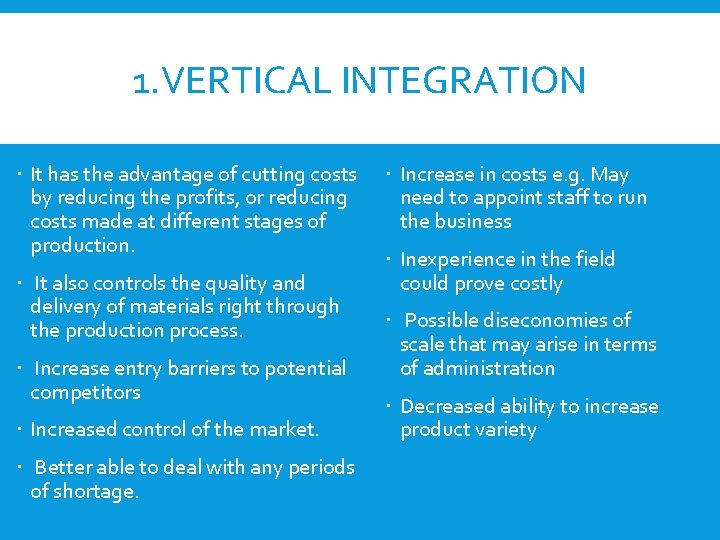
1. VERTICAL INTEGRATION It has the advantage of cutting costs by reducing the profits, or reducing costs made at different stages of production. It also controls the quality and delivery of materials right through the production process. Increase entry barriers to potential competitors Increased control of the market. Better able to deal with any periods of shortage. Increase in costs e. g. May need to appoint staff to run the business Inexperience in the field could prove costly Possible diseconomies of scale that may arise in terms of administration Decreased ability to increase product variety
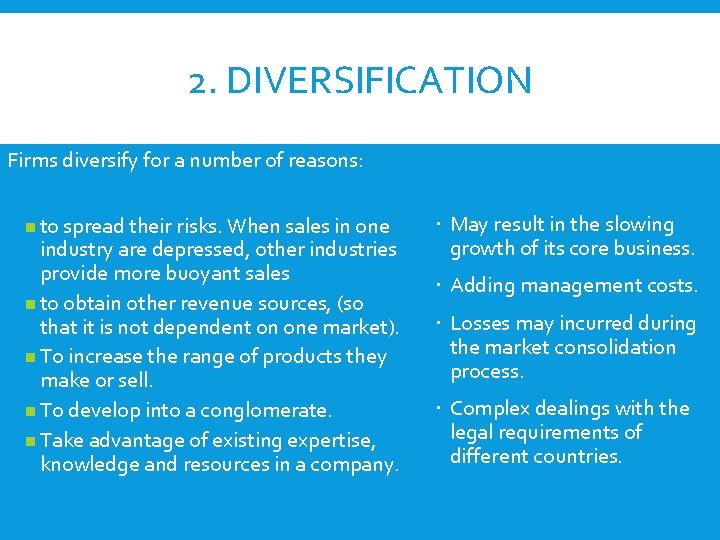
2. DIVERSIFICATION Firms diversify for a number of reasons: n to spread their risks. When sales in one industry are depressed, other industries provide more buoyant sales n to obtain other revenue sources, (so that it is not dependent on one market). n To increase the range of products they make or sell. n To develop into a conglomerate. n Take advantage of existing expertise, knowledge and resources in a company. May result in the slowing growth of its core business. Adding management costs. Losses may incurred during the market consolidation process. Complex dealings with the legal requirements of different countries.
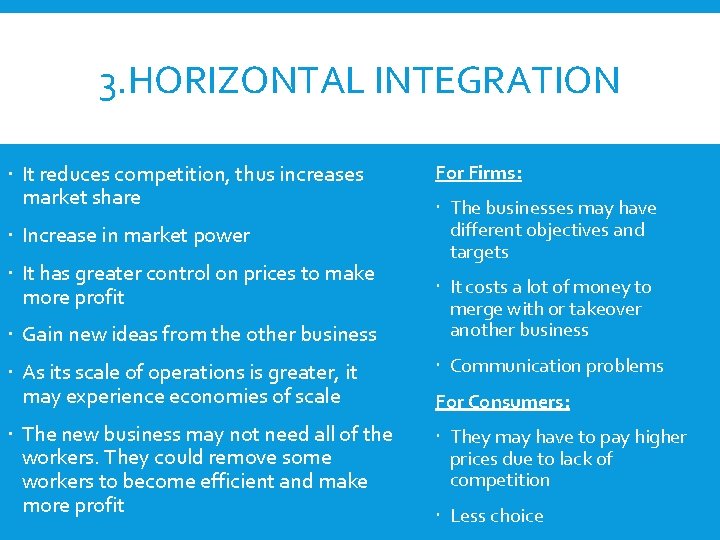
3. HORIZONTAL INTEGRATION It reduces competition, thus increases market share Increase in market power It has greater control on prices to make more profit Gain new ideas from the other business For Firms: The businesses may have different objectives and targets It costs a lot of money to merge with or takeover another business As its scale of operations is greater, it may experience economies of scale Communication problems The new business may not need all of the workers. They could remove some workers to become efficient and make more profit They may have to pay higher prices due to lack of competition For Consumers: Less choice
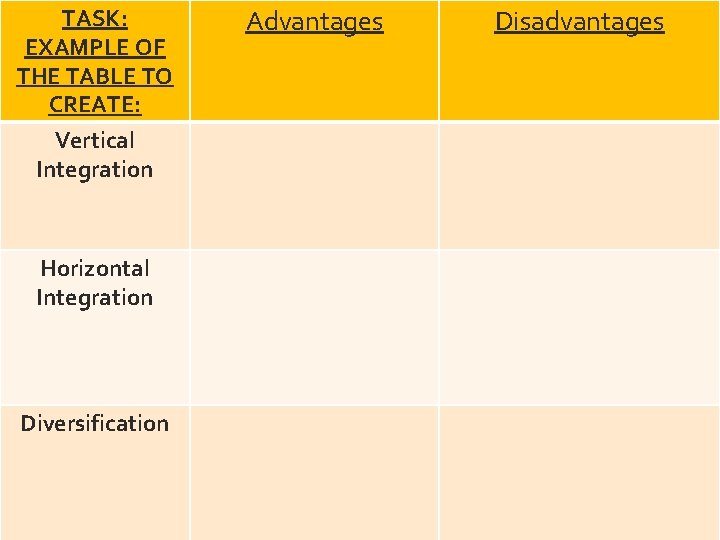
TASK: EXAMPLE OF THE TABLE TO CREATE: Vertical Integration Horizontal Integration Diversification Advantages Disadvantages
PLENARY 1 On the next slide are 9 key definitions for this topic Write down the definition on a piece of paper When you correctly identify the definition, click on the box (you need to be in slideshow) & it will reveal a clue to 1 of 3 famous brand names. Use your GCSE Revision Guide to check your definitions if your not sure. Can you get enough definitions right to work out the brands?
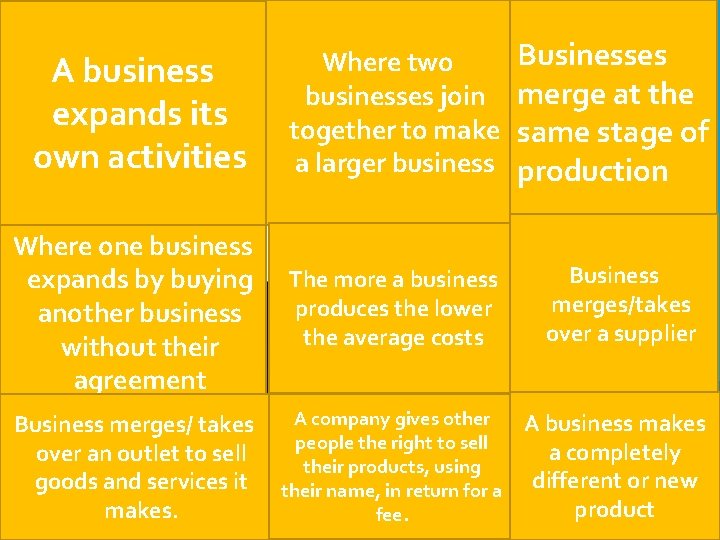
A business expands its own activities Where two businesses join together to make a larger business Where one business expands by buying another business without their agreement The more a business produces the lower the average costs Business merges/ takes over an outlet to sell goods and services it makes. A company gives other people the right to sell their products, using their name, in return for a fee. Businesses merge at the same stage of production Business merges/takes over a supplier A business makes a completely different or new product
THE ANSWERS Marks and Spencer Fortnite Superdry
PLENARY 2 MY DEFINITION Study the following definitions and see how many you can remember
NAME THE BUSINESS TERM 1. A business expands its own activities Organic Growth
NAME THE BUSINESS TERM 2. A business expands by takeover another business External Expansion
NAME THE BUSINESS TERM 3. A business makes a completely different or new product. diversification
NAME THE BUSINESS TERM 4. Where two businesses join together to make a larger business Merger
NAME THE BUSINESS TERM 5. Where one business expands by buying another business Take Over
NAME THE BUSINESS TERM 6. Business merges/takes over a supplier Backwards vertical Integration

NAME THE BUSINESS TERM 7. Businesses at the same stage of production Horizontal Integration
NAME THE BUSINESS TERM 8. Business merges/ takes over an outlet to sell goods and services it makes. Forwards Vertical Integration

9. ORGANIC EXPANSION A business expands its own activities
10. EXTERNAL EXPANSION A business expands by takeover another business
11. ECONOMIES OF SCALE The more a business produces the lower the average costs
12. DIVERSIFICATION A business makes a completely different or new product.
13. FRANCHISE A company gives other people the right to sell their products, using their name, in return for a fee.
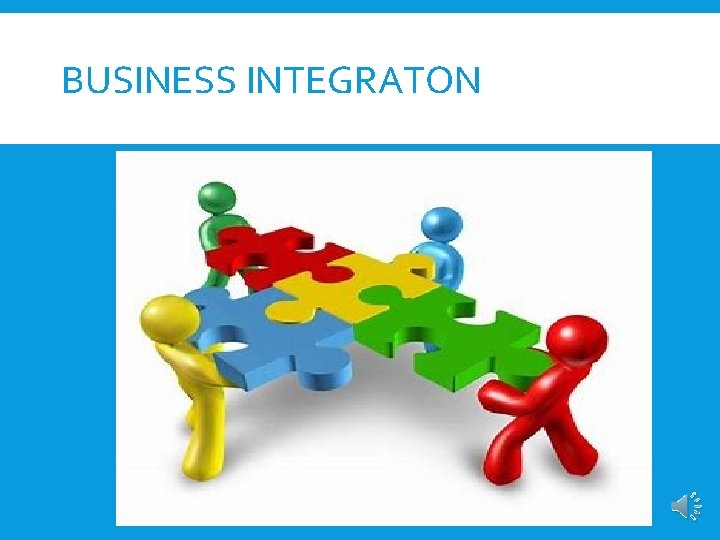
BUSINESS INTEGRATON
- Slides: 33