
Business Integration Model 1999 Andersen Consulting 0 A
Business Integration Model © 1999 Andersen Consulting 0
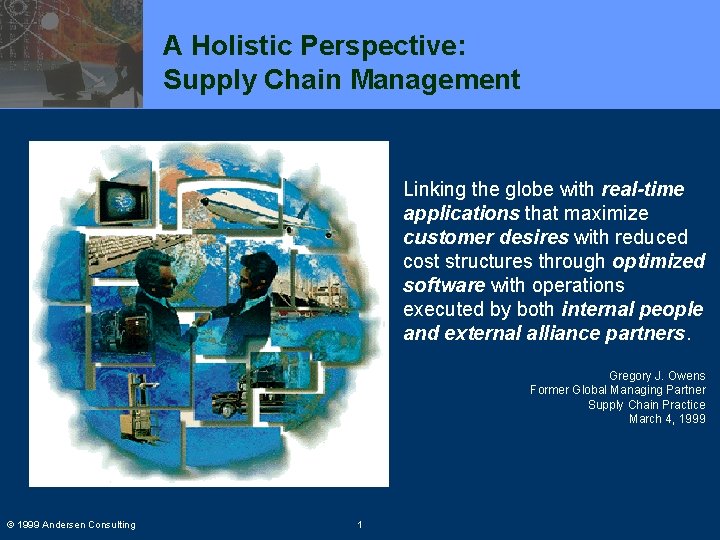
A Holistic Perspective: Supply Chain Management Linking the globe with real-time applications that maximize customer desires with reduced cost structures through optimized software with operations executed by both internal people and external alliance partners. Gregory J. Owens Former Global Managing Partner Supply Chain Practice March 4, 1999 © 1999 Andersen Consulting 1
The SCM pitfalls we have learned to date. • Benefits from sharing sales forecasts and inventory levels are achievable but fall short of the promise • The barriers to collaboration and integration are organizational and behavioral not technological or economic - the Fear of Change • Lack of trust and integration of company practices are key obstacles © 1999 Andersen Consulting 2
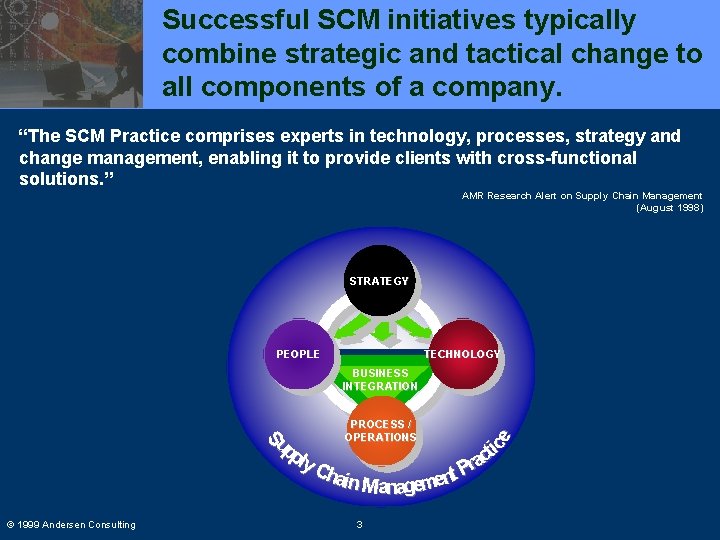
Successful SCM initiatives typically combine strategic and tactical change to all components of a company. “The SCM Practice comprises experts in technology, processes, strategy and change management, enabling it to provide clients with cross-functional solutions. ” AMR Research Alert on Supply Chain Management (August 1998) STRATEGY PEOPLE TECHNOLOGY BUSINESS INTEGRATION PROCESS / OPERATIONS © 1999 Andersen Consulting 3 e S up tic ply c a r Cha P in Management
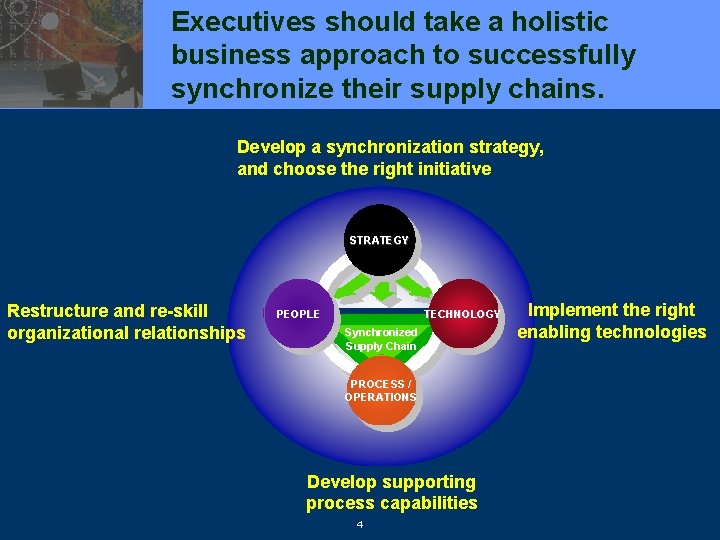
Executives should take a holistic business approach to successfully synchronize their supply chains. Develop a synchronization strategy, and choose the right initiative STRATEGY Restructure and re-skill organizational relationships PEOPLE TECHNOLOGY Synchronized Supply Chain PROCESS / OPERATIONS Develop supporting process capabilities 4 Implement the right enabling technologies
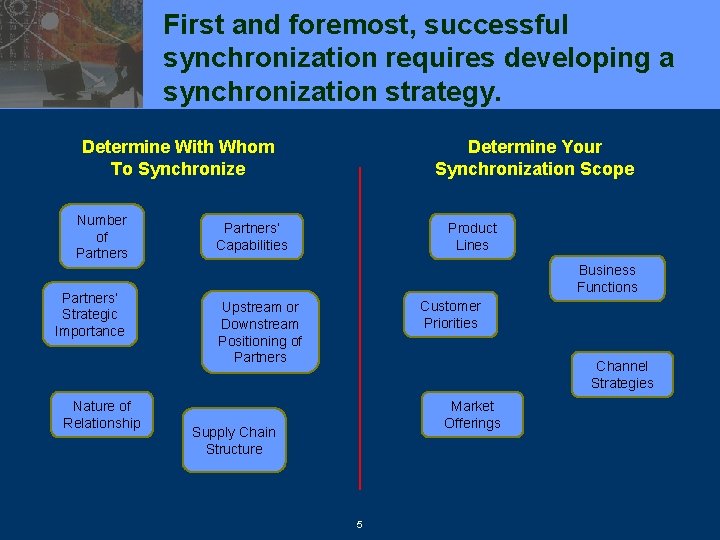
First and foremost, successful synchronization requires developing a synchronization strategy. Determine With Whom To Synchronize Number of Partners’ Strategic Importance Nature of Relationship Determine Your Synchronization Scope Partners’ Capabilities Product Lines Business Functions Customer Priorities Upstream or Downstream Positioning of Partners Channel Strategies Market Offerings Supply Chain Structure 5
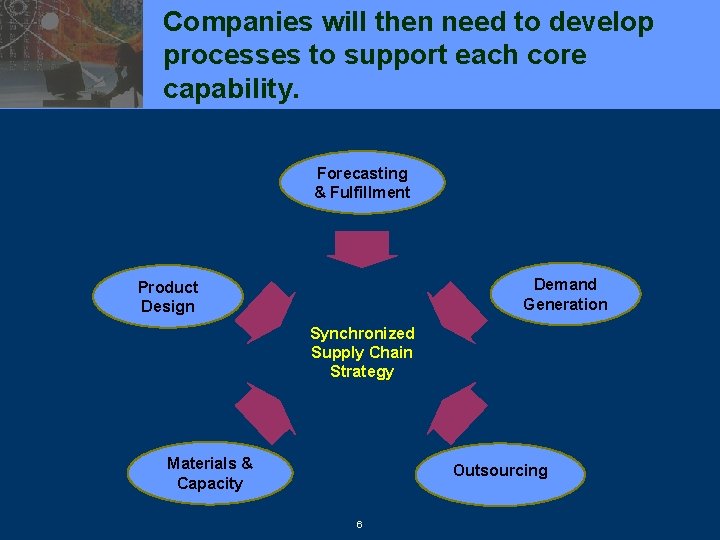
Companies will then need to develop processes to support each core capability. Forecasting & Fulfillment Demand Generation Product Design Synchronized Supply Chain Strategy Materials & Capacity Outsourcing 6
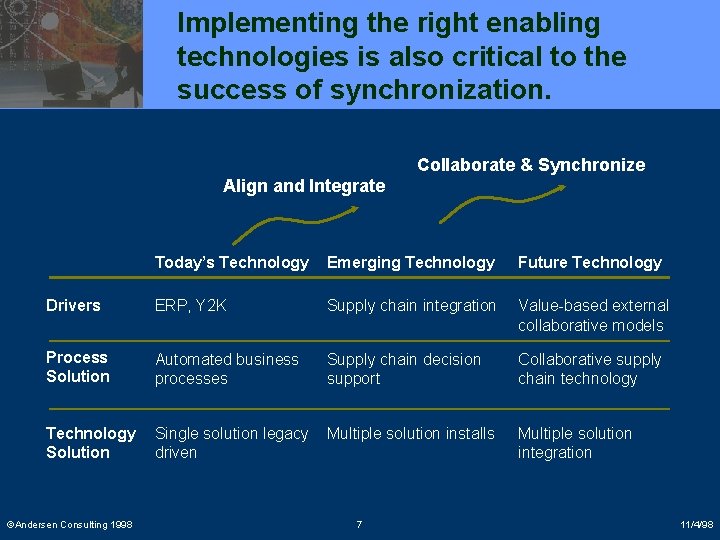
Implementing the right enabling technologies is also critical to the success of synchronization. Collaborate & Synchronize Align and Integrate Today’s Technology Emerging Technology Future Technology Drivers ERP, Y 2 K Supply chain integration Value-based external collaborative models Process Solution Automated business processes Supply chain decision support Collaborative supply chain technology Technology Solution Single solution legacy driven Multiple solution installs Multiple solution integration ©Andersen Consulting 1998 7 11/4/98
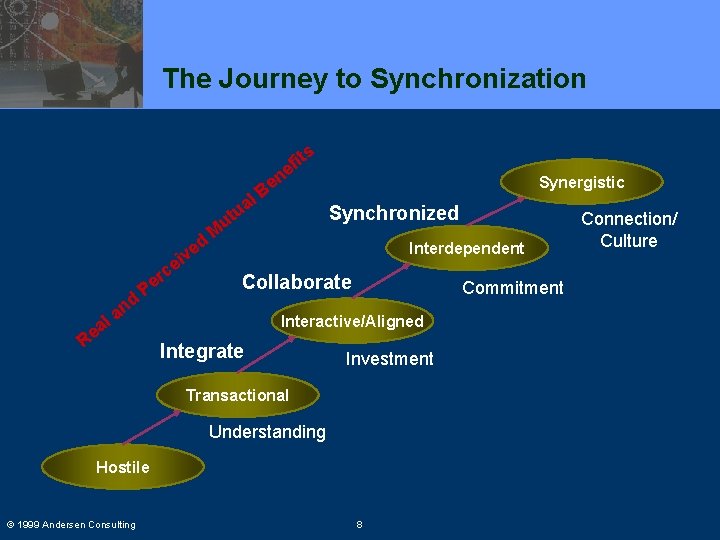
The Journey to Synchronization it f ne s e B l ed v i al e R nd P ce r e M ua t u Synergistic Synchronized Interdependent Collaborate a Commitment Interactive/Aligned Integrate Investment Transactional Understanding Hostile © 1999 Andersen Consulting 8 Connection/ Culture
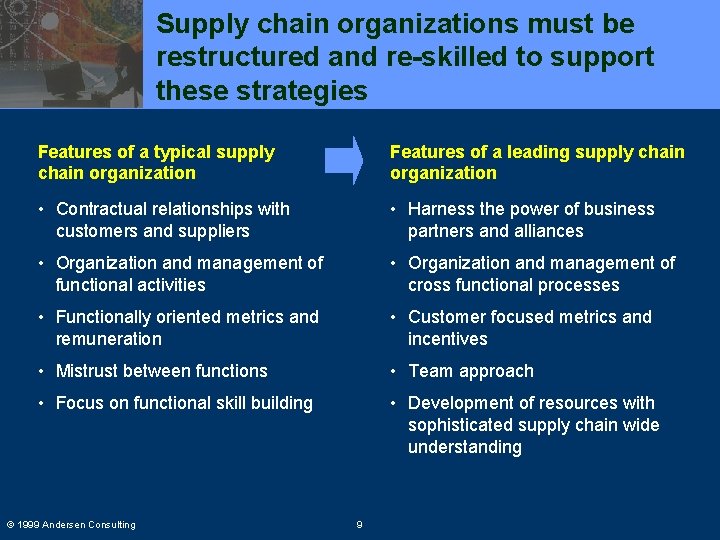
Supply chain organizations must be restructured and re-skilled to support these strategies Features of a typical supply chain organization Features of a leading supply chain organization • Contractual relationships with customers and suppliers • Harness the power of business partners and alliances • Organization and management of functional activities • Organization and management of cross functional processes • Functionally oriented metrics and remuneration • Customer focused metrics and incentives • Mistrust between functions • Team approach • Focus on functional skill building • Development of resources with sophisticated supply chain wide understanding © 1999 Andersen Consulting 9
- Slides: 10