
Business Foundations Capstone A business model for Smart
Business Foundations Capstone A business model for Smart home Using the open. HAB technology as open source automation software for home Automation Systems. By : Jahed Habbak
Smart Home History Smart Homes is not really a new thing. Home Automation is being marketed under different names for many decades now. ‘Soon Homeowners Will Be Able To Control All Home Appliances Through A Central System’ was the title of a Chicago Tribune article released in 1989. In fact the term ‘Smart House’ was coined as early as 1984 by the American Association of House Builders. Prior to that, In 1966 Jim Sutherland, an engineer working for Westinghouse Electric, developed a home automation system called "ECHO IV"; this was a private project and never commercialized. There are several reasons why home automation technology could not become a commercial success. The first and foremost reason is technology adoption among the masses. Before the evolution of smart phones, it was unusual for the masses to adopt the technology of the time. The human machine interfaces were complex and the system design required technical know‐how. The invention of touchscreen changed that overnight. It provided simple and intuitive human machine interface and led the technology adoption through the development of ‘apps’. The second reason was the machine to machine communication and information technology of the time. The cost of technology was so high that it could not permeate the grass‐root level appliances used by the masses. This significantly reduced the utility of the automation systems. Another aspect was standardization of communication technology. Prior to the adoption of Ethernet and IP protocol, the communication technologies for machine to machine communication were being developed in silos. Even today, the challenge of standard technology for home automation has not been resolved but we have still covered a lot of distance. Having partially resolved the two major challenges of technology adoptions and standardization, the industry should now be read to the third and most formidable challenge of home automation – marketing it to the masses!
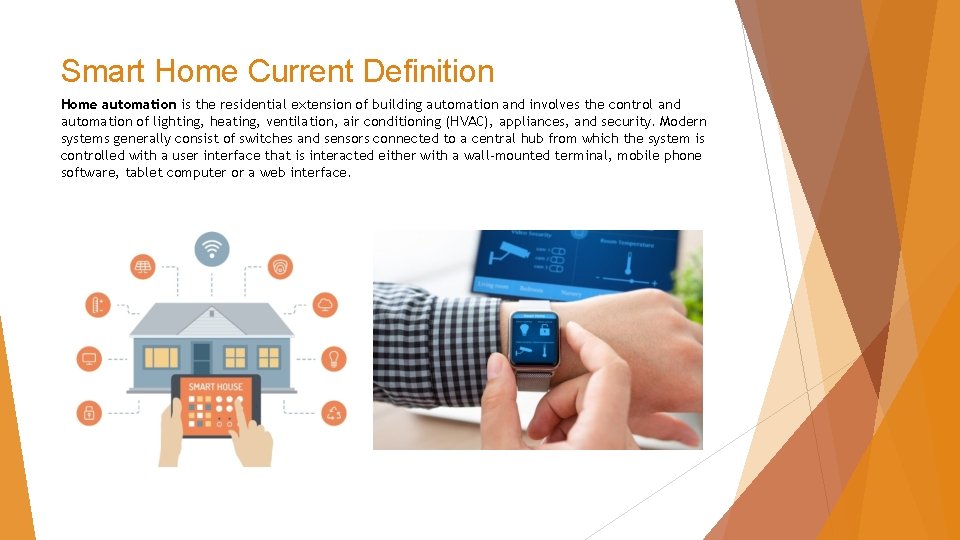
Smart Home Current Definition Home automation is the residential extension of building automation and involves the control and automation of lighting, heating, ventilation, air conditioning (HVAC), appliances, and security. Modern systems generally consist of switches and sensors connected to a central hub from which the system is controlled with a user interface that is interacted either with a wall‐mounted terminal, mobile phone software, tablet computer or a web interface.
Technological Trends & Levels of Home Automation systems can be categorized into 5 different levels based on several factors. The factors are primarily complexity and functionality. These factors determine the level of sophistication, the type of hardware and the software used. The levels are: 1 – Remote Control : simple & inexpensive But it basically controlling “one” device at a time, for example, simple remote control of lights and appliances using a transmitter and a receiver. 2 – Macros : A macro is the ability to use one command to actually control several devices. A single touch could dim the lights, close the drapes, put on soft music and start the Hot Tub. One macro can actually run another macro as well. Some type of programming is required to store the macros. This programming can be done from another controller or from a computer. These devices are in fact sophisticated controllers that do not require a computer to run normally. This level units is a sophisticated transmitter but does not monitor actions or do conditional control.
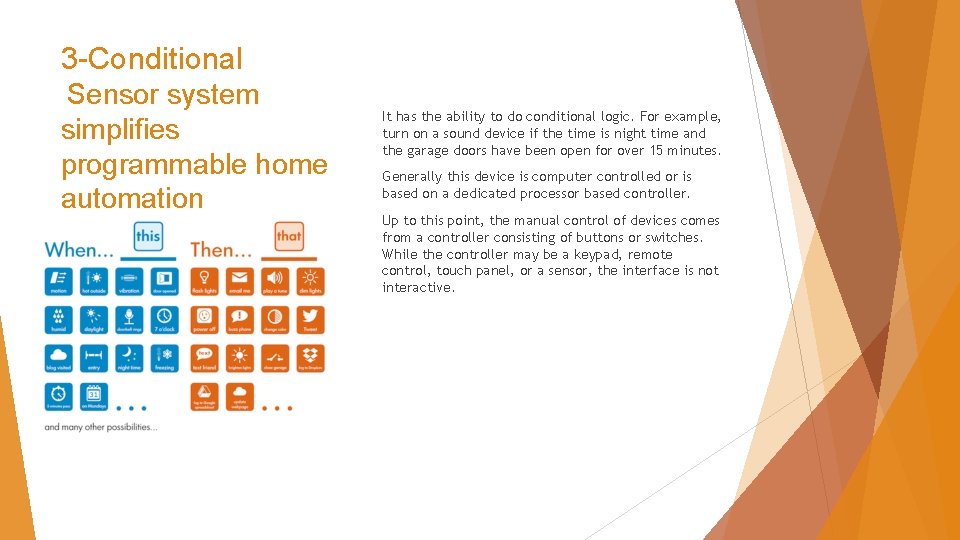
3 -Conditional Sensor system simplifies programmable home automation It has the ability to do conditional logic. For example, turn on a sound device if the time is night time and the garage doors have been open for over 15 minutes. Generally this device is computer controlled or is based on a dedicated processor based controller. Up to this point, the manual control of devices comes from a controller consisting of buttons or switches. While the controller may be a keypad, remote control, touch panel, or a sensor, the interface is not interactive.
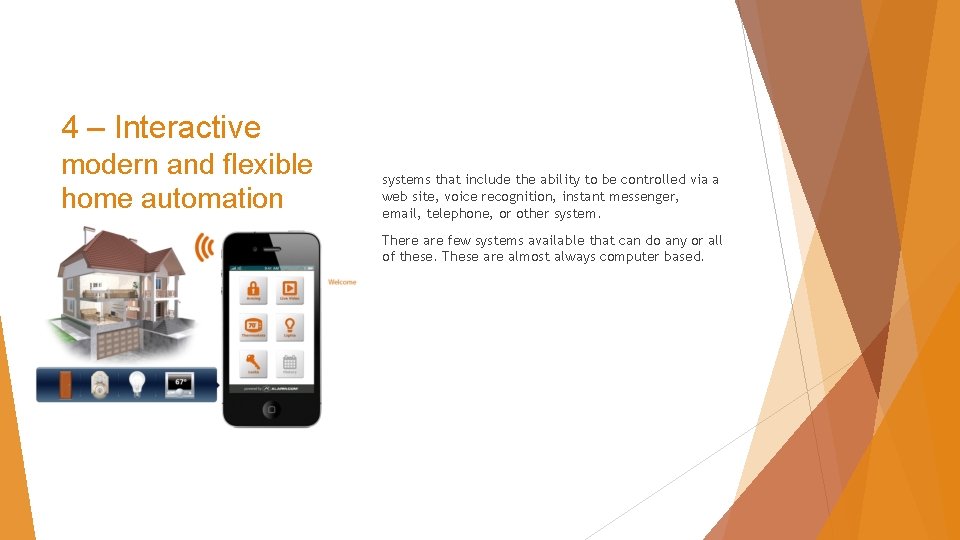
4 – Interactive modern and flexible home automation systems that include the ability to be controlled via a web site, voice recognition, instant messenger, email, telephone, or other system. There are few systems available that can do any or all of these. These are almost always computer based.
And finally the most sophisticated level of control systems. 5 – Self Learning welcome to future systems incorporates “learning” into the system. The actions of the system might change automatically based on living patterns, etc. This capability is basically the ability for the system to reprogram itself. For example, if the system detects that someone routinely turns a particular device on at about the same time on weekdays, an event would be automatically added to turn on this device.
Situational Analysis
External Environment A technological trends for homes to be smart they must also be simple and seamless – operating systems, appliances and devices must talk to each other, This is a market where partnerships, collaboration and Cinergy are needed to provide clarity. So the technological trends can be listed as below : Security/Safety – Technology and tools that are changing how locks, doors, smoke alarms, and security systems in the home are operated and managed. “ 90% of consumers say personal and family security remains one of the top reasons to purchase a smart home system. ” Convenience – Technology and tools that are making it easier to manage and control the home from anywhere (i. e. without having to actually be in the home). “ 48% of consumers say they are excited about the potential convenience in programming home settings and maintenance. ” Productivity/Efficiency – Technology and tools that are helping homeowners spend less money and time heating, cooling, and lighting their homes. “ 70% of consumers say they are excited about the potential cost savings from energy efficiency and monitoring. ” Entertainment – Technology and tools that are adding new entertainment capabilities and opportunities into the home. ” 47% of consumers say they are excited about the potential to help the environment with greater energy efficiency. ” Master Control – Technology and tools that are creating the opportunity to manage all aspects of the home from one centralized location. understanding these five main categories can help you become more effective at selling potential buyers on the added value that such features will bring to them and their families.
External Environment A technological trends On the other hand, consumers expressed limited levels of excitement around the following smart home benefits: Greater productivity and ability to manage work‐life balance: 23% Helping to anticipate one’s needs: 18% Ability to have more interactive features to help connect with people in their lives: 13% While there are many competing vendors, there are very few world‐wide accepted industry standards and the smart home space is heavily fragmented. Popular suites of products include X 10, Ethernet, RS‐ 485 and Z‐Wave. Manufacturers often prevent independent implementations by withholding documentation and by suing people, But Open Hub, is a website which provides a web services suite and online community platform that aims to index the open source software development community. It was founded by former Microsoft managers Jason Allen and Scott Collison. As of 15 January 2016, the site lists 669, 601 open source projects, 681, 345 source control repositories, 3, 848, 524 contributors and 31, 688, 426, 179 lines of code.
External Environment B Nature and extent of demand (demand elasticity & size of the market) Revenue in the "Smart Home" market amounts to M. USD 11. 4 in 2016. Revenue is expected to show an annual growth rate (CAGR 2016‐ 2020) of 46. 03% resulting in a market volume of M. USD 52. 0 in 2020. Household penetration is at 0. 16% in 2016 and is expected to hit 0. 82% in 2020. The average revenue per Smart Home currently amounts to USD 1, 513. 67. From a global comparison perspective it is shown that most revenue is generated in the United States (M. USD 9, 712. 5 in 2016). Global Comparison of Household in the "Smart Home" market Penetration in percent in 2016 is highest in the United States With a rate of 5. 82% while in Saudi Arabia it’s drops to 0. 2% only.
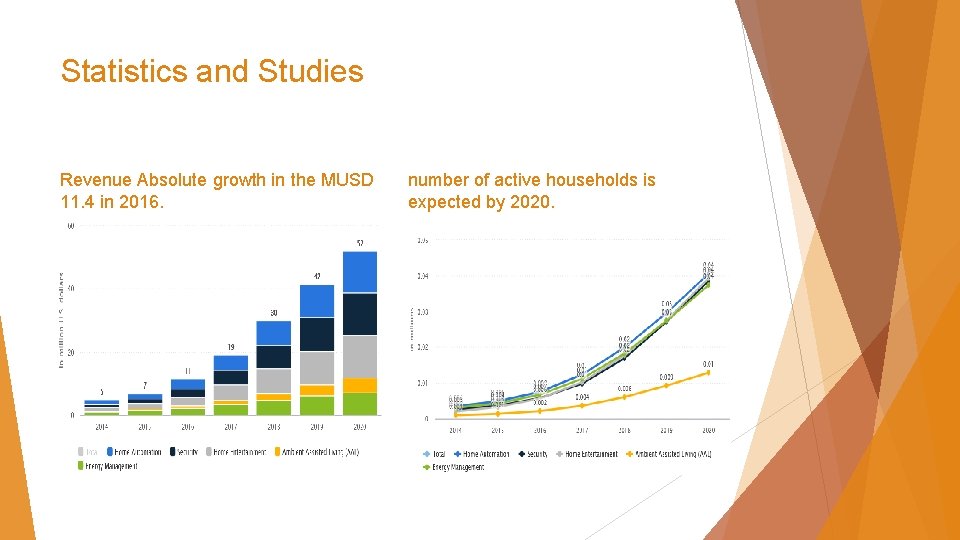
Statistics and Studies Revenue Absolute growth in the MUSD 11. 4 in 2016. number of active households is expected by 2020.
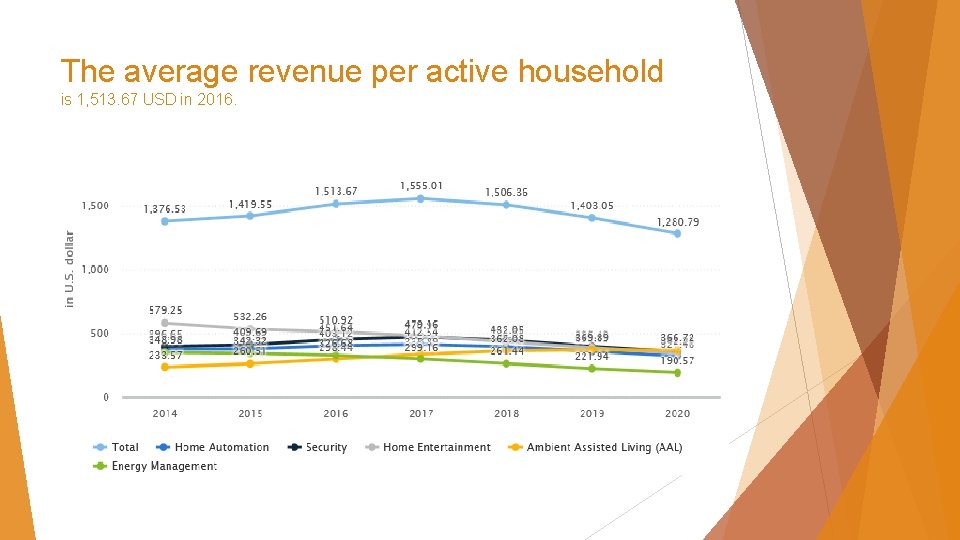
The average revenue per active household is 1, 513. 67 USD in 2016.
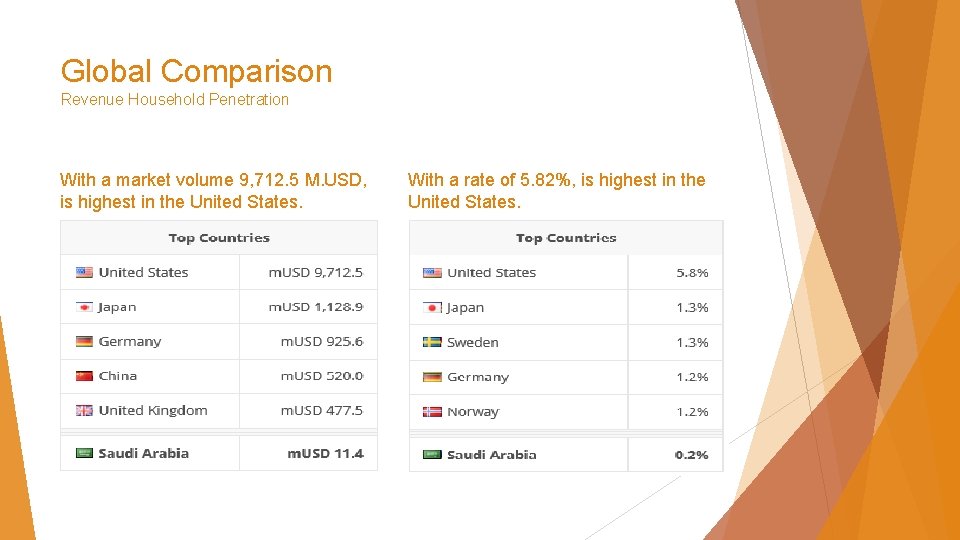
Global Comparison Revenue Household Penetration With a market volume 9, 712. 5 M. USD, is highest in the United States. With a rate of 5. 82%, is highest in the United States.
External Environment C Industry structure (entry/exit barriers) List of barriers to market entry are as per the below Connectivity: smart home services require high‐speed wireless connectivity inside the home and ultra‐ broadband connectivity to the home for the exchange of data. Owning the connectivity enables operators to partner with third party service providers as well as offer their own services. Existing presence inside the home: customers would rather not add another device from a third party when they already have a hub or CPE from their operator. Credibility and trust: smart home services capture a lot of personal data. Customers already trust their operators with personal information and billing. Organized operations: customer service teams and technicians are already in place for fast implementation of equipment and services, troubleshooting and customer peace of mind. Competitor list BKAV Smart home FPT Smart home Lumi Việt Nam Honeywell (From america) Kocom (Korean) Ihome (Thailand) Cytechnology (Singapore)
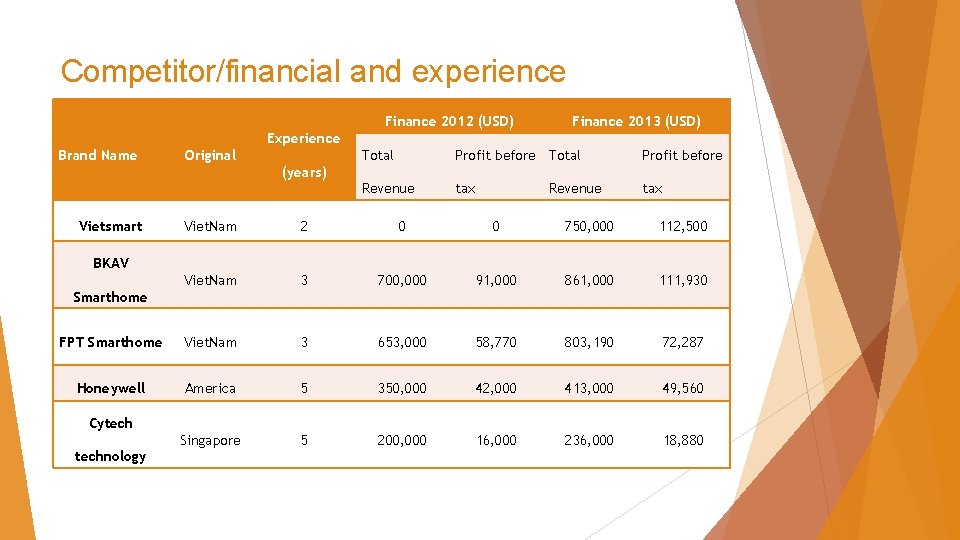
Competitor/financial and experience Finance 2012 (USD) Finance 2013 (USD) Experience Brand Name Original Total Profit before Revenue tax (years) Vietsmart Revenue Viet. Nam 2 0 0 750, 000 112, 500 Viet. Nam 3 700, 000 91, 000 861, 000 111, 930 FPT Smarthome Viet. Nam 3 653, 000 58, 770 803, 190 72, 287 Honeywell America 5 350, 000 42, 000 413, 000 49, 560 Singapore 5 200, 000 16, 000 236, 000 18, 880 BKAV Smarthome Cytechnology
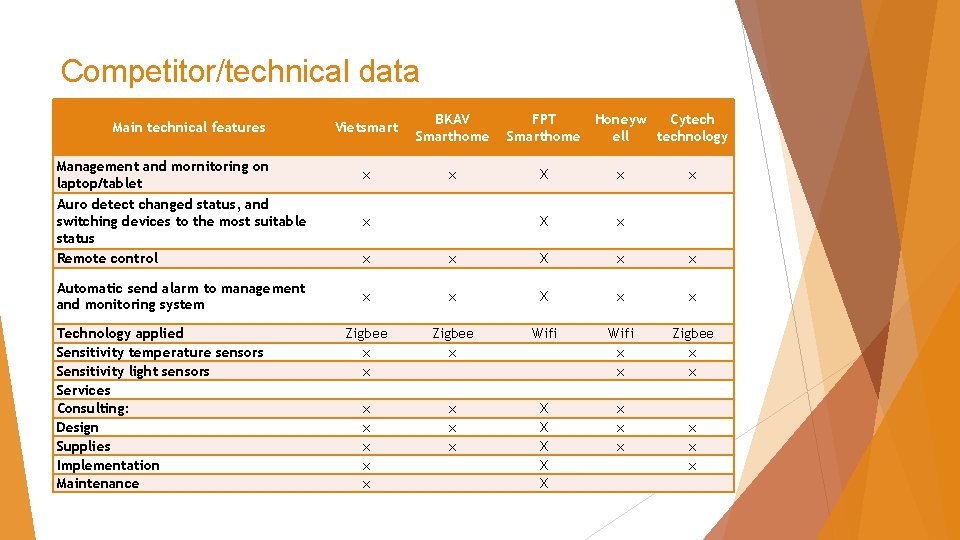
Competitor/technical data Main technical features Management and mornitoring on laptop/tablet Auro detect changed status, and switching devices to the most suitable status Remote control Automatic send alarm to management and monitoring system Technology applied Sensitivity temperature sensors Sensitivity light sensors Services Consulting: Design Supplies Implementation Maintenance Vietsmart BKAV Smarthome FPT Honeyw Cytech Smarthome ell technology x x X x x Zigbee x x x x x Zigbee x x Wifi X X X Wifi x x x Zigbee x x x
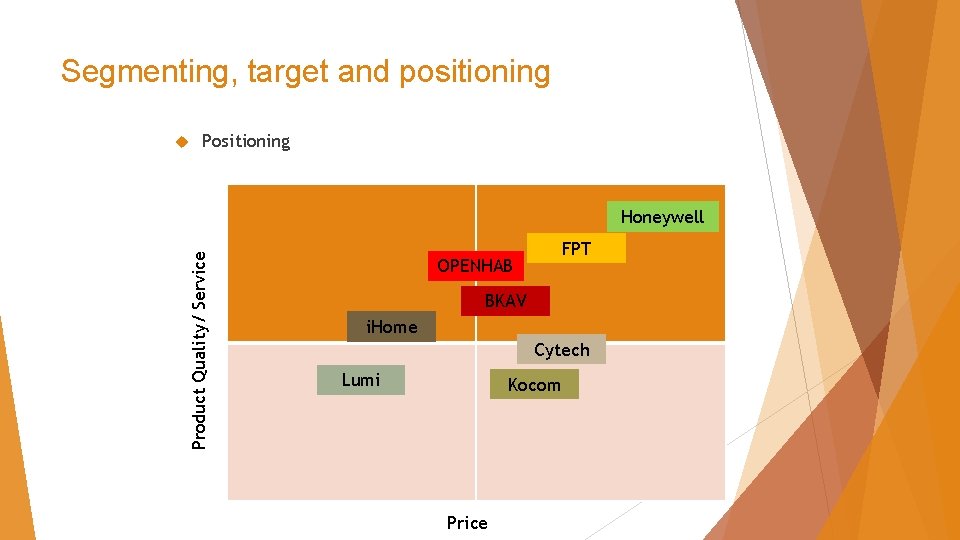
Segmenting, target and positioning Positioning Product Quality/ Service Honeywell FPT OPENHAB BKAV i. Home Cytech Lumi Kocom Price
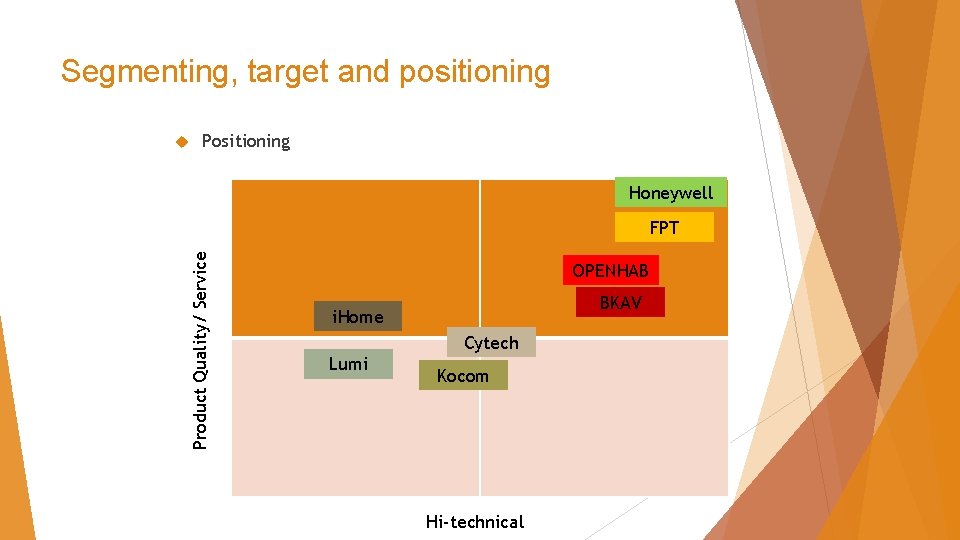
Segmenting, target and positioning Positioning Honeywell Product Quality/ Service FPT OPENHAB BKAV i. Home Cytech Lumi Kocom Hi‐technical
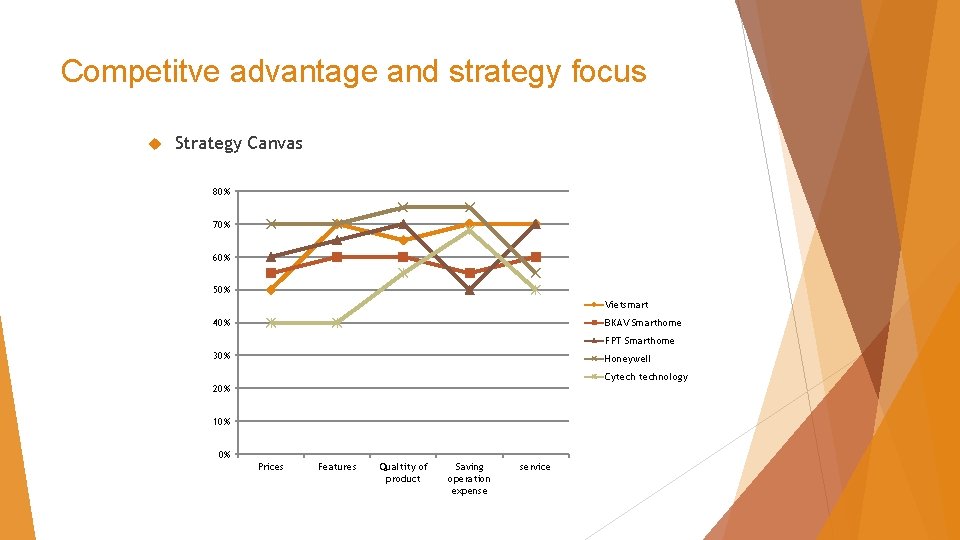
Competitve advantage and strategy focus Strategy Canvas 80% 70% 60% 50% Vietsmart 40% BKAV Smarthome FPT Smarthome 30% Honeywell Cytechnology 20% 10% 0% Prices Features Qualtity of product Saving operation expense service
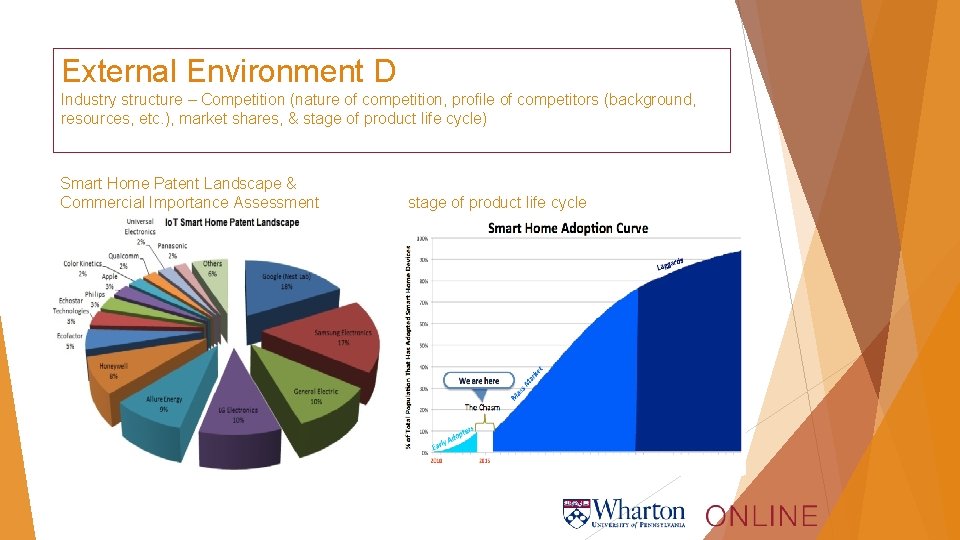
External Environment D Industry structure – Competition (nature of competition, profile of competitors (background, resources, etc. ), market shares, & stage of product life cycle) Smart Home Patent Landscape & Commercial Importance Assessment stage of product life cycle
External Environment – Promotion Strategies Marketing Channels The first stage 2013‐ 2014: Concentrate to the Media and advertising programs The second stage: 2015‐ 2017: Maintenance media programs and improve republic relations programs. Media channels: implementation on first stage The cost of marketing is low. Focus to company’s segment: It focuses to the hi‐tech people. Social network are rapid developing. Concentrate to build a brand of company. There are some media channel marketing: Social network such as facebook, twitter, youtube, Google advertising … Cost for that channel is low. Company website: to build the brand of company Advertising channels: implementation on first stage Product advertising: the features and benefits of a product to customers and prospects. Corporate advertising prospects about the firm’s capability to provide high quality services There are some advertising channel marketing: Advertising programs are concentrated television channel, on the science, newest technology channels. In addition, company can take advertising program on newspapers, especially technical magazines
Promotion Strategies/Programs Describe your plan for cost, quality, variety and responsiveness of the new line Public Relations channels: implementation on second stage Customers has already known products and services of Vietsmart. Implement the public relation channels to maintenance the company’s image. There are some Public Relations channels marketing: Company will invite a famous family to present company images. Take a customer workshop every year Personal selling channels: implementation on second stage Programs will supports for main programs, it use for maintenance customer, and build a image of brand name Personal selling channels marketing SMS marketing: Individual email marketing. Direct call.
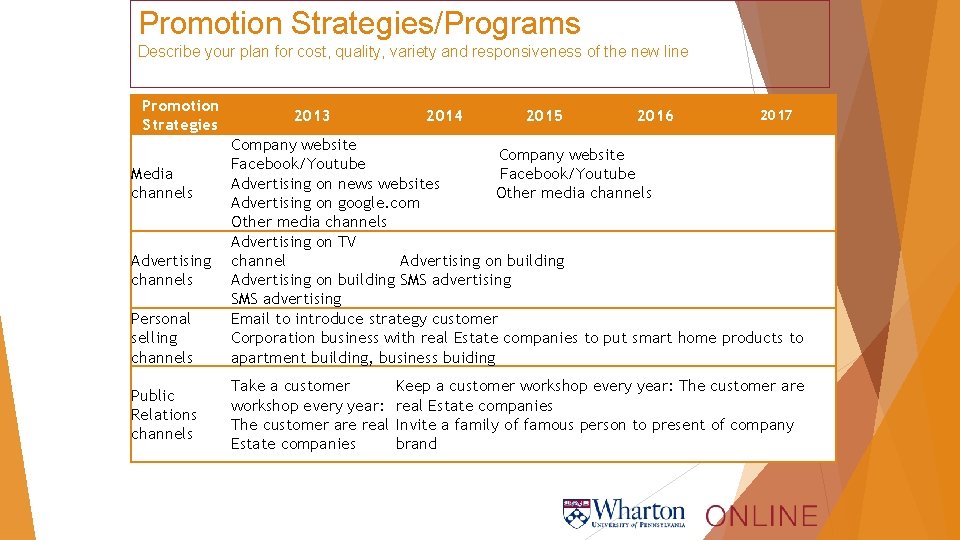
Promotion Strategies/Programs Describe your plan for cost, quality, variety and responsiveness of the new line Promotion Strategies Media channels Advertising channels Personal selling channels Public Relations channels 2013 2014 2015 2016 2017 Company website Facebook/Youtube Advertising on news websites Other media channels Advertising on google. com Other media channels Advertising on TV channel Advertising on building SMS advertising Email to introduce strategy customer Corporation business with real Estate companies to put smart home products to apartment building, business buiding Take a customer workshop every year: The customer are real Estate companies Keep a customer workshop every year: The customer are real Estate companies Invite a family of famous person to present of company brand
Our System Overview A system is capable of all levels of control, The wonderful aspect of our system is the ability to start out at Level 1 and gradually move up to the more sophisticated levels, Or you can start out at our recommended Level. Applications and technologies Smart Lighting : fully automated with Elegance & Ambiance. Comfort & Convenience : Heating, ventilation and air conditioning. Energy‐Efficient : Smart home can save you money while you save the planet. Safety & Security : Smoke Detectors, Security Cameras, Central Locking. Entertainment : watching movies & streaming music. Systems types Several type of systems will be provided with different fees and features, this will be explained in detailed later on.
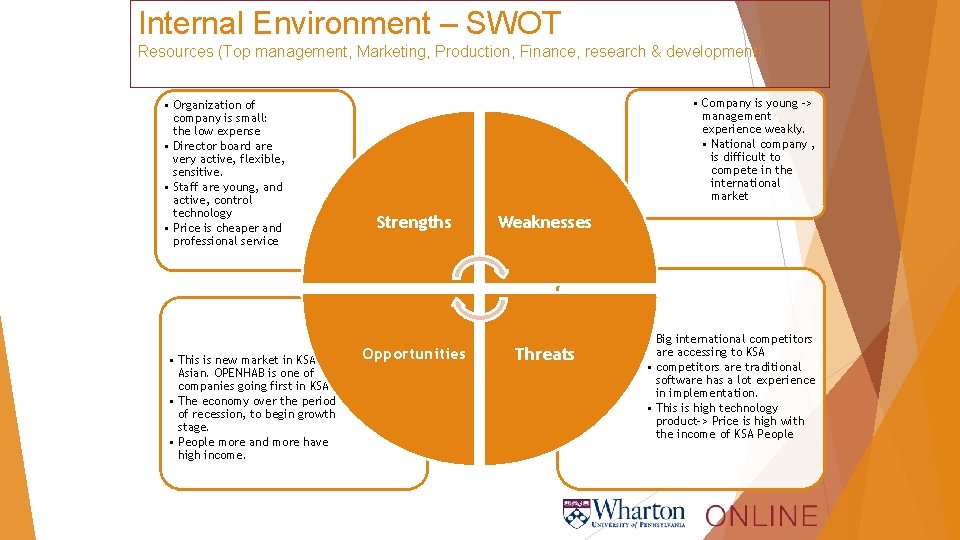
Internal Environment – SWOT Resources (Top management, Marketing, Production, Finance, research & development) • Organization of company is small: the low expense • Director board are very active, flexible, sensitive. • Staff are young, and active, control technology • Price is cheaper and professional service • This is new market in KSA and Asian. OPENHAB is one of companies going first in KSA • The economy over the period of recession, to begin growth stage. • People more and more have high income. • Company is young ‐> management experience weakly. • National company , is difficult to compete in the international market Strengths Opportunities Weaknesses Threats • Big international competitors are accessing to KSA • competitors are traditional software has a lot experience in implementation. • This is high technology product‐> Price is high with the income of KSA People
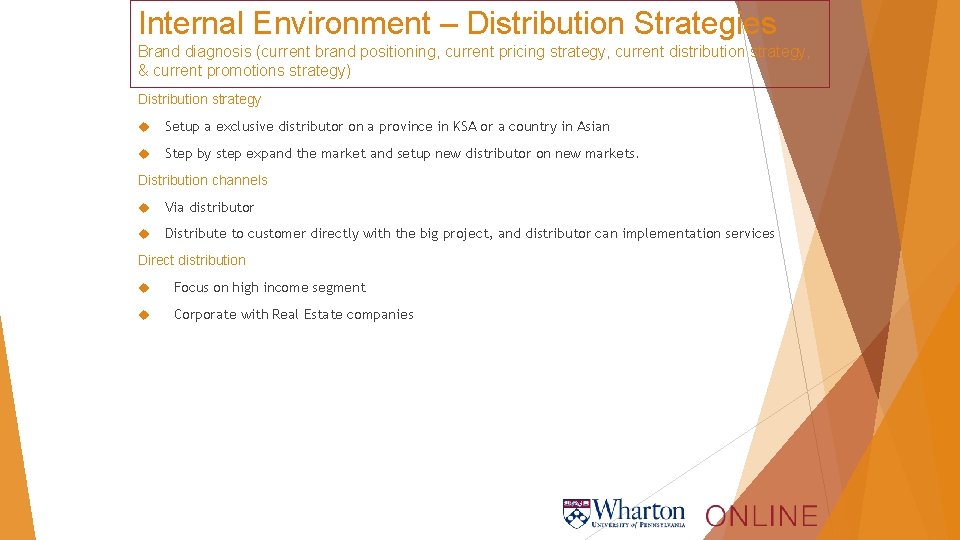
Internal Environment – Distribution Strategies Brand diagnosis (current brand positioning, current pricing strategy, current distribution strategy, & current promotions strategy) Distribution strategy Setup a exclusive distributor on a province in KSA or a country in Asian Step by step expand the market and setup new distributor on new markets. Distribution channels Via distributor Distribute to customer directly with the big project, and distributor can implementation services Direct distribution Focus on high income segment Corporate with Real Estate companies
Segmentation, Targeting & Positioning
Vision, Mission and objectives Vision Provide to customer a freedom life. Mission Provide the best products, the best services to customers Slogan “Auto freedom life” Strategy Individual communication Corporate identify Focus to the high income people Focus to Real Estate companies Content of program advertising must be followed the mission of company The message send to customer “OPENHAB give you auto freedom life”
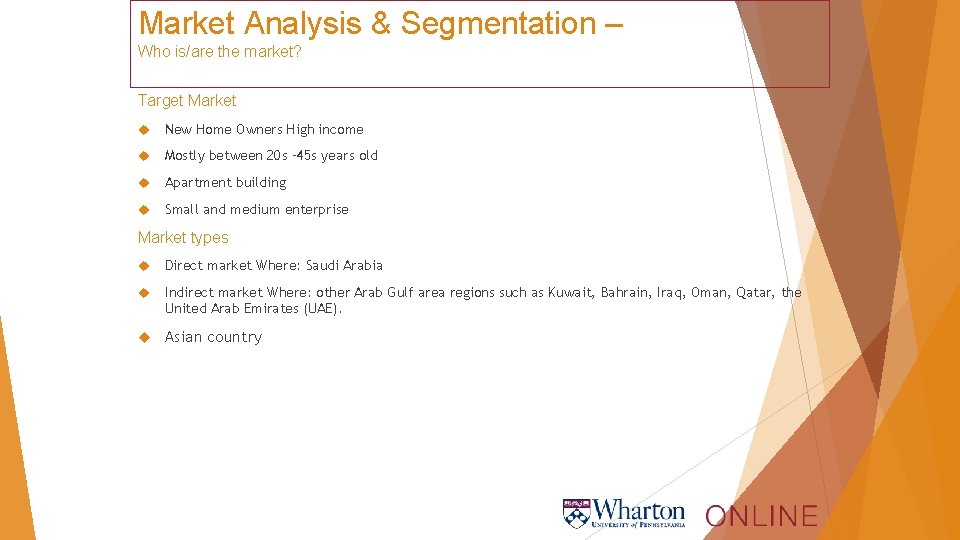
Market Analysis & Segmentation – Who is/are the market? Target Market New Home Owners High income Mostly between 20 s – 45 s years old Apartment building Small and medium enterprise Market types Direct market Where: Saudi Arabia Indirect market Where: other Arab Gulf area regions such as Kuwait, Bahrain, Iraq, Oman, Qatar, the United Arab Emirates (UAE). Asian country
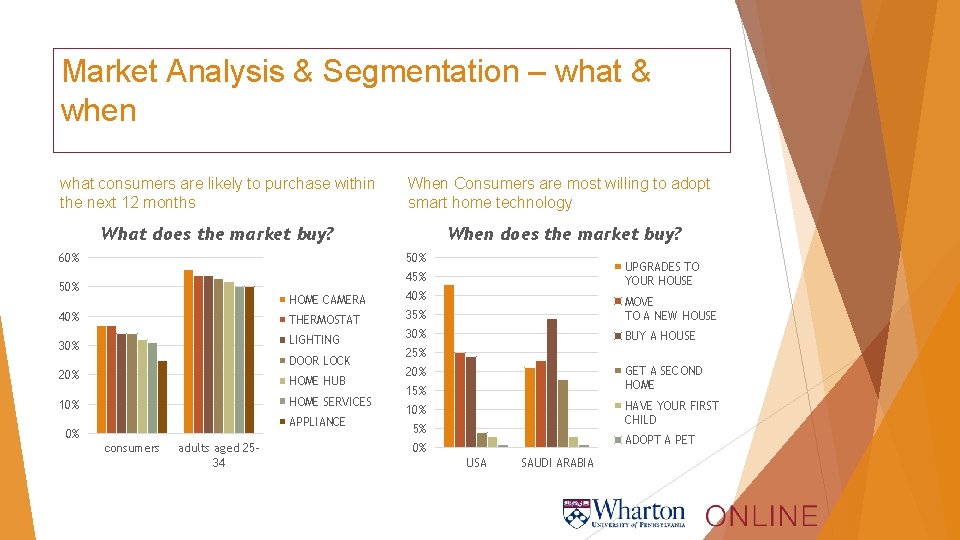
Market Analysis & Segmentation – what & when what consumers are likely to purchase within the next 12 months When Consumers are most willing to adopt smart home technology What does the market buy? 60% When does the market buy? 50% UPGRADES TO YOUR HOUSE 45% 50% HOME CAMERA 40% THERMOSTAT 35% MOVE TO A NEW HOUSE 30% LIGHTING 30% BUY A HOUSE DOOR LOCK 20% HOME HUB 10% HOME SERVICES APPLIANCE 0% consumers adults aged 25‐ 34 25% GET A SECOND HOME 20% 15% HAVE YOUR FIRST CHILD 10% 5% ADOPT A PET 0% USA SAUDI ARABIA
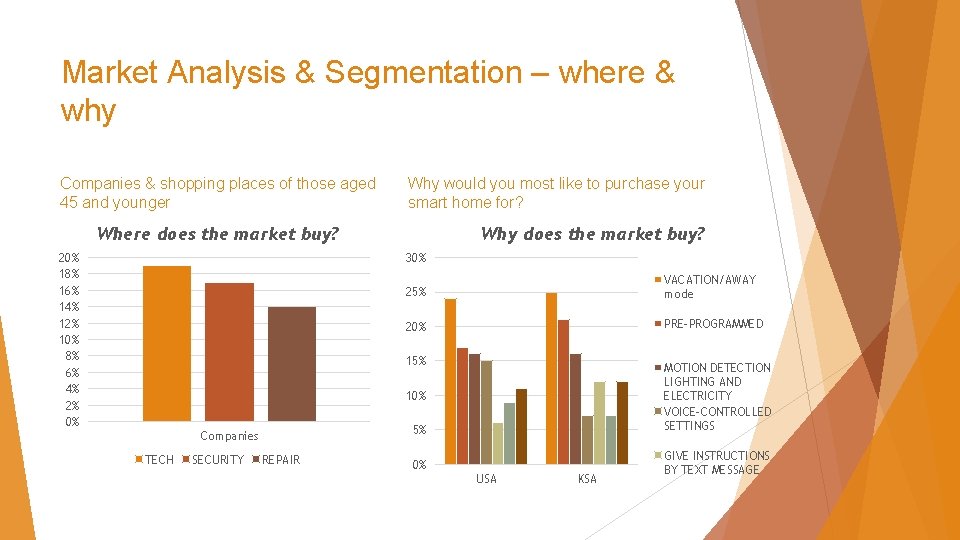
Market Analysis & Segmentation – where & why Companies & shopping places of those aged 45 and younger Why would you most like to purchase your smart home for? Where does the market buy? 20% 18% 16% 14% 12% 10% 8% 6% 4% 2% 0% Why does the market buy? 30% 25% VACATION/AWAY mode 20% PRE‐PROGRAMMED 15% 5% MOTION DETECTION LIGHTING AND ELECTRICITY VOICE‐CONTROLLED SETTINGS 0% GIVE INSTRUCTIONS BY TEXT MESSAGE 10% Companies TECH SECURITY REPAIR USA KSA
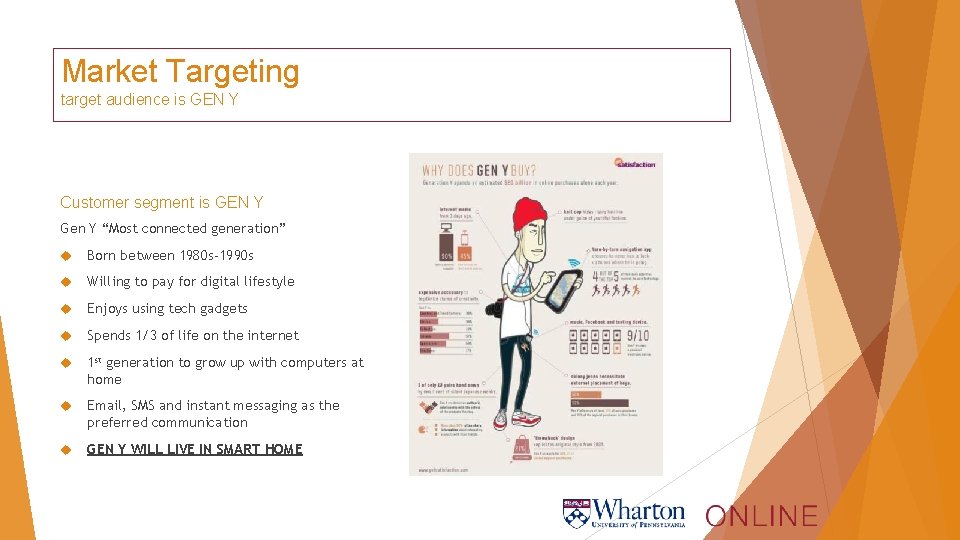
Market Targeting target audience is GEN Y Customer segment is GEN Y Gen Y “Most connected generation” Born between 1980 s‐ 1990 s Willing to pay for digital lifestyle Enjoys using tech gadgets Spends 1/3 of life on the internet 1 st generation to grow up with computers at home Email, SMS and instant messaging as the preferred communication GEN Y WILL LIVE IN SMART HOME
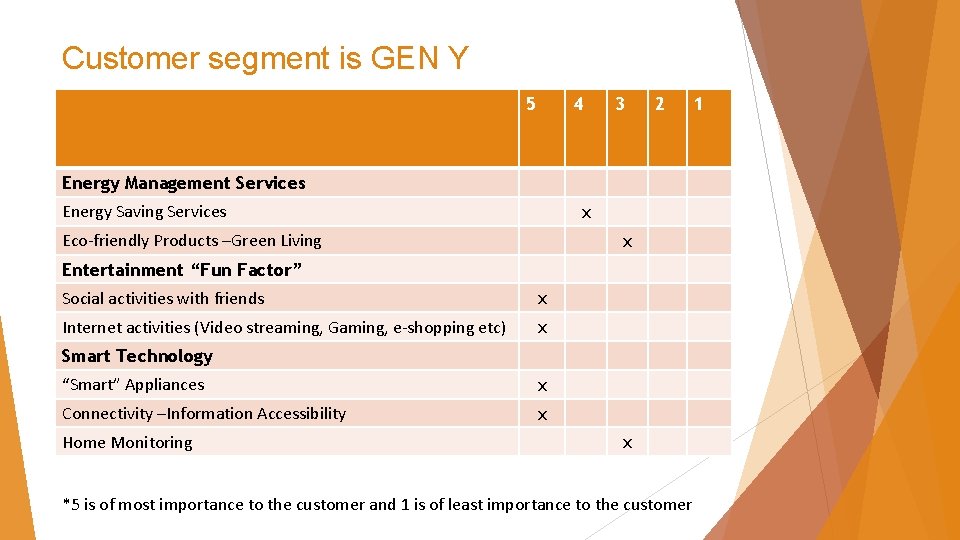
Customer segment is GEN Y 5 4 3 2 Energy Management Services Energy Saving Services x Eco‐friendly Products –Green Living x Entertainment “Fun Factor” Social activities with friends x Internet activities (Video streaming, Gaming, e‐shopping etc) x Smart Technology “Smart” Appliances x Connectivity –Information Accessibility x Home Monitoring x *5 is of most importance to the customer and 1 is of least importance to the customer 1
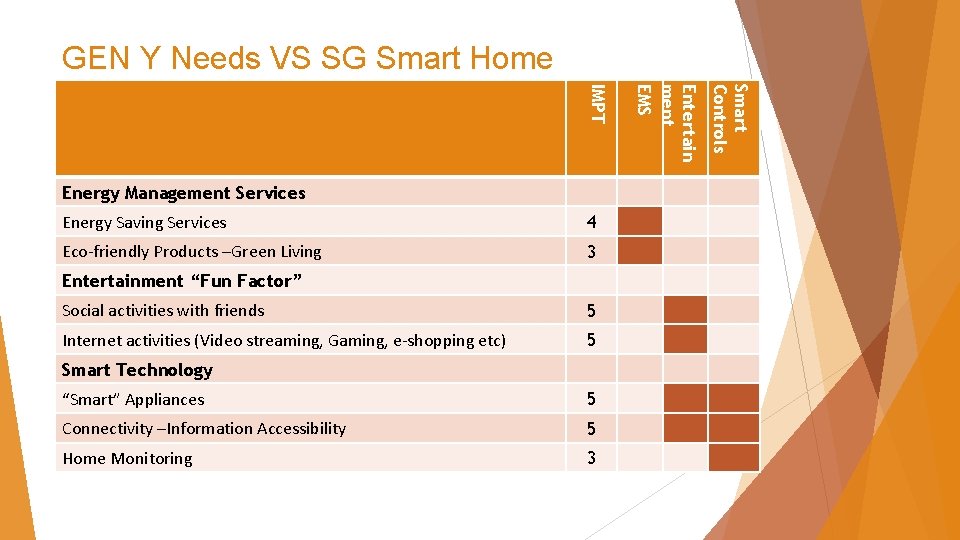
GEN Y Needs VS SG Smart Home 4 Eco‐friendly Products –Green Living 3 Entertainment “Fun Factor” Social activities with friends 5 Internet activities (Video streaming, Gaming, e‐shopping etc) 5 Smart Technology “Smart” Appliances 5 Connectivity –Information Accessibility 5 Home Monitoring 3 Smart Controls Energy Saving Services Entertain ment EMS IMPT Energy Management Services
Competitive advantage and strategy focus Products advantages Products are innovations, applied newest technical in the world. Superior features than competitors it make customer are saving operation expense. Price advantages organization is small, company operation effectively. We can saving the expense operation Human Resources Advantages With the young staffs, active, control technology, working effectively, and the director board are sensitive with the markets Strategy focus Aggressive: We will apply all newest technology into the product, build a expert team in provide services. Customize product as the customer demand. Defensive: Improving the management experience to optimize cost of products. Corporation with the big real estate companies to improves finances, and extension markets.
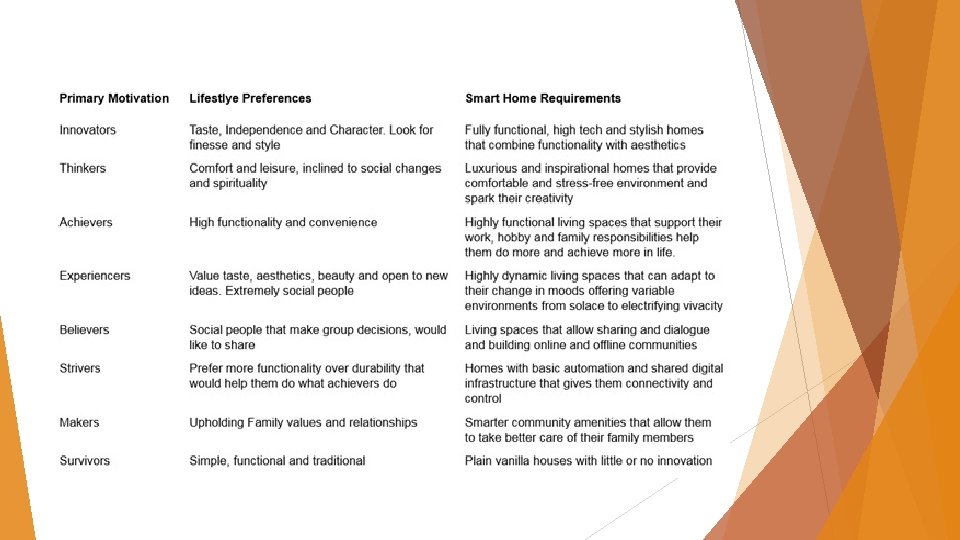
Market Positioning – Proposed brand positioning For decades now, the smart connected homes were being developed by niche players and were being targeted to the tech savvy upper echelons of the society and the companies soon realized that segment cannot offer a sustainable mainstream market. The commercialization of internet of things technology has made smart homes affordable to middle class but the problem of marketing still persists. This articles offers segmentation, targeting and positioning (STP) methodology to the home automation industry. I have used the VALS (Values, Attitudes and Lifestyles) framework for the STP analysis of smart homes. VALS framework has been used because home means different things to different people depending upon their values, attitudes, lifestyles, emotional drivers and resources and VALS framework captures it beautifully. The picture below explains the motivational drivers for different segment of people under VALS segmentation. This framework also make the distinction between smart lifestyles and smart communities depending upon whether the segments prefer exclusive or shared resources. Smart Homes in its colloquial meaning refer to smart lifestyle solutions for high‐income, high resources class of people. For the low‐income, low resources class, smart communities will be more appealing because of its lower total cost of ownership. Based on this distinction, the smart home preferences for different segments are described below. Based on these smart home/community preferences, the home automation industry can develop smart home concepts that appeal to the individual preferences and desires of different segment of people. This approach will make smart homes not only more acceptable for the masses but also more meaningful and relevant to their lives.
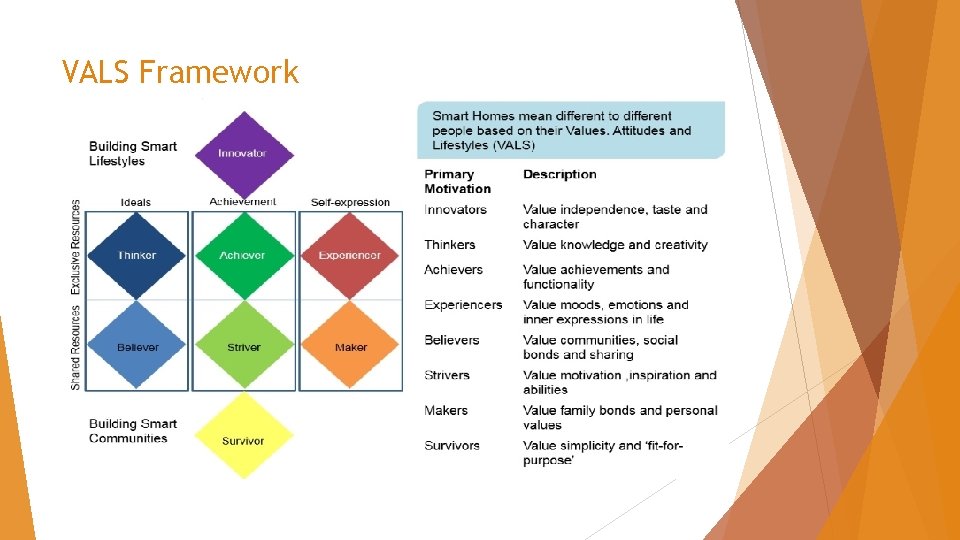
VALS Framework

Operations Plan
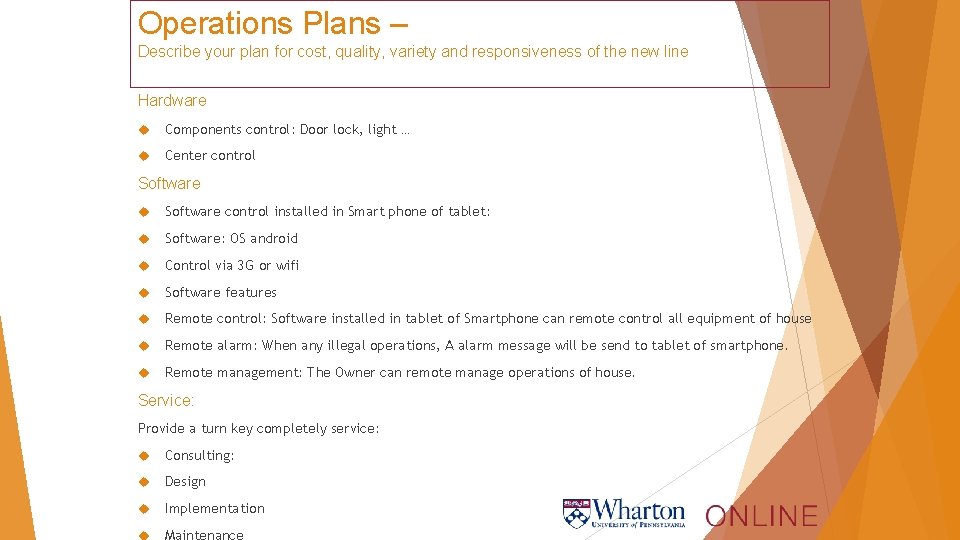
Operations Plans – Describe your plan for cost, quality, variety and responsiveness of the new line Hardware Components control: Door lock, light … Center control Software control installed in Smart phone of tablet: Software: OS android Control via 3 G or wifi Software features Remote control: Software installed in tablet of Smartphone can remote control all equipment of house Remote alarm: When any illegal operations, A alarm message will be send to tablet of smartphone. Remote management: The Owner can remote manage operations of house. Service: Provide a turn key completely service: Consulting: Design Implementation
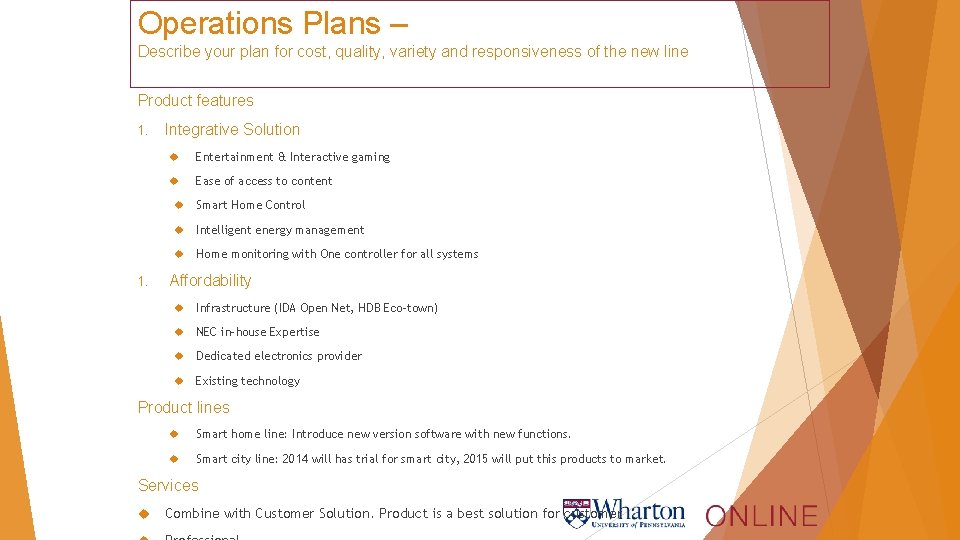
Operations Plans – Describe your plan for cost, quality, variety and responsiveness of the new line Product features 1. Integrative Solution Entertainment & Interactive gaming Ease of access to content Smart Home Control Intelligent energy management Home monitoring with One controller for all systems Affordability Infrastructure (IDA Open Net, HDB Eco‐town) NEC in‐house Expertise Dedicated electronics provider Existing technology Product lines Smart home line: Introduce new version software with new functions. Smart city line: 2014 will has trial for smart city, 2015 will put this products to market. Services Combine with Customer Solution. Product is a best solution for customer
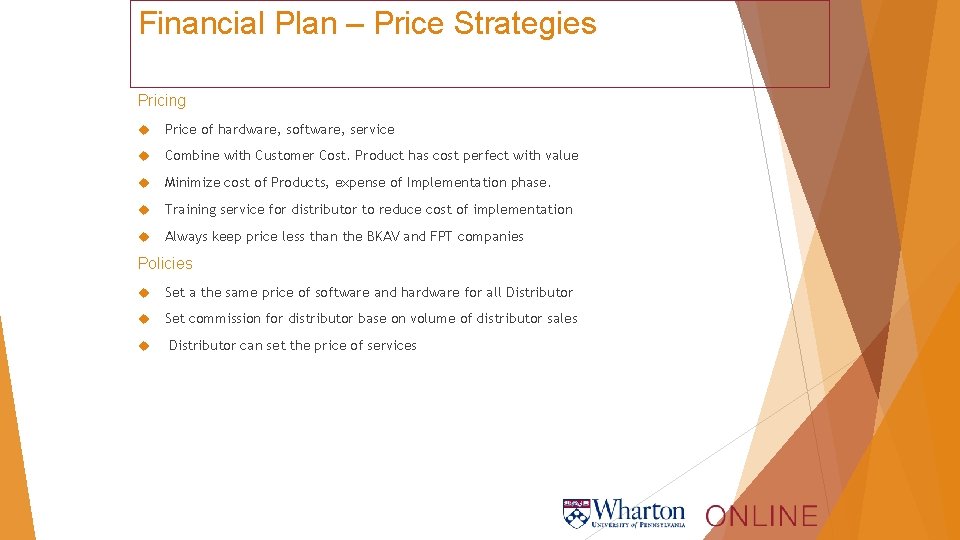
Financial Plan – Price Strategies Pricing Price of hardware, software, service Combine with Customer Cost. Product has cost perfect with value Minimize cost of Products, expense of Implementation phase. Training service for distributor to reduce cost of implementation Always keep price less than the BKAV and FPT companies Policies Set a the same price of software and hardware for all Distributor Set commission for distributor base on volume of distributor sales Distributor can set the price of services
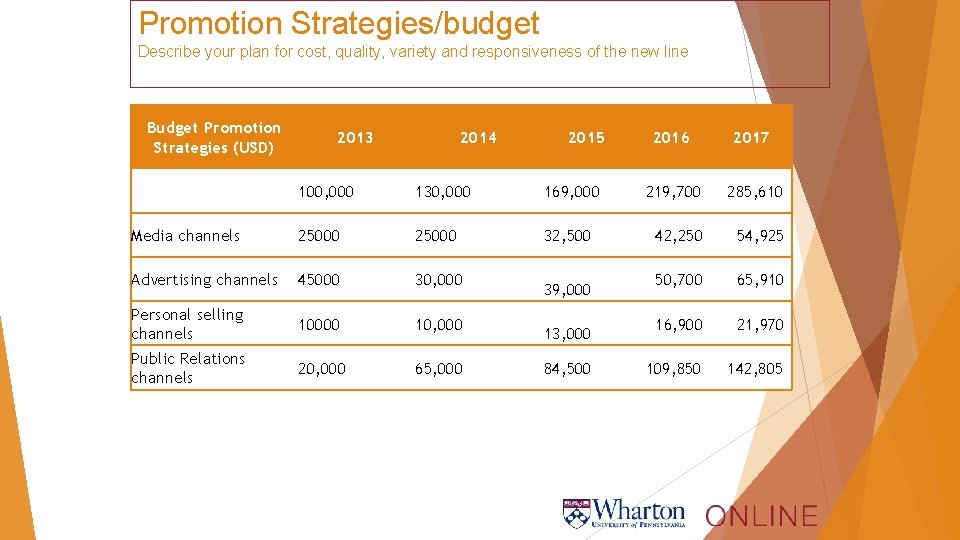
Promotion Strategies/budget Describe your plan for cost, quality, variety and responsiveness of the new line Budget Promotion Strategies (USD) 2013 2014 2015 100, 000 130, 000 169, 000 Media channels 25000 32, 500 Advertising channels 45000 30, 000 Personal selling channels 10000 10, 000 Public Relations channels 20, 000 65, 000 39, 000 13, 000 84, 500 2016 2017 219, 700 285, 610 42, 250 54, 925 50, 700 65, 910 16, 900 21, 970 109, 850 142, 805
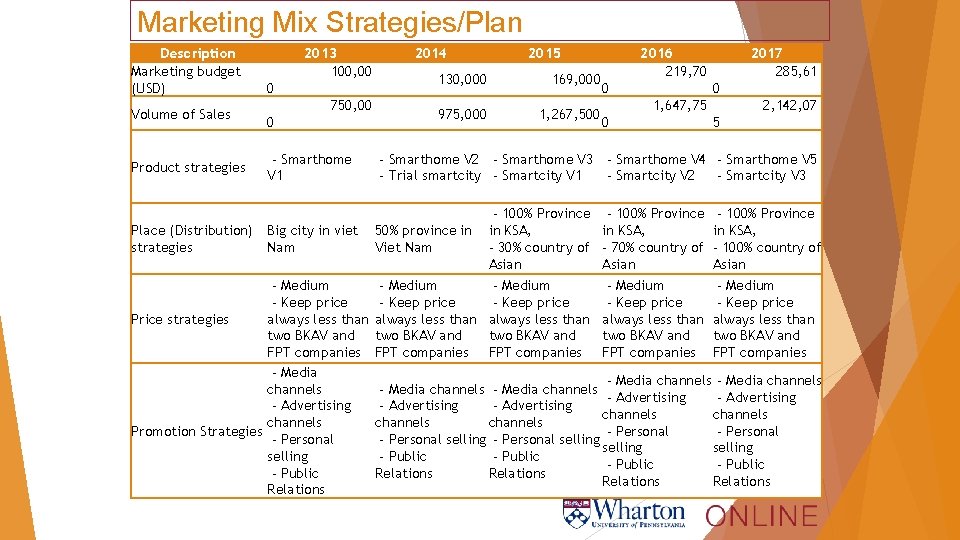
Marketing Mix Strategies/Plan Description Marketing budget (USD) Volume of Sales Product strategies Place (Distribution) strategies 2013 100, 00 0 750, 00 0 2014 2015 130, 000 169, 000 975, 000 1, 267, 500 2016 219, 70 0 2017 285, 61 0 1, 647, 75 0 2, 142, 07 5 ‐ Smarthome V 1 ‐ Smarthome V 2 ‐ Smarthome V 3 ‐ Smarthome V 4 ‐ Smarthome V 5 ‐ Trial smartcity ‐ Smartcity V 1 ‐ Smartcity V 2 ‐ Smartcity V 3 Big city in viet Nam ‐ 100% Province in KSA, ‐ 30% country of ‐ 70% country of Asian ‐ Medium ‐ Keep price Price strategies always less than two BKAV and FPT companies ‐ Media channels ‐ Advertising channels Promotion Strategies ‐ Personal selling ‐ Public Relations 50% province in Viet Nam ‐ Medium ‐ Keep price always less than two BKAV and FPT companies ‐ 100% Province in KSA, ‐ 100% country of Asian ‐ Medium ‐ Keep price always less than two BKAV and FPT companies ‐ Media channels ‐ Advertising channels ‐ Personal selling ‐ Public Relations
Integration & Evaluation

Evaluation Objective Become the top threes companies provide smart home products in KSA in 2017 Volume of sale in 2017 is 2. 000 USD

Thanks
- Slides: 48